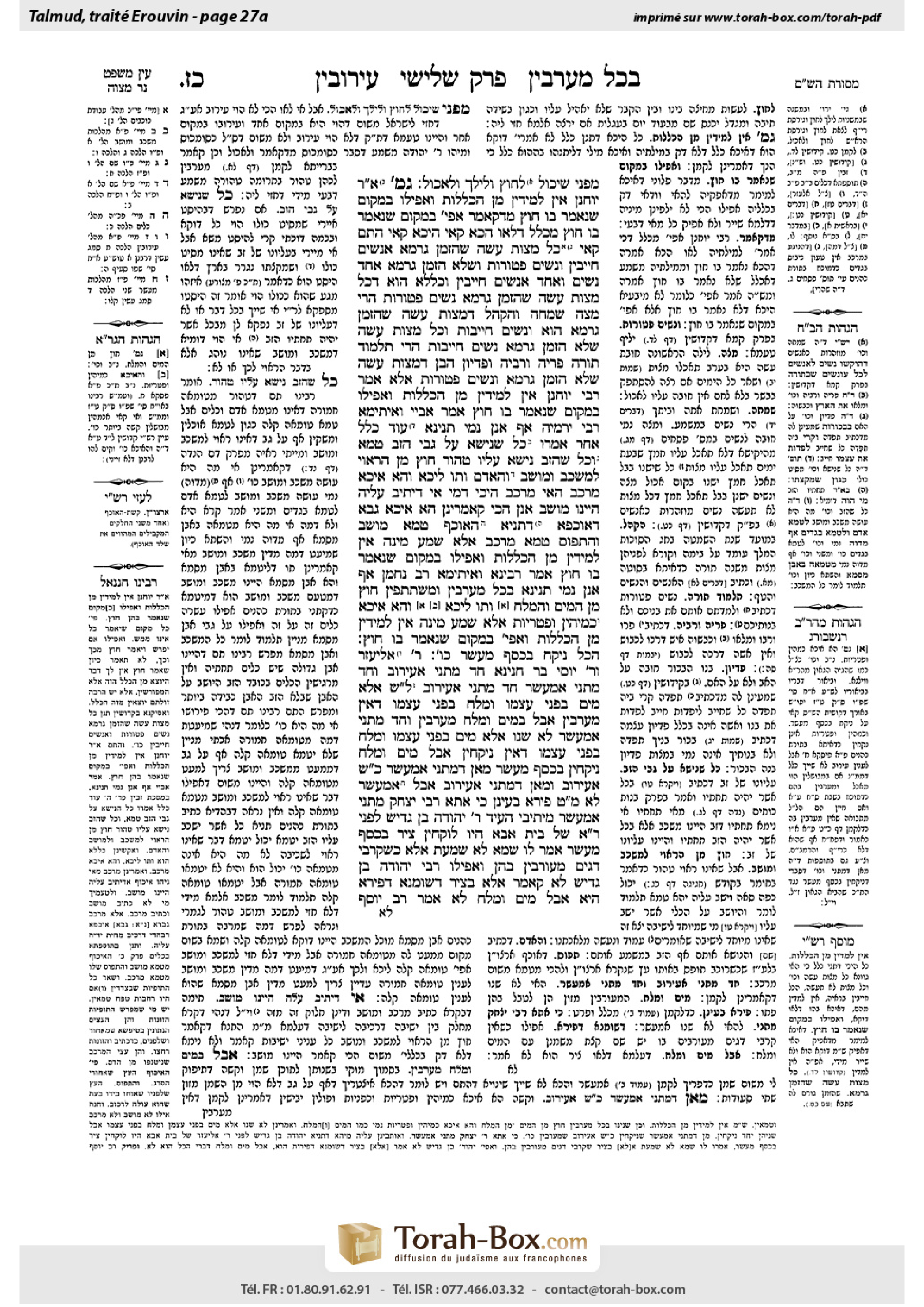
Eruvin 27a: Talmud study for Daf Yomi
Study the Talmud for Daf Yomi with scanned pages, Hebrew text, English translations from Sefaria and AI-generated French translations.
Passage selection and English or AI-generated French translation are available where the scan has annotations. Daf Study is independent of Torah-Box and Sefaria.
Browse Eruvin · עירובין · All tractatesEruvin 27a text and translations
This page of Eruvin includes the Aramaic text, an English translation and an AI-generated French translation, alongside the scan above.
עירובין כ״ז א · Aramaic and Hebrew text
מִפְּנֵי שֶׁיָּכוֹל לָחוֹץ, וְלֵילֵךְ וְלֶאֱכוֹל.
גְּמָ׳ אָמַר רַבִּי יוֹחָנָן: אֵין לְמֵידִין מִן הַכְּלָלוֹת, וַאֲפִילּוּ בִּמְקוֹם שֶׁנֶּאֱמַר בּוֹ חוּץ.
מִדְּקָאָמַר: אֲפִילּוּ בִּמְקוֹם שֶׁנֶּאֱמַר בּוֹ חוּץ, מִכְּלָל דְּלָאו הָכָא קָאֵי, הֵיכָא קָאֵי?
הָתָם קָאֵי כׇּל מִצְוַת עֲשֵׂה שֶׁהַזְּמַן גְּרָמָא, אֲנָשִׁים חַיָּיבִין וְנָשִׁים פְּטוּרוֹת. וְשֶׁלֹּא הַזְּמַן גְּרָמָא, אֶחָד נָשִׁים וְאֶחָד אֲנָשִׁים חַיָּיבִין.
וּכְלָלָא הוּא דְּכׇל מִצְוַת עֲשֵׂה שֶׁהַזְּמַן גְּרָמָא נָשִׁים פְּטוּרוֹת? הֲרֵי מַצָּה שִׂמְחָה וְהַקְהֵל, דְּמִצְוַת עֲשֵׂה שֶׁהַזְּמַן גְּרָמָא הוּא, וְנָשִׁים חַיָּיבוֹת.
וְכׇל מִצְוַת עֲשֵׂה שֶׁלֹּא הַזְּמַן גְּרָמָא נָשִׁים חַיָּיבוֹת? הֲרֵי תַּלְמוּד תּוֹרָה, פְּרִיָּה וּרְבִיָּה, וּפִדְיוֹן הַבֵּן, דְּמִצְוַת עֲשֵׂה שֶׁלֹּא הַזְּמַן גְּרָמָא וְנָשִׁים פְּטוּרוֹת. אֶלָּא אָמַר רַבִּי יוֹחָנָן: אֵין לְמֵידִין מִן הַכְּלָלוֹת וַאֲפִילּוּ בִּמְקוֹם שֶׁנֶּאֱמַר בּוֹ חוּץ.
אָמַר אַבָּיֵי, וְאִיתֵּימָא רַבִּי יִרְמְיָה: אַף אֲנַן נָמֵי תְּנֵינָא, עוֹד כְּלָל אַחֵר אָמְרוּ: כׇּל שֶׁנִּישָּׂא עַל גַּבֵּי הַזָּב — טָמֵא, וְכֹל שֶׁהַזָּב נִישָּׂא עָלָיו — טָהוֹר, חוּץ מִן הָרָאוּי לְמִשְׁכָּב וּמוֹשָׁב, וְהָאָדָם. וְתוּ לֵיכָּא? וְהָא אִיכָּא מֶרְכָּב?!
מֶרְכָּב הֵיכִי דָמֵי? אִי דְּיָתֵיב עֲלֵיהּ — הַיְינוּ מוֹשָׁב. אֲנַן הָכִי קָאָמְרִינַן: הָא אִיכָּא גַּבָּא דְאוּכָּפָא, דְּתַנְיָא: הָאוּכָּף — טָמֵא מוֹשָׁב, וְהַתְּפוּס — טָמֵא מֶרְכָּב. אֶלָּא שְׁמַע מִינַּהּ אֵין לְמֵידִין מִן הַכְּלָלוֹת וַאֲפִילּוּ בִּמְקוֹם שֶׁנֶּאֱמַר בּוֹ חוּץ.
אָמַר רָבִינָא, וְאִיתֵּימָא רַב נַחְמָן: אַף אֲנַן נָמֵי תְּנֵינָא: בַּכֹּל מְעָרְבִין וּמִשְׁתַּתְּפִין, חוּץ מִן הַמַּיִם וְהַמֶּלַח. וְתוּ לֵיכָּא? וְהָא אִיכָּא כְּמֵיהִין וּפִטְרִיּוֹת?! — אֶלָּא שְׁמַע מִינַּהּ: אֵין לְמֵידִין מִן הַכְּלָלוֹת וַאֲפִילּוּ בִּמְקוֹם שֶׁנֶּאֱמַר בּוֹ חוּץ.
הַכֹּל נִיקָּח בְּכֶסֶף מַעֲשֵׂר כּוּ׳. רַבִּי אֱלִיעֶזֶר וְרַבִּי יוֹסֵי בַּר חֲנִינָא, חַד מַתְנֵי אַעֵירוּב וְחַד מַתְנֵי אַמַּעֲשֵׂר.
חַד מַתְנֵי אַעֵירוּב: לֹא שָׁנוּ אֶלָּא מַיִם בִּפְנֵי עַצְמוֹ וּמֶלַח בִּפְנֵי עַצְמוֹ דְּאֵין מְעָרְבִין. אֲבָל בְּמַיִם וּמֶלַח — מְעָרְבִין.
וְחַד מַתְנֵי אַמַּעֲשֵׂר: לֹא שָׁנוּ אֶלָּא מַיִם בִּפְנֵי עַצְמוֹ וּמֶלַח בִּפְנֵי עַצְמוֹ, דְּאֵין נִיקָּחִין. אֲבָל מַיִם וּמֶלַח — נִיקָּחִין בְּכֶסֶף מַעֲשֵׂר.
מַאן דְּמַתְנֵי אַמַּעֲשֵׂר, כׇּל שֶׁכֵּן אַעֵירוּב. וּמַאן דְּמַתְנֵי אַעֵירוּב, אֲבָל אַמַּעֲשֵׂר לָא. מַאי טַעְמָא — פֵּירָא בָּעִינַן.
כִּי אֲתָא רַבִּי יִצְחָק, מַתְנֵי אַמַּעֲשֵׂר. מֵיתִיבִי: הֵעִיד רַבִּי יְהוּדָה בֶּן גָּדִישׁ לִפְנֵי רַבִּי אֱלִיעֶזֶר: שֶׁל בֵּית אַבָּא הָיוּ לוֹקְחִין צִיר בְּכֶסֶף מַעֲשֵׂר. אָמַר לוֹ: שֶׁמָּא לֹא שָׁמַעְתָּ אֶלָּא כְּשֶׁקִּרְבֵי דָגִים מְעוֹרָבִין בָּהֶן. וַאֲפִילּוּ רַבִּי יְהוּדָה בֶּן גָּדִישׁ לָא קָאָמַר אֶלָּא בְּצִיר, דְּשׁוּמְנָא דְפֵירָא הִיא, אֲבָל מַיִם וּמֶלַח — לֹא.
אָמַר רַב יוֹסֵף:
Eruvin 27a · English translation
since he can interpose between himself and the graves and go and eat the food that comprises the eiruv without contracting ritual impurity.
GEMARA: Rabbi Yoḥanan said: One may not learn from general statements, i.e., when a general statement is made in a mishna using the word all, it is not to be understood as an all-inclusive, general statement without exceptions. This is true even in a place where it says the word except. Even in that case, there may be other exceptions to the rule that are not listed.
The Gemara notes: From the fact that Rabbi Yoḥanan said: Even in a place where it says except, this proves by inference that he was not relating to the general statement made here in the mishna, which uses the word except. To which mishna, then, was he relating when he formulated his principle?
The Gemara answers: He was relating to a mishna found there: With regard to all time-bound, positive commandments, i.e., mitzvot that can only be performed at a certain time of the day, or during the day rather than at night, or on certain days of the year, men are obligated to perform them and women are exempt. But positive commandments that are not time-bound, both women and men are obligated to perform.
Is it a general principle that women are exempt from all time-bound, positive commandments without exception? But there is the commandment to eat matza on Passover, the commandment of rejoicing on a Festival, and the commandment of assembly in the Temple courtyard once every seven years during the festival of Sukkot following the Sabbatical Year, all of which are time-bound, positive commandments, and nevertheless, women are obligated to perform them.
Similarly, are women obligated in all positive commandments that are not time-bound? But there is the commandment of Torah study, the commandment to be fruitful and multiply, and the commandment of redemption of the firstborn, all of which are positive commandments that are not time-bound, and nevertheless, women are exempt from them. Rather, Rabbi Yoḥanan said: One may not learn from general statements, even in a place where it says except, because it is always possible that there other exceptions to the rule.
Abaye said, and some say it was Rabbi Yirmeya who said: We, too, have also learned a proof for Rabbi Yoḥanan’s principle from a mishna: They stated yet another general principle: Anything that is carried upon a zav is ritually impure. And anything on which a zav is carried is ritually pure, except for an object suitable for lying or sitting upon and a human being, which become defiled if a zav is borne on them. The following objection may be raised: And is there nothing else? But there is an object upon which a person rides that becomes impure, as explained in the Torah itself.
The Gemara first asks: What are the circumstances of an object upon which one rides? If he sat upon it, it is a seat. If not, how does it become defiled? What is there that is suitable for riding upon but does not fall into the category of something upon which one lies or sits? The Gemara answers: We say as follows: There is the upper part of a saddle, which becomes ritually impure as a riding accessory and not as a regular seat. As it was taught in the Tosefta: A saddle upon which a zav sat is impure as a seat of a zav, and the pommel, which is attached to the front of the saddle and used by the rider to maintain his position or to assist in mounting, is impure as a riding accessory. Therefore, we see that the general statement found in the mishna omits that which is suitable for riding upon. Rather, conclude from this that one may not learn from general statements, even in a place where it says except.
Ravina said, and some say it was Rav Naḥman who said: We, too, have also learned a proof for Rabbi Yoḥanan’s principle from the mishna, which states: One may establish an eiruv and merge alleyways with all kinds of food, except for water and salt. And is there nothing else? But there are truffles and mushrooms, which also may not be used for an eiruv because they are not regarded as food. Rather, conclude from this that one may not learn from general statements, even in a place where it says except.
We learned in the mishna: All types of food may be bought with second-tithe money, except for water and salt. Rabbi Eliezer and Rabbi Yosei bar Ḥanina both had the same tradition, but one teaches it with regard to eiruv, and one teaches it with regard to the second tithe.
The Gemara elaborates: One teaches this halakha with regard to the issue of eiruv, as follows: They only taught that one may not establish an eiruv with water or salt in the case of water by itself or salt by itself. But with water and salt together, one may indeed establish an eiruv.
And the other one teaches this halakha with regard to the issue of the second tithe: They only taught that water or salt may not be bought with second-tithe money in the case of water by itself or salt by itself. But water and salt mixed together may indeed be bought with second-tithe money.
The Gemara comments: The one who teaches this law with regard to the second tithe, all the more so would he apply it to an eiruv, i.e., he would certainly maintain that water and salt together are suitable to be used for an eiruv. However, according to the one who teaches this law with regard to an eiruv, it applies only to an eiruv; but with regard to the second tithe, no, it does not apply. What is the reason for this distinction? For the second tithe, we require produce, as stated in the Torah, and even when water and salt are mixed together they do not have the status of produce.
When Rabbi Yitzḥak came from Eretz Yisrael to Babylonia, he taught this law with regard to the second tithe. The Gemara raises an objection from the following baraita: Rabbi Yehuda ben Gadish testified before Rabbi Eliezer: In Father’s house they would buy fish brine with second-tithe money. He said to him: Perhaps you only heard this in a case where the fish’s innards were mixed with the brine. Since this mixture contains a small portion of the fish, the brine becomes significant enough to be purchased with second-tithe money. And even Rabbi Yehuda ben Gadish only said his statement with regard to brine, which is the fat of produce, i.e., because a certain amount of fish fat, which itself may be purchased with second-tithe money, is mixed in with the brine; but a mixture of water and salt alone may not be bought with it.
In response to this difficulty, Rav Yosef said:
Eruvin 27a · Traduction française (IA)
puisque il peut s'interposer entre lui et les tombes et aller manger la nourriture qui compose l'eiruv sans contracter une impureté rituelle.
GUEMARA : Rabbi Yoḥanan a dit : On ne peut pas tirer une conclusion d'une affirmation générale, c'est-à-dire lorsque l'on fait une affirmation générale dans une mitsva en utilisant le mot « tous », il ne faut pas la comprendre comme une affirmation générale sans exception. Cela est vrai même dans un cas où il est dit le mot « sauf ». Même dans ce cas, il peut y avoir d'autres exceptions à la règle qui ne sont pas mentionnées.
La Guemara note : D'après le fait que Rabbi Yoḥanan a dit : Même dans un cas où il est dit « sauf », cela prouve par l'inférence qu'il ne faisait pas référence à l'affirmation générale trouvée ici dans la mitsva, qui utilise le mot « sauf ». À quelle mitsva, alors, faisait-il référence lorsqu'il a formulé son principe ?
La Guemara répond : Il faisait référence à une Michna trouvée là : Concernant tous les commandements positifs à temps déterminé, c'est-à-dire des mitsvot qui peuvent être exécutés uniquement à un moment précis de la journée, ou pendant la journée plutôt que la nuit, ou à certaines dates de l'année, les hommes sont tenus de les exécuter et les femmes sont exemptées. Mais les commandements positifs non à temps déterminé, les hommes et les femmes sont tenus de les exécuter.
Est-ce un principe général que les femmes sont exemptées de tous les commandements positifs à temps déterminé sans exception ? Mais il y a le commandement de manger la matza pendant la Pessah, le commandement de se réjouir pendant un festival, et le commandement de se rassembler dans le courtyard du Temple une fois tous les sept ans pendant le festival de Tabernacles suivant l'année sabbatique, tous des commandements positifs à temps déterminé, et pourtant, les femmes sont tenues de les exécuter.
De même, les femmes sont-elles tenues de tous les commandements positifs non à temps déterminé ? Mais il y a le commandement d'étudier la Torah, le commandement de procréer et de multiplier, et le commandement de racheter le premier-né, tous des commandements positifs non à temps déterminé, et pourtant, les femmes y sont exemptées. Plutôt, Rabbi Yoḥanan a dit : On ne peut pas tirer une conclusion d'une affirmation générale, même dans un cas où il est dit « sauf », car il est toujours possible qu'il y ait d'autres exceptions à la règle.
Abaye a dit, et certains disent que c'était Rabbi Yirmeya qui a dit : Nous aussi, nous avons tiré une preuve pour le principe de Rabbi Yoḥanan d'une mitsna : Ils ont énoncé un autre principe général : Tout ce qui est porté par un zav devient impur. Et tout ce sur lequel un zav est porté devient pur, sauf un objet adapté à l'assise ou à la position et un être humain, qui deviennent impurs si un zav est porté dessus. L'objection suivante peut être soulevée : Et n'y a-t-il rien d'autre ? Mais il y a un objet sur lequel on monte qui devient impur, comme expliqué dans la Torah elle-même.
La Guemara pose d'abord la question : Quelles sont les circonstances d'un objet sur lequel on monte ? Si l'on s'est assis dessus, c'est un siège. Si non, comment devient-il impur ? Quel objet est adapté à la montée mais ne tombe pas dans la catégorie d'un objet adapté à l'assise ou à la position ? La Guemara répond : Nous disons comme suit : Il y a la partie supérieure d'un siège, qui devient impur comme accessoire de montée et non comme siège ordinaire. Comme il a été enseigné dans la Tosefta : Un siège sur lequel un zav s'est assis devient impur comme siège d'un zav, et le pommeau, qui est attaché devant le siège et utilisé par le monteur pour maintenir sa position ou pour aider à monter, devient impur comme accessoire de montée. Ainsi, nous voyons que l'affirmation générale trouvée dans la mitsna omet ce qui est adapté à la montée. Plutôt, concluez-en que l'on ne peut pas tirer une conclusion d'une affirmation générale, même dans un cas où il est dit « sauf ».
Ravina a dit, et certains disent que c'était Rav Naḥman qui a dit : Nous aussi, nous avons tiré une preuve pour le principe de Rabbi Yoḥanan d'une mitsva, qui énonce : On peut établir un eiruv et fusionner les cours avec tous les types de nourriture, sauf l'eau et le sel. Et n'y a-t-il rien d'autre ? Mais il y a les truffes et les champignons, qui ne peuvent pas non plus être utilisés pour un eiruv car ils ne sont pas considérés comme de la nourriture. Plutôt, concluez-en que l'on ne peut pas tirer une conclusion d'une affirmation générale, même dans un cas où il est dit « sauf ».
Nous avons appris dans la mitsva : Tous les types de nourriture peuvent être achetés avec les fonds de la deuxième tithe, sauf l'eau et le sel. Rabbi Eliezer et Rabbi Yosei bar Ḥanina avaient tous deux la même tradition, mais l'un l'enseignait concernant l'eiruv, et l'autre concernant la deuxième tithe.
La Guemara développe : L'un enseigne cette halakha concernant l'eiruv, comme suit : Ils n'ont enseigné que l'on ne peut pas établir un eiruv avec de l'eau ou du sel dans le cas de l'eau seul ou du sel seul. Mais avec de l'eau et du sel ensemble, l'on peut effectivement établir un eiruv.
Et l'autre enseigne cette halakha concernant la deuxième tithe : Ils n'ont enseigné que l'eau ou le sel ne peuvent pas être achetés avec les fonds de la deuxième tithe dans le cas de l'eau seul ou du sel seul. Mais l'eau et le sel mélangés peuvent effectivement être achetés avec les fonds de la deuxième tithe.
La Guemara commente : Celui qui enseigne cette loi concernant la deuxième tithe, tout autant que cela pourrait s'appliquer à un eiruv, c'est-à-dire il maintiendrait certainement que l'eau et le sel ensemble sont adaptés à être utilisés pour un eiruv. Cependant, selon celui qui enseigne cette loi concernant un eiruv, cela s'applique uniquement à un eiruv ; mais concernant la deuxième tithe, non, cela ne s'applique pas. Quelle est la raison de cette distinction ? Pour la deuxième tithe, nous exigeons des produits, comme dit dans la Torah, et même lorsque l'eau et le sel sont mélangés, ils n'ont pas le statut de produits.
Quand le Rabbi Yitzḥak est revenu de la Terre d'Israël vers Babylone, il a enseigné cette loi concernant la deuxième part. La Guemara soulève une objection tirée de la suivante baraïta : Le Rabbi Yehuda ben Gadish a témoigné devant le Rabbi Eliezer : Dans la maison de son père, ils achetaient du saumure de poisson avec l'argent de la deuxième part. Il lui a répondu : Peut-être as-tu seulement entendu cela dans un cas où les entrailles du poisson étaient mélangées avec la saumure. Puisque ce mélange contient une petite quantité de poisson, la saumure devient suffisamment importante pour être achetée avec l'argent de la deuxième part. Et même le Rabbi Yehuda ben Gadish n'a dit que cela concernant la saumure, qui est la graisse des produits, c'est-à-dire parce qu'une certaine quantité de graisse de poisson, elle-même pouvant être achetée avec l'argent de la deuxième part, est mélangée dans la saumure ; mais un mélange d'eau et de sel seul ne peut pas être acheté avec cela.
En réponse à cette difficulté, Rav Yosef a dit :
Traduction française générée par IA à partir de l’édition anglaise de Sefaria. Vérifie toujours un passage avec le texte source.
Text from Sefaria: William Davidson Edition - Vocalized Aramaic (CC BY NC); William Davidson Edition - English (CC BY NC).