Eruvin 27b: Talmud study for Daf Yomi
Study the Talmud for Daf Yomi with scanned pages, Hebrew text, English translations from Sefaria and AI-generated French translations.
Passage selection and English or AI-generated French translation are available where the scan has annotations. Daf Study is independent of Torah-Box and Sefaria.
Browse Eruvin · עירובין · All tractatesEruvin 27b text and translations
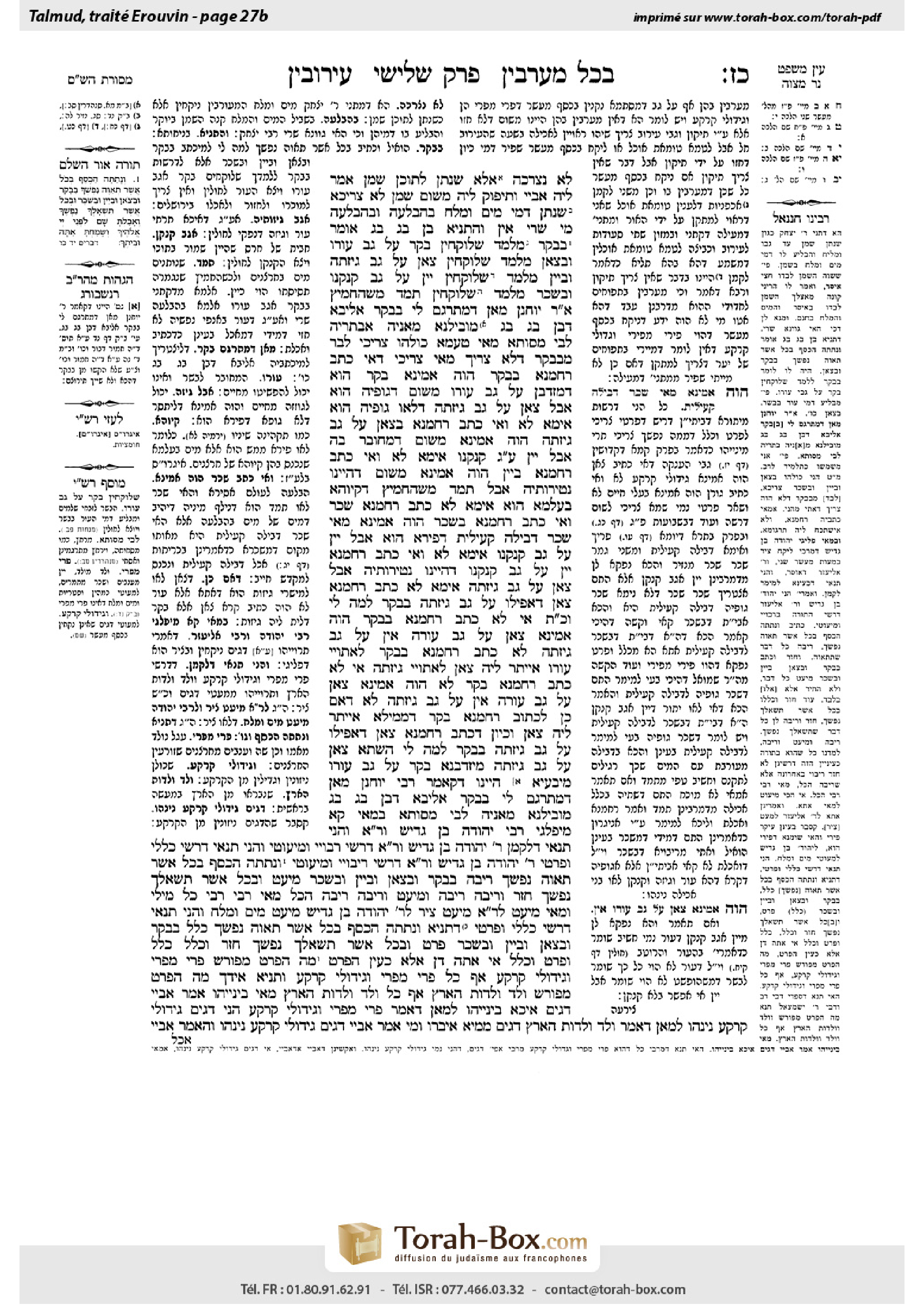
This page of Eruvin includes the Aramaic text, an English translation and an AI-generated French translation, alongside the scan above.
עירובין כ״ז ב · Aramaic and Hebrew text
לֹא נִצְרְכָה אֶלָּא שֶׁנָּתַן לְתוֹכָן שֶׁמֶן.
אֲמַר לֵיהּ אַבָּיֵי: וְתִיפּוֹק לֵיהּ מִשּׁוּם שֶׁמֶן! לֹא צְרִיכָא, שֶׁנָּתַן דְּמֵי מַיִם וּמֶלַח בְּהַבְלָעָה.
וּבְהַבְלָעָה מִי שְׁרֵי? אִין — וְהָתַנְיָא, בֶּן בַּג בַּג אוֹמֵר: ״בַּבָּקָר״ — מְלַמֵּד שֶׁלּוֹקְחִין בָּקָר עַל גַּב עוֹרוֹ. ״וּבַצֹּאן״ — מְלַמֵּד שֶׁלּוֹקְחִין צֹאן עַל גַּב גִּיזָּתָהּ. ״וּבַיַּיִן״ — מְלַמֵּד שֶׁלּוֹקְחִין יַיִן עַל גַּב קַנְקַנּוֹ. ״וּבַשֵּׁכָר״ — מְלַמֵּד שֶׁלּוֹקְחִין תֶּמֶד מִשֶּׁהֶחְמִיץ.
אָמַר רַבִּי יוֹחָנָן: מַאן דִּמְתַרְגֵּם לִי ״בַּבָּקָר״ אַלִּיבָּא דְּבֶן בַּג בַּג, מוֹבֵילְנָא מָאנֵיהּ אַבָּתְרֵיהּ לְבֵי מַסּוּתָא.
מַאי טַעְמָא? כּוּלְּהוּ צְרִיכִי לְבַר מִ״בַּבָּקָר״, דְּלָא צְרִיךְ. מַאי צְרִיכִי? דְּאִי כְּתַב רַחֲמָנָא ״בַּבָּקָר״, הֲוָה אָמֵינָא: בָּקָר הוּא דְּמִזְדַּבַּן עַל גַּב עוֹרוֹ, מִשּׁוּם דְּגוּפֵיהּ הוּא. אֲבָל צֹאן עַל גַּב גִּיזָּתָהּ, דְּלָאו גּוּפֵיהּ הוּא — אֵימָא לָא.
וְאִי כְּתַב רַחֲמָנָא ״בַּצֹּאן״ עַל גַּב גִּיזָּתָהּ, הֲוָה אָמֵינָא: מִשּׁוּם דִּמְחוּבָּר בָּהּ. אֲבָל יַיִן עַל גַּב קַנְקַנּוֹ — אֵימָא לָא.
וְאִי כְּתַב רַחֲמָנָא ״בַּיַּיִן״, הֲוָה אָמֵינָא: מִשּׁוּם דְּהַיְינוּ נְטִירוּתֵיהּ. אֲבָל תֶּמֶד מִשֶּׁהֶחְמִיץ דְּקִיּוּהָא בְּעָלְמָא הוּא, אֵימָא לָא. כְּתַב רַחֲמָנָא ״שֵׁכָר״.
וְאִי כְּתַב רַחֲמָנָא ״בַּשֵּׁכָר״, הֲוָה אָמֵינָא: מַאי שֵׁכָר? דְּבֵילָה קְעִילִית, דְּפֵירָא הוּא. אֲבָל יַיִן עַל גַּב קַנְקַנּוֹ — אֵימָא לָא.
וְאִי כְּתַב רַחֲמָנָא יַיִן עַל גַּב קַנְקַנּוֹ — דְּהַיְינוּ נְטִירוּתֵיהּ. אֲבָל צֹאן עַל גַּב גִּיזָּתָהּ — אֵימָא לָא. כְּתַב רַחֲמָנָא ״צֹאן״, דַּאֲפִילּוּ עַל גַּב גִּיזָּתָהּ.
״בַּבָּקָר״ לְמָה לִי?! וְכִי תֵּימָא: אִי לָא כְּתַב רַחֲמָנָא ״בַּבָּקָר״, הֲוָה אָמֵינָא: צֹאן עַל גַּב עוֹרָהּ אִין, עַל גַּב גִּיזָּתָהּ לָא. כְּתַב רַחֲמָנָא ״בַּבָּקָר״ לְאֵתוֹיֵי עוֹרוֹ. אִיַּיתַּר לֵיהּ ״צֹאן״ לְאֵתוֹיֵי גִּיזָּתָהּ.
אִי לָא כְּתַב רַחֲמָנָא ״בָּקָר״, לָא הֲוָה אָמֵינָא צֹאן עַל גַּב עוֹרָהּ — אִין, עַל גַּב גִּיזָּתָהּ — לָא. דְּאִם כֵּן, לִכְתּוֹב רַחֲמָנָא ״בָּקָר״, דְּמִמֵּילָא אִיַּיתַּר לֵיהּ ״צֹאן״.
וְכֵיוָן דִּכְתַב רַחֲמָנָא ״צֹאן״, דַּאֲפִילּוּ עַל גַּב גִּיזָּתָהּ. ״בַּבָּקָר״ לְמָה לִי? הַשְׁתָּא צֹאן עַל גַּב גִּיזָּתָהּ מִיזְדַּבְּנָא, בָּקָר עַל גַּב עוֹרוֹ מִיבַּעְיָא? הַיְינוּ דְּקָאָמַר רַבִּי יוֹחָנָן: מַאן דִּמְתַרְגֵּם לִי ״בַּבָּקָר״ אַלִּיבָּא דְּבֶן בַּג בַּג, מוֹבֵילְנָא מָאנֵיהּ לְבֵי מַסּוּתָא.
בְּמַאי קָא מִיפַּלְגִי רַבִּי יְהוּדָה בֶּן גָּדִישׁ וְרַבִּי אֱלִיעֶזֶר וְהָנֵי תַּנָּאֵי דִּלְקַמַּן? רַבִּי יְהוּדָה בֶּן גָּדִישׁ וְרַבִּי אֱלִיעֶזֶר דָּרְשִׁי רִבּוּיֵי וּמִיעוּטֵי, וְהָנֵי תַּנָּאֵי דָּרְשִׁי כְּלָלֵי וּפְרָטֵי.
רַבִּי יְהוּדָה בֶּן גָּדִישׁ וְרַבִּי אֱלִיעֶזֶר דָּרְשִׁי רִיבּוּיֵי וּמִיעוּטֵי. ״וְנָתַתָּה הַכֶּסֶף בְּכֹל אֲשֶׁר תְּאַוֶּה נַפְשְׁךָ״ — רִיבָּה, ״בַּבָּקָר וּבַצֹּאן וּבַיַּיִן וּבַשֵּׁכָר״ — מִיעֵט, ״וּבְכֹל אֲשֶׁר תִּשְׁאׇלְךָ נַפְשֶׁךָ״ — חָזַר וְרִיבָּה. רִיבָּה וּמִיעֵט וְרִיבָּה — רִיבָּה הַכֹּל. מַאי רַבִּי? רַבִּי כׇּל מִילֵּי. וּמַאי מִיעֵט? לְרַבִּי אֱלִיעֶזֶר מִיעֵט צִיר, לְרַבִּי יְהוּדָה בֶּן גָּדִישׁ מִיעֵט מַיִם וּמֶלַח.
וְהָנֵי תַּנָּאֵי דָּרְשִׁי כְּלָלֵי וּפְרָטֵי. דְּתַנְיָא: ״וְנָתַתָּה הַכֶּסֶף בְּכֹל אֲשֶׁר תְּאַוֶּה נַפְשְׁךָ״ — כָּלַל, ״בַּבָּקָר וּבַצֹּאן וּבַיַּיִן וּבַשֵּׁכָר״ — פָּרַט, ״וּבְכֹל אֲשֶׁר תִּשְׁאׇלְךָ נַפְשֶׁךָ״ — חָזַר וְכָלַל. כְּלָל וּפְרָט וּכְלָל אִי אַתָּה דָן אֶלָּא כְּעֵין הַפְּרָט. וּמָה הַפְּרָט מְפוֹרָשׁ: פְּרִי מִפְּרִי, וְגִידּוּלֵי קַרְקַע, אַף כֹּל פְּרִי מִפְּרִי וְגִידּוּלֵי קַרְקַע.
וְתַנְיָא אִידַּךְ: מָה הַפְּרָט מְפוֹרָשׁ: וְלַד וַלְדוֹת הָאָרֶץ, אַף כֹּל וְלַד וַלְדוֹת הָאָרֶץ.
מַאי בֵּינַיְיהוּ? אָמַר אַבָּיֵי: דָּגִים אִיכָּא בֵּינַיְיהוּ. לְמַאן דְּאָמַר פְּרִי מִפְּרִי וְגִידּוּלֵי קַרְקַע, הָנֵי דָּגִים — גִּידּוּלֵי קַרְקַע נִינְהוּ. לְמַאן דְּאָמַר וְלַד וַלְדוֹת הָאָרֶץ, דָּגִים — מִמַּיָּא אִיבְּרוֹ.
וּמִי אָמַר אַבָּיֵי דָּגִים גִּידּוּלֵי קַרְקַע נִינְהוּ? וְהָאָמַר אַבָּיֵי:
Eruvin 27b · English translation
Rabbi Yitzḥak’s ruling that water and salt mixed together may be bought with second-tithe money was only necessary in a case where one added oil to them. But a mixture of water and salt alone may not be purchased with second-tithe money.
Abaye said to Rav Yosef: If so, let him derive that the mixture may be bought with second-tithe money because of the oil alone. The Gemara refutes this argument: No, it was necessary for a case in which one paid the value of the water and salt by including it in the payment for the oil. Although ostensibly the money that he paid was for the oil, he added to the price of the oil in order to include payment for the water and salt that were mixed with it.
The Gemara asks: But if something may not be bought with second-tithe money, is one permitted to buy it by including it in the payment for something which may be bought with second-tithe money? The Gemara answers: Yes, and so it was taught in the following baraita: Ben Bag Bag says in exposition of the verse: “And you shall bestow that money on all that your heart desires, on oxen, on sheep, on wine, on strong drink, on whatever your soul requests” (Deuteronomy 14:26): “On oxen” teaches that one may buy an ox and include in its price payment for its hide. Although the hide cannot be eaten, it may be bought together with the ox, and it does not acquire the sanctity of the second tithe. “On sheep” teaches that one may buy a sheep and include in its price payment for its fleece, which is used for purposes other than eating. “On wine” teaches that one may buy wine and include in its price payment for its jug. “On strong drink” teaches that one is permitted to buy not only actual wine, but one may buy even mead, water in which grape seeds are soaked, once it has fermented and acquired the flavor of wine.
Having cited ben Bag Bag’s exposition of the verse, the Gemara continues: Rabbi Yoḥanan said: Whoever interprets the words “on oxen” for me in accordance with the opinion of ben Bag Bag, I will carry his clothes after him into the bathhouse, i.e., I will honor him to such an extent that I will be prepared to treat him as a servant treats his master.
What is the reason for Rabbi Yoḥanan’s difficulty? All parts of the verse cited above are necessary, except for the expression “on oxen,” which is not necessary. The Gemara clarifies: For what purpose are all the other words necessary? As, if the Torah had written only “on oxen,” I might have said that it is only an ox that may be bought together with its hide with second-tithe money because the hide is an inseparable part of its body, and therefore it is not considered an independent entity from its flesh. But as for buying a sheep together with its fleece, which is not an inseparable part of its body because the fleece can be removed from the sheep while it is alive, you might say no, second-tithe money may not be spent in this manner. It was therefore necessary to state “on sheep.”
And if the Torah had also written “on sheep,” teaching that one may buy even a sheep with second-tithe money together with its fleece, I might have said that it is only a sheep that may be bought together with its fleece because the fleece is attached to it, and therefore it is considered part of the animal. But as for buying wine together with its jug, you might say no, second-tithe money may not be spent this way. It was therefore necessary to state “on wine.”
And if the Torah had also written “on wine,” indicating that one may even buy wine together with its jug with second-tithe money, I might still have said that this is because the jug is needed for the wine’s preservation, as there is no way to carry wine without some sort of container. But as for mead that has fermented, which is mere acidity, you might say no, it should not be included among the items that may be bought with second-tithe money. Therefore, the Torah wrote: “On strong drink.”
The necessity of each word much be proven in the opposite order as well. And if the Torah had only written “on strong drink,” I might have said: What is meant by strong drink? Dried figs from the town of Ke’ila, which are choice and juicy figs that can have an intoxicating effect. They are therefore considered produce and not merely mead. But as for buying wine together with its jug, you might say no, this may not be done with second-tithe money, and therefore it was necessary to state “on wine.”
And if the Torah had also written “on wine,” indicating that one may buy even wine together with its jug with second-tithe money, I might have said that this is because the jug is needed for the wine’s preservation. But as for buying a sheep together with its fleece, you might say no, this may not be done with second-tithe money. Therefore, the Torah stated “on sheep,” to teach that a sheep may be bought with second-tithe money even together with its fleece.
If so, why do I need the words “on oxen”? If one may purchase a sheep together with its fleece with second-tithe money, it should certainly be permitted to buy an ox together with its hide. And if you say that if the Torah had not written “on oxen,” I might have said that a sheep together with its hide, yes, it may be bought with second-tithe money, but together with its fleece, no, it may not be bought; therefore, the Torah wrote “on oxen,” to include its hide, and so “on sheep” remains available for interpretation to include its fleece, i.e., that a sheep may be bought even together with its fleece. Therefore, the words “on oxen” are necessary, for without them I would have understood “on sheep” differently.
This argument can, however, be refuted: Even if the Torah had not written “on oxen,” I would not have said that a sheep together with its hide, yes, it may be bought with second-tithe money, but together with its fleece, no, it may not. For if it were so, the Torah should have written “on oxen,” in which case the words “on sheep” would remain available for interpretation. “On sheep” can be explained in two ways, both in reference to its hide as well as in reference to its fleece. Had the Torah wanted to teach only that an animal may be bought together with its hide but not with its fleece, it would have written “on oxen” only, which would have left no room for error, as oxen do not have fleece.
And since the Torah writes “on sheep,” teaching that a sheep may be bought with second-tithe money even together with its fleece, why do I need the words “on oxen”? These words are now entirely superfluous. If a sheep may be bought together with its fleece, is it necessary to state that an ox may be bought together with its hide? This is what Rabbi Yoḥanan meant when he said: Whoever interprets the words “on oxen” for me in accordance with the opinion of ben Bag Bag, I will carry his clothes after him into the bathhouse.
The Gemara now returns to the tannaitic disagreement pertaining to buying fish brine with second-tithe money: With regard to what principle do Rabbi Yehuda ben Gadish, and Rabbi Eliezer, and these tanna’im whose views will be cited below, disagree? The Gemara explains: Rabbi Yehuda ben Gadish and Rabbi Eliezer expound the verse based on the principle of amplifications and restrictions, and these tanna’im expound it based on the principle of generalizations and details, which is a different approach to biblical exegesis.
Rabbi Yehuda ben Gadish and Rabbi Eliezer expound the verse based on the principle of amplifications and restrictions. When the verse states: “And you shall bestow the money on all that your heart desires” (Deuteronomy 14:26), it has amplified. When it then states: “On oxen, on sheep, on wine, and on strong drink,” it has restricted its discussion to certain specific items. When it concludes with the phrase: “On whatever your soul requests,” it has once again amplified. According to this exegetical approach, we conclude that since it amplified and restricted and once again amplified, it has amplified the general category to include everything. What has it amplified the category to include? It has amplified the category to include everything. And what has it restricted from inclusion in the category? Only one thing: According to Rabbi Eliezer, it restricted brine from inclusion because brine is not at all similar to the items listed in the verse; according to Rabbi Yehuda ben Gadish, it restricted water and salt.
And these other tanna’im expound the verse according to the principle of generalizations and details, as it was taught in a baraita: The phrase: “And you shall bestow the money on all that your heart desires” is a generalization, as no particular type of food is specified. The phrase: “On cattle, on sheep, on wine, and on strong drink” is a detail, as specific types of food are mentioned. When the verse concludes: “On whatever your soul requests,” it has generalized again, as no specific type of food is mentioned. Since the verse is formulated as a generalization, and a detail, and a generalization, you may deduce that the verse is referring only to items similar to the detail. Just as the items mentioned in the detail are clearly defined as the produce of produce, i.e., not only the produce itself but also things that come from it, such as the calf that comes from a cow or grapes from a seed, and they are also things grown from the ground, as all of these items grow from the ground or receive their main sustenance from it, so it includes all things that are the produce of produce and are grown from the ground.
And it was taught in another baraita: Just as the items mentioned in the detail are clearly defined as the offspring of the offspring of the earth, i.e., things that come from items that came from the ground, so it includes all things that are the offspring of the offspring of the earth.
The Gemara asks: What is the practical difference between these two baraitot? Abaye said: There is a practical difference between them with regard to fish. According to the one who said that we apply the law to that which is the produce of produce and grown from the ground, fish are regarded as having grown from the ground. However, according to the one who said we apply it to that which is the offspring of the offspring of the earth, fish were created from water. Therefore, they are not of the offspring of the earth, and consequently they are not included among the items that may be purchased with second-tithe money.
The Gemara asks: Did Abaye say that fish are regarded as having been grown from the ground? Didn’t Abaye say the following?
Eruvin 27b · Traduction française (IA)
La décision du maître Yitzhak selon laquelle un mélange d'eau et de sel peut être acheté avec l'argent de la deuxième part est nécessaire uniquement dans le cas où l'on ajoute de l'huile à ce mélange. Cependant, un mélange d'eau et de sel seul ne peut pas être acheté avec l'argent de la deuxième part.
Abaye dit à Rava Yosef : Si c'est ainsi, qu'il déduise que ce mélange peut être acheté avec l'argent de la deuxième part grâce à l'huile seule. La Guemara réfute cet argument : Non, cela était nécessaire dans le cas où l'on payait la valeur de l'eau et du sel en les incluant dans le paiement pour l'huile. Bien que l'argent payé fût pour l'huile, il ajoutait à son prix afin d'inclure le paiement pour l'eau et le sel mélangés avec elle.
La Guemara pose la question : Mais si quelque chose ne peut pas être acheté avec l'argent de la deuxième part, est-on autorisé à l'acheter en le combinant avec le paiement pour quelque chose qui peut être acheté avec l'argent de la deuxième part ? La Guemara répond : Oui, et cela a été enseigné dans la baraïta suivante : Ben Bag Bag explique la parole : « Et tu donneras cet argent à tout ce qui plaît à ton cœur, à des bœufs, à des brebis, à du vin, à du vin doux, à tout ce que ton âme désire » (Deutéronome 14:26) : « À des bœufs » enseigne qu'on peut acheter un bœuf et inclure dans son prix le paiement pour sa peau. Bien que la peau ne puisse pas être mangée, elle peut être achetée avec le bœuf, et elle ne prend pas la sanctité de la deuxième part. « À des brebis » enseigne qu'on peut acheter une brebis et inclure dans son prix le paiement pour sa laine, utilisée à des fins autres que la consommation. « À du vin » enseigne qu'on peut acheter du vin et inclure dans son prix le paiement pour son récipient. « À du vin doux » enseigne qu'on est autorisé à acheter non seulement du vin réel, mais aussi du miel, de l'eau dans laquelle des graines de raisin sont trempées, une fois fermenté et acquis le goût du vin.
Ayant cité l'explication de Ben Bag Bag sur la parole, la Guemara continue : Rabbi Yoḥanan dit : Celui qui m'interprète les mots « à des bœufs » selon l'opinion de Ben Bag Bag, je porterai ses vêtements après lui dans la baignoire, c'est-à-dire je le honorerai à tel point que je serai prêt à le traiter comme un serviteur traite son maître.
Quelle est la raison de la difficulté de Rabbi Yoḥanan ? Toutes les parties de la parole citée ci-dessus sont nécessaires, sauf l'expression « à des bœufs », qui n'est pas nécessaire. La Guemara clarifie : À quel usage sont nécessaires toutes les autres expressions ? Car, si la Torah avait écrit seulement « à des bœufs », je pourrais avoir pensé qu'il n'est que le bœuf qui puisse être acheté avec son peau avec l'argent de la deuxième part, car la peau est une partie indissociable de son corps, et donc elle n'est pas considérée comme une entité indépendante de sa chair. Mais concernant l'achat d'une brebis avec sa laine, qui n'est pas une partie indissociable de son corps car la laine peut être retirée de la brebis alors qu'elle est vivante, tu pourrais dire non, l'argent de la deuxième part ne peut pas être dépensé ainsi. Il était donc nécessaire d'écrire « à des brebis ».
Et si la Torah avait aussi écrit « à des brebis », enseignant qu'on peut acheter même une brebis avec l'argent de la deuxième part avec sa laine, je pourrais avoir pensé que c'est seulement la brebis qui puisse être achetée avec sa laine avec l'argent de la deuxième part, car la laine est attachée à elle, et donc elle est considérée comme partie de l'animal. Mais concernant l'achat du vin avec son récipient, tu pourrais dire non, l'argent de la deuxième part ne peut pas être dépensé ainsi. Il était donc nécessaire d'écrire « à du vin ».
Et si la Torah avait aussi écrit « sur du vin », indiquant qu'on peut même acheter du vin avec son récipient avec l'argent de la deuxième part, je pourrais encore avoir pensé que c'est parce que le récipient est nécessaire à la conservation du vin, car il n'y a pas de moyen de transporter le vin sans un contenant. Mais concernant le miel fermenté, qui est simplement de l'acidité, tu pourrais dire non, il ne devrait pas être inclus parmi les choses qui peuvent être achetées avec l'argent de la deuxième part. Il était donc nécessaire d'écrire « sur du vin doux ».
La nécessité de chaque mot doit être prouvée dans l'ordre opposé également. Et si la Torah avait écrit seulement « sur du vin doux », je pourrais avoir pensé : De quoi s'agit-il par « vin doux » ? Des figues sèches de la ville de Ke’ila, des figues de qualité et juteuses qui peuvent avoir un effet ivre. Elles sont donc considérées comme des produits et non simplement du miel. Mais concernant l'achat du vin avec son récipient, tu pourrais dire non, cela ne peut pas être fait avec l'argent de la deuxième part, et donc il était nécessaire d'écrire « sur du vin ».
Et si la Torah avait aussi écrit « sur du vin », indiquant qu'on peut même acheter du vin avec son récipient avec l'argent de la deuxième part, je pourrais avoir pensé que c'est parce que le récipient est nécessaire à la conservation du vin. Mais concernant l'achat d'une brebis avec sa laine, tu pourrais dire non, cela ne peut pas être fait avec l'argent de la deuxième part. Il était donc nécessaire d'écrire « sur des brebis », pour enseigner qu'une brebis peut être achetée avec l'argent de la deuxième part même avec sa laine.
Si c'est ainsi, pourquoi ai-je besoin des mots « à des bœufs » ? Si l'on peut acheter une brebis avec sa laine avec l'argent de la deuxième part, il devrait certainement être permis d'acheter un bœuf avec sa peau. Et si tu dis que si la Torah n'avait pas écrit « à des bœufs », je pourrais avoir pensé que l'achat d'une brebis avec sa laine est permis, mais pas l'achat d'un bœuf avec sa peau, il était donc nécessaire d'écrire « à des bœufs », pour inclure sa peau, et ainsi « à des brebis » reste disponible pour l'interprétation qui inclut sa laine, c'est-à-dire qu'une brebis peut être achetée même avec sa laine. Il était donc nécessaire d'écrire « à des bœufs », car sans cela, je comprendrais « à des brebis » différemment.
Ce raisonnement peut cependant être réfuté : Même si la Torah n'avait pas écrit « sur des bœufs », je n'aurais pas dit qu'un mouton avec sa peau, oui, peut être acheté avec l'argent de la deuxième part, mais avec sa laine, non, il ne peut pas. Car si c'était le cas, la Torah aurait dû écrire « sur des bœufs », ce qui aurait laissé les mots « sur des moutons » disponibles à l'interprétation. « Sur des moutons » peut être expliqué de deux manières, tant en référence à sa peau qu'à sa laine. Si la Torah avait voulu enseigner seulement que l'animal peut être acheté avec sa peau mais pas avec sa laine, elle aurait dû écrire « sur des bœufs » uniquement, ce qui n'aurait laissé aucune ambiguïté, car les bœufs n'ont pas de laine.
Et puisque la Torah écrit « sur des moutons », enseignant qu'un mouton peut être acheté avec l'argent de la deuxième part même avec sa laine, pourquoi ai-je besoin des mots « sur des bœufs » ? Ces mots sont désormais entièrement superflus. Si un mouton peut être acheté avec sa laine, est-il nécessaire de préciser qu'un bœuf peut être acheté avec sa peau ? C'est ce que signifiait Rabbi Yoḥanan lorsqu'il a dit : Celui qui m'interprète les mots « sur des bœufs » selon l'opinion de ben Bag Bag, je porterai ses vêtements après lui dans la salle de bain.
Le Guemara revient maintenant au désaccord tannaitique concernant l'achat de la saumure de poisson avec l'argent de la deuxième part : Sur quel principe ces tannaïm, Rabbi Yehuda ben Gadish, Rabbi Eliezer et ces tannaïm dont les opinions seront citées plus tard, s'opposent-ils ? Le Guemara explique : Rabbi Yehuda ben Gadish et Rabbi Eliezer interprètent la parole selon le principe des amplifications et des restrictions, tandis que ces tannaïm interprètent selon le principe des généralisations et des détails, ce qui est une approche différente d'exégèse biblique.
Rabbi Yehuda ben Gadish et Rabbi Eliezer interprètent la parole selon le principe des amplifications et des restrictions. Lorsque la parole dit : « Et tu donneras l'argent à tout ce qui plaît à ton cœur » (Deutéronome 14:26), elle s'élargit. Lorsqu'elle dit ensuite : « Sur des bœufs, sur des moutons, sur du vin et sur du vin doux », elle restreint sa discussion à certains objets spécifiques. Lorsqu'elle conclut par la phrase : « Sur tout ce que ton âme désire », elle s'élargit à nouveau. Selon cette approche exégétique, nous concluons que puisque l'élargissement, la restriction et l'élargissement à nouveau, l'élargissement a inclus tout. Qu'a-t-il inclus dans la catégorie ? Il a inclus tout. Et qu'a-t-il exclu de la catégorie ? Seulement une chose : selon Rabbi Eliezer, il a exclu la saumure, car la saumure n'a rien à voir avec les objets mentionnés dans la parole ; selon Rabbi Yehuda ben Gadish, il a exclu l'eau et le sel.
Et ces autres tannaïm interprètent la parole selon le principe des généralisations et des détails, comme il a été enseigné dans une baraïta : La phrase : « Et tu donneras l'argent à tout ce qui plaît à ton cœur » est une généralisation, car aucun type particulier de nourriture n'est spécifié. La phrase : « Sur des bœufs, sur des moutons, sur du vin et sur du vin doux » est un détail, car des types spécifiques de nourriture sont mentionnés. Lorsque la parole conclut : « Sur tout ce que ton âme désire », elle généralise à nouveau, car aucun type particulier de nourriture n'est mentionné. Puisque la parole est formulée comme une généralisation, un détail et une généralisation, vous pouvez déduire que la parole se réfère uniquement aux objets semblables au détail. Tout comme les objets mentionnés dans le détail sont clairement définis comme la production de la production, c'est-à-dire non seulement la production elle-même mais aussi les choses qui en découlent, comme le veau qui vient du bœuf ou les raisins qui viennent des graines, et qu'ils sont également des choses cultivées du sol, car toutes ces choses croissent du sol ou reçoivent leur principale sustentation du sol, ainsi tout ce qui est la production de la production et qui est cultivé du sol est inclus.
Et il a été enseigné dans une autre baraïta : Tout comme les objets mentionnés dans le détail sont clairement définis comme les descendants des descendants du sol, c'est-à-dire les choses qui viennent des choses qui sont issues du sol, ainsi tout ce qui est les descendants des descendants du sol est inclus.
Le Guemara pose la question : Quelle est la différence pratique entre ces deux baraitot ? Abaye a dit : Il y a une différence pratique entre eux concernant les poissons. Selon celui qui dit que nous appliquons la loi à ce qui est la production de la production et qui est cultivé du sol, les poissons sont considérés comme ayant été cultivés du sol. Cependant, selon celui qui dit que nous appliquons la loi à ce qui est le descendant des descendants du sol, les poissons ont été créés à partir de l'eau. Par conséquent, ils ne sont pas des descendants du sol, et par conséquent, ils ne sont pas inclus parmi les objets qui peuvent être achetés avec l'argent de la deuxième part.
Le Guemara pose la question : Abaye a-t-il dit que les poissons sont considérés comme ayant été cultivés du sol ? N'a-t-il pas dit cela auparavant ?
Traduction française générée par IA à partir de l’édition anglaise de Sefaria. Vérifie toujours un passage avec le texte source.
Text from Sefaria: William Davidson Edition - Vocalized Aramaic (CC BY NC); William Davidson Edition - English (CC BY NC).