Eruvin 28a: Talmud study for Daf Yomi
Study the Talmud for Daf Yomi with scanned pages, Hebrew text, English translations from Sefaria and AI-generated French translations.
Passage selection and English or AI-generated French translation are available where the scan has annotations. Daf Study is independent of Torah-Box and Sefaria.
Browse Eruvin · עירובין · All tractatesEruvin 28a text and translations
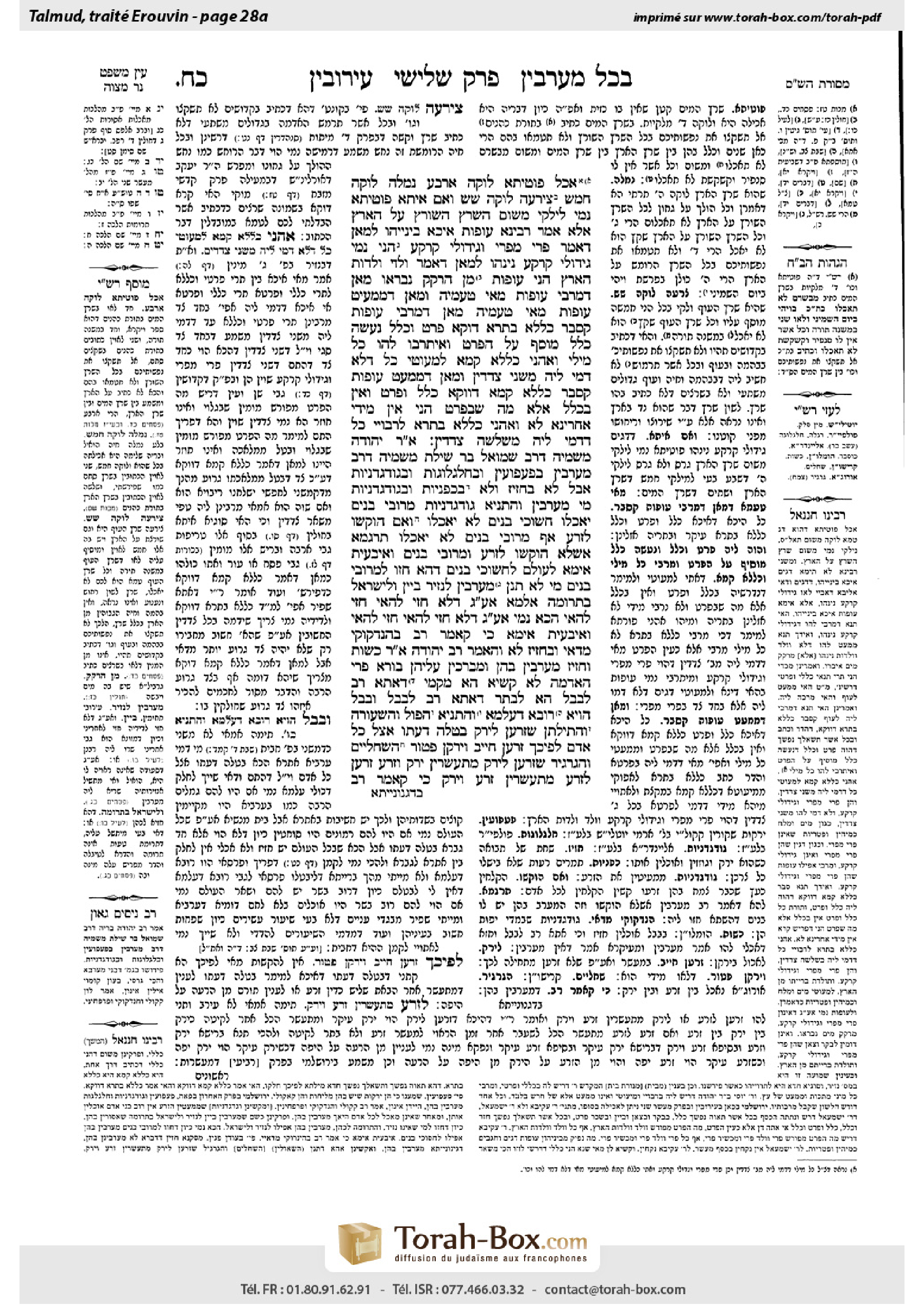
This page of Eruvin includes the Aramaic text, an English translation and an AI-generated French translation, alongside the scan above.
עירובין כ״ח א · Aramaic and Hebrew text
אָכַל פּוּטִיתָא — לוֹקֶה אַרְבַּע. נְמָלָה — לוֹקֶה חָמֵשׁ. צִירְעָה — לוֹקֶה שֵׁשׁ. וְאִם אִיתָא — פּוּטִיתָא נָמֵי לִילְקֵי מִשּׁוּם ״הַשֶּׁרֶץ הַשֹּׁרֵץ עַל הָאָרֶץ״!
אֶלָּא אָמַר רָבִינָא: עוֹפוֹת אִיכָּא בֵּינַיְיהוּ. לְמַאן דְּאָמַר פְּרִי מִפְּרִי וְגִידּוּלֵי קַרְקַע, הָנֵי נָמֵי — גִּידּוּלֵי קַרְקַע נִינְהוּ. לְמַאן דְּאָמַר וְלַד וַלְדוֹת הָאָרֶץ, הָנֵי עוֹפוֹת — מִן הָרְקָק נִבְרְאוּ.
מַאן דִּמְרַבֵּי עוֹפוֹת — מַאי טַעְמֵיהּ, וּמַאן דִּמְמַעֵיט עוֹפוֹת — מַאי טַעְמֵיהּ?
מַאן דִּמְרַבֵּי עוֹפוֹת, קָסָבַר: כְּלָלָא בָּתְרָא דַּוְקָא. פְּרָט וּכְלָל — נַעֲשֶׂה כְּלָל מוּסָף עַל הַפְּרָט, וְאִיתְרַבּוּ לְהוּ כׇּל מִילֵּי. וְאַהְנִי כְּלָלָא קַמָּא לְמַעוֹטֵי כֹּל דְּלָא דָּמֵי לֵיהּ מִשְּׁנֵי צְדָדִין.
וּמַאן דִּמְמַעֵט עוֹפוֹת, קָסָבַר: כְּלָלָא קַמָּא דַּוְוקָא, כְּלָל וּפְרָט — וְאֵין בַּכְּלָל אֶלָּא מַה שֶּׁבַּפְּרָט: הָנֵי — אִין, מִידֵּי אַחֲרִינָא — לָא. וְאַהְנִי כְּלָלָא בָּתְרָא לְרַבּוֹיֵי כֹּל דְּדָמֵי לֵיהּ מִשְּׁלֹשָׁה צְדָדִין.
אָמַר רַב יְהוּדָה מִשְּׁמֵיהּ דְּרַב שְׁמוּאֵל בַּר שִׁילַת מִשְּׁמֵיהּ דְּרַב: מְעָרְבִין בְּפַעְפּוּעִין וּבַחֲלַגְלוֹגוֹת וּבְגוּדְגְּדָנִיּוֹת, אֲבָל לֹא בַּחֲזִיז וְלֹא בְּכַפְנִיּוֹת.
וּבְגוּדְגְּדָנִיּוֹת מִי מְעָרְבִין? וְהָתַנְיָא: גּוּדְגְּדָנִיּוֹת — מְרוּבֵּי בָנִים יֹאכֵלוּ, חֲשׂוּכֵי בָנִים לֹא יֹאכֵלוּ. וְאִם הוּקְשׁוּ לְזֶרַע — אַף מְרוּבֵּי בָּנִים לֹא יֹאכֵלוּ!
תַּרְגְּמָא: אַשֶּׁלֹא הוּקְשׁוּ לְזֶרַע, וּמְרוּבֵּי בָנִים.
וְאִיבָּעֵית אֵימָא: לְעוֹלָם לַחֲשׂוּכֵי בָנִים, דְּהָא חֲזוּ לִמְרוּבֵּי בָנִים. מִי לָא תְּנַן: מְעָרְבִין לַנָּזִיר בְּיַיִן וּלְיִשְׂרָאֵל בִּתְרוּמָה. אַלְמָא: אַף עַל גַּב דְּלָא חֲזֵי לְהַאי — חֲזֵי לְהַאי. הָכָא נָמֵי, אַף עַל גַּב דְּלָא חֲזֵי לְהַאי — חֲזֵי לְהַאי.
וְאִיבָּעֵית אֵימָא: כִּי קָאָמַר רַב, בְּהַנְדְּקוֹקֵי מָדָאֵי.
וּבַחֲזִיז לָא? וְהָאָמַר רַב יְהוּדָה אָמַר רַב: כְּשׁוּת וַחֲזִיז מְעָרְבִין בָּהֶן, וּמְבָרְכִין עֲלֵיהֶן ״בּוֹרֵא פְּרִי הָאֲדָמָה״!
לָא קַשְׁיָא: הָא — מִקַּמֵּי דַּאֲתָא רַב לְבָבֶל, הָא — לְבָתַר דַּאֲתָא רַב לְבָבֶל.
וּבָבֶל הָוְיָא רוּבָּא דְּעָלְמָא? וְהָתַנְיָא: הַפּוֹל וְהַשְּׂעוֹרָה וְהַתִּילְתָּן שֶׁזְּרָעָן לְיָרָק — בָּטְלָה דַּעְתּוֹ אֵצֶל כׇּל אָדָם. לְפִיכָךְ: זַרְעָן חַיָּיב, וְיַרְקָן פָּטוּר. הַשַּׁחֲלַיִים וְהַגַּרְגִּיר שֶׁזְּרָעָן לְיָרָק — מִתְעַשְּׂרִין יָרָק וְזֶרַע, זְרָעָן לְזֶרַע — מִתְעַשְּׂרִין זֶרַע וְיָרָק.
כִּי קָאָמַר רַב,
Eruvin 28a · English translation
If one ate a putita, a certain water insect, he is given four sets of lashes, as he has transgressed four separate negative Torah commandments, two that relate to creeping animals in general and two that relate to water insects in particular. If he ate an ant, he is given five sets of lashes for violating the two general prohibitions and another three negative commandments stated with regard to insects that creep upon the earth. If he ate a hornet, he is given six sets of lashes, for in addition to the prohibitions applying to an ant, he has transgressed a prohibition stated with regard to flying insects. And if it is correct that something that lives in water is considered as growing from the ground, one who eats a putita should also be given lashes for violating the following prohibition: “And every creeping thing that creeps upon the earth is a detestable thing; it shall not be eaten” (Leviticus 11:41). Rather, fish must certainly not be considered as growing from the ground, and therefore this explanation is to be rejected.
Rather, Ravina said: There is a practical difference between the two baraitot with regard to fowl. According to the one who said that one may use second-tithe money only to purchase food which is the produce of produce and grown from the ground, these fowl are also regarded as having grown from the ground. However, according to the one who said that we apply it to that which is the offspring of the offspring of the earth, these fowl were created from mud and not from the ground, and consequently they are not included among the items that may be bought with second-tithe money.
These two distinct opinions are both based upon the exegetical principle of a generalization and a detail. The Gemara now asks: What is the reason of the one who includes fowl, and what is the reason of the one who excludes fowl?
The Gemara explains: The one who includes fowl holds that when there is a generalization, a detail, and another generalization, the latter generalization is primary. Therefore, the rule is similar to that governing a detail followed by a generalization, which maintains that the generalization is considered an addition to the detail, and all other items are included. However, the first generalization is effective in excluding anything that is not similar to it in two respects, as it is nonetheless a case of a generalization, a detail, and a generalization. Therefore, he excludes anything that does not grow from the ground and is not the produce of produce.
And the one who excludes fowl holds that the first generalization is primary. Therefore, a generalization, detail, and generalization is similar to a single generalization that is followed by a detail, with regard to which we maintain that the generalization only includes that which is spelled out in the detail. Therefore, with regard to these items mentioned in the verse, yes, one may purchase them with second-tithe money. With regard to something else, no, one may not. However, the latter generalization is effective to include anything that is similar to it in three respects, namely, it is the produce of produce, grows from the ground, and is offspring of the offspring of the earth, to the exclusion of fowl.
Rav Yehuda said in the name of Rav Shmuel bar Sheilat, who said in the name of Rav: One may establish an eiruv with cheap and unimportant produce such as cress, purslane, and sweet clover, but one may not establish an eiruv with green grain or with unripe dates.
The Gemara asks: But may one establish an eiruv with sweet clover? Wasn’t it taught in a baraita with regard to sweet clover that those who have many children may eat it, but those without children may not eat it, as it is harmful to one’s reproductive capacity; and if it was hardened into seed, i.e., if it became very hard and already fit to be planted, even those who have many children may not eat it? Therefore, we see that it is prohibited to eat sweet clover. How can it possibly be used to establish an eiruv?
The Gemara answers: Interpret Rav’s statement as referring to sweet clover that was not yet hardened into seed, and its use for establishing an eiruv is limited to those who have many children and are therefore permitted to eat it.
And if you wish, you can say instead that actually, sweet clover is fit for an eiruv even for those without children because it is fit to be eaten by those who have many children. The food used for an eiruv must be edible, but it does not need to be edible for the particular person using it as his eiruv. Didn’t we learn in the mishna: One may establish an eiruv for a nazirite with wine, and for an Israelite with teruma? Apparently, these items may be used as an eiruv even though they are not fit for this person, because they are fit for that other person. Here too, even though the sweet clover is not fit for this person, it may be used because it is fit for that other person.
And if you wish, you can say instead: When Rav said that sweet clover may be used for an eiruv, he was referring to Median clover, which is of superior quality and is not harmful.
The Gemara considers the continuation of Rav’s statement: And may one not establish an eiruv with green grain? Didn’t Rav Yehuda say that Rav said: In the case of dodder and green grain, one may establish an eiruv with them; and when eating them one recites the blessing: Who creates the fruit of the ground?
The Gemara answers: This is not difficult. This first statement, according to which green grain may not be used for an eiruv, was made before Rav came to Babylonia. That second statement was made after Rav came to Babylonia and saw that people there ate green grain, at which point he ruled that it is fit to be used for an eiruv.
The Gemara asks: Is Babylonia the majority of the world? Laws are established according to the custom prevalent in most of the world. Wasn’t it taught in a baraita: In the case of beans, barley, and fenugreek that one planted in order to use as an herb, e.g., as animal fodder, his opinion is rendered irrelevant by the opinions of all other people? Since most people do not act this way, we do not consider this particular person’s intention to be significant. Therefore, one is obligated to tithe their seeds, and their herbs are exempt. When one harvests these plants in their green state, before their seeds have matured, they are regarded as not having fully ripened. However, in the case of cress and arugula, which are commonly eaten both in their green state and as seeds, if one planted them in order to use them as herbs, they are tithed both as herbs and as seeds; if one planted them for their seeds, they are tithed as seeds and as herbs, no matter how they are eaten. In any case, the first part of the baraita teaches that the law is determined in accordance with the common custom of most of the world and not with the practice in one particular place.
The Gemara answers: When Rav said that green grain may be used for an eiruv,
Eruvin 28a · Traduction française (IA)
Si l'on a mangé un putita, un insecte aquatique, on lui administre quatre séries de fessures, car il a transgressé quatre commandements négatifs distincts de la Torah, deux concernant les animaux rampants en général et deux concernant les insectes aquatiques en particulier. Si l'on a mangé une fourmi, on lui administre cinq séries de fessures pour avoir violé les deux interdits généraux et trois autres commandements négatifs relatifs aux insectes terrestres. Si l'on a mangé une guêpe, on lui administre six séries de fessures, car, en plus des interdits applicables à la fourmi, il a transgressé un interdit relatif aux insectes volants. Et si c'est exact que ce qui vit dans l'eau est considéré comme poussant du sol, celui qui a mangé un putita devrait aussi être fessé pour avoir violé l'interdiction suivante : « Et tout ce qui rampe sur la terre est abomination ; il ne doit pas être mangé » (Lévitique 11:41). Cependant, les poissons ne peuvent certainement pas être considérés comme poussant du sol, et donc cette explication doit être rejetée.
En effet, Ravina a dit : Il y a une différence pratique entre les deux baraitot concernant les oiseaux. Selon celui qui affirme qu'on peut utiliser l'argent de la deuxième part pour acheter uniquement des aliments qui sont la production de la production et qui poussent du sol, ces oiseaux sont aussi considérés comme poussant du sol. Cependant, selon celui qui affirme qu'on l'applique à ce qui est l'offspring de l'offspring du sol, ces oiseaux ont été créés à partir de boue et non du sol, et par conséquent ils ne sont pas inclus parmi les choses pouvant être achetées avec l'argent de la deuxième part.
Ces deux opinions distinctes sont toutes deux basées sur le principe exégétique de la généralisation et du détail. La Guemara pose alors la question : Quel est le raisonnement de celui qui inclut les oiseaux et quel est celui de celui qui exclut les oiseaux ?
La Guemara explique : Celui qui inclut les oiseaux considère que lorsqu'il y a une généralisation, un détail et une autre généralisation, la dernière généralisation est prioritaire. Ainsi, la règle est semblable à celle qui régit un détail suivi d'une généralisation, dans laquelle on considère que la généralisation est une addition au détail et que tous les autres objets sont inclus. Cependant, la première généralisation est efficace pour exclure tout ce qui n'est pas similaire à elle en deux points, car il s'agit tout de même d'une généralisation, d'un détail et d'une généralisation. Ainsi, il exclut tout ce qui ne pousse pas du sol et n'est pas la production de la production.
Et celui qui exclut les oiseaux considère que la première généralisation est prioritaire. Ainsi, une généralisation, un détail et une généralisation est semblable à une seule généralisation suivie d'un détail, dans laquelle on maintient que la généralisation ne comprend que ce qui est spécifié dans le détail. Ainsi, concernant ces objets mentionnés dans la Torah, oui, on peut les acheter avec l'argent de la deuxième part. Concernant quelque chose d'autre, non, on ne peut pas. Cependant, la dernière généralisation est efficace pour inclure tout ce qui est similaire à elle en trois points, à savoir, il est la production de la production, pousse du sol et est l'offspring de l'offspring du sol, excluant ainsi les oiseaux.
Rav Yehuda a dit en nom de Rav Shmuel bar Sheilat, qui a dit en nom de Rav : On peut établir un eiruv avec des productions peu importantes et peu coûteuses telles que le cresson, la bryophyllum et le trèfle sucré, mais on ne peut pas établir un eiruv avec des céréales vertes ou avec des dattes non mûres.
La Guemara pose la question : Mais peut-on établir un eiruv avec le trèfle sucré ? N'avait-on pas appris dans une baraïta concernant le trèfle sucré que ceux qui ont beaucoup d'enfants peuvent le manger, mais ceux qui n'ont pas d'enfants ne peuvent pas le manger, car il est nuisible à la capacité reproductive ; et si c'était durci en grain, c'est-à-dire si c'était très dur et déjà prêt à être planté, même ceux qui ont beaucoup d'enfants ne peuvent pas le manger ? Ainsi, on voit que le trèfle sucré est interdit à manger. Comment peut-il être utilisé pour établir un eiruv ?
La Guemara répond : Interprète la déclaration de Rav comme se référant au trèfle sucré qui n'était pas encore durci en grain, et son utilisation pour établir un eiruv est limitée à ceux qui ont beaucoup d'enfants et sont donc autorisés à le manger.
Et si tu veux, tu peux dire plutôt que, en réalité, le trèfle sucré est adapté à un eiruv même pour ceux qui n'ont pas d'enfants, car il est adapté à manger pour ceux qui ont beaucoup d'enfants. L'aliment utilisé pour un eiruv doit être comestible, mais il n'a pas besoin d'être comestible pour la personne utilisant l'eiruv. N'avons-nous pas appris dans la mishna : On peut établir un eiruv pour un nazirite avec du vin et pour un Israélite avec la terouma ? Apparemment, ces objets peuvent être utilisés comme un eiruv même s'ils ne sont pas adaptés à cette personne, car ils sont adaptés à une autre personne. Ici aussi, même si le trèfle sucré n'est pas adapté à cette personne, il peut être utilisé car il est adapté à une autre personne.
Et si tu veux, tu peux dire plutôt : Lorsque Rav a dit que le trèfle sucré peut être utilisé pour un eiruv, il faisait référence au trèfle médian, qui est de meilleure qualité et n'est pas nuisible.
La Guemara examine la continuation de la déclaration de Rav : Et peut-on établir un eiruv avec des céréales vertes ? N'avait-on pas dit Rav Yehuda que Rav a dit : Dans le cas du dodder et des céréales vertes, on peut établir un eiruv avec eux ; et lorsqu'on les mange, on récite la bénédiction : Celui qui crée la fruit de la terre ?
La Guemara répond : Ce n'est pas difficile. Cette première déclaration, selon laquelle les céréales vertes ne peuvent pas être utilisées pour un eiruv, a été faite avant que Rav ne vienne en Babylonie. Cette deuxième déclaration a été faite après que Rav soit venu en Babylonie et ait vu que les gens y mangeaient des céréales vertes, à ce moment-là il a décidé qu'elles étaient adaptées à être utilisées pour un eiruv.
La Guemara pose la question : Babylone est-elle la majorité du monde ? Les lois sont établies selon la coutume prévalente dans la majorité du monde. N’a-t-il pas été enseigné dans une baraïta : dans le cas des haricots, du blé et du fenouil que l’on plante afin de les utiliser comme herbe, par exemple en tant que nourriture pour bétail, l’opinion de cette personne est rendue insignifiante par l’opinion de tous les autres ? Puisque la plupart des gens n’agissent pas ainsi, nous ne considérons pas l’intention particulière de cette personne comme importante. Ainsi, on est tenu de dîmer ses semences, et ses herbes sont exemptes. Lorsqu’on récolte ces plantes dans leur état vert, avant que leurs semences ne soient mûres, on les considère comme non pleinement mûres. Cependant, dans le cas des cress et de l’arugula, qui sont couramment mangés à l’état vert ainsi que en semences, si l’on les a plantés afin de les utiliser comme herbes, on les dîme à la fois comme herbes et comme semences ; si l’on les a plantés pour leurs semences, on les dîme comme semences et comme herbes, indépendamment de la manière dont on les consomme. En tout cas, la première partie de la baraïta enseigne que la loi est déterminée selon la coutume courante de la majorité du monde et non selon la pratique d’un lieu particulier.
La Guemara répond : Lorsque Rav a dit que le grain vert peut être utilisé pour un eruv,
Traduction française générée par IA à partir de l’édition anglaise de Sefaria. Vérifie toujours un passage avec le texte source.
Text from Sefaria: William Davidson Edition - Vocalized Aramaic (CC BY NC); William Davidson Edition - English (CC BY NC).