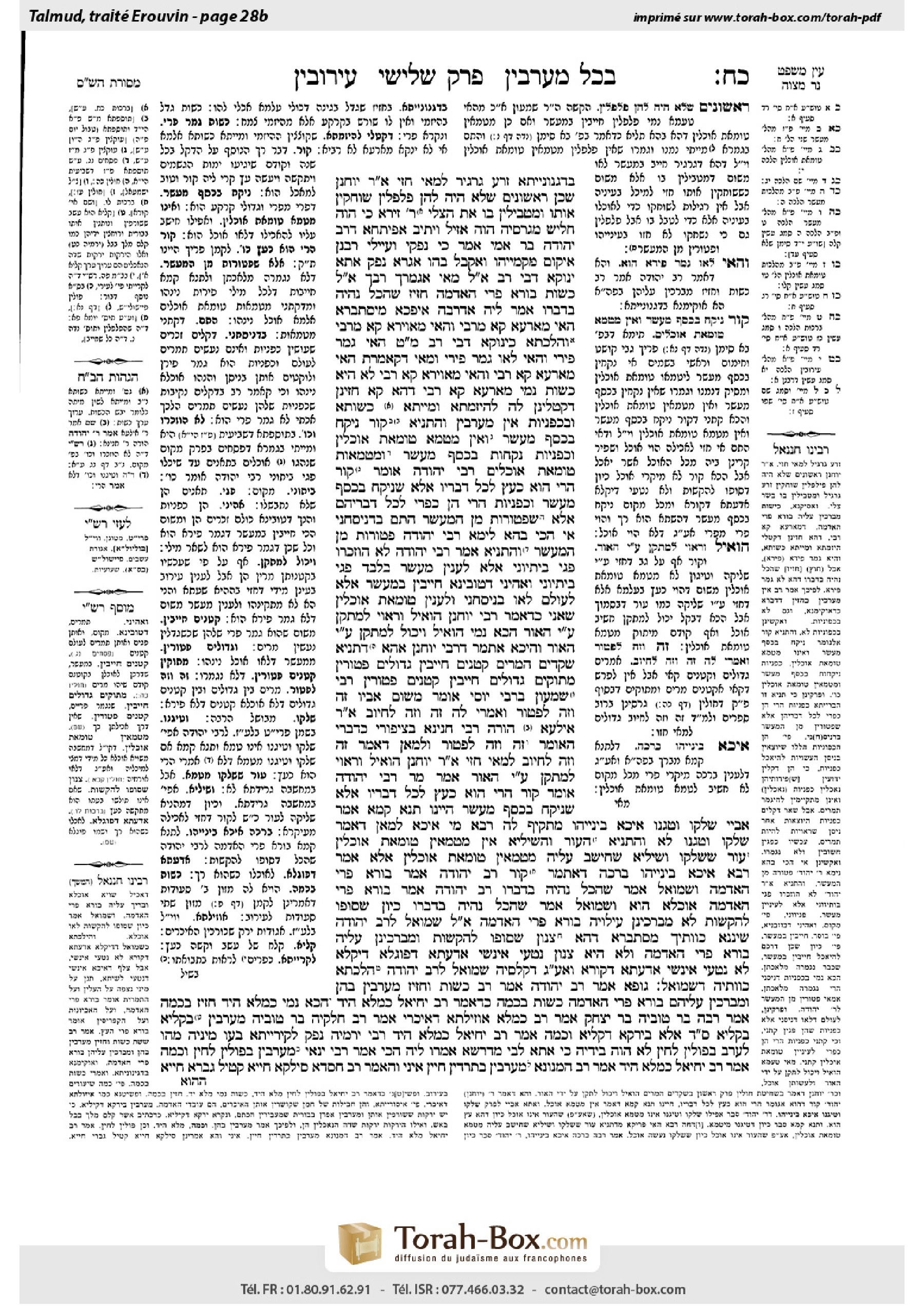
Eruvin 28b: Talmud study for Daf Yomi
Study the Talmud for Daf Yomi with scanned pages, Hebrew text, English translations from Sefaria and AI-generated French translations.
Passage selection and English or AI-generated French translation are available where the scan has annotations. Daf Study is independent of Torah-Box and Sefaria.
Browse Eruvin · עירובין · All tractatesEruvin 28b text and translations
This page of Eruvin includes the Aramaic text, an English translation and an AI-generated French translation, alongside the scan above.
עירובין כ״ח ב · Aramaic and Hebrew text
בִּדְגִנּוּנְיָיתָא.
זֶרַע גַּרְגִּיר. לְמַאי חֲזֵי? אָמַר רַבִּי יוֹחָנָן: שֶׁכֵּן רִאשׁוֹנִים שֶׁלֹּא הָיָה לָהֶן פִּלְפְּלִין, שׁוֹחֲקִין אוֹתוֹ וּמַטְבִּילִין בּוֹ אֶת הַצָּלִי.
רַבִּי זֵירָא כִּי הֲוָה חֲלִישׁ מִגִּרְסֵיהּ, הֲוָה אָזֵיל וְיָתֵיב אַפִּיתְחָא דְּרַב יְהוּדָה בַּר אַמֵּי, אָמַר: כִּי נָפְקִי וְעָיְילִי רַבָּנַן — אֵיקוּם מִקַּמַּיְיהוּ וַאֲקַבֵּל בְּהוּ אַגְרָא.
נְפַק אֲתָא יָנוֹקָא דְּבֵי רַב, אֲמַר לֵיהּ: מַאי אַגְמְרָךְ רַבָּךְ? אֲמַר לֵיהּ: כְּשׁוּת ״בּוֹרֵא פְּרִי הָאֲדָמָה״, חֲזִיז ״שֶׁהַכֹּל נִהְיֶה בִּדְבָרוֹ״. אֲמַר לֵיהּ: אַדְּרַבָּה, אִיפְּכָא מִיסְתַּבְּרָא, הַאי — מֵאַרְעָא קָא מִרַבֵּי, וְהַאי — מֵאַוֵּירָא קָא מִרַבֵּי.
וְהִלְכְתָא כְּיָנוֹקָא דְּבֵי רַב. מַאי טַעְמָא: הַאי — גְּמַר פֵּירֵי, וְהַאי — לָאו גְּמַר פֵּירֵי. וּמַאי דְּקָאָמְרַתְּ: הַאי מֵאַרְעָא קָא רָבֵי, וְהַאי מֵאַוֵּירָא קָא רָבֵי — לָא הִיא. כְּשׁוּת נָמֵי מֵאַרְעָא קָא רָבֵי, דְּהָא קָא חָזֵינַן דְּקָטְלִינַן לַהּ לְהִיזְמְתָא וּמָיְיתָא כְּשׁוּתָא.
וּבְכַפְנִיּוֹת אֵין מְעָרְבִין? וְהָתַנְיָא: קוֹר נִיקָּח בְּכֶסֶף מַעֲשֵׂר, וְאֵין מִטַּמֵּא טוּמְאַת אוֹכָלִין. וְכַפְנִיּוֹת נִקָּחוֹת בְּכֶסֶף מַעֲשֵׂר, וּמִטַּמְּאוֹת טוּמְאַת אוֹכָלִים.
רָבֵי יְהוּדָה אוֹמֵר: קוֹר הֲרֵי הוּא כְּעֵץ לְכׇל דְּבָרָיו — אֶלָּא שֶׁנִּיקָּח בְּכֶסֶף מַעֲשֵׂר, וְכַפְנִיּוֹת הֲרֵי הֵן כִּפְרִי לְכׇל דִּבְרֵיהֶם — אֶלָּא שֶׁפְּטוּרוֹת מִן הַמַּעֲשֵׂר.
הָתָם, בִּדְנִיסְחָנֵי.
אִי הָכִי, בְּהָא לֵימָא רַבִּי יְהוּדָה פְּטוּרוֹת מִן הַמַּעֲשֵׂר? וְהָתַנְיָא, אָמַר רַבִּי יְהוּדָה: לֹא הוּזְכְּרוּ פַּגֵּי בֵיתְיוֹנֵי אֶלָּא לְעִנְיַן מַעֲשֵׂר בִּלְבַד. פַּגֵּי בֵיתְיוֹנֵי וַאֲהִינֵי דְטוֹבִינָא חַיָּיבִין בְּמַעֲשֵׂר.
אֶלָּא לְעוֹלָם לָאו בְּנִיסְחָנֵי, וּלְעִנְיַן טוּמְאַת אוֹכָלִין שָׁאנֵי, כִּדְאָמַר רַבִּי יוֹחָנָן: הוֹאִיל וְרָאוּי לְמַתְּקָן עַל יְדֵי הָאוּר, הָכָא נָמֵי: הוֹאִיל וְיָכוֹל לְמַתְּקָן עַל יְדֵי הָאוּר.
וְהֵיכָא אִתְּמַר דְּרַבִּי יוֹחָנָן? אַהָא דְּתַנְיָא: שְׁקֵדִים הַמָּרִים — קְטַנִּים חַיָּיבִין, גְּדוֹלִים פְּטוּרִין. מְתוּקִים — גְּדוֹלִים חַיָּיבִין, קְטַנִּים פְּטוּרִין. רַבִּי שִׁמְעוֹן בְּרַבִּי יוֹסֵי אוֹמֵר מִשּׁוּם אָבִיו: זֶה וָזֶה, לִפְטוּר. וְאָמְרִי לַהּ: זֶה וָזֶה לְחִיּוּב. אָמַר רַבִּי אִילְעָא: הוֹרָה רַבִּי חֲנִינָא בְּצִיפּוֹרִי כְּדִבְרֵי הָאוֹמֵר זֶה וְזֶה לִפְטוּר.
וּלְמַאן דְּאָמַר זֶה וָזֶה לְחִיּוּב, לְמַאי חֲזֵי? אָמַר רַבִּי יוֹחָנָן: הוֹאִיל וְרָאוּי לְמַתְּקָן עַל יְדֵי הָאוּר.
אָמַר מָר, רַבִּי יְהוּדָה אוֹמֵר: קוֹר הֲרֵי הוּא כְּעֵץ לְכׇל דְּבָרָיו, אֶלָּא שֶׁנִּיקָּח בְּכֶסֶף מַעֲשֵׂר. הַיְינוּ תַּנָּא קַמָּא!
אָמַר אַבָּיֵי: שְׁלָקוֹ וְטִגְּנוֹ אִיכָּא בֵּינַיְיהוּ.
מַתְקֵיף לַהּ רָבָא: מִי אִיכָּא לְמַאן דְּאָמַר שְׁלָקוֹ וְטִגְּנוֹ לָא? וְהָתַנְיָא: הָעוֹר וְהַשִּׁילְיָא אֵין מִטַּמְּאִין טוּמְאַת אוֹכָלִין. עוֹר שֶׁשְּׁלָקוֹ, וְשִׁילְיָא שֶׁחִישֵּׁב עָלֶיהָ — מִטַּמְּאִין טוּמְאַת אוֹכָלִין!
אֶלָּא אָמַר רָבָא: אִיכָּא בֵּינַיְיהוּ בְּרָכָה. דְּאִתְּמַר: קוֹר — רַב יְהוּדָה אָמַר: ״בּוֹרֵא פְּרִי הָאֲדָמָה״, וּשְׁמוּאֵל אָמַר: ״שֶׁהַכֹּל נִהְיֶה בִּדְבָרוֹ״.
רַב יְהוּדָה אָמַר: ״בּוֹרֵא פְּרִי הָאֲדָמָה״ — אוּכְלָא הוּא. וּשְׁמוּאֵל אָמַר: ״שֶׁהַכֹּל נִהְיֶה בִּדְבָרוֹ״ — כֵּיוָן שֶׁסּוֹפוֹ לְהַקְשׁוֹת, לָא מְבָרְכִינַן עִילָּוֵיהּ ״בּוֹרֵא פְּרִי הָאֲדָמָה״.
אֲמַר לֵיהּ שְׁמוּאֵל לְרַב יְהוּדָה: שִׁינָּנָא, כְּווֹתָיךְ מִסְתַּבְּרָא, דְּהָא צְנוֹן שֶׁסּוֹפוֹ לְהַקְשׁוֹת, וּמְבָרְכִינַן עֲלֵיהּ ״בּוֹרֵא פְּרִי הָאֲדָמָה״.
וְלָא הִיא, צְנוֹן נָטְעִי אִינָשֵׁי אַדַּעְתָּא דְפוּגְלָא, דִּיקְלָא — לָא נָטְעִי אִינָשֵׁי אַדַּעְתָּא דְקוֹרָא. וְאַף עַל גַּב דְּקַלְּסֵיהּ שְׁמוּאֵל לְרַב יְהוּדָה, הִלְכְתָא כְּווֹתֵיהּ דִּשְׁמוּאֵל.
גּוּפָא, אָמַר רַב יְהוּדָה אָמַר רַב: כְּשׁוּת וַחֲזִיז מְעָרְבִין בָּהֶן, וּמְבָרְכִין עֲלֵיהֶם ״בּוֹרֵא פְּרִי הָאֲדָמָה״. כְּשׁוּת בְּכַמָּה? כִּדְאָמַר רַב יְחִיאֵל: כִּמְלֹא הַיָּד — הָכָא נָמֵי כִּמְלֹא הַיָּד.
חֲזִיז בְּכַמָּה? אָמַר רַבָּה בַּר טוֹבִיָּה בַּר יִצְחָק אָמַר רַב: כִּמְלֹא אוּזִילְתָּא דְאִיכָּרֵי.
אֲמַר רַב חִלְקִיָּה בַּר טוֹבִיָּה: מְעָרְבִין בְּקִלְיָא. בְּקִלְיָא סָלְקָא דַּעְתָּךְ?! אֶלָּא בְּיַרְקָא דְקִלְיָא, וְכַמָּה? אָמַר רַב יְחִיאֵל: כִּמְלֹא הַיָּד.
רַבִּי יִרְמְיָה נְפַק לְקִירְיָיתָא, בְּעוֹ מִינֵּיהּ: מַהוּ לְעָרֵב בְּפוֹלִין לַחִין? לָא הֲוָה בִּידֵיהּ. כִּי אֲתָא לְבֵי מִדְרְשָׁא, אֲמַרוּ לֵיהּ: הָכִי אָמַר רַבִּי יַנַּאי: מְעָרְבִין בְּפוֹלִין לַחִין. וְכַמָּה? אָמַר רַב יְחִיאֵל: כִּמְלֹא הַיָּד.
אָמַר רַב הַמְנוּנָא: מְעָרְבִין בִּתְרָדִין חַיִּין. אִינִי? וְהָאָמַר רַב חִסְדָּא: סִילְקָא חַיָּיא קָטֵיל גַּבְרָא חַיָּיא!
Eruvin 28b · English translation
he was referring to the garden variety, which is commonly eaten.
Having mentioned arugula seeds, the Gemara asks: For what are they suitable? Generally, only the plant’s leaves are eaten. Rabbi Yoḥanan said: The earlier generations, who had no pepper, would crush these seeds and dip their roasted meat in them. Therefore, arugula seeds are also eaten, even though this is not their typical use.
The Gemara relates that when Rabbi Zeira was exhausted from his studies, he would go and sit at the entrance to the academy of Rav Yehuda bar Ami, and say: When the Sages go in and out, I shall stand up before them and receive reward for honoring them, as it is a mitzva to honor Torah scholars. Too tired to engage in actual Torah study, he sought a way to rest while fulfilling a different mitzva at the same time.
Once, a young school child was leaving the study hall. Rabbi Zeira said to him: What did your teacher teach you today? He said to him: The proper blessing for dodder is: Who creates the fruit of the ground; the proper blessing for green grain is: By Whose word all things came to be. Rabbi Zeira said to him: On the contrary, the opposite is more reasonable, as this, the green grain, derives nourishment from the ground, whereas that, the dodder, derives nourishment from the air, and it is fitting to recite a blessing over each item in accordance with its source of nourishment.
The Gemara concludes: The halakha is in accordance with the young school child. What is the reason for this? This, the dodder, is fully ripened produce, and that, green grain, is not fully ripened produce. If produce is not fully ripened one can only recite the blessing: By Whose word all things came to be. And that which you said: This, the green grain, derives nourishment from the ground, whereas that, the dodder, derives nourishment from the air, this is not so. Dodder also derives nourishment from the ground, for we see that when the prickly shrub is cut off, the dodder attached to it dies. This shows that dodder also derives its nourishment from the ground, albeit indirectly.
The Gemara now considers the next part of Rav’s statement: And is it correct that one may not establish an eiruv with unripe dates? Wasn’t it taught in a baraita: Heart of palm, the soft, edible inner core of a palm tree, may be bought with second-tithe money; but it does not contract the ritual impurity of foods, as it is not actually a food, but rather a part of the tree itself. And unripe dates may be bought with second-tithe money, and they even contract the ritual impurity of foods.
Rabbi Yehuda says this somewhat differently: Heart of palm is like a tree in all its legal aspects, except that it may be bought with second-tithe money, as it is edible. And unripe dates are like fruit in all regards, as they are actual fruit, except with respect to one characteristic, which is that they are exempt from tithes because they are not yet fully ripened.
The Gemara answers: There, the baraita is referring to the fruit of palms that never fully ripen. They are therefore regarded as full-fledged fruit even in their unripe state. Rav, however, was referring to the fruit of palms, which eventually ripen. Their unripe state is merely a transitional stage in their development.
The Gemara asks: If so, would Rabbi Yehuda say with regard to this that they are exempt from tithes? Wasn’t it taught in a baraita that Rabbi Yehuda said: The unripe figs of the place called Beityoni were only mentioned with regard to tithes, as it was stated: In the case of the unripe figs of Beityoni, and the unripe dates of the place called Tuvina, one is obligated to tithe them even though they never ripen, since they are considered full-fledged fruit in all respects?
Rather, say as follows: Actually, the baraita is not referring to the fruit of palms that never fully ripen, but rather to the fruit of palms that eventually ripen. However, the halakha pertaining to the ritual impurity of foods is different, and an item’s status as a food with regard to the impurity of foods cannot be brought as proof of its status as a food with regard to an eiruv. As Rabbi Yoḥanan said elsewhere: Since they are fit to be sweetened through cooking with fire, they are regarded as food for the purpose of tithes; here too, we can say: Since they are fit to be sweetened through cooking with fire, unripe dates are fit to contract the impurity of foods. However, with regard to an eiruv, we require food that is ready for consumption, and something that can be prepared to become food is not sufficient.
The Gemara asks: Where was this comment of Rabbi Yoḥanan originally stated? The Gemara answers: It was stated on this ruling, which was taught in a baraita: One is obligated to tithe bitter almonds while they are still small and green, as they are fit to be eaten while still undeveloped. When they are large, however, one is exempt from tithing them, as they are no longer edible. One is obligated to tithe sweet, large almonds, whereas one is exempt from tithing small ones, as they have not yet fully ripened. Rabbi Shimon, son of Rabbi Yosei, said in the name of his father: One is exempt from tithing both this and that, large and small bitter almonds. And some say that he said in the name of his father: One is obligated to tithe both this and that. Rabbi Ila said: Rabbi Ḥanina ruled in Tzippori in accordance with the one who said: One is exempt from tithing both this and that.
The Gemara asks: According to the view of the one who said one is obligated to tithe both this and that, for what are large, bitter almonds suitable? Rabbi Yoḥanan said: Since these almonds are fit to be sweetened and made edible through cooking with fire, they are regarded as food for the purpose of tithes.
The Gemara further examines the baraita cited earlier. The Master said that Rabbi Yehuda says: Heart of palm is like a tree in all its legal aspects, except that it may be bought with second-tithe money. The Gemara asks: Rabbi Yehuda’s opinion is identical to that of the first tanna.
Abaye said: There is a practical difference between them in a case where one boiled or fried the heart of palm. According to Rabbi Yehuda, it does not contract the ritual impurity of foods even if it was boiled or fried, whereas the first tanna holds that in that case it does contract impurity.
Rava strongly objects to this: Is there really anyone who said that even if one boiled or fried it, it does not contract the ritual impurity of foods? Wasn’t it taught in a baraita: The hide and the placenta of an animal, which people do not typically eat, do not contract the ritual impurity of foods; however, a hide that one boiled until it became edible and a placenta that one intended to eat do contract the impurity of foods? This indicates that even something not originally fit to be eaten contracts the impurity of foods once it has been boiled or fried, and the same should apply to heart of palm according to all opinions.
Rather, Rava said: There is a practical difference between them with regard to the blessing that must be recited prior to eating, for it was stated that the amora’im disagreed about the blessing recited over heart of palm: Rav Yehuda said the appropriate blessing is: Who creates the fruit of the ground. And Shmuel said the appropriate blessing is: By Whose word all things came to be.
The Gemara explains the two opinions: Rav Yehuda said the appropriate blessing is: Who creates the fruit of the ground, as it is food. Since heart of palm is edible it is called a fruit, and we recite a blessing over it in the manner of all fruits. And Shmuel said the appropriate blessing is: By Whose word all things came to be. Since it will eventually harden and become like an inedible tree, we do not recite over it the blessing: Who creates the fruit of the ground, as it will eventually lose the status of a fruit.
Shmuel said to Rav Yehuda: Shinnana, your opinion is reasonable, as a radish will eventually harden, and yet we recite over it the blessing: Who creates the fruit of the ground.
The Gemara comments: But it is not so, because people plant radish with the intention of eating it while it is soft; but people do not plant palm trees with the intention of eating heart of palm. Therefore, heart of palm is not considered the fruit of the palm, but rather food extracted from it, over which only the following blessing should be recited: By Whose word all things came to be. And the Gemara concludes: Even though Shmuel praised Rav Yehuda, the halakha is in accordance with the opinion of Shmuel.
The Gemara now examines the matter itself cited in the previous discussion in the name of Rav. Rav Yehuda said that Rav said with regard to dodder and green grain: One may establish an eiruv with them, and when eating them one recites the blessing: Who creates the fruit of the ground. The Gemara asks: How much dodder must be used to establish an eiruv? The Gemara answers: As Rav Yeḥiel said with regard to a similar issue: A handful. Here, too, the measure is a handful.
Similarly, how much green grain is needed to establish an eiruv? Rabba bar Toviya bar Yitzḥak said that Rav said: A full farmers’ bundle.
Rav Ḥilkiya bar Toviya said: One may establish an eiruv with glasswort. The Gemara expresses astonishment: Does it enter your mind that one may establish an eiruv with glasswort? People do not eat glasswort. Rather, one may establish an eiruv with the herb from whose ashes glasswort is prepared, as it is fit for human consumption before it is burnt. And how much of it is needed to establish an eiruv? Rav Yeḥiel said: A handful.
The Gemara relates that Rabbi Yirmeya once went out to visit certain villages, and the villagers asked him: What is the halakha with regard to establishing an eiruv with moist beans? He did not have an answer for them. When he came to the study hall, they said to him: This is what Rabbi Yannai said: One may establish an eiruv with moist beans. And how much is needed for that purpose? Rav Yeḥiel said: A handful.
Rav Hamnuna said: One may also establish an eiruv with raw beets. The Gemara raises a difficulty: Is that so? Didn’t Rav Ḥisda say: Raw beet kills a healthy person, which indicates that beets are unhealthy and should therefore be unfit for establishing an eiruv?
Eruvin 28b · Traduction française (IA)
il faisait référence aux graines de roquette, qui sont couramment consommées.
Ayant mentionné les graines de roquette, le Guemara pose la question : à quoi sont-elles utilisables ? Généralement, seul les feuilles de la plante sont mangées. Rabbi Yoḥanan a dit : les générations précédentes, qui n'avaient pas de poivre, écrasaient ces graines et les trempaient dans leur viande grillée. Ainsi, les graines de roquette sont également consommées, même si cela n'est pas leur usage habituel.
Le Guemara rapporte que lorsque Rabbi Zeira était épuisé par ses études, il allait s'asseoir à l'entrée de l'académie de Rav Yehuda bar Ami et disait : Lorsque les Sages entrent et sortent, je me leverai devant eux et recevrai la récompense de leur honorer, car il s'agit d'une mitsva d'honorer les savants de la Torah. Trop fatigué pour s'engager dans des études de Torah, il cherchait un moyen de se reposer tout en accomplissant une autre mitsva à la fois.
Un jour, un jeune élève quittait la salle d'étude. Rabbi Zeira lui demanda : Qu'a-t-on appris aujourd'hui ? Il répondit : La prière appropriée pour le dodder est : Celui qui crée les fruits de la terre ; la prière appropriée pour le grain vert est : Par la Parole dont toutes choses sont venues à l'être. Rabbi Zeira lui dit : Au contraire, l'inverse est plus rationnel, car ce grain vert tire sa nourriture de la terre, tandis que ce dodder tire sa nourriture de l'air, et il est convenable de réciter une prière pour chaque chose selon sa source de nourriture.
Le Guemara conclut : la halakha suit l'opinion du jeune élève. Quelle est la raison de cela ? Cette vigne fourragère est un produit totalement mûri, tandis que ce grain vert n'est pas totalement mûri. Si un produit n'est pas totalement mûri, on peut seulement réciter la prière : Par la Parole dont toutes choses sont venues à l'être. Et ce que vous avez dit : ce grain vert tire sa nourriture de la terre, tandis que cette vigne fourragère tire sa nourriture de l'air, cela n'est pas vrai. La vigne fourragère tire également sa nourriture de la terre, car nous voyons que lorsque la plante épineuse est coupée, la vigne fourragère qui y est attachée meurt. Cela montre que la vigne fourragère tire sa nourriture de la terre, même indirectement.
Le Guemara considère maintenant la prochaine partie de la déclaration de Rav : Et est-ce correct que l'on ne puisse pas établir un eiruv avec des dattes non mûres ? N'a-t-on pas appris dans une baraïta : le cœur de palmier, la partie molle et comestible du palmier, peut être acheté avec l'argent de la deuxième part, mais il ne contracte pas la souillure rituelle des aliments, car il n'est pas réellement un aliment, mais plutôt une partie du palmier lui-même. Les dattes non mûres peuvent être achetées avec l'argent de la deuxième part, et elles contractent même la souillure rituelle des aliments.
Rabbi Yehuda exprime cela différemment : le cœur de palmier est comme un arbre en tous ses aspects juridiques, sauf qu'il peut être acheté avec l'argent de la deuxième part, car il est comestible. Les dattes non mûres sont comme des fruits en tous points, car elles sont des fruits réels, sauf en ce qui concerne une caractéristique, à savoir qu'elles sont exemptes des dîmes car elles ne sont pas encore pleinement mûres.
Le Guemara répond : là, la baraïta fait référence aux fruits de palmier qui ne mûrissent jamais. Ils sont donc considérés comme des fruits pleinement développés même dans leur état non mûr. Rav, en revanche, faisait référence aux fruits de palmier qui finissent par mûrir. Leur état non mûr n'est qu'une étape transitoire de leur développement.
Le Guemara pose la question : Si c'est ainsi, Rabbi Yehuda dirait-il que ces fruits sont exemptés des dîmes ? N'a-t-on pas appris dans une baraïta que Rabbi Yehuda a dit : les figues non mûres du lieu appelé Beityoni furent mentionnées uniquement en ce qui concerne les dîmes, car il était dit : dans le cas des figues non mûres de Beityoni, et des dattes non mûres du lieu appelé Tuvina, on est tenu de les dîmer même s'ils ne mûrissent jamais, car ils sont considérés comme des fruits pleinement développés en tous aspects ?
Plutôt, disons ainsi : en réalité, la baraïta ne fait pas référence aux fruits de palmier qui ne mûrissent jamais, mais plutôt aux fruits de palmier qui finissent par mûrir. Cependant, la halakha concernant la souillure rituelle des aliments est différente, et le statut d'un objet en tant que nourriture concernant la souillure rituelle ne peut pas être utilisé comme preuve de son statut en tant que nourriture concernant un eiruv. Comme Rabbi Yoḥanan a dit ailleurs : puisqu'ils sont aptes à être rendus sucrés par la cuisson au feu, ils sont considérés comme de la nourriture pour les dîmes ; ici aussi, nous pouvons dire : puisqu'ils sont aptes à être rendus sucrés par la cuisson au feu, les dattes non mûres sont aptes à contracter la souillure rituelle des aliments. Cependant, concernant un eiruv, nous exigeons une nourriture prête à l'emploi, et quelque chose qui peut être préparé pour devenir de la nourriture n'est pas suffisant.
Le Guemara pose la question : où cette remarque de Rabbi Yoḥanan a-t-elle été originellement émise ? Le Guemara répond : elle a été émise sur cette décision, qui a été apprise dans une baraïta : on est tenu de dîmer les amandes amères alors qu'elles sont encore petites et vertes, car elles sont aptes à être mangées alors qu'elles sont encore in développées. Lorsqu'elles sont grandes, cependant, on est exempt de les dîmer, car elles ne sont plus comestibles. On est tenu de dîmer les amandes douces et grandes, tandis qu'on est exempt de dîmer les petites, car elles n'ont pas encore pleinement mûri. Rabbi Shimon, fils de Rabbi Yosei, a dit en nom de son père : on est exempt de dîmer à la fois ces amandes amères, grandes et petites. Et certains disent qu'il a dit en nom de son père : on est tenu de dîmer à la fois ces amandes amères. Rabbi Ila a dit : Rabbi Ḥanina a rendu un jugement à Tzippori selon celui qui a dit : on est exempt de dîmer à la fois ces amandes amères.
Le Guemara pose la question : selon l'opinion de celui qui dit qu'on est tenu de dîmer à la fois ces amandes amères, à quoi sont-elles adaptées ? Rabbi Yoḥanan a dit : puisque ces amandes sont aptes à être rendues sucrées par la cuisson au feu, elles sont considérées comme de la nourriture pour les dîmes.
La Guemara examine davantage la baraïta citée plus tôt. Le Maître dit que Rabbi Yéhuda dit : Le cœur de palmier est comme un arbre en tous ses aspects juridiques, sauf qu'il peut être acheté avec l'argent des dixièmes secondaires. La Guemara demande : L'opinion de Rabbi Yéhuda est identique à celle du premier tanna.
Abaye dit : Il y a une différence pratique entre eux dans le cas où l'on a bouilli ou frit le cœur de palmier. Selon Rabbi Yéhuda, il ne contracte pas la souillure rituelle des aliments même s'il a été bouilli ou frit, tandis que le premier tanna considère qu'en ce cas il contracte la souillure.
Rava s'oppose fermement à cela : Est-ce que quelqu'un a vraiment dit que même si l'on a bouilli ou frit le cœur de palmier, il ne contracte pas la souillure rituelle des aliments ? N'a-t-il pas été enseigné dans une baraïta : La peau et le placenta d'un animal, qui ne sont pas habituellement mangés, ne contractent pas la souillure rituelle des aliments ; cependant, une peau que l'on a bouillie jusqu'à ce qu'elle devienne comestible et un placenta que l'on avait l'intention de manger contractent la souillure rituelle des aliments ? Cela montre que même quelque chose qui n'était pas initialement comestible contracte la souillure rituelle des aliments une fois bouilli ou frit, et la même chose devrait s'appliquer au cœur de palmier selon toutes les opinions.
Plutôt, Rava dit : Il y a une différence pratique entre eux concernant la bénédiction qui doit être récitée avant de manger, car il a été dit que les amoraïm s'entendaient sur la bénédiction récitée sur le cœur de palmier : Rav Yéhuda disait que la bénédiction appropriée est : Qui crée les fruits de la terre. Et Shmuel disait que la bénédiction appropriée est : Par la Parole dont toutes choses sont venues à l'être.
La Guemara explique les deux opinions : Rav Yéhuda disait que la bénédiction appropriée est : Qui crée les fruits de la terre, car c'est un aliment. Puisque le cœur de palmier est comestible, il est appelé un fruit, et nous récitons une bénédiction sur lui comme pour tous les fruits. Et Shmuel disait que la bénédiction appropriée est : Par la Parole dont toutes choses sont venues à l'être. Puisque cela finira par durcir et devenir comme un arbre inedible, nous ne récitons pas sur lui la bénédiction : Qui crée les fruits de la terre, car il perdra finalement le statut de fruit.
Shmuel dit à Rav Yéhuda : Shinnana, ton opinion est raisonnable, car un radis finira par durcir, et pourtant nous récitons sur lui la bénédiction : Qui crée les fruits de la terre.
La Guemara commente : Mais ce n'est pas ainsi, car les gens plantent le radis avec l'intention de le manger tel qu'il est mou, mais les gens ne plantent pas les palmiers avec l'intention de manger le cœur de palmier. Par conséquent, le cœur de palmier n'est pas considéré comme le fruit du palmier, mais plutôt comme un aliment extrait de lui, sur lequel on récite seulement la bénédiction suivante : Par la Parole dont toutes choses sont venues à l'être. Et la Guemara conclut : Même si Shmuel a loué Rav Yéhuda, la halakha suit l'opinion de Shmuel.
La Guemara examine maintenant la question elle-même citée précédemment en nom de Rav. Rav Yéhuda dit que Rav dit concernant le dodder et le grain vert : On peut établir un eiruv avec eux, et lorsqu'on les mange, on récite la bénédiction : Qui crée les fruits de la terre. La Guemara demande : Combien de dodder faut-il utiliser pour établir un eiruv ? La Guemara répond : Comme Rav Yéhiel a dit concernant une question similaire : Une poignée. Ici aussi, la mesure est une poignée.
De même, combien de grain vert est-il nécessaire pour établir un eiruv ? Rabba bar Toviya bar Yitzḥak dit que Rav dit : Un faisceau complet de fermier.
Rav Ḥilkiya bar Toviya dit : On peut établir un eiruv avec le chénopodie. La Guemara exprime son étonnement : Est-ce que cela entre dans votre esprit qu'on puisse établir un eiruv avec le chénopodie ? Les gens ne mangent pas le chénopodie. Plutôt, on peut établir un eiruv avec l'herbe dont on prépare le chénopodie à partir des cendres, car elle est comestible avant d'être brûlée. Et combien en faut-il pour établir un eiruv ? Rav Yéhiel dit : Une poignée.
La Guemara rapporte que Rabbi Yirmeya est allé un jour visiter certaines villes, et les villageois lui ont demandé : Quelle est la halakha concernant l'établissement d'un eiruv avec les haricots mouillés ? Il n'avait pas de réponse pour eux. Lorsqu'il est arrivé dans la salle de étude, ils lui ont dit : C'est ce que Rabbi Yannai a dit : On peut établir un eiruv avec les haricots mouillés. Et combien en faut-il pour cela ? Rav Yéhiel a dit : Une poignée.
Rav Hamnuna dit : On peut aussi établir un eiruv avec les betteraves crues. La Guemara soulève une difficulté : Est-ce que cela est vrai ? N'a-t-il pas dit Rav Ḥisda : La betterave crue tue un homme sain, ce qui indique que les betteraves sont nuisibles et devraient donc être inadaptées pour établir un eiruv ?
Traduction française générée par IA à partir de l’édition anglaise de Sefaria. Vérifie toujours un passage avec le texte source.
Text from Sefaria: William Davidson Edition - Vocalized Aramaic (CC BY NC); William Davidson Edition - English (CC BY NC).