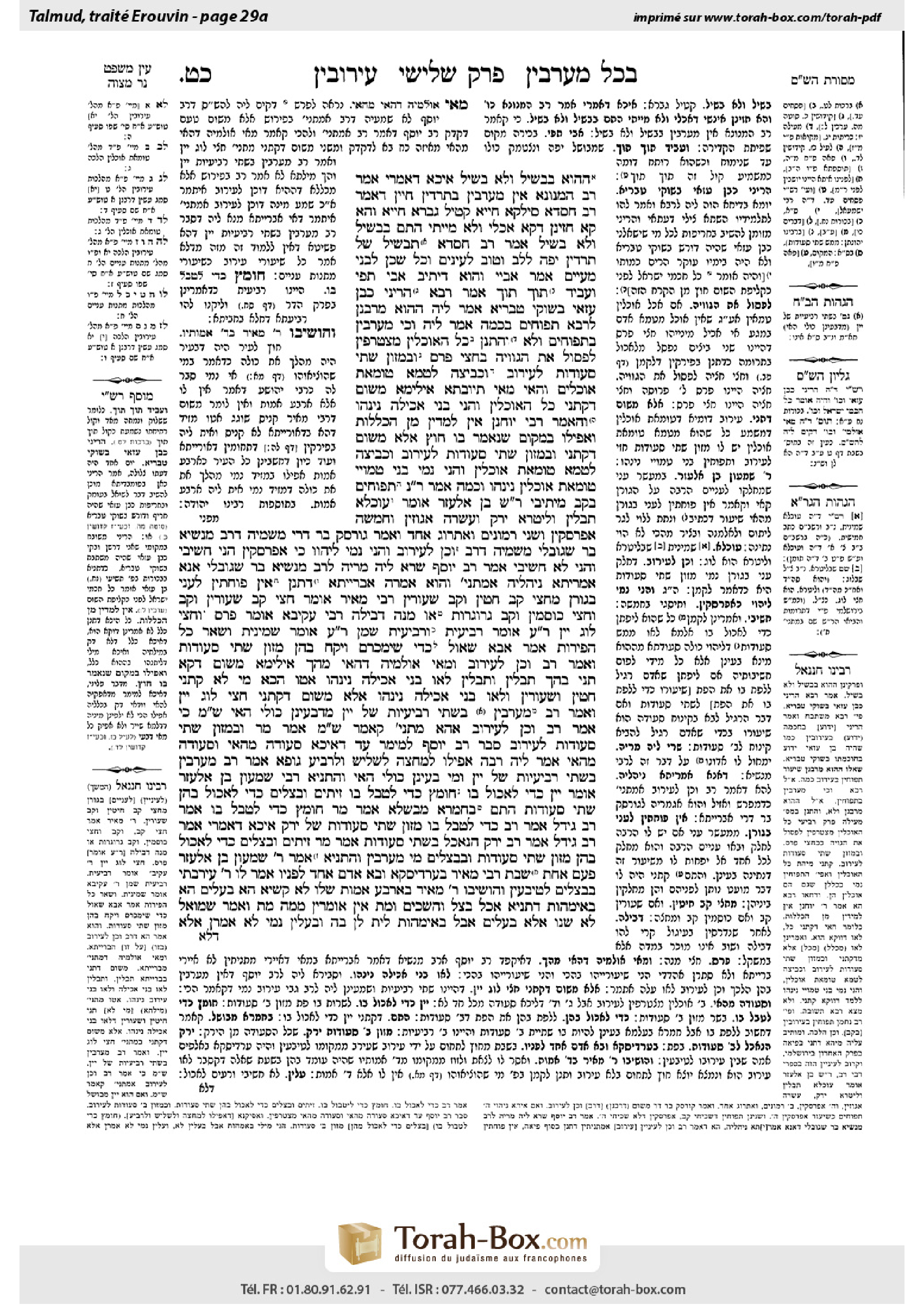
Eruvin 29a: Talmud study for Daf Yomi
Study the Talmud for Daf Yomi with scanned pages, Hebrew text, English translations from Sefaria and AI-generated French translations.
Passage selection and English or AI-generated French translation are available where the scan has annotations. Daf Study is independent of Torah-Box and Sefaria.
Browse Eruvin · עירובין · All tractatesEruvin 29a text and translations
This page of Eruvin includes the Aramaic text, an English translation and an AI-generated French translation, alongside the scan above.
עירובין כ״ט א · Aramaic and Hebrew text
הָהוּא, בִּבְשִׁיל וְלָא בְּשִׁיל.
אִיכָּא דְּאָמְרִי, אָמַר רַב הַמְנוּנָא: אֵין מְעָרְבִין בִּתְרָדִין חַיִּין, דְּאָמַר רַב חִסְדָּא: סִילְקָא חַיָּיא קָטֵיל גַּבְרָא חַיָּיא. וְהָא קָא חָזֵינַן דְּקָא אָכְלִי וְלָא מָיְיתִי? הָתָם בִּבְשִׁיל וְלָא בְּשִׁיל.
אָמַר רַב חִסְדָּא: תַּבְשִׁיל שֶׁל תְּרָדִין יָפֶה לַלֵּב וְטוֹב לָעֵינַיִם, וְכׇל שֶׁכֵּן לִבְנֵי מֵעַיִים. אָמַר אַבָּיֵי: וְהוּא דְּיָתֵיב אַבֵּי תָפֵי וְעָבֵיד תּוֹךְ תּוֹךְ.
אָמַר רָבָא: הֲרֵינִי כְּבֶן עַזַּאי בְּשׁוּקֵי טְבֶרְיָא. אֲמַר לֵיהּ הָהוּא מֵרַבָּנַן לְרָבָא: תַּפּוּחִים בְּכַמָּה? אֲמַר לֵיהּ: וְכִי מְעָרְבִין בְּתַפּוּחִים?
וְלָא? וְהָתְנַן: כׇּל הָאוֹכָלִין מִצְטָרְפִין לִפְסוֹל אֶת הַגְּוִויָּה בַּחֲצִי פְרָס, וּבִמְזוֹן שְׁתֵּי סְעוּדוֹת לְעֵירוּב, וּכְבֵיצָה לְטַמֵּא טוּמְאַת אוֹכָלִים!
וְהַאי מַאי תְּיוּבְתָּא? אִילֵּימָא מִשּׁוּם דְּקָתָנֵי ״כׇּל הָאוֹכָלִין״, וְהָנֵי בְּנֵי אֲכִילָה נִינְהוּ — וְהָאָמַר רַבִּי יוֹחָנָן: אֵין לְמֵדִין מִן הַכְּלָלוֹת וַאֲפִילּוּ בִּמְקוֹם שֶׁנֶּאֱמַר בּוֹ ״חוּץ״!
אֶלָּא מִשּׁוּם דְּקָתָנֵי ״וּבִמְזוֹן שְׁתֵּי סְעוּדוֹת לְעֵירוּב וּכְבֵיצָה לְטַמֵּא טוּמְאַת אוֹכָלִין״. וְהָנֵי נָמֵי בְּנֵי טַמּוֹיֵי טוּמְאַת אוֹכָלִין נִינְהוּ.
וְכַמָּה? אָמַר רַב נַחְמָן: תַּפּוּחִים בְּקַב.
מֵיתִיבִי, רַבִּי שִׁמְעוֹן בֶּן אֶלְעָזָר אוֹמֵר: עוּכְלָא תַּבְלִין, וְלִיטְרָא יָרָק, וַעֲשָׂרָה אֱגוֹזִין, וַחֲמִשָּׁה אֲפַרְסְקִין, וּשְׁנֵי רִמּוֹנִים, וְאֶתְרוֹג אֶחָד. וְאָמַר גּוּרְסַק בַּר דָּרֵי מִשְּׁמֵיהּ דְּרַב מְנַשְּׁיָא בַּר שְׂגוּבְלִי מִשְּׁמֵיהּ דְּרַב, וְכֵן לְעֵירוּב. וְהָנֵי נָמֵי לִיהְווֹ כִּי אֲפַרְסְקִין!
הָנֵי חֲשִׁיבִי, וְהָנֵי לָא חֲשִׁיבִי.
אָמַר רַב יוֹסֵף: שְׁרָא לֵיהּ מָרֵיהּ לְרַב מְנַשְּׁיָא בַּר שְׂגוּבְלִי, אֲנָא אַמְרִיתָא נִיהֲלֵיהּ אַמַּתְנִיתִין, וְהוּא אַמְרַהּ אַבָּרַיְיתָא. דִּתְנַן: אֵין פּוֹחֲתִין לְעָנִי בַּגּוֹרֶן מֵחֲצִי קַב חִטִּין וְקַב שְׂעוֹרִין. רַבִּי מֵאִיר אוֹמֵר: חֲצִי קַב שְׂעוֹרִין. וְקַב וַחֲצִי כוּסְּמִין, וְקַב גְּרוֹגְרוֹת אוֹ מָנֶה דְּבֵילָה. רַבִּי עֲקִיבָא אוֹמֵר: פְּרָס. וַחֲצִי לוֹג יַיִן, רַבִּי עֲקִיבָא אוֹמֵר: רְבִיעִית. וּרְבִיעִית שֶׁמֶן, רַבִּי עֲקִיבָא אוֹמֵר: שְׁמִינִית. וּשְׁאָר כׇּל הַפֵּירוֹת, אָמַר אַבָּא שָׁאוּל: כְּדֵי שֶׁיִּמְכְּרֵם וְיִקַּח בָּהֶן מְזוֹן שְׁתֵּי סְעוּדוֹת. וְאָמַר רַב: וְכֵן לְעֵירוּב.
וּמַאי אוּלְמֵיהּ דְּהַאי מֵהָךְ? אִילֵּימָא מִשּׁוּם דְּקָא תָּנֵי בְּהָךְ תַּבְלִין, וְתַבְלִין לָאו בְּנֵי אֲכִילָה נִינְהוּ — אַטּוּ הָכָא מִי לָא קָתָנֵי חִטִּין וּשְׂעוֹרִין, וְלָאו בְּנֵי אֲכִילָה נִינְהוּ!
אֶלָּא מִשּׁוּם דְּקָתָנֵי חֲצִי לוֹג יַיִן, וְאָמַר רַב: מְעָרְבִין בִּשְׁתֵּי רְבִיעִיּוֹת שֶׁל יַיִן. מִדְּבָעִינַן כּוּלֵּי הַאי — שְׁמַע מִינַּהּ כִּי אָמַר רַב ״וְכֵן לְעֵירוּב״ — אַהָא מַתְנִיתִין קָאָמַר. שְׁמַע מִינַּהּ.
אָמַר מָר: וּבִמְזוֹן שְׁתֵּי סְעוּדוֹת לְעֵירוּב. סָבַר רַב יוֹסֵף לְמֵימַר: עַד דְּאִיכָּא סְעוּדָה מֵהַאי וּסְעוּדָה מֵהַאי. אֲמַר לֵיהּ רַבָּה: אֲפִילּוּ לְמֶחֱצָה לִשְׁלִישׁ וְלִרְבִיעַ.
גּוּפָא, אָמַר רַב: מְעָרְבִין בִּשְׁתֵּי רְבִיעִיּוֹת שֶׁל יַיִן. וּמִי בָּעִינַן כּוּלֵּי הַאי? וְהָתַנְיָא, רַבִּי שִׁמְעוֹן בֶּן אֶלְעָזָר אוֹמֵר: יַיִן כְּדֵי לֶאֱכוֹל בּוֹ, חוֹמֶץ כְּדֵי לְטַבֵּל בּוֹ, זֵיתִים וּבְצָלִים כְּדֵי לֶאֱכוֹל בָּהֶן שְׁתֵּי סְעוּדוֹת?
הָתָם בְּחַמְרָא מְבַשְּׁלָא.
אָמַר מָר: חוֹמֶץ כְּדֵי לְטַבֵּל בּוֹ. אָמַר רַב גִּידֵּל אָמַר רַב: כְּדֵי לְטַבֵּל בּוֹ מְזוֹן שְׁתֵּי סְעוּדוֹת שֶׁל יָרָק. אִיכָּא דְּאָמְרִי, אָמַר רַב גִּידֵּל אָמַר רַב: יָרָק הַנֶּאֱכָל בִּשְׁתֵּי סְעוּדוֹת.
אָמַר מָר: זֵיתִים וּבְצָלִים כְּדֵי לֶאֱכוֹל בָּהֶן מְזוֹן שְׁתֵּי סְעוּדוֹת. וּבִבְצָלִים מִי מְעָרְבִין? וְהָתַנְיָא: אָמַר רַבִּי שִׁמְעוֹן בֶּן אֶלְעָזָר: פַּעַם אַחַת שָׁבַת רַבִּי מֵאִיר בְּעַרְדִּיסְקָא, וּבָא אָדָם אֶחָד לְפָנָיו, אָמַר לוֹ: רַבִּי, עֵירַבְתִּי בִּבְצָלִים לְטִיבְעִין, וְהוֹשִׁיבוֹ רַבִּי מֵאִיר בְּאַרְבַּע אַמּוֹת שֶׁלּוֹ.
לָא קַשְׁיָא: הָא בְּעָלִים, הָא בְּאִימָּהוֹת. דְּתַנְיָא: אָכַל בָּצָל וְהִשְׁכִּים וּמֵת, אֵין אוֹמְרִין מִמָּה מֵת. וְאָמַר שְׁמוּאֵל: לֹא שָׁנוּ אֶלָּא בֶּעָלִים, אֲבָל בְּאִימָּהוֹת — לֵית לַן בַּהּ. וּבְעָלִין נָמֵי לָא אֲמַרַן אֶלָּא
Eruvin 29a · English translation
The Gemara answers: That is referring to a beet that was only partially cooked, which is dangerous.
There are some who say that Rav Hamnuna said: One may not establish an eiruv with raw beets, as Rav Ḥisda said: Raw beet kills a healthy person. The Gemara asks: Don’t we see people eating it and they do not die? The Gemara answers: There, it is referring to a beet that was only partially cooked, which is dangerous.
Rav Ḥisda said: A cooked dish of beets is beneficial for the heart, good for the eyes, and all the more so beneficial for the intestines. Abaye said: That is specifically when the dish sits on the stove and makes a tukh tukh sound, i.e., it is cooked thoroughly enough to produce a boiling sound.
Rava once said when he was in an especially good mood: Behold, I am like the intellectually sharp ben Azzai, who would regularly expound in the markets of Tiberias. I, too, am ready to answer any question posed to me. One of the Sages said to Rava: How many apples are needed to establish an eiruv? Rava said to him: Does one establish an eiruv with apples?
The other Sage responded: And is it not permissible to establish an eiruv with them? Didn’t we learn in a mishna: All foods combine to disqualify the body of a priest who eats half of a half-loaf of ritually impure food, and to complete the measure of food required for two meals for the purpose of an eiruv, and to complete the measure of an egg-bulk required for a food to be able to contract the ritual impurity of foods? An apple is a kind of food, so it should be included in the items that may be used to establish an eiruv.
The Gemara asks: And what is the refutation? If you say it is because it was taught using the term all foods, and these apples are fit for eating, how can an objection be raised from such a general term? Didn’t Rabbi Yoḥanan already say: One may not learn from general statements using the word all, even in a place where it says except, since no rule exhausts all cases?
Rather, it is because it taught: And all foods combine to complete the measure of food required for two meals for the purpose of an eiruv, and to complete the measure of an egg-bulk to contract the ritual impurity of foods; and these apples are also susceptible to the ritual impurity of foods. Therefore, there is clear proof that the mishna is referring to apples as well.
Having established that an eiruv may be established with apples, the Gemara returns to the question raised above: How many apples are needed to establish an eiruv? Rav Naḥman said: The minimum measure of apples that must be used for an eiruv is a kav.
The Gemara raises an objection from a baraita: Rabbi Shimon ben Elazar says: When distributing poor man’s tithe, one must give each individual poor person at least an ukla, an eighth of a log, of spices, a liter of vegetables, ten nuts, five peaches, two pomegranates, or one citron, as these are worthy amounts for distribution. And Gursak bar Darei said in the name of Rav Menashya bar Sheguvlei, who said in the name of Rav: And similarly, this is the halakha with regard to an eiruv. Now, it can be asked: These apples should also be like peaches, as they are similar in size, and it should be enough to use five apples for an eiruv.
The Gemara answers that there is a distinction between them: These peaches are important, and therefore five of them are a significant amount, but these apples are not important, and therefore one must use the larger measure of a kav.
Rav Yosef said: May his Master, God, forgive Rav Menashya bar Sheguvlei, for he erred and caused others to err. I stated before him a ruling in the name of Rav concerning a mishna, and he stated it concerning the baraita, which led to the error. As we learned in a mishna: One may not give a pauper receiving poor man’s tithe at the threshing floor less than half a kav of wheat or less than a kav of barley. Rabbi Meir says: He must be given at least half a kav of barley. Similarly, he must be given no less than a kav and a half of spelt, a kav of dried figs, or a maneh of pressed figs. Rabbi Akiva says: Not a maneh, but half a maneh. He must be given at least half a log of wine. Rabbi Akiva says: Half that amount, a quarter log. And similarly, he must be given a quarter log of oil. Rabbi Akiva says: Half that amount, an eighth of a log. And with regard to all other fruit, Abba Shaul said: He must be given enough to sell them and buy food that suffices for two meals with the proceeds of their sale. And with regard to this mishna, Rav said: And similarly, this is the halakha with regard to an eiruv.
The Gemara poses a question with regard to Rav Yosef’s harsh reaction to Rav Menashya bar Sheguvlei’s statement: What is the strength of this over that? The mishna and baraita seem to share the same content, so why should Rav’s ruling be more applicable to one than the other? If you say it is because the halakha with regard to spices was also taught in this baraita, and spices are not fit for eating on their own but only when added as a flavoring to other foods, and therefore Rav could not have been referring to the baraita when he said that the same law applies to an eiruv; wasn’t the halakha with regard to wheat and barley taught here in the mishna, and they too are not immediately fit for eating until they are processed further.
Rather, it is because it was taught in the mishna that one must give half a log of wine. And Rav said: One may establish an eiruv with two-quarters of a log of wine, which is equal to half a log. Since we require so much wine, learn from here that when Rav said: And similarly, this is the halakha with regard to an eiruv, he said it about this mishna and the measures mentioned therein. The Gemara concludes: Indeed, conclude from this that this is the proper understanding of Rav’s statement.
The Gemara further examines the mishna cited earlier. The Master said: And all foods combine to complete the measure of food required for two meals for the purpose of an eiruv. Rav Yosef thought to say that an eiruv may not be established unless there is a complete meal of this kind of food and a complete meal of that kind of food, meaning that an eiruv may only be established if each meal consists of a single type of food. Rabba said to him: An eiruv may be established with the amount of food required for two meals even if each type of food made up only half, a third, or a quarter of a meal.
The Gemara now examines Rav’s statement itself, which was cited in the course of the previous discussion. Rav said: One may establish an eiruv with two-quarters of a log of wine. The following question may be raised: Do we really need so much? Wasn’t it taught in a baraita that Rabbi Shimon ben Elazar says: The minimal amount of wine required for an eiruv is enough to eat bread with it, i.e., enough to soak the bread in to enable one to eat it? Additionally, the minimal amount of vinegar that may be used to establish an eiruv is enough to dip the food in it, and the minimal amount of olives and onions is enough to eat them together with the bread. All of these quantities are calculated on the basis of two meals. This baraita clearly indicates that an eiruv may be established with much less than two-quarters of a log of wine.
The Gemara answers: There, the baraita is referring to cooked wine, which is very strong, and therefore even a small amount suffices.
The Master said in the baraita that the minimal amount of vinegar that may be used for an eiruv is enough to dip food in it. Rav Giddel said that Rav said: Enough to dip in it the food of two meals consisting of vegetables. Some say that Rav Giddel said that Rav said: Enough to dip in it the vegetables that are eaten in two ordinary meals, which is less than the amount consumed in two meals consisting entirely of vegetables.
The Master also said that the minimum measure of olives and onions that may be used for an eiruv is enough to eat them with the food of two meals. The Gemara asks: May one establish an eiruv with onions? Wasn’t it taught in a baraita that Rabbi Shimon ben Elazar said: Rabbi Meir once spent Shabbat in the town of Ardiska, and a certain person came before him and said to him: Rabbi, I made an eiruv of Shabbat borders [eiruv teḥumin] with onions, so that I might walk to the town of Tiv’in. Ardiska was located between the man’s eiruv and his destination of Tiv’in, which was beyond his Shabbat limit as measured from his hometown. And Rabbi Meir made him remain within his four cubits. He forbade him to leave his four cubits, as he held that an eiruv made with onions is not an eiruv, and therefore the person had left his Shabbat limit without an eiruv teḥumin.
The Gemara answers: This is not difficult. This ruling, which states that onions may not be used for an eiruv, is referring to onion leaves, which are harmful; whereas that ruling, which states that onions may be used for an eiruv, is referring to onion bulbs, which are edible. As it was taught in a baraita: If one ate an onion and died early the next morning, we need not ask from what he died, as his death was certainly caused by the onion. And Shmuel said: They only taught this with regard to the leaves; but with regard to onion bulbs, we have no problem with it. And even with regard to the leaves, we only stated this concern
Eruvin 29a · Traduction française (IA)
Le Guemara répond : Cela fait référence à une betterave qui n'était que partiellement cuite, ce qui est dangereux.
Certains disent que Rav Hamnuna a dit : On ne peut pas établir un eiruv avec des betteraves crues, car Rav Ḥisda a dit : La betterave crue tue un homme sain. Le Guemara demande : Ne voyons-nous pas des gens qui mangent cela et ne meurent pas ? Le Guemara répond : Là, il s'agit d'une betterave qui n'était que partiellement cuite, ce qui est dangereux.
Rav Ḥisda a dit : Une préparation cuite de betteraves est bénéfique pour le cœur, bonne pour les yeux, et encore plus bénéfique pour les intestins. Abaye a dit : Cela fait référence spécifiquement à une préparation qui est sur le feu et produit un bruit de tukh tukh, c'est-à-dire qu'elle est cuite suffisamment pour produire un bruit de bouillonnement.
Rava a un jour dit, lorsqu'il était dans un bon état d'esprit : Regardez, je suis comme ben Azzai, le sage intelligent, qui exposait régulièrement dans les marchés de Tébérija. Moi aussi, je suis prêt à répondre à toute question posée à mon sujet. Un des Sages a dit à Rava : Combien de pommes faut-il pour établir un eiruv ? Rava a répondu à celui-ci : Est-ce qu'on établit un eiruv avec des pommes ?
L'autre Sage a répondu : Et n'est-ce pas permis d'établir un eiruv avec elles ? N'avons-nous pas appris dans une mitsna : Tous les aliments combinés disqualifient le corps d'un prêtre qui mange la moitié d'une demi-boule de nourriture impure, et permettent de compléter la mesure de nourriture nécessaire pour deux repas dans le but d'un eiruv, et de compléter la mesure d'un œuf pour que la nourriture puisse contracter l'impureté rituelle ? Une pomme est un type d'aliment, donc elle devrait être incluse dans les éléments qui peuvent être utilisés pour établir un eiruv.
Le Guemara demande : Et quelle est la réfutation ? Si vous dites que c'est parce qu'il a été dit avec le terme « tous les aliments », et que ces pommes sont comestibles, comment peut-on élever un objet d'objection à partir d'un terme général ? N'a-t-on pas déjà dit Rabbi Yoḥanan : On ne peut pas apprendre à partir d'affirmations générales utilisant le mot « tous », même dans un lieu où il dit « sauf », car aucune règle ne couvre tous les cas ?
Plutôt, c'est parce qu'il a dit : « Et tous les aliments combinés permettent de compléter la mesure de nourriture nécessaire pour deux repas dans le but d'un eiruv, et de compléter la mesure d'un œuf pour que la nourriture puisse contracter l'impureté rituelle » ; et ces pommes sont également sujets à l'impureté rituelle des aliments. Ainsi, il y a une preuve claire que la mitsna fait référence aux pommes également.
Ayant établi que l'eiruv peut être établi avec des pommes, le Guemara retourne à la question soulevée ci-dessus : Combien de pommes faut-il pour établir un eiruv ? Rav Naḥman a dit : La mesure minimale de pommes nécessaire pour un eiruv est un kav.
Le Guemara soulève un objet à partir d'une baraïta : Rabbi Shimon ben Elazar dit : Lors de la distribution de la tithe des pauvres, on doit donner à chaque personne pauvre au moins un ukla, c'est-à-dire un huitième d'un log, de épices, un litre de légumes, dix noix, cinq pêches, deux grenades, ou un citron, car ces quantités sont dignes d'être distribuées. Et Gursak bar Darei a dit en nom de Rav Menashya bar Sheguvlei, qui a dit en nom de Rav : Et de même, c'est la halakha concernant l'eiruv. Maintenant, on peut demander : Ces pommes devraient être comme les pêches, car elles sont semblables en taille, et il devrait suffire d'utiliser cinq pommes pour un eiruv.
Le Guemara répond que cela repose sur une distinction entre eux : Ces pêches sont importantes, donc cinq d'entre elles constituent une quantité significative, mais ces pommes ne sont pas importantes, donc on doit utiliser la mesure plus grande d'un kav.
Rav Yosef a dit : Que Dieu, son Maître, pardonne Rav Menashya bar Sheguvlei, car il s'est trompé et a causé aux autres de s'écarter. J'avais auparavant exposé une décision en nom de Rav concernant une mitsva, et il l'a exposée concernant la baraïta, ce qui a causé l'erreur. Comme nous avons appris dans une mitsna : On ne doit pas donner à un pauvre qui reçoit la tithe des pauvres à la meule de blé moins qu'une demi-kav de blé ou moins qu'un kav de seigle. Rabbi Meir dit : Il doit être donné au moins une demi-kav de seigle. De même, il doit être donné au moins un kav et demi de blé, un kav de figues sèches, ou un maneh de figues pressées. Rabbi Akiva dit : Pas un maneh, mais une demi-maneh. Il doit être donné au moins une demi-log de vin. Rabbi Akiva dit : Moitié de cette quantité, un quart de log. De même, il doit être donné un quart de log d'huile. Rabbi Akiva dit : Moitié de cette quantité, un huitième de log. Et concernant tous les autres fruits, Abba Shaul a dit : Il doit être donné suffisamment pour les vendre et acheter de la nourriture suffisante pour deux repas avec les revenus de leur vente. Et concernant cette mitsna, Rav a dit : Et de même, c'est la halakha concernant l'eiruv.
Le Guemara pose une question concernant la réaction sévère de Rav Yosef à l'affirmation de Rav Menashya bar Sheguvlei : Quelle est la force de cela par rapport à cela ? La mitsna et la baraïta semblent partager le même contenu, donc pourquoi la décision de Rav devrait-elle être plus applicable à l'une qu'à l'autre ? Si vous dites que c'est parce que la halakha concernant les épices a également été enseignée dans cette baraïta, et que les épices ne sont pas comestibles en eux-mêmes mais seulement en tant que condiments ajoutés à d'autres aliments, et donc Rav ne pouvait pas avoir fait référence à la baraïta lorsqu'il a dit que la même loi s'applique à l'eiruv ; n'était-ce pas la halakha concernant le blé et le seigle enseignée ici dans la mitsna, et ces derniers ne sont pas immédiatement comestibles jusqu'à ce qu'ils soient traités davantage.
Plutôt, c'est parce qu'il a été enseigné dans la mitsna que l'on doit donner un demi-log de vin. Et Rav a dit : On peut établir un eiruv avec deux-quarts de log de vin, ce qui équivaut à un demi-log. Puisque nous exigeons tant de vin, apprenez-en ici que lorsque Rav a dit : Et de même, c'est la halakha concernant l'eiruv, il faisait référence à cette mitsna et aux mesures mentionnées dedans. Le Guemara conclut : En effet, concluez-en de cela que c'est la bonne compréhension de l'affirmation de Rav.
La Guemara examine davantage la Michna citée plus haut. Le Maître dit : Et toutes les aliments combinés permettent d'atteindre la mesure de nourriture nécessaire pour deux repas, afin d'établir un eiruv. Rav Yosef pensait dire qu'un eiruv ne peut être établi qu'à condition qu'il y ait un repas complet de ce type de nourriture et un repas complet de ce type de nourriture, c'est-à-dire qu'un eiruv ne peut être établi que si chaque repas est composé d'un seul type de nourriture. Rabba lui répondit : On peut établir un eiruv avec la quantité de nourriture nécessaire pour deux repas, même si chaque type de nourriture ne représente que la moitié, le tiers ou le quart d'un repas.
La Guemara examine maintenant l'affirmation de Rav elle-même, qui avait été citée lors de la discussion précédente. Rav dit : On peut établir un eiruv avec deux quarts de log de vin. La question suivante peut être posée : N'avons-nous vraiment besoin de si peu ? N'avait-il pas été enseigné dans une baraïta que Rabbi Shim'on ben Elazar dit : La quantité minimale de vin nécessaire pour un eiruv est suffisante pour manger du pain avec, c'est-à-dire suffisante pour imbibir le pain afin de pouvoir le manger. De même, la quantité minimale de vinaigre utilisable pour établir un eiruv est suffisante pour tremper la nourriture dedans, et la quantité minimale d'olives et d'oignons est suffisante pour les manger avec le pain. Toutes ces quantités sont calculées sur la base de deux repas. Cette baraïta indique clairement qu'un eiruv peut être établi avec bien moins de deux quarts de log de vin.
La Guemara répond : Là, la baraïta fait référence au vin cuit, qui est très fort, et donc même une petite quantité suffit.
Le Maître dit dans la baraïta que la quantité minimale de vinaigre utilisable pour un eiruv est suffisante pour tremper la nourriture dedans. Rav Giddel dit que Rav dit : Suffisante pour tremper la nourriture de deux repas composés de légumes. Certains disent que Rav Giddel dit que Rav dit : Suffisante pour tremper les légumes qui sont mangés dans deux repas ordinaires, ce qui est moins que la quantité consommée dans deux repas composés uniquement de légumes.
Le Maître a aussi dit que la mesure minimale d'oignons et d'olives utilisable pour un eiruv est suffisante pour les manger avec la nourriture de deux repas. La Guemara pose la question : Peut-on établir un eiruv avec des oignons ? N'avait-il pas été enseigné dans une baraïta que Rabbi Shim'on ben Elazar dit : Rabbi Meir a passé le Shabbat dans la ville d'Ardiska, et un certain homme est venu le voir et lui a dit : Rabbi, j'ai établi un eiruv des limites du Shabbat [eiruv teḥumin] avec des oignons, afin de pouvoir marcher vers la ville de Tiv'in. Ardiska était située entre la maison de l'homme et sa destination de Tiv'in, qui était au-delà de son limites du Shabbat mesurée depuis sa ville natale. Et Rabbi Meir a fait rester l'homme dans ses quatre coudées. Il l'a interdit de sortir de ses quatre coudées, car il considérait qu'un eiruv établi avec des oignons n'était pas un eiruv, et donc l'homme avait quitté sa limite du Shabbat sans eiruv teḥumin.
La Guemara répond : Ce n'est pas difficile. Cette décision, qui affirme que les oignons ne peuvent pas être utilisés pour un eiruv, fait référence aux feuilles d'oignons, qui sont nuisibles ; tandis que celle qui affirme que les oignons peuvent être utilisés pour un eiruv fait référence aux bulbilles d'oignons, qui sont comestibles. Comme il a été enseigné dans une baraïta : Si l'on mange un oignon et meurt tôt le lendemain matin, nous n'avons pas besoin de savoir de quoi il est mort, car sa mort a certainement été causée par l'oignon. Et Shmuel dit : Ils ont enseigné cela uniquement concernant les feuilles ; mais concernant les bulbilles d'oignons, nous n'avons pas de problème. Et même concernant les feuilles, nous n'avons exprimé cette préoccupation que
Traduction française générée par IA à partir de l’édition anglaise de Sefaria. Vérifie toujours un passage avec le texte source.
Text from Sefaria: William Davidson Edition - Vocalized Aramaic (CC BY NC); William Davidson Edition - English (CC BY NC).