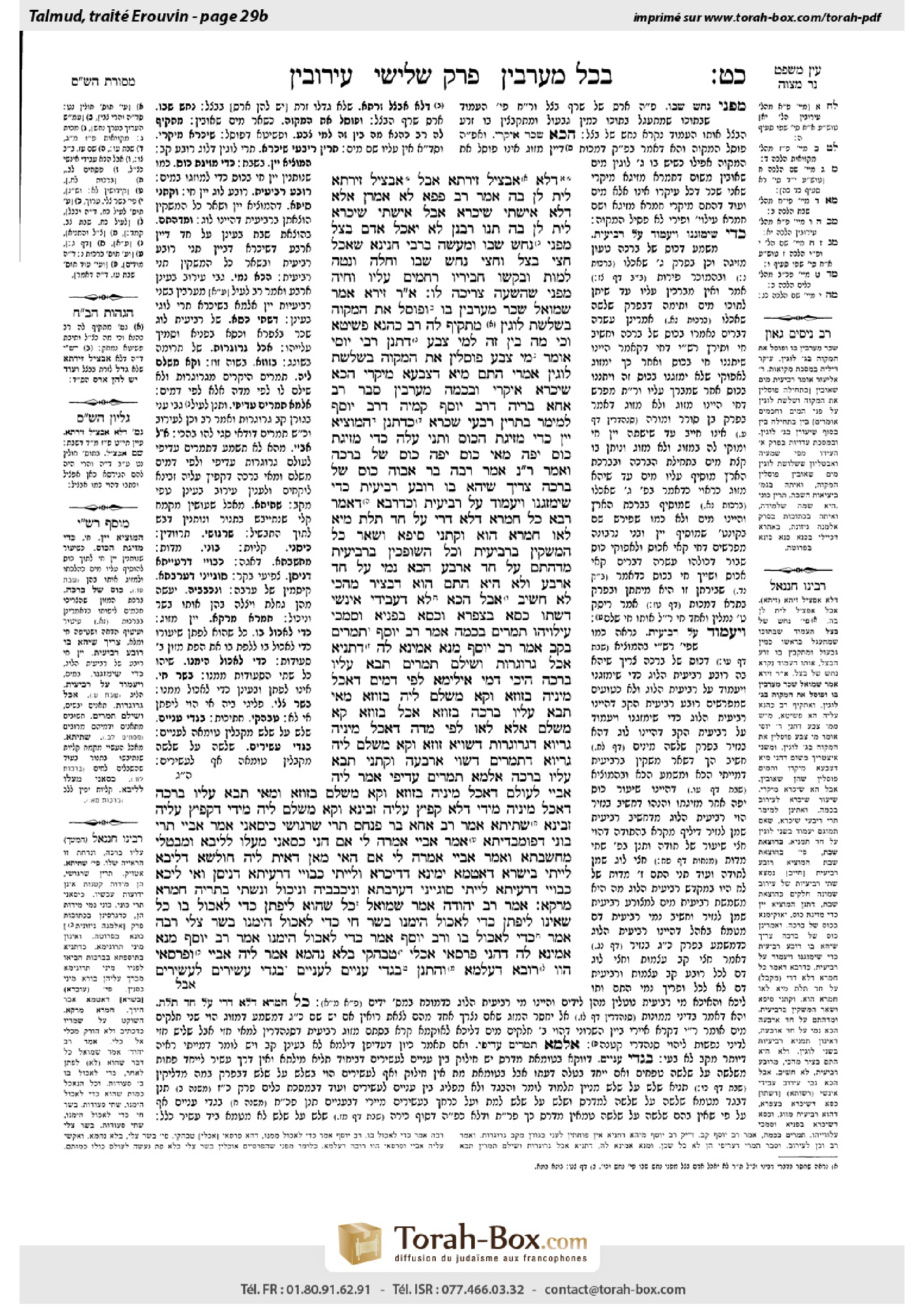
Eruvin 29b: Talmud study for Daf Yomi
Study the Talmud for Daf Yomi with scanned pages, Hebrew text, English translations from Sefaria and AI-generated French translations.
Passage selection and English or AI-generated French translation are available where the scan has annotations. Daf Study is independent of Torah-Box and Sefaria.
Browse Eruvin · עירובין · All tractatesEruvin 29b text and translations
This page of Eruvin includes the Aramaic text, an English translation and an AI-generated French translation, alongside the scan above.
עירובין כ״ט ב · Aramaic and Hebrew text
דְּלָא אִבְּצִיל זִירְתָּא, אֲבָל אִבְּצִיל זִירְתָּא — לֵית לַן בַּהּ.
אָמַר רַב פָּפָּא: לָא אֲמַרַן אֶלָּא דְּלָא אִישְׁתִּי שִׁיכְרָא, אֲבָל אִישְׁתִּי שִׁיכְרָא לֵית לַן בַּהּ.
תָּנוּ רַבָּנַן: לֹא יֹאכַל אָדָם בָּצָל, מִפְּנֵי נָחָשׁ שֶׁבּוֹ. וּמַעֲשֶׂה בְּרַבִּי חֲנִינָא שֶׁאָכַל חֲצִי בָצָל וַחֲצִי נָחָשׁ שֶׁבּוֹ וְחָלָה וְנָטָה לָמוּת, וּבִקְּשׁוּ חֲבֵירָיו רַחֲמִים עָלָיו וְחָיָה, מִפְּנֵי שֶׁהַשָּׁעָה צְרִיכָה לוֹ.
אָמַר רַבִּי זֵירָא אָמַר שְׁמוּאֵל: שֵׁכָר מְעָרְבִין בּוֹ, וּפוֹסֵל אֶת הַמִּקְוֶה בִּשְׁלֹשֶׁת לוּגִּין. מַתְקֵיף לַהּ רַב כָּהֲנָא: פְּשִׁיטָא, וְכִי מָה בֵּין זֶה לְמֵי צֶבַע? דִּתְנַן: רַבִּי יוֹסֵי אוֹמֵר: מֵי צֶבַע פּוֹסְלִין אֶת הַמִּקְוֶה בִּשְׁלֹשֶׁת לוּגִּין. אָמְרִי: הָתָם מַיָּא דְצִבְעָא מִיקְּרֵי, הָכָא שִׁיכְרָא אִיקְּרִי.
וּבְכַמָּה מְעָרְבִין? סָבַר רַב אַחָא בְּרֵיהּ דְּרַב יוֹסֵף קַמֵּיהּ דְּרַב יוֹסֵף לְמֵימַר: בִּתְרֵין רִבְעֵי שִׁכְרָא, כְּדִתְנַן: הַמּוֹצִיא יַיִן, כְּדֵי מְזִיגַת הַכּוֹס. וְתָנֵי עֲלַהּ: כְּדֵי מְזִיגַת כּוֹס יָפֶה. מַאי כּוֹס יָפֶה? כּוֹס שֶׁל בְּרָכָה. וְאָמַר רַב נַחְמָן אָמַר רַבָּה בַּר אֲבוּהּ: כּוֹס שֶׁל בְּרָכָה צָרִיךְ שֶׁיְּהֵא בּוֹ רוֹבַע רְבִיעִית, כְּדֵי שֶׁיִּמְזְגֶנּוּ וְיַעֲמוֹד עַל רְבִיעִית. וְכִדְרָבָא, דְּאָמַר רָבָא: כֹּל חַמְרָא דְּלָא דָּרֵי עַל חַד תְּלָת מַיָּא — לָאו חַמְרָא הוּא.
וְקָתָנֵי סֵיפָא: וּשְׁאָר כׇּל הַמַּשְׁקִין בִּרְבִיעִית, וְכׇל הַשּׁוֹפְכִין בִּרְבִיעִית. מִדְּהָתָם עַל חַד אַרְבַּע — הָכָא נָמֵי עַל חַד אַרְבַּע.
וְלָא הִיא, הָתָם הוּא דִּבְצִיר מֵהֲכִי לָא חֲשִׁיב, אֲבָל הָכָא — לָא. דַּעֲבִידִי אִינָשֵׁי דְּשָׁתוּ כָּסָא בְּצַפְרָא וְכָסָא בְּפַנְיָא, וְסָמְכִי עִילָּוַיְהוּ.
תְּמָרִים בְּכַמָּה? אָמַר רַב יוֹסֵף: תְּמָרִים בְּקַב. אָמַר רַב יוֹסֵף: מְנָא אָמֵינָא לַהּ? דְּתַנְיָא: אָכַל גְּרוֹגְרוֹת וְשִׁילֵּם תְּמָרִים — תָּבוֹא עָלָיו בְּרָכָה.
הֵיכִי דָמֵי? אִילֵּימָא לְפִי דָמִים, דַּאֲכַל מִינֵּיהּ בְּזוּזָא וְקָא מְשַׁלֵּם לֵיהּ בְּזוּזָא — מַאי ״תָּבֹא עָלָיו בְּרָכָה״? בְּזוּזָא אֲכַל, בְּזוּזָא קָא מְשַׁלֵּם! אֶלָּא לָאו, לְפִי מִדָּה, דַּאֲכַל מִינֵּיהּ גְּרִיוָא דִּגְרוֹגְרוֹת דְּשָׁוְיָא זוּזָא, וְקָא מְשַׁלֵּם לֵיהּ גְּרִיוָא דִתְמָרִים דְּשָׁוֵי אַרְבְּעָה — וְקָתָנֵי: ״תָּבֹא עָלָיו בְּרָכָה״, אַלְמָא: תְּמָרִים עֲדִיפִי.
אֲמַר לֵיהּ אַבָּיֵי: לְעוֹלָם דַּאֲכַל מִינֵּיהּ בְּזוּזָא, וְקָא מְשַׁלֵּם בְּזוּזָא. וּמַאי ״תָּבֹא עָלָיו בְּרָכָה״? דַּאֲכַל מִינֵּיהּ מִידֵּי דְּלָא קָפֵיץ עֲלֵיהּ זָבֵינָא, וְקָא מְשַׁלֵּם לֵיהּ מִידֵּי דְּקָפֵיץ עֲלֵיהּ זָבֵינָא.
שְׁתִיתָא — אָמַר רַב אַחָא בַּר פִּנְחָס: תְּרֵי שַׁרְגּוּשֵׁי. כִּיסָאנֵי — אָמַר אַבָּיֵי: תְּרֵי בוּנֵי דְּפוּמְבְּדִיתָא.
אָמַר אַבָּיֵי, אֲמַרָה לִי אֵם: הָנֵי כִּסָאנֵי מְעַלּוּ לְלִיבָּא, וּמְבַטְּלִי מַחְשְׁבָתָא.
וְאָמַר אַבָּיֵי, אֲמַרָה לִי אֵם: הַאי מַאן דְּאִית לֵיהּ חוּלְשָׁא דְּלִיבָּא, לַיְיתֵי בִּישְׂרָא דְּאַטְמָא יַמִּינָא דְּדִיכְרָא, וְלַיְיתֵי כַּבּוּיֵי דְרֵעִיתָא דְּנִיסָן, וְאִי לֵיכָּא כַּבּוּיֵי דְרֵעִיתָא — לַיְיתֵי סוּגְיָינֵי דַעֲרַבְתָּא, וְנִיכַבְּבֵיהּ וְנֵיכוּל, וְנִשְׁתֵּי בָּתְרֵיהּ חַמְרָא מַרְקָא.
אָמַר רַב יְהוּדָה אָמַר שְׁמוּאֵל: כׇּל שֶׁהוּא לִיפְתָּן, כְּדֵי לֶאֱכוֹל בּוֹ. כֹּל שֶׁאֵינוֹ לִיפְתָּן, כְּדֵי לֶאֱכוֹל הֵימֶנּוּ. בָּשָׂר חַי — כְּדֵי לֶאֱכוֹל הֵימֶנּוּ. בָּשָׂר צָלִי, רַבָּה אָמַר: כְּדֵי לֶאֱכוֹל בּוֹ, וְרַב יוֹסֵף אָמַר: כְּדֵי לֶאֱכוֹל הֵימֶנּוּ.
אָמַר רַב יוֹסֵף: מְנָא אָמֵינָא לַהּ — דְּהָנֵי פָּרְסָאֵי אָכְלִי טַבְהָקִי בְּלָא נַהֲמָא! אֲמַר לֵיהּ אַבָּיֵי: וּפָרְסָאֵי הֲווֹ רוּבָּא דְעָלְמָא?! וְהָתְנַן: בִּגְדֵי עֲנִיִּים לַעֲנִיִּים, בִּגְדֵי עֲשִׁירִים לַעֲשִׁירִים.
Eruvin 29b · English translation
in a case where the bulb has not grown to the size of a span, the distance between the thumb and the little finger of a hand that is spread apart, because at that stage the leaves are very toxic; however, if it has grown to the size of a span, we have no problem with it.
Rav Pappa said: We only stated this concern about eating onion leaves in a case where one did not drink beer afterward; however, if he drank beer afterward, we have no problem with it.
The Sages taught in a baraita: A person should not eat onion because of the toxins in it. There was an incident with Rabbi Ḥanina, who ate half an onion and half of its toxins, and he fell deathly ill, and his colleagues prayed for mercy for him, and he survived. He was rescued only because the time needed him, as his generation was in need of his teaching, but otherwise he would not have recovered.
Rabbi Zeira said that Shmuel said: One may establish an eiruv with beer, and it invalidates a ritual bath with a measure of three log, similar to drawn water. Rav Kahana strongly objects to this: This is obvious, for what is the difference between this and dye-water? As we learned in a mishna that Rabbi Yosei says: Dye-water invalidates a ritual bath with a measure of three log, like regular drawn water. They said: There is a difference between the two cases, as there, the liquid is called dye-water; here, it is called beer. Therefore, it might have been possible to argue that beer is not considered like water at all, in which case it would only invalidate a ritual bath if it changed the color of the water, and so Shmuel’s novel teaching was necessary.
The Gemara asks: And how much beer is needed to establish an eiruv? Rav Aḥa, son of Rav Yosef, thought to say before Rav Yosef as follows: Two-quarters of a log of beer. Rav Aḥa’s reasoning is now spelled out in detail. As we learned in a mishna: If one carries out wine on Shabbat from a private domain to a public domain, he is liable if he carries out enough wine for diluting a cup, i.e., enough undiluted wine to fill a cup after it has been diluted with water. And a baraita was taught about this mishna: Enough wine for diluting a fine cup. They inquired: What is meant by a fine cup? They answered: A cup of blessing. And Rav Naḥman said that Rabba bar Avuh said: A cup of blessing must contain a quarter of a quarter-log of wine, so that after one dilutes the wine with water, it amounts to a full quarter-log. And this measure is in accordance with the statement of Rava with regard to the strength of wine, as Rava said: Any wine that is not strong enough to require that it be diluted with three parts water to one part wine is not proper wine.
And we learned in the latter clause of the aforementioned mishna: And one is liable for carrying out all other liquids, and similarly all waste water, in the measure of a quarter-log. Now, Rav Aḥa argues as follows: Since there, with respect to liability for carrying on Shabbat, the ratio is one to four, as one is liable for carrying out a quarter of a quarter-log of wine, and one is only liable for carrying out other liquids if one carries out a quarter-log; here, too, with respect to making an eiruv, the ratio of one to four should be maintained. Therefore, since Rav said that two-quarters of a log of wine are required for an eiruv, the minimum amount of beer one may use should be two full log.
The Gemara rejects this argument: And this is not so. There, with regard to carrying on Shabbat, we require four times as much beer as wine because less than that amount, i.e., less than a quarter-log of beer, is insignificant. However, here, with regard to establishing an eiruv, this is not relevant, as it is common for people to drink a cup of beer in the morning and a cup of beer in the evening, and they rely on them as their meals, as beer is satisfying even in such quantities. Therefore, we should require only two-quarters of a log of beer for an eiruv.
The Gemara asks: How many dates are needed to establish an eiruv? Rav Yosef said: The minimal amount of dates one may use is a kav. Rav Yosef said: From where do I say this halakha? As it was taught in a baraita: If one inadvertently ate dried figs of teruma, and paid dates in compensation, may a blessing come upon him.
The Gemara proceeds to clarify this ruling: What are the circumstances of this case? If you say that one paid according to the value of the figs he ate, e.g., he ate a zuz worth of figs and he paid a zuz worth of dates, what is the reason it says: May a blessing come upon him? He ate a zuz and paid a zuz. Rather, is it not that he paid in accordance with the measure of the figs eaten, e.g., that he ate a se’a of dried figs worth one zuz, and he paid a se’a of dates worth four zuz. And it says: May a blessing come upon him. Apparently, dates are superior to dried figs. Accordingly, since we learned above that one may establish an eiruv with a kav of dried figs, a kav of dates should certainly suffice for the purpose of an eiruv.
Abaye said to Rav Yosef: No proof can be brought from here. It can be argued that he actually ate a zuz worth of figs and he paid a zuz worth of dates. And what is the reason it says: May a blessing come upon him? For he ate something that buyers are not eager to buy, and he paid him something that buyers are eager to buy. Even though they are equal in value, the priest benefits, for it is easier for him to sell dates than to sell dried figs.
With regard to shetita, a dish made of roasted flour and honey, Rav Aḥa bar Pineḥas said: Two large spoonfuls are needed for an eiruv. With regard to kisanei, a type of roasted grain, Abaye said: Two Pumbeditan bunei, the name of a particular of measurement.
Having mentioned roasted grain, the Gemara tangentially relates that Abaye said: Mother, actually his foster mother, told me: These roasted grains are good for the heart and drive away worrisome thoughts.
And Abaye said: Mother told me about another remedy. One who suffers from weakness of the heart should go and bring the meat of the right thigh of a ram, and also bring the dung of grazing cattle from the month of Nisan, and if there is no cattle dung he should bring willow twigs, and then roast the meat on a fire made with the dung or twigs, and eat it, and drink afterward some diluted wine. This will improve his condition.
Returning to the matter of quantities of food required for an eiruv, Rav Yehuda said that Shmuel said: The minimum quantity for anything that serves as a relish is enough to eat two meals with it, i.e., enough to serve as a relish for the bread eaten in two meals. And with regard to anything that is not a relish, but rather is a food in its own right, one must use enough to eat two meals of it. The minimum quantity of raw meat is enough to eat two meals of it. Roasted meat is the subject of a dispute: Rabba said: Enough to eat the bread of two meals with it. That is to say, roasted meat is not a food in itself, but rather it serves as relish for other foods. And Rav Yosef said: Enough to eat two meals of it, as it is a food in its own right.
Rav Yosef said: From where do I say this halakha? For these Persians eat pieces of roasted meat [tabahakki] without bread, which shows that meat itself is a food. Abaye said to him: But are the Persians a majority of the world? The halakha follows the customary practice of most of the world and not that of particular locales. Didn’t we learn the following in a baraita? Clothing of the poor, i.e., pieces of cloth measuring three by three fingerbreadths, contracts impurity when in the possession of any poor people because poor people attach importance even to scraps of cloth of such small size. Clothing of the wealthy measuring at least three by three handbreadths contracts impurity in all cases, whether or not it is owned by the wealthy.
Eruvin 29b · Traduction française (IA)
dans un cas où la plante n'a pas atteint la taille d'un pouce, c'est-à-dire la distance entre le pouce et l'annulaire d'une main écartée, car à cette étape les feuilles sont très toxiques ; cependant, si elle a atteint la taille d'un pouce, nous n'avons pas de problème avec elle.
Rav Pappa a dit : Nous avons exprimé cette préoccupation uniquement dans le cas où l'on ne boit pas de bière après avoir mangé les feuilles d'ail ; cependant, si l'on boit de la bière après, nous n'avons pas de problème avec cela.
Les Sages ont enseigné dans une baraïta : Une personne ne doit pas manger d'oignon en raison des toxines qu'il contient. Il y a eu un incident avec Rabbi Ḥanina, qui a mangé la moitié d'un oignon et la moitié de ses toxines, et il est tombé gravement malade, et ses collègues ont prié pour sa miséricorde, et il a survécu. Il a été sauvé uniquement parce que le moment était nécessaire pour lui, car sa génération avait besoin de ses enseignements, mais autrement il ne se serait pas rétabli.
Rabbi Zeira a dit que Shmuel a dit : On peut établir un eiruv avec de la bière, et cela invalidate un bain rituel avec une mesure de trois log, semblable à l'eau tirée. Rav Kahana s'oppose fermement à cela : Cela est évident, car quelle est la différence entre cela et l'eau de teinture ? Comme nous avons appris dans une mitsva que Rabbi Yosei dit : L'eau de teinture invalidate un bain rituel avec une mesure de trois log, comme l'eau tirée normale. Ils ont dit : Il y a une différence entre les deux cas, car là, le liquide est appelé eau de teinture ; ici, il est appelé bière. Ainsi, il aurait pu être possible d'argumenter que la bière n'est pas considérée comme de l'eau du tout, dans ce cas, elle invalidate un bain rituel uniquement si elle change la couleur de l'eau, et donc l'enseignement nouveau de Shmuel était nécessaire.
Le Guemara pose la question : Et quelle quantité de bière est nécessaire pour établir un eiruv ? Rav Aḥa, fils de Rav Yosef, pensait à dire devant Rav Yosef comme suit : Deux quarts de log de bière. La raison de Rav Aḥa est maintenant expliquée en détail. Comme nous avons appris dans une mitsva : Si l'on transporte du vin le sabbat d'un domaine privé vers un domaine public, il est responsable si l'on transporte assez de vin pour diluer un verre, c'est-à-dire assez de vin non dilué pour remplir un verre après dilution avec de l'eau. Et une baraïta a été enseignée à ce sujet : Assez de vin pour diluer un verre fin. Ils ont demandé : De quoi est-ce que l'on parle par un verre fin ? Ils ont répondu : Un verre de bénédiction. Et Rav Naḥman a dit que Rabba bar Avuh a dit : Un verre de bénédiction doit contenir un quart d'un quart-log de vin, de sorte que, après dilution du vin avec de l'eau, il atteint un quart-log complet. Et cette mesure est conforme à l'affirmation de Rava concernant la force du vin, car Rava a dit : Tout vin qui n'est pas suffisamment fort pour nécessiter qu'il soit dilué avec trois parties d'eau à une partie de vin n'est pas considéré comme un bon vin.
Et nous avons appris dans la dernière partie de la Michna mentionnée : Et l'on est responsable de transporter tous les autres liquides, et de même tous les eaux usagées, dans la mesure d'un quart-log. Maintenant, Rav Aḥa argumente comme suit : Puisque là, concernant la responsabilité de transporter le sabbat, le rapport est un à quatre, car l'on est responsable de transporter un quart d'un quart-log de vin, et l'on est seulement responsable de transporter d'autres liquides si l'on transporte un quart-log ; ici aussi, concernant l'établissement d'un eiruv, le rapport d'un à quatre devrait être maintenu. Ainsi, puisque Rav a dit que deux quarts de log de vin sont nécessaires pour un eiruv, la quantité minimale de bière qu'on peut utiliser devrait être deux log complets.
Le Guemara rejette cet argument : Et cela n'est pas ainsi. Là, concernant le transport le sabbat, nous exigeons quatre fois plus de bière que de vin, car une quantité inférieure à cela, c'est-à-dire moins d'un quart-log de bière, est insignifiante. Cependant, ici, concernant l'établissement d'un eiruv, cela n'est pas pertinent, car il est courant que les gens boivent un verre de bière le matin et un verre de bière le soir, et ils comptent sur eux comme leur repas, car la bière est satisfaisante même en telle quantité. Ainsi, nous devrions exiger seulement deux quarts de log de bière pour un eiruv.
Le Guemara pose la question : Combien de dattes sont nécessaires pour établir un eiruv ? Rav Yosef a dit : La quantité minimale de dattes qu'on peut utiliser est un kav. Rav Yosef a dit : D'où je dis cette halakha ? Comme cela a été enseigné dans une baraïta : Si l'on a accidentellement mangé des figues sèches de terouma, et qu'on a payé des dattes en compensation, peut-il y avoir une bénédiction sur lui.
Le Guemara poursuit pour clarifier cette décision : Quelles sont les circonstances de ce cas ? Si l'on dit que l'on a payé selon la valeur des figues qu'on a mangées, par exemple, on a mangé une zuz de figues et on a payé une zuz de dattes, pourquoi dit-on : Peut-il y avoir une bénédiction sur lui ? On a mangé une zuz et on a payé une zuz. Plutôt, est-ce que ce n'est pas parce qu'on a payé selon la mesure des figues mangées, par exemple, qu'on a mangé un se'a de figues sèches valant une zuz, et on a payé un se'a de dattes valant quatre zuz. Et il dit : Peut-il y avoir une bénédiction sur lui ? Apparemment, les dattes sont supérieures aux figues sèches. Ainsi, puisque nous avons appris ci-dessus que l'on peut établir un eiruv avec un kav de figues sèches, un kav de dattes devrait certainement suffire pour l'objet d'un eiruv.
Abaye a dit à Rav Yosef : Aucune preuve ne peut être apportée à partir de là. On peut argumenter qu'il a effectivement mangé une zuz de figues et on a payé une zuz de dattes. Et pourquoi dit-on : Peut-il y avoir une bénédiction sur lui ? Parce qu'il a mangé quelque chose que les acheteurs ne sont pas pressés d'acheter, et il a payé quelque chose que les acheteurs sont pressés d'acheter. Même si elles sont égales en valeur, le prêtre en bénéficie, car il est plus facile pour lui de vendre des dattes que des figues sèches.
Concernant la shetita, un plat fait de farine grillée et de miel, Rav Aḥa bar Pineḥas a dit : Deux grandes cuillérées sont nécessaires pour un eiruv. Concernant les kisanei, un type de grain grillé, Abaye a dit : Deux Pumbeditan bunei, le nom d'une mesure particulière.
Ayant mentionné le grain grillé, le Guemara relate de manière tangentielle que Abaye a dit : Mère, en fait sa mère adoptive, m'a dit : Ces grains grillés sont bons pour le cœur et éloignent les pensées inquiétantes.
Et Abaye dit : Ma mère m’a raconté un autre remède. Celui qui souffre d’une faiblesse du cœur doit aller chercher la viande du quartier du flanc droit d’un agneau, ainsi que les crottins de vaches paissant en Nisan, et s’il n’y a pas de crottins, il doit prendre des branches de saule, puis faire cuire la viande sur un feu fait avec les crottins ou les branches, et la manger, et boire ensuite du vin dilué. Cela améliorera son état.
En ce qui concerne la quantité de nourriture nécessaire pour un eiruv, Rav Yehuda a dit que Shmuel a dit : La quantité minimale pour quelque chose qui sert de condiment est suffisante pour manger deux repas avec, c’est-à-dire suffisante pour servir de condiment pour le pain mangé dans deux repas. Et concernant quelque chose qui n’est pas un condiment, mais qui est en soi une nourriture, on doit utiliser suffisamment pour manger deux repas de cette nourriture. La quantité minimale de viande crue est suffisante pour manger deux repas de cette viande. La viande rôtie est l’objet d’un débat : Rabba a dit : Suffisante pour manger le pain de deux repas avec. C’est-à-dire que la viande rôtie n’est pas en soi une nourriture, mais sert de condiment pour d’autres aliments. Et Rav Yosef a dit : Suffisante pour manger deux repas de cette nourriture, car elle est en soi une nourriture.
Rav Yosef a dit : D’où dis-je cette halakha ? Parce que ces Perses mangent des morceaux de viande rôtie [tabahakki] sans pain, ce qui montre que la viande elle-même est une nourriture. Abaye lui a répondu : Mais les Perses ne sont-ils pas la majorité du monde ? La halakha suit la coutume de la majorité du monde et non celle des lieux particuliers. N’avons-nous pas appris dans une baraïta ? Les vêtements des pauvres, c’est-à-dire des morceaux de tissu mesurant trois doigts par trois doigts, contractent une impureté lorsqu’ils sont en possession de toute personne pauvre, car les pauvres attachent de l’importance même à des morceaux de tissu de telle petite taille. Les vêtements des riches mesurant au moins trois doigts par trois doigts contractent une impureté dans tous les cas, qu’ils soient possédés par les riches ou non.
Traduction française générée par IA à partir de l’édition anglaise de Sefaria. Vérifie toujours un passage avec le texte source.
Text from Sefaria: William Davidson Edition - Vocalized Aramaic (CC BY NC); William Davidson Edition - English (CC BY NC).