Eruvin 30a: Talmud study for Daf Yomi
Study the Talmud for Daf Yomi with scanned pages, Hebrew text, English translations from Sefaria and AI-generated French translations.
Passage selection and English or AI-generated French translation are available where the scan has annotations. Daf Study is independent of Torah-Box and Sefaria.
Browse Eruvin · עירובין · All tractatesEruvin 30a text and translations
This page of Eruvin includes the Aramaic text, an English translation and an AI-generated French translation, alongside the scan above.
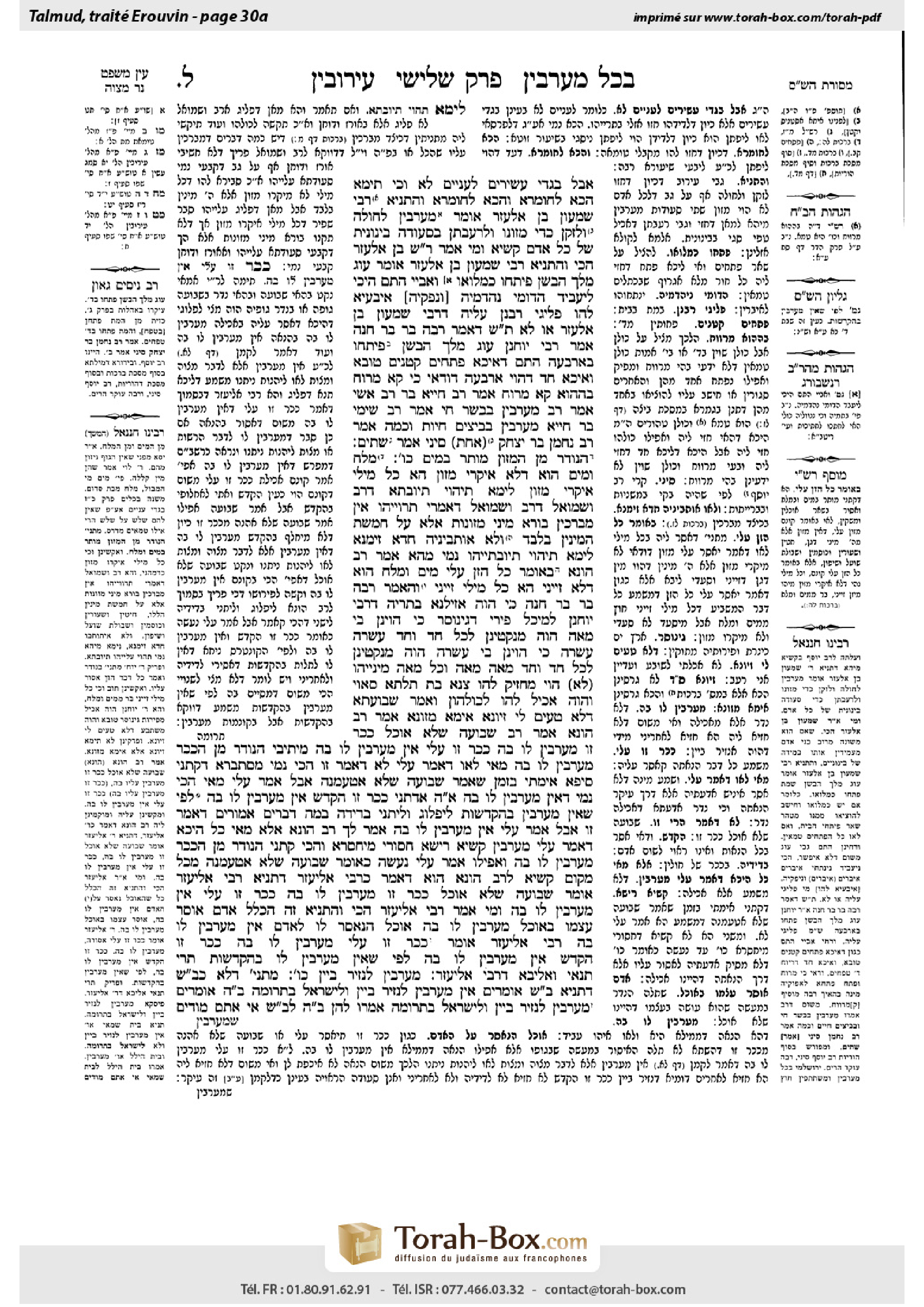
עירובין ל׳ א · Aramaic and Hebrew text
אֲבָל בִּגְדֵי עֲשִׁירִים לַעֲנִיִּים — לָא.
וְכִי תֵּימָא: הָכָא לְחוּמְרָא וְהָכָא לְחוּמְרָא, וְהָתַנְיָא, רַבִּי שִׁמְעוֹן בֶּן אֶלְעָזָר אוֹמֵר: מְעָרְבִין לְחוֹלֶה וּלְזָקֵן כְּדֵי מְזוֹנוֹ. וּלְרַעַבְתָן, בִּסְעוּדָה בֵּינוֹנִית שֶׁל כׇּל אָדָם. קַשְׁיָא.
וּמִי אָמַר רַבִּי שִׁמְעוֹן בֶּן אֶלְעָזָר הָכִי? וְהָתַנְיָא, רַבִּי שִׁמְעוֹן בֶּן אֶלְעָזָר אוֹמֵר: עוֹג מֶלֶךְ הַבָּשָׁן — פִּיתְחוֹ כִּמְלוֹאוֹ!
וְאַבָּיֵי: הָתָם הֵיכִי לֶיעְבֵּיד, הַדּוֹמֵי נְהַדְּמֵיהּ [וְנַפְּקֵיהּ]?!
אִיבַּעְיָא לְהוּ: פְּלִיגִי רַבָּנַן עֲלֵיהּ דְּרַבִּי שִׁמְעוֹן בֶּן אֶלְעָזָר, אוֹ לָא? תָּא שְׁמַע, דְּאָמַר רַבָּה בַּר בַּר חָנָה אָמַר רַבִּי יוֹחָנָן: עוֹג מֶלֶךְ הַבָּשָׁן פִּיתְחוֹ בְּאַרְבָּעָה.
הָתָם דְּאִיכָּא פְּתָחִים קְטַנִּים טוּבָא, וְאִיכָּא חַד דְּהָוֵי אַרְבָּעָה, דְּוַדַּאי כִּי קָא מְרַוַּח — בְּהָהוּא קָא מְרַוַּח.
אָמַר רַב חִיָּיא בַּר רַב אָשֵׁי אָמַר רַב: מְעָרְבִין בְּבָשָׂר חַי. אָמַר רַב שִׁימִי בַּר חִיָּיא: מְעָרְבִין בְּבֵיצִים חַיּוֹת. וְכַמָּה? אָמַר רַב נַחְמָן בַּר יִצְחָק: אַחַת. סִינַי אָמַר: שְׁתַּיִם.
הַנּוֹדֵר מִן הַמָּזוֹן, מוּתָּר בַּמַּיִם כּוּ׳. מֶלַח וּמַיִם הוּא דְּלָא אִיקְּרִי מָזוֹן, הָא כׇּל מִילֵּי אִיקְּרִי מָזוֹן. לֵימָא תֶּיהְוֵי תְּיוּבְתָּא דְּרַב וּשְׁמוּאֵל. דְּרַב וּשְׁמוּאֵל דְּאָמְרִי תַּרְוַיְיהוּ: אֵין מְבָרְכִין ״בּוֹרֵא מִינֵי מְזוֹנוֹת״ אֶלָּא עַל חֲמֵשֶׁת הַמִּינִין בִּלְבַד.
וְלָא אוֹתְבִינֵּיהּ חֲדָא זִימְנָא? לֵימָא תֶּיהְוֵי תְּיוּבְתַּיְיהוּ נָמֵי מֵהָא!
אָמַר רַב הוּנָא: בְּאוֹמֵר ״כׇּל הַזָּן עָלַי״. מַיִם וּמֶלַח הוּא דְּלָא זָיְינִי, הָא כׇּל מִילֵּי זָיְינִי.
וְהָאָמַר רַבָּה בַּר בַּר חָנָה: כִּי הֲוָה אָזֵילְנָא בָּתְרֵיהּ דְּרַבִּי יוֹחָנָן לְמֵיכַל פֵּירֵי דְּגִינּוֹסַר, כִּי הֲוֵינַן בֵּי מְאָה — הֲוָה מְנַקְּטִינַן לְכׇל חַד וְחַד עַשְׂרָה עַשְׂרָה. כִּי הֲוֵינַן בֵּי עַשְׂרָה — הֲוָה מְנַקְּטִינַן לְכׇל חַד וְחַד מְאָה מְאָה. וְכׇל מְאָה מִינַּיְיהוּ (לָא) הֲוֵי מַחֲזִיק לְהוּ צַנָּא בַּת תְּלָתָא סָאוֵי, וַהֲוָה אָכֵיל לְהוּ לְכוּלְּהוֹן, וְאָמַר: שְׁבוּעָתָא דְּלָא טְעִים לִי זִיּוּנָא! אֵימָא: ״מְזוֹנָא״.
אָמַר רַב הוּנָא אָמַר רַב: ״שְׁבוּעָה שֶׁלֹּא אוֹכַל כִּכָּר זוֹ״ — מְעָרְבִין לוֹ בָּהּ. ״כִּכָּר זוֹ עָלַי״ — אֵין מְעָרְבִין לוֹ בָּהּ.
מֵיתִיבִי: הַנּוֹדֵר מִן הַכִּכָּר — מְעָרְבִין לוֹ בָּהּ. מַאי לָאו, דְּאָמַר ״עָלַי״? לָא, דְּאָמַר ״זוֹ״.
הָכִי נָמֵי מִסְתַּבְּרָא, דְּקָתָנֵי סֵיפָא: אֵימָתַי, בִּזְמַן שֶׁאָמַר ״שְׁבוּעָה שֶׁלֹּא אֶטְעָמֶנָּה״.
אֲבָל אָמַר ״עָלַי״, מַאי? הָכִי נָמֵי דְּאֵין מְעָרְבִין לוֹ בָּהּ? אִי הָכִי, אַדְּתָנֵי ״כִּכָּר זוֹ הֶקְדֵּשׁ״ אֵין מְעָרְבִין לוֹ בָּהּ, לְפִי שֶׁאֵין מְעָרְבִין בַּהֶקְדֵּשׁוֹת — לִיפְלוֹג וְלִיתְנֵי בְּדִידַהּ: בַּמֶּה דְּבָרִים אֲמוּרִים, דְּאָמַר ״זוֹ״, אֲבָל אָמַר ״עָלַי״ — אֵין מְעָרְבִין לוֹ בָּהּ!
אָמַר לְךָ רַב הוּנָא: אֶלָּא מַאי, כֹּל הֵיכָא דְּאָמַר ״עָלַי״ מְעָרְבִין? קַשְׁיָא רֵישָׁא?
חַסּוֹרֵי מִיחַסְּרָא, וְהָכִי קָתָנֵי: הַנּוֹדֵר מִן הַכִּכָּר מְעָרְבִין לוֹ בָּהּ, וַאֲפִילּוּ אָמַר ״עָלַי״ — נַעֲשָׂה כְּאוֹמֵר: שְׁבוּעָה שֶׁלֹּא אֶטְעָמֶנָּה.
מִכׇּל מָקוֹם קַשְׁיָא לְרַב הוּנָא! הוּא דְּאָמַר כְּרַבִּי אֱלִיעֶזֶר. דְּתַנְיָא, רַבִּי אֱלִיעֶזֶר אוֹמֵר: ״שְׁבוּעָה שֶׁלֹּא אוֹכַל כִּכָּר זוֹ״ — מְעָרְבִין לוֹ בָּהּ. ״כִּכָּר זוֹ עָלַי״ — אֵין מְעָרְבִין לוֹ בָּהּ.
וּמִי אָמַר רַבִּי אֱלִיעֶזֶר הָכִי? וְהָתַנְיָא, זֶה הַכְּלָל: אָדָם אוֹסֵר עַצְמוֹ בְּאוֹכֶל — מְעָרְבִין לוֹ בָּהּ. אוֹכֶל הַנֶּאְסָר לוֹ לְאָדָם — אֵין מְעָרְבִין לוֹ בָּהּ. רַבִּי אֱלִיעֶזֶר אוֹמֵר: ״כִּכָּר זוֹ עָלַי״ — מְעָרְבִין לוֹ בָּהּ. ״כִּכָּר זוֹ הֶקְדֵּשׁ״ — אֵין מְעָרְבִין לוֹ בָּהּ, לְפִי שֶׁאֵין מְעָרְבִין לוֹ בַּהֶקְדֵּשׁוֹת!
תְּרֵי תַנָּאֵי וְאַלִּיבָּא דְּרַבִּי אֱלִיעֶזֶר.
מְעָרְבִין לַנָּזִיר בְּיַיִן כּוּ׳. מַתְנִיתִין דְּלָא כְּבֵית שַׁמַּאי. דְּתַנְיָא, בֵּית שַׁמַּאי אוֹמְרִים: אֵין מְעָרְבִין לַנָּזִיר בְּיַיִן וּלְיִשְׂרָאֵל בִּתְרוּמָה, בֵּית הִלֵּל אוֹמְרִים: מְעָרְבִין לַנָּזִיר בְּיַיִן וּלְיִשְׂרָאֵל בִּתְרוּמָה. אָמְרוּ לָהֶן בֵּית הִלֵּל לְבֵית שַׁמַּאי: אִי אַתֶּם מוֹדִים
Eruvin 30a · English translation
But the clothing of the wealthy does not need to be three by three handbreadths in order to become ritually impure for the poor because even smaller pieces of cloth are significant for the poor. Therefore, the law with regard to the poor is not determined by the customary practice of the rich. So too, the law of eiruv pertaining to the rest of the world should not be determined by the customary practice of the Persians to eat roasted meat as a food in itself.
And if you say: Both here the ruling is stringent, and there the ruling is stringent, i.e., with regard to ritual impurity the halakha is stringent with respect to the poor and declares scraps of cloth that are only three by three fingerbreadths impure, but with regard to eiruv the halakha requires enough roasted meat to suffice for two meals as a food in its own right, in accordance with the practice of the Persians, then there is a difficulty: Wasn’t it taught in a baraita that Rabbi Shimon ben Elazar says: One may establish an eiruv for an ill or elderly person with an amount of food that is enough for him for two meals, and if he eats less than the average person due to his sickness or age, a smaller amount of food is required in order to establish an eiruv on his behalf; however, for a glutton, we do not require food in an amount that would satisfy him but merely enough food for two meals measured according to an average meal for the typical person? This indicates that the halakha with respect to an eiruv is lenient and not stringent. The Gemara concludes: Indeed, this is difficult.
The Gemara raises a difficulty with the aforementioned baraita: Did Rabbi Shimon ben Elazar really say this? Wasn’t it taught in another baraita pertaining to the laws of ritual impurity that Rabbi Shimon ben Elazar says: Og, king of the Bashan, or any similar giant, requires an opening as big as his full size? If a person dies in a house and it is not clear how his corpse will be removed, all of the openings in the house are considered ritually impure, as the corpse might be carried out through any one of them. If the corpse can fit through some of the openings but not through others, only the larger openings are ritually impure. Rabbi Shimon ben Elazar says that in the case of a giant the size of Og, king of the Bashan, one opening can only prevent the others from contracting impurity if it is large enough for Og’s corpse to fit through. This indicates that the law is determined by the measure of each particular person and not by some general measure.
The Gemara asks: And what does Abaye say? How does he reconcile his position with regard to an eiruv, which maintains that we follow the customary practice of most of the world and not that of particular locales, with Rabbi Shimon ben Elazar’s ruling with regard to the corpse of a giant? The Gemara answers: There, in the case of a giant, what should we do? Should we cut the corpse into pieces and carry it out? We have no choice but to carry it out through an opening large enough for the corpse to pass through. However, in the case of the food for the two meals of an eiruv, there is no such logistical constraint, and the law should be determined in accordance with the usual practice.
A dilemma was raised before the Sages: Do the Rabbis disagree with Rabbi Shimon ben Elazar, or not? Come and hear a proof from that which Rabba bar bar Ḥana said that Rabbi Yoḥanan said: Og, king of the Bashan, requires an opening of four handbreadths in order to save the other openings in the house from becoming ritually impure. This indicates that the Rabbis disagree with Rabbi Shimon ben Elazar.
The Gemara rejects this proof: There, we are dealing with a case where there are many small openings, and there is only one that is four handbreadths wide. Therefore, it may be assumed with certainty that when one widens one of the openings in order to remove the corpse from the house, he will widen that opening. Consequently, that opening is ritually impure while the others are not. However, if all the openings in the house are equal in size, they are all ritually impure, as we cannot know through which opening the corpse will be carried out.
Returning to the laws of eiruv, Rav Ḥiyya bar Rav Ashi said that Rav said: One may establish an eiruv with raw meat because it can be eaten when necessary, even though it is not ordinarily regarded as food. Rav Shimi bar Ḥiyya said: One may also establish an eiruv with raw eggs. The Gemara asks: How many eggs are required for an eiruv? Rav Naḥman bar Yitzḥak said: One. Sinai, a nickname of Rav Yosef, said: Two.
We learned in the mishna: One who vows that nourishment is prohibited to him is permitted to eat water and salt. The Gemara infers from this: It is only salt and water that are not considered nourishment, but all other food items are considered nourishment. Let us say that this is a refutation of the position of Rav and Shmuel. As it was Rav and Shmuel who both said: One only recites the blessing: Who creates the various kinds of nourishment, over the five species of grain alone, but not over other types of food.
The Gemara asks a question: Did we not already refute their position on one occasion from a different source? The Gemara answers: Indeed, we already refuted their view, but let us say that there is a refutation of their position from here as well.
Rav Huna said: We can resolve the difficulty from the mishna by saying that it is referring to someone who vows and says: Anything that nourishes is prohibited to me. In that case, it is water and salt that are permitted to him, as they do not nourish, but all other food items are prohibited, as they do nourish. This inclusive formulation includes anything that provides even a small degree of nourishment; but the particular term mazon, nourishment or sustenance, used in the blessing over food, is reserved only for the five species of grain.
The Gemara asks: Didn’t Rabba bar bar Ḥana say: When we were following Rabbi Yoḥanan to eat of the fruits of Genosar, very sweet fruits that grow in the region of the Sea of Galilee, when we were a group of a hundred people, each and every person would take ten fruits; and when we were a group of ten, each and every person would take a hundred fruits for him. And each hundred of these fruits could not fit into a three-se’a basket. And Rabbi Yoḥanan would eat them all and then say: I swear that I have not yet tasted something that nourishes. Didn’t we say that only water and salt are excluded from the category of things that nourish? The Gemara corrects the rendition of the story: Say that he said as follows: I have not tasted sustaining food, but fruit is certainly considered something that nourishes.
Rav Huna said that Rav said: If one said: I swear that I shall not eat this loaf, one may nonetheless establish an eiruv for him with it because the food used for an eiruv does not have to be edible for the particular individual the eiruv services. However, if one said: This loaf shall be forbidden to me, one may not establish an eiruv for him with it, as this formulation indicates that he is prohibiting himself to use or benefit from the loaf in any manner.
The Gemara raises an objection based upon the following baraita: With regard to one who vows not to benefit from a loaf, one may nonetheless establish an eiruv for him with it. What, is it not referring to one who said: This loaf shall be forbidden to me? The Gemara answers: No, the baraita is only is referring to a case where he said: I swear that I shall not eat this loaf.
The Gemara comments: So too, it is reasonable to understand the baraita in this fashion, as it was taught in the latter clause: When do we apply this halakha? Only when one said: I swear that I shall not taste it.
The Gemara asks: But if he said: This loaf shall be forbidden to me, what is the halakha? So too, one may not establish an eiruv for him with it. But if so, there is a difficulty. Instead of teaching in the continuation of the baraita that if one said: This loaf is consecrated property, one may not establish an eiruv for him with it, as one may not establish an eiruv with consecrated objects, let him make an internal distinction in the case of a non-sacred loaf itself and state: In what case is this statement said? Only where one said: I swear that I shall not eat this loaf. But if one said: This loaf shall be forbidden to me, one may not establish an eiruv for him with it. This indicates that Rav Huna’s understanding of the baraita is incorrect.
Rav Huna could have said to you: Rather, what would you say, that wherever one said: This loaf shall be forbidden to me, one may establish an eiruv for him with it? If so, there is a difficulty from the first clause of the baraita, which states: When do we say this? Only when one said: I swear that I shall not taste it. That indicates that if one said: This loaf shall be forbidden to me, one may not establish an eiruv for him with it.
The Gemara answers that the baraita is incomplete, and it teaches the following: With regard to one who vows not to benefit from a loaf, one may nonetheless establish an eiruv for him with it. And even if one said: This loaf shall be forbidden to me, it is as though he said: I swear that I shall not taste it. Therefore, the loaf itself is only forbidden to him as food, but he can use it for the purpose of an eiruv.
The Gemara comments: Nevertheless, the difficulty remains according to the opinion of Rav Huna. The Gemara answers: He stated his view in accordance with the opinion of Rabbi Eliezer; as it was taught in a baraita that Rabbi Eliezer says: If one said: I swear that I shall not eat this loaf, one may establish an eiruv for him with it; but if he said: This loaf shall be forbidden to me, one may not establish an eiruv for him with it.
The Gemara asks: Did Rabbi Eliezer really say this? Wasn’t it taught in a baraita: This is the principle: With regard to a person who prohibits himself from eating a particular food, e.g., if one said: I swear that I shall not eat this loaf, one may establish an eiruv for him with that loaf. However, if the food was prohibited to a person, e.g., if he said: This loaf shall be forbidden to me, one may not establish an eiruv for him with it. Rabbi Eliezer says: If he said: This loaf shall be forbidden to me, one may establish an eiruv for him with it. However, if he said: This loaf is consecrated property, one may not establish an eiruv for him with it, as one may not establish an eiruv for him with consecrated objects. Therefore, Rabbi Eliezer does not distinguish between the two differently worded types of vows, but between a vow and consecration.
The Gemara answers: It must be explained that these are two tanna’im who both held according to Rabbi Eliezer. Two later tanna’im disagreed with each other in reporting Rabbi Eliezer’s opinion.
We learned in the mishna: One may establish an eiruv for a nazirite with wine and for an Israelite with teruma, even though they themselves may not partake of these foods. The Gemara comments: The mishna was not taught in accordance with the opinion of Beit Shammai, as it was taught in a baraita that Beit Shammai say: One may not establish an eiruv for a nazirite with wine and for an Israelite with teruma. Beit Hillel disagree and say: One may establish an eiruv for a nazirite with wine and for an Israelite with teruma. Beit Hillel said to Beit Shammai: Do you not concede
Eruvin 30a · Traduction française (IA)
Mais la vêture des riches n'a pas besoin d'être de trois tefachim par trois tefachim pour devenir impure rituellement pour les pauvres, car même des morceaux de tissu plus petits sont importants pour les pauvres. Ainsi, la loi concernant les pauvres n'est pas déterminée par la coutume des riches. De même, la loi concernant l'eiruv en ce qui concerne le reste du monde ne devrait pas être déterminée par la coutume des Perses de manger de la viande grillée comme aliment en soi.
Et si l'on dit : ici la décision est stricte, et là aussi la décision est stricte, c'est-à-dire, concernant l'impureté rituelle, la halakha est stricte concernant les pauvres et déclare que des morceaux de tissu de trois tefachim par trois tefachim sont impurs, mais concernant l'eiruv, la halakha exige assez de viande grillée pour suffire à deux repas comme aliment en soi, conformément à la coutume des Perses, alors il y a une difficulté : N'était-ce pas enseigné dans une baraïta que Rabbi Shimon ben Elazar dit : On peut établir un eiruv pour une personne malade ou âgée avec une quantité d'aliments suffisante pour lui pour deux repas, et si cette personne mange moins que la normale en raison de sa maladie ou de son âge, une quantité d'aliments plus petite est requise pour établir un eiruv à son nom ; cependant, pour un gourmand, nous ne requirons pas une quantité d'aliments suffisante pour lui, mais simplement une quantité d'aliments pour deux repas mesurée selon un repas moyen pour une personne normale ? Cela indique que la halakha concernant l'eiruv est clémente et non stricte. La Guemara conclut : En effet, cela est difficile.
La Guemara soulève une difficulté concernant la baraïta mentionnée précédemment : Rabbi Shimon ben Elazar a-t-il vraiment dit cela ? N'était-ce pas enseigné dans une autre baraïta concernant les lois d'impureté rituelle que Rabbi Shimon ben Elazar dit : Og, roi du Bassan, ou tout géant semblable, exige une ouverture aussi grande que sa taille complète ? Si une personne meurt dans une maison et qu'il n'est pas clair comment son corps sera retiré, toutes les ouvertures de la maison sont considérées comme impures rituellement, car le corps pourrait être sorti par n'importe laquelle d'entre elles. Si le corps peut passer par certaines ouvertures mais pas par d'autres, seules les ouvertures plus grandes sont impures rituellement. Rabbi Shimon ben Elazar dit que dans le cas d'un géant de la taille d'Og, roi du Bassan, une seule ouverture peut empêcher les autres de contracter l'impureté si elle est suffisamment grande pour que le corps puisse passer. Cela indique que la loi est déterminée par la mesure de chaque personne particulière et non par une mesure générale.
La Guemara demande : Et que dit Abaye ? Comment réconcilie-t-il sa position concernant l'eiruv, qui maintient que nous suivons la coutume de la plupart du monde et non celle des lieux particuliers, avec la décision de Rabbi Shimon ben Elazar concernant le corps du géant ? La Guemara répond : Là, concernant le géant, que devons-nous faire ? Devons-nous couper le corps en morceaux et le transporter ? Nous n'avons pas d'autre choix que de le transporter par une ouverture suffisamment grande pour que le corps puisse passer. Cependant, concernant les aliments pour les deux repas de l'eiruv, il n'y a pas de contrainte logistique similaire, et la loi devrait être déterminée selon la coutume habituelle.
Un dilemme a été soulevé devant les Sages : Les Rabbins discutent-ils avec Rabbi Shimon ben Elazar, ou non ? Venez écouter une preuve de ce que Rabbi Yoḥanan a dit, selon Rabba bar bar Ḥana : Og, roi du Bassan, exige une ouverture de quatre tefachim afin de sauver les autres ouvertures de la maison de l'impureté rituelle. Cela indique que les Rabbins discutent avec Rabbi Shimon ben Elazar.
La Guemara rejette cette preuve : Là, nous sommes dans un cas où il y a de nombreuses petites ouvertures, et il n'y a qu'une seule qui est large de quatre tefachim. Il peut donc être supposé avec certitude que lorsqu'on élargit une de ces ouvertures pour retirer le corps de la maison, on élargit celle-ci. Ainsi, cette ouverture est impure rituellement, tandis que les autres ne le sont pas. Cependant, si toutes les ouvertures de la maison sont de la même taille, elles sont toutes impures rituellement, car nous ne pouvons pas savoir par quelle ouverture le corps sera transporté.
En revenant aux lois de l'eiruv, Rav Ḥiyya bar Rav Ashi a dit que Rav a dit : On peut établir un eiruv avec de la viande crue, car elle peut être mangée lorsqu'il le faut, même si elle n'est pas habituellement considérée comme aliment. Rav Shimi bar Ḥiyya a dit : On peut aussi établir un eiruv avec des œufs crus. La Guemara demande : Combien d'œufs sont requis pour un eiruv ? Rav Naḥman bar Yitzḥak a dit : Un. Sinai, un surnom de Rav Yosef, a dit : Deux.
Nous avons appris dans la Michna : Celui qui fait un vœu interdisant la nourriture à lui-même est autorisé à manger de l'eau et du sel. La Guemara en déduit : Ce sont seulement le sel et l'eau qui ne sont pas considérés comme de la nourriture, mais tous les autres aliments sont considérés comme de la nourriture. Disons que cela constitue une réfutation de la position de Rav et de Shmuel. Car c'est Rav et Shmuel qui ont dit : On ne récite pas la bénédiction : Celui qui a créé les diverses sortes de nourriture, sur les cinq espèces de céréales seulement, mais pas sur d'autres types d'aliments.
La Guemara pose une question : N'avons-nous pas déjà réfuté leur position à une autre occasion à partir d'une source différente ? La Guemara répond : En effet, nous avons déjà réfuté leur point de vue, mais disons que cela constitue également une réfutation de leur position à partir d'ici.
Rav Huna a dit : Nous pouvons résoudre la difficulté à partir de la Michna en disant qu'il s'agit d'une personne qui fait un vœu et dit : Tout ce qui nourrit est interdit à moi. Dans ce cas, il est permis à lui d'en manger de l'eau et du sel, car ils ne nourrissent pas, mais tous les autres aliments sont interdits, car ils nourrissent. Cette formulation inclusive inclut tout ce qui fournit même une petite quantité de nourriture ; cependant, le terme particulier mazon, nourriture ou sustenance, utilisé dans la bénédiction sur les aliments, est réservé uniquement aux cinq espèces de céréales.
La Guemara pose la question : N’a-t-il pas dit Rabba bar bar Ḥana : Quand nous suivions Rabbi Yoḥanan pour manger les fruits de Genosar, des fruits très doux qui poussent dans la région de la Mer de Galilée, quand nous étions un groupe de cent personnes, chacun prenait dix fruits ; et quand nous étions un groupe de dix personnes, chacun prenait cent fruits. Et chaque cent de ces fruits ne pouvait pas entrer dans un panier de trois sé’as. Et Rabbi Yoḥanan mangeait tous ces fruits et disait ensuite : Je jure que je n’ai pas encore goûté quelque chose qui nourrit. N’avons-nous pas dit que seul l’eau et le sel sont exclus de la catégorie des choses qui nourrissent ? La Guemara corrige la version de l’histoire : Dis qu’il a dit ceci : Je n’ai pas goûté de nourriture sustentatrice, mais les fruits sont certainement considérés comme quelque chose qui nourrit.
Rav Huna a dit que Rav a dit : Si l’on dit : Je jure que je ne mangerai pas ce pain, on peut toutefois établir un eiruv pour lui avec ce pain, car la nourriture utilisée pour un eiruv n’a pas besoin d’être comestible pour la personne spécifique pour laquelle l’eiruv sert. Cependant, si l’on dit : Ce pain est interdit à moi, on ne peut pas établir un eiruv pour lui avec ce pain, car cette formulation indique qu’il interdit à lui-même d’utiliser ou de bénéficier du pain de toute manière.
La Guemara soulève un objection basée sur la suivante baraïta : Concernant celui qui jure de ne pas bénéficier d’un pain, on peut toutefois établir un eiruv pour lui avec ce pain. Qu’est-ce que cela signifie ? N’est-ce pas concernant celui qui a dit : Ce pain est interdit à moi ? La Guemara répond : Non, la baraïta ne fait référence qu’à un cas où il a dit : Je jure que je ne mangerai pas ce pain.
La Guemara commente : De même, il est raisonnable de comprendre la baraïta ainsi, car il a été enseigné dans la clause ultérieure : Dans quel cas appliquons-nous cette halakha ? Seulement quand l’on a dit : Je jure que je ne goûterai pas cela.
La Guemara pose la question : Mais si l’on a dit : Ce pain est interdit à moi, quelle est la halakha ? De même, on ne peut pas établir un eiruv pour lui avec ce pain. Cependant, si c’est ainsi, il y a une difficulté. Au lieu de faire enseigner dans la continuation de la baraïta que si l’on a dit : Ce pain est une propriété sacrée, on ne peut pas établir un eiruv pour lui avec ce pain, car on ne peut pas établir un eiruv avec des objets sacrés, laissez-le faire une distinction interne dans le cas d’un pain non sacré lui-même et dites : Dans quel cas cette déclaration est-elle faite ? Seulement quand l’on a dit : Je jure que je ne mangerai pas ce pain. Cependant, si l’on a dit : Ce pain est interdit à moi, on ne peut pas établir un eiruv pour lui avec ce pain. Cela indique que l’interprétation de Rav Huna de la baraïta est incorrecte.
Rav Huna aurait pu dire à vous : Plutôt, que diriez-vous, que partout où l’on a dit : Ce pain est interdit à moi, on peut établir un eiruv pour lui avec ce pain ? Si c’est ainsi, il y a une difficulté à partir de la première clause de la baraïta, qui dit : Dans quel cas disons-nous cela ? Seulement quand l’on a dit : Je jure que je ne goûterai pas cela. Cela indique que si l’on a dit : Ce pain est interdit à moi, on ne peut pas établir un eiruv pour lui avec ce pain.
La Guemara répond que la baraïta est incomplète, et elle enseigne ceci : Concernant celui qui a fait un vœu de ne pas bénéficier d’un pain, on peut toutefois établir un eiruv pour lui avec ce pain. Et même si l’on a dit : Ce pain est interdit à moi, cela équivaut à ce qu’il a dit : Je jure que je ne mangerai pas ce pain. Par conséquent, le pain lui-même est seulement interdit à lui comme nourriture, mais il peut l’utiliser à l’effet d’un eiruv.
La Guemara commente : Cependant, la difficulté reste selon l’opinion de Rav Huna. La Guemara répond : Il a exprimé son avis selon l’opinion de Rabbi Eliezer ; car il a été enseigné dans une baraïta que Rabbi Eliezer dit : Si l’on a dit : Je jure que je ne mangerai pas ce pain, on peut établir un eiruv pour lui avec ce pain ; mais si l’on a dit : Ce pain est interdit à moi, on ne peut pas établir un eiruv pour lui avec ce pain.
La Guemara pose la question : Rabbi Eliezer a-t-il vraiment dit cela ? N’était-ce pas enseigné dans une baraïta : C’est le principe : Concernant une personne qui interdit à lui-même de manger une nourriture particulière, par exemple, si l’on a dit : Je jure que je ne mangerai pas ce pain, on peut établir un eiruv pour lui avec ce pain. Cependant, si la nourriture était interdite à une personne, par exemple, si l’on a dit : Ce pain est interdit à moi, on ne peut pas établir un eiruv pour lui avec ce pain. Rabbi Eliezer dit : Si l’on a dit : Ce pain est interdit à moi, on peut établir un eiruv pour lui avec ce pain. Cependant, si l’on a dit : Ce pain est une propriété sacrée, on ne peut pas établir un eiruv pour lui avec ce pain, car on ne peut pas établir un eiruv avec des objets sacrés. Par conséquent, Rabbi Eliezer ne distingue pas entre les deux formulations différentes des vœux, mais entre un vœu et une consécration.
La Guemara répond : Il faut expliquer que ces deux tanna’im ont tous deux suivi Rabbi Eliezer. Deux tanna’im ultérieurs ont eu un désaccord entre eux quant à la transmission de l’opinion de Rabbi Eliezer.
Nous avons appris dans la mishna : On peut établir un eiruv pour un nazirite avec du vin et pour un Israélite avec la terouma, même s’ils ne peuvent pas eux-mêmes en consommer. La Guemara commente : La mishna n’a pas été enseignée selon l’opinion de Beit Shammai, car il a été enseigné dans une baraïta que Beit Shammai disent : On ne peut pas établir un eiruv pour un nazirite avec du vin et pour un Israélite avec la terouma. Beit Hillel désaccordent et disent : On peut établir un eiruv pour un nazirite avec du vin et pour un Israélite avec la terouma. Beit Hillel a dit à Beit Shammai : N’êtes-vous pas d’accord ?
Traduction française générée par IA à partir de l’édition anglaise de Sefaria. Vérifie toujours un passage avec le texte source.
Text from Sefaria: William Davidson Edition - Vocalized Aramaic (CC BY NC); William Davidson Edition - English (CC BY NC).