Eruvin 3a: Talmud study for Daf Yomi
Study the Talmud for Daf Yomi with scanned pages, Hebrew text, English translations from Sefaria and AI-generated French translations.
Passage selection and English or AI-generated French translation are available where the scan has annotations. Daf Study is independent of Torah-Box and Sefaria.
Browse Eruvin · עירובין · All tractatesEruvin 3a text and translations
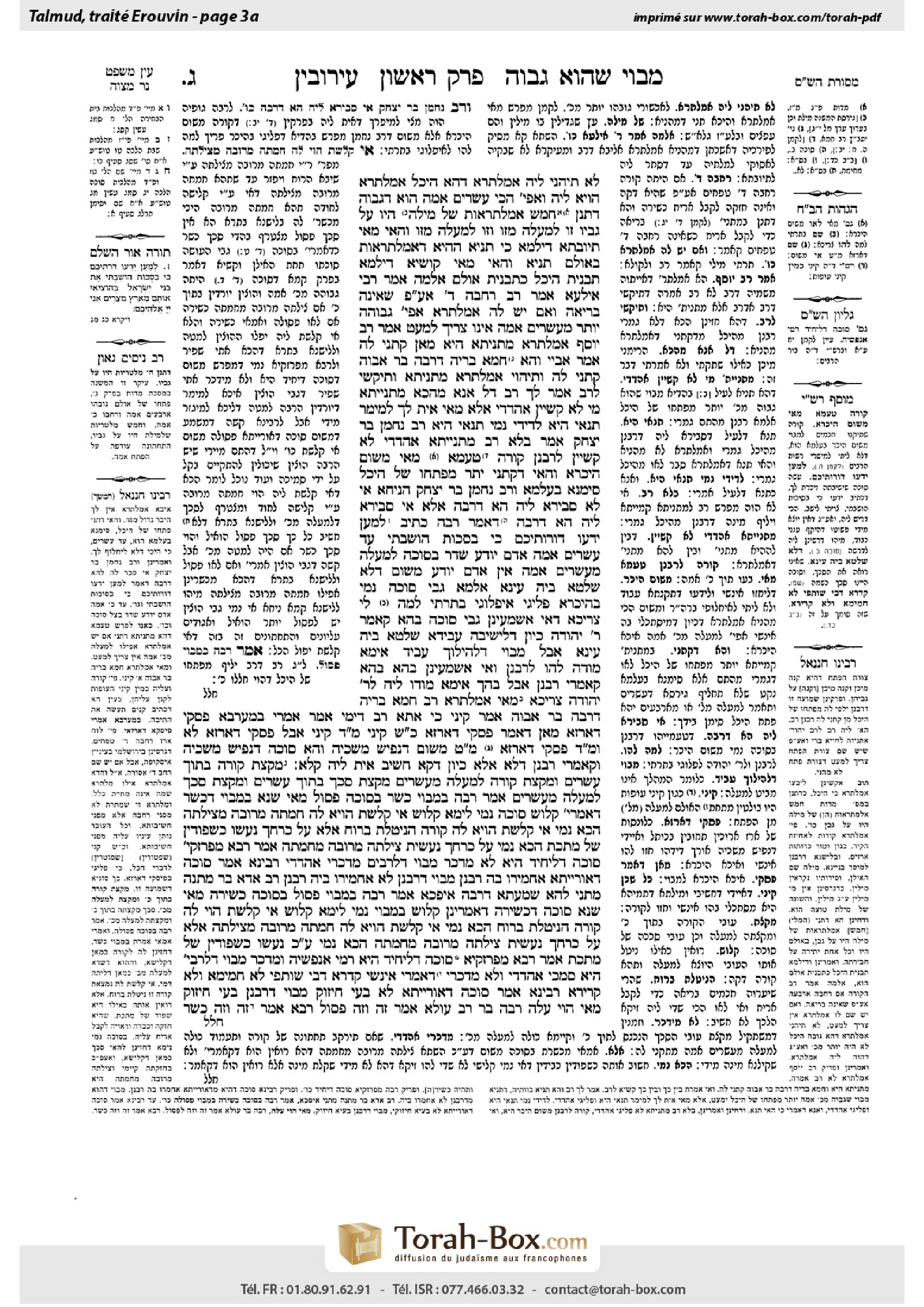
This page of Eruvin includes the Aramaic text, an English translation and an AI-generated French translation, alongside the scan above.
עירובין ג׳ א · Aramaic and Hebrew text
לָא תַּיהֲנֵי לֵיהּ אֲמַלְתְּרָא, דְּהָא הֵיכָל אֲמַלְתְּרָא הַוְיָא לֵיהּ, וַאֲפִילּוּ הָכִי — עֶשְׂרִים אַמָּה הוּא דְּגָבוֹהַּ, דִּתְנַן: חָמֵשׁ אֲמַלְתְּרָאוֹת שֶׁל מֵילָה הָיוּ עַל גַּבָּיו, זוֹ לְמַעְלָה מִזּוֹ, וְזוֹ לְמַעְלָה מִזּוֹ.
וְהַאי מַאי תְּיוּבְתָּא? דִילְמָא כִּי תַּנְיָא הָהִיא דַּאֲמַלְתְּרָאוֹת, בָּאוּלָם תַּנְיָא?
וְהַאי מַאי קוּשְׁיָא? דִילְמָא תַּבְנִית הֵיכַל כְּתַבְנִית אוּלָם?
אַלְּמָה אָמַר רַבִּי אִילְעָא אָמַר רַב: רְחָבָה אַרְבָּעָה, אַף עַל פִּי שֶׁאֵינָהּ בְּרִיאָה. וְאִם יֵשׁ לָהּ אֲמַלְתְּרָא אֲפִילּוּ גְּבוֹהָה יוֹתֵר מֵעֶשְׂרִים אַמָּה אֵינוֹ צָרִיךְ לְמַעֵט.
אָמַר רַב יוֹסֵף: אֲמַלְתְּרָא מַתְנִיתָא הִיא, מַאן קָתָנֵי לַהּ?
אָמַר אַבָּיֵי: וְהָא חָמָא בְּרֵיהּ דְּרַבָּה בַּר אֲבוּהּ קָתָנֵי לַהּ, וְתִיהְוֵי אֲמַלְתְּרָא מַתְנִיתָא וְתִיקְשֵׁי לְרַב!
אָמַר לְךָ רַב: דַּל אֲנָא מֵהָכָא, מַתְנְיָיתָא מִי לָא קַשְׁיָין אַהֲדָדֵי? אֶלָּא מַאי אִית לָךְ לְמֵימַר — תַּנָּאֵי הִיא, לְדִידִי נָמֵי תַּנָּאֵי הִיא.
רַב נַחְמָן בַּר יִצְחָק אָמַר: בְּלָא רַב — מַתְנְיָיתָא אַהֲדָדֵי לָא קַשְׁיָין: לְרַבָּנַן קוֹרָה טַעְמָא מַאי — מִשּׁוּם הֶיכֵּרָא, וְהַאי דְּקָתָנֵי ״יָתֵר מִפִּתְחוֹ שֶׁל הֵיכָל״ — סִימָנָא בְּעָלְמָא.
וְרַב נַחְמָן בַּר יִצְחָק, הָנִיחָא אִי לָא סְבִירָא לֵיהּ הָא דְּרַבָּה, אֶלָּא אִי סְבִירָא לֵיהּ הָא דְּרַבָּה, דְּאָמַר רַבָּה, כְּתִיב: ״לְמַעַן יֵדְעוּ דוֹרוֹתֵיכֶם כִּי בַסֻּכּוֹת הוֹשַׁבְתִּי״, עַד עֶשְׂרִים אַמָּה אָדָם יוֹדֵעַ שֶׁדָּר בַּסּוּכָּה, לְמַעְלָה מֵעֶשְׂרִים אַמָּה אֵין אָדָם יוֹדֵעַ, מִשּׁוּם דְּלָא שָׁלְטָא בֵּיהּ עֵינָא.
אַלְמָא גַּבֵּי סוּכָּה נָמֵי בְּהֶיכֵּרָא פְּלִיגִי, אִיפְּלוֹגֵי בְּתַרְתֵּי לְמָה לִי?
צְרִיכָא, דְּאִי אַשְׁמְעִינַן גַּבֵּי סוּכָּה — בְּהָא קָאָמַר רַבִּי יְהוּדָה כֵּיוָן דְּלִישִׁיבָה עֲבִידָא, שָׁלְטָא בֵּיהּ עֵינָא. אֲבָל מָבוֹי, דִּלְהִילּוּךְ עֲבִיד — אֵימָא מוֹדֶה לְהוּ לְרַבָּנַן. וְאִי אַשְׁמְעִינַן בְּהָא — בְּהָא קָאָמְרִי רַבָּנַן, אֲבָל בְּהָךְ אֵימָא מוֹדוּ לֵיהּ לְרַבִּי יְהוּדָה. צְרִיכָא.
מַאי אֲמַלְתְּרָא? רַב חָמָא בְּרֵיהּ דְּרַבָּה בַּר אֲבוּהּ אָמַר: קִינֵּי. כִּי אֲתָא רַב דִּימִי אֲמַר, אָמְרִי בְּמַעְרְבָא: פִּסְקֵי דְאַרְזָא.
מַאן דְּאָמַר פִּסְקֵי דְאַרְזָא, כׇּל שֶׁכֵּן קִינֵּי. מַאן דְּאָמַר קִינֵּי, אֲבָל פִּסְקֵי דְאַרְזָא לָא.
וּמַאן דְּאָמַר פִּסְקֵי דְאַרְזָא מַאי טַעְמָא — מִשּׁוּם דִּנְפִישׁ מְשָׁכֵיהּ. וְהָא סוּכָּה דִּנְפִישׁ מְשָׁכֵיהּ, וְקָאָמְרִי רַבָּנַן דְּלָא!
אֶלָּא: כֵּיוָן דְּקָא חֲשִׁיב אִית לֵיהּ קָלָא.
מִקְצָת קוֹרָה בְּתוֹךְ עֶשְׂרִים, וּמִקְצָת קוֹרָה לְמַעְלָה מֵעֶשְׂרִים, מִקְצָת סְכָךְ בְּתוֹךְ עֶשְׂרִים, וּמִקְצָת סְכָךְ לְמַעְלָה מֵעֶשְׂרִים? אָמַר רַבָּה: בְּמָבוֹי כָּשֵׁר, בְּסוּכָּה פָּסוּל.
מַאי שְׁנָא בְּמָבוֹי דְּכָשֵׁר, דְּאָמְרִינַן קְלוֹשׁ? סוּכָּה נָמֵי לֵימָא קְלוֹשׁ!
אִי קָלְשַׁתְּ — הָוְיָא לַהּ חֲמָתָהּ מְרוּבָּה מִצִּילָּתָהּ.
הָכָא נָמֵי, אִי קָלְשַׁתְּ הָוְיָא לַהּ קוֹרָה הַנִּיטֶּלֶת בָּרוּחַ. אֶלָּא עַל כׇּרְחָךְ, נַעֲשׂוּ כְּשַׁפּוּדִין שֶׁל מַתֶּכֶת. הָכָא נָמֵי — עַל כׇּרְחָךְ נַעֲשֵׂית צִילָּתָהּ מְרוּבָּה מֵחַמָּתָהּ!
אָמַר רָבָא מִפַּרְזַקְיָא: סוּכָּה דִּלְיָחִיד הִיא לָא מִדְּכַר, מָבוֹי דִּלְרַבִּים מַדְכְּרִי אַהֲדָדֵי.
רָבִינָא אָמַר: סוּכָּה דְּאוֹרָיְיתָא — אַחְמִירוּ בַּהּ רַבָּנַן, מָבוֹי דְּרַבָּנַן — לָא אַחְמִירוּ בֵּיהּ רַבָּנַן.
רַב אַדָּא בַּר מַתְנָה מַתְנֵי לְהָא שְׁמַעְתָּא דְּרַבָּה אִיפְּכָא. אָמַר רַבָּה: בְּמָבוֹי פָּסוּל, בְּסוּכָּה כְּשֵׁירָה!
מַאי שְׁנָא סוּכָּה דִּכְשֵׁירָה, דְּאָמְרִינַן קְלוֹשׁ? בְּמָבוֹי נָמֵי לֵימָא קְלוֹשׁ!
אִי קְלַשַׁת, הָוֵי לַהּ קוֹרָה הַנִּיטֶּלֶת בְּרוּחַ. הָכָא נָמֵי, אִי קָלְשַׁתְּ — הָוְיָא לַהּ חֲמָתָהּ מְרוּבָּה מִצִּילָּתָהּ! אֶלָּא עַל כׇּרְחֲךָ, נַעֲשֵׂית צִילָּתָהּ מְרוּבָּה מֵחַמָּתָהּ, הָכָא נָמֵי, עַל כׇּרְחָךְ נַעֲשׂוּ כְּשַׁפּוּדִין שֶׁל מַתֶּכֶת!
אָמַר רָבָא מִפַּרְזַקְיָא: סוּכָּה דִּלְיָחִיד הִיא רָמֵי אַנַּפְשֵׁיהּ וּמִדְּכַר, מָבוֹי דִּלְרַבִּים הִיא סָמְכִי אַהֲדָדֵי וְלָא מִדַּכְרִי, דְאָמְרִי אִינָשֵׁי: קִדְרָא דְבֵי שׁוּתָּפֵי, לָא חַמִּימָא וְלָא קָרִירָא.
רָבִינָא אָמַר: סוּכָּה דְּאוֹרָיְיתָא — לָא בָּעֵי חִיזּוּק. מָבוֹי דְּרַבָּנַן — בָּעֵי חִיזּוּק.
מַאי הָוֵי עֲלַהּ? רַבָּה בַּר רַב עוּלָּא אָמַר: זֶה וָזֶה — פָּסוּל. רָבָא אָמַר: זֶה וָזֶה כָּשֵׁר.
Eruvin 3a · English translation
a molded or protruding cornice [amaltera] crowning the entrance should not be effective in rendering an alleyway fit to carry within it if it is higher than twenty cubits, as the Sanctuary had a cornice, and even so it was twenty cubits high, and no more. As we learned in a mishna: Over it were five oak cornices, one protruding above the other.
The Gemara attempts to dismiss this difficulty: And, with regard to that mishna, what is the refutation? Perhaps when that mishna with regard to cornices was taught, it was taught with regard to the Entrance Hall, whose height was forty cubits, and not with regard to the Sanctuary.
The Gemara responds: And what is the difficulty with that? Perhaps the design of the Sanctuary was like the design of the Entrance Hall. Just as there were cornices in one doorway, there were cornices in the other.
The Gemara returns to its question with regard to a cornice: Why then did Rabbi Ile’a say that Rav himself said: If the width of a cross beam is four handbreadths, even if it is not sturdy, it renders the alleyway fit for carrying within it. And if it has a cornice, even if it is higher than twenty cubits, one need not diminish its height.
Rav Yosef said: This halakha with regard to a cornice was not actually stated by Rav, but rather it is a baraita. Who, in fact, teaches that baraita? Perhaps it is not an authoritative baraita, and Rav does not have to accept what it says.
Abaye said: Isn’t it Ḥama, son of Rabba bar Avuh, who teaches it? And therefore, even if the halakha with regard to a cornice will be a baraita, it nevertheless poses a difficulty to Rav.
Rav could have said to you: Even if you eliminate me and my explanation from the discussion here, don’t the two baraitot themselves, the baraita that states that the Rabbis derive the dimensions of an entrance from the doorway of the Sanctuary and the baraita that states that in the case of a cornice, even if it is higher than twenty cubits, it need not be lowered, contradict each other? Rather, what have you to say to reconcile the contradiction? The matter is the subject of a dispute between tanna’im; so too, according to my opinion, it is the subject of a dispute between tanna’im.
Rav Naḥman bar Yitzḥak said: Without Rav, the baraitot do not contradict each other, as according to the Rabbis, what is the reason that a cross beam renders an alleyway fit for carrying? Because it serves as a conspicuous marker between the alleyway and the public domain. Ordinarily a cross beam more than twenty cubits high is not noticeable; however, a cornice attracts attention even at that height. And that which is taught in the other baraita with regard to the height of a beam at the entrance to an alleyway: Greater than the entrance of the Sanctuary, is merely a mnemonic device. No actual halakhot are derived from the entrance of the Sanctuary.
The Gemara notes: And that the explanation of Rav Naḥman bar Yitzḥak works out well if he does not hold this opinion of Rabba; however, if he holds this opinion of Rabba, it is difficult. As Rabba said with regard to the fitness of a sukka whose roofing is higher than twenty cubits that it is written: “In order that your generations should know that I made the children of Israel dwell in booths when I brought them out of the land of Egypt; I am the Lord your God” (Leviticus 23:43). When the roofing of a sukka is up to twenty cubits high, a person is aware that he is dwelling in a sukka; however, when the roofing of the sukka is above twenty cubits, a person is not aware that he is dwelling in a sukka, because the eye does not discern the sukka roofing. One does not usually raise his head to look that high, and consequently, he sees the walls and does not notice the defining feature of the sukka, its roofing.
The Gemara explains the difficulty: Apparently, with regard to sukka as well, the Rabbis and Rabbi Yehuda disagree whether or not an item more than twenty cubits high is conspicuous. According to Rav Naḥman bar Yitzḥak, why do I need them to disagree about the same point in two cases, that of sukka and that of an alleyway? That the dispute between the Rabbis and Rabbi Yehuda with regard to sukka revolves around this issue indicates that their dispute with regard to an alleyway revolves around a different point, as asserted by Rav.
The Gemara answers: It is necessary to teach both disputes, as had the mishna taught us only with regard to sukka, one might have thought that only in this case does Rabbi Yehuda say that an object is conspicuous even above twenty cubits; since a sukka is designed for extended dwelling, the eye undoubtedly discerns the roofing at some point. However, in the case of an alleyway, which is designed for walking, say that he concedes to the Rabbis that a person walking in an alleyway does not notice objects at so significant a height. And had the mishna taught us only with regard to that case of an alleyway, one might have thought that only in that case do the Rabbis say that people do not notice objects at so significant a height; however, in that case of sukka, say that they concede to Rabbi Yehuda, for the above-stated reason. Therefore, it is necessary to teach both disputes.
The Gemara seeks to arrive at a precise definition of amaltera, translated above as cornice. What is an amaltera? Rav Ḥama, son of Rabba bar Avuh, said: It refers to decorative wood carvings in the shape of birds’ nests. When Rav Dimi came from Eretz Yisrael to Babylonia, he said that they say in the West, Eretz Yisrael, it is referring to cedar poles.
The Gemara explains: The one who said that amaltera refers to cedar poles would all the more so permit use of carvings of birds’ nests, as a cross beam engraved with images attracts attention and is noticeable even at a great height. However, the one who said that amaltera refers to carvings of birds’ nests would say that the halakha with regard to a cornice applies only to them, but not to cedar poles.
The Gemara clarifies the opinion of the one who said cedar poles. What is the reason for his opinion? He holds that since its length is great, a cedar pole attracts attention. But isn’t the length of a sukka great as well, and nevertheless, the Rabbis say that a sukka higher than twenty cubits is not fit?
Rather, the reason is as follows: Since a cedar pole is of significant value, it generates publicity. People passing through an alleyway stop and stare at a cross beam of that kind, even when it is higher than twenty cubits, leading others to do so as well.
The Gemara raises a question: If part of the cross beam of an alleyway is within twenty cubits of the ground, and part of the cross beam is above twenty cubits, and similarly, if part of the roofing of a sukka is within twenty cubits, and part of the roofing is above twenty cubits, what is its legal status? Rabba said: In the case of an alleyway, it is fit; in the case of a sukka, it is unfit.
The Gemara asks: What is different in the case of an alleyway that the ruling is that it is fit? It is because we say: Thin the part of the cross beam that is beyond twenty cubits, i.e., consider it as if it were not there. If so, in the case of sukka too, say: Thin the roofing that is beyond twenty cubits.
The Gemara answers: If you thin the roofing beyond twenty cubits, it will result in a sukka whose sun is more than its shade. Were the section of the roofing above twenty cubits removed, the roofing that remained would not provide sufficient shade for the sukka.
The Gemara rejects this argument: Here too, in the case of a cross beam, if you thin the section above twenty cubits, it would become a weak and unstable cross beam that is removed by the wind, which does not render the alleyway fit for carrying within it. Rather, perforce, the status of the remaining parts of those cross beams becomes like that of metal skewers [shefudin], which, although they are thin, are not removed by the wind. Here too, in the case of a sukka, perforce, even after the upper roofing is removed, the status of the sukka becomes like that of a sukka whose shade is more than its sun.
The Gemara explains Rabba’s distinction differently. Rava from Parzakya said: A sukka, which is generally erected for an individual, if the portion of the roofing below twenty were removed and only the portion above twenty remained, he would not be reminded to lower the remaining roofing and would dwell in a sukka that is unfit. An alleyway, in contrast, which is used by many people, if the section of the cross beam below twenty cubits were removed, they would remind each other to remedy the situation.
Ravina said a different explanation: With regard to a sukka, since its mitzva is by Torah law, the Sages were stringent. However, with regard to an alleyway, since the entire requirement to place a cross beam across the entrance in order to permit carrying in an alleyway is only by rabbinic law, the Sages were not stringent.
The Gemara cites a different version of Rabba’s distinction: Rav Adda bar Mattana taught this halakha of Rabba in the opposite manner. Rabba said: In the case of an alleyway, it is unfit; in the case of a sukka, it is fit. As a result, all the previous explanations must be reversed.
The Gemara asks: What is different in the case of a sukka that it is fit? Because we say: Thin the roofing that is beyond twenty cubits. If so, then in the case of a cross beam as well, let us say: Thin the part of the cross beam that is beyond twenty cubits.
The Gemara answers: If you thin the part beyond twenty cubits, it will become a weak and unstable cross beam that moves in the wind. The Gemara rejects this argument: Here too, in the case of a sukka, if you thin the upper section of the roofing, it would become a sukka whose sun is more than its shade. Rather, perforce, even after the upper roofing is removed, the status of the sukka becomes like that of a sukka whose shade is more than its sun; here too, in the case of an alleyway, perforce, the status of the remaining parts of those cross beams becomes like that of metal skewers, which, although they are thin, do not move in the wind.
The Gemara offers a different explanation of Rabba’s distinction: Rava from Parzakya said: In the case of a sukka, which is generally erected for an individual, he casts responsibility upon himself and is reminded to make certain that the roofing is fit. In the case of an alleyway, which is used by many people, they are likely to rely upon each other and are not reminded to check the height of the cross beam. As people say: A pot belonging to partners is neither hot nor cold. When responsibility falls upon more than one person, each relies on the other, and ultimately the task is not completed.
Ravina offered a different explanation and said: The mitzva of sukka, which is by Torah law, does not require reinforcement by the Sages, and consequently, they were lenient in that case. However, since the entire requirement to place a cross beam across the entrance to an alleyway is by rabbinic law, it requires reinforcement, and therefore the Sages were stringent.
Since there are two contradictory versions of Rabba’s statement, the Gemara inquires: What practical conclusion was reached about this problem, if part of the roofing of the sukka or the cross beam was above twenty cubits? Rabba bar Rav Ulla said: In that case, both this, an alleyway, and that, a sukka, are unfit. Rava said: Both this and that are fit,
Eruvin 3a · Traduction française (IA)
Un balconnet ou un rebord saillant [amaltera] surplombant l'entrée ne rend pas une cour intérieure propre à la portée d'objets à l'intérieur si son hauteur est supérieure à vingt coudées, car le Sanctuaire avait un rebord, et même ainsi, il n'était pas plus haut que vingt coudées. Comme nous l'avons appris dans une mitsva : Au-dessus se trouvaient cinq balcons en chêne, l'un surplombant l'autre.
Le Guemara tente de résoudre cette difficulté : Et, concernant cette mitsva, quelle est la réfutation ? Peut-être que lorsque cette mitsva concernant les balcons a été enseignée, elle a été enseignée concernant la Salle d'Entrée, dont la hauteur était de quarante coudées, et non concernant le Sanctuaire.
Le Guemara répond : Et quelle est la difficulté avec cela ? Peut-être que la conception du Sanctuaire était semblable à celle de la Salle d'Entrée. Comme il y avait des balcons dans une porte, il y avait des balcons dans l'autre.
Le Guemara reprend sa question concernant le balcon : Pourquoi alors Rabbi Ile’a a-t-il dit que Rav lui-même a dit : Si la largeur d'une poutre transversale est de quatre tefachim, même si elle n'est pas solide, elle rend la cour intérieure propre à la portée d'objets à l'intérieur. Et si elle a un balcon, même s'il est plus haut que vingt coudées, on n'a pas besoin de diminuer sa hauteur.
Rav Yosef dit : Cette halakha concernant le balcon n'a pas été réellement émise par Rav, mais plutôt c'est une baraïta. Qui, en effet, enseigne cette baraïta ? Peut-être que ce n'est pas une baraïta autoritaire, et Rav n'a pas besoin d'accepter ce qu'elle dit.
Abaye dit : N'est-ce pas Ḥama, fils de Rabba bar Avuh, qui l'enseigne ? Et donc, même si la halakha concernant le balcon est une baraïta, elle pose tout de même une difficulté pour Rav.
Rav pourrait avoir dit à vous : Même si vous éliminez moi et mon explication de cette discussion, ne sont-ce pas les deux baraitot elles-mêmes, la baraïta qui dit que les Rabbins dérivent les dimensions d'une entrée du seuil du Sanctuaire et la baraïta qui dit que, dans le cas d'un balcon, même s'il est plus haut que vingt coudées, il n'est pas nécessaire de le baisser, qui s'opposent l'une à l'autre ? Et que dites-vous pour concilier cette contradiction ? La question est l'objet d'un débat entre les tannaïm ; de même, selon mon avis, elle est l'objet d'un débat entre les tannaïm.
Rav Naḥman bar Yitzḥak dit : Sans Rav, les baraitot ne s'opposent pas l'une à l'autre, car selon les Rabbins, quelle est la raison pour laquelle une poutre rend une cour intérieure propre à la portée d'objets à l'intérieur ? Parce qu'elle sert de marque visible entre la cour intérieure et le domaine public. Ordinairement, une poutre plus haute que vingt coudées n'est pas remarquable ; cependant, un balcon attire l'attention même à cette hauteur. Et ce qui est enseigné dans l'autre baraïta concernant la hauteur d'une poutre à l'entrée d'une cour intérieure : Plus grande que l'entrée du Sanctuaire, est simplement un dispositif mnémotechnique. Aucune halakha n'est dérivée de l'entrée du Sanctuaire.
Le Guemara observe : Et cette explication de Rav Naḥman bar Yitzḥak s'avère correcte si il ne tient pas l'opinion de Rabba ; cependant, si il tient l'opinion de Rabba, cela est difficile. Car Rabba a dit concernant une sukka dont le toit est plus haut que vingt coudées que c'est écrit : « Afin que vos générations sachent que je fis habiter les enfants d'Israël dans des abris lors que je les fis sortir du pays d'Égypte ; je suis le Seigneur votre Dieu » (Lévitique 23:43). Lorsque le toit d'une sukka est jusqu'à vingt coudées de haut, une personne sait qu'elle habite dans une sukka ; cependant, lorsque le toit de la sukka est au-dessus de vingt coudées, une personne ne sait pas qu'elle habite dans une sukka, car l'œil ne distingue pas le toit de la sukka. On ne lève généralement pas la tête pour regarder si haut, et par conséquent, on voit les murs et ne remarque pas la caractéristique définissante de la sukka, son toit.
Le Guemara explique la difficulté : Apparemment, concernant la sukka également, les Rabbins et Rabbi Yehuda divergent sur le fait que ou non un objet plus haut que vingt coudées est remarquable. Selon Rav Naḥman bar Yitzḥak, pourquoi ai-je besoin de leur divergence sur le même point dans deux cas, celui de la sukka et celui d'une cour intérieure ? Que le débat entre les Rabbins et Rabbi Yehuda concernant la sukka tourne autour de ce point indique que leur débat concernant une cour intérieure tourne autour d'un point différent, comme l'affirme Rav.
Le Guemara répond : Il est nécessaire d'enseigner les deux divergences, car si la mitsva nous avait appris seulement concernant la sukka, on aurait pu penser que seul dans ce cas Rabbi Yehuda dit qu'un objet est remarquable même au-dessus de vingt coudées ; puisque la sukka est conçue pour un séjour prolongé, l'œil distingue certainement le toit à un certain point. Cependant, dans le cas d'une cour intérieure, conçue pour la marche, disons qu'il concède aux Rabbins que la personne marchant dans une cour intérieure ne remarque pas les objets à une hauteur aussi significative. Et si la mitsva nous avait appris seulement concernant ce cas de cour intérieure, on aurait pu penser que seul dans ce cas les Rabbins disent que les gens ne remarquent pas les objets à une hauteur aussi significative ; cependant, dans ce cas de sukka, disons qu'ils concèdent à Rabbi Yehuda, pour la raison ci-dessus. Par conséquent, il est nécessaire d'enseigner les deux divergences.
Le Guemara tente d'arriver à une définition précise d'amaltera, traduit ci-dessus comme corniche. Qu'est-ce qu'un amaltera ? Rav Ḥama, fils de Rabba bar Avuh, dit : Il s'agit de décorations en bois sculpté en forme de nids d'oiseaux. Lorsque Rav Dimi est venu de la Terre d'Israël vers Babylone, il a dit qu'ils disent en Occident, en Terre d'Israël, qu'il s'agit de poteaux de cèdre.
Le Guemara explique : Celui qui a dit que l'amaltera désigne des poteaux de cèdre permettrait tout autant l'usage de sculptures de nids d'oiseaux, car une poutre gravée d'images attire l'attention et est remarquable même à une hauteur considérable. Cependant, celui qui a dit que l'amaltera désigne des sculptures de nids d'oiseaux dirait que la halakha concernant la corniche s'applique uniquement à eux, mais pas aux poteaux de cèdre.
La Guemara clarifie l'opinion de celui qui a dit les poteaux de cèdre. Quelle est la raison de son opinion ? Il considère que puisque sa longueur est grande, un poteau de cèdre attire l'attention. Mais ne la longueur d'une sukka est-elle pas aussi grande, et pourtant, les Sages disent qu'une sukka plus haute de vingt coudées n'est pas convenable ?
En réalité, la raison est la suivante : Puisque le poteau de cèdre est d'une valeur considérable, il génère de la publicité. Les gens passant par un passage s'arrêtent et regardent un tel poteau, même s'il est plus haut de vingt coudées, ce qui conduit d'autres à le faire également.
La Guemara pose une question : Si une partie du poteau d'un passage est à moins de vingt coudées du sol et une autre partie est au-dessus de vingt coudées, et de même, si une partie du toit d'une sukka est à moins de vingt coudées et une autre partie est au-dessus de vingt coudées, quelle est la situation légale ? Rabba dit : Dans le cas d'un passage, il est convenable ; dans le cas d'une sukka, il n'est pas convenable.
La Guemara demande : Qu'est-ce qui diffère dans le cas d'un passage dont la décision est qu'il est convenable ? C'est parce que nous disons : Éliminez la partie du poteau qui dépasse vingt coudées, c'est-à-dire considérez-la comme si elle n'était pas là. Si tel est le cas, dans le cas d'une sukka également, dites : Éliminez la partie du toit qui dépasse vingt coudées.
La Guemara répond : Si vous éliminez la partie du toit au-dessus de vingt coudées, cela entraînera une sukka dont le soleil est plus que l'ombre. Si la partie du toit au-dessus de vingt coudées était retirée, le toit restant ne fournirait pas suffisamment d'ombre pour la sukka.
La Guemara rejette cet argument : Ici aussi, dans le cas d'un poteau, si vous éliminez la partie au-dessus de vingt coudées, cela rendrait le poteau faible et instable, susceptible d'être emporté par le vent, ce qui ne rendrait pas le passage convenable pour le transport à l'intérieur. En réalité, la situation des parties restantes de ces poteaux devient comme celle des piques en métal [shefudin], qui, bien qu'étroites, ne sont pas emportées par le vent. Ici aussi, dans le cas d'une sukka, en réalité, même après l'élimination de la partie supérieure du toit, la situation de la sukka devient comme celle d'une sukka dont l'ombre est plus que le soleil.
La Guemara explique différemment la distinction de Rabba. Rava de Parzakya dit : Une sukka, qui est généralement dressée pour une personne, si la partie du toit en dessous de vingt coudées était retirée et seule la partie au-dessus de vingt coudées restait, il ne serait pas rappelé à baisser le toit restant et il habiterait dans une sukka inadéquate. En revanche, un passage, qui est utilisé par beaucoup de personnes, si la partie du poteau en dessous de vingt coudées était retirée, ils se rappelleraient mutuellement de résoudre la situation.
Ravina dit une autre explication : En ce qui concerne une sukka, puisque sa mitsva est selon la Torah, les Sages ont été stricts. Cependant, en ce qui concerne un passage, puisque la totalité de la nécessité de placer un poteau à l'entrée afin de permettre le transport dans un passage est seulement selon la loi rabbinique, les Sages n'ont pas été stricts.
La Guemara cite une autre version de la distinction de Rabba : Rav Adda bar Mattana a enseigné cette halakha de Rabba dans le sens opposé. Rabba dit : Dans le cas d'un passage, il est inadéquat ; dans le cas d'une sukka, il est adéquat. En conséquence, toutes les explications précédentes doivent être inversées.
La Guemara demande : Qu'est-ce qui diffère dans le cas d'une sukka qui est conforme ? Parce que nous disons : Éliminez la partie du toit qui dépasse vingt coudées. Si tel est le cas, alors dans le cas d'un poteau également, disons : Éliminez la partie du poteau qui dépasse vingt coudées.
La Guemara répond : Si vous éliminez la partie au-dessus de vingt coudées, cela deviendra un poteau faible et instable qui bouge avec le vent. La Guemara rejette cet argument : Ici aussi, dans le cas d'une sukka, si vous éliminez la partie supérieure du toit, cela deviendra une sukka dont le soleil est plus que l'ombre. En réalité, même après l'élimination de la partie supérieure du toit, la situation de la sukka devient comme celle d'une sukka dont l'ombre est plus que le soleil ; ici aussi, dans le cas d'un passage, en réalité, la situation des parties restantes de ces poteaux devient comme celle des piques en métal, qui, bien qu'étroites, ne bougent pas avec le vent.
La Guemara offre une autre explication de la distinction de Rabba : Rava de Parzakya dit : Dans le cas d'une sukka, qui est généralement dressée pour une personne, il assume la responsabilité sur lui-même et est rappelé à s'assurer que le toit est conforme. Dans le cas d'un passage, qui est utilisé par beaucoup de personnes, ils sont susceptibles de se reposer les uns sur les autres et ne sont pas rappelés à vérifier la hauteur du poteau. Comme on dit : Une marmite appartenant à des partenaires n'est ni chaude ni froide. Lorsque la responsabilité incombe à plus d'une personne, chacun repose sur l'autre, et finalement la tâche n'est pas accomplie.
Ravina offrit une autre explication et dit : La mitsva de sukka, qui est selon la Torah, ne nécessite pas de renforcement par les Sages, et par conséquent, ils ont été cléments dans ce cas. Cependant, puisque la totalité de la nécessité de placer un poteau à l'entrée d'un passage est selon la loi rabbinique, elle nécessite un renforcement, et par conséquent les Sages ont été stricts.
Puisque deux versions contradictoires de l'affirmation de Rabba existent, la Guemara interroge : Quelle conclusion pratique a été tirée concernant ce problème, si une partie du toit de la sukka ou du poteau était au-dessus de vingt coudées ? Rabba bar Rav Ulla dit : Dans ce cas, à la fois ce passage et cette sukka sont inadéquats. Rava dit : À la fois ce passage et cette sukka sont adéquats,
Traduction française générée par IA à partir de l’édition anglaise de Sefaria. Vérifie toujours un passage avec le texte source.
Text from Sefaria: William Davidson Edition - Vocalized Aramaic (CC BY NC); William Davidson Edition - English (CC BY NC).