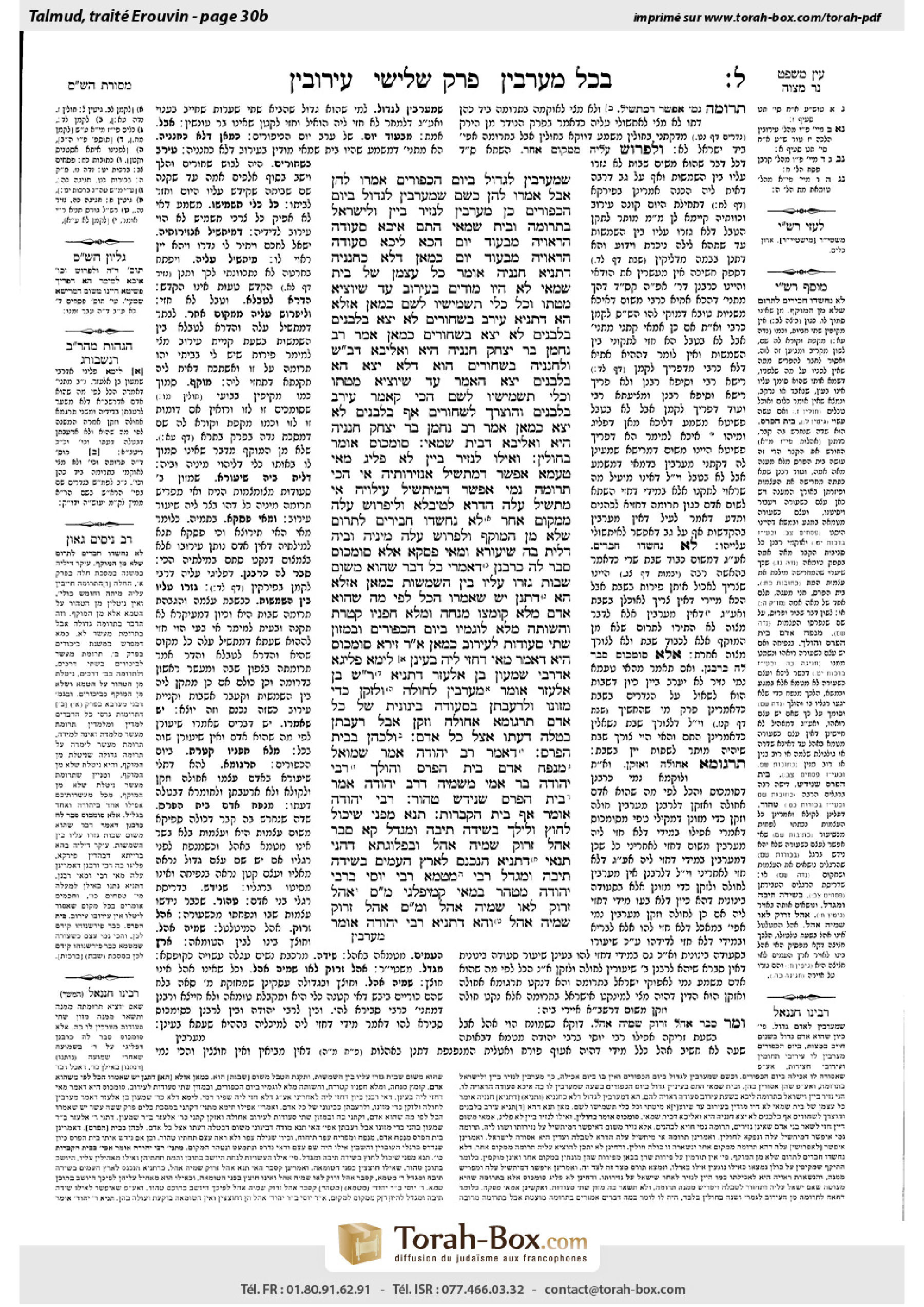
Eruvin 30b: Talmud study for Daf Yomi
Study the Talmud for Daf Yomi with scanned pages, Hebrew text, English translations from Sefaria and AI-generated French translations.
Passage selection and English or AI-generated French translation are available where the scan has annotations. Daf Study is independent of Torah-Box and Sefaria.
Browse Eruvin · עירובין · All tractatesEruvin 30b text and translations
This page of Eruvin includes the Aramaic text, an English translation and an AI-generated French translation, alongside the scan above.
עירובין ל׳ ב · Aramaic and Hebrew text
שֶׁמְּעָרְבִין לְגָדוֹל בְּיוֹם הַכִּפּוּרִים!
אָמְרוּ לָהֶן: אֲבָל! אָמְרוּ לָהֶן: כְּשֵׁם שֶׁמְּעָרְבִין לַגָּדוֹל בְּיוֹם הַכִּפּוּרִים, כֵּן מְעָרְבִין לַנָּזִיר בְּיַיִן וּלְיִשְׂרָאֵל בִּתְרוּמָה.
וּבֵית שַׁמַּאי: הָתָם — אִיכָּא סְעוּדָה הָרְאוּיָה מִבְּעוֹד יוֹם, הָכָא — לֵיכָּא סְעוּדָה הָרְאוּיָה מִבְּעוֹד יוֹם.
כְּמַאן? דְּלָא כַּחֲנַנְיָה. דְּתַנְיָא, חֲנַנְיָה אוֹמֵר: כׇּל עַצְמָן שֶׁל בֵּית שַׁמַּאי לֹא הָיוּ מוֹדִים בְּעֵירוּב עַד שֶׁיּוֹצִיא מִטָּתוֹ וְכׇל כְּלֵי תַּשְׁמִישָׁיו לְשָׁם.
כְּמַאן אָזְלָא הָא דְּתַנְיָא: עֵירַב בִּשְׁחוֹרִים לֹא יֵצֵא בִּלְבָנִים, בִּלְבָנִים לֹא יֵצֵא בִּשְׁחוֹרִים. כְּמַאן? אָמַר רַב נַחְמָן בַּר יִצְחָק: חֲנַנְיָה הִיא, וְאַלִּיבָּא דְּבֵית שַׁמַּאי.
וְלַחֲנַנְיָה, בִּשְׁחוֹרִים הוּא דְּלֹא יֵצֵא, הָא בִּלְבָנִים יֵצֵא? הָאָמַר עַד שֶׁיּוֹצִיא מִטָּתוֹ וּכְלֵי תַּשְׁמִישָׁיו לְשָׁם! הָכִי קָאָמַר: עֵירַב בִּלְבָנִים וְהוּצְרַךְ לִשְׁחוֹרִים, אַף בִּלְבָנִים לֹא יֵצֵא. כְּמַאן? אָמַר רַב נַחְמָן בַּר יִצְחָק: חֲנַנְיָה הִיא, וְאַלִּיבָּא דְּבֵית שַׁמַּאי.
סוֹמְכוֹס אוֹמֵר בְּחוּלִּין. וְאִילּוּ לַנָּזִיר בְּיַיִן לָא פְּלִיג, מַאי טַעְמָא — אֶפְשָׁר דְּמִתְּשִׁיל אַנְּזִירוּתֵיהּ.
אִי הָכִי, תְּרוּמָה נָמֵי אֶפְשָׁר דְּמִיתְּשִׁיל עִילָּוָיהּ? אִי מִתְּשִׁיל עֲלַהּ — הָדְרָא לְטִיבְלָא.
וְלַיפְרוֹשׁ עֲלַהּ מִמָּקוֹם אַחֵר? לָא נֶחְשְׁדוּ חֲבֵירִים לִתְרוֹם שֶׁלֹּא מִן הַמּוּקָּף.
וְלַפְרוֹשׁ עֲלַהּ מִינֵּיהּ וּבֵיהּ! דְּלֵית בַּהּ שִׁיעוּרָא.
וּמַאי פַּסְקָא? אֶלָּא, סוֹמְכוֹס סָבַר לַהּ כְּרַבָּנַן דְּאָמְרִי: כׇּל דָּבָר שֶׁהוּא מִשּׁוּם שְׁבוּת גָּזְרוּ עָלָיו בֵּין הַשְּׁמָשׁוֹת.
כְּמַאן אָזְלָא הָא דִּתְנַן: יֵשׁ שֶׁאָמְרוּ הַכֹּל לְפִי מַה שֶּׁהוּא אָדָם. מְלֹא קוּמְצוֹ מִנְחָה, וּמְלֹא חׇפְנָיו קְטֹרֶת, וְהַשּׁוֹתֶה מְלֹא לוּגְמָיו בְּיוֹם הַכִּפּוּרִים, וּבִמְזוֹן שְׁתֵּי סְעוּדוֹת לְעֵירוּב. כְּמַאן? אָמַר רַבִּי זֵירָא: סוֹמְכוֹס הִיא, דְּאָמַר: מַאי דַּחֲזֵי לֵיהּ בָּעִינַן.
לֵימָא פְּלִיגָא אַדְּרַבִּי שִׁמְעוֹן בֶּן אֶלְעָזָר, דְּתַנְיָא, רַבִּי שִׁמְעוֹן בֶּן אֶלְעָזָר אוֹמֵר: מְעָרְבִין לְחוֹלֶה וּלְזָקֵן כְּדֵי מְזוֹנוֹ, וּלְרַעַבְתָן בִּסְעוּדָה בֵּינוֹנִית שֶׁל כׇּל אָדָם!
תַּרְגּוּמָא, אַחוֹלֶה וְזָקֵן. אֲבָל רַעַבְתָן, בָּטְלָה דַּעְתּוֹ אֵצֶל כׇּל אָדָם.
וְלַכֹּהֵן בְּבֵית הַפְּרָס. דְּאָמַר רַב יְהוּדָה אָמַר שְׁמוּאֵל: מְנַפֵּחַ אָדָם בֵּית הַפְּרָס וְהוֹלֵךְ. רַבִּי יְהוּדָה בַּר אַמֵּי מִשְּׁמֵיהּ דְּרַב יְהוּדָה אָמַר: בֵּית הַפְּרָס שֶׁנִּידַּשׁ — טָהוֹר.
רַבִּי יְהוּדָה אוֹמֵר: אַף בֵּית הַקְּבָרוֹת. תָּנָא: מִפְּנֵי שֶׁיָּכוֹל לָחוֹץ וְלֵילֵךְ בְּשִׁידָּה תֵּיבָה וּמִגְדָּל. קָא סָבַר: אֹהֶל זָרוּק שְׁמֵיהּ אֹהֶל.
וּבִפְלוּגְתָּא דְהָנֵי תַנָּאֵי, דְּתַנְיָא: הַנִּכְנָס לְאֶרֶץ הָעַמִּים בְּשִׁידָּה תֵּיבָה וּמִגְדָּל — רַבִּי מְטַמֵּא, רַבִּי יוֹסֵי בְּרַבִּי יְהוּדָה מְטַהֵר.
בְּמַאי קָמִיפַּלְגִי? מָר סָבַר אֹהֶל זָרוּק לָאו שְׁמֵיהּ אֹהֶל, וּמָר סָבַר אֹהֶל זָרוּק שְׁמֵיהּ אֹהֶל.
וְהָא דְּתַנְיָא, רַבִּי יְהוּדָה אוֹמֵר:
Eruvin 30b · English translation
that one may establish an eiruv for an adult even on Yom Kippur, despite the fact that he may not eat on Yom Kippur? It must be because eating is permitted to a minor.
Beit Shammai said to them: Indeed [aval], it is so. Beit Hillel said to them: Just as one may establish an eiruv for an adult on Yom Kippur, so too, one may establish an eiruv for a nazirite with wine and for an Israelite with teruma.
And how do Beit Shammai explain the difference between these cases? The Gemara explains: There, with regard to Yom Kippur, there is at least a meal that was fit to be eaten by that person while it was still day, on the eve of Yom Kippur. Here, in the cases of wine for a nazirite and teruma for an Israelite, there is no meal that was fit to be eaten by them while it was still day, on Friday.
The Gemara asks: In accordance with whose opinion was that entire baraita stated? It was not taught in accordance with the opinion of Ḥananya, as it was taught in another baraita that Ḥananya says: The whole view of Beit Shammai, i.e., their fundamental position, was that they did not concede to the very possibility of joining Shabbat borders [eiruv teḥumin] by simply placing food in a particular location. Rather, they hold that one’s Shabbat residence remains the same until he literally moves his residence, such as if he carries out his bed and his utensils to there, to a new location.
The Gemara asks: In accordance with whose opinion is the ruling that was taught in the following baraita: If one established an eiruv in black clothing, and Shabbat commenced while he was still dressed those clothes, he may not go out in white clothing. If one established the eiruv while dressed in white, he may not go out in black. According to whose opinion is this halakha? Rav Naḥman bar Yitzḥak said: It is the opinion of Ḥananya, and it is in accordance with the opinion of Beit Shammai.
The Gemara asks: And according to the opinion of Ḥananya, is it with black clothing that he may not go out, but in white clothing he may go out? Didn’t Ḥananya say that according to Beit Shammai an eiruv is not effective at all until one carries out his bed and his utensils to the place he wishes to establish as his residence? The Gemara answers: The wording of the baraita must be emended and this is what it said: If one established an eiruv while dressed in white clothing, and he needed black clothing but did not have it with him, he may not go out even in white clothing. In accordance with whose opinion was this baraita taught? Rav Naḥman bar Yitzḥak said: It is the opinion of Ḥananya, and it is in accordance with the opinion of Beit Shammai.
We learned in the mishna: Summakhos disagrees and says: One may not establish an eiruv for an Israelite with teruma, but only with regular, non-sacred food items. The Gemara notes: But with regard to the mishna’s ruling that an eiruv may be established for a nazirite with wine, Summakhos does not appear to disagree. What is the reason for the distinction? The Gemara explains: A nazirite can ask a Sage to annul his vow and release him from his nazirite status, and then he himself will be able to drink the wine.
The Gemara asks: If so, in the case of teruma as well, one can ask a Sage to annul its status. Teruma is consecrated through a verbal declaration by the one separating it, and that declaration, like other consecrations and vows, can be nullified by a Sage. The Gemara answers: Such a course of action would not help. If one asks a Sage to annul his declaration that turned the produce into teruma, the produce will return to its status as tevel, produce from which the requisite dues and tithes were not separated, and he will still be prohibited to consume it.
The Gemara asks: Let him separate teruma for that produce from produce located somewhere else and thus permit it to be eaten. The Gemara answers: Ḥaverim, members of a group dedicated to the precise observance of mitzvot, are not suspected of separating teruma from produce that is not situated near the produce it comes to exempt, as this is prohibited ab initio.
The Gemara asks: Let him separate teruma from the produce used for the eiruv itself and consequently permit the rest of the produce to be eaten. The Gemara answers: We are dealing with a case where, after removing teruma, it would not contain the amount required for an eiruv, i.e., one would be left with less than the quantity of food sufficient for two meals.
The Gemara asks: What makes it necessary to say that the mishna is referring to this very unique case? Rather, we must retract all that was stated above and say as follows: Summakhos agrees with the opinion of the Rabbis, who say: Anything that is prohibited on Shabbat due to a rabbinic decree [shevut], the Sages issued the decree to apply even during twilight. Even though this period is of questionable status with regard to whether it is day or night, the Shabbat restrictions instituted by the Sages apply then as they do on Shabbat itself. Consequently, since it is prohibited to separate teruma on Shabbat, it is prohibited during the twilight period as well. Therefore, during twilight, when the eiruv would go into effect, it is impossible to cause it to become permitted to an Israelite.
The Gemara now asks: In accordance with whose opinion is the ruling that we learned in the following mishna: There are halakhot with regard to which they stated that measures are all in accordance with the particular person involved, e.g., the handful of flour that a priest scoops out from a meal-offering, and the handfuls of incense the High Priest would offer on Yom Kippur, and one who drinks a cheekful on Yom Kippur, and with regard to the measure of two meals’ worth of nourishment for an eiruv. All these measures are determined by the particular individual involved. In accordance with whose opinion is this halakha? Rabbi Zeira said: It is in accordance with the opinion of Summakhos, who said: We require that which is fit for him, the particular individual, and we do not follow a standard measure.
The Gemara suggests: Let us say that the aforementioned mishna disagrees with the opinion of Rabbi Shimon ben Elazar. As it was taught in a baraita: Rabbi Shimon ben Elazar says: One may establish an eiruv for an ill or elderly person with an amount of food that is enough for him for two meals; and if he eats less than the average amount due to his sickness or age, a smaller amount of food is sufficient. But for a glutton we do not require food in an amount that would satisfy him; we measure on the basis of an average meal for the typical person.
The Gemara answers: When the mishna says that the measure of food for two meals is determined by the particular person involved, interpret that as referring to an ill or elderly person. But with regard to a glutton, we do not determine the measure of food by his standard for a different reason, namely because his opinion is rendered irrelevant by the opinions of all other people. Therefore, there is no reason to be stringent with him and determine the measure according to his particular needs.
We learned in the mishna: One may establish an eiruv for a priest in a beit haperas, an area in which there is doubt concerning the location of a grave or a corpse. The Gemara explains that the reason for this is as Rav Yehuda said that Shmuel said: In a time of need a person may blow on the dust in a beit haperas before taking each step, so that if there is a bone beneath the dust he will expose it and avoid it, and he may thus walk across the area. Similarly, Rabbi Yehuda bar Ami said in the name of Rav Yehuda: A beit haperas that has been trodden underfoot, creating a path, is pure, as we assume that it no longer contains any bones as large as a kernel of barley. Both of these statements indicate that the ritual impurity of a beit haperas is a stringency decreed by the Sages. Therefore, since there is a way to avoid becoming ritually impure there, even a priest may place his eiruv in a beit haperas.
We learned in the mishna that Rabbi Yehuda says: An eiruv may be established for a priest even in a cemetery, an area which the priest may not enter by Torah law. It was taught: This is permitted because the priest can interpose and walk between the graves inside a carriage, a crate, or a cupboard. These containers do not contract impurity because of their large size, and anything found inside of them remains pure. From here we see that he holds the following: A moving tent is called a tent, and therefore the carriage, box, or cupboard are also considered tents. They shield a person carried in them from the impurity imparted by the graves in a cemetery.
The Gemara notes that this matter is the subject of a dispute between the following tanna’im, as it was taught in a baraita: With regard to one who enters the land of the nations, i.e., any territory outside Eretz Yisrael, not on foot, but in a carriage, a crate, or a cupboard, Rabbi Yehuda HaNasi renders him ritually impure. Rabbi Yosei, son of Rabbi Yehuda, renders him pure.
The Gemara explains: With regard to what do they disagree? One Sage, Rabbi Yehuda HaNasi, holds that a moving tent is not called a tent. The principle is that only something fixed can shield against ritual impurity, but if one is situated inside a portable vessel, the vessel contracts impurity and he becomes impure along with it. And the other Sage, Rabbi Yosei, son of Rabbi Yehuda, holds that a moving tent is called a tent, and it shields the person inside from contracting ritual impurity.
And with regard to that which was taught in a baraita: Rabbi Yehuda says:
Eruvin 30b · Traduction française (IA)
que l'on puisse établir un eiruv pour un adulte même le jour de l'Expiation, malgré le fait qu'il ne puisse pas manger le jour de l'Expiation ? Cela doit être parce que manger est permis à un mineur.
Beit Shammai a dit à eux : En effet [aval], c'est ainsi. Beit Hillel a dit à eux : Comme l'on peut établir un eiruv pour un adulte le jour de l'Expiation, ainsi l'on peut établir un eiruv pour un nazir avec du vin et pour un Israélite avec la terouma.
Et comment Beit Shammai explique-t-il la différence entre ces cas ? La Guemara explique : Là, concernant le jour de l'Expiation, il y a au moins un repas qui était propre à être mangé par cette personne alors qu'il était encore jour, le soir du jour de l'Expiation. Ici, dans les cas du vin pour un nazir et de la terouma pour un Israélite, il n'y a pas de repas qui était propre à être mangé par eux alors qu'il était encore jour, le samedi.
La Guemara demande : Selon l'opinion de qui a été formulée cette baraïta ? Elle n'a pas été enseignée selon l'opinion de Hananya, comme il a été enseigné dans une autre baraïta que Hananya dit : L'ensemble de la position de Beit Shammai, c'est-à-dire leur position fondamentale, était qu'ils ne reconnaissaient pas la possibilité de joindre les limites du Shabbat [eiruv teḥumin] simplement en plaçant de la nourriture dans un lieu particulier. Ils considéraient plutôt que la résidence du Shabbat reste la même jusqu'à ce qu'on déplace physiquement sa résidence, comme si on transportait son lit et ses ustensiles vers un nouveau lieu.
La Guemara demande : Selon l'opinion de qui est la décision enseignée dans la baraïta suivante : Si l'on a établi un eiruv en vêtements noirs, et que le Shabbat est commencé alors qu'il était encore vêtu de ces vêtements, il ne peut pas sortir en vêtements blancs. Si l'on a établi l'eiruv en vêtements blancs, il ne peut pas sortir en vêtements noirs. Selon l'opinion de qui est cette halakha ? Rav Naḥman bar Yitzḥak a dit : C'est l'opinion de Hananya, et c'est selon l'opinion de Beit Shammai.
La Guemara demande : Et selon l'opinion de Hananya, est-ce que c'est avec des vêtements noirs qu'il ne peut pas sortir, mais avec des vêtements blancs il peut sortir ? N'a-t-il pas dit Hananya que selon Beit Shammai un eiruv n'est pas efficace du tout jusqu'à ce qu'on transporte son lit et ses ustensiles vers le lieu où il souhaite établir sa résidence ? La Guemara répond : La formulation de la baraïta doit être corrigée et c'est ce que dit : Si l'on a établi un eiruv en vêtements blancs, et qu'il a besoin de vêtements noirs mais n'en a pas avec lui, il ne peut pas sortir même en vêtements blancs. Selon l'opinion de qui a été enseignée cette baraïta ? Rav Naḥman bar Yitzḥak a dit : C'est l'opinion de Hananya, et c'est selon l'opinion de Beit Shammai.
Nous avons appris dans la mishna : Summakhos s'oppose et dit : On ne peut pas établir un eiruv pour un Israélite avec de la terouma, mais seulement avec des aliments ordinaires, non sacrés. La Guemara note : Mais concernant la décision de la mishna qui permet d'établir un eiruv pour un nazir avec du vin, Summakhos ne semble pas s'opposer. Quelle est la raison de cette distinction ? La Guemara explique : Un nazir peut demander à un Sage d'annuler son serment et de le libérer de son statut de nazir, et alors lui-même pourra boire du vin.
La Guemara demande : Si c'est ainsi, dans le cas de la terouma également, on peut demander à un Sage d'annuler sa déclaration. La terouma est consacrée par une déclaration verbale par celui qui la sépare, et cette déclaration, comme d'autres consacrations et serments, peut être annulée par un Sage. La Guemara répond : Une telle action ne serait pas utile. Si l'on demande à un Sage d'annuler sa déclaration qui a transformé les produits en terouma, les produits retourneront à leur statut de tevel, produits dont les impôts et les dîmes n'ont pas été séparés, et il restera interdit de les consommer.
La Guemara demande : Laissez-le séparer la terouma pour ces produits à partir de produits situés ailleurs et ainsi permettre leur consommation. La Guemara répond : Les Ḥaverim, membres d'un groupe dédié à l'observation précise des mitsvot, ne sont pas soupçonnés de séparer la terouma à partir de produits situés loin de ceux qu'ils veulent exempter, car cela est interdit dès le départ.
La Guemara demande : Que l'on sépare la terouma à partir des produits utilisés pour l'eiruv lui-même et ainsi permette la consommation du reste des produits. La Guemara répond : Nous traitons d'un cas où, après avoir retiré la terouma, il ne resterait pas la quantité nécessaire pour un eiruv, c'est-à-dire qu'on resterait avec moins de la quantité de nourriture suffisante pour deux repas.
La Guemara demande : Qu'est-ce qui rend nécessaire de dire que la mishna fait référence à ce cas unique ? Plutôt, nous devons retraiter tout ce qui a été dit ci-dessus et dire comme suit : Summakhos est d'accord avec l'opinion des Rabbins, qui disent : Tout ce qui est interdit le Shabbat en raison d'un décret rabbinique [shevut], les Sages ont émis ce décret pour s'appliquer même pendant le crépuscule. Même si cette période est de statut incertain concernant si c'est jour ou nuit, les restrictions du Shabbat instituées par les Sages s'appliquent alors comme elles le font le Shabbat lui-même. Ainsi, puisque séparer la terouma est interdit le Shabbat, il est interdit aussi pendant la période du crépuscule. Par conséquent, pendant le crépuscule, lorsque l'eiruv entrerait en vigueur, il serait impossible de le rendre permis à un Israélite.
La Guemara demande maintenant : Selon l'opinion de qui est la décision que nous avons apprise dans la mishna suivante : Il y a des halakhot selon lesquelles ils ont dit que les mesures sont toutes selon la personne concernée, par exemple, la quantité de farine que le prêtre retire d'une offrande de table, et les quantités d'encens que le Grand Prêtre offrait le jour de l'Expiation, et celui qui boit une gorgée le jour de l'Expiation, et concernant la mesure de deux repas de nourriture pour un eiruv. Toutes ces mesures sont déterminées par la personne concernée. Selon l'opinion de qui est cette halakha ? Rabbi Zeira a dit : C'est selon l'opinion de Summakhos, qui a dit : Nous exigeons ce qui est propre à lui, la personne concernée, et nous ne suivons pas une mesure standard.
La Guemara suggère : Disons que la michna mentionnée précédemment est en désaccord avec l'opinion du Rabbi Shimon ben Elazar. Comme il a été enseigné dans une baraïta : Le Rabbi Shimon ben Elazar dit : On peut établir un eiruv pour une personne malade ou âgée avec une quantité de nourriture suffisante pour deux repas ; et si cette personne mange moins que la quantité moyenne en raison de sa maladie ou de son âge, une quantité de nourriture plus petite suffit. Mais pour un gourmand, nous ne requirons pas une quantité de nourriture suffisante pour lui ; nous mesurons en fonction d'un repas moyen pour une personne typique.
La Guemara répond : Lorsque la michna dit que la quantité de nourriture pour deux repas est déterminée par la personne concernée, interprétez cela comme se référant à une personne malade ou âgée. Mais concernant un gourmand, nous ne déterminons pas la quantité de nourriture en fonction de son propre standard pour une autre raison, à savoir que son opinion est rendue inutile par l'opinion de toutes les autres personnes. Par conséquent, il n'y a pas de raison de se montrer strict avec lui et de déterminer la quantité en fonction de ses besoins particuliers.
Nous avons appris dans la michna : On peut établir un eiruv pour un prêtre dans un beit haperas, une zone dans laquelle il y a doute concernant la localisation d'un sépulcre ou d'un cadavre. La Guemara explique que la raison de cela est comme Rav Yehuda a dit que Shmuel a dit : En temps de besoin, une personne peut souffler sur la poussière dans un beit haperas avant de prendre chaque pas, de sorte qu'en cas de présence d'un os sous la poussière, il le découvre et l'évite, et peut ainsi marcher dans la zone. De même, Rabbi Yehuda bar Ami a dit en nom de Rav Yehuda : Un beit haperas qui a été foulé, créant un chemin, est pur, car nous supposons qu'il ne contient plus d'os aussi grands qu'un grain de blé. Ces deux déclarations indiquent que l'impureté rituelle d'un beit haperas est une stricte déclaration des Sages. Par conséquent, puisque il existe un moyen d'éviter l'impureté rituelle dans cette zone, même un prêtre peut placer son eiruv dans un beit haperas.
Nous avons appris dans la michna que Rabbi Yehuda dit : On peut établir un eiruv pour un prêtre même dans un cimetière, une zone où le prêtre ne peut pas entrer selon la loi torahique. Il a été enseigné : Cela est permis car le prêtre peut interposer et marcher entre les sépultures à l'intérieur d'une charrette, d'une caisse ou d'un armoire. Ces conteneurs ne contractent pas l'impureté en raison de leur grande taille, et tout ce qui est trouvé à l'intérieur reste pur. De là, nous voyons qu'il tient le suivant : Un tentérieur mobile est appelé un tentérieur, et par conséquent, la charrette, la caisse ou l'armoire sont également considérés comme des tentes. Ils protègent une personne transportée à l'intérieur d'avec l'impureté transmise par les sépultures dans un cimetière.
La Guemara note que cette question est l'objet d'un débat entre les tannaïm suivants, comme il a été enseigné dans une baraïta : Concernant celui qui entre dans la terre des nations, c'est-à-dire tout territoire en dehors d'Israël, non à pied, mais dans une charrette, une caisse ou un armoire, Rabbi Yehuda HaNasi le rend rituellement impur. Rabbi Yosei, fils de Rabbi Yehuda, le rend pur.
La Guemara explique : Concernant quoi se disputent-ils ? Un Sage, Rabbi Yehuda HaNasi, considère qu'un tentérieur mobile n'est pas appelé un tentérieur. Le principe est que seul quelque chose fixe peut protéger contre l'impureté rituelle, mais si l'on est situé à l'intérieur d'un vaisseau portable, le vaisseau contracte l'impureté et l'individu devient impur avec lui. Et l'autre Sage, Rabbi Yosei, fils de Rabbi Yehuda, considère qu'un tentérieur mobile est appelé un tentérieur, et il protège la personne à l'intérieur de contracter l'impureté rituelle.
Et concernant ce qui a été enseigné dans une baraïta : Rabbi Yehuda dit :
Traduction française générée par IA à partir de l’édition anglaise de Sefaria. Vérifie toujours un passage avec le texte source.
Text from Sefaria: William Davidson Edition - Vocalized Aramaic (CC BY NC); William Davidson Edition - English (CC BY NC).