Eruvin 31a: Talmud study for Daf Yomi
Study the Talmud for Daf Yomi with scanned pages, Hebrew text, English translations from Sefaria and AI-generated French translations.
Passage selection and English or AI-generated French translation are available where the scan has annotations. Daf Study is independent of Torah-Box and Sefaria.
Browse Eruvin · עירובין · All tractatesEruvin 31a text and translations
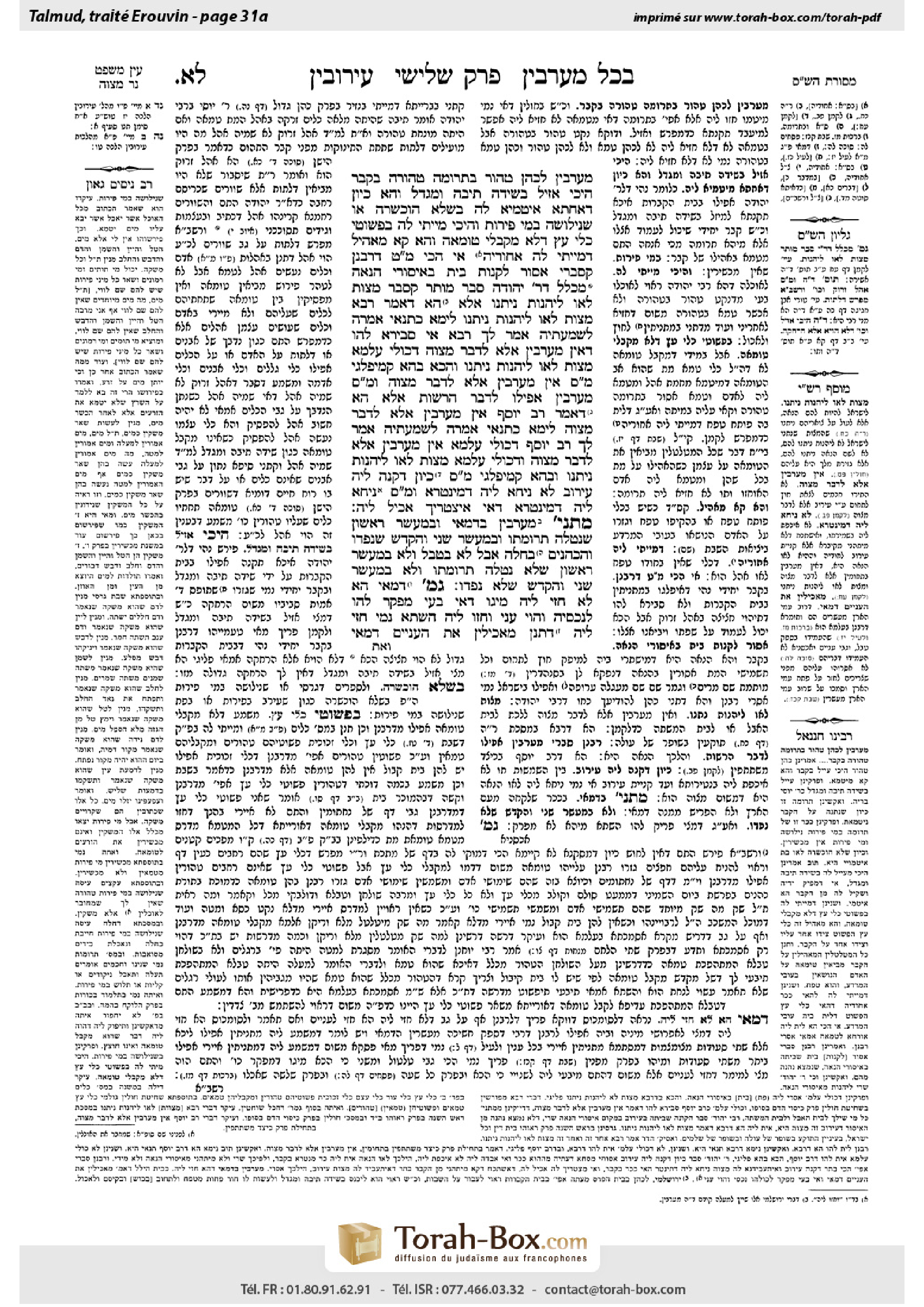
This page of Eruvin includes the Aramaic text, an English translation and an AI-generated French translation, alongside the scan above.
עירובין ל״א א · Aramaic and Hebrew text
מְעָרְבִין לְכֹהֵן טָהוֹר בִּתְרוּמָה טְהוֹרָה בְּקֶבֶר, הֵיכִי אָזֵיל? בְּשִׁידָּה תֵּיבָה וּמִגְדָּל.
וְהָא כֵּיוָן דְּאַחֲתָא אִיטַּמְּיָא לַהּ! בְּשֶׁלֹּא הוּכְשְׁרָה, אוֹ שֶׁנִּילּוֹשָׁה בְּמֵי פֵּירוֹת.
וְהֵיכִי מַיְיתֵי לַהּ? בִּפְשׁוּטֵי כְלֵי עֵץ דְּלָא מְקַבְּלִי טוּמְאָה.
וְהָא קָא מַאֲהִיל?! דְּמַיְיתֵי לַהּ אֲחוֹרֵיהּ.
אִי הָכִי, מַאי טַעְמָא דְּרַבָּנַן? קָסָבְרִי: אָסוּר לִקְנוֹת בַּיִת בְּאִיסּוּרֵי הֲנָאָה.
מִכְּלָל דְּרַבִּי יְהוּדָה סָבַר מוּתָּר? קָסָבַר: מִצְוֹת לָאו לֵיהָנוֹת נִיתְּנוּ.
אֶלָּא הָא דְּאָמַר רָבָא: מִצְוֹת לָאו לֵיהָנוֹת נִיתְּנוּ, לֵימָא כְּתַנָּאֵי אַמְרַהּ לִשְׁמַעְתֵּיהּ?! אָמַר לָךְ רָבָא: אִי סְבִירָא לְהוּ דְּאֵין מְעָרְבִין אֶלָּא לִדְבַר מִצְוָה — דְּכוּלֵּי עָלְמָא מִצְוֹת לָאו לֵיהָנוֹת נִיתְּנוּ. וְהָכָא בְּהָא קָמִיפַּלְגִי: מָר סָבַר אֵין מְעָרְבִין אֶלָּא לִדְבַר מִצְוָה, וּמָר סָבַר מְעָרְבִין אֲפִילּוּ לִדְבַר הָרְשׁוּת.
אֶלָּא הָא דְּאָמַר רַב יוֹסֵף: אֵין מְעָרְבִין אֶלָּא לִדְבַר מִצְוָה, לֵימָא כְּתַנָּאֵי אַמְרַהּ לִשְׁמַעְתֵּיהּ?
אָמַר לְךָ רַב יוֹסֵף: דְּכוּלֵּי עָלְמָא אֵין מְעָרְבִין אֶלָּא לִדְבַר מִצְוָה, וּדְכוּלֵּי עָלְמָא מִצְוֹת לָאו לֵיהָנוֹת נִיתְּנוּ, וּבְהָא קָמִיפַּלְגִי: מָר סָבַר כֵּיוָן דִּקְנָה לֵיהּ עֵירוּב — לָא נִיחָא לֵיהּ דְּמִינַּטְרָא. וּמָר סָבַר — נִיחָא לֵיהּ דְּמִינַּטְרָא, דְּאִי אִיצְטְרִיךְ אָכֵיל לֵיהּ.
מַתְנִי׳ מְעָרְבִין בִּדְמַאי, וּבְמַעֲשֵׂר רִאשׁוֹן שֶׁנִּטְּלָה תְּרוּמָתוֹ, וּבְמַעֲשֵׂר שֵׁנִי וְהֶקְדֵּשׁ שֶׁנִּפְדּוּ, וְהַכֹּהֲנִים בְּחַלָּה.
אֲבָל לֹא בְּטֶבֶל, וְלֹא בְּמַעֲשֵׂר רִאשׁוֹן שֶׁלֹּא נִטְּלָה תְּרוּמָתוֹ, וְלֹא בְּמַעֲשֵׂר שֵׁנִי וְהֶקְדֵּשׁ שֶׁלֹּא נִפְדּוּ.
גְּמָ׳ דְּמַאי, הָא לָא חֲזֵי לֵיהּ? מִיגּוֹ דְּאִי בָּעֵי מַפְקַר לְהוּ לְנִכְסֵיהּ וְהָוֵי עָנִי וַחֲזוּ לֵיהּ — הַשְׁתָּא נָמֵי חֲזֵי לֵיהּ. דִּתְנַן: מַאֲכִילִין אֶת הָעֲנִיִּים דְּמַאי
Eruvin 31a · English translation
One may establish an eiruv for a priest who is ritually pure with teruma that is ritually pure and resting on a grave, even though the location is impure and he cannot reach it. How does he go there? In a carriage, crate, or cupboard, which shield him from the ritual impurity.
The Gemara asks: Isn’t it true that once the eiruv was placed directly on the grave, the teruma became defiled, and ritually impure teruma is not fit to be eaten by anyone? The Gemara answers: We are dealing here with a case where the teruma had not yet been rendered susceptible to ritual impurity, as it had not yet come into contact with a liquid. Produce that has yet to come into contact with a liquid does not contract impurity. Or we are dealing with bread that was kneaded with fruit juice, which is not one of the seven liquids that render a food susceptible to ritual impurity.
The Gemara now asks: How can he bring it from where it is resting on the grave in order to eat it? The Gemara answers: With flat wooden utensils that are not shaped as receptacles and therefore do not contract ritual impurity.
The Gemara asks: Doesn’t the utensil cover the grave? The Sages decreed that anyone who holds a utensil that is a handbreadth wide over a corpse or grave is ritually impure. The Gemara answers: He may bring it on the edge of the utensil while holding the utensil sideways so that it does not form a cover that is a handbreadth wide over the grave.
The Gemara asks: If that is so, and there is a way for the teruma to remain ritually pure and for the priest to access it, what is the reason the Sages disagreed with Rabbi Yehuda and did not allow an eiruv to be established for a priest on a grave? The Gemara answers: They hold that it is prohibited to acquire a home with items from which benefit is prohibited. It is prohibited to derive benefit from a grave. Since one acquires a place of residence for Shabbat by means of the eiruv, it would be as if the priest acquired a home for himself with something from which he may not derive benefit.
The Gemara asks: If so, does this prove by inference that Rabbi Yehuda holds that it is permitted to acquire a home with items from which benefit is prohibited? The Gemara answers: Rabbi Yehuda holds that mitzvot were not given for benefit. The fulfillment of a mitzva is not in itself considered a benefit. Since the acquisition of a place of residence by means of an eiruv is a mitzva, as one may establish an eiruv teḥumin only for the sake of a mitzva, it is even permitted to establish one’s eiruv in a place from which it is prohibited to benefit.
The Gemara suggests: But if so, with regard to that which Rava said: Mitzvot were not given for benefit, let us say that he stated his halakha only in accordance with the opinion of one side in a dispute between tanna’im. The Gemara answers that Rava could have said to you: If they hold that one may establish an eiruv only for the sake of a mitzva, all would agree that the eiruv may be placed on a grave because mitzvot were not given for benefit. However, the dispute between Rabbi Yehuda and the Sages centers on a different aspect of the issue. Here, they disagree with regard to this: One Sage, Rabbi Yehuda, holds: One may establish an eiruv only for the sake of a mitzva. Since mitzvot do not constitute forbidden benefit, it is therefore permitted to make use of the grave. And one Sage, i.e., the Rabbis, holds: One may establish an eiruv even for a voluntary matter. Establishing a Shabbat residence on the site of a grave by means of an eiruv made for a voluntary matter is regarded as forbidden benefit, and therefore it is prohibited.
The Gemara suggests: But if so, with regard to that which Rav Yosef said as a general principle: One may establish an eiruv only for the sake of a mitzva, let us say that he stated his halakha in accordance with one side in a dispute between the tanna’im.
The Gemara answers: Rav Yosef could have said to you: In fact, all agree that one may establish an eiruv only for the sake of a mitzva, and all agree that mitzvot were not given for benefit, and they disagree with regard to this: One Sage, Rabbi Yehuda, holds: Once he acquired his Shabbat residence at twilight by means of the eiruv, he is indifferent to its safeguarding, as his main goal has already been achieved. He has no further need for the food used for the eiruv, and therefore, he receives no benefit from its placement on the grave. And one Sage, i.e., the Rabbis, holds: It is pleasing to him that the eiruv is safeguarded, for if he needs it the next day, he can eat it. According to this opinion, he would be making prohibited use of the grave to preserve his meal for the following day, and therefore the Sages prohibited placing an eiruv on a grave.
MISHNA: One may establish an eiruv with demai, produce purchased from one who may not have separated the required tithes, and similarly, one may establish an eiruv with the first tithe whose teruma has been taken in order to be given to a priest, and with the second tithe and consecrated articles that have been redeemed; and priests may establish an eiruv with ḥalla, the portion of dough that must be given to a priest.
However, one may not establish an eiruv with tevel, produce from which the priestly dues [teruma] and other tithes have not been separated, nor with first tithe whose teruma, which must be given to a priest, has not been taken, nor with the second tithe or consecrated articles that have not been redeemed.
GEMARA: The Gemara asks: How can one establish an eiruv with demai? Isn’t it unfit for him? Since it is prohibited to eat demai, how can it be used as an eiruv? The Gemara answers: Since if he wants, he could declare his property ownerless, and he would be a poor person, and the demai would then be fit for him, as a poor person is permitted to eat demai, now too, even though he has not renounced ownership of his property, it is considered fit for him to use as an eiruv. As we learned in a mishna: One may feed the poor demai,
Eruvin 31a · Traduction française (IA)
On peut établir un eiruv pour un prêtre rituellement pur avec une terouma rituellement pure, reposant sur une tombe, même si le lieu est impur et qu'il ne peut pas y accéder. Comment va-t-il y arriver ? En chariot, en caisse ou en armoire, qui le protègent de l'impureté rituelle.
La Guemara demande : N'est-ce pas vrai que lorsque l'eiruv a été placé directement sur la tombe, la terouma est devenue impure, et que la terouma impure n'est pas propre à être mangée par quiconque ? La Guemara répond : Nous sommes en présence d'un cas où la terouma n'avait pas encore été rendue susceptible d'impureté rituelle, car elle n'avait pas encore été en contact avec un liquide. Les produits qui n'ont pas encore été en contact avec un liquide ne contractent pas d'impureté. Ou nous sommes en présence de pain pétri avec du jus de fruit, qui n'est pas l'un des sept liquides qui rendent un aliment susceptible d'impureté rituelle.
La Guemara demande alors : Comment peut-il l'apporter depuis le lieu où il repose sur la tombe pour le manger ? La Guemara répond : Avec des ustensiles en bois plat qui ne sont pas façonnés comme des récipients et qui ne contractent donc pas d'impureté rituelle.
La Guemara demande : N'est-ce pas que l'ustensile couvre la tombe ? Les Sages ont décrété que celui qui tient un ustensile d'un dactyle de large sur un cadavre ou une tombe devient impur. La Guemara répond : Il peut l'apporter sur le bord de l'ustensile en le tenant de côté de manière à ce qu'il ne forme pas un couvercle d'un dactyle de large sur la tombe.
La Guemara demande : Si c'est ainsi, et qu'il existe un moyen pour que la terouma reste pure rituellement et que le prêtre puisse l'atteindre, pourquoi les Sages ont-ils désaccordé avec Rabbi Yéhuda et n'ont-ils pas permis d'établir un eiruv pour un prêtre sur une tombe ? La Guemara répond : Ils considèrent que c'est interdit d'acquérir une maison avec des objets dont l'usage est interdit. Il est interdit d'exploiter une tombe. Puisque l'on acquiert un lieu de résidence pour le Shabbat par l'intermédiaire de l'eiruv, cela reviendrait à ce que le prêtre acquière une maison pour lui-même avec quelque chose d'où il ne peut pas tirer un bénéfice.
La Guemara demande : Si c'est ainsi, cela prouve-t-il par déduction que Rabbi Yéhuda considère que c'est permis d'acquérir une maison avec des objets dont l'usage est interdit ? La Guemara répond : Rabbi Yéhuda considère que les mitsvot n'ont pas été données pour le bénéfice. La réalisation d'une mitsva n'est pas elle-même considérée comme un bénéfice. Puisque l'acquisition d'un lieu de résidence par l'intermédiaire d'un eiruv est une mitsva, car on peut établir un eiruv teḥumin uniquement pour la mitsva, il est même permis d'établir son eiruv dans un lieu d'où il est interdit de tirer un bénéfice.
La Guemara suggère : Mais si c'est ainsi, concernant ce que Rava a dit : Les mitsvot n'ont pas été données pour le bénéfice, disons que cela s'applique uniquement selon l'opinion d'un côté d'un débat entre les tannaïm. La Guemara répond que Rava aurait pu dire à vous : Si ils considèrent que l'on peut établir un eiruv uniquement pour la mitsva, tous seraient d'accord que l'eiruv peut être placé sur une tombe car les mitsvot n'ont pas été données pour le bénéfice. Cependant, le débat entre Rabbi Yéhuda et les Sages porte sur un aspect différent de la question. Ici, ils s'opposent sur ceci : Un sage, Rabbi Yéhuda, considère que l'on peut établir un eiruv uniquement pour la mitsva. Puisque les mitsvot ne constituent pas un bénéfice interdit, il est donc permis d'utiliser la tombe. Et un autre sage, c'est-à-dire les Rabbins, considère que l'on peut établir un eiruv même pour une affaire volontaire. Établir une résidence du Shabbat sur le site d'une tombe par l'intermédiaire d'un eiruv établi pour une affaire volontaire est considéré comme un bénéfice interdit, et par conséquent, il est interdit.
La Guemara suggère : Mais si c'est ainsi, concernant ce que Rav Yosef a dit comme principe général : On peut établir un eiruv uniquement pour la mitsva, disons que cela s'applique selon l'opinion d'un côté d'un débat entre les tannaïm.
La Guemara répond : Rav Yosef aurait pu dire à vous : En réalité, tous s'accordent sur le fait que l'on peut établir un eiruv uniquement pour la mitsva, et tous s'accordent sur le fait que les mitsvot n'ont pas été données pour le bénéfice, et ils s'opposent sur ceci : Un sage, Rabbi Yéhuda, considère que lorsqu'il a acquis sa résidence du Shabbat à l'heure du crépuscule par l'intermédiaire de l'eiruv, il est indifférent à sa protection, car son objectif principal a déjà été atteint. Il n'a plus besoin des aliments utilisés pour l'eiruv, et par conséquent, il ne reçoit aucun bénéfice de sa mise sur la tombe. Et un autre sage, c'est-à-dire les Rabbins, considère qu'il est agréable à lui que l'eiruv soit protégé, car s'il en a besoin le lendemain, il peut le manger. Selon cette opinion, il ferait usage interdit de la tombe pour préserver son repas pour le lendemain, et par conséquent les Sages ont interdit de placer un eiruv sur une tombe.
MICHNA : On peut établir un eiruv avec demai, des produits achetés auprès de celui qui n'a pas séparé les dîmes nécessaires, et de même, on peut établir un eiruv avec la première dîme dont la terouma a été prise afin d'être donnée à un prêtre, et avec la deuxième dîme et les objets consacrés qui ont été rachetés ; et les prêtres peuvent établir un eiruv avec la challa, la part de pain qui doit être donnée à un prêtre.
Cependant, on ne peut pas établir un eiruv avec tevel, des produits dont les dîmes sacrées [terouma] et autres dîmes n'ont pas été séparées, ni avec la première dîme dont la terouma, qui doit être donnée à un prêtre, n'a pas été prise, ni avec la deuxième dîme ou les objets consacrés qui n'ont pas été rachetés.
GUEMARA : La Guemara demande : Comment peut-on établir un eiruv avec du demai ? N'est-ce pas inadapté ? Puisque c'est interdit de manger du demai, comment peut-il être utilisé comme eiruv ? La Guemara répond : Puisque s'il le veut, il peut déclarer ses biens comme appartenant à personne, et il deviendrait un pauvre, et le demai serait alors adapté à lui, car un pauvre est autorisé à manger du demai. Maintenant aussi, même s'il n'a pas renoncé à la propriété de ses biens, il est considéré comme adapté à l'utiliser comme eiruv. Comme nous avons appris dans une mitsva : On peut nourrir les pauvres avec du demai,
Traduction française générée par IA à partir de l’édition anglaise de Sefaria. Vérifie toujours un passage avec le texte source.
Text from Sefaria: William Davidson Edition - Vocalized Aramaic (CC BY NC); William Davidson Edition - English (CC BY NC).