Eruvin 31b: Talmud study for Daf Yomi
Study the Talmud for Daf Yomi with scanned pages, Hebrew text, English translations from Sefaria and AI-generated French translations.
Passage selection and English or AI-generated French translation are available where the scan has annotations. Daf Study is independent of Torah-Box and Sefaria.
Browse Eruvin · עירובין · All tractatesEruvin 31b text and translations
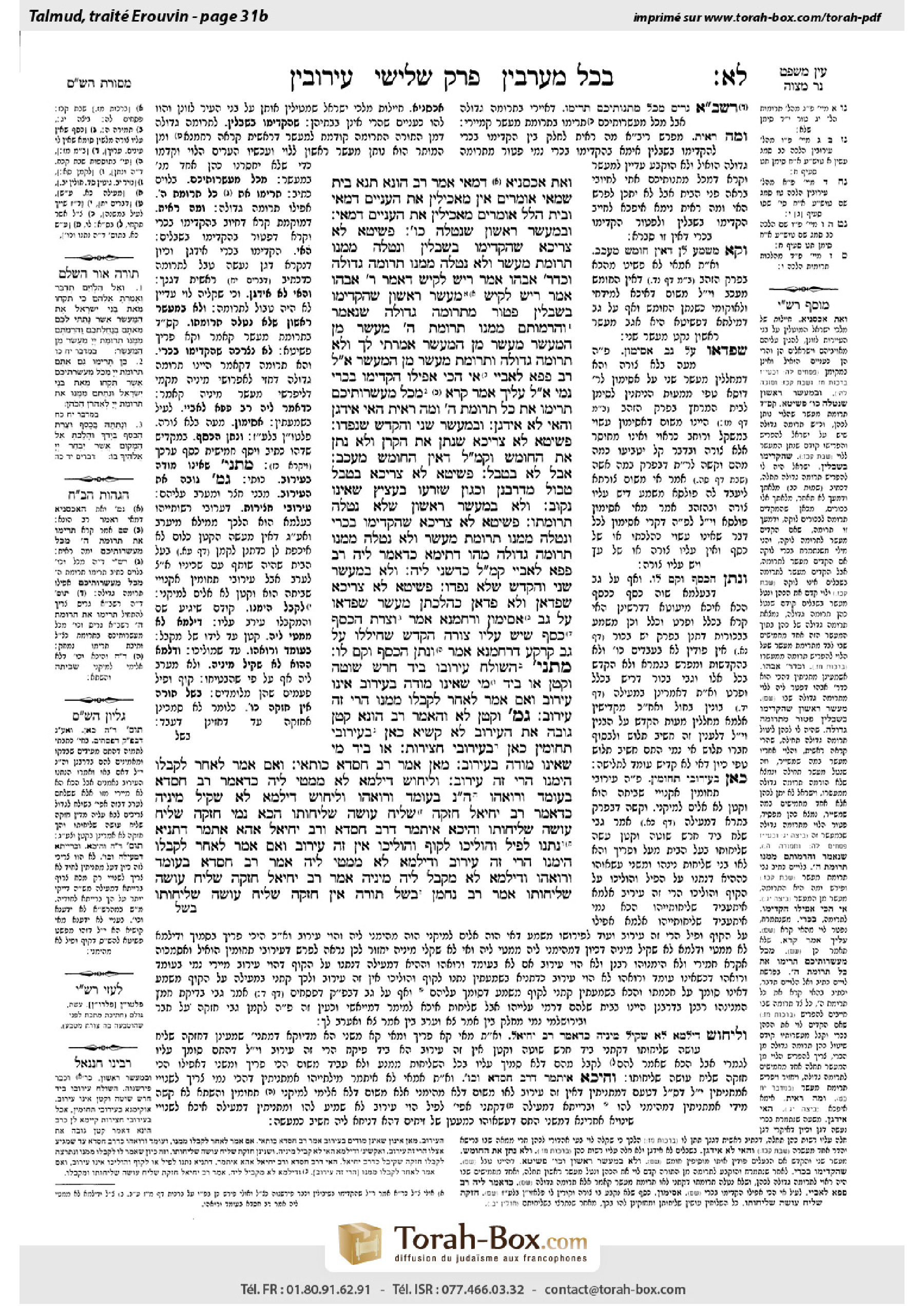
This page of Eruvin includes the Aramaic text, an English translation and an AI-generated French translation, alongside the scan above.
עירובין ל״א ב · Aramaic and Hebrew text
וְאֶת אַכְסַנְיָא דְּמַאי.
אָמַר רַב הוּנָא: תָּנָא, בֵּית שַׁמַּאי אוֹמְרִים: אֵין מַאֲכִילִין אֶת הָעֲנִיִּים דְּמַאי, וּבֵית הִלֵּל אוֹמְרִים: מַאֲכִילִין אֶת הָעֲנִיִּים דְּמַאי.
וּבְמַעֲשֵׂר רִאשׁוֹן שֶׁנִּטְּלָה כּוּ׳. פְּשִׁיטָא! לָא צְרִיכָא, שֶׁהִקְדִּימוֹ בְּשִׁבֳּלִין, וְנִטְּלָה מִמֶּנּוּ תְּרוּמַת מַעֲשֵׂר, וְלֹא נִטְּלָה מִמֶּנּוּ תְּרוּמָה גְּדוֹלָה.
וְכִדְרַבִּי אֲבָהוּ אָמַר רֵישׁ לָקִישׁ, דְּאָמַר רַבִּי אֲבָהוּ אָמַר רֵישׁ לָקִישׁ: מַעֲשֵׂר רִאשׁוֹן שֶׁהִקְדִּימוֹ בְּשִׁבֳּלִין — פָּטוּר מִתְּרוּמָה גְּדוֹלָה, שֶׁנֶּאֱמַר: ״וַהֲרֵמוֹתֶם מִמֶּנּוּ תְּרוּמַת ה׳ מַעֲשֵׂר מִן הַמַּעֲשֵׂר״. מַעֲשֵׂר מִן הַמַּעֲשֵׂר אָמַרְתִּי לְךָ, וְלֹא תְּרוּמָה גְּדוֹלָה וּתְרוּמַת מַעֲשֵׂר מִן הַמַּעֲשֵׂר.
אֲמַר לֵיהּ רַב פָּפָּא לְאַבָּיֵי: אִי הָכִי, אֲפִילּוּ הִקְדִּימוֹ בִּכְרִי נָמֵי! אֲמַר לֵיהּ: עָלֶיךָ אָמַר קְרָא: ״מִכֹּל מַעְשְׂרוֹתֵיכֶם תָּרִימוּ אֵת כׇּל תְּרוּמַת ה׳״.
וּמָה רָאִיתָ? הַאי — אִידְּגַן, וְהַאי — לָא אִידְּגַן.
וּבְמַעֲשֵׂר שֵׁנִי וְהֶקְדֵּשׁ שֶׁנִּפְדּוּ. פְּשִׁיטָא! לָא צְרִיכָא, שֶׁנָּתַן אֶת הַקֶּרֶן וְלֹא נָתַן אֶת הַחוֹמֶשׁ. וְקָא מַשְׁמַע לַן דְּאֵין הַחוֹמֶשׁ מְעַכֵּב.
אֲבָל לֹא בְּטֶבֶל. פְּשִׁיטָא! לָא צְרִיכָא, בְּטֶבֶל טָבוּל מִדְּרַבָּנַן, וּכְגוֹן שֶׁזְּרָעוֹ בְּעָצִיץ שֶׁאֵינוֹ נָקוּב.
וְלֹא בְּמַעֲשֵׂר רִאשׁוֹן שֶׁלֹּא נִטְּלָה תְּרוּמָתוֹ. פְּשִׁיטָא! לָא צְרִיכָא, שֶׁהִקְדִּימוֹ בִּכְרִי, וְנִטְּלָה מִמֶּנּוּ תְּרוּמַת מַעֲשֵׂר וְלֹא נִטְּלָה מִמֶּנּוּ תְּרוּמָה גְּדוֹלָה.
מַהוּ דְּתֵימָא כְּדַאֲמַר לֵיהּ רַב פָּפָּא לְאַבָּיֵי. קָא מַשְׁמַע לַן כִּדְשַׁנִּי לֵיהּ.
וְלֹא בְּמַעֲשֵׂר שֵׁנִי וְהֶקְדֵּשׁ שֶׁלֹּא נִפְדּוּ. פְּשִׁיטָא!
לָא צְרִיכָא, שֶׁפְּדָאָן, וְלֹא פְּדָאָן כְּהִלְכָתָן: מַעֲשֵׂר — שֶׁפְּדָאוֹ עַל גַּב אֲסִימוֹן, וְרַחֲמָנָא אָמַר: ״וְצַרְתָּ הַכֶּסֶף״ — כֶּסֶף שֶׁיֵּשׁ עָלָיו צוּרָה.
הֶקְדֵּשׁ — שֶׁחִילְּלוֹ עַל גַּב קַרְקַע, דְּרַחֲמָנָא אָמַר: ״וְנָתַן הַכֶּסֶף וְקָם לוֹ״.
מַתְנִי׳ הַשּׁוֹלֵחַ עֵירוּבוֹ בְּיַד חֵרֵשׁ שׁוֹטֶה וְקָטָן, אוֹ בְּיַד מִי שֶׁאֵינוֹ מוֹדֶה בְּעֵירוּב — אֵינוֹ עֵירוּב. וְאִם אָמַר לְאַחֵר לְקַבְּלוֹ מִמֶּנּוּ — הֲרֵי זֶה עֵירוּב.
גְּמָ׳ וְקָטָן לָא? וְהָאָמַר רַב הוּנָא: קָטָן גּוֹבֶה אֶת הָעֵירוּב! לָא קַשְׁיָא: כָּאן בְּעֵירוּבֵי תְּחוּמִין, כָּאן בְּעֵירוּבֵי חֲצֵירוֹת.
אוֹ בְּיַד מִי שֶׁאֵינוֹ מוֹדֶה בְּעֵירוּב. מַאן? אָמַר רַב חִסְדָּא: כּוּתָאֵי.
וְאִם אָמַר לְאַחֵר לְקַבְּלוֹ הֵימֶנּוּ, הֲרֵי זֶה עֵירוּב. וְלֵיחוּשׁ דִּילְמָא לָא מַמְטֵי לֵיהּ? כִּדְאָמַר רַב חִסְדָּא בְּעוֹמֵד וְרוֹאֵהוּ, הָכָא נָמֵי — בְּעוֹמֵד וְרוֹאֵהוּ.
וְלֵיחוּשׁ דִּילְמָא לָא שָׁקֵיל מִינֵּיהּ? כִּדְאָמַר רַב יְחִיאֵל: חֲזָקָה שָׁלִיחַ עוֹשֶׂה שְׁלִיחוּתוֹ, הָכָא נָמֵי — חֲזָקָה שָׁלִיחַ עוֹשֶׂה שְׁלִיחוּתוֹ.
וְהֵיכָא אִיתְּמַר דְּרַב חִסְדָּא וְרַב יְחִיאֵל? אַהָא אִתְּמַר, דְּתַנְיָא: נְתָנוֹ לַפִּיל וְהוֹלִיכוֹ, לַקּוֹף וְהוֹלִיכוֹ, אֵין זֶה עֵירוּב. וְאִם אָמַר לְאַחֵר לְקַבְּלוֹ הֵימֶנּוּ — הֲרֵי זֶה עֵירוּב. וְדִילְמָא לָא מַמְטֵי לֵיהּ? אָמַר רַב חִסְדָּא בְּעוֹמֵד וְרוֹאֵהוּ. וְדִילְמָא לָא מְקַבֵּל לֵיהּ מִינֵּיהּ? אָמַר רַב יְחִיאֵל: חֲזָקָה שָׁלִיחַ עוֹשֶׂה שְׁלִיחוּתוֹ.
אָמַר רַב נַחְמָן: בְּשֶׁל תּוֹרָה — אֵין חֲזָקָה שָׁלִיחַ עוֹשֶׂה שְׁלִיחוּתוֹ.
Eruvin 31b · English translation
and one may also feed soldiers demai.
Rav Huna said: It was taught that Beit Shammai say: One may not feed the impoverished demai. And Beit Hillel say: One may feed the impoverished demai. The halakha is in accordance with the opinion of Beit Hillel.
We learned in the mishna: One may establish an eiruv with first tithe whose teruma has been taken. The Gemara expresses surprise: It is obvious that if the teruma was already taken there is no problem. Why is it necessary to state it may be used for an eiruv? The Gemara answers: It is only necessary to teach this halakha in a case where the Levite preceded the priest while the grain was still on the stalks, i.e., the Levite took his tithe before the grain was threshed and before the priest took the teruma; and the teruma of the tithes was taken from it but teruma gedola was not taken from it. Therefore, since the teruma is generally separated first, a portion of the first tithe that the Levite took should have been separated as teruma.
And this is in accordance with the opinion that Rabbi Abbahu said that Reish Lakish said, as Rabbi Abbahu said that Reish Lakish said: First tithe, in a case where the Levite preceded the priest while the grain was still on the stalks, is exempt from teruma gedola, as it is stated: “And you shall set apart from it a gift for the Lord, even a tenth part of the tithe” (Numbers 18:26), from which the following inference is made: A tenth part of the tithe, i.e., the teruma of the tithe, I told you, the Levite, to separate. And I did not tell you to separate teruma gedola and the teruma of the tithe.
With regard to this matter, Rav Pappa said to Abaye: If so, even if the Levite preceded the priest after the kernels of grain were removed from the stalks and placed in a pile, the Levite should still not have to separate teruma gedola. Abaye said to him: With regard to your claim, the verse states: “From all that is given to you, you shall set apart that which is the Lord’s teruma” (Numbers 18:29). The inclusive phrase “from all” indicates that teruma gedola must be separated even from the first tithe in the case where the Levite precedes the priest after the grain has been collected in a pile.
Rav Pappa asks: And what did you see that led you to expound one verse as exempting the Levite from separating teruma gedola from first tithe that has been separated while the grain was on the stalks, and to expound another verse as requiring teruma gedola to be separated when the Levite took his first tithe after the grain was collected in a pile? Abaye answers: This produce, which has been threshed and placed into piles, is completely processed and has become grain, and that produce, which remained on the stalks, did not yet become grain. The wording of the biblical verses indicates that the requirement to separate teruma applies only to grain, whereas the produce is not considered grain until it has been threshed.
The mishna also stated that one may establish an eiruv with the second tithe and consecrated food that have been redeemed. The Gemara asks: It is obvious that these foods may be used to establish an eiruv. The Gemara answers: This ruling was only needed for a case where one redeemed the second tithe or consecrated food and paid the principle but did not pay the additional fifth of their value, which must be paid when they are redeemed. And the mishna teaches us that the failure to pay the additional fifth does not invalidate the redemption. Once the principle is paid, even if payment of the additional fifth is still outstanding, the article is regarded as redeemed and may be used for mundane purposes.
The mishna further states: But one may not establish an eiruv with tevel, produce from which the priestly dues and other tithes have not been separated. The Gemara asks: This too is obvious, as it is prohibited to eat or derive any benefit from tevel. The Gemara answers: This ruling is only needed with regard to tevel that is considered tevel by rabbinic decree. What is included in this category? For example, if one planted seeds in an imperforated container, one is exempt by Torah law from separating teruma and tithes from the resulting produce because Torah law does not consider produce grown in such a container to have grown from the ground.
The mishna stated that one may not establish an eiruv with first tithe whose teruma has not been taken. The Gemara asks: It is obvious, as such produce is tevel. The Gemara answers: This ruling is only needed for a case where the Levite preceded the priest and took first tithe from the pile, and only teruma of the tithe was taken from it, but teruma gedola was not taken from it, and the produce is therefore still tevel.
Lest you say the halakha in that case is as Rav Pappa said to Abaye, and the Levite is exempt from separating teruma gedola, and therefore the food may be used for an eiruv, the mishna teaches us as Abaye responded to Rav Pappa: If the Levite takes grain after it had been gathered in a pile, he must separate teruma gedola. Until he does so the produce may not be eaten.
We also learned in the mishna that one may not establish an eiruv with the second tithe or consecrated food that have not been redeemed. The Gemara asks: It is obvious that these items may not be used.
The Gemara answers: This ruling is only needed for a case where he redeemed them, but did not redeem them properly, e.g., in the case of second tithe that was redeemed with an unminted coin [asimon]. And the Torah says with regard to the redemption of the second tithe: And bind up [vetzarta] the money in your hand” (Deuteronomy 14:25). This is expounded to mean that the second tithe may only be redeemed with money that has a form [tzura] engraved upon it; however, unminted coins are not considered money for the purpose of redeeming the second tithe.
With regard to consecrated property, the reference is to a case where one redeemed it by exchanging it for land instead of money, as the Torah states: “He will give the money and it shall become his.” Since the verse speaks of giving money, it may be inferred that consecrated property cannot be redeemed by giving the Temple treasury land of equivalent value.
MISHNA: If one sends his eiruv in the hands of a deaf-mute, an imbecile, or a minor, all of whom are regarded as legally incompetent, or in the hands of one who does not accept the principle of eiruv, it is not a valid eiruv. But if one told another person to receive it from him at a specific location and set it down in that spot, it is a valid eiruv. The critical point in the establishment of an eiruv is that it must be deposited in the proper location by a competent person; but it is immaterial how the eiruv arrives there.
GEMARA: The Gemara asks: Is a minor not fit to set down an eiruv? Didn’t Rav Huna say: A minor may collect the food for an eiruv from the residents of a courtyard and establish an eiruv on their behalf even ab initio? The Gemara answers: This is not difficult, as here, where the mishna invalidates an eiruv placed by a minor, it is referring to an eiruv of Shabbat borders. These laws are relatively stringent, as they require that one establish a new place of residence, which a minor cannot do. There, where Rav Huna said that a minor may collect the food for an eiruv, he was referring to an eiruv of courtyards. This type of eiruv is more lenient and may be established even by a minor, as all that is necessary is to join together domains that already exist.
We learned in the mishna: Or if one sends his eiruv in the hands of one who does not accept the principle of eiruv. The Gemara asks: Who is this? Rav Ḥisda said: A Samaritan [Kuti], who does not accept the laws of the Sages with regard to eiruv.
The mishna also states: And if he told another person to receive the eiruv from him, it is a valid eiruv. The Gemara challenges this statement: Let us be concerned that perhaps the minor or other incompetent person will not bring the eiruv to the other person. The Gemara responds: This may be answered as Rav Ḥisda said with regard to a different statement, that it was referring to a case where he stands and watches him. Here, too, the mishna is referring to a case where the person sending the eiruv stands and watches him from afar until the eiruv reaches the person designated to receive it.
The Gemara asks: But nonetheless, let us be concerned that perhaps the other person will not take the eiruv from the deaf-mute, imbecile, or minor and deposit it in the designated place. From a distance, one cannot see exactly what is happening. He only saw that the messenger arrived at his destination. The Gemara answers this question as follows: Rav Yeḥiel said in a different context that there is a legal presumption that an agent fulfills his agency. Here, too, there is a legal presumption that the agent appointed to accept the eiruv fulfills his agency.
The Gemara asks: Where were these principles of Rav Ḥisda and Rav Yeḥiel stated? The Gemara answers: They were stated with regard to the following, as it was taught in a baraita: If one gave the eiruv to a trained elephant, and it brought it to the place where he wanted the eiruv deposited, or if he gave it to a monkey, and it brought it to the proper location, it is not a valid eiruv. But if he told another person to receive it from the animal, it is a valid eiruv. The Gemara asks: But perhaps the animal will not bring the eiruv to the person appointed to receive it? Rav Ḥisda said: The baraita is referring to a case where the person sending the eiruv stands and watches it from afar until it reaches the person designated to receive the eiruv. The Gemara asks further: But perhaps the person appointed to receive the eiruv will not accept it from the elephant or monkey. Rav Yeḥiel said: There is a legal presumption that an agent fulfills his agency.
Rav Naḥman said: With regard to Torah laws, we do not rely on the presumption that an agent fulfills his agency; rather, one must actually see the agent performing his mission.
Eruvin 31b · Traduction française (IA)
et on peut aussi nourrir des soldats demai.
Rav Huna a dit : On a appris que Beit Shammai disent : On ne peut pas nourrir les pauvres demai. Et Beit Hillel disent : On peut nourrir les pauvres demai. La halakha suit l'opinion de Beit Hillel.
Nous avons appris dans la mitsva : On peut établir un eiruv avec la première tithe dont la terouma a été prise. La Guemara exprime une surprise : Il est évident que si la terouma avait déjà été prise, il n'y aurait pas de problème. Pourquoi est-il nécessaire de dire qu'on peut l'utiliser pour un eiruv ? La Guemara répond : Il est seulement nécessaire d'enseigner cette halakha dans un cas où le Lévi a précédé le prêtre pendant que les grains étaient encore sur les tiges, c'est-à-dire que le Lévi a pris sa tithe avant que les grains ne soient moulus et avant que le prêtre ne prenne la terouma ; et la terouma de la tithe a été prise à partir de cela mais la terouma gedola n'a pas été prise à partir de cela. Ainsi, puisque la terouma est généralement séparée en premier, une portion de la première tithe que le Lévi a prise devrait avoir été séparée comme terouma.
Et cela correspond à l'opinion que Rabbi Abbahu a dit que Reish Lakish a dit, comme Rabbi Abbahu a dit que Reish Lakish a dit : La première tithe, dans un cas où le Lévi a précédé le prêtre pendant que les grains étaient encore sur les tiges, est exemptée de terouma gedola, car il est dit : « Et tu sépareras de cela un don pour l'Éternel, c'est-à-dire dixième partie de la tithe » (Nombres 18:26), d'où on déduit : Dixième partie de la tithe, c'est-à-dire la terouma de la tithe, je t'ai dit, le Lévi, de séparer. Et je ne t'ai pas dit de séparer la terouma gedola et la terouma de la tithe.
Concernant cette question, Rav Pappa a dit à Abaye : Si c'est ainsi, même si le Lévi a précédé le prêtre après que les grains aient été retirés des tiges et placés en tas, le Lévi ne devrait pas avoir à séparer la terouma gedola. Abaye a répondu à lui : Concernant votre affirmation, la parabole dit : « De tout ce que vous donnerez, vous séparerez ce qui est le don de l'Éternel » (Nombres 18:29). L'expression inclusive « de tout » indique que la terouma gedola doit être séparée même de la première tithe dans le cas où le Lévi précède le prêtre après que les grains ont été rassemblés en tas.
Rav Pappa demande : Et qu'avez-vous vu qui vous a conduit à interpréter une parabole comme exemptant le Lévi de séparer la terouma gedola de la première tithe qui a été séparée pendant que les grains étaient sur les tiges, et à interpréter une autre parabole comme exigeant la séparation de la terouma gedola lorsque le Lévi a pris sa première tithe après que les grains avaient été rassemblés en tas ? Abaye répond : Ce produit, qui a été foulé et placé en tas, est complètement traité et est devenu du grain, et ce produit, qui restait sur les tiges, n'était pas encore devenu du grain. Le wording des paraboles indique que la séparation de la terouma s'applique uniquement au grain, tandis que le produit n'est pas considéré comme du grain jusqu'à ce qu'il ait été foulé.
La mitsva a également dit que l'on peut établir un eiruv avec la deuxième tithe et les aliments consacrés qui ont été rachetés. La Guemara demande : Cela est évident, car ces aliments peuvent être utilisés pour établir un eiruv. La Guemara répond : Cette décision était nécessaire uniquement dans un cas où l'on a racheté la deuxième tithe ou les aliments consacrés et a payé le principal mais n'a pas payé le cinquième supplémentaire de leur valeur, qui doit être payé lorsqu'ils sont rachetés. Et la mitsva nous enseigne que l'omission de payer le cinquième supplémentaire n'invalidé pas le rachat. Une fois que le principal est payé, même si le paiement du cinquième supplémentaire est encore en attente, l'article est considéré comme racheté et peut être utilisé à des fins ordinaires.
La mitsva précise également que l'on ne peut pas établir un eiruv avec le tevel, c'est-à-dire les produits dont les dettes du prêtre et d'autres tithes n'ont pas été séparées. La Guemara demande : Cela est évident, car il est interdit de manger ou d'obtenir un bénéfice du tevel. La Guemara répond : Cette décision est nécessaire uniquement concernant le tevel considéré comme tel par un décret rabbinique. Quel est le cas inclus dans cette catégorie ? Par exemple, si l'on a planté des graines dans un contenant non percé, l'on est exempt par la loi divine de séparer la terouma et les tithes du produit résultant, car la loi divine ne considère pas un produit cultivé dans un tel contenant comme ayant grandi du sol.
La mitsva a dit que l'on ne peut pas établir un eiruv avec la première tithe dont la terouma n'a pas été prise. La Guemara demande : Cela est évident, car ce produit est tevel. La Guemara répond : Cette décision est nécessaire uniquement dans un cas où le Lévi a précédé le prêtre et a pris la première tithe du tas, et seulement la terouma de la tithe a été prise à partir de cela, mais la terouma gedola n'a pas été prise à partir de cela, et le produit est donc encore tevel.
Pour éviter que vous ne disiez que la halakha dans ce cas est comme Rav Pappa a dit à Abaye, et que le Lévi est exempt de séparer la terouma gedola, et donc que les aliments peuvent être utilisés pour un eiruv, la mitsna nous enseigne comme Abaye a répondu à Rav Pappa : Si le Lévi prend des grains après qu'ils aient été rassemblés en tas, il doit séparer la terouma gedola. Jusqu'à ce qu'il le fasse, le produit ne peut pas être mangé.
Nous avons également appris dans la mitsna que l'on ne peut pas établir un eiruv avec la deuxième tithe ou les aliments consacrés qui n'ont pas été rachetés. La Guemara demande : Cela est évident, car ces objets ne peuvent pas être utilisés.
La Guemara répond : Cette décision est nécessaire uniquement dans un cas où l'on a racheté ces objets mais pas correctement, par exemple, dans le cas de la deuxième tithe rachetée avec une pièce non mintée [asimon]. Et la Torah dit concernant le rachat de la deuxième tithe : « Et tu enfermeras [vetzarta] l'argent dans ta main » (Lévitique 14:25). Cela est interprété pour signifier que la deuxième tithe peut être rachetée uniquement avec de l'argent qui a une forme [tzura] gravée dessus ; cependant, les pièces non mintées ne sont pas considérées comme de l'argent pour le rachat de la deuxième tithe.
Concernant les biens consacrés, la référence est à un cas où l'on a racheté ces biens en les échangeant contre un terrain plutôt qu'en argent, comme le stipule la Torah : « Il donnera l'argent et cela lui appartiendra. » Puisque la parole du texte parle de donner de l'argent, on peut en déduire que les biens consacrés ne peuvent être rachetés en donnant au trésor du Temple un terrain de valeur équivalente.
MICHNA : Si l'on envoie son eiruv entre les mains d'un sourd-muet, d'un imbécile ou d'un mineur, tous considérés comme incapables juridiquement, ou entre les mains d'une personne qui ne reconnaît pas le principe de l'eiruv, l'eiruv n'est pas valide. Mais si l'on a dit à une autre personne de le recevoir à un endroit précis et de le déposer là, l'eiruv est valide. Le point crucial dans l'établissement d'un eiruv est qu'il doit être déposé à l'endroit approprié par une personne compétente ; il n'est pas important comment l'eiruv arrive là.
GUEMARA : La Guemara pose la question : Un mineur n'est-il pas inadéquat pour déposer un eiruv ? N'a-t-il pas dit Rav Huna : Un mineur peut récolter les aliments pour un eiruv des habitants d'un courtil et établir un eiruv à leur place dès le début ? La Guemara répond : Ce n'est pas difficile, car ici, où la Michna invalide un eiruv placé par un mineur, il s'agit d'un eiruv des limites du sabbat. Ces lois sont relativement strictes, car elles exigent qu'on établisse un nouveau lieu de résidence, que le mineur ne peut pas faire. Là, où Rav Huna a dit qu'un mineur peut récolter les aliments pour un eiruv, il s'agissait d'un eiruv de courtils. Ce type d'eiruv est plus clément et peut être établi même par un mineur, car il suffit de joindre des domaines qui existent déjà.
Nous avons appris dans la Michna : Ou si l'on envoie son eiruv entre les mains d'une personne qui ne reconnaît pas le principe de l'eiruv. La Guemara pose la question : Qui est-ce ? Rav Ḥisda a dit : Un Samaritain [Kuti], qui ne reconnaît pas les lois des Sages concernant l'eiruv.
La Michna mentionne également : Et si l'on a dit à une autre personne de recevoir l'eiruv de sa part, l'eiruv est valide. La Guemara conteste cette affirmation : Peut-être devons-nous craindre que le mineur ou une autre personne incompétente ne ramène pas l'eiruv à la personne désignée. La Guemara répond : Cela peut être répondu comme Rav Ḥisda l'a dit concernant une autre affirmation, que cela faisait référence à un cas où il est présent et observe. Ici aussi, la Michna fait référence à un cas où la personne envoyant l'eiruv est présente et observe de loin jusqu'à ce que l'eiruv arrive à la personne désignée.
La Guemara pose la question : Mais malgré cela, devons-nous craindre que la personne désignée ne prenne pas l'eiruv du sourd-muet, de l'imbécile ou du mineur et ne le dépose pas à l'endroit désigné. De loin, on ne peut pas voir exactement ce qui se passe. On a seulement vu que le messager était arrivé à son destination. La Guemara répond à cette question comme suit : Rav Yeḥiel a dit dans un contexte différent qu'il y a une présomption juridique que l'agent accompli son mandat. Ici aussi, il y a une présomption juridique que l'agent désigné pour recevoir l'eiruv accompli son mandat.
La Guemara pose la question : Où ces principes de Rav Ḥisda et de Rav Yeḥiel ont-ils été énoncés ? La Guemara répond : Ils ont été énoncés concernant ce qui suit, comme il a été enseigné dans une baraïta : Si l'on a donné l'eiruv à un éléphant dressé, et qu'il l'a amené à l'endroit où l'on voulait déposer l'eiruv, ou si l'on a donné l'eiruv à un singe, et qu'il l'a amené à l'endroit approprié, l'eiruv n'est pas valide. Mais si l'on a dit à une autre personne de le recevoir de l'animal, l'eiruv est valide. La Guemara pose la question : Mais peut-être l'animal ne ramènera pas l'eiruv à la personne désignée ? Rav Ḥisda a dit : La baraïta fait référence à un cas où la personne envoyant l'eiruv est présente et observe de loin jusqu'à ce qu'il arrive à la personne désignée pour recevoir l'eiruv. La Guemara pose une question supplémentaire : Mais peut-être la personne désignée pour recevoir l'eiruv ne prendra pas l'eiruv de l'éléphant ou du singe. Rav Yeḥiel a dit : Il y a une présomption juridique que l'agent accompli son mandat.
Rav Naḥman a dit : Concernant les lois de la Torah, nous ne nous appuyons pas sur la présomption que l'agent accompli son mandat ; plutôt, on doit voir personnellement l'agent accomplir sa mission.
Traduction française générée par IA à partir de l’édition anglaise de Sefaria. Vérifie toujours un passage avec le texte source.
Text from Sefaria: William Davidson Edition - Vocalized Aramaic (CC BY NC); William Davidson Edition - English (CC BY NC).