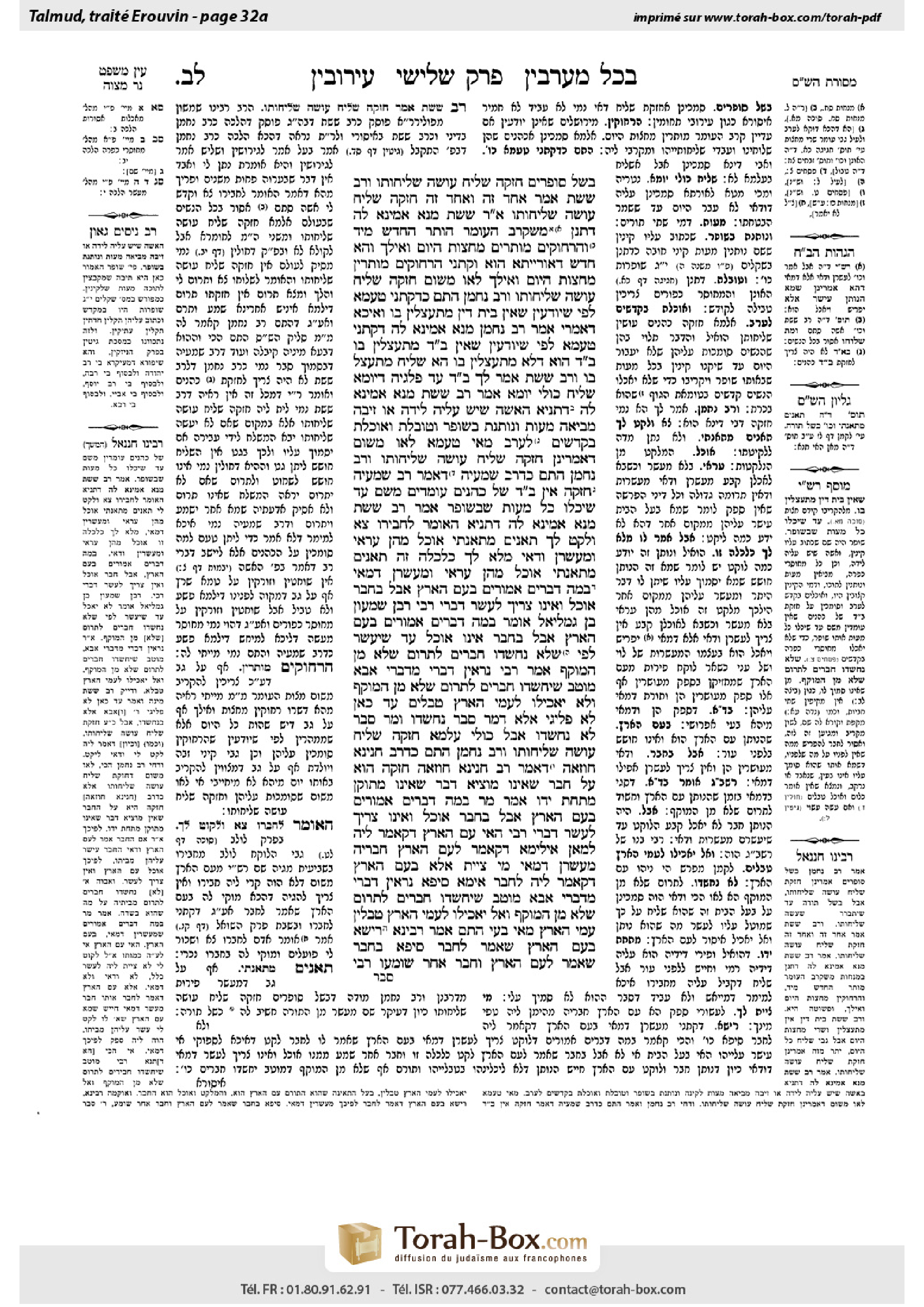
Eruvin 32a: Talmud study for Daf Yomi
Study the Talmud for Daf Yomi with scanned pages, Hebrew text, English translations from Sefaria and AI-generated French translations.
Passage selection and English or AI-generated French translation are available where the scan has annotations. Daf Study is independent of Torah-Box and Sefaria.
Browse Eruvin · עירובין · All tractatesEruvin 32a text and translations
This page of Eruvin includes the Aramaic text, an English translation and an AI-generated French translation, alongside the scan above.
עירובין ל״ב א · Aramaic and Hebrew text
בְּשֶׁל סוֹפְרִים — חֲזָקָה שָׁלִיחַ עוֹשֶׂה שְׁלִיחוּתוֹ. וְרַב שֵׁשֶׁת אָמַר: אֶחָד זֶה וְאֶחָד זֶה — חֲזָקָה שָׁלִיחַ עוֹשֶׂה שְׁלִיחוּתוֹ.
אָמַר רַב שֵׁשֶׁת: מְנָא אָמֵינָא לַהּ, דִּתְנַן: מִשֶּׁקָּרַב הָעוֹמֶר, הוּתַּר הֶחָדָשׁ מִיָּד.
וְהָרְחוֹקִים מוּתָּרִים מֵחֲצוֹת הַיּוֹם וְאֵילָךְ. וְהָא חָדָשׁ דְּאוֹרָיְיתָא הוּא, וְקָתָנֵי: הָרְחוֹקִים מוּתָּרִין מֵחֲצוֹת הַיּוֹם וְאֵילָךְ. לָאו מִשּׁוּם חֲזָקָה שָׁלִיחַ עוֹשֶׂה שְׁלִיחוּתוֹ?
וְרַב נַחְמָן? הָתָם כִּדְקָתָנֵי טַעְמָא — לְפִי שֶׁיּוֹדְעִין שֶׁאֵין בֵּית דִּין מִתְעַצְּלִין בּוֹ.
וְאִיכָּא דְּאָמְרִי, אָמַר רַב נַחְמָן: מְנָא אָמֵינָא לַהּ, דְּקָתָנֵי טַעְמָא לְפִי שֶׁיּוֹדְעִין שֶׁאֵין בֵּית דִּין מִתְעַצְּלִין בּוֹ. בֵּית דִּין הוּא דְּלָא מִתְעַצְּלִין בּוֹ — הָא שְׁלִיחַ מִתְעַצֵּל בּוֹ!
וְרַב שֵׁשֶׁת אָמַר לָךְ: בֵּית דִּין עַד פַּלְגֵיהּ דְּיוֹמָא, שָׁלִיחַ כּוּלֵּי יוֹמָא.
אָמַר רַב שֵׁשֶׁת: מְנָא אָמֵינָא לַהּ, דְּתַנְיָא: הָאִשָּׁה שֶׁיֵּשׁ עָלֶיהָ לֵידָה אוֹ זִיבָה, מְבִיאָה מָעוֹת וְנוֹתֶנֶת בַּשּׁוֹפָר, וְטוֹבֶלֶת וְאוֹכֶלֶת בַּקֳּדָשִׁים לָעֶרֶב. מַאי טַעְמָא — לָאו מִשּׁוּם דְּאָמְרִינַן חֲזָקָה שָׁלִיחַ עוֹשֶׂה שְׁלִיחוּתוֹ.
וְרַב נַחְמָן? הָתָם כִּדְרַב שְׁמַעְיָה, דְּאָמַר רַב שְׁמַעְיָה: חֲזָקָה אֵין בֵּית דִּין שֶׁל כֹּהֲנִים עוֹמְדִים מִשָּׁם עַד שֶׁיִּכְלוּ כׇּל מָעוֹת שֶׁבַּשּׁוֹפָר.
אָמַר רַב שֵׁשֶׁת: מְנָא אָמֵינָא לַהּ, דְּתַנְיָא: הָאוֹמֵר לַחֲבֵירוֹ ״צֵא וְלַקֵּט לְךָ תְּאֵנִים מִתְּאֵנָתִי״ — אוֹכֵל מֵהֶן עֲרַאי וּמְעַשְּׂרָן וַדַּאי. ״מַלֵּא לְךָ כַּלְכַּלָּה זֹה תְּאֵנִים מִתְּאֵנָתִי״ — אוֹכֵל מֵהֶן עֲרַאי וּמְעַשְּׂרָן דְּמַאי.
בַּמֶּה דְּבָרִים אֲמוּרִים — בְּעַם הָאָרֶץ, אֲבָל בְּחָבֵר — אוֹכֵל וְאֵינוֹ צָרִיךְ לְעַשֵּׂר, דִּבְרֵי רַבִּי. רַבָּן שִׁמְעוֹן בֶּן גַּמְלִיאֵל אוֹמֵר: בַּמֶּה דְּבָרִים אֲמוּרִים — בְּעַם הָאָרֶץ, אֲבָל בְּחָבֵר — אֵינוֹ אוֹכֵל עַד שֶׁיְּעַשֵּׂר, לְפִי שֶׁלֹּא נֶחְשְׁדוּ חֲבֵרִים לִתְרוֹם שֶׁלֹּא מִן הַמּוּקָּף.
אָמַר רַבִּי: נִרְאִין דְּבָרַי מִדִּבְרֵי אַבָּא. מוּטָב שֶׁיֵּחָשְׁדוּ חֲבֵרִים לִתְרוֹם שֶׁלֹּא מִן הַמּוּקָּף, וְלֹא יַאֲכִילוּ לְעַמֵּי הָאָרֶץ טְבָלִים.
עַד כָּאן לָא פְּלִיגִי אֶלָּא דְּמָר סָבַר: נֶחְשְׁדוּ, וּמָר סָבַר: לֹא נֶחְשְׁדוּ. אֲבָל כּוּלֵּי עָלְמָא: חֲזָקָה שָׁלִיחַ עוֹשֶׂה שְׁלִיחוּתוֹ.
וְרַב נַחְמָן, הָתָם כִּדְרַב חֲנִינָא חוֹזָאָה, דְּאָמַר רַב חֲנִינָא חוֹזָאָה: חֲזָקָה הוּא עַל חָבֵר שֶׁאֵינוֹ מוֹצִיא דָּבָר שֶׁאֵינוֹ מְתוּקָּן מִתַּחַת יָדוֹ.
אָמַר מָר: בַּמֶּה דְּבָרִים אֲמוּרִים — בְּעַם הָאָרֶץ, אֲבָל בְּחָבֵר — אוֹכֵל וְאֵינוֹ צָרִיךְ לְעַשֵּׂר, דִּבְרֵי רַבִּי.
הַאי עַם הָאָרֶץ, דְּקָאֲמַר לֵיהּ לְמַאן? אִילֵימָא דְּקָאָמַר לְעַם הָאָרֶץ חַבְרֵיהּ — מְעַשְּׂרָן דְּמַאי, מִי צָיֵית? אֶלָּא בְּעַם הָאָרֶץ דְּקָאֲמַר לֵיהּ לְחָבֵר. אֵימָא סֵיפָא: נִרְאִין דְּבָרַי מִדִּבְרֵי אַבָּא, מוּטָב שֶׁיֵּחָשְׁדוּ חֲבֵרִים לִתְרוֹם שֶׁלֹּא מִן הַמּוּקָּף וְאַל יַאֲכִילוּ לְעַמֵּי הָאָרֶץ טְבָלִין. עַמֵּי הָאָרֶץ מַאי בָּעֵי הָתָם?
אָמַר רָבִינָא: רֵישָׁא — בְּעַם הָאָרֶץ שֶׁאָמַר לְחָבֵר, סֵיפָא — בְּחָבֵר שֶׁאָמַר לְעַם הָאָרֶץ, וְחָבֵר אַחֵר שׁוֹמְעוֹ. רַבִּי
Eruvin 32a · English translation
However, with regard to rabbinic laws, we do rely on the presumption that an agent fulfills his agency. And Rav Sheshet disagreed and said: With regard to both this, Torah law, and that, rabbinic law, we rely on the presumption that an agent fulfills his agency.
Rav Sheshet said: From where do I say this? As we learned in a mishna: Once the omer has been offered, the grain from the new crop is immediately permitted. The Torah prohibits eating from the new crop of grain until the omer sacrifice is offered on the second day of Passover (Leviticus 23:14); once the omer is offered, it is immediately permitted to partake of the new grain.
And those far from Jerusalem, who do not know whether or not the omer has already been offered, are permitted to eat from the new crop from midday and on, as the omer must surely have been offered by this time. Isn’t the prohibition to eat from the new crop a Torah law? And nevertheless, it was taught: And those far from Jerusalem are permitted to eat from the new crop from midday and on. Is this not because we may rely on the presumption that an agent fulfills his agency? The priests in the Temple serve as the agents of the entire Jewish people, and it may be assumed that they have performed the mission entrusted to them.
The Gemara asks: And how does Rav Naḥman, who holds that with respect to Torah laws we may not rely on the presumption that an agent fulfills his agency, refute this proof? He can respond as follows: There, the agents may be trusted for the reason that was explicitly taught: Because we know that the court will not be indolent in offering the omer sacrifice; however, the same cannot be said of ordinary agents.
And some say a different version of this response: Rav Naḥman said: From where do I say this principle? As it was taught that the reason is because we know that the court will not be indolent in offering the omer past midday. From this we may infer: It is the court that will not be indolent with regard to missions entrusted to it, but an ordinary agent may indeed be indolent with regard to his mission. Therefore, we cannot rely upon an ordinary agent.
And Rav Sheshet could have said to you that this is not the correct inference; rather, we should infer as follows: It is only the court that is presumed to have executed its mission by midday, even though the mitzva to bring the omer offering lasts all day. However, an ordinary agent, who is not as diligent, is only presumed to have completed his mission by the end of the entire day.
Rav Sheshet said: From where do I say my opinion? As it was taught in a baraita: A woman who is responsible to offer sacrifices following childbirth or after experiencing ziva (Leviticus 12, 15) brings money and puts it in the appropriate collection box in the Temple, immerses in a ritual bath, and she may then eat sacrificial food at nightfall. What is the reason that she is permitted to eat immediately at nightfall? Is it not because we say that there is a presumption that an agent fulfills his agency, and the priests certainly purchased the appropriate sacrifices with her money and offered them during the day?
The Gemara asks: And how does Rav Naḥman counter this proof? There, in the case of a woman who put money in the box, the reason she may rely on agency is in accordance with the statement of Rav Shemaya, as Rav Shemaya said: There is a legal presumption that the court of priests would not leave the Temple until all the money in the collection box has been spent on the purchase of sacrifices. We may rely only on the special court appointed to carry out this task, as it can be trusted. However, no proof may be brought from here with regard to an ordinary agent.
Rav Sheshet said another proof: From where do I say this? As it was taught in a baraita: One who says to another person: Go and gather for yourself figs from my fig tree, if he does not specify the amount that he should take, the gatherer may eat casually from them even without separating tithes. However, if one wishes to eat the figs as a regular, set meal, he must first tithe them as fruit that is known with certainty not to previously be tithed. In this case, it may be assumed that the owner of the fig tree did not separate tithes to exempt these figs, as he did not know how many the gatherer would take. However, if the owner of the fig tree said to him: Fill this basket for yourself with figs from my fig tree, he may eat from them casually without tithing, and before eating them as a regular meal, he must tithe them as demai, produce with regard to which we are unsure if the appropriate tithes have been separated. Since the owner of the tree knows how many figs the gatherer will take, it is possible that he has already separated tithes for these figs.
In what case is this statement said? Where the owner of the fig tree is an am ha’aretz. But if he is a ḥaver, the gatherer may eat the figs, and he need not tithe them even as demai, as the owner certainly separated tithes for them from other produce; this is the statement of Rabbi Yehuda HaNasi. His father, Rabban Shimon ben Gamliel, says the opposite: In what case is this statement said? Where the owner of the fig tree is an am ha’aretz. But if he is a ḥaver, the gatherer may not eat the fruit until he tithes them because ḥaverim, who are meticulous in their observance of halakha, are not suspected of separating teruma and tithes from produce that is not adjacent to the produce they seek to exempt. Since the figs that have been picked are not adjacent to the owner’s other figs, he has certainly not separated teruma and tithes on their account.
Rabbi Yehuda HaNasi said: My statement appears to be more correct than Father’s statement: It is better that ḥaverim should be suspected of separating teruma and tithes from produce that is not adjacent to the produce they seek to exempt, and they should not feed amei ha’aretz produce that is tevel.
The Gemara infers: The tanna’im disagreed only with regard to the following point: That one Sage, Rabbi Yehuda HaNasi, holds that ḥaverim are suspected of tithing with produce that is not adjacent to the produce it comes to exempt, and one Sage, Rabban Shimon ben Gamliel, holds that they are not suspected of that. But all agree that we may rely on the presumption that an agent fulfills his agency, i.e., that the owner, who is regarded as an agent to tithe his produce so that no one will eat tevel on his account, can be relied upon to separate the tithes.
And Rav Naḥman can respond as follows: There, the owner can be trusted, in accordance with the statement of Rav Ḥanina Ḥoza’a, as Rav Ḥanina Ḥoza’a said: There is a legal presumption with regard to a ḥaver that he does not release anything that is not tithed from his possession. Therefore, we are not relying on a general presumption with regard to agents but on a presumption with regard to ḥaverim.
The previous baraita contained several puzzling elements. Now that the Gemara has completed its primary discussion, namely the presumption that an agent carries out his mission, it turns to a discussion of the baraita itself. The Master said: If one said to his fellow: Go and gather for yourself figs, in what case is this statement said? It is in a case where the owner of the fig tree is an am ha’aretz. However, if he is a ḥaver, the gatherer may eat the figs, and he need not tithe them; this is the statement of Rabbi Yehuda HaNasi.
The Gemara asks: This am ha’aretz, who addressed his fellow man, to whom did he speak? If you say that he spoke to his fellow am ha’aretz, if so, how are we to understand the statement that follows: He must tithe them as demai? Would an am ha’aretz comply with the admonition of the Sages to suspect that the produce of his fellow am ha’aretz may not have been tithed? Rather, this must be referring to an am ha’aretz who told a ḥaver to gather figs from his fig tree, and the ḥaver will certainly tithe them. However, say that the latter clause of this baraita: My statement appears to be more correct than Father’s statement, means the following: It is better that ḥaverim should be suspected of separating teruma and tithes from produce that is not adjacent to the produce they seek to exempt, and they should not feed amei ha’aretz produce that is tevel. What is the relevance of amei ha’aretz there? According to that explanation, the situation is the opposite. The person eating the figs is a ḥaver, and the owner of the fig tree is an am ha’aretz.
Ravina said: The first clause is referring to an am ha’aretz who spoke to a ḥaver, while the latter clause is referring to a ḥaver who spoke to an am ha’aretz, and a different ḥaver heard him speak, and the discussion relates not to the one gathering the figs but to whether the second ḥaver may partake of the figs if they are offered to him. The Gemara explains the disagreement according to this understanding: Rabbi Yehuda HaNasi
Eruvin 32a · Traduction française (IA)
Cependant, concernant les lois rabbiniques, nous nous appuyons sur l'assomption que l'agent accomplira son mandat. Et Rav Sheshet a dit : Concernant à la fois cette loi de la Torah et celle des lois rabbiniques, nous nous appuyons sur l'assomption que l'agent accomplira son mandat.
Rav Sheshet a dit : D'où dis-je cela ? Comme nous avons appris dans une mitsva : Dès que l'omer a été offert, le grain de la nouvelle moisson est immédiatement permis. La Torah interdit de manger du grain de la nouvelle moisson jusqu'à ce que l'offrande d'omer soit offerte le deuxième jour de la Pâque (Lévitique 23:14) ; dès que l'omer est offert, il est immédiatement permis de consommer le grain nouveau.
Et ceux qui sont éloignés de Jérusalem, qui ne savent pas si l'omer a déjà été offert, sont autorisés à manger du grain nouveau à partir de midi, car l'omer a certainement été offert à cette heure. N'est-ce pas une loi de la Torah qui interdit de manger du grain nouveau ? Et pourtant, il a été enseigné : Et ceux qui sont éloignés de Jérusalem sont autorisés à manger du grain nouveau à partir de midi. N'est-ce pas parce que nous pouvons nous appuyer sur l'assomption que l'agent accomplira son mandat ? Les prêtres du Temple servent d'agents pour tout le peuple juif, et on peut supposer qu'ils ont accompli la mission confiée à eux.
La Guemara demande : Et comment Rav Naḥman, qui considère que concernant les lois de la Torah nous ne pouvons pas nous appuyer sur l'assomption que l'agent accomplira son mandat, réfute cette preuve ? Il peut répondre comme suit : Là, les agents peuvent être considérés comme fiables pour la raison explicitement enseignée : parce que nous savons que le tribunal ne sera pas indolent à offrir l'offrande d'omer ; cependant, cela ne peut pas être dit des agents ordinaires.
Et certains disent une version différente de cette réponse : Rav Naḥman a dit : D'où dis-je ce principe ? Comme il a été enseigné que la raison est parce que nous savons que le tribunal ne sera pas indolent à offrir l'offrande d'omer après midi. De cela, nous pouvons déduire : C'est le tribunal qui n'est pas indolent concernant les missions confiées à lui, mais un agent ordinaire peut être indolent concernant sa mission. Par conséquent, nous ne pouvons pas nous appuyer sur un agent ordinaire.
Et Rav Sheshet aurait pu dire à vous que cette déduction n'est pas correcte ; plutôt, nous devrions déduire comme suit : C'est uniquement le tribunal qui est supposé avoir exécuté sa mission à midi, même si la mitsva d'offrir l'offrande d'omer dure toute la journée. Cependant, un agent ordinaire, qui n'est pas aussi diligent, est supposé avoir accompli sa mission à la fin de la journée entière.
Rav Sheshet a dit : D'où dis-je mon opinion ? Comme il a été enseigné dans une baraïta : Une femme qui est tenue d'offrir des sacrifices après l'accouchement ou après une ziva (Lévitique 12, 15) apporte de l'argent et le place dans la boîte appropriée du Temple, se baigne dans un bain rituel, et elle peut alors manger de la nourriture sacrée au coucher du soleil. Quelle est la raison pour laquelle elle est autorisée à manger immédiatement au coucher du soleil ? N'est-ce pas parce que nous disons qu'il y a une présomption que l'agent accomplira son mandat, et les prêtres ont certainement acheté les sacrifices appropriés avec son argent et les ont offerts pendant la journée ?
La Guemara demande : Et comment Rav Naḥman réfute cette preuve ? Là, dans le cas d'une femme qui a mis de l'argent dans la boîte, la raison pour laquelle elle peut se fier à l'agent est selon la déclaration de Rav Shemaya, car Rav Shemaya a dit : Il y a une présomption légale que le tribunal des prêtres ne quittera pas le Temple jusqu'à ce que tous les fonds de la boîte aient été dépensés pour l'achat des sacrifices. Nous pouvons nous fier uniquement au tribunal spécial désigné pour accomplir cette tâche, car il peut être considéré comme fiable. Cependant, aucune preuve ne peut être tirée de cela concernant un agent ordinaire.
Rav Sheshet a dit une autre preuve : D'où dis-je cela ? Comme il a été enseigné dans une baraïta : Celui qui dit à un autre : Va et ramasse pour toi des figues de mon arbre à figues, si il ne spécifie pas la quantité qu'il doit prendre, le ramasseur peut manger à loisir de ces figues même sans séparer les dîmes. Cependant, si l'on veut manger ces figues comme un repas régulier, il faut d'abord les dîmer comme des fruits dont on est certain qu'ils n'ont pas été dîmés auparavant. Dans ce cas, on peut supposer que le propriétaire de l'arbre à figues n'a pas séparé les dîmes pour exempter ces figues, car il ne savait pas combien le ramasseur prendrait. Cependant, si le propriétaire de l'arbre à figues dit à lui : Remplis ce panier pour toi de figues de mon arbre à figues, il peut manger à loisir de ces figues sans dîmer, et avant de les manger comme un repas régulier, il doit les dîmer comme demai, des produits dont on est incertain si les dîmes appropriées ont été séparées. Puisque le propriétaire de l'arbre sait combien de figues le ramasseur prendra, il est possible qu'il ait déjà séparé les dîmes pour ces figues.
Dans quel cas cette déclaration est-elle dite ? Lorsque le propriétaire de l'arbre à figues est un am ha'aretz. Mais si c'est un ḥaver, le ramasseur peut manger les figues, et il n'a pas besoin de les dîmer même comme demai, car le propriétaire a certainement séparé les dîmes pour elles à partir d'autres produits ; c'est la déclaration de Rabbi Yehuda HaNasi. Son père, Rabban Shimon ben Gamliel, dit l'inverse : Dans quel cas cette déclaration est-elle dite ? Lorsque le propriétaire de l'arbre à figues est un am ha'aretz. Mais si c'est un ḥaver, le ramasseur ne peut pas manger les fruits jusqu'à ce qu'il les dîme, car les ḥaverim, qui sont méticuleux dans l'observation de la halakha, ne sont pas soupçonnés de séparer la terouma et les dîmes à partir de produits non adjacents aux produits qu'ils cherchent à exempter. Puisque les figues qui ont été récoltées ne sont pas adjacentes aux figues du propriétaire, il a certainement ne séparé pas la terouma et les dîmes à leur sujet.
Rabbi Yehuda HaNasi a dit : Mon déclaration semble plus correcte que celle de mon père : Il est préférable que les ḥaverim soient soupçonnés de séparer la terouma et les dîmes à partir de produits non adjacents aux produits qu'ils cherchent à exempter, et qu'ils ne nourrissent pas les amei ha'aretz avec des produits tevel.
La Guemara conclut : Les tannaïm n'ont désaccordé que sur un point : celui-ci, que l'un des Sages, Rabbi Yehuda HaNasi, considère que les ḥaverim sont soupçonnés de tithier avec des produits non adjacents à ceux qu'ils veulent exempter, et l'autre Sage, Rabban Shimon ben Gamliel, considère qu'ils ne sont pas soupçonnés de cela. Toutefois, tous s'accordent sur le fait que nous pouvons nous fier à la présomption selon laquelle un agent accomplira sa mission, c'est-à-dire que l'propriétaire, considéré comme un agent pour tithier ses produits afin que personne ne mange de tevel à son compte, peut être considéré comme fiable pour séparer les dîmes.
Et Rav Naḥman peut répondre ainsi : Là, l'propriétaire peut être considéré comme fiable, conformément à la déclaration de Rav Ḥanina Ḥoza’a, comme Rav Ḥanina Ḥoza’a a dit : Il y a une présomption juridique concernant un ḥaver qu'il ne libère pas de chose non tithiée de ses possessions. Ainsi, nous ne nous appuyons pas sur une présomption générale concernant les agents, mais sur une présomption concernant les ḥaverim.
La précédente baraïta contenait plusieurs éléments troublants. Maintenant que la Guemara a terminé sa discussion principale, à savoir la présomption selon laquelle un agent accomplira sa mission, elle passe à la discussion de la baraïta elle-même. Le Maître dit : Si l'on dit à son camarade : Va et récolte pour toi des figues, dans quel cas cette déclaration est-elle faite ? C'est dans le cas où l'propriétaire de l'arbre à figues est un am ha'aretz. Cependant, si c'est un ḥaver, le récolteur peut manger les figues, et il n'a pas besoin de les tithier ; c'est la déclaration de Rabbi Yehuda HaNasi.
La Guemara pose la question : Cet am ha'aretz, qui a adressé un message à son camarade, à qui a-t-il parlé ? Si vous dites qu'il a parlé à son camarade am ha'aretz, alors comment comprendre la déclaration suivante : Il doit les tithier comme demai ? Un am ha'aretz suivrait-il l'avertissement des Sages pour soupçonner que les produits de son camarade am ha'aretz n'ont pas été tithiés ? Plutôt, cela doit se référer à un am ha'aretz qui a demandé à un ḥaver de récolter des figues de son arbre à figues, et le ḥaver titiera certainement ces figues. Cependant, disons que la dernière partie de cette baraïta : Mon déclaration semble plus correcte que celle de mon père, signifie ceci : Il est préférable que les ḥaverim soient soupçonnés de séparer la terouma et les dîmes de produits non adjacents à ceux qu'ils veulent exempter, et qu'ils ne nourrissent pas les amei ha'aretz avec des produits tevel. Quel est le rôle des amei ha'aretz là-dedans ? Selon cette explication, la situation est l'inverse. La personne mangeant les figues est un ḥaver, et l'propriétaire de l'arbre à figues est un am ha'aretz.
Ravina dit : La première partie se réfère à un am ha'aretz qui a parlé à un ḥaver, tandis que la seconde partie se réfère à un ḥaver qui a parlé à un am ha'aretz, et un autre ḥaver a entendu parler de cela, et la discussion ne concerne pas celui qui récolte les figues, mais si le second ḥaver peut participer aux figues si elles sont offertes à lui. La Guemara explique le désaccord selon cette compréhension : Rabbi Yehuda HaNasi
Traduction française générée par IA à partir de l’édition anglaise de Sefaria. Vérifie toujours un passage avec le texte source.
Text from Sefaria: William Davidson Edition - Vocalized Aramaic (CC BY NC); William Davidson Edition - English (CC BY NC).