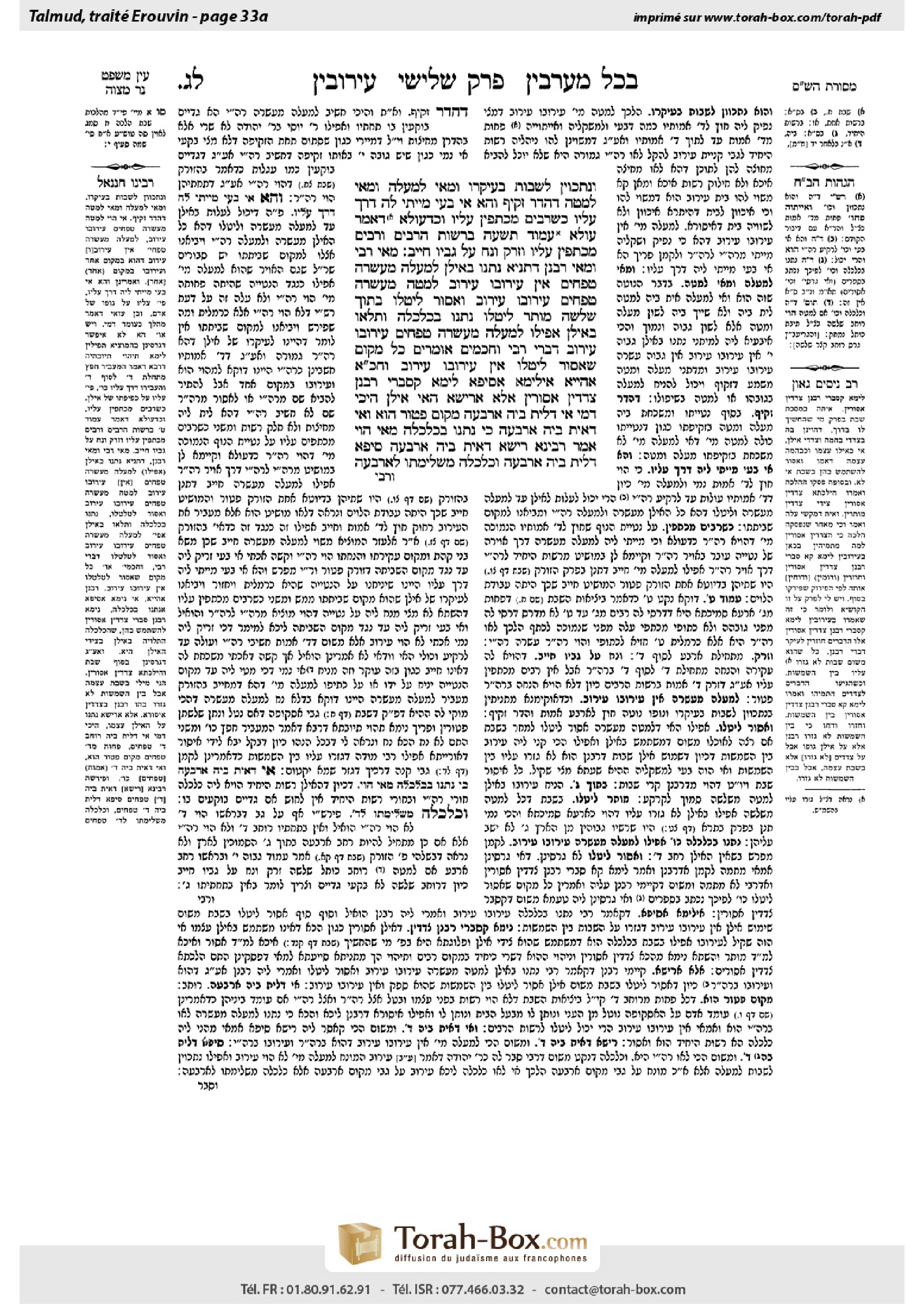
Eruvin 33a: Talmud study for Daf Yomi
Study the Talmud for Daf Yomi with scanned pages, Hebrew text, English translations from Sefaria and AI-generated French translations.
Passage selection and English or AI-generated French translation are available where the scan has annotations. Daf Study is independent of Torah-Box and Sefaria.
Browse Eruvin · עירובין · All tractatesEruvin 33a text and translations
This page of Eruvin includes the Aramaic text, an English translation and an AI-generated French translation, alongside the scan above.
עירובין ל״ג א · Aramaic and Hebrew text
וְנִתְכַּוֵּין לִשְׁבּוֹת בְּעִיקָּרוֹ. וּמַאי ״לְמַעְלָה״ וּמַאי ״לְמַטָּה״ — דַּהֲדַר זָקֵיף.
וְהָא אִי בָּעֵי מַיְיתֵי לַהּ דֶּרֶךְ עָלָיו!
כְּשֶׁרַבִּים מְכַתְּפִין עָלָיו, וְכִדְעוּלָּא. דְּאָמַר עוּלָּא: עַמּוּד תִּשְׁעָה בִּרְשׁוּת הָרַבִּים, וְרַבִּים מְכַתְּפִין עָלָיו, וְזָרַק וְנָח עַל גַּבָּיו — חַיָּיב.
מַאי רַבִּי, וּמַאי רַבָּנַן?
דְּתַנְיָא: נְתָנוֹ בְּאִילָן, לְמַעְלָה מֵעֲשָׂרָה טְפָחִים — אֵין עֵירוּבוֹ עֵירוּב, לְמַטָּה מֵעֲשָׂרָה טְפָחִים — עֵירוּבוֹ עֵירוּב, וְאָסוּר לִיטְּלוֹ. בְּתוֹךְ שְׁלֹשָׁה — מוּתָּר לִיטְּלוֹ. נְתָנוֹ בְּכַלְכַּלָּה וּתְלָאוֹ בְּאִילָן, אֲפִילּוּ לְמַעְלָה מֵעֲשָׂרָה טְפָחִים — עֵירוּבוֹ עֵירוּב, דִּבְרֵי רַבִּי. וַחֲכָמִים אוֹמְרִים: כׇּל מָקוֹם שֶׁאָסוּר לִיטְּלוֹ — אֵין עֵירוּבוֹ עֵירוּב.
וַחֲכָמִים אוֹמְרִים אַהֵיָיא? אִילֵּימָא אַסֵּיפָא — לֵימָא קָסָבְרִי רַבָּנַן, צְדָדִין אֲסוּרִין?! אֶלָּא אַרֵישָׁא.
הַאי אִילָן הֵיכִי דָמֵי? אִי דְּלֵית בֵּיהּ אַרְבָּעָה — מְקוֹם פְּטוּר הוּא. וְאִי דְּאִית בֵּיהּ אַרְבָּעָה, כִּי נְתָנוֹ בְּכַלְכַּלָּה מַאי הָוֵי?
אָמַר רָבִינָא: רֵישָׁא דְּאִית בֵּיהּ אַרְבָּעָה, סֵיפָא דְּלֵית בֵּיהּ אַרְבָּעָה וְכַלְכַּלָּה מַשְׁלִימָתוֹ לְאַרְבָּעָה.
Eruvin 33a · English translation
and he intended to establish his Shabbat residence at its base. And what is the meaning of the terms above and below, as we said that this tree extends horizontally to the side, which indicates that it remains at a uniform height? After the tree leans horizontally beyond four cubits from the place of its roots, it rises once again in an upright position, and therefore the terms above and below are applicable.
The Gemara asks: Isn’t it true that even if the eiruv is above ten handbreadths, if one wants, he can remove it from where it was deposited and bring it by way of the tree’s leaves, i.e., its branches that are above ten handbreadths, to within four cubits of the place where he intended to establish his Shabbat residence? Therefore, the eiruv should be valid even though it is above ten handbreadths.
The Gemara answers: We are dealing with a unique situation where the horizontal section of the tree is used by the masses to shoulder their burdens on it, i.e., to temporarily rest their loads on it, so that they can adjust them and easily lift them up again; and the halakha in that case is in accordance with the opinion of Ulla, as Ulla said: With regard to a pillar that is nine handbreadths high and situated in the public domain, and the masses use it to shoulder their loads upon it, and someone threw an object from a private domain and it came to rest upon it, he is liable, as this pillar has the status of a public domain. Consequently, in the case of the tree, one may not bring the eiruv by way of the tree’s branches, as the horizontal section of the tree has the status of a public domain, and one may not carry from one private domain to another via a public domain.
The Gemara previously cited the opinion of Rabbi Yehuda HaNasi that anything that is prohibited on Shabbat due to rabbinic decree is not prohibited during the twilight period. The Gemara now attempts to clarify the matter: What is the source that originally cites Rabbi Yehuda HaNasi’s opinion, and what is the source which cites the opinion of the Rabbis?
The Gemara cites the source of the disagreement: As it was taught in the Tosefta: If one placed his eiruv in a tree above ten handbreadths from the ground, his eiruv is not a valid eiruv. If he placed it below ten handbreadths, his eiruv is a valid eiruv, but he is prohibited to take it on Shabbat in order to eat it because it is prohibited to use the tree on Shabbat. However, if the eiruv is within three handbreadths of the ground, he is permitted to take it because it is considered as though it were on the ground and not in a tree. If one placed the eiruv in a basket and hung it on a tree, even above ten handbreadths, his eiruv is a valid eiruv; this is the statement of Rabbi Yehuda HaNasi. And the Rabbis disagree and say: In any situation in which the eiruv was placed in a location where it is prohibited to take it, his eiruv is not a valid eiruv.
The Gemara clarifies: With regard to which statement did the Rabbis state their opinion? If you say they were referring to the latter clause with respect to the basket hanging from the tree, let us say that the Rabbis hold that using even the sides of a tree is prohibited, as making use of the basket is considered using the sides of a tree. Rather, the Rabbis’ statement must refer to the first clause, in which Rabbi Yehuda HaNasi says that if one put the eiruv below ten handbreadths, his eiruv is valid, but he is prohibited to move it.
The Gemara clarifies further: This tree, what are its circumstances? If it is not four by four handbreadths wide, it is an exempt domain, i.e., a neutral place with respect to the laws of carrying on Shabbat, from which an object may be carried into any other Shabbat domain. In that case, the eiruv should be valid even if it was placed higher than ten handbreadths in the tree. And if it is four by four handbreadths wide, when one places it in a basket, what of it? What difference does it make? In any event it is in a private domain.
Ravina said: The first clause is referring to a case where the tree is four by four handbreadths wide. The eiruv is not valid if it was placed above ten handbreadths because the tree at that height constitutes a private domain, and the eiruv cannot be brought to the public domain below, where one wishes to establish his Shabbat residence. The latter clause, however, is referring to a case where the tree is not four by four handbreadths wide, and the basket completes the width of the tree at that spot to four.
Eruvin 33a · Traduction française (IA)
et il avait l'intention d'établir sa résidence sabbatique à sa base. Et que signifient les termes « haut » et « bas », comme nous l'avons dit que cet arbre s'étend horizontalement vers le côté, ce qui indique qu'il reste à une hauteur uniforme ? Après que l'arbre s'incline horizontalement au-delà de quatre cubits du lieu de ses racines, il se redresse à nouveau dans une position verticale, et par conséquent les termes « haut » et « bas » s'appliquent.
Le Guemara demande : N'est-ce pas vrai que même si l'eiruv est au-dessus de dix tefachim, si l'on veut, on peut le retirer du lieu où il a été déposé et le transporter par les branches de l'arbre, c'est-à-dire par ses branches qui sont au-dessus de dix tefachim, jusqu'à quatre cubits du lieu où l'on voulait établir sa résidence sabbatique ? Par conséquent, l'eiruv devrait être valide même s'il est au-dessus de dix tefachim.
Le Guemara répond : Nous sommes en présence d'une situation particulière où la partie horizontale de l'arbre est utilisée par la foule pour porter leurs charges dessus, c'est-à-dire pour y poser temporairement leurs charges afin de les ajuster et de les soulever facilement à nouveau ; et la halakha dans ce cas suit l'opinion d'Ulla, comme Ulla a dit : En ce qui concerne un poteau de neuf tefachim de haut situé dans le domaine public, et que la foule utilise ce poteau pour porter leurs charges dessus, et que quelqu'un jette un objet d'un domaine privé et qu'il vient se poser dessus, il est responsable, car ce poteau a le statut d'un domaine public. Par conséquent, dans le cas de l'arbre, on ne peut pas transporter l'eiruv par ses branches, car la partie horizontale de l'arbre a le statut d'un domaine public, et on ne peut pas transporter d'un domaine privé à un autre via un domaine public.
Le Guemara avait précédemment cité l'opinion de Rabbi Yehuda HaNasi selon laquelle tout ce qui est interdit le sabbat en vertu d'un décret rabbinique n'est pas interdit pendant la période de crépuscule. Le Guemara tente maintenant de clarifier la question : Quelle est la source qui cite l'opinion de Rabbi Yehuda HaNasi, et quelle est la source qui cite l'opinion des Rabbins ?
Le Guemara cite la source du désaccord : Comme il a été enseigné dans la Tosefta : Si l'on place son eiruv dans un arbre au-dessus de dix tefachim du sol, son eiruv n'est pas un eiruv valide. Si l'on le place en dessous de dix tefachim, son eiruv est un eiruv valide, mais il est interdit de le prendre le sabbat pour le manger, car il est interdit d'utiliser l'arbre le sabbat. Cependant, si l'eiruv est à trois tefachim du sol, il est permis de le prendre, car on le considère comme étant au sol et non dans un arbre. Si l'on place l'eiruv dans un panier et le suspend sur un arbre, même au-dessus de dix tefachim, son eiruv est un eiruv valide ; c'est l'opinion de Rabbi Yehuda HaNasi. Et les Rabbins s'opposent et disent : Dans tout cas où l'eiruv a été placé dans un lieu où il est interdit de le prendre, son eiruv n'est pas un eiruv valide.
Le Guemara clarifie : À propos de quelle déclaration les Rabbins ont-ils exprimé leur opinion ? Si vous dites qu'ils faisaient référence à la dernière clause concernant le panier suspendu de l'arbre, disons que les Rabbins considèrent que même l'utilisation des côtés de l'arbre est interdite, car l'utilisation du panier est considérée comme l'utilisation des côtés de l'arbre. Plutôt, la déclaration des Rabbins doit faire référence à la première clause, dans laquelle Rabbi Yehuda HaNasi dit que si l'on place l'eiruv en dessous de dix tefachim, son eiruv est valide, mais il est interdit de le déplacer.
Le Guemara précise davantage : Quelle est la situation de cet arbre ? Si elle n'est pas de quatre par quatre tefachim de large, c'est un domaine exempt, c'est-à-dire un lieu neutre par rapport aux lois du transport le sabbat, d'où un objet peut être transporté vers n'importe quel autre domaine sabbatique. Dans ce cas, l'eiruv devrait être valide même s'il a été placé plus haut que dix tefachim dans l'arbre. Et si elle est de quatre par quatre tefachim de large, que cela change-t-il ? Qu'importe, il est dans un domaine privé.
Ravina a dit : La première clause fait référence à un cas où l'arbre est de quatre par quatre tefachim de large. L'eiruv n'est pas valide s'il a été placé au-dessus de dix tefachim, car l'arbre à cette hauteur constitue un domaine privé, et l'eiruv ne peut pas être transporté vers le domaine public en dessous, où l'on souhaite établir sa résidence sabbatique. La dernière clause, en revanche, fait référence à un cas où l'arbre n'est pas de quatre par quatre tefachim de large, et le panier complète la largeur de l'arbre à ce point à quatre.
Traduction française générée par IA à partir de l’édition anglaise de Sefaria. Vérifie toujours un passage avec le texte source.
Text from Sefaria: William Davidson Edition - Vocalized Aramaic (CC BY NC); William Davidson Edition - English (CC BY NC).