Eruvin 33b: Talmud study for Daf Yomi
Study the Talmud for Daf Yomi with scanned pages, Hebrew text, English translations from Sefaria and AI-generated French translations.
Passage selection and English or AI-generated French translation are available where the scan has annotations. Daf Study is independent of Torah-Box and Sefaria.
Browse Eruvin · עירובין · All tractatesEruvin 33b text and translations
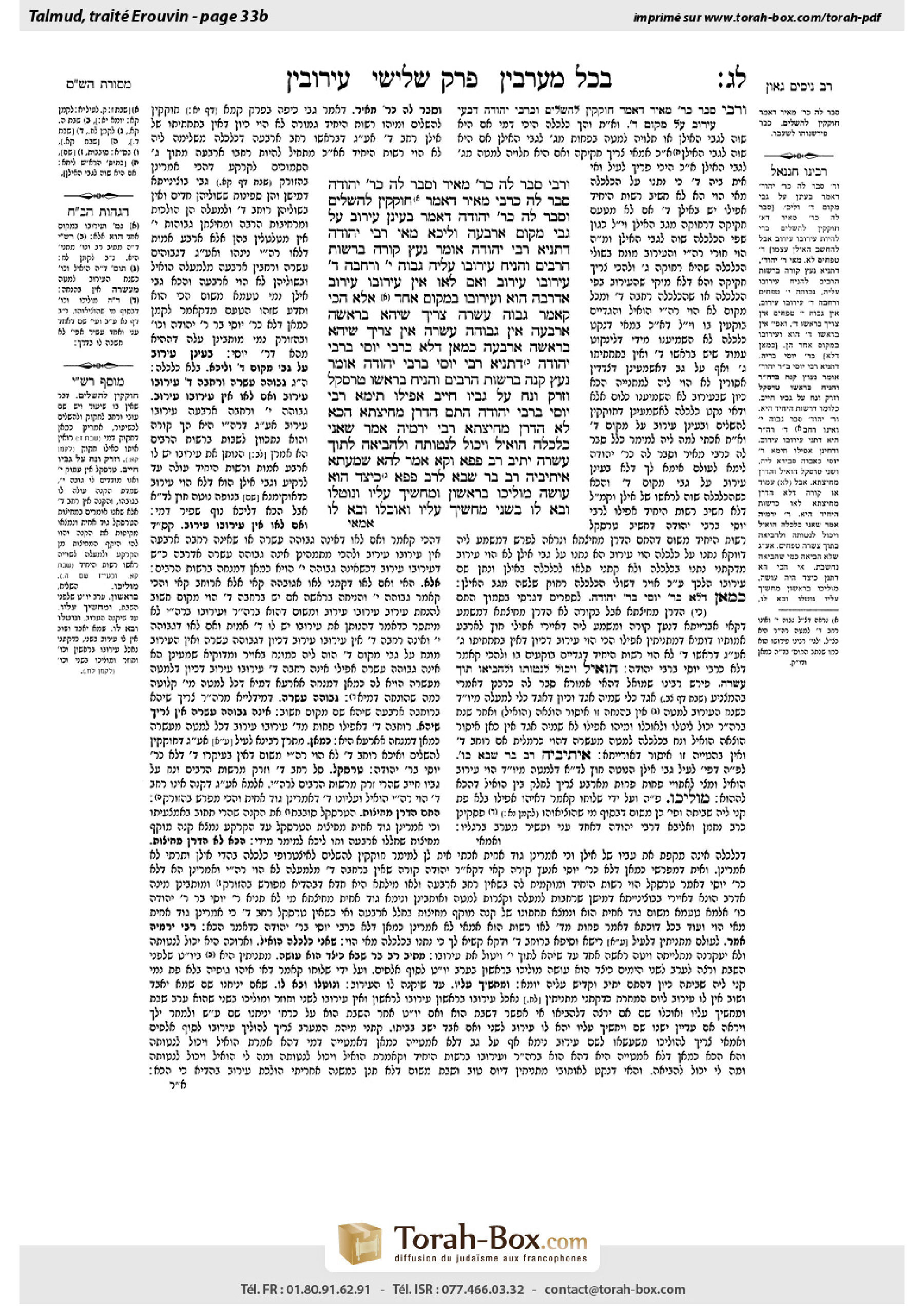
This page of Eruvin includes the Aramaic text, an English translation and an AI-generated French translation, alongside the scan above.
עירובין ל״ג ב · Aramaic and Hebrew text
וְרַבִּי סָבַר לַהּ כְּרַבִּי מֵאִיר, וְסָבַר לַהּ כְּרַבִּי יְהוּדָה.
סָבַר לַהּ כְּרַבִּי מֵאִיר, דְּאָמַר חוֹקְקִין לְהַשְׁלִים.
וְסָבַר לַהּ כְּרַבִּי יְהוּדָה, דְּאָמַר בָּעִינַן עֵירוּב עַל גַּבֵּי מְקוֹם אַרְבָּעָה, וְלֵיכָּא.
מַאי רַבִּי יְהוּדָה? דְּתַנְיָא: רַבִּי יְהוּדָה אוֹמֵר: נָעַץ קוֹרָה בִּרְשׁוּת הָרַבִּים וְהִנִּיחַ עֵירוּבוֹ עָלֶיהָ, גָּבוֹהַּ עֲשָׂרָה וּרְחָבָה אַרְבָּעָה — עֵירוּבוֹ עֵירוּב, וְאִם לָאו — אֵין עֵירוּבוֹ עֵירוּב.
אַדְּרַבָּה, הוּא וְעֵירוּבוֹ בִּמְקוֹם אֶחָד! אֶלָּא הָכִי קָאָמַר: גָּבוֹהַּ עֲשָׂרָה — צָרִיךְ שֶׁיְּהֵא בְּרֹאשָׁהּ אַרְבָּעָה, אֵין גְּבוֹהָה עֲשָׂרָה — אֵין צָרִיךְ שֶׁיְּהֵא בְּרֹאשָׁהּ אַרְבָּעָה.
כְּמַאן? דְּלָא כְּרַבִּי יוֹסֵי בְּרַבִּי יְהוּדָה, דְּתַנְיָא, רַבִּי יוֹסֵי בְּרַבִּי יְהוּדָה אוֹמֵר: נָעַץ קָנֶה בִּרְשׁוּת הָרַבִּים וְהִנִּיחַ בְּרֹאשׁוֹ טְרַסְקָל, וְזָרַק וְנָח עַל גַּבָּיו — חַיָּיב!
אֲפִילּוּ תֵּימָא רַבִּי יוֹסֵי בְּרַבִּי יְהוּדָה, הָתָם — הָדְרָן מְחִיצָתָא. הָכָא — לָא הָדְרָן מְחִיצָתָא.
רַבִּי יִרְמְיָה אָמַר: שָׁאנֵי כַּלְכַּלָּה, הוֹאִיל וְיָכוֹל לִנְטוֹתָהּ וְלַהֲבִיאָהּ לְתוֹךְ עֲשָׂרָה.
יָתֵיב רַב פָּפָּא וְקָא אָמַר לְהָא שְׁמַעְתָּא. אֵיתִיבֵיהּ רַב בַּר שַׁבָּא לְרַב פָּפָּא: כֵּיצַד הוּא עוֹשֶׂה? מוֹלִיכוֹ בָּרִאשׁוֹן וּמַחְשִׁיךְ עָלָיו, וְנוֹטְלוֹ וּבָא לוֹ. בַּשֵּׁנִי, מַחְשִׁיךְ עָלָיו וְאוֹכְלוֹ, וּבָא לוֹ.
Eruvin 33b · English translation
And Rabbi Yehuda HaNasi holds in accordance with the opinion of Rabbi Meir, and he also holds in accordance with the opinion of Rabbi Yehuda.
The Gemara clarifies: He holds in accordance with the opinion of Rabbi Meir, who said the following in the case of an arched gateway in which the lower, straight-walled section is three handbreadths high, and the entire arch is ten handbreadths high: Even if, at the height of ten handbreadths, the arch is less than four handbreadths wide, one considers it as if he carves out the space to complete it, i.e., the arch has the legal status as though it were actually enlarged to a width of four handbreadths. Similarly, in our case the basket is taken into account and enlarges the tree to a width of four handbreadths.
And he also holds in accordance with the opinion of Rabbi Yehuda, who said: We require that the eiruv rest on a place that is four by four handbreadths wide, and here there is not a width of four handbreadths without taking the basket into account.
The Gemara now asks: What is the source of the ruling of Rabbi Yehuda? As it was taught in a baraita that Rabbi Yehuda says: If one stuck a cross beam into the ground in the public domain and placed his eiruv upon it, if the cross beam is ten handbreadths high and four handbreadths wide, so that it has the status of a private domain, his eiruv is a valid eiruv; but if not, his eiruv is not a valid eiruv.
The Gemara expresses surprise: On the contrary, if the cross beam is not ten handbreadths high, why shouldn’t his eiruv be valid? He and his eiruv are in the same place, i.e., in the public domain. Rather, this is what he said: If the cross beam is ten handbreadths high, it is necessary that its top be four handbreadths wide, so that it can be considered its own domain; but if it is not ten handbreadths high, it is not necessary that its top be four handbreadths wide because it is considered part of the public domain.
The Gemara poses a question: In accordance with whose opinion did Ravina offer his explanation, which maintains that we are dealing with a basket that completes the dimension of the tree to four handbreadths and yet it is not treated as a private domain? It is not in accordance with the opinion of Rabbi Yosei, son of Rabbi Yehuda, as it was taught in a baraita that Rabbi Yosei, son of Rabbi Yehuda, says: If one stuck a reed into the ground in the public domain, and placed a basket [teraskal] four by four handbreadths wide on top of it, and threw an object from the public domain, and it landed upon it, he is liable for carrying from a public domain to a private domain. According to Rabbi Yosei, son of Rabbi Yehuda, if a surface of four by four handbreadths rests at a height of ten handbreadths from the ground, this is sufficient for it to be considered a private domain. Ravina’s explanation of Rabbi Yehuda HaNasi’s position, however, does not appear to accept this assumption.
The Gemara refutes this and claims that this proof is not conclusive: Even if you say that Ravina’s explanation is in accordance with the opinion of Rabbi Yosei, son of Rabbi Yehuda, a distinction can be made: There, in the case of the basket resting on a reed, the sides of the basket constitute partitions that surround the reed on all sides, and we can invoke the principle of: Lower the partition, according to which the partitions are viewed as extending down to the ground. Consequently, a kind of private domain is created within the public domain. Here, in the case of the basket hanging from the tree, the partitions of the basket do not surround the tree, and so they do not suffice to create a private domain.
Rabbi Yirmeya said that the opinion of Rabbi Yehuda HaNasi in the Tosefta can be explained in an entirely different manner: A basket is different, since one can tilt it and in that way bring it to within ten handbreadths of the ground. Without moving the entire basket, one can tilt it and thereby remove the eiruv in order to eat it, without carrying it from one domain to another.
Rav Pappa sat and recited this halakha. Rav bar Shabba raised an objection to Rav Pappa from the following mishna: What does one do if a Festival occurs on Friday, and he wishes to establish an eiruv that will be valid for both the Festival and Shabbat? He brings the eiruv to the location that he wishes to establish as his residence on the eve of the first day, i.e., the eve of the Festival, and stays there with it until nightfall, the time when the eiruv establishes that location as his residence, and then he takes it with him and goes away, so that it does not become lost before Shabbat begins, in which case he would not have an eiruv for Shabbat. On the eve of the second day, i.e., on Friday afternoon, he takes it back to the same place as the day before, and stays there with it until nightfall, thereby establishing his Shabbat residence; and then he may then eat the eiruv and go away, if he so desires.
Eruvin 33b · Traduction française (IA)
Et le maître Yéhuda HaNasi suit l'opinion du maître Méir, et il suit également l'opinion du maître Yéhuda.
La Guemara clarifie : Il suit l'opinion du maître Méir, qui a dit ceci dans le cas d'une porte en arc, dans laquelle la partie inférieure, rectiligne, mesure trois paumes de haut, et l'ensemble de l'arc mesure dix paumes de haut : Même si, à la hauteur de dix paumes, l'arc est moins large de quatre paumes, on considère qu'il a été sculpté pour le compléter, c'est-à-dire que l'arc a le statut juridique d'un arc élargi à une largeur de quatre paumes. De même, dans notre cas, le panier est pris en compte et élargit l'arbre à une largeur de quatre paumes.
Et il suit également l'opinion du maître Yéhuda, qui dit : Nous exigeons que l'eiruv repose sur un lieu de quatre paumes de largeur, et ici il n'y a pas de largeur de quatre paumes sans prendre en compte le panier.
La Guemara pose alors une question : De quelle source provient la décision du maître Yéhuda ? Il a été enseigné dans une baraïta que le maître Yéhuda dit : Si l'on a planté un poteau dans le domaine public et qu'on a posé son eiruv dessus, si le poteau mesure dix paumes de haut et quatre paumes de large, de sorte qu'il a le statut d'un domaine privé, son eiruv est un eiruv valide ; mais s'il n'en est pas ainsi, son eiruv n'est pas valide.
La Guemara exprime une surprise : Au contraire, si le poteau n'est pas dix paumes de haut, pourquoi ne serait-il pas valide ? Il et son eiruv sont dans le même lieu, c'est-à-dire dans le domaine public. En réalité, c'est ce que le maître Yéhuda a dit : Si le poteau est dix paumes de haut, il faut que son sommet soit quatre paumes de large, de sorte qu'il puisse être considéré comme un domaine privé ; mais si il n'est pas dix paumes de haut, il n'est pas nécessaire que son sommet soit quatre paumes de large, car on le considère comme faisant partie du domaine public.
La Guemara pose une question : Selon l'opinion de qui l'explication de Ravina est-elle donnée, qui affirme que nous sommes en présence d'un panier qui complète la dimension de l'arbre à quatre paumes et pourtant n'est pas traité comme un domaine privé ? Ce n'est pas selon l'opinion du maître Yosei, fils du maître Yéhuda, car il a été enseigné dans une baraïta que le maître Yosei, fils du maître Yéhuda, dit : Si l'on a planté un roseau dans le domaine public, et qu'on a posé un panier [teraskal] de quatre paumes de largeur sur lui, et qu'on a lancé un objet du domaine public, et qu'il est tombé dessus, il est responsable de porter de domaine public à domaine privé. Selon le maître Yosei, fils du maître Yéhuda, si une surface de quatre paumes de largeur repose à dix paumes de haut du sol, cela suffit pour qu'elle soit considérée comme un domaine privé. Cependant, l'explication de Ravina concernant la position du maître Yéhuda HaNasi ne semble pas accepter cette hypothèse.
La Guemara réfute cela et affirme que cette preuve n'est pas concluante : Même si vous dites que l'explication de Ravina suit l'opinion du maître Yosei, fils du maître Yéhuda, une distinction peut être faite : Là, dans le cas du panier reposant sur un roseau, les côtés du panier constituent des parois qui entourent le roseau de tous les côtés, et on peut invoquer le principe de : Abaissez la paroi, selon lequel les parois sont considérées comme s'étendant jusqu'au sol. Ainsi, un domaine privé est créé à l'intérieur du domaine public. Ici, dans le cas du panier suspendu à l'arbre, les parois du panier ne entourent pas l'arbre, et par conséquent, elles ne suffisent pas à créer un domaine privé.
Le maître Yirmeya a dit que l'opinion du maître Yéhuda HaNasi dans la Tosefta peut être expliquée d'une manière entièrement différente : Le panier est différent, car on peut le pencher et ainsi le faire descendre à dix paumes du sol. Sans déplacer tout le panier, on peut le pencher et ainsi le retirer pour manger, sans porter de domaine à un autre domaine.
Rav Pappa s'est assis et a récité cette halakha. Rav bar Shabba a soulevé une objection contre Rav Pappa à partir de la suivante mitsva : Que fait-on si un festival tombe le vendredi, et qu'on veut établir un eiruv valide pour le festival et le sabbat ? On amène l'eiruv au lieu où l'on veut établir sa résidence le soir du premier jour, c'est-à-dire le soir du festival, et l'on y reste avec lui jusqu'au coucher du soleil, moment où l'eiruv établit que ce lieu est sa résidence, et ensuite on le prend avec soi et on s'en va, afin qu'il ne soit pas perdu avant le début du sabbat, dans le cas où l'on n'aurait plus d'eiruv pour le sabbat. Le soir du deuxième jour, c'est-à-dire le vendredi après-midi, on le ramène au même lieu que la veille, et l'on y reste avec lui jusqu'au coucher du soleil, établissant ainsi sa résidence du sabbat ; et ensuite, on peut manger l'eiruv et s'en aller, si l'on le désire.
Traduction française générée par IA à partir de l’édition anglaise de Sefaria. Vérifie toujours un passage avec le texte source.
Text from Sefaria: William Davidson Edition - Vocalized Aramaic (CC BY NC); William Davidson Edition - English (CC BY NC).