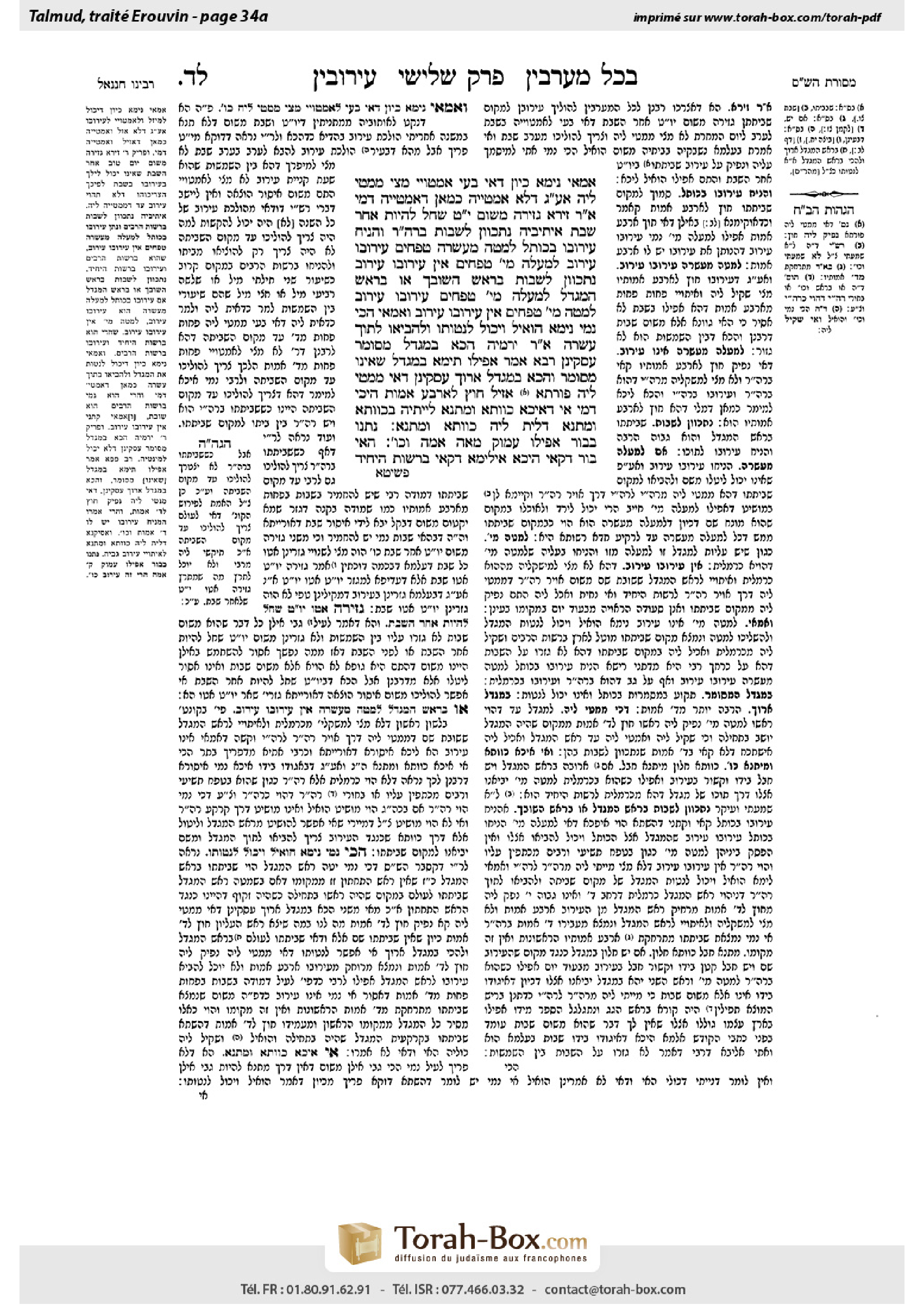
Eruvin 34a: Talmud study for Daf Yomi
Study the Talmud for Daf Yomi with scanned pages, Hebrew text, English translations from Sefaria and AI-generated French translations.
Passage selection and English or AI-generated French translation are available where the scan has annotations. Daf Study is independent of Torah-Box and Sefaria.
Browse Eruvin · עירובין · All tractatesEruvin 34a text and translations
This page of Eruvin includes the Aramaic text, an English translation and an AI-generated French translation, alongside the scan above.
עירובין ל״ד א · Aramaic and Hebrew text
אַמַּאי? נֵימָא: כֵּיוָן דְּאִי בָּעֵי אַמְטוֹיֵי מָצֵי מַמְטֵי לֵיהּ, אַף עַל גַּב דְּלָא אַמְטְיֵיהּ — כְּמַאן דְּאַמְטְיֵיהּ דָּמֵי!
אָמַר רַבִּי זֵירָא: גְּזֵירָה מִשּׁוּם יוֹם טוֹב שֶׁחָל לִהְיוֹת אַחַר שַׁבָּת.
אֵיתִיבֵיהּ: נִתְכַּוֵּון לִשְׁבּוֹת בִּרְשׁוּת הָרַבִּים, וְהִנִּיחַ עֵירוּבוֹ בַּכּוֹתֶל, לְמַטָּה מֵעֲשָׂרָה טְפָחִים — עֵירוּבוֹ עֵירוּב, לְמַעְלָה מֵעֲשָׂרָה טְפָחִים — אֵין עֵירוּבוֹ עֵירוּב. נִתְכַּוֵּון לִשְׁבּוֹת בְּרֹאשׁ הַשּׁוֹבָךְ אוֹ בְּרֹאשׁ הַמִּגְדָּל, לְמַעְלָה מֵעֲשָׂרָה טְפָחִים — עֵירוּבוֹ עֵירוּב. לְמַטָּה מֵעֲשָׂרָה טְפָחִים — אֵין עֵירוּבוֹ עֵירוּב.
וְאַמַּאי? הָכִי נָמֵי נֵימָא: הוֹאִיל וְיָכוֹל לִנְטוֹתוֹ וְלַהֲבִיאוֹ לְתוֹךְ עֲשָׂרָה! אָמַר רַבִּי יִרְמְיָה: הָכָא בְּמִגְדָּל מְסוּמָּר עָסְקִינַן.
רָבָא אָמַר: אֲפִילּוּ תֵּימָא בְּמִגְדָּל שֶׁאֵינוֹ מְסוּמָּר, וְהָכָא בְּמִגְדָּל אָרוֹךְ עָסְקִינַן, דְּאִי מַמְטֵי לֵיהּ פּוּרְתָּא, אָזֵיל חוּץ לְאַרְבַּע אַמּוֹת.
הֵיכִי דָמֵי? אִי דְּאִיכָּא כַּוְּותָא וּמִתְנָא — לַיְיתֵיהּ בְּכַוְּותָא וּמִתְנָא! דְּלֵית לֵיהּ כַּוְּותָא וּמִתְנָא.
נְתָנוֹ בְּבוֹר אֲפִילּוּ עָמוֹק מֵאָה אַמָּה וְכוּ׳. הַאי בּוֹר דְּקָאֵי הֵיכָא? אִילֵּימָא דְּקָאֵי בִּרְשׁוּת הַיָּחִיד —
Eruvin 34a · English translation
Why must one actually bring the eiruv to the place where he wishes to establish his residence? Let us say: Since if he wished to bring the eiruv there he could bring it, even though he did not bring it, it is considered as though he did bring it there. This follows the same reasoning proposed by Rav Yirmeya in the case of the basket: Since one can tilt it. The fact that this reasoning is not employed here indicates that the potential to do something is insufficient; rather, the deed must actually be done.
Rabbi Zeira said: The fact that one must bring his eiruv the day before to the spot that he wishes to establish as his place of residence, and the potential to bring it there does not suffice, is a decree due to a Festival that occurs after Shabbat. In that case, the eiruv is valid for the Festival only if it was brought there before Shabbat, for it cannot be carried there on Shabbat. Since one cannot actually bring the eiruv there, it cannot be said: It is considered as though he did bring it there because had he wished to bring the eiruv he could have. Consequently, the Sages decreed that in all cases, the eiruv is only valid if it was actually brought to the designated spot, lest one come to think that even on a Festival that occurs after Shabbat it need not be brought there.
Rav bar Shabba raised another objection from a different baraita: With regard to one who intended to establish his Shabbat residence in the public domain and placed his eiruv in a wall that is more than four cubits away from that location; if he placed the eiruv below a height of ten handbreadths above the ground, his eiruv is a valid eiruv; but if he placed it above ten handbreadths, his eiruv is not a valid eiruv because he is in a public domain while his eiruv is in a private domain. If one intended to establish his Shabbat residence on top of a dovecote or on top of a large cupboard, if he placed the eiruv in the dovecote or cupboard above ten handbreadths from the ground, his eiruv is a valid eiruv because both he and his eiruv are in a private domain; but if he placed it below ten handbreadths, the area in which he placed his eiruv is considered a karmelit, and his eiruv is not a valid eiruv because he cannot transport his eiruv from there to his own domain on Shabbat.
Why should this be so? Here too, let us say that his eiruv should be valid even if it was placed below ten handbreadths, since one can tilt the cupboard and bring it to within ten handbreadths from the ground, in which case he and his eiruv would be in the same domain. Rabbi Yirmeya said: Here, we are dealing with a cupboard that is nailed to the wall so that it cannot be tilted.
Rava said: Even if you say that it is referring to a cupboard that is not nailed to the wall, here, we are dealing with a very tall cupboard, such that were one to tilt it a little in order to bring the top of the cupboard within ten handbreadths from the ground, the top of the cupboard would project beyond the four cubits that constitute one’s Shabbat residence.
The Gemara asks: What, exactly, are the circumstances? If it is referring to a case where the cupboard has a window, and one has a rope at hand, let him bring it by means of the window and rope. In other words, let him lower the rope through the cupboard’s window and bring the eiruv with it, and he will not have to move the entire cupboard. The Gemara answers: Here we are dealing with a case where it does not have a window, and he does not have a rope at hand.
We learned in the mishna: If one placed the eiruv in a pit, even if it is a hundred cubits deep, his eiruv is a valid eiruv. The Gemara asks: This pit, where is it situated? If you say that it is situated in the private domain,
Eruvin 34a · Traduction française (IA)
Pourquoi doit-on réellement apporter l'eiruv au lieu où l'on souhaite établir sa résidence ? Disons que c'est parce que si l'on souhaitait apporter l'eiruv là, on aurait pu le faire, même s'il n'a pas été apporté, il est considéré comme s'il avait été apporté là. Cela suit le même raisonnement proposé par Rav Yirmeya dans le cas du panier : puisque l'on peut le pencher. Le fait que ce raisonnement ne soit pas appliqué ici indique que le potentiel d'agir n'est pas suffisant ; plutôt, l'acte doit être effectivement accompli.
Rabbi Zeira a dit : Le fait que l'on doive apporter son eiruv la veille au lieu où l'on souhaite établir sa résidence, et que le potentiel d'apporter l'eiruv là ne suffise pas, est une déclaration due à un festival qui survient après le sabbat. Dans ce cas, l'eiruv est valide pour le festival uniquement s'il a été apporté là avant le sabbat, car il ne peut pas être transporté là le sabbat. Puisque l'on ne peut pas réellement apporter l'eiruv là, on ne peut pas dire : il est considéré comme s'il avait été apporté là, car s'il avait souhaité l'apporter, il aurait pu le faire. Ainsi, les Sages ont décrété que dans tous les cas, l'eiruv est valide uniquement s'il a été réellement apporté au lieu désigné, afin que l'on ne pense pas que même lors d'un festival qui survient après le sabbat, il ne soit pas nécessaire de l'apporter là.
Rav bar Shabba souleva une autre objection tirée d'une autre baraïta : concernant celui qui souhaitait établir sa résidence sabbatique dans le domaine public et qui a placé son eiruv dans un mur situé à plus de quatre cubits de ce lieu ; si l'on a placé l'eiruv à une hauteur inférieure à dix palmes au-dessus du sol, l'eiruv est valide ; mais si l'on l'a placé à une hauteur supérieure à dix palmes, l'eiruv n'est pas valide, car l'individu est dans le domaine public tandis que son eiruv est dans le domaine privé. Si l'on souhaitait établir sa résidence sabbatique sur un perchoir ou sur un grand meuble, et qu'on a placé l'eiruv dans le perchoir ou le meuble à une hauteur supérieure à dix palmes du sol, l'eiruv est valide, car à la fois l'individu et son eiruv sont dans le domaine privé ; mais si l'on l'a placé à une hauteur inférieure à dix palmes, la zone où l'on a placé l'eiruv est considérée comme un karmelit, et l'eiruv n'est pas valide, car l'individu ne peut pas transporter son eiruv de là vers son domaine sabbatique.
Pourquoi devrait-ce être ainsi ? Ici aussi, disons que l'eiruv devrait être valide même s'il a été placé à une hauteur inférieure à dix palmes, puisque l'on peut pencher le meuble et le faire descendre à une hauteur de dix palmes du sol, ce qui ferait en sorte que l'individu et son eiruv soient dans le même domaine. Rabbi Yirmeya dit : ici, nous sommes en présence d'un meuble fixé au mur de sorte qu'il ne peut pas être penché.
Rava dit : Même si vous dites qu'il s'agit d'un meuble non fixé au mur, ici, nous sommes en présence d'un meuble très haut, de sorte que si l'on penchait un peu ce meuble pour faire descendre la partie supérieure à dix palmes du sol, la partie supérieure du meuble dépasserait les quatre cubits qui constituent la résidence sabbatique de l'individu.
La Guemara pose la question : Quelles sont exactement les circonstances ? Si cela concerne un cas où le meuble a une fenêtre et qu'on a une corde à portée de main, qu'on apporte l'eiruv par la fenêtre et la corde. En d'autres termes, qu'on fasse descendre la corde par la fenêtre du meuble et qu'on apporte l'eiruv avec elle, sans avoir à déplacer tout le meuble. La Guemara répond : ici, nous sommes en présence d'un meuble sans fenêtre et sans corde à portée de main.
Nous avons appris dans la mitsna : Si l'on a placé l'eiruv dans un puits, même s'il est profond de cent cubits, l'eiruv est valide. La Guemara pose la question : où est-ce que ce puits est situé ? Si vous dites qu'il est situé dans le domaine privé,
Traduction française générée par IA à partir de l’édition anglaise de Sefaria. Vérifie toujours un passage avec le texte source.
Text from Sefaria: William Davidson Edition - Vocalized Aramaic (CC BY NC); William Davidson Edition - English (CC BY NC).