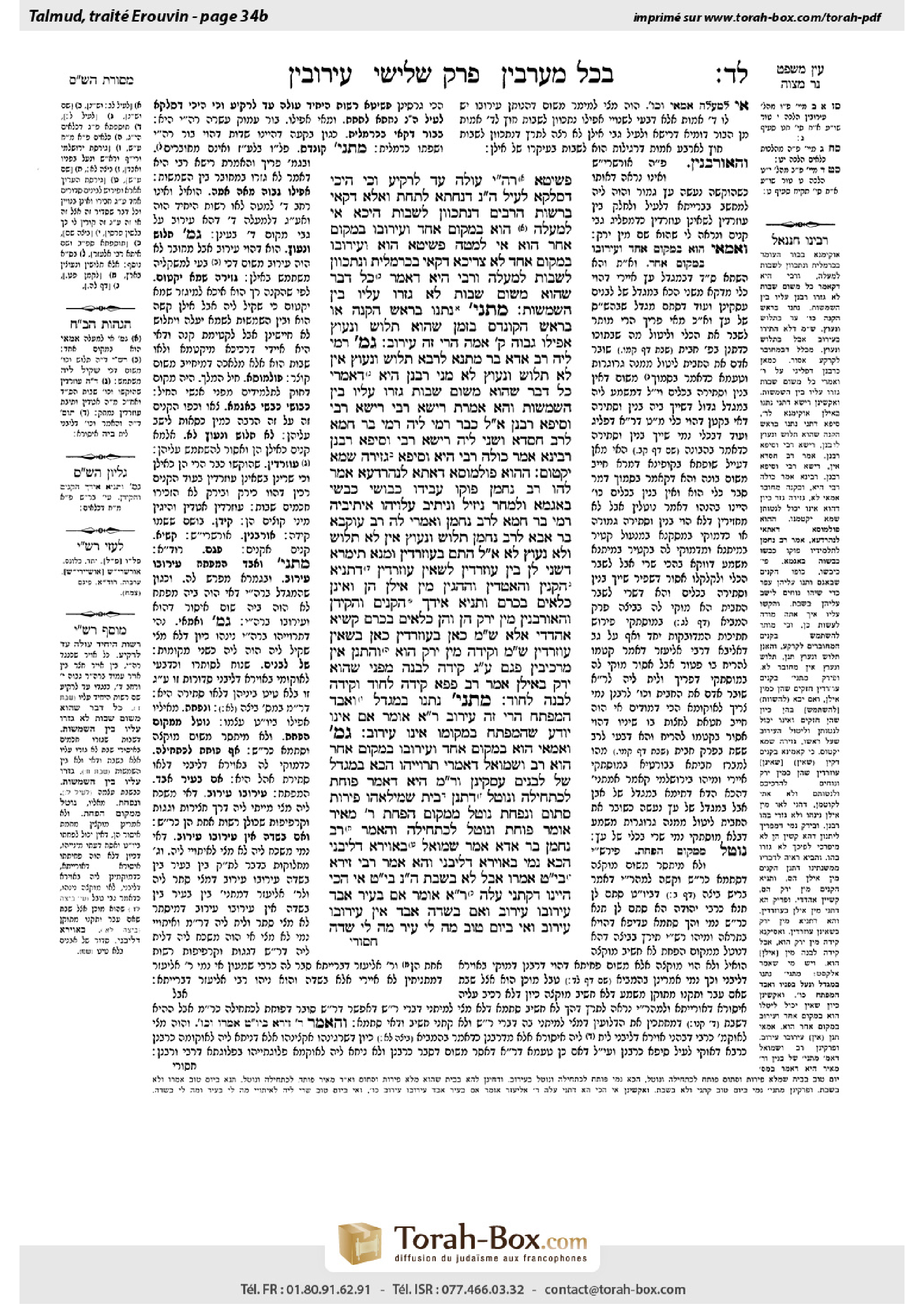
Eruvin 34b: Talmud study for Daf Yomi
Study the Talmud for Daf Yomi with scanned pages, Hebrew text, English translations from Sefaria and AI-generated French translations.
Passage selection and English or AI-generated French translation are available where the scan has annotations. Daf Study is independent of Torah-Box and Sefaria.
Browse Eruvin · עירובין · All tractatesEruvin 34b text and translations
This page of Eruvin includes the Aramaic text, an English translation and an AI-generated French translation, alongside the scan above.
עירובין ל״ד ב · Aramaic and Hebrew text
פְּשִׁיטָא! רְשׁוּת הַיָּחִיד עוֹלָה עַד לָרָקִיעַ, וְכִי הֵיכִי דְּסָלְקָא לְעֵיל, הָכִי נָמֵי דְּנָחֲתָא לְתַחַת. וְאֶלָּא דְּקָאֵי בִּרְשׁוּת הָרַבִּים.
דְּנִתְכַּוֵּון לִשְׁבּוֹת הֵיכָא? אִי לְמַעְלָה — הוּא בְּמָקוֹם אֶחָד וְעֵירוּבוֹ בְּמָקוֹם אַחֵר הוּא. אִי לְמַטָּה, פְּשִׁיטָא — הוּא וְעֵירוּבוֹ בִּמְקוֹם אֶחָד!
לָא צְרִיכָא, דְּקָאֵי בְּכַרְמְלִית וְנִתְכַּוֵּון לִשְׁבּוֹת לְמַעְלָה, וְרַבִּי הִיא דְּאָמַר: כׇּל דָּבָר שֶׁהוּא מִשּׁוּם שְׁבוּת לֹא גָּזְרוּ עָלָיו בֵּין הַשְּׁמָשׁוֹת.
מַתְנִי׳ נְתָנוֹ בְּרֹאשׁ הַקָּנֶה אוֹ בְּרֹאשׁ הַקּוּנְדָּס, בִּזְמַן שֶׁהוּא תָּלוּשׁ וְנָעוּץ, אֲפִילּוּ גָּבוֹהַּ מֵאָה אַמָּה — הֲרֵי זֶה עֵירוּב.
גְּמָ׳ רָמֵי לֵיהּ רַב אַדָּא בַּר מַתְנָא לְרָבָא: תָּלוּשׁ וְנָעוּץ — אִין. לֹא תָּלוּשׁ וְנָעוּץ — לָא. מַנִּי? רַבָּנַן הִיא, דְּאָמְרִי: כׇּל דָּבָר שֶׁהוּא מִשּׁוּם שְׁבוּת גָּזְרוּ עָלָיו בֵּין הַשְּׁמָשׁוֹת. וְהָא אָמְרַתְּ רֵישָׁא רַבִּי! רֵישָׁא רַבִּי וְסֵיפָא רַבָּנַן?!
אֲמַר לֵיהּ: כְּבָר רָמֵי לֵיהּ רָמֵי בַּר חָמָא לְרַב חִסְדָּא, וְשַׁנִּי לֵיהּ: רֵישָׁא רַבִּי, וְסֵיפָא רַבָּנַן.
רָבִינָא אָמַר: כּוּלָּהּ רַבִּי הִיא, וְסֵיפָא גְּזֵירָה שֶׁמָּא יִקְטוֹם.
הָהוּא פּוּלְמוּסָא דַּאֲתָא לִנְהַרְדְּעָא. אֲמַר לְהוּ רַב נַחְמָן: פּוּקוּ עֲבִידוּ כְּבוּשֵׁי כַּבְשֵׁי בְּאַגְמָא, וּלְמָחָר נֵיזִיל וְנִיתֵּיב עִלָּוַיְהוּ.
אֵיתִיבֵיהּ רָמֵי בַּר חָמָא לְרַב נַחְמָן, וְאָמְרִי לַהּ רַב עוּקְבָא בַּר אַבָּא לְרַב נַחְמָן: תָּלוּשׁ וְנָעוּץ אִין, לֹא תָּלוּשׁ וְלֹא נָעוּץ לָא.
אֲמַר לֵיהּ: הָתָם בְּעוּזְרָדִין. וּמְנָא תֵּימְרָא דְּשָׁנֵי לַן בֵּין עוּזְרָדִין לְשֶׁאֵין עוּזְרָדִין — דְּתַנְיָא: הַקָּנִין וְהָאֲטָדִין וְהַהִגִּין — מִין אִילָן הֵן, וְאֵינָן כִּלְאַיִם בַּכֶּרֶם. וְתַנְיָא אִידַּךְ: הַקָּנִים וְהַקִּידָן וְהָאוּרְבָּנִין — מִין יָרָק הֵן, וְהֵן כִּלְאַיִם בַּכֶּרֶם. קַשְׁיָא אַהֲדָדֵי!
אֶלָּא שְׁמַע מִינַּהּ: כָּאן בְּעוּזְרָדִין, כָּאן בְּשֶׁאֵין עוּזְרָדִין. שְׁמַע מִינַּהּ.
וְקִידָּה מִין יָרָק הוּא?! וְהָתְנַן: אֵין מַרְכִּיבִין פֵּגָם עַל גַּבֵּי קִידָּה לְבָנָה, מִפְּנֵי שֶׁהוּא יָרָק בְּאִילָן! אָמַר רַב פָּפָּא: קִידָּה לְחוּד, וְקִידָּה לְבָנָה לְחוּד.
מַתְנִי׳ נְתָנוֹ בְּמִגְדָּל וְאָבַד הַמַּפְתֵּחַ — הֲרֵי זֶה עֵירוּב. רַבִּי אֱלִיעֶזֶר אוֹמֵר: אִם אֵינוֹ יוֹדֵעַ שֶׁהַמַּפְתֵּחַ בִּמְקוֹמוֹ — אֵינוֹ עֵירוּב.
גְּמָ׳ וְאַמַּאי? הוּא בְּמָקוֹם אֶחָד וְעֵירוּבוֹ בְּמָקוֹם אַחֵר הוּא!
רַב וּשְׁמוּאֵל דְּאָמְרִי תַּרְוַיְיהוּ: הָכָא בְּמִגְדָּל שֶׁל לְבֵנִים עָסְקִינַן וְרַבִּי מֵאִיר הִיא, דְּאָמַר: פּוֹחֵת לְכַתְּחִילָּה וְנוֹטֵל. דִּתְנַן: בַּיִת שֶׁמִּילְּאָהוּ פֵּירוֹת, סָתוּם וְנִפְחַת — נוֹטֵל מִמְּקוֹם הַפְּחָת, רַבִּי מֵאִיר אוֹמֵר: פּוֹחֵת וְנוֹטֵל לְכַתְּחִילָּה.
וְהָאָמַר רַב נַחְמָן בַּר אַדָּא אָמַר שְׁמוּאֵל: בְּאַוֵּירָא דְלִיבְנֵי. הָכָא נָמֵי בַּאֲוֵירָא דְלִיבְנֵי.
וְהָא אָמַר רַבִּי זֵירָא: בְּיוֹם טוֹב אָמְרוּ, אֲבָל לֹא בְּשַׁבָּת! הָכָא נָמֵי בְּיוֹם טוֹב.
אִי הָכִי, הַיְינוּ דְּקָתָנֵי עֲלַהּ, רַבִּי אֱלִיעֶזֶר אוֹמֵר: אִם בָּעִיר אָבַד — עֵירוּבוֹ עֵירוּב, וְאִם בַּשָּׂדֶה אָבַד — אֵין עֵירוּבוֹ עֵירוּב. וְאִי בְּיוֹם טוֹב, מָה לִי עִיר מָה לִי שָׂדֶה?
Eruvin 34b · English translation
it is obvious, for the private domain ascends to the sky, and just as it ascends upward, so too, it descends downward to the bottom of the pit, even if it is more than ten handbreadths deep. Rather, we must say that the pit is situated in the public domain.
The Gemara now clarifies: Where did one intend to establish his Shabbat residence? If he intended to establish his residence above the pit in the public domain, this is a case where he is in one place and his eiruv is in another place, i.e., in a private domain, and therefore his eiruv is not valid. Alternatively, if one intended to establish his Shabbat residence below, in the pit, it is also obvious, as he and his eiruv are in one place.
The Gemara answers: This ruling is necessary only in a case where the pit is situated in a karmelit, and he intended to establish his Shabbat residence above the pit in the karmelit. And with regard to the question of how this eiruv can be valid, as one cannot bring the eiruv from the pit to the karmelit, the answer is that the mishna was taught in accordance with the opinion of Rabbi Yehuda HaNasi, who said: With regard to anything that is prohibited on Shabbat due to rabbinic decree [shevut], they did not issue the decree to apply during twilight. Since carrying from the pit to the karmelit is only prohibited as a shevut, a person may carry from the pit to the karmelit during twilight, the time when the eiruv establishes one’s Shabbat residence.
MISHNA: If one placed his eiruv on top of a reed or on top of a pole [kundas], when the reed or pole is detached from its original place and stuck into the ground, even if it is a hundred cubits high, it is a valid eiruv, as one can remove the reed or pole from the ground and take his eiruv.
GEMARA: Rav Adda bar Mattana raised a contradiction before Rava concerning two tannaitic rulings: The mishna states that if the reed was detached from its place of growth and then stuck into the ground, yes, the eiruv is valid. That indicates that if it was not detached and then stuck back into the ground, no, the eiruv is not valid. In accordance with whose opinion is this mishna? It is in accordance with the opinion of the Rabbis, who say: Anything that is prohibited on Shabbat due to rabbinic decree [shevut], such as using a tree on Shabbat, they issued the decree to apply even during twilight. Therefore, if the eiruv was on top of a reed that was still attached to the ground in its original place of growth, since it is prohibited by rabbinic decree to make use of trees on Shabbat, one cannot remove the eiruv from its place at the time that he must establish his Shabbat residence, and therefore his eiruv is invalid. But didn’t you say that the first clause, i.e., the previous mishna, is in accordance with the opinion of Rabbi Yehuda HaNasi? How can you say that the first clause is in accordance with the opinion of Rabbi Yehuda HaNasi and the latter clause is in accordance with the opinion of the Rabbis?
Rava said to Rav Adda: Rami bar Ḥama already raised this contradiction before Rav Ḥisda, and Rav Ḥisda answered him: Indeed, the first clause is in accordance with the opinion of Rabbi Yehuda HaNasi, and the latter clause is in accordance with the opinion of the Rabbis.
Ravina said: You can, in fact, say that it is all Rabbi Yehuda HaNasi, and the latter clause, i.e., the mishna that insists that the reed be detached and inserted, is not based upon the prohibition of utilizing trees on Shabbat. Rather, in that case there is a unique decree lest he break it off from the ground if the reed is relatively soft. Therefore, the mishna requires one to use something that has already been detached from the ground and reinserted. However, the previous mishna is referring to someone who placed his eiruv in a tree, where this concern is not relevant.
The Gemara relates that a certain army [pulmosa] once came to Neharde’a and took quarters in the study hall, so that there was not enough room for the students. Rav Naḥman said to the students: Go out and create seats by compressing reeds in the marshes, and tomorrow, on Shabbat, we will go and sit on them and study there.
Rami bar Ḥama raised an objection to Rav Naḥman, and some say that it was Rav Ukva bar Abba who raised the objection to Rav Naḥman, from the mishna that states that if the reed was detached and then stuck into the ground, yes; but if it was not detached and not stuck into the ground, no. This shows that it is not enough to compress the reeds, and they must actually be detached from the ground before they may be used on Shabbat.
Rav Naḥman said to him: There, in the mishna, we are dealing with hard reeds, which may not be bent and used on Shabbat, unlike soft reeds. He adds: And from where do you say that we distinguish between hard reeds and reeds that are not hard? As it was taught in a baraita: Reeds, boxthorn, and thistles are species of trees, and therefore they are not included in the prohibition of food crops in a vineyard, which applies only to herbs planted among vines. And it was taught in another baraita: Reeds, cassia, and bulrushes are species of herbs, and therefore they are included in the prohibition of food crops in a vineyard. These two baraitot contradict one another, as one states that reeds are trees, while the other says that they are considered herbs.
Rather, conclude from this that we must distinguish between them as follows: Here, in the first baraita, it is referring to hard reeds, which are like trees; whereas there, in the second baraita, it is referring to reeds that are not hard. The Gemara concludes: Indeed, conclude from this that our resolution of the contradiction is correct.
The Gemara raises a question with regard to the previously cited baraita: Is cassia a type of herb? Didn’t we learn in a mishna: One may not graft rue to white cassia, as this involves the grafting of herbs to a tree? This proves that white cassia is a tree. Rav Pappa said: There is no difficulty, as cassia is distinct and is considered a type of herb, and white cassia is distinct and is considered a type of tree.
MISHNA: If one put the eiruv in a cupboard and locked it, and the key was lost, so that he is now unable to open the cupboard and access the eiruv, it is nonetheless a valid eiruv. Rabbi Eliezer says: If he does not know that the key is in its place, it is not a valid eiruv.
GEMARA: The Gemara asks: And why should the eiruv be valid if the key was lost? He is in one place and his eiruv is in a different place, since he cannot access the eiruv.
It was Rav and Shmuel who both said: Here, we are dealing with a cupboard made of bricks, and the mishna is in accordance with the opinion of Rabbi Meir, who said: One may create a breach in a brick wall on Shabbat ab initio, and take produce from the other side. As we learned in a mishna: If a house filled with produce had been sealed and was then breached, one may take out produce from the place of the breach. Rabbi Meir disagrees and says: One may even create a breach in the wall of the house and take produce ab initio. Consequently, according to Rabbi Meir it is permissible to make a hole in the cupboard in order to remove the produce found inside.
The Gemara asks: Didn’t Rav Naḥman bar Adda say that Shmuel said that that very mishna cited as a proof is referring to a structure built from layers of bricks piled one atop the other without cement or mortar between them, in which case making a hole cannot be considered dismantling a bona fide structure? The Gemara answers: Here too, we are dealing with a cupboard made from layers of bricks.
The Gemara raises another difficulty: Didn’t Rabbi Zeira say: The Sages in the aforementioned mishna, who discussed the breaching of a wall, spoke only with regard to a Festival, but not with regard to Shabbat? Therefore, it cannot be derived from that mishna that it is permitted to breach the cupboard on Shabbat in order to access the food inside. The Gemara answers: Here too, the mishna is referring to a case where the person needed an eiruv for a Festival but not for Shabbat.
The Gemara asks: If it is so that the mishna is referring only to a Festival, there is a difficulty with that which was taught about it in the following Tosefta: Rabbi Eliezer says: If the key was lost in a city, his eiruv is a valid eiruv; and if it was lost in a field, his eiruv is not a valid eiruv, for within a city it is possible to carry the key by way of courtyards that have joined together in an eiruv or the like, but in a field it is impossible to carry it, as the field has the status of a karmelit. And if the mishna is referring to a Festival, what is the difference to me whether the key was lost in a city or a field? On a Festival there is no prohibition against carrying from a private to a public domain, and therefore if the key was lost even in a field, the eiruv should still be valid.
Eruvin 34b · Traduction française (IA)
C’est évident, car le domaine privé monte jusqu’au ciel, et tout comme il monte vers le haut, il descend aussi vers le fond du puits, même s’il est plus profond que dix paumes. En réalité, nous devons dire que le puits est situé dans le domaine public.
La Guemara clarifie maintenant : Où l’homme avait-il l’intention d’établir sa résidence sabbatique ? Si l’intention était d’établir sa résidence au-dessus du puits dans le domaine public, c’est un cas où il est dans un lieu et son eiruv est dans un autre lieu, c’est-à-dire dans un domaine privé, et par conséquent son eiruv n’est pas valide. Alternativement, si l’homme avait l’intention d’établir sa résidence en dessous, dans le puits, c’est aussi évident, car il et son eiruv sont dans le même lieu.
La Guemara répond : Cette décision est nécessaire uniquement dans le cas où le puits est situé dans un karmelit, et l’homme avait l’intention d’établir sa résidence sabbatique au-dessus du puits dans le karmelit. Et concernant la question de la validité de cet eiruv, puisque l’on ne peut pas apporter l’eiruv du puits vers le karmelit, la réponse est que la michna a été enseignée selon l’opinion de Rabbi Yehuda HaNasi, qui disait : Concernant tout ce qui est interdit le sabbat en raison d’un décret rabbinique [shevut], ils n’ont pas émis le décret pour s’appliquer pendant le crépuscule. Puisque le transport du puits vers le karmelit est seulement interdit en tant que shevut, une personne peut transporter du puits vers le karmelit pendant le crépuscule, l’époque où l’eiruv établit sa résidence sabbatique.
MICHNA : Si l’homme a placé son eiruv sur un roseau ou sur un bâton [kundas], et que le roseau ou le bâton est détaché de son lieu d’origine et planté dans le sol, même s’il est cent coudées de haut, c’est un eiruv valide, car l’homme peut retirer le roseau ou le bâton du sol et récupérer son eiruv.
GUEMARA : Rav Adda bar Mattana a soulevé un problème devant Rava concernant deux décrets tannaitiques : La michna dit que si le roseau était détaché de son lieu de croissance et ensuite planté dans le sol, oui, l’eiruv est valide. Cela indique que si le roseau n’était pas détaché et ensuite replanté dans le sol, non, l’eiruv n’est pas valide. Selon l’opinion de qui est cette michna ? C’est selon l’opinion des Rabbins, qui disent : Tout ce qui est interdit le sabbat en raison d’un décret rabbinique [shevut], comme l’utilisation d’un arbre le sabbat, ils ont émis le décret pour s’appliquer même pendant le crépuscule. Par conséquent, si l’eiruv était sur un roseau qui était encore attaché au sol dans son lieu d’origine, puisque c’est interdit par un décret rabbinique d’utiliser des arbres le sabbat, l’homme ne peut pas retirer l’eiruv de son lieu au moment où il doit établir sa résidence sabbatique, et par conséquent son eiruv est invalide. Mais n’avez-vous pas dit que la première clause, c’est-à-dire la michna précédente, est selon l’opinion de Rabbi Yehuda HaNasi ? Comment pouvez-vous dire que la première clause est selon l’opinion de Rabbi Yehuda HaNasi et la seconde clause selon l’opinion des Rabbins ?
Rava dit à Rav Adda : Rami bar Ḥama a déjà soulevé cette contradiction devant Rav Ḥisda, et Rav Ḥisda a répondu à lui : En effet, la première clause est selon l’opinion de Rabbi Yehuda HaNasi, et la seconde clause est selon l’opinion des Rabbins.
Ravina dit : Vous pouvez, en effet, dire que c’est tout Rabbi Yehuda HaNasi, et la seconde clause, c’est-à-dire la michna qui insiste sur le fait que le roseau soit détaché et inséré, n’est pas basée sur l’interdiction d’utiliser des arbres le sabbat. Plutôt, dans ce cas-là, il y a un décret spécial pour éviter qu’il ne le détache du sol si le roseau est relativement mou. Par conséquent, la michna exige que l’on utilise quelque chose qui a déjà été détaché du sol et réinséré. Cependant, la michna précédente fait référence à quelqu’un qui a placé son eiruv dans un arbre, où ce souci n’est pas pertinent.
La Guemara rapporte qu’une certaine armée [pulmosa] est venue à Neharde’a et a pris ses quartiers dans la salle de study, de sorte qu’il n’y avait pas assez de place pour les étudiants. Rav Naḥman a dit aux étudiants : Sortez et créez des sièges en compressant des roseaux dans les marais, et demain, le sabbat, nous irons nous asseoir dessus et étudier là-bas.
Rami bar Ḥama souleva une objection contre Rav Naḥman, et certains disent que c’était Rav Ukva bar Abba qui avait soulevé l’objection contre Rav Naḥman, à partir de la michna qui stipule que si le roseau était détaché et ensuite planté dans le sol, oui ; mais si il n’était pas détaché et non planté dans le sol, non. Cela montre que ce n’est pas suffisant de comprimer les roseaux, et qu’ils doivent être effectivement détachés du sol avant d’être utilisés le sabbat.
Rav Naḥman répondit à lui : Là, dans la michna, nous parlons de roseaux durs, qui ne peuvent pas être pliés et utilisés le sabbat, contrairement aux roseaux mous. Il ajoute : Et d’où disiez-vous que nous distinguons entre les roseaux durs et les roseaux qui ne sont pas durs ? Comme il a été enseigné dans une baraïta : Les roseaux, le buis et les chardons sont des espèces d’arbres, et par conséquent ils ne sont pas inclus dans l’interdiction des cultures alimentaires dans un vignoble, qui s’applique uniquement aux herbes plantées parmi les vignes. Et il a été enseigné dans une autre baraïta : Les roseaux, le cinnamome et les roseaux de marais sont des espèces d’herbes, et par conséquent ils sont inclus dans l’interdiction des cultures alimentaires dans un vignoble. Ces deux baraitot s’opposent l’une à l’autre, car l’une dit que les roseaux sont des arbres, tandis que l’autre dit qu’ils sont considérés comme des herbes.
En réalité, concluez-en à partir de cela que nous devons distinguer entre eux comme suit : Ici, dans la première baraïta, il s’agit de roseaux durs, qui sont comme des arbres ; tandis que là, dans la seconde baraïta, il s’agit de roseaux qui ne sont pas durs. La Guemara conclut : En effet, concluez-en à partir de cela que notre résolution de la contradiction est correcte.
La Guemara pose une question concernant la baraïta citée précédemment : Cassie est-elle une plante ? N'avons-nous pas appris dans une mitsva : On ne doit pas greffer la rue à la cassie blanche, car cela implique de greffer des plantes à un arbre ? Cela prouve que la cassie blanche est un arbre. Rav Pappa dit : Il n'y a pas de difficulté, car la cassie est distincte et considérée comme une plante, et la cassie blanche est distincte et considérée comme un arbre.
MITSVA : Si l'on a mis l'eiruv dans un placard et l'a verrouillé, et que la clé a été perdue, de sorte qu'il ne peut plus ouvrir le placard et accéder à l'eiruv, il reste toutefois un eiruv valide. Rabbi Eliezer dit : Si l'on ne sait pas que la clé est à sa place, l'eiruv n'est pas valide.
GUEMARA : La Guemara demande : Et pourquoi l'eiruv est-il valide si la clé a été perdue ? Il est dans un lieu et son eiruv est dans un autre lieu, puisqu'il ne peut plus accéder à l'eiruv.
Rav et Shmuel ont tous les deux dit : Ici, nous parlons d'un placard en briques, et la Guemara est selon l'opinion de Rabbi Meir, qui a dit : On peut faire un trou dans un mur de briques le premier jour de Shabbat, et prendre les produits de l'autre côté. Comme nous avons appris dans une mitsva : Si une maison remplie de produits avait été scellée et ensuite percée, on peut prendre les produits du lieu du trou. Rabbi Meir est d'avis contraire et dit : On peut même faire un trou dans le mur de la maison et prendre les produits dès le début. Ainsi, selon Rabbi Meir, il est permis de faire un trou dans le placard afin d'en retirer les produits.
La Guemara demande : N’a-t-on pas dit que Rav Naḥman bar Adda a dit que Shmuel a dit que la mitsna citée comme preuve est relative à une structure construite à partir de couches de briques empilées les unes sur les autres sans ciment ou mortier entre elles, dans le cas où faire un trou ne peut pas être considéré comme démanteler une structure réelle ? La Guemara répond : Ici aussi, nous parlons d’un placard construit à partir de couches de briques.
La Guemara soulève une autre difficulté : N’a-t-on pas dit que Rabbi Zeira a dit : Les Sages mentionnés dans la mitsna précédente, qui discutaient de la percée d’un mur, parlaient uniquement d’un Festival, mais pas de Shabbat ? Ainsi, il ne peut pas être déduit de cette mitsna que l’on peut percer le placard le samedi afin d’accéder aux aliments à l’intérieur. La Guemara répond : Ici aussi, la mitsna fait référence à un cas où la personne avait besoin d’un eiruv pour un Festival mais pas pour le Shabbat.
La Guemara demande : Si c'est ainsi que la Michna fait référence uniquement à un Festival, il y a une difficulté avec ce qui a été enseigné à son sujet dans la Tosefta suivante : Rabbi Eliezer dit : Si la clé a été perdue dans une ville, son eiruv est valide ; et si elle a été perdue dans un champ, son eiruv n'est pas valide, car dans une ville il est possible de porter la clé par les cours qui se sont joints dans un eiruv ou du style, mais dans un champ il est impossible de la porter, car le champ a le statut de karmelit. Et si la Michna fait référence à un Festival, quelle est la différence pour moi que la clé ait été perdue dans une ville ou un champ ? Pendant un Festival, il n'y a pas de prohibition contre le transport d'un domaine privé à un domaine public, et donc si la clé a été perdue même dans un champ, l'eiruv devrait rester valide.
Traduction française générée par IA à partir de l’édition anglaise de Sefaria. Vérifie toujours un passage avec le texte source.
Text from Sefaria: William Davidson Edition - Vocalized Aramaic (CC BY NC); William Davidson Edition - English (CC BY NC).