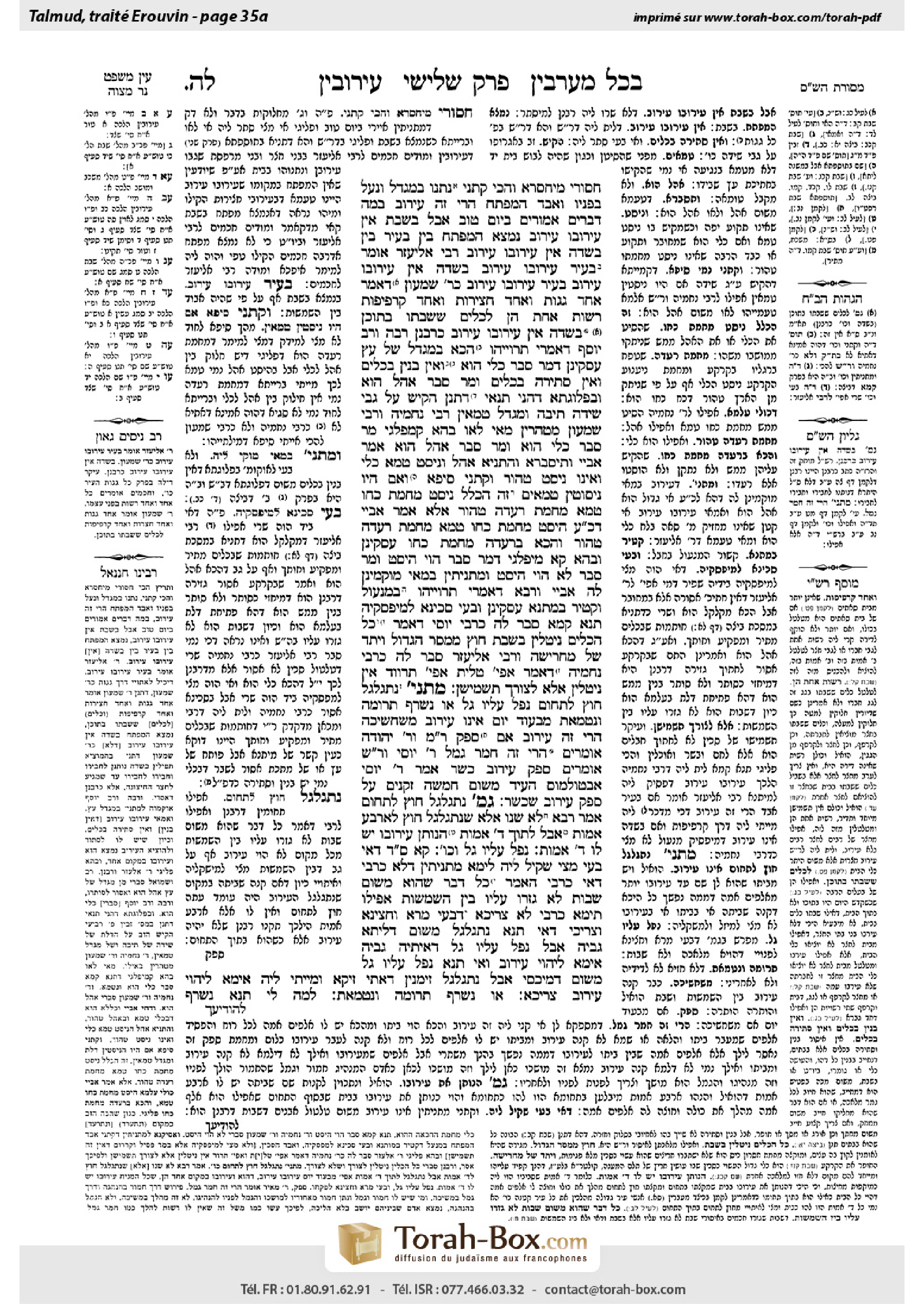
Eruvin 35a: Talmud study for Daf Yomi
Study the Talmud for Daf Yomi with scanned pages, Hebrew text, English translations from Sefaria and AI-generated French translations.
Passage selection and English or AI-generated French translation are available where the scan has annotations. Daf Study is independent of Torah-Box and Sefaria.
Browse Eruvin · עירובין · All tractatesEruvin 35a text and translations
This page of Eruvin includes the Aramaic text, an English translation and an AI-generated French translation, alongside the scan above.
עירובין ל״ה א · Aramaic and Hebrew text
חַסּוֹרֵי מִיחַסְּרָא וְהָכִי קָתָנֵי: נְתָנוֹ בְּמִגְדָּל, וְנָעַל בְּפָנָיו וְאָבַד הַמַּפְתֵּחַ — הֲרֵי זֶה עֵירוּב. בַּמֶּה דְּבָרִים אֲמוּרִים? בְּיוֹם טוֹב, אֲבָל בְּשַׁבָּת — אֵין עֵירוּבוֹ עֵירוּב. נִמְצָא הַמַּפְתֵּחַ, בֵּין בָּעִיר בֵּין בַּשָּׂדֶה — אֵין עֵירוּבוֹ עֵירוּב. רַבִּי אֱלִיעֶזֶר אוֹמֵר: בָּעִיר — עֵירוּבוֹ עֵירוּב, בַּשָּׂדֶה — אֵין עֵירוּבוֹ עֵירוּב.
בָּעִיר — עֵירוּבוֹ עֵירוּב, כְּרַבִּי שִׁמְעוֹן דְּאָמַר: אֶחָד גַּגּוֹת וְאֶחָד חֲצֵירוֹת וְאֶחָד קַרְפֵּיפוֹת — רְשׁוּת אַחַת הֵן לְכֵלִים שֶׁשָּׁבְתוּ בְּתוֹכָן. בַּשָּׂדֶה אֵין עֵירוּבוֹ עֵירוּב — כְּרַבָּנַן.
רַבָּה וְרַב יוֹסֵף דְּאָמְרִי תַּרְוַיְיהוּ: הָכָא בְּמִגְדָּל שֶׁל עֵץ עָסְקִינַן, דְּמָר סָבַר: כְּלִי הוּא, וְאֵין בִּנְיָן בְּכֵלִים וְאֵין סְתִירָה בְּכֵלִים. וּמָר סָבַר: אֹהֶל הוּא.
וּבִפְלוּגְתָּא דְהָנֵי תַנָּאֵי, דִּתְנַן: הִקִּישׁ עַל גַּבֵּי שִׁידָּה תֵּיבָה וּמִגְדָּל — טְמֵאִין. רַבִּי נְחֶמְיָה וְרַבִּי שִׁמְעוֹן מְטַהֲרִין.
מַאי לָאו, בְּהָא קָמִפַּלְגִי: מָר סָבַר — כְּלִי הוּא, וּמָר סָבַר — אֹהֶל הוּא.
אָמַר אַבָּיֵי: וְתִיסְבְּרָא? וְהָתַנְיָא: אֹהֶל וְנִיסָּט — טָמֵא, כְּלִי וְאֵינוֹ נִיסָּט — טָהוֹר. וְקָתָנֵי סֵיפָא: וְאִם הָיוּ נִיסּוֹטִין — טְמֵאִים, זֶה הַכְּלָל: נִיסָּט מֵחֲמַת כֹּחוֹ — טָמֵא, מֵחֲמַת רְעָדָה — טָהוֹר!
אֶלָּא אָמַר אַבָּיֵי: דְּכוּלֵּי עָלְמָא הֶיסֵּט מֵחֲמַת כֹּחוֹ — טָמֵא, מֵחֲמַת רְעָדָה — טָהוֹר. וְהָכָא בִּרְעָדָה מֵחֲמַת כֹּחוֹ עָסְקִינַן, וּבְהָא קָא מִיפַּלְגִי: דְּמָר סָבַר — הָוֵי הֶיסֵּט, וּמָר סָבַר — לָא הָוֵי הֶיסֵּט.
וּמַתְנִיתִין בְּמַאי מוֹקְמִינַן לַהּ? אַבָּיֵי וְרָבָא דְּאָמְרִי תַּרְוַיְיהוּ: בְּמַנְעוּל וּקְטִיר בְּמִתְנָא עָסְקִינַן, וּבָעֵי סַכִּינָא לְמִיפְסְקֵיהּ.
תַּנָּא קַמָּא סָבַר לַהּ כְּרַבִּי יוֹסֵי, דְּאָמַר: כָּל הַכֵּלִים נִיטָּלִין בְּשַׁבָּת, חוּץ מִמַּסָּר הַגָּדוֹל וְיָתֵד שֶׁל מַחֲרֵישָׁה.
וְרַבִּי אֱלִיעֶזֶר סָבַר לַהּ כְּרַבִּי נְחֶמְיָה, דְּאָמַר: אֲפִילּוּ טַלִּית אֲפִילּוּ תַּרְווֹד — אֵין נִיטָּלִין אֶלָּא לְצוֹרֶךְ תַּשְׁמִישָׁן.
מַתְנִי׳ נִתְגַּלְגֵּל חוּץ לַתְּחוּם, נָפַל עָלָיו גַּל אוֹ נִשְׂרַף, תְּרוּמָה וְנִטְמֵאת, מִבְּעוֹד יוֹם — אֵינוֹ עֵירוּב. מִשֶּׁחָשֵׁיכָה — הֲרֵי זֶה עֵירוּב.
אִם סָפֵק, רַבִּי מֵאִיר וְרַבִּי יְהוּדָה אוֹמְרִים: הֲרֵי זֶה חַמָּר גַּמָּל.
רַבִּי יוֹסֵי וְרַבִּי שִׁמְעוֹן אוֹמְרִים: סְפֵק עֵירוּב כָּשֵׁר. אָמַר רַבִּי יוֹסֵי: אַבְטוּלְמוֹס הֵעִיד מִשּׁוּם חֲמִשָּׁה זְקֵנִים עַל סְפֵק עֵירוּב שֶׁכָּשֵׁר.
גְּמָ׳ נִתְגַּלְגֵּל חוּץ לַתְּחוּם. אָמַר רָבָא: לֹא שָׁנוּ אֶלָּא שֶׁנִּתְגַּלְגֵּל חוּץ לְאַרְבַּע אַמּוֹת, אֲבָל לְתוֹךְ אַרְבַּע אַמּוֹת — הַנּוֹתֵן עֵירוּבוֹ יֵשׁ לוֹ אַרְבַּע אַמּוֹת.
נָפַל עָלָיו גַּל וְכוּ׳. קָא סָלְקָא דַּעְתָּךְ דְּאִי בָּעֵי מָצֵי שָׁקֵיל לֵיהּ.
לֵימָא מַתְנִיתִין דְּלָא כְּרַבִּי, דְּאִי כְּרַבִּי, הָאָמַר: כָּל דָּבָר שֶׁהוּא מִשּׁוּם שְׁבוּת — לֹא גָּזְרוּ עָלָיו בֵּין הַשְּׁמָשׁוֹת.
אֲפִילּוּ תֵּימָא כְּרַבִּי, לָא צְרִיכָא, דְּבָעֵי מָרָא וַחֲצִינָא.
וּצְרִיכִי. דְּאִי תְּנָא ״נִתְגַּלְגֵּל״ — מִשּׁוּם דְּלֵיתָא גַּבֵּיהּ. אֲבָל נָפַל עָלָיו גַּל, דְּאִיתֵיהּ גַּבֵּיהּ — אֵימָא לֶיהֱוֵי עֵירוּב.
וְאִי תְּנָא ״נָפַל עָלָיו גַּל״ — מִשּׁוּם דְּמִיכַּסֵּי. אֲבָל נִתְגַּלְגֵּל, זִימְנִין דְּאָתֵי זִיקָא וּמַיְיתֵי לֵיהּ — אֵימָא לֶיהֱוֵי עֵירוּב צְרִיכָא.
אוֹ נִשְׂרַף, תְּרוּמָה וְנִטְמֵאת. לְמָה לִי? תְּנָא נִשְׂרַף —
Eruvin 35a · English translation
The Gemara answers: The mishna is incomplete and it teaches the following: If one placed the eiruv in a cupboard and locked it, and the key is lost, it is nonetheless a valid eiruv. In what case is this statement said? On a Festival; however, on Shabbat, his eiruv is not a valid eiruv. If the key is found, whether in a city or in a field, his eiruv is not a valid eiruv. Rabbi Eliezer disagrees and says: If it is found in a city, his eiruv is a valid eiruv; but if it is found in a field, his eiruv is not a valid eiruv.
The Gemara now explains the difference: If the key is found in a city, his eiruv is a valid eiruv in accordance with the opinion of Rabbi Shimon, who said: Roofs, courtyards, and enclosed fields [karpeifot] are all one domain with regard to utensils that began Shabbat in them. Accordingly, a utensil that was left on a roof at the beginning of Shabbat may be carried into a courtyard or a karpef. It is possible to transfer anything located in a city from one place to another in a similar manner. If, however, the key is found in a field, his eiruv is not a valid eiruv, in accordance with the opinion of the Rabbis, due to the prohibition to carry in a karmelit. Although carrying there is merely a shevut, the eiruv is not valid.
The discussion above constitutes one understanding of the mishna. Rabba and Rav Yosef, however, both said: Here, we are dealing with a wooden cupboard, and the tanna’im disagree with regard to the following point: The first, anonymous Sage, who rules that the eiruv is valid, holds that the cupboard is a utensil, and that there is no prohibited labor of building utensils, and similarly, there is no dismantling of utensils. Since dismantling a utensil is not included in the prohibited labor of dismantling, one may make a hole in the cupboard in order to access the food used for the eiruv. And the other Sage, Rabbi Eliezer, who invalidates the eiruv, holds that the cupboard is a tent. A wooden implement of such a large size is no longer classified as a utensil; rather, it is considered a building, and therefore it is subject to the prohibitions against building and dismantling on Shabbat.
And their dispute is parallel to the dispute between these tanna’im, as we learned in a mishna with regard to the ritual impurity of a zav: One of the unique laws of a zav is that he imparts impurity to an object simply by moving it, even if he does not touch it directly. If a zav knocked on a carriage, crate, or cupboard, even if he did not actually come into direct contact with them, they are nonetheless ritually impure because he caused them to move when he struck them. Rabbi Neḥemya and Rabbi Shimon disagree and render them pure.
What, are they not disagreeing about this point: The first Sage holds that a carriage, crate, or cupboard is categorized as a utensil, and therefore it contracts ritual impurity when a zav causes it to move; and the other Sage, Rabbi Neḥemya and Rabbi Shimon, holds that it is a tent, and a building does not contract ritual impurity in any way from a zav?
Abaye said in refutation of this proof: And do you think that this is a reasonable explanation of the mishna? Wasn’t it taught in a baraita: If a zav shook a real tent, and it moved, it is ritually impure; and if he shook a utensil and it did not move, it is ritually pure? This indicates that the critical factor is not whether the article is classified as a tent or as a utensil but whether or not it actually moves when shaken. Furthermore, it was taught in the latter clause of that baraita: And if they moved, they are ritually impure, and this is the principle: If a utensil or a tent moved due to the direct force of the zav, it is ritually impure. But if it moved due to vibrations, e.g., if the zav knocked on the floor or on the platform upon which the object is located, and the vibrations of the floor or the platform caused the object to move, it is ritually pure, as it was not moved by the direct force of the zav. Once again, the determining factor is not the object’s classification as a tent or a utensil but whether it was actually moved by the zav.
Rather, Abaye said that the dispute between the first tanna and Rabbi Neḥemya and Rabbi Shimon should be understood as follows: All agree that movement due to the direct force of the zav causes the object to become ritually impure, whether it is a tent or a utensil. Conversely, if the movement was due to vibrations of the floor or base, it is ritually pure. And here, we are dealing with a case where the object vibrated because of the direct force of the zav, i.e., where he banged upon the object itself, causing it to vibrate but not to move. And the tanna’im disagree with regard to the following point: The first Sage holds that this, too, is considered movement; and the other Sage, Rabbi Neḥemya and Rabbi Shimon, holds that vibration is not considered movement. Therefore, Abaye rejects Rabba and Rav Yosef’s proof for their explanation of the mishna.
The Gemara therefore proceeds to ask: If so, how is the mishna with regard to eiruv to be interpreted? The Gemara answers: Abaye and Rava both said: We are dealing here with a lock that is tied with a leather strap, and a knife is required to cut it if there is no key.
The anonymous first tanna holds in accordance with the opinion of Rabbi Yosei, who said: All utensils may be moved on Shabbat, except for a large saw and the blade of a plow. Consequently, one may take a knife, cut the strap, and remove his eiruv from the cupboard.
And Rabbi Eliezer holds in accordance with the opinion of Rabbi Neḥemya, who said: Even a cloak, and even a spoon, which are certainly used only for activities permitted on Shabbat, may be moved on Shabbat only for the purpose of their ordinary use. The same applies to a knife, which may be moved only in order to cut food, but not for any other purpose. Consequently, one cannot cut the strap around the lock of the cupboard, and therefore his eiruv is invalid unless the key is located in town and he can transport it via courtyards.
MISHNA: If one’s eiruv rolled beyond the Shabbat limit, and he no longer has access to his eiruv since he may not go beyond his limit, or if a pile of stones fell on it, or if it was burnt, or if the eiruv was teruma and it became ritually impure; if any of these occurrences took place while it was still day, prior to the onset of Shabbat, it is not a valid eiruv, since one did not have an eiruv at twilight, which is the time one’s Shabbat residence is established. However, if any of these occurred after dark, when it was already Shabbat, it is a valid eiruv, as it was intact and accessible at the time one’s Shabbat residence is determined.
If the matter is in doubt, i.e., if he does not know when one of the aforementioned incidents occurred, Rabbi Meir and Rabbi Yehuda say: This person is in the position of both a donkey driver, who must prod the animal from behind, and a camel driver, who must lead the animal from the front, i.e., he is a person who is pulled in two opposite directions. Due to the uncertainty concerning his Shabbat border, he must act stringently, as though his resting place were both in his town and at the location where he placed the eiruv. He must restrict his Shabbat movement to those areas that are within two thousand cubits of both locations.
Rabbi Yosei and Rabbi Shimon disagree and say: An eiruv whose validity is in doubt is nevertheless valid. Rav Yosei said: The Sage Avtolemos testified in the name of five Elders that an eiruv whose validity is in doubt is valid.
GEMARA: We learned in the mishna: If one’s eiruv rolled beyond the Shabbat limit prior to the onset of Shabbat, it is not a valid eiruv. Rava said: They only taught this in a case where one established his eiruv at the edge of his town’s Shabbat limit and the eiruv rolled more than four cubits outside that limit; however, if it remained within four cubits of the Shabbat limit, it is a valid eiruv. The principle is that one who places his eiruv in a particular location has four cubits around it, since he has established his Shabbat residence there.
The mishna continues: If a pile of stones fell on the eiruv prior to the onset of Shabbat, it is not a valid eiruv. It might enter your mind to say that the mishna is referring to a case where if one wanted he could take the eiruv, i.e., where it is physically possible to clear the stones and remove the eiruv from underneath them. The only reason he cannot do so is because of the rabbinic prohibition to handle items that are set-aside, such as stones, on Shabbat.
If so, let us say that the mishna is not in accordance with the opinion of Rabbi Yehuda HaNasi. As, if you say that it is in accordance with the opinion of Rabbi Yehuda HaNasi, there is a difficulty: Didn’t he say that with regard to anything prohibited due to rabbinic decree, they did not issue the decree to apply during twilight? The prohibition to handle items that are set-aside is also a rabbinic decree, and therefore, according to Rabbi Yehuda HaNasi, since the eiruv was accessible at twilight, it should be valid.
The Gemara rejects this argument: Even if you say that the mishna is in accordance with the opinion of Rabbi Yehuda HaNasi, we can say that this ruling was necessary only in a case where a hoe or a spade would be required in order to remove the eiruv from under the stones, i.e., one would have to dig, which is a Shabbat labor prohibited by Torah law, not only by rabbinic decree.
The Gemara comments: And both rulings, the ruling concerning an eiruv that rolled beyond the Shabbat limit and the ruling concerning an eiruv that became buried under a pile of rocks, are necessary. As, if the mishna had only taught the case of the eiruv that rolled away, we might have said that the eiruv is invalid because it is not near him, but if a pile of rocks fell on the eiruv, since it is near him, you might say that it should be a valid eiruv, as one does not actually have to eat the eiruv.
And conversely, if the mishna had only taught the case where a pile of rocks fell on the eiruv, we might have said that the eiruv is invalid because it is covered, but in the case where it rolled away, since sometimes a wind comes and brings it back, you might say that it should be a valid eiruv. Therefore, it was necessary to teach both cases.
The mishna further states: Or if the eiruv was burnt, or if the eiruv was teruma that became ritually impure before Shabbat, it is not a valid eiruv. The Gemara asks: Why do I need to teach these two cases? The essential point of both cases is the same: The eiruv is no longer fit to be eaten. The Gemara answers: The mishna taught the case where the eiruv was burnt
Eruvin 35a · Traduction française (IA)
Le Guemara répond : La Michna est incomplète et elle enseigne ceci : Si l'on a mis l'eiruv dans un armoire et l'a verrouillé, et que la clé est perdue, l'eiruv reste toutefois valide. Dans quel cas cette déclaration est-elle faite ? Sur un festival ; cependant, le sabbat, son eiruv n'est pas valide. Si la clé est trouvée, que ce soit en ville ou à la campagne, son eiruv n'est pas valide. Rabbi Eliezer désaccorde et dit : Si la clé est trouvée en ville, son eiruv est valide ; mais si elle est trouvée à la campagne, son eiruv n'est pas valide.
Le Guemara explique maintenant la différence : Si la clé est trouvée en ville, son eiruv est valide selon l'opinion de Rabbi Shimon, qui dit : Les toits, les courtyards et les champs enclos [karpeifot] sont tous un seul domaine concernant les ustensiles qui ont commencé le sabbat dedans. Ainsi, un ustensile laissé sur un toit au début du sabbat peut être porté dans un courtyard ou un karpef. Il est possible de transférer n'importe quel objet situé en ville d'un endroit à un autre de la même manière. Cependant, si la clé est trouvée à la campagne, son eiruv n'est pas valide, selon l'opinion des Rabbins, en raison de l'interdiction de porter dans un karmelit. Bien que le port là-bas soit simplement une shevut, l'eiruv n'est pas valide.
La discussion ci-dessus constitue une interprétation de la Michna. Rabba et Rav Yosef, cependant, disent tous les deux : Ici, nous parlons d'un armoire en bois, et les tanna’im divergent concernant le point suivant : Le premier sage anonyme, qui considère que l'eiruv est valide, considère que l'armoire est un ustensile, et qu'il n'y a pas de travail interdit de construction d'ustensiles, et de même, il n'y a pas de démontage d'ustensiles. Puisque le démontage d'un ustensile n'est pas inclus dans le travail interdit de démontage, on peut percer l'armoire pour accéder aux aliments utilisés pour l'eiruv. Et l'autre sage, Rabbi Eliezer, qui invalide l'eiruv, considère que l'armoire est une tente. Un objet en bois de cette taille n'est plus classé comme un ustensile ; il est considéré comme une construction, et donc soumis aux interdits de construction et de démontage le sabbat.
Et leur débat est parallèle au débat entre ces tanna’im, comme nous l'avons appris dans une Michna concernant l'impureté rituelle d'un zav : L'une des lois uniques d'un zav est qu'il transmet l'impureté à un objet simplement en le faisant bouger, même s'il ne le touche pas directement. Si un zav a frappé un chariot, une caisse ou un armoire, même s'il n'a pas eu contact direct avec eux, ils sont tout de même impurs rituellement car il a causé leur mouvement en les frappant. Rabbi Neḥemya et Rabbi Shimon divergent et les rendent purs.
Qu'est-ce que ce n'est pas un débat sur ce point : Le premier sage considère qu'un chariot, une caisse ou un armoire est classé comme un ustensile, et donc il contracte l'impureté rituelle quand un zav le fait bouger ; et l'autre sage, Rabbi Neḥemya et Rabbi Shimon, considère qu'il est une tente, et une construction ne contracte pas l'impureté rituelle d'une quelconque manière à cause d'un zav ?
Abaye dit pour réfuter cette preuve : Et vous pensez que c'est une explication raisonnable de la Michna ? N'était-ce pas enseigné dans une baraïta : Si un zav a secoué une vraie tente, et qu'elle a bougé, elle est impure rituellement ; et si il a secoué un ustensile et qu'elle n'a pas bougé, elle est pure rituellement ? Cela indique que le facteur critique n'est pas si l'objet est classé comme une tente ou comme un ustensile, mais si l'objet a effectivement bougé en raison de la secousse. De plus, il a été enseigné dans la dernière partie de cette baraïta : Et si ils ont bougé, ils sont impurs rituellement, et c'est le principe : Si un ustensile ou une tente a bougé en raison de la force directe du zav, il est impur rituellement. Mais si l'objet a bougé en raison de vibrations, par exemple, si le zav a frappé le sol ou la plateforme sur laquelle l'objet est situé, et que les vibrations du sol ou de la plateforme ont fait bouger l'objet, il est pur rituellement, car il n'a pas été bougé par la force directe du zav. À nouveau, le facteur déterminant n'est pas la classification de l'objet comme une tente ou un ustensile, mais si l'objet a effectivement été bougé par le zav.
Plutôt, Abaye dit que le débat entre le premier tanna et Rabbi Neḥemya et Rabbi Shimon devrait être compris comme suit : Tout le monde est d'accord que le mouvement en raison de la force directe du zav cause l'objet à devenir impur rituellement, que ce soit une tente ou un ustensile. À l'inverse, si le mouvement était en raison des vibrations du sol ou de la base, il est pur rituellement. Et ici, nous sommes dans un cas où l'objet a vibré en raison de la force directe du zav, c'est-à-dire où il a frappé l'objet lui-même, causant des vibrations mais pas un mouvement. Et les tanna’im divergent concernant le point suivant : Le premier sage considère que cela est également considéré comme un mouvement ; et l'autre sage, Rabbi Neḥemya et Rabbi Shimon, considère que la vibration n'est pas considérée comme un mouvement. Ainsi, Abaye rejette la preuve de Rabba et de Rav Yosef pour leur explication de la Michna.
Le Guemara procède donc à poser une question : Si c'est ainsi, comment interpréter la Michna concernant l'eiruv ? Le Guemara répond : Abaye et Rava ont tous les deux dit : Nous sommes ici dans le cas d'un verrou lié par une corde en cuir, et un couteau est requis pour le couper si l'on n'a pas de clé.
Le premier tanna anonyme suit l'opinion de Rabbi Yosei, qui dit : Tous les ustensiles peuvent être déplacés le sabbat, sauf un grand sabre et la lame d'une charrue. Ainsi, on peut prendre un couteau, couper la corde et retirer son eiruv de l'armoire.
Et Rabbi Eliezer suit l'opinion de Rabbi Néchemyah, qui dit : Même une cape et même une cuillère, qui sont certainement utilisés uniquement pour des activités permises le sabbat, peuvent être déplacés le sabbat uniquement pour l'usage ordinaire. C'est pareil pour un couteau, qui peut être déplacé uniquement pour couper les aliments, mais pas pour tout autre usage. Ainsi, on ne peut pas couper la corde autour du verrou de l'armoire, et donc son eiruv est invalide à moins que la clé soit en ville et qu'il puisse la transporter via les courtyards.
MICHNA : Si l'eiruv d'une personne a dépassé la limite du Shabbat, et qu'il n'a plus accès à son eiruv car il ne peut pas sortir de sa limite, ou si un tas de pierres est tombé dessus, ou s'il a été brûlé, ou si l'eiruv était terouma et est devenu impur rituellement ; si l'une de ces occurrences s'est produite pendant la journée, avant l'entrée du Shabbat, l'eiruv n'est pas valide, car l'on n'avait pas d'eiruv à la tombée de la nuit, moment où l'on établit sa résidence du Shabbat. Cependant, si l'une de ces occurrences s'est produite après la tombée de la nuit, lorsque le Shabbat était déjà commencé, l'eiruv est valide, car il était intact et accessible au moment où l'on détermine la résidence du Shabbat.
Si la question est douteuse, c'est-à-dire si l'on ne sait pas quand l'une de ces occurrences s'est produite, Rabbi Meir et Rabbi Yéhuda disent : cette personne est dans la situation d'un conducteur de chameau qui doit pousser l'animal de l'arrière et d'un conducteur de chameau qui doit le guider de l'avant, c'est-à-dire qu'il est une personne tirée dans deux directions opposées. En raison de l'incertitude concernant sa limite du Shabbat, il doit agir avec rigueur, comme si sa résidence du Shabbat était à la fois dans sa ville et au lieu où il a placé l'eiruv. Il doit limiter ses déplacements du Shabbat aux zones situées à deux mille coudées de chaque lieu.
Rabbi Yosei et Rabbi Shimon s'opposent et disent : un eiruv dont la validité est en doute est toutefois valide. Rav Yosei a dit : le Sage Avtolaïmos a témoigné en nom de cinq Anciens que tout eiruv dont la validité est en doute est valide.
GUEMARA : Nous avons appris dans la mishna : si l'eiruv d'une personne a dépassé la limite du Shabbat avant l'entrée du Shabbat, il n'est pas un eiruv valide. Rava a dit : ils ont enseigné cela uniquement dans le cas où l'on a établi son eiruv à la limite de la ville du Shabbat et que l'eiruv a dépassé plus de quatre coudées en dehors de cette limite ; cependant, si il est resté à moins de quatre coudées de la limite du Shabbat, il est un eiruv valide. Le principe est que celui qui place son eiruv à un endroit donné a quatre coudées autour de lui, car il a établi sa résidence du Shabbat là.
La mishna continue : si un tas de pierres est tombé sur l'eiruv avant l'entrée du Shabbat, il n'est pas un eiruv valide. Il pourrait entrer en vous-même de penser que la mishna fait référence à un cas où l'on pourrait prendre l'eiruv, c'est-à-dire où il est physiquement possible de retirer les pierres et de récupérer l'eiruv sous elles. La seule raison pour laquelle il ne peut pas le faire est la prohibition rabbinique de manipuler des objets désignés, tels que les pierres, le Shabbat.
Si c'est ainsi, disons que la mishna n'est pas en accord avec l'opinion de Rabbi Yéhuda HaNasi. En effet, si vous dites qu'elle l'est, il y a une difficulté : n'a-t-il pas dit que concernant tout ce qui est interdit par une déclaration rabbinique, ils n'ont pas émis la déclaration pour s'appliquer à la tombée de la nuit ? La prohibition de manipuler des objets désignés est également une déclaration rabbinique, et donc, selon Rabbi Yéhuda HaNasi, puisque l'eiruv était accessible à la tombée de la nuit, il devrait être valide.
La Guemara rejette cet argument : même si vous dites que la Michna est en accord avec l'opinion de Rabbi Yéhuda HaNasi, nous pouvons dire que cette décision était nécessaire uniquement dans le cas où une houe ou une pelle auraient été nécessaires pour retirer l'eiruv sous les pierres, c'est-à-dire qu'il aurait fallu creuser, qui est un travail du Shabbat interdit par la Loi divine, et non seulement par une déclaration rabbinique.
La Guemara commente : et les deux décisions, celle concernant un eiruv qui a dépassé la limite du Shabbat et celle concernant un eiruv recouvert par un tas de roches, sont nécessaires. En effet, si la Michna avait seulement enseigné le cas de l'eiruv qui s'était éloigné, nous aurions pu dire que l'eiruv est invalide car il n'est plus proche de lui, mais si un tas de roches est tombé sur l'eiruv, puisqu'il est proche de lui, vous pourriez dire qu'il devrait être un eiruv valide, car on n'a pas besoin de manger l'eiruv.
Et inversement, si la Michna avait seulement enseigné le cas où un tas de roches est tombé sur l'eiruv, nous aurions pu dire que l'eiruv est invalide car il est recouvert, mais dans le cas où il s'est éloigné, puisque parfois un vent vient le ramener, vous pourriez dire qu'il devrait être un eiruv valide. Par conséquent, il était nécessaire d'enseigner les deux cas.
La mishna précise encore : ou si l'eiruv a été brûlé, ou si l'eiruv était terouma et est devenu impur rituellement avant le Shabbat, il n'est pas un eiruv valide. La Guemara pose la question : pourquoi ai-je besoin d'enseigner ces deux cas ? Le point essentiel des deux cas est le même : l'eiruv n'est plus adapté à être mangé. La Guemara répond : la mishna a enseigné le cas où l'eiruv a été brûlé
Traduction française générée par IA à partir de l’édition anglaise de Sefaria. Vérifie toujours un passage avec le texte source.
Text from Sefaria: William Davidson Edition - Vocalized Aramaic (CC BY NC); William Davidson Edition - English (CC BY NC).