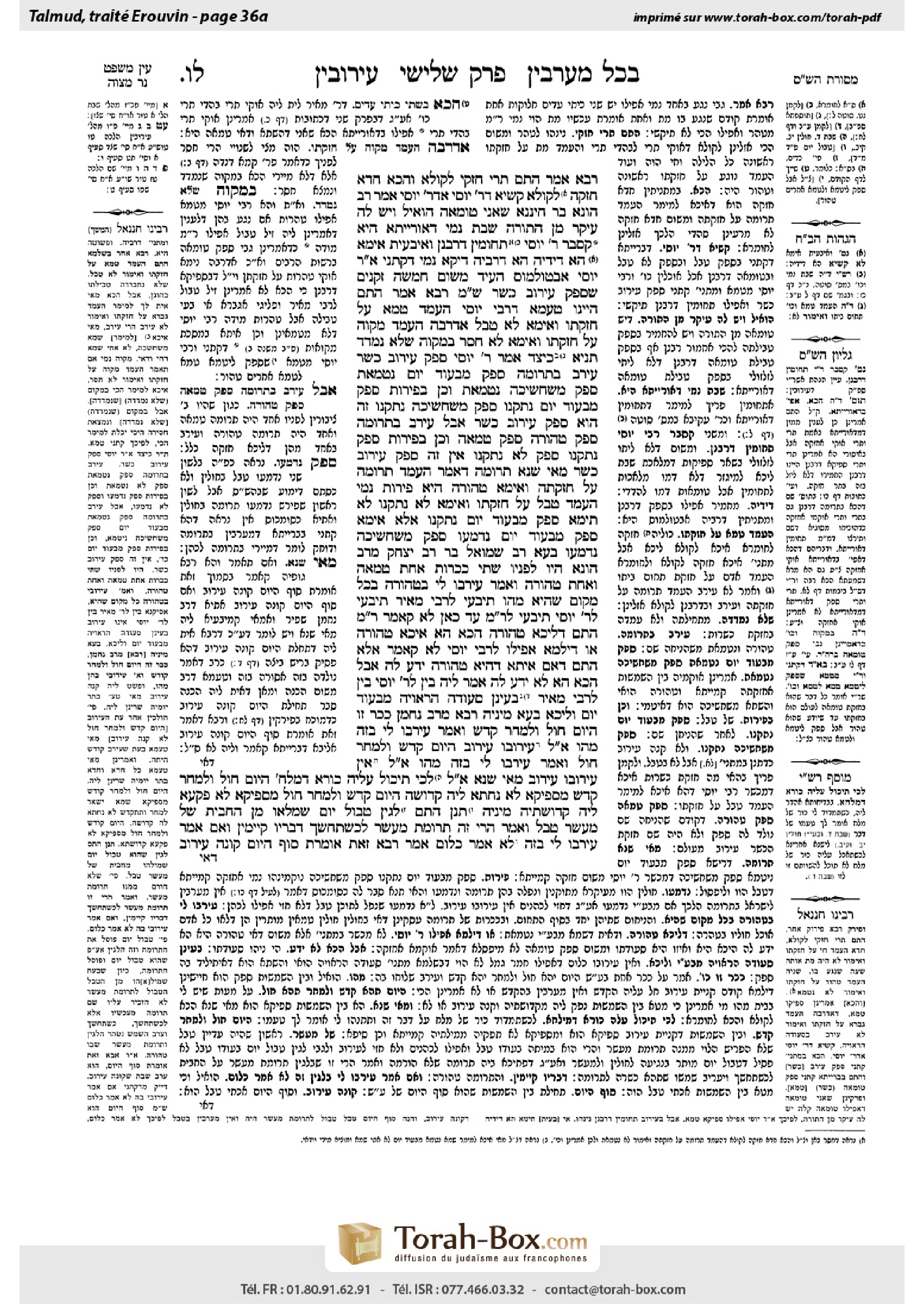
Eruvin 36a: Talmud study for Daf Yomi
Study the Talmud for Daf Yomi with scanned pages, Hebrew text, English translations from Sefaria and AI-generated French translations.
Passage selection and English or AI-generated French translation are available where the scan has annotations. Daf Study is independent of Torah-Box and Sefaria.
Browse Eruvin · עירובין · All tractatesEruvin 36a text and translations
This page of Eruvin includes the Aramaic text, an English translation and an AI-generated French translation, alongside the scan above.
עירובין ל״ו א · Aramaic and Hebrew text
רָבָא אָמַר: הָתָם תְּרֵי חֶזְקֵי לְקוּלָּא, וְהָכָא חֲדָא חֲזָקָה לְקוּלָּא.
קַשְׁיָא דְּרַבִּי יוֹסֵי אַדְּרַבִּי יוֹסֵי!
אָמַר רַב הוּנָא בַּר חִינָּנָא: שָׁאנֵי טוּמְאָה, הוֹאִיל וְיֵשׁ לָהּ עִיקָּר מִן הַתּוֹרָה. שַׁבָּת נָמֵי דְּאוֹרָיְיתָא הִיא? קָסָבַר רַבִּי יוֹסֵי: תְּחוּמִין דְּרַבָּנַן.
וְאִיבָּעֵית אֵימָא: הָא דִּידֵיהּ, הָא דְּרַבֵּיהּ. דַּיְקָא נָמֵי, דְּקָתָנֵי: אָמַר רַבִּי יוֹסֵי: אַבְטוּלְמוֹס הֵעִיד מִשּׁוּם חֲמִשָּׁה זְקֵנִים שֶׁסְּפֵק עֵירוּב כָּשֵׁר — שְׁמַע מִינַּהּ.
רָבָא אָמַר, הָתָם הַיְינוּ טַעְמָא דְּרַבִּי יוֹסֵי: הַעֲמֵד טָמֵא עַל חֶזְקָתוֹ, וְאֵימָא לֹא טָבַל.
אַדְּרַבָּה הַעֲמֵד מִקְוֶה עַל חֶזְקָתוֹ, וְאֵימָא לֹא חָסַר! בְּמִקְוֶה שֶׁלֹּא נִמְדַּד.
תַּנְיָא: כֵּיצַד אָמַר רַבִּי יוֹסֵי סְפֵק עֵירוּב כָּשֵׁר? עֵירַב בִּתְרוּמָה, סָפֵק מִבְּעוֹד יוֹם נִטְמֵאת סָפֵק מִשֶּׁחָשֵׁיכָה נִטְמֵאת; וְכֵן בְּפֵירוֹת, סָפֵק מִבְּעוֹד יוֹם נִתַּקְּנוּ סָפֵק מִשֶּׁחָשֵׁיכָה נִתַּקְּנוּ — זֶה הוּא סָפֵק עֵירוּב כָּשֵׁר.
אֲבָל עֵירַב בִּתְרוּמָה, סָפֵק טְהוֹרָה סָפֵק טְמֵאָה; וְכֵן בְּפֵירוֹת, סָפֵק נִתַּקְּנוּ סָפֵק לֹא נִתַּקְּנוּ — אֵין זֶה סְפֵק עֵירוּב כָּשֵׁר.
מַאי שְׁנָא תְּרוּמָה — דְּאָמַר הַעֲמֵד תְּרוּמָה עַל חֶזְקָתָהּ, וְאֵימָא טְהוֹרָה הִיא; פֵּירוֹת נָמֵי — הַעֲמֵד טֶבֶל עַל חֶזְקָתוֹ, וְאֵימָא לֹא נִתַּקְּנוּ!
לָא תֵּימָא: סָפֵק מִבְּעוֹד יוֹם נִתַּקְּנוּ, אֶלָּא אֵימָא: סָפֵק מִבְּעוֹד יוֹם נִדְמְעוּ, סָפֵק מִשֶּׁחָשֵׁיכָה נִדְמְעוּ.
בְּעָא רַב שְׁמוּאֵל בַּר רַב יִצְחָק מֵרַב הוּנָא: הָיוּ לְפָנָיו שְׁתֵּי כִכָּרוֹת, אַחַת טְמֵאָה וְאַחַת טְהוֹרָה, וְאָמַר: עָירְבוּ לִי בַּטְּהוֹרָה בְּכׇל מָקוֹם שֶׁהִיא, מַהוּ?
תִּיבְּעֵי לְרַבִּי מֵאִיר, תִּיבְּעֵי לְרַבִּי יוֹסֵי. תִּיבְּעֵי לְרַבִּי מֵאִיר: עַד כָּאן לָא קָאָמַר רַבִּי מֵאִיר הָתָם — דְּלֵיכָּא טְהוֹרָה. הָכָא — הָא אִיכָּא טְהוֹרָה. אוֹ דִילְמָא: אֲפִילּוּ לְרַבִּי יוֹסֵי, לָא קָאָמַר אֶלָּא הָתָם, דְּאִם אִיתָא דְּהִיא טְהוֹרָה — יָדַע לַהּ. אֲבָל הָכָא, הָא לָא יָדַע לַהּ?
אֲמַר לֵיהּ: בֵּין לְרַבִּי יוֹסֵי בֵּין לְרַבִּי מֵאִיר בָּעִינַן סְעוּדָה הָרְאוּיָה מִבְּעוֹד יוֹם — וְלֵיכָּא.
בְּעָא מִינֵּיהּ רָבָא מֵרַב נַחְמָן: כִּכָּר זוֹ הַיּוֹם חוֹל וּלְמָחָר קֹדֶשׁ, וְאָמַר: עָירְבוּ לִי בָּזֶה, מַהוּ? אֲמַר לֵיהּ: עֵירוּבוֹ עֵירוּב.
הַיּוֹם קֹדֶשׁ וּלְמָחָר חוֹל, וְאָמַר: עָירְבוּ לִי בָּזֶה, מַהוּ? אֲמַר לֵיהּ: אֵין עֵירוּבוֹ עֵירוּב. מַאי שְׁנָא?
אֲמַר לֵיהּ: לְכִי תֵּיכוּל עֲלֵיהּ כּוֹרָא דְמִלְחָא: הַיּוֹם חוֹל וּלְמָחָר קֹדֶשׁ — מִסְּפֵיקָא לָא נָחֲתָא לֵיהּ קְדוּשָּׁה. הַיּוֹם קֹדֶשׁ וּלְמָחָר חוֹל — מִסְּפֵיקָא לָא פָּקְעָא לֵיהּ קְדוּשְׁתֵּיהּ מִינֵּיהּ.
תְּנַן הָתָם: לָגִין טְבוּל יוֹם שֶׁמִּלְּאוֹ מִן הֶחָבִית שֶׁל מַעֲשֵׂר טֶבֶל, וְאָמַר: הֲרֵי זֶה תְּרוּמַת מַעֲשֵׂר לִכְשֶׁתֶּחֱשַׁךְ — דְּבָרָיו קַיָּימִין.
וְאִם אָמַר: עָירְבוּ לִי בָּזֶה — לֹא אָמַר כְּלוּם. אָמַר רָבָא זֹאת אוֹמֶרֶת: סוֹף הַיּוֹם קוֹנֶה עֵירוּב,
Eruvin 36a · English translation
Rava said: That is not the way to resolve the apparent contradiction between the two rulings; rather, there is a difference between the cases with regard to the ritual impurity itself: There, with regard to touching a person who was later found dead, there are two presumptions supporting leniency, whereas here, with respect to the teruma being used for an eiruv, there is only one presumption supporting leniency. How so? With regard to one who touched another person who was later found to be dead, there are two presumptions of purity: Firstly, the person who was found dead was previously alive, and the presumption is that he remained in that state until we know with certainty that he was dead. Secondly, the one who touched that person was previously pure, and he remains in that presumptive state until we know with certainty that he became impure. Therefore, Rabbi Meir had adequate reason to be lenient. However, with regard to teruma, only one presumption exists, that the teruma was previously pure and presumably remained in that state until proven otherwise. Since there is no additional presumption, Rabbi Meir ruled stringently.
All the difficulties raised above are based on the seemingly conflicting statements of Rabbi Meir. Yet it would appear that there is also a contradiction between one statement of Rabbi Yosei and another statement of Rabbi Yosei, for he was stringent with regard to the doubts involving ritual baths but lenient with regard to doubts involving eiruv.
Rav Huna bar Ḥinnana said: The law with regard to ritual impurity is different, since it has a basis in the Torah. Therefore, Rabbi Yosei was stringent even with respect to immersion performed in order to remove impurity that is only of rabbinic origin. The Gemara asks: The prohibitions of Shabbat limits are also prohibited by Torah law; why isn’t Rabbi Yosei stringent about them as well? The Gemara answers: Rabbi Yosei holds: The laws of Shabbat limits are by rabbinic law, not by Torah law.
And if you wish, say instead: This stringent ruling is his; that lenient ruling with regard to an eiruv is his teacher’s. The Gemara comments: The language of the mishna is also precise according to this explanation, as we learned in the mishna that Rabbi Yosei said: The Sage Avtolemos testified in the name of five Elders that an eiruv whose validity is in doubt is valid. This formulation indicates that Rabbi Yosei was merely reporting a ruling that he had heard from his teacher, although he may not have accepted it. The Gemara concludes: Indeed, conclude from this that this resolution of the contradiction is correct.
Rava said that a different resolution of the contradiction may be suggested: There, with regard to ritual baths, this is the reason for Rabbi Yosei’s opinion: Keep the impure person in his presumptive state of ritual impurity, and say that he did not properly immerse himself.
The Gemara responds: On the contrary, keep the ritual bath in its presumptive state of validity and say that the ritual bath was not lacking the requisite measure of water. The Gemara answers: We are dealing here with a ritual bath that had not been previously measured to determine whether it contained forty se’a, and therefore it had no prior presumption of validity.
It was taught in the Tosefta: In what case did Rabbi Yosei say that an eiruv whose validity is in doubt is nevertheless valid? For example, if one established an eiruv with teruma that had been ritually pure but later became impure, and there is doubt whether it became impure while it was still day, before the onset of Shabbat, or whether it became impure only after nightfall, and similarly, if one made an eiruv with untithed produce that was later tithed and thereby became permissible for eating, and there is doubt whether it was rendered fit while it was still day, before the onset of Shabbat, or whether it was rendered fit only after nightfall, this is an eiruv whose validity is in doubt which Rabbi Yosei said is valid.
However, if one established an eiruv with teruma about which there was doubt whether it was ritually pure or ritually impure from the outset; and similarly, if one established an eiruv with produce about which there was doubt from the outset whether it had been tithed and thereby rendered fit or whether it had not been tithed and thereby rendered fit, this is not a case of an eiruv whose validity is in doubt that Rabbi Yosei said is valid.
The Gemara raises a question in order to clarify the Tosefta: What is different about teruma, with regard to which we say: Keep the teruma in its presumptive state of ritual purity, and say that it was still pure at the onset of Shabbat, since it had been previously pure and it is not known when it became impure? According to that reasoning, with regard to untithed produce [tevel] it should also be said: Keep the untithed produce in its presumptive state, as the produce had certainly been untithed originally, and say that it was not tithed and thereby rendered fit prior to the onset of Shabbat.
Rather, emend the wording of the Tosefta: Do not say: There is doubt whether it was rendered fit while it was still day, before the onset of Shabbat. Rather, say: There is doubt whether regular produce became mixed with untithed produce while it was still day, or whether it became mixed only after nightfall. In other words, one used regular food to establish his eiruv, but then tevel was mixed with that food, prohibiting the entire mixture from being consumed until tithes are separated for the tevel. However, there is doubt whether the produce became mixed with the tevel while it was still day, in which case the eiruv is invalid, or whether it became mixed only after nightfall, in which case the eiruv is valid. In that case, we say: Keep the produce in its presumptive state and say that it was not mixed with tevel during the day, and therefore the eiruv is valid.
Rav Shmuel bar Rav Yitzḥak raised a dilemma to Rav Huna: If there were two loaves of teruma before someone, one that was ritually impure and one that was ritually pure, and he did not know which one was pure; and he said: Establish an eiruv teḥumin for me with the pure loaf, wherever it is, i.e., even though I do not know which it is, I wish to establish my Shabbat residence at the location of the pure loaf, and those present placed both loaves in the same place, what is the halakha? Is this a valid eiruv or not?
The Gemara clarifies: The question may be asked according to the stringent opinion of Rabbi Meir, and it may be asked according to the lenient opinion of Rabbi Yosei. The question may be asked according to the opinion of Rabbi Meir in the following manner: Perhaps Rabbi Meir only stated his stringent opinion with regard to a questionable eiruv there, where there is no teruma that is definitely pure present, but only teruma whose purity is in doubt. Here, however, there definitely is a pure loaf, and therefore even Rabbi Meir may agree to rule leniently. Or perhaps it may be argued that even according to the opinion of Rabbi Yosei, he only said that we are lenient with regard to an eiruv whose validity is in doubt in the case dealt with there, where, if indeed the teruma is pure, he knows where it is; but here, he does not know how to identify it.
Rav Huna said to Rav Shmuel bar Rav Yitzḥak: According to both the opinion of Rabbi Yosei and the opinion of Rabbi Meir, we require that an eiruv consist of a meal that is fit to be eaten while it is still day, prior to the onset of Shabbat, and in this case there is none. Due to the uncertainty as to which loaf is pure and which is impure, neither of the two loaves may be eaten, and an eiruv made with food that may not be eaten while it is still day is not a valid eiruv.
Rava raised another dilemma to Rav Naḥman: If one said: This loaf shall remain unconsecrated today, and tomorrow it shall be consecrated, and he then said: Establish an eiruv for me with this loaf, what is the halakha? Do we say that since the twilight period’s status as part of the previous day or part of the day that follows is questionable, the consecration of the loaf may take effect before the eiruv establishes one’s Shabbat residence, and since an eiruv cannot be made with a consecrated object, the eiruv is not valid? Rav Naḥman said to Rava: In that case, his eiruv is a valid eiruv.
Rava then asked about one who made the opposite statement: This loaf shall be consecrated today, and tomorrow it shall be unconsecrated, i.e., it shall be redeemed with money that I have in my house, and he then said: Establish an eiruv for me with this loaf, what is the halakha? Rav Naḥman said to him: His eiruv is not a valid eiruv. Rava asked him: What is different between the two cases? If we are lenient with regard to the twilight period, we should be lenient in both cases.
Rav Naḥman said to Rava in jest: After you eat a kor of salt over it, and analyze the matter at length, you will be able to understand the difference. The difference is obvious: When one says that today the loaf shall remain unconsecrated, and tomorrow it shall be consecrated, we do not assume out of doubt that sanctity has descended upon the loaf. Therefore, the loaf remains in its presumptive state of being unconsecrated during the twilight period, and the eiruv is valid. With regard to the opposite case, however, when one says that today the loaf shall be consecrated, and tomorrow it shall be unconsecrated, we do not assume out of doubt that the loaf’s sanctity has departed from it. The loaf remains in its presumptive state of consecration for the duration of the twilight period, and therefore the eiruv is invalid.
We learned in a mishna there: If one filled a flask that was immersed during the day [tevul yom] but does not become fully ritually pure until night from a barrel of tithe that was still tevel, meaning that the produce inside was first tithe from which teruma of the tithe had not yet been separated, and he said: Let the contents of this flask be teruma of the tithe for the contents of the barrel when night falls, his statement takes effect. If he were to say that the designated portion should immediately become teruma of the tithe, the teruma of the tithe would be defiled by the flask that is still a tevul yom. Once night falls, however, the flask is absolutely pure, and if the designation of the flask’s contents as teruma of the tithe takes effect at that time, the produce remains pure. The mishna teaches that teruma of the tithe can be separated in this manner.
The mishna continues: And if he said: Establish an eiruv for me with the contents of this flask, he has not said anything, as the contents of the flask are still tevel. Rava said: That is to say that the end of the day is when the eiruv acquires one’s Shabbat residence. The critical time with respect to an eiruv is the last moment of Shabbat eve, rather than the first moment of Shabbat.
Eruvin 36a · Traduction française (IA)
Rava a dit : Ce n'est pas ainsi qu'on doit résoudre la contradiction apparente entre les deux décisions ; plutôt, il y a une différence entre les cas en ce qui concerne l'impureté rituelle elle-même : là, en ce qui concerne le toucher d'une personne qui fut ultérieurement trouvée morte, il y a deux présomptions favorables à la leniencé, tandis que ici, en ce qui concerne l'usage de la terouma pour un eiruv, il n'y a qu'une seule présomption favorable à la leniencé. Comment cela ? En ce qui concerne celui qui a touché une autre personne qui fut ultérieurement trouvée morte, il y a deux présomptions de pureté : premièrement, la personne trouvée morte était précédemment vivante, et la présomption est qu'elle est restée dans cet état jusqu'à ce que nous sachions avec certitude qu'elle était morte. Deuxièmement, celui qui a touché cette personne était précédemment pur, et il reste dans cet état présomptif jusqu'à ce que nous sachions avec certitude qu'il est devenu impur. Ainsi, le maître Rabbi Meïr avait une bonne raison d'être leniant. Cependant, en ce qui concerne la terouma, il n'y a qu'une seule présomption, celle que la terouma était précédemment pure et qu'elle est restée dans cet état jusqu'à preuve du contraire. Puisque il n'y a pas de présomption supplémentaire, le maître Rabbi Meïr a rendu un jugement strict.
Toutes les difficultés soulevées ci-dessus sont basées sur les apparences de contradictions entre les paroles du maître Rabbi Meïr. Cependant, il semble également qu'il y ait une contradiction entre une déclaration du maître Rabbi Yosei et une autre déclaration du même maître Rabbi Yosei, car il était strict en ce qui concerne les doutes concernant les ablutions rituelles mais leniant en ce qui concerne les doutes concernant l'eiruv.
Rav Huna bar Ḥinnana a dit : La loi concernant l'impureté rituelle est différente, car elle a une base dans la Torah. Ainsi, le maître Rabbi Yosei était strict même en ce qui concerne l'immersion effectuée pour éliminer une impureté uniquement de droit rabbinique. La Guemara pose la question : Les prohibitions des limites du Shabbat sont également interdites par la Torah ; pourquoi le maître Rabbi Yosei n'est-il pas strict à leur égard également ? La Guemara répond : Le maître Rabbi Yosei considère que les lois des limites du Shabbat sont de droit rabbinique, pas de droit divin.
Et si vous le souhaitez, dites plutôt : Ce jugement strict est le sien ; ce jugement leniant concernant l'eiruv est celui de son maître. La Guemara commente : La formulation de la michna est aussi précise selon cette explication, comme nous l'avons appris dans la michna que le maître Rabbi Yosei a dit : Le sage Avtolemos a témoigné en nom de cinq anciens que l'eiruv dont la validité est en doute est valide. Cette formulation indique que le maître Rabbi Yosei rapportait simplement un jugement qu'il avait entendu de son maître, bien qu'il ne l'ait peut-être pas accepté. La Guemara conclut : En effet, concluez-en que cette résolution de la contradiction est correcte.
Rava a dit qu'une autre résolution de la contradiction pourrait être suggérée : Là, en ce qui concerne les ablutions rituelles, c'est la raison du point de vue du maître Rabbi Yosei : gardez la personne impure dans son état présomptif d'impureté rituelle et dites qu'elle n'a pas correctement immergé.
La Guemara répond : Au contraire, conservez l'ablution rituelle dans son état présomptif de validité et dites que l'ablution n'avait pas manqué de la mesure requise d'eau. La Guemara répond : Nous traitons ici d'une ablution qui n'avait pas été mesurée auparavant pour déterminer si elle contenait quarante se'ah, et par conséquent elle n'avait pas de présomption de validité antérieure.
Il a été enseigné dans la Tosefta : Dans quel cas le maître Rabbi Yosei a-t-il dit qu'un eiruv dont la validité est en doute est toutefois valide ? Par exemple, si l'on a établi un eiruv avec de la terouma qui était initialement pure mais est devenu impure ultérieurement, et s'il y a doute sur le moment où elle est devenue impure, avant que le Shabbat ne commence ou après la nuit, et de même, si l'on a établi un eiruv avec des produits non titrés qui sont devenus permis à l'usage après avoir été tithés, et s'il y a doute sur le moment où ils ont été rendus permis, avant que le Shabbat ne commence ou après la nuit, c'est un eiruv dont la validité est en doute que le maître Rabbi Yosei a dit être valide.
Cependant, si l'on a établi un eiruv avec de la terouma dont on avait doute sur sa pureté rituelle ou son impureté initialement ; et de même, si l'on a établi un eiruv avec des produits dont on avait doute initialement sur leur titrage ou leur non-titrage, ce n'est pas un cas d'eiruv dont la validité est en doute que le maître Rabbi Yosei a dit être valide.
La Guemara soulève une question afin de clarifier la Tosefta : Qu'est-ce qui diffère concernant la terouma, en ce qui concerne lequel nous disons : Gardez la terouma dans son état présomptif de pureté rituelle et dites qu'elle était pure au début du Shabbat, puisque elle avait été précédemment pure et qu'on ne sait pas quand elle est devenue impure ? Selon cette raisonnement, concernant les produits non tithés [tevel], il devrait aussi être dit : Gardez les produits non tithés dans leur état présomptif, car les produits étaient certainement non tithés initialement, et dites qu'ils n'ont pas été tithés avant le début du Shabbat.
Plutôt, corrigez la formulation de la Tosefta : Ne dites pas : Il y a doute sur le moment où il a été rendu permis pendant la journée, avant le début du Shabbat. Plutôt, dites : Il y a doute sur le moment où les produits ordinaires ont été mélangés avec des produits non tithés pendant la journée, ou si ce mélange a eu lieu seulement après la nuit. En d'autres termes, l'homme a utilisé des aliments ordinaires pour établir son eiruv, mais ensuite des produits non tithés ont été mélangés à ces aliments, rendant le mélange interdit à la consommation jusqu'à ce que les tithes soient séparées pour les produits non tithés. Cependant, il y a doute sur le moment où le mélange a eu lieu avec les produits non tithés pendant la journée, dans ce cas l'eiruv est invalide, ou si le mélange a eu lieu seulement après la nuit, dans ce cas l'eiruv est valide. Dans ce cas, nous disons : Gardez les produits dans leur état présomptif et dites qu'ils n'ont pas été mélangés avec des produits non tithés pendant la journée, et par conséquent l'eiruv est valide.
Rav Shmuel bar Rav Yitzḥak posa un doute à Rav Huna : Si deux pains de terouma étaient devant une personne, l'un impur et l'autre pur, et s'il ne savait pas lequel était pur ; et s'il disait : Établis un eiruv teḥumin pour moi avec le pain pur, où qu'il soit, c'est-à-dire, même si je ne sais pas lequel il est, je veux établir mon résidence sabbatique à l'emplacement du pain pur, et ceux présents ont mis les deux pains dans le même lieu, quelle est la halakha ? Cet eiruv est-il valide ou non ?
La Guemara clarifie : La question peut être posée selon l'opinion stricte de Rabbi Meir, et aussi selon l'opinion clémente de Rabbi Yosei. La question peut être posée selon l'opinion de Rabbi Meir de la manière suivante : Peut-être que Rabbi Meir a seulement exprimé son opinion stricte concernant un eiruv douteux là où il n'y a pas de terouma certainement pure, mais seulement de la terouma dont la pureté est en doute. Ici, cependant, il y a certainement un pain pur, et donc même Rabbi Meir pourrait accepter de décider avec clémence. Ou peut-être peut-on argumenter que même selon l'opinion de Rabbi Yosei, il a seulement dit que nous sommes cléments concernant un eiruv dont la validité est en doute dans le cas traité là, où, si la terouma est pure, il sait où elle est ; mais ici, il ne sait pas comment l'identifier.
Rav Huna a dit à Rav Shmuel bar Rav Yitzḥak : Selon les opinions de Rabbi Yosei et de Rabbi Meir, nous exigeons que l'eiruv consiste en un repas propre à être mangé pendant la journée, avant l'approche du sabbat, et dans ce cas, il n'y en a pas. En raison de l'incertitude sur lequel des pains est pur et lequel est impur, aucun des deux pains ne peut être mangé, et un eiruv fait avec un aliment qui ne peut être mangé pendant la journée n'est pas un eiruv valide.
Rava souleva un autre doute contre Rav Naḥman : Si l'on disait : Ce pain restera non consacré aujourd'hui, et demain il sera consacré, et ensuite l'on disait : Établis un eiruv pour moi avec ce pain, quelle est la halakha ? Disons-nous que, puisque le statut de la période de crépuscule, faisant partie du jour précédent ou du jour suivant, est en doute, la consécration du pain peut prendre effet avant que l'eiruv ne fixe la résidence sabbatique, et puisque l'eiruv ne peut être fait avec un objet consacré, l'eiruv n'est pas valide ? Rav Naḥman dit à Rava : Dans ce cas, son eiruv est un eiruv valide.
Rava posa ensuite une question sur celui qui avait fait l'affirmation contraire : Ce pain sera consacré aujourd'hui, et demain il sera non consacré, c'est-à-dire qu'il sera racheté avec l'argent que j'ai chez moi, et ensuite il disait : Établis un eiruv pour moi avec ce pain, quelle est la halakha ? Rav Naḥman dit à lui : Son eiruv n'est pas valide. Rava demanda : Quelle est la différence entre les deux cas ? Si nous sommes cléments concernant la période de crépuscule, nous devrions être cléments dans les deux cas.
Rav Naḥman dit à Rava avec humour : Après que vous ayez mangé un kor de sel sur cela, et que vous ayez analysé la question en détail, vous comprendrez la différence. La différence est évidente : Lorsqu'on dit que le pain restera non consacré aujourd'hui et sera consacré demain, nous ne supposons pas, en cas de doute, que la sanctité est descendue sur le pain. Ainsi, le pain reste dans son état présomptif de non consécration pendant la période de crépuscule, et l'eiruv est valide. Concernant le cas contraire, cependant, lorsque l'on dit que le pain sera consacré aujourd'hui et non consacré demain, nous ne supposons pas, en cas de doute, que la sanctité du pain a quitté. Le pain reste dans son état présomptif de consécration pendant la période de crépuscule, et donc l'eiruv est invalide.
Nous avons appris dans une michna là : Si l'on remplissait une bouteille immergée pendant la journée [tevul yom] mais ne devient pleinement pure qu'au soir à partir d'un tonneau de tithe dont les produits étaient encore tevel, c'est-à-dire que les produits à l'intérieur étaient d'abord tithe dont la terouma n'avait pas encore été séparée, et s'il disait : Que les contenus de cette bouteille soient la terouma du tithe pour les contenus du tonneau lorsque l'heure du soir arrive, sa déclaration prend effet. Si il disait que la portion désignée devienne immédiatement la terouma du tithe, la terouma du tithe serait contaminée par la bouteille qui est encore tevul yom. Une fois que l'heure du soir arrive, cependant, la bouteille est absolument pure, et si la désignation des contenus de la bouteille comme terouma du tithe prend effet à ce moment-là, les produits restent purs. La michna enseigne que la terouma du tithe peut être séparée ainsi.
La michna continue : Et si il disait : Établis un eiruv pour moi avec les contenus de cette bouteille, il n'a pas dit quelque chose, car les contenus de la bouteille sont encore tevel. Rava a dit : Cela signifie que la fin de la journée est le moment où l'eiruv acquiert la résidence sabbatique. Le moment critique concernant l'eiruv est la dernière minute de la veille du sabbat, et non la première minute du sabbat.
Traduction française générée par IA à partir de l’édition anglaise de Sefaria. Vérifie toujours un passage avec le texte source.
Text from Sefaria: William Davidson Edition - Vocalized Aramaic (CC BY NC); William Davidson Edition - English (CC BY NC).