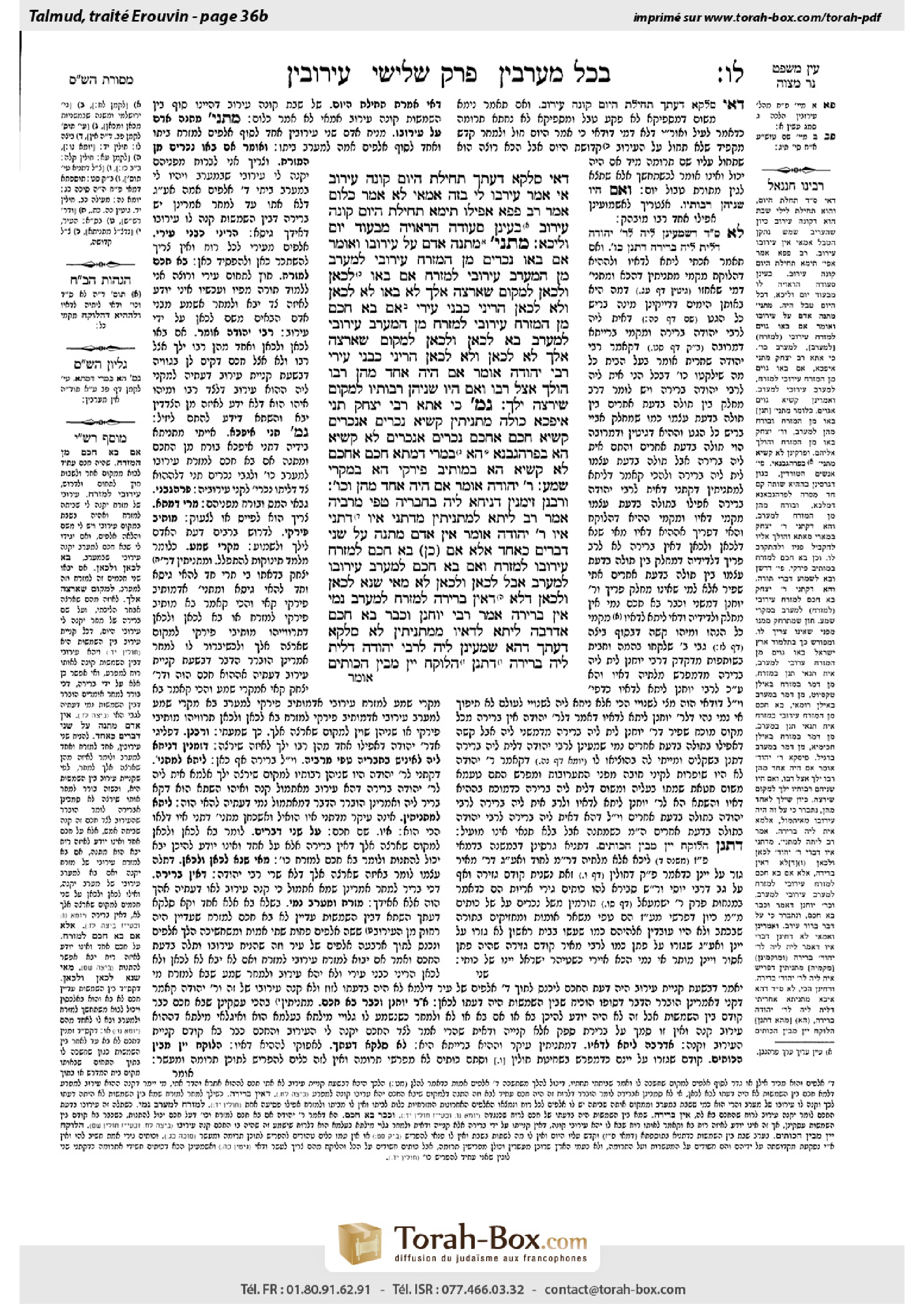
Eruvin 36b: Talmud study for Daf Yomi
Study the Talmud for Daf Yomi with scanned pages, Hebrew text, English translations from Sefaria and AI-generated French translations.
Passage selection and English or AI-generated French translation are available where the scan has annotations. Daf Study is independent of Torah-Box and Sefaria.
Browse Eruvin · עירובין · All tractatesEruvin 36b text and translations
This page of Eruvin includes the Aramaic text, an English translation and an AI-generated French translation, alongside the scan above.
עירובין ל״ו ב · Aramaic and Hebrew text
דְּאִי סָלְקָא דַעְתָּךְ תְּחִילַּת הַיּוֹם קוֹנֶה עֵירוּב, אִי אָמַר עָירְבוּ לִי בָּזֶה, אַמַּאי לֹא אָמַר כְּלוּם?
אָמַר רַב פָּפָּא: אֲפִילּוּ תֵּימָא תְּחִילַּת הַיּוֹם קוֹנֶה עֵירוּב, בָּעִינַן סְעוּדָה הָרְאוּיָה מִבְּעוֹד יוֹם, וְלֵיכָּא.
מַתְנִי׳ מַתְנֶה אָדָם עַל עֵירוּבוֹ, וְאוֹמֵר: אִם בָּאוּ גּוֹיִם מִן הַמִּזְרָח — עֵירוּבִי לַמַּעֲרָב. מִן הַמַּעֲרָב — עֵירוּבִי לַמִּזְרָח. אִם בָּאוּ לְכָאן וּלְכָאן — לִמְקוֹם שֶׁאֶרְצֶה אֵלֵךְ. לֹא בָּאוּ לֹא לְכָאן וְלֹא לְכָאן — הֲרֵינִי כִּבְנֵי עִירִי.
אִם בָּא חָכָם מִן הַמִּזְרָח — עֵירוּבִי לַמִּזְרָח. מִן הַמַּעֲרָב — עֵירוּבִי לַמַּעֲרָב. בָּא לְכָאן וּלְכָאן — לִמְקוֹם שֶׁאֶרְצֶה אֵלֵךְ. לֹא לְכָאן וְלֹא לְכָאן — הֲרֵינִי כִּבְנֵי עִירִי. רַבִּי יְהוּדָה אוֹמֵר: אִם הָיָה אֶחָד מֵהֶן רַבּוֹ — הוֹלֵךְ אֵצֶל רַבּוֹ, וְאִם הָיוּ שְׁנֵיהֶן רַבּוֹתָיו — לִמְקוֹם שֶׁיִּרְצֶה יֵלֵךְ.
גְּמָ׳ כִּי אֲתָא רַבִּי יִצְחָק תָּנֵי אִיפְּכָא כּוּלָּהּ מַתְנִיתִין. קַשְׁיָא גּוֹיִם אַגּוֹיִם, קַשְׁיָא חָכָם אַחָכָם!
גּוֹיִם אַגּוֹיִם לָא קַשְׁיָא: הָא — בְּפַרְהַגְבָּנָא, הָא — בְּמָרֵי דְמָתָא.
חָכָם אַחָכָם לָא קַשְׁיָא: הָא — בְּמוֹתֵיב פִּירְקֵי, הָא — בְּמַקְרֵי שְׁמַע.
רַבִּי יְהוּדָה אוֹמֵר אִם הָיָה אֶחָד מֵהֶן וְכוּ׳. וְרַבָּנַן — זִימְנִין דְּנִיחָא לֵיהּ בְּחַבְרֵיהּ טְפֵי מֵרַבֵּיהּ.
אָמַר רַב: לֵיתָא לְמַתְנִיתִין מִדְּתָנֵי אַיּוֹ. דְּתָנֵי אַיּוֹ: רַבִּי יְהוּדָה אוֹמֵר אֵין אָדָם מַתְנֶה עַל שְׁנֵי דְבָרִים כְּאֶחָד, אֶלָּא: אִם (כֵּן) בָּא חָכָם לַמִּזְרָח — עֵירוּבוֹ לַמִּזְרָח, וְאִם בָּא חָכָם לַמַּעֲרָב — עֵירוּבוֹ לַמַּעֲרָב, אֲבָל לְכָאן וּלְכָאן — לָא.
מַאי שְׁנָא לְכָאן וּלְכָאן דְּלָא — דְּאֵין בְּרֵירָה, לַמִּזְרָח לַמַּעֲרָב — נָמֵי אֵין בְּרֵירָה.
אָמַר רַבִּי יוֹחָנָן: וּכְבָר בָּא חָכָם.
אַדְּרַבָּה, לֵיתָא לִדְאַיּוֹ מִמַּתְנִיתִין.
לָא סָלְקָא דַּעְתָּךְ, דְּהָא שָׁמְעִינַן לֵיהּ לְרַבִּי יְהוּדָה דְּלֵית לֵיהּ בְּרֵירָה. דִּתְנַן: הַלּוֹקֵחַ יַיִן מִבֵּין הַכּוּתִים,
Eruvin 36b · English translation
As, if it should enter your mind that an eiruv acquires one’s Shabbat residence at the beginning of the day of Shabbat, then if he said: Establish an eiruv for me with the produce in this flask, why hasn’t he said anything? After nightfall, when Shabbat begins, the flask is already pure, and therefore the teruma of the tithe inside it is also pure and is suitable for an eiruv.
Rav Pappa said: This is no proof; even if you say that an eiruv acquires one’s Shabbat residence at the beginning of the day of Shabbat, nonetheless, we require a meal that is fit to be eaten while it is still day, prior to the onset of Shabbat, in order for the eiruv to be valid, and there is none in this case. While it was still day, it was certainly prohibited to consume the contents of the flask, which were still tevel, and therefore it could not be used as an eiruv.
MISHNA: A person may make a condition with regard to his eiruv of Shabbat borders. In other words, he need not decide in advance in which direction his eiruv should take effect. For example, he may deposit an eiruv on each of two opposite sides of his town, and say: If gentiles come from the east, my eiruv is in the west, so that I can escape in that direction; and if they come from the west, my eiruv is in the east. If they come from here and from there, i.e., from both directions, I will go wherever I wish, and my eiruv will retroactively take effect in that direction; and if they do not come at all, neither from here nor from there, I will be like the rest of the inhabitants of my town and give up both eiruvin that I deposited, leaving me with two thousand cubits in all directions from the town.
Similarly, one may say: If a Sage comes from the east and he is spending Shabbat beyond the boundaries of my town, my eiruv is in the east, so that I may go out to greet him there; and if he comes from the west, my eiruv is in the west. If one Sage comes from here, and another Sage comes from there, I will go wherever I wish; and if no Sage comes, neither from here nor from there, I will be like the rest of the inhabitants of my town. Rabbi Yehuda says: If one of the Sages coming from opposite directions was his teacher, he may go only to his teacher, as it is assumed that was his original intention. And if they were both his teachers, so that there is no reason to suppose that he preferred one over the other, he may go wherever he wishes.
GEMARA: The Gemara relates that when Rabbi Yitzḥak came from Eretz Yisrael to Babylonia, he taught all of the laws in the mishna in the opposite manner. That is to say, according to him, if the gentiles came from the east, his eiruv would be to the east, and, conversely, if the Sage came from the east, his eiruv would be to the west. This is difficult because if this is correct, there is a contradiction between the ruling concerning gentiles in the mishna and the ruling concerning gentiles in the baraita, and similarly there is a contradiction between the ruling concerning a Sage in the mishna and the ruling concerning a Sage in the baraita.
The Gemara answers: The apparent contradiction between the ruling concerning gentiles in the mishna and the ruling concerning gentiles in the baraita is not difficult: This case in the mishna is referring to a tax collector [parhagabena], from whom one wishes to flee; whereas that case in the baraita is referring to the lord of the town, with whom he wishes to speak. Therefore, there are times that one wants to go out toward the gentile, while at other times one wants to flee from him.
Similarly, the apparent contradiction between the ruling concerning a Sage in the mishna and the ruling concerning a Sage in the baraita is not difficult: This case in the mishna is referring to a scholar who sits and delivers public Torah lectures, and one wishes to come and learn Torah from him; whereas that case in the baraita is referring to one who teaches children how to recite the Shema, i.e., one who teaches young children how to pray, of whom he has no need. The baraita teaches that if a scholar came from one direction to deliver a public lecture and the school teacher came from the opposite direction, his eiruv is in the direction of the scholar.
We learned in the mishna that Rabbi Yehuda says: If one of the Sages was his teacher, he may go only to his teacher, as we can assume that this was his original intention. The Gemara asks: And what is the reason that the Rabbis do not accept this straightforward argument? The Gemara answers: The Rabbis maintain that sometimes one prefers to meet the Sage who is his colleague rather than the Sage who is his teacher, as sometimes one learns more from his peers than from his teachers.
Rav said: This version of the mishna should not be accepted because of what the Sage Ayo taught to the opposite effect, as Ayo taught the following baraita: Rabbi Yehuda says: A person cannot make conditions about two things at once, i.e., he cannot say that if one Sage comes from one direction and another Sage comes from the other direction, he will go wherever he wishes. Rather, he may say that if a Sage came from the east, his eiruv is in the east, and if a Sage came from the west, his eiruv is in the west. But he may not say that if one Sage came from here, and another Sage came from there, he will go wherever he wishes.
The Gemara asks: What is different about a case in which one stipulated that if Sages came from here and from there he may go to whichever side he chooses, such that his eiruv is not effective? Apparently, this is due to the principle that there is no retroactive designation, meaning that a doubtful state of affairs cannot be clarified retroactively. However, according to this principle, when one established an eiruv to the east and to the west in order to be able to travel in the direction of one Sage who comes toward the town in a case where one does not know in advance from which direction he will come, we should also invoke the principle that there is no retroactive designation. Therefore, even if one deposited an eiruv at both ends of his town for the sake of one Sage who might come from either side, he should not be able to rely on what becomes clarified afterward and decide retroactively which eiruv he is interested in.
Rabbi Yoḥanan said: This is not a true case of retroactive designation, as the Sage had already come by twilight but the person who established the eiruv did not yet know which side of the town the Sage had come toward. Therefore, at the time the eiruv establishes his Shabbat residence it is clear which eiruv the person wants, even though he himself will only become aware of that later.
The Gemara poses a question with regard to Rav’s statement cited above: Why should we reject the mishna because of the baraita? On the contrary, let us say that the ruling of Ayo should not be accepted because of the mishna.
The Gemara answers: It should not enter your mind to uphold the mishna’s ruling because it contradicts other sources, as we have already heard that Rabbi Yehuda does not accept the principle of retroactive designation. As it was taught in the Tosefta: One who buys wine from among the Samaritans [Kutim], who do not tithe their produce properly,
Eruvin 36b · Traduction française (IA)
Si, par exemple, vous pensez qu’un eiruv acquiert la résidence de repos du sabbat au début du jour du sabbat, alors si l’on dit : Établissez un eiruv pour moi avec les produits de ce flacon, pourquoi n’a-t-on pas dit quelque chose ? Après la nuit, lorsque le sabbat commence, le flacon est déjà pur, et donc la terouma des dîmes à l’intérieur est également pure et convient à l’eiruv.
Rav Pappa a dit : Cela ne constitue pas une preuve ; même si vous dites qu’un eiruv acquiert la résidence de repos du sabbat au début du jour du sabbat, néanmoins, nous exigeons un repas propre à être mangé pendant la journée, avant le début du sabbat, afin que l’eiruv soit valide, et il n’y en a pas dans ce cas. Tant que c’était la journée, il était certainement interdit de consommer le contenu du flacon, qui était encore tevel, et donc il ne pouvait pas être utilisé comme un eiruv.
MICHNA : Une personne peut établir une condition concernant son eiruv des limites du sabbat. En d’autres termes, elle n’a pas besoin de décider à l’avance dans quelle direction son eiruv devrait s’appliquer. Par exemple, elle peut déposer un eiruv sur chaque côté opposé de sa ville, et dire : Si des non-Juifs viennent de l’est, mon eiruv est à l’ouest, afin que je puisse m’échapper dans cette direction ; et si ils viennent de l’ouest, mon eiruv est à l’est. Si ils viennent d’ici et d’ailleurs, c’est-à-dire des deux côtés, je pourrai aller où je veux, et mon eiruv prendra effet rétrospectivement dans cette direction ; et si aucun ne vient du tout, ni d’ici ni d’ailleurs, je serai comme les autres habitants de ma ville et abandonnerai les deux eiruvin que j’ai déposés, me laissant avec deux mille coudées dans toutes les directions de la ville.
De même, on peut dire : Si un Sage vient de l’est et il passe le sabbat au-delà des limites de ma ville, mon eiruv est à l’est, afin que je sorte pour le saluer là-bas ; et si il vient de l’ouest, mon eiruv est à l’ouest. Si un Sage vient d’ici, et un autre Sage vient d’ailleurs, je pourrai aller où je veux ; et si aucun Sage ne vient, ni d’ici ni d’ailleurs, je serai comme les autres habitants de ma ville. Rabbi Yehuda dit : Si l’un des Sages venant de directions opposées était son maître, il ne peut aller qu’au maître, car on suppose que c’était son intention originelle. Et si ils étaient tous les deux ses maîtres, de sorte qu’il n’y a pas de raison de penser qu’il préférait l’un à l’autre, il peut aller où il veut.
GUEMARA : La Guemara rapporte que lorsque Rabbi Yitzḥak est venu d’Eretz Yisrael vers Babylone, il a enseigné toutes les lois de la mishna dans l’ordre inverse. C’est-à-dire, selon lui, si les non-Juifs venaient de l’est, son eiruv serait à l’est, et inversement, si le Sage venait de l’est, son eiruv serait à l’ouest. Cela est difficile, car si c’est correct, il y a une contradiction entre la décision concernant les non-Juifs dans la mishna et la décision concernant les non-Juifs dans la baraïta, et de même entre la décision concernant un Sage dans la mishna et la décision concernant un Sage dans la baraïta.
La Guemara répond : La contradiction apparente entre la décision concernant les non-Juifs dans la mishna et la décision concernant les non-Juifs dans la baraïta n’est pas difficile : Ce cas dans la mishna fait référence à un collecteur d’impôts [parhagabena], duquel on veut s’échapper ; tandis que ce cas dans la baraïta fait référence au maître de la ville, avec lequel on veut parler. Il y a donc des moments où l’on veut sortir vers le non-Juif, tandis qu’à d’autres moments l’on veut s’en échapper.
De même, la contradiction apparente entre la décision concernant un Sage dans la Michna et la décision concernant un Sage dans la baraïta n’est pas difficile : ce cas dans la Michna fait référence à un savant qui siège et enseigne la Torah publiquement, et l’on souhaite venir apprendre la Torah avec lui ; tandis que ce cas dans la baraïta fait référence à celui qui enseigne aux enfants à réciter le Chéma, c’est-à-dire celui qui enseigne aux jeunes enfants à prier, dont on n’a pas besoin. La baraïta enseigne que si un savant est venu d’un côté pour donner un cours public et un instituteur d’enfants est venu de l’autre côté, son eiruv est dans la direction du savant.
Nous avons appris dans la Michna que Rabbi Yehuda dit : Si l’un des Sages était son maître, il ne peut aller qu’au maître, car on peut supposer que c’était son intention originale. La Guemara pose la question : Et quelle est la raison pour laquelle les Rabbins ne acceptent pas cet argument direct ? La Guemara répond : Les Rabbins maintiennent que parfois l’on préfère rencontrer le Sage qui est son collègue plutôt que le Sage qui est son maître, car parfois l’on apprend davantage de ses pairs que de ses maîtres.
Rav a dit : Cette version de la Michna ne doit pas être acceptée en raison de ce que le Sage Ayo a enseigné à l’opposé, car Ayo a enseigné la baraïta suivante : Rabbi Yehuda dit : Une personne ne peut pas établir de conditions concernant deux choses à la fois, c’est-à-dire qu’elle ne peut pas dire que si un Sage vient d’un côté et un autre Sage vient de l’autre côté, il ira où il veut. Plutôt, elle peut dire que si un Sage vient de l’est, son eiruv est à l’est, et si un Sage vient de l’ouest, son eiruv est à l’ouest. Mais elle ne peut pas dire que si un Sage vient d’ici et un autre Sage vient d’ailleurs, il ira où il veut.
Le Guemara pose la question : Quelle est la différence dans le cas où l'on stipule que si des Sages viennent d'ici et d'ailleurs, il peut aller vers le côté qu'il veut, de sorte que son eiruv n'est pas efficace ? Apparemment, cela est dû au principe selon lequel il n'y a pas de désignation rétrospective, c'est-à-dire qu'un état incertain ne peut pas être clarifié rétrospectivement. Cependant, selon ce principe, lorsqu'on établit un eiruv à l'est et à l'ouest afin de pouvoir voyager dans la direction du Sage qui arrive vers la ville, dans le cas où l'on ne sait pas à l'avance de quel côté il viendra, on devrait aussi invoquer le principe de non désignation rétrospective. Ainsi, même si l'on dépose un eiruv aux deux extrémités de sa ville à cause d'un Sage qui pourrait venir d'un côté ou de l'autre, il ne devrait pas pouvoir se fier à ce qui est clarifié plus tard et décider rétrospectivement quel eiruv il souhaite.
Rabbi Yoḥanan dit : Ce n'est pas un cas réel de désignation rétrospective, car le Sage était déjà arrivé au crépuscule, mais la personne qui a établi l'eiruv ne savait pas encore de quel côté du village le Sage était venu. Ainsi, au moment où l'eiruv établit sa résidence du sabbat, il est clair quel eiruv la personne veut, même si elle ne devient consciente de cela que plus tard.
Le Guemara pose une question concernant l'affirmation de Rav citée ci-dessus : Pourquoi devrions-nous rejeter la baraïta à cause de la mitsna ? Au contraire, disons que la décision d'Ayo ne devrait pas être acceptée à cause de la mitsna.
Le Guemara répond : Il ne devrait pas entrer dans votre esprit de soutenir la décision de la Michna, car elle contredit d'autres sources, comme nous l'avons déjà entendu : Rabbi Yehuda ne reconnaît pas le principe de désignation rétrospective. Comme il a été enseigné dans la Tosefta : Celui qui achète du vin parmi les Samaritains [Kutim], qui n'ont pas bien titré leurs produits,
Traduction française générée par IA à partir de l’édition anglaise de Sefaria. Vérifie toujours un passage avec le texte source.
Text from Sefaria: William Davidson Edition - Vocalized Aramaic (CC BY NC); William Davidson Edition - English (CC BY NC).