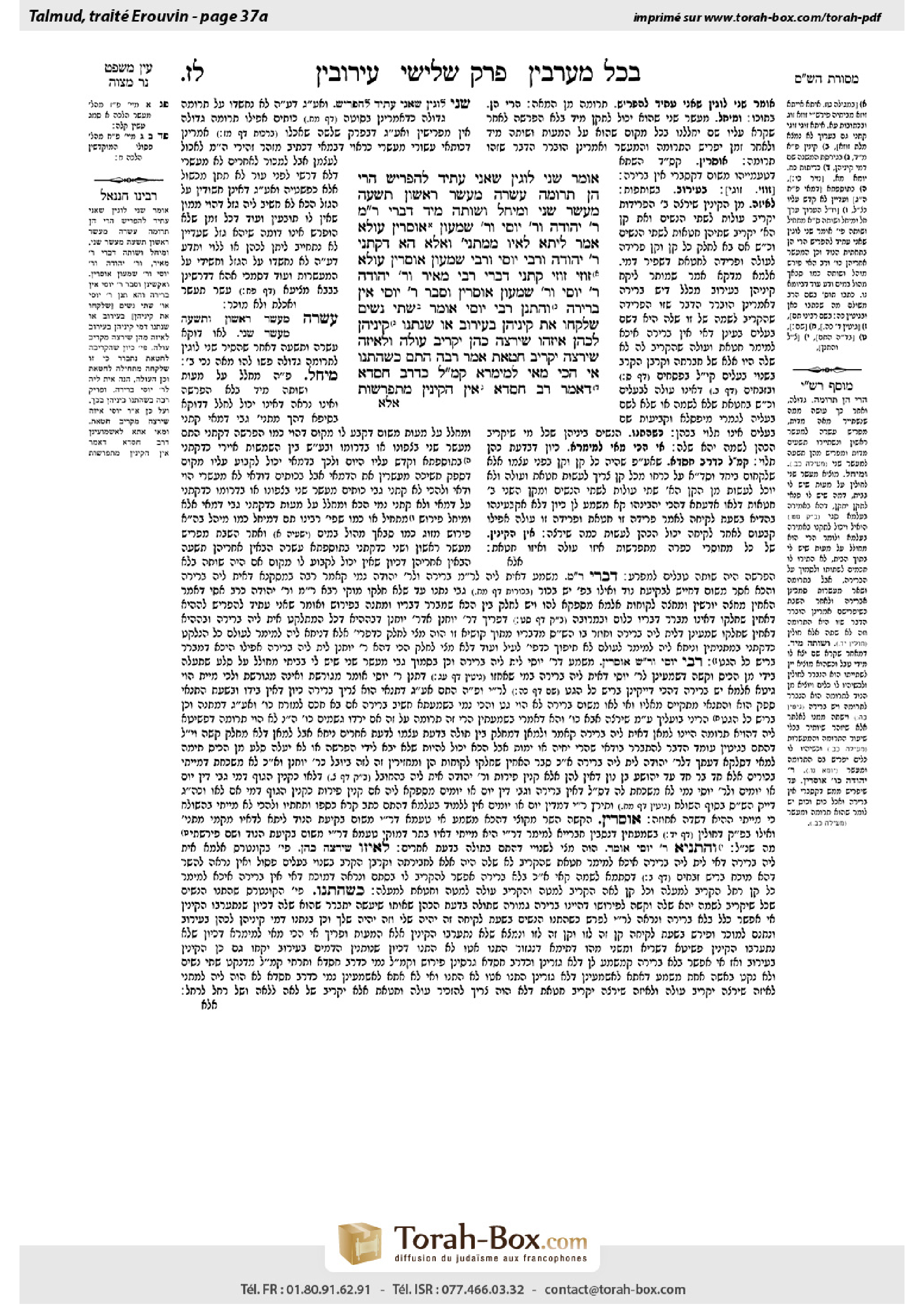
Eruvin 37a: Talmud study for Daf Yomi
Study the Talmud for Daf Yomi with scanned pages, Hebrew text, English translations from Sefaria and AI-generated French translations.
Passage selection and English or AI-generated French translation are available where the scan has annotations. Daf Study is independent of Torah-Box and Sefaria.
Browse Eruvin · עירובין · All tractatesEruvin 37a text and translations
This page of Eruvin includes the Aramaic text, an English translation and an AI-generated French translation, alongside the scan above.
עירובין ל״ז א · Aramaic and Hebrew text
אוֹמֵר: שְׁנֵי לוּגִּין שֶׁאֲנִי עָתִיד לְהַפְרִישׁ הֲרֵי הֵן תְּרוּמָה, עֲשָׂרָה מַעֲשֵׂר רִאשׁוֹן, תִּשְׁעָה מַעֲשֵׂר שֵׁנִי, וּמֵיחֵל וְשׁוֹתֶה מִיָּד — דִּבְרֵי רַבִּי מֵאִיר. רַבִּי יְהוּדָה וְרַבִּי יוֹסֵי וְרַבִּי שִׁמְעוֹן אוֹסְרִין.
עוּלָּא אָמַר: לֵיתָא לְאַיּוֹ מִמַּתְנִיתִין. וְאֶלָּא הָא דְּקָתָנֵי: רַבִּי יְהוּדָה וְרַבִּי יוֹסֵי וְרַבִּי שִׁמְעוֹן אוֹסְרִין —
עוּלָּא זוּזֵי זוּזֵי קָתָנֵי: דִּבְרֵי רַבִּי מֵאִיר וְרַבִּי יְהוּדָה, רַבִּי יוֹסֵי וְרַבִּי שִׁמְעוֹן אוֹסְרִין.
וְסָבַר רַבִּי יוֹסֵי אֵין בְּרֵירָה? וְהָתְנַן: רַבִּי יוֹסֵי אוֹמֵר: שְׁתֵּי נָשִׁים שֶׁלָּקְחוּ אֶת קִינֵּיהֶן בְּעֵירוּב, אוֹ שֶׁנָּתְנוּ קִינֵּיהֶן לַכֹּהֵן — אֵיזֶהוּ שֶׁיִּרְצֶה כֹּהֵן יַקְרִיב עוֹלָה, וּלְאֵיזֶה שֶׁיִּרְצֶה יַקְרִיב חַטָּאת!
אָמַר רַבָּה: הָתָם — כְּשֶׁהִתְנוּ.
אִי הָכִי, מַאי לְמֵימְרָא? קָא מַשְׁמַע לַן כִּדְרַב חִסְדָּא, דְּאָמַר רַב חִסְדָּא: אֵין הַקִּינִּין מִתְפָּרְשׁוֹת.
Eruvin 37a · English translation
may say: Two log of the hundred log present here, which I will separate in the future, when I have finished drinking, shall be the great teruma given to a priest; ten log shall be first tithe; and nine log, which are a tenth of the remaining ninety log, shall be second tithe. He then redeems the second-tithe with money because in its sanctified state second tithe may only be consumed in Jerusalem, and he may then immediately drink the wine, and the wine remaining at the end will be teruma and tithes. One may rely on the principle of retroactive designation and say that when he is finished drinking, the wine that is left becomes retroactively designated as teruma and tithes, such that the wine he drank was permitted for consumption. This is the statement of Rabbi Meir. However, Rabbi Yehuda, Rabbi Yosei, and Rabbi Shimon prohibit drinking the wine in this manner. Therefore, it would appear that Rabbi Yehuda rejects the principle of retroactive designation, contrary to the ruling of the mishna and in accordance with the opinion of Ayo.
Ulla also took note of this contradiction between the statements of Rabbi Yehuda, but he said the opposite: The statement of Ayo should not be accepted because it contradicts what is stated in the mishna. The Gemara raises a difficulty: But that which was taught in the Tosefta: Rabbi Yehuda, Rabbi Yosei, and Rabbi Shimon prohibit drinking the wine in this manner, indicates, as was demonstrated above, that Rabbi Yehuda rejects the principle of retroactive designation.
Ulla taught the names of the authorities mentioned in the Tosefta dealing with wine in pairs, as follows: The allowance mentioned in the Tosefta is according to the statement of Rabbi Meir and Rabbi Yehuda, whereas Rabbi Yosei and Rabbi Shimon prohibit drinking the wine in this manner. Therefore, Rabbi Yehuda agrees with Rabbi Meir and accepts the principle of retroactive designation, in accordance with the mishna.
To this point, it has been accepted that Rabbi Yosei clearly prohibits the procedure described in the Tosefta. Therefore, he apparently rejects the principle of retroactive designation. With regard to this point, the Gemara asks: Does Rabbi Yosei really hold that there is no retroactive designation? Didn’t we learn in a mishna elsewhere that Rabbi Yosei says: If two women took their birds’ nests, pairs of turtledoves or pigeons as purification offerings following childbirth, jointly and without specifying which pair of birds was for which woman, or if they gave their birds’ nests to a priest but did not inform him which birds were consecrated as sin-offerings and which as burnt-offerings, whichever the priest wishes he may offer as a burnt-offering, and whichever he wishes he may offer as a sin-offering. Therefore, Rabbi Yosei must accept the principle of retroactive designation, such that when the priest offers any of the birds as a sacrifice, it is retroactively clarified that the bird had been selected for that woman and as that sacrifice.
Rabba said: There is no proof from there, with regard to retroactive designation, as the mishna there deals with a special case, where the women stipulated from the outset that the priest would decide which bird would be offered for which woman and as what sacrifice.
The Gemara asks: If so, what need was there for the mishna to say anything? If they made an explicit stipulation to that effect, then the priest certainly has the power to fulfill their condition. The Gemara answers: The mishna nonetheless teaches us that the law is in accordance with the opinion of Rav Ḥisda, as Rav Ḥisda said: Birds’ nests become designated as burnt-offerings or sin-offerings only
Eruvin 37a · Traduction française (IA)
on peut dire : Deux log des cent log présents ici, que je séparerai ultérieurement, une fois que j'aurai fini de boire, seront la grande terouma donnée à un prêtre ; dix log seront la première dîme ; et neuf log, qui constituent le dixième des neuf dizaines restantes, seront la deuxième dîme. Il rachète alors la deuxième dîme avec de l'argent, car, dans son état sanctifié, la deuxième dîme ne peut être consommée qu'à Jérusalem, et il peut alors boire immédiatement le vin, et le vin restant à la fin sera terouma et dîmes. On peut s'appuyer sur le principe de désignation rétroactive et dire que, lorsqu'il aura fini de boire, le vin restant devient rétroactivement désigné comme terouma et dîmes, de sorte que le vin qu'il a bu était permis à la consommation. C'est la déclaration du Rabbi Meir. Cependant, les Rabbis Yéhuda, Yosei et Shim'on interdisent de boire le vin ainsi. Par conséquent, il semble que le Rabbi Yéhuda rejette le principe de désignation rétroactive, contrairement à la décision de la mitsva et conformément à l'opinion d'Ayo.
Ulla a également noté ce conflit entre les déclarations du Rabbi Yéhuda, mais il a dit l'inverse : La déclaration d'Ayo ne devrait pas être acceptée, car elle contredit ce qui est dit dans la mitsva. La Guemara soulève une difficulté : Mais ce qui a été enseigné dans la Tosefta : les Rabbis Yéhuda, Yosei et Shim'on interdisent de boire le vin ainsi, indique, comme cela a été démontré ci-dessus, que le Rabbi Yéhuda rejette le principe de désignation rétroactive.
Ulla enseigna les noms des autorités mentionnés dans la Tosefta concernant le vin, en paires, comme suit : L'autorisation mentionnée dans la Tosefta est selon la déclaration du Rabbi Meir et du Rabbi Yéhuda, tandis que les Rabbis Yosei et Shim'on interdisent de boire le vin ainsi. Par conséquent, le Rabbi Yéhuda est d'accord avec le Rabbi Meir et accepte le principe de désignation rétroactive, conformément à la mitsva.
Jusqu'à présent, il a été accepté que le Rabbi Yosei interdit clairement la procédure décrite dans la Tosefta. Par conséquent, il semble qu'il rejette le principe de désignation rétroactive. En ce qui concerne ce point, la Guemara pose la question : Le Rabbi Yosei ne tient-il pas vraiment à ce qu'il n'y ait pas de désignation rétroactive ? N'avons-nous pas appris dans une mitsva ailleurs que le Rabbi Yosei dit : Si deux femmes avaient pris leurs nids d'oiseaux, des couples de moineaux ou de colombes comme offrandes de purification après l'accouchement, ensemble sans spécifier quel couple d'oiseaux était pour quelle femme, ou si elles avaient donné leurs nids d'oiseaux à un prêtre sans lui indiquer quels oiseaux étaient consacrés comme offrandes de péché et quels comme offrandes brûlées, le prêtre peut offrir celui qu'il veut comme offrande brûlée, et celui qu'il veut comme offrande de péché. Par conséquent, le Rabbi Yosei doit accepter le principe de désignation rétroactive, de sorte que lorsque le prêtre offre n'importe quel oiseau en sacrifice, il est rétroactivement clarifié que l'oiseau avait été sélectionné pour cette femme et en tant que sacrifice.
Rabba dit : Il n'y a pas de preuve là-dessus, concernant la désignation rétroactive, car la mitsva là-dessus traite d'un cas particulier, où les femmes avaient stipulé dès le départ que le prêtre déciderait quel oiseau serait offert pour quelle femme et en tant que quel sacrifice.
La Guemara pose la question : Si c'est ainsi, à quoi bon la mitsva a-t-elle dit quelque chose ? Si elles avaient fait une stipulation explicite à cet effet, le prêtre aurait certainement le pouvoir de respecter leur condition. La Guemara répond : La mitsva enseigne néanmoins que la loi suit l'opinion de Rav Ḥisda, car Rav Ḥisda a dit : Les nids d'oiseaux ne deviennent désignés comme offrandes brûlées ou offrandes de péché que
Traduction française générée par IA à partir de l’édition anglaise de Sefaria. Vérifie toujours un passage avec le texte source.
Text from Sefaria: William Davidson Edition - Vocalized Aramaic (CC BY NC); William Davidson Edition - English (CC BY NC).