Eruvin 37b: Talmud study for Daf Yomi
Study the Talmud for Daf Yomi with scanned pages, Hebrew text, English translations from Sefaria and AI-generated French translations.
Passage selection and English or AI-generated French translation are available where the scan has annotations. Daf Study is independent of Torah-Box and Sefaria.
Browse Eruvin · עירובין · All tractatesEruvin 37b text and translations
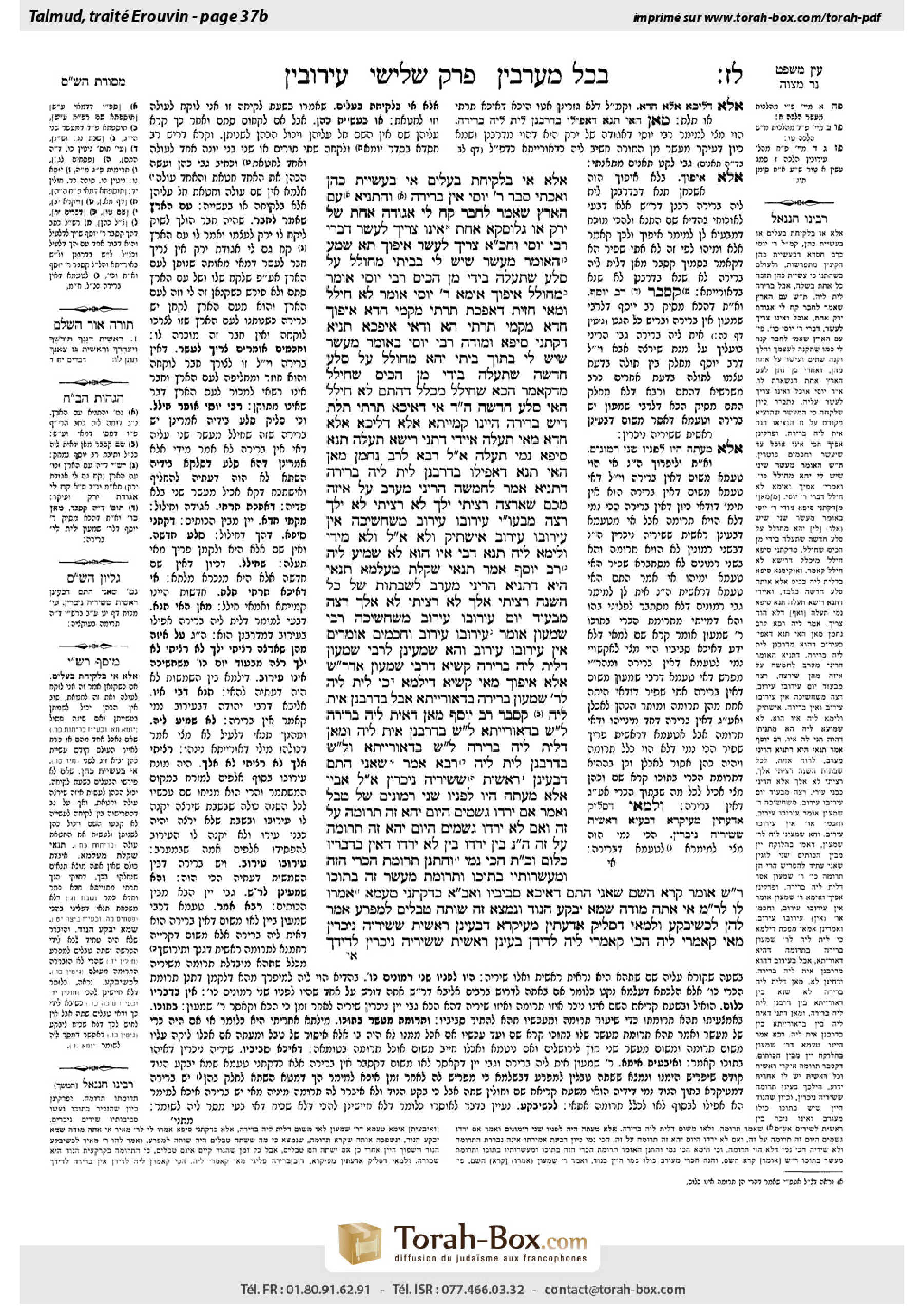
This page of Eruvin includes the Aramaic text, an English translation and an AI-generated French translation, alongside the scan above.
עירובין ל״ז ב · Aramaic and Hebrew text
אֶלָּא אִי בִּלְקִיחַת בְּעָלִים, אִי בַּעֲשִׂיַּית כֹּהֵן.
וְאַכַּתִּי: סָבַר רַבִּי יוֹסֵי אֵין בְּרֵירָה? וְהָתַנְיָא: עַם הָאָרֶץ שֶׁאָמַר לְחָבֵר ״קַח לִי אֲגוּדָּה אַחַת שֶׁל יָרָק אוֹ גְּלוּסְקָא אַחַת״ — אֵינוֹ צָרִיךְ לְעַשֵּׂר, דִּבְרֵי רַבִּי יוֹסֵי.
וַחֲכָמִים אוֹמְרִים: צָרִיךְ לְעַשֵּׂר. אֵיפוֹךְ.
תָּא שְׁמַע, הָאוֹמֵר: ״מַעֲשֵׂר שֶׁיֵּשׁ לִי בְּבֵיתִי מְחוּלָּל עַל סֶלַע שֶׁתַּעֲלֶה בְּיָדִי מִן הַכִּיס״. רַבִּי יוֹסֵי אוֹמֵר: מְחוּלָּל!
אֵיפוֹךְ, אֵימָא: רַבִּי יוֹסֵי אוֹמֵר: לֹא חִילֵּל. וּמַאי חֲזֵית דְּאָפְכַתְּ תַּרְתֵּי מִקַּמֵּי חֲדָא, אֵיפוֹךְ חֲדָא מִקַּמֵּי תַּרְתֵּי!
הָא וַדַּאי אִיפְּכָא תַּנְיָא, דְּקָתָנֵי סֵיפָא: וּמוֹדֶה רַבִּי יוֹסֵי בְּאוֹמֵר ״מַעֲשֵׂר שֶׁיֵּשׁ לִי בְּתוֹךְ בֵּיתִי יְהֵא מְחוּלָּל עַל סֶלַע חֲדָשָׁה שֶׁתַּעֲלֶה בְּיָדִי מִן הַכִּיס״ — שֶׁחִילֵּל. מִדְּקָאָמַר הָכָא שֶׁחִילֵּל, מִכְּלָל דְּהָתָם — לֹא חִילֵּל.
הַאי סֶלַע חֲדָשָׁה הֵיכִי דָּמֵי? אִי דְּאִיכָּא תַּרְתֵּי תְּלָת, דְּיֵשׁ בְּרֵירָה — הַיְינוּ קַמַּיְיתָא? אֶלָּא דְּלֵיכָּא אֶלָּא חֲדָא — מַאי ״תַּעֲלֶה״?
אַיְּידֵי דְּתָנֵי רֵישָׁא ״תַּעֲלֶה״, תְּנָא סֵיפָא נָמֵי ״תַּעֲלֶה״.
אֲמַר לֵיהּ רָבָא לְרַב נַחְמָן: מַאן הַאי תַּנָּא דַּאֲפִילּוּ בִּדְרַבָּנַן לֵית לֵיהּ בְּרֵירָה? דְּתַנְיָא: אָמַר לַחֲמִשָּׁה הֲרֵינִי מְעָרֵב עַל אֵיזֶה מִכֶּם שֶׁאֶרְצֶה, רָצִיתִי — יֵלֵךְ, לֹא רָצִיתִי — לֹא יֵלֵךְ. רָצָה מִבְּעוֹד יוֹם — עֵירוּבוֹ עֵירוּב, מִשֶּׁחָשֵׁיכָה — אֵין עֵירוּבוֹ עֵירוּב.
אִישְׁתִּיק, וְלָא אֲמַר לֵיהּ וְלָא מִידֵּי. וְלֵימָא לֵיהּ תַּנָּא דְּבֵי אַיּוֹ הוּא! לָא שְׁמִיעַ לֵיהּ.
רַב יוֹסֵף אָמַר: תַּנָּאֵי שָׁקְלַתְּ מֵעָלְמָא? תַּנָּאֵי הִיא! דְּתַנְיָא: הֲרֵינִי מְעָרֵב לְשַׁבָּתוֹת שֶׁל כׇּל הַשָּׁנָה, רָצִיתִי — אֵלֵךְ, לֹא רָצִיתִי — לֹא אֵלֵךְ. רָצָה מִבְּעוֹד יוֹם — עֵירוּבוֹ עֵירוּב. מִשֶּׁחָשֵׁיכָה, רַבִּי שִׁמְעוֹן אוֹמֵר: עֵירוּבוֹ עֵירוּב, וַחֲכָמִים אוֹמְרִים: אֵין עֵירוּבוֹ עֵירוּב.
וְהָא שָׁמְעִינַן לְרַבִּי שִׁמְעוֹן דְּלֵית לֵיהּ בְּרֵירָה, קַשְׁיָא דְּרַבִּי שִׁמְעוֹן אַדְּרַבִּי שִׁמְעוֹן! אֶלָּא אֵיפוֹךְ.
מַאי קַשְׁיָא? דִּילְמָא כִּי לֵית לֵיהּ לְרַבִּי שִׁמְעוֹן בְּרֵירָה — בִּדְאוֹרָיְיתָא, אֲבָל בִּדְרַבָּנַן — אִית לֵיהּ!
קָסָבַר רַב יוֹסֵף: מַאן דְּאִית לֵיהּ בְּרֵירָה, לָא שְׁנָא בִּדְאוֹרָיְיתָא, לָא שְׁנָא בִּדְרַבָּנַן — אִית לֵיהּ. וּמַאן דְּלֵית לֵיהּ בְּרֵירָה, לָא שְׁנָא בִּדְאוֹרָיְיתָא וְלָא שְׁנָא בִּדְרַבָּנַן — לֵית לֵיהּ.
רָבָא אָמַר: שָׁאנֵי הָתָם, דְּבָעֵינַן ״רֵאשִׁית שֶׁשְּׁיָרֶיהָ נִיכָּרִין״.
אֲמַר לֵיהּ אַבָּיֵי: אֶלָּא מֵעַתָּה, הָיוּ לְפָנָיו שְׁנֵי רִמּוֹנִים שֶׁל טֶבֶל, וְאָמַר: אִם יֵרְדוּ גְּשָׁמִים הַיּוֹם יְהֵא זֶה תְּרוּמָה עַל זֶה, וְאִם לֹא יֵרְדוּ גְּשָׁמִים הַיּוֹם יְהֵא זֶה תְּרוּמָה עַל זֶה, הָכִי נָמֵי בֵּין יָרְדוּ בֵּין לֹא יָרְדוּ דְּאֵין בִּדְבָרָיו כְּלוּם?
וְכִי תֵּימָא הָכִי נָמֵי, וְהָתְנַן: תְּרוּמַת הַכְּרִי הַזֶּה וּמַעְשְׂרוֹתָיו בְּתוֹכוֹ, וּתְרוּמַת מַעֲשֵׂר זֶה בְּתוֹכוֹ. רַבִּי שִׁמְעוֹן אוֹמֵר: קָרָא הַשֵּׁם!
שָׁאנֵי הָתָם — דְּאִיכָּא סְבִיבָיו.
וְאִי בָּעֵית אֵימָא — כִּדְקָתָנֵי טַעְמָא, אָמְרוּ לוֹ לְרַבִּי מֵאִיר: אִי אַתָּה מוֹדֶה שֶׁמָּא יִבָּקַע הַנּוֹד, וְנִמְצָא זֶה שׁוֹתֶה טְבָלִים לְמַפְרֵעַ! אָמַר לָהֶן: לִכְשֶׁיִּבָּקַע!
וּלְמַאי דִּסְלֵיק אַדַּעְתִּין מֵעִיקָּרָא דְּבָעֵינַן רֵאשִׁית שֶׁשְּׁיָרֶיהָ נִיכָּרִין, מַאי קָאָמְרִי לֵיהּ?
הָכִי קָאָמְרִי לֵיהּ: לְדִידַן — בָּעִינַן רֵאשִׁית שֶׁשְּׁיָרֶיהָ נִיכָּרִין. לְדִידָךְ —
Eruvin 37b · English translation
when they are purchased by their owner, if the owner explicitly consecrated it as a burnt-offering or sin-offering when he purchased it, or through the actions of the priest when he offers the birds as sacrifices. Therefore, even if the women did not verbalize their intentions, it is considered as if they had made a stipulation from the outset. Therefore, this case is not an instance of retroactive designation.
And still the question may be raised: Does Rabbi Yosei really hold that there is no retroactive designation? Wasn’t it taught in a baraita: If an am ha’aretz, who is not known to be scrupulous in separating tithes, said to a ḥaver, one known to be meticulous in his observance of halakha and especially the laws of teruma and tithes, before the ḥaver went to the market to buy himself vegetables from another am ha’aretz: Buy for me as well a bundle of vegetables or a cake [geluska], the ḥaver does not need to tithe the food that he gives to the am ha’aretz. The only reason the food needs to be tithed is because it is demai, and an am ha’aretz is not particular about that issue. This is the statement of Rabbi Yosei. It can be deduced from this ruling that Rabbi Yosei accepts the principle of retroactive designation, as the ḥaver purchased bundles of vegetables without specifying which was for himself and which was for the am ha’aretz, and when he gave one to the am ha’aretz, it became retroactively clear that he had purchased that bundle for the am ha’aretz from the start, and therefore he does not need to separate tithes from it as demai.
And the Rabbis say: He must tithe it. Since we do not accept the principle of retroactive designation, everything that the ḥaver bought was bought for himself, and the fact that he later gave part of it to the am ha’aretz does not exempt him from his original obligation to separate tithes from the demai. In any case, it seems that Rabbi Yosei’s opinion in this baraita contradicts his opinion in the Tosefta cited above with regard to wine. The Gemara answers: Reverse the opinions in the baraita and say that according to Rabbi Yosei he must tithe the produce he gives to the am ha’aretz, while the Rabbis permit him to proceed without tithing.
The Gemara attempts to bring another proof. Come and hear a proof from a different Tosefta: In the case of one who says: The second tithe that I have in my house shall be redeemed upon the sela coin that will happen to come up in my hand when I remove it from the pouch, i.e., he did not have a particular coin in mind, Rabbi Yosei says: The second tithe is redeemed. When the coin is removed from the pouch, it is retroactively clarified that this is the coin that he had in his mind from the outset. This indicates that Rabbi Yosei accepts the principle of retroactive designation.
The Gemara answers again: Reverse the attributions, and say that Rabbi Yosei says: He has not redeemed the second tithe. The Gemara raises a difficulty: What did you see that you reversed two sources because of one, and made the two baraitot conform to the mishna, which indicates that Rabbi Yosei holds that there is no retroactive designation? Perhaps I should reverse one source, i.e., the mishna, because of the two baraitot and say that in fact Rabbi Yosei accepts the principle of retroactive designation, and it is the lone source that indicates otherwise that must be revised.
The Gemara answers: This Tosefta was certainly taught in reverse, as the latter clause states: And Rabbi Yosei concedes with regard to one who says: The second tithe that I have in my house shall be redeemed with the new sela coin that will happen to come up in my hand when I remove it from the pouch, that he has redeemed the second tithe. The Gemara makes the following inference: From the fact that it said here that he has redeemed the second tithe, it can be proven by inference that there, in the first clause of the Tosefta, he did not redeem the second tithe. Therefore, the wording found in the earlier part of the baraita is clearly incorrect and must be reversed.
The Gemara raises a question with regard to the halakha cited in the Tosefta: This new sela, what are its circumstances? If it is referring to a situation where there are two or three coins in his pouch, so that it is not clear which coin he is referring to, and there is the possibility of retroactive designation, this is exactly the same as the first case. Why does he rule here, as opposed to the earlier case, that there is retroactive designation? Rather, it must refer to a situation where he has only one coin in his pouch. But if so, what is the meaning of the expression: Will happen to come up?
The Gemara answers: In fact, it is referring to a case where one has only one coin in his pouch, and the wording of the latter clause is imprecise. Since the first clause taught the halakha using this expression: Will happen to come up, the latter clause also taught the halakha using this same expression: Will happen to come up, even though he was referring to the only new coin that he has in his pouch.
Rava said to Rav Naḥman: Who is this tanna who does not accept the principle of retroactive designation even concerning rabbinic decrees? As it was taught in a baraita: If one person said to five people: I am hereby establishing an eiruv for whichever one of you I will choose, so that the person I have chosen will be able to walk two thousand cubits from the spot of the eiruv, whereas whomever I have not chosen will not be able to walk two thousand cubits from the location of the eiruv, the following distinction applies: If he chose the person for whom he was making the eiruv before Shabbat, while it was still day, his eiruv is a valid eiruv; but if he only chose him after nightfall, his eiruv is not a valid eiruv. The tanna of this baraita apparently rejects the principle of retroactive designation, even with regard to rabbinic enactments, as if that were not the case, the eiruv should be valid even if he only chose the person for whom he was making the eiruv after nightfall.
Rav Naḥman was silent and did not say anything to Rava. The Gemara asks: And let Rav Naḥman say to him that the baraita is the opinion of a Sage of the school of Ayo, in accordance with the opinion of Rabbi Yehuda, which maintains that even with regard to an eiruv there is no retroactive designation. The Gemara answers: He did not accept Ayo’s version of Rabbi Yehuda’s opinion and considered it incorrect.
Rav Yosef said, in his unique style: Have you removed the tanna’im from the world? Is there no tanna who holds this position? The possibility of retroactive designation with regard to rabbinic enactments is a dispute among tanna’im, as it was taught in a baraita: One said: I am hereby establishing an eiruv for the Shabbatot of the entire year, so that if I want to make use of it, I will be able to walk two thousand cubits from the eiruv, and if I do not want to do so, I will not walk. If he wanted to make use of the eiruv for a particular Shabbat while it was still day, his eiruv is a valid eiruv for that Shabbat. However, if he only decided after nightfall that he wanted the eiruv to be in effect, the tanna’im disagree: Rabbi Shimon says: His eiruv is a valid eiruv; and the Rabbis say: His eiruv is not a valid eiruv. This indicates that according to the Rabbis there is no retroactive designation, even with regard to eiruvin, while Rabbi Shimon holds that his eiruv is in effect because of the principle of retroactive designation.
The Gemara asks: Didn’t we hear that Rabbi Shimon does not accept the principle of retroactive designation in the case of wine from Kutim? The contradiction between one ruling of Rabbi Shimon and another ruling of Rabbi Shimon himself is difficult. The Gemara answers: Rather, reverse the opinions and say that it is Rabbi Shimon who holds that his eiruv is not valid, and therefore he can be identified as the tanna who holds that there is no retroactive designation at all, even with regard to rabbinic decrees.
The Gemara asks: What is the difficulty here? Perhaps it is with regard to Torah law that Rabbi Shimon does not accept the principle of retroactive designation, but with regard to rabbinic decrees, he does accept the principle of retroactive designation. Therefore, it is not necessary to reverse the opinions.
The Gemara answers: Rav Yosef holds that one who accepts the principle of retroactive designation accepts it in all cases; there is no difference between Torah law and rabbinic decrees. And one who does not accept the principle of retroactive designation does not accept it at all; there is no difference between Torah law and rabbinic decrees.
Rava said: The distinction between the case of the wine and the other cases is not related to the principle of retroactive designation. Rather, there, the case of the wine of a Kuti, is different, as we require that the teruma be the first of your produce, whose remnants are recognizable. Since teruma is called the first, if it is not clear which portion was separated and which portion is left over, the designation of part of the wine as teruma is not effective, despite the fact that Rabbi Shimon accepts the principle of retroactive designation.
Abaye said to him: Do you really think that this ruling is correct? But if that is so, if there were two pomegranates that were tevel before him, and he said: If rain falls today, this pomegranate shall be teruma for that other pomegranate, and if rain does not fall today, that second pomegranate shall be teruma for this first one, so too, whether rain fell or did not fall, there is no significance to his statement because the remnants that are not teruma are not immediately recognizable.
And if you say that indeed, it is so, there is a difficulty. Didn’t we learn in a mishna that if one says: The teruma of this pile of produce and its tithes shall be inside it, without specifying the location of the produce that he is designating for these purposes, and similarly, if one says about a pile of first-tithe produce: The teruma of this tithe shall be inside it, without specifying the location, Rabbi Shimon says: He has given it a name, i.e., the designation of the teruma and tithes take effect, even though it is impossible to distinguish between them and the permitted portion of the produce? Therefore, it is not necessary for the remnants of the act of separation to be recognizable.
Rava refutes this argument: There, with regard to a pile of produce, it is different because there are recognizable remnants around it. He specified that the teruma should be inside the heap, which indicates that it is in the middle of the pile, and therefore the produce on the perimeter of the pile is certainly not teruma, and some of the remnants of the act of separation are recognizable.
And if you wish, you can reconcile the difference between the case of separating teruma from wine and the other cases and say in accordance with the reason that was taught in the case of the wine: The Rabbis said to Rabbi Meir: Don’t you concede that perhaps the leather flask will burst before he manages to separate the teruma, and retroactively this person would have been drinking tevel? Since he never ended up separating teruma, the wine remained tevel all along. Rabbi Meir said to them: When it bursts, I will consider the matter, but presently I am not concerned that the bottle might burst. Therefore, we see that these tanna’im do not disagree about the principle of retroactive designation but over the likelihood that the flask will burst.
The Gemara now asks: And according to what initially entered our minds, which is that we require teruma that is the first, whose remnants are recognizable what did the Rabbis say to Rabbi Meir about that? That is the objection they should have raised against him.
The Gemara answers: This is what they said to him: According to our own opinion, we require teruma that is the first, whose remnants are recognizable; according to your opinion,
Eruvin 37b · Traduction française (IA)
lorsqu'ils sont achetés par leur propriétaire, si le propriétaire a explicitement consacré l'animal en tant que holocauste ou sacrifice expiatoire lors de son achat, ou par les actions du prêtre lorsqu'il offre les oiseaux en sacrifice. Ainsi, même si les femmes n'ont pas verbalisé leurs intentions, cela est considéré comme s'ils avaient fait une stipulation dès le départ. Par conséquent, ce cas n'est pas un exemple de désignation rétrospective.
Et pourtant, la question peut être posée : Rabbi Yosei ne tient-il vraiment pas compte du principe de désignation rétrospective ? N’a-t-il pas été enseigné dans une baraïta : Si un am ha’aretz, qui n’est pas connu pour être minutieux dans la séparation des dixièmes, dit à un ḥaver, qui est connu pour être rigoureux dans l’observation de la halakha et particulièrement des lois de terouma et des dixièmes, avant que le ḥaver ne parte au marché pour acheter lui-même des légumes à un autre am ha’aretz : Achète-moi aussi un faisceau de légumes ou un gâteau [geluska], le ḥaver n’a pas besoin de séparer les dixièmes de la nourriture qu’il donne à l’am ha’aretz. La seule raison pour laquelle la nourriture doit être tithée est qu’elle est demai, et l’am ha’aretz n’est pas particulier à ce sujet. C’est l’opinion de Rabbi Yosei. On peut en déduire de cette décision que Rabbi Yosei accepte le principe de désignation rétrospective, car le ḥaver a acheté des faisceaux de légumes sans spécifier lequel était pour lui-même et lequel pour l’am ha’aretz, et lorsqu’il a donné un à l’am ha’aretz, cela est devenu rétrospectivement clair qu’il avait acheté ce faisceau pour l’am ha’aretz dès le départ, et par conséquent il n’a pas besoin de séparer les dixièmes de demai.
Et les Rabbins disent : Il doit le tithier. Puisque nous ne reconnaissons pas le principe de désignation rétrospective, tout ce que le ḥaver a acheté a été acheté pour lui-même, et le fait qu'il ait plus tard donné une partie à l'am ha'aretz ne l'exonère pas de son obligation originale de séparer les dixièmes du demai. En tout cas, il semble que l'opinion de Rabbi Yosei dans cette baraïta contredit son opinion dans la Tosefta citée ci-dessus concernant le vin. La Guemara répond : Inversez les opinions dans la baraïta et dites que selon Rabbi Yosei il doit tithier la production qu'il donne à l'am ha'aretz, tandis que les Rabbins autorisent à agir sans tithier.
La Guemara tente de présenter un autre preuve. Venez écouter une preuve tirée d'une autre Tosefta : Dans le cas où l'on dit : Le dixième second que j'ai chez moi doit être racheté avec la pièce sela qui sortira de ma poche lorsque je la retirerai, c'est-à-dire qu'il n'avait pas une pièce particulière en tête, Rabbi Yosei dit : Le dixième second est racheté. Lorsque la pièce est retirée de la poche, cela devient rétrospectivement clair que c'est la pièce qu'il avait en tête dès le départ. Cela indique que Rabbi Yosei accepte le principe de désignation rétrospective.
La Guemara répond à nouveau : Inversez les attributions et dites que Rabbi Yosei dit : Il n'a pas racheté le dixième second. La Guemara soulève une difficulté : Qu'avez-vous vu qui vous a fait inverser deux sources à cause d'une seule, et faire correspondre les deux baraitot à la mitsva, ce qui indique que Rabbi Yosei considère qu'il n'y a pas de désignation rétrospective ? Peut-être devrais-je inverser une seule source, c'est-à-dire la mitsva, à cause des deux baraitot et dire que, en réalité, Rabbi Yosei accepte le principe de désignation rétrospective, et c'est la seule source qui indique le contraire qui doit être révisé.
La Guemara répond : Cette Tosefta a certainement été enseignée à l'envers, car la clause ultérieure dit : Et Rabbi Yosei concède concernant celui qui dit : Le dixième second que j'ai chez moi doit être racheté avec la nouvelle pièce sela qui sortira de ma poche lorsque je la retirerai de la poche, qu'il a racheté le dixième second. La Guemara tire la suivante inférence : Du fait qu'il a dit ici qu'il a racheté le dixième second, on peut en déduire par analogie que là, dans la première clause de la Tosefta, il n'a pas racheté le dixième second. Par conséquent, le texte trouvé dans la partie précédente de la baraïta est clairement incorrect et doit être inversé.
La Guemara soulève une question concernant la halakha citée dans la Tosefta : Quelles sont les circonstances de cette nouvelle sela ? Si cela fait référence à un cas où il y a deux ou trois pièces dans sa poche, de sorte qu'il n'est pas clair quelle pièce il désigne, et qu'il y a la possibilité de désignation rétrospective, c'est exactement le même cas que le premier. Pourquoi règle-t-il ici, contrairement au premier cas, qu'il y a une désignation rétrospective ? Plutôt, cela doit faire référence à un cas où il n'y a qu'une seule pièce dans sa poche. Mais si c'est le cas, quelle est la signification de l'expression : Sortira de ma poche ?
La Guemara répond : En réalité, cela fait référence à un cas où l'on a une seule pièce dans sa poche, et l'expression de la clause ultérieure est imprecise. Puisque la première clause a enseigné la halakha en utilisant cette expression : Sortira de ma poche, la clause ultérieure a aussi enseigné la halakha en utilisant la même expression : Sortira de ma poche, même s'il faisait référence à la seule nouvelle pièce qu'il avait dans sa poche.
Rava dit à Rav Naḥman : Qui est ce tanna qui ne reconnaît pas le principe de désignation rétrospective même concernant les décrets rabbiniques ? Comme il a été enseigné dans une baraïta : Si une personne a dit à cinq personnes : Je m'installe ici un eiruv pour celui que je choisirai parmi vous, de sorte que la personne que j'ai choisie puisse marcher deux mille coudées depuis le lieu de l'eiruv, tandis que celui que je n'ai pas choisi ne puisse pas marcher deux mille coudées depuis le lieu de l'eiruv, la distinction suivante s'applique : S'il a choisi la personne pour laquelle il faisait l'eiruv avant la Shabbat, alors que c'était encore jour, son eiruv est un eiruv valide ; mais s'il a seulement choisi cette personne après la nuit, son eiruv n'est pas valide. Le tanna de cette baraïta semble rejeter le principe de désignation rétrospective, même concernant les décrets rabbiniques, car si ce n'était pas le cas, l'eiruv devrait être valide même s'il a seulement choisi la personne pour laquelle il faisait l'eiruv après la nuit.
Rav Naḥman a été silencieux et n'a pas dit un mot à Rava. La Guemara pose la question : Et que Rav Naḥman dise à lui que la baraïta est l'opinion d'un Sage de la maison d'Ayo, conformément à l'opinion de Rabbi Yehuda, qui affirme que même concernant un eiruv, il n'y a pas de désignation rétroactive. La Guemara répond : Il n'a pas accepté la version d'Ayo de l'opinion de Rabbi Yehuda et l'a considérée comme erronée.
Rav Yosef a dit, dans son style unique : Avez-vous expulsé les tannaïm du monde ? Y a-t-il un tanna qui adopte cette position ? La possibilité de désignation rétroactive concernant les édicts rabbiniques est un débat entre les tannaïm, comme il a été enseigné dans une baraïta : On dit : Je déclare ici l'établissement d'un eiruv pour les sabbats de l'année entière, de sorte que si je veux en faire usage, je pourrai marcher deux mille coudées depuis l'eiruv, et si je n'en veux pas faire usage, je ne marcherai pas. Si l'on voulait utiliser l'eiruv pour un sabbat particulier alors qu'il était encore jour, son eiruv est un eiruv valide pour ce sabbat. Cependant, si l'on a décidé après la nuit que l'on voulait que l'eiruv soit en vigueur, les tannaïm s'opposent : Rabbi Shimon dit : Son eiruv est un eiruv valide ; et les Rabbins disent : Son eiruv n'est pas un eiruv valide. Cela montre que selon les Rabbins, il n'y a pas de désignation rétroactive, même concernant les eiruvin, tandis que Rabbi Shimon maintient que son eiruv est en vigueur en raison du principe de désignation rétroactive.
La Guemara pose la question : N'avons-nous pas entendu que Rabbi Shimon ne reconnaît pas le principe de désignation rétroactive dans le cas du vin des Kutiim ? La contradiction entre un jugement de Rabbi Shimon et un autre jugement de Rabbi Shimon lui-même est difficile. La Guemara répond : Plutôt, inversez les opinions et dites que c'est Rabbi Shimon qui maintient que son eiruv n'est pas valide, et donc qu'il peut être identifié comme le tanna qui maintient qu'il n'y a pas de désignation rétroactive du tout, même concernant les édicts rabbiniques.
La Guemara pose la question : Quel est le problème ici ? Peut-être s'agit-il de la loi divine que Rabbi Shimon ne reconnaît pas le principe de désignation rétroactive, mais concernant les édicts rabbiniques, il le reconnaît. Ainsi, il n'est pas nécessaire d'inverser les opinions.
La Guemara répond : Rav Yosef affirme que celui qui accepte le principe de désignation rétroactive l'accepte dans tous les cas ; il n'y a pas de différence entre la loi divine et les édicts rabbiniques. Et celui qui ne l'accepte pas ne l'accepte pas du tout ; il n'y a pas de différence entre la loi divine et les édicts rabbiniques.
Rava dit : La distinction entre le cas du vin et les autres cas n'est pas liée au principe de désignation rétroactive. Plutôt, là, le cas du vin d'un Kuti est différent, car nous exigeons que la terouma soit la première de votre produit, dont les restes sont identifiables. Puisque la terouma est appelée la première, si ce n'est pas clair quelle portion a été séparée et quelle portion reste, la désignation d'une partie du vin comme terouma n'est pas efficace, malgré le fait que Rabbi Shimon accepte le principe de désignation rétroactive.
Abaye dit à lui : Pensez-vous vraiment que ce jugement est correct ? Mais si c'est ainsi, si deux pamplemousses étaient tevel avant lui, et s'il disait : Si la pluie tombe aujourd'hui, ce pamplemousse sera terouma pour cet autre pamplemousse, et si la pluie ne tombe pas aujourd'hui, ce deuxième pamplemousse sera terouma pour ce premier, de même, que la pluie tombe ou non, sa déclaration n'a pas d'importance, car les restes qui ne sont pas terouma ne sont pas immédiatement identifiables.
Et si vous dites que c'est effectivement ainsi, il y a une difficulté. N'avons-nous pas appris dans une mitsva que si l'on dit : La terouma de ce tas de produits et ses dîmes doivent être à l'intérieur, sans spécifier la localisation des produits que l'on désigne pour ces fins, et de même, si l'on dit concernant un tas de dîmes de premier fruit : La terouma de cette dîme doit être à l'intérieur, sans spécifier la localisation, Rabbi Shimon dit : Il lui a donné un nom, c'est-à-dire que la désignation de la terouma et des dîmes prend effet, même si on ne peut pas distinguer entre elles et la portion permise des produits ? Ainsi, il n'est pas nécessaire que les restes de l'acte de séparation soient identifiables.
Rava réfute cet argument : Là, concernant un tas de produits, c'est différent, car il y a des restes identifiables autour de lui. Il a spécifié que la terouma doit être à l'intérieur du tas, ce qui indique qu'elle est au milieu du tas, et donc les produits à la périphérie du tas ne sont certainement pas de la terouma, et certains des restes de l'acte de séparation sont identifiables.
Et si vous le souhaitez, vous pouvez concilier la différence entre le cas de la séparation de la terouma du vin et les autres cas et dire selon la raison qui a été enseignée dans le cas du vin : Les Rabbins ont dit à Rabbi Meir : Ne reconnaissez-vous pas que peut-être la bouteille en cuir éclatera avant qu'il ne puisse séparer la terouma, et rétroactivement, cette personne boirait du tevel ? Puisque l'on n'a jamais séparé la terouma, le vin a resté tevel tout le temps. Rabbi Meir a dit à eux : Lorsqu'elle éclatera, je considérerai la question, mais pour l'instant, je ne m'inquiète pas que la bouteille éclate. Ainsi, nous voyons que ces tannaïm ne s'opposent pas au principe de désignation rétroactive, mais sur la probabilité que la bouteille éclate.
La Guemara pose maintenant la question : Et selon ce que nous avions initialement en tête, à savoir que nous exigeons une terouma qui est la première, dont les restes sont identifiables, que dirent les Rabbins à Rabbi Meir à ce sujet ? C'est l'objection qu'ils devraient avoir soulevée contre lui.
La Guemara répond : C'est ce qu'ils lui ont dit : Selon notre propre opinion, nous exigeons une terouma qui est la première, dont les restes sont identifiables ; selon votre opinion,
Traduction française générée par IA à partir de l’édition anglaise de Sefaria. Vérifie toujours un passage avec le texte source.
Text from Sefaria: William Davidson Edition - Vocalized Aramaic (CC BY NC); William Davidson Edition - English (CC BY NC).