Eruvin 38a: Talmud study for Daf Yomi
Study the Talmud for Daf Yomi with scanned pages, Hebrew text, English translations from Sefaria and AI-generated French translations.
Passage selection and English or AI-generated French translation are available where the scan has annotations. Daf Study is independent of Torah-Box and Sefaria.
Browse Eruvin · עירובין · All tractatesEruvin 38a text and translations
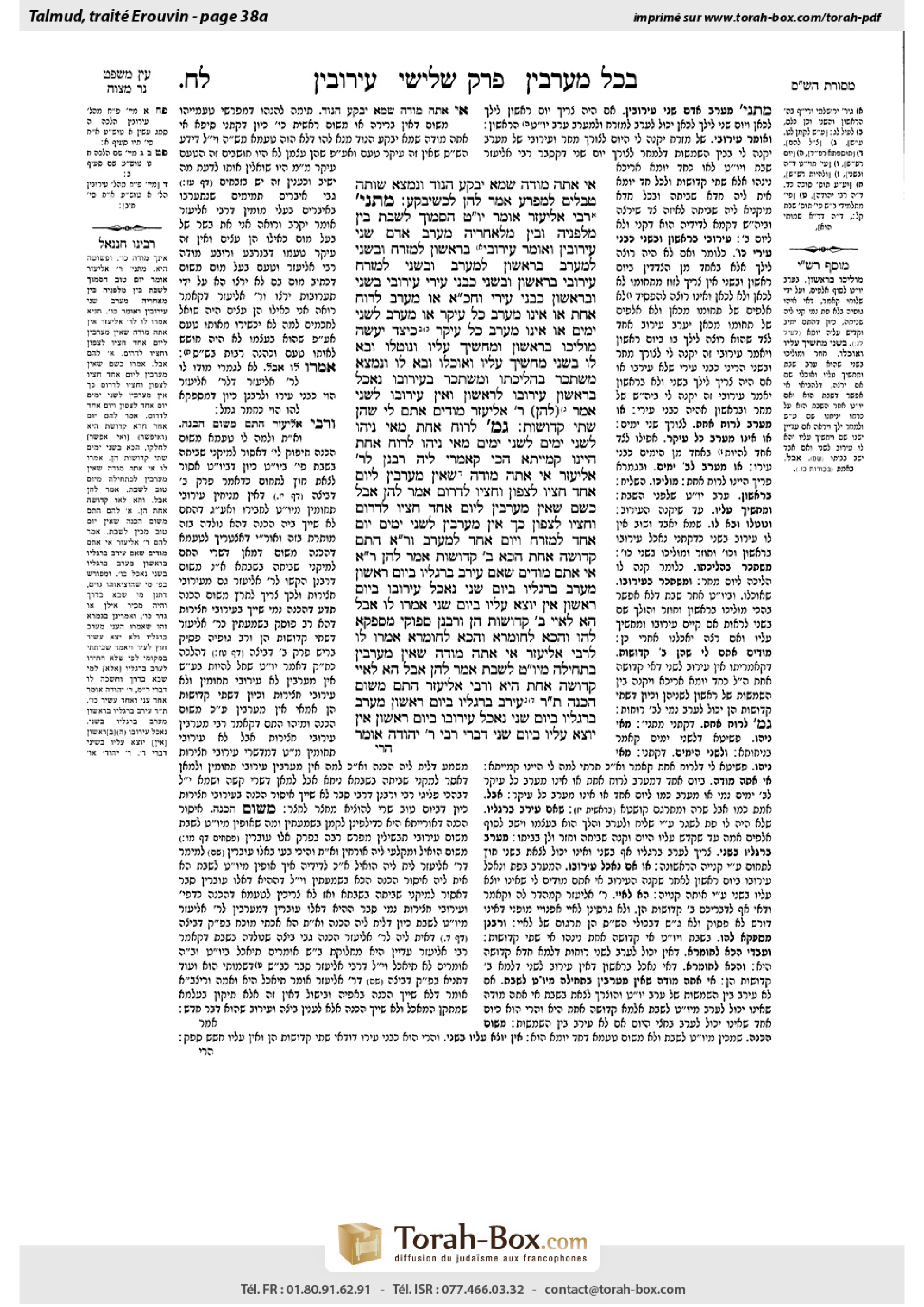
This page of Eruvin includes the Aramaic text, an English translation and an AI-generated French translation, alongside the scan above.
עירובין ל״ח א · Aramaic and Hebrew text
אִי אַתָּה מוֹדֶה שֶׁמָּא יִבָּקַע הַנּוֹד, וְנִמְצָא שׁוֹתֶה טְבָלִים לְמַפְרֵעַ? אָמַר לָהֶן: לִכְשֶׁיִּבָּקַע.
מַתְנִי׳ רַבִּי אֱלִיעֶזֶר אוֹמֵר: יוֹם טוֹב הַסָּמוּךְ לַשַּׁבָּת, בֵּין מִלְּפָנֶיהָ וּבֵין מִלְּאַחֲרֶיהָ — מְעָרֵב אָדָם שְׁנֵי עֵירוּבִין, וְאוֹמֵר: עֵירוּבִי בָּרִאשׁוֹן לַמִּזְרָח וּבַשֵּׁנִי לַמַּעֲרָב; בָּרִאשׁוֹן לַמַּעֲרָב וּבַשֵּׁנִי לַמִּזְרָח; עֵירוּבִי בָּרִאשׁוֹן, וּבַשֵּׁנִי כִּבְנֵי עִירִי; עֵירוּבִי בַּשֵּׁנִי, וּבְרִאשׁוֹן כִּבְנֵי עִירִי.
וַחֲכָמִים אוֹמְרִים: אוֹ מְעָרֵב לְרוּחַ אַחַת, אוֹ אֵינוֹ מְעָרֵב כׇּל עִיקָּר. אוֹ מְעָרֵב לִשְׁנֵי יָמִים, אוֹ אֵינוֹ מְעָרֵב כׇּל עִיקָּר.
כֵּיצַד יַעֲשֶׂה? מוֹלִיכוֹ בָּרִאשׁוֹן וּמַחְשִׁיךְ עָלָיו, וְנוֹטְלוֹ, וּבָא לוֹ. בַּשֵּׁנִי מַחְשִׁיךְ עָלָיו וְאוֹכְלוֹ וּבָא לוֹ, וְנִמְצָא מִשְׂתַּכֵּר בַּהֲלִיכָתוֹ, וּמִשְׂתַּכֵּר בְּעֵירוּבוֹ.
נֶאֱכַל בָּרִאשׁוֹן — עֵירוּבוֹ לָרִאשׁוֹן, וְאֵין עֵירוּבוֹ לַשֵּׁנִי.
אָמַר (לָהֶן) רַבִּי אֱלִיעֶזֶר: מוֹדִים אַתֶּם לִי שֶׁהֵן שְׁתֵּי קְדוּשּׁוֹת.
גְּמָ׳ ״לְרוּחַ אַחַת״ מַאי נִיהוּ? לִשְׁנֵי יָמִים. ״לִשְׁנֵי יָמִים״ מַאי נִיהוּ? לְרוּחַ אַחַת. הַיְינוּ קַמַּיְיתָא!
הָכִי קָאָמְרִי לֵיהּ רַבָּנַן לְרַבִּי אֱלִיעֶזֶר: אִי אַתָּה מוֹדֶה שֶׁאֵין מְעָרְבִין לְיוֹם אֶחָד חֶצְיוֹ לַצָּפוֹן וְחֶצְיוֹ לַדָּרוֹם? אָמַר לָהֶן: אֲבָל. כְּשֵׁם שֶׁאֵין מְעָרְבִין לְיוֹם אֶחָד, חֶצְיוֹ לַדָּרוֹם וְחֶצְיוֹ לַצָּפוֹן — כָּךְ אֵין מְעָרְבִין לִשְׁנֵי יָמִים, יוֹם אֶחָד לַמִּזְרָח וְיוֹם אֶחָד לַמַּעֲרָב.
וְרַבִּי אֱלִיעֶזֶר? הָתָם — קְדוּשָּׁה אַחַת. הָכָא — שְׁתֵּי קְדוּשּׁוֹת.
אָמַר לָהֶן רַבִּי אֱלִיעֶזֶר: אִי אַתֶּם מוֹדִים שֶׁאִם עֵירַב בְּרַגְלָיו בְּיוֹם רִאשׁוֹן — מְעָרֵב בְּרַגְלָיו בְּיוֹם שֵׁנִי? נֶאֱכַל עֵירוּבוֹ בְּיוֹם רִאשׁוֹן — אֵין יוֹצֵא עָלָיו בְּיוֹם שֵׁנִי.
אָמְרוּ לוֹ: אֲבָל. הָא לָאיֵי שְׁתֵּי קְדוּשּׁוֹת הֵן. וְרַבָּנַן סַפּוֹקֵי מְסַפְּקָא לְהוּ, וְהָכָא לְחוּמְרָא וְהָכָא לְחוּמְרָא.
אָמְרוּ לוֹ לְרַבִּי אֱלִיעֶזֶר: אִי אַתָּה מוֹדֶה שֶׁאֵין מְעָרְבִין בַּתְּחִילָּה מִיּוֹם טוֹב לַשַּׁבָּת? אָמַר לָהֶן: אֲבָל. הָא לָאיֵי קְדוּשָּׁה אַחַת הִיא!
וְרַבִּי אֱלִיעֶזֶר: הָתָם מִשּׁוּם הֲכָנָה.
תָּנוּ רַבָּנַן: עֵירַב בְּרַגְלָיו בְּיוֹם רִאשׁוֹן — מְעָרֵב בְּרַגְלָיו בְּיוֹם שֵׁנִי. נֶאֱכַל עֵירוּבוֹ בְּיוֹם רִאשׁוֹן — אֵין יוֹצֵא עָלָיו בְּיוֹם שֵׁנִי, דִּבְרֵי רַבִּי.
רַבִּי יְהוּדָה אוֹמֵר:
Eruvin 38a · English translation
don’t you at least concede that we must be concerned that perhaps the leather flask will burst, and retroactively this person would have been drinking tevel? Rabbi Meir said to them: When it bursts, I will consider the matter, but now I am not concerned about this possibility.
MISHNA: Rabbi Eliezer says: With regard to a Festival adjacent to Shabbat, whether before it, on a Friday, or after it, on a Sunday, a person may establish two eiruvin of Shabbat borders [teḥumin] and say as follows: My eiruv on the first day shall be to the east, and on the second day to the west. Alternatively, one may say: On the first day it shall be to the west and on the second day to the east. Similarly, one may say: My eiruv shall apply on the first day, but on the second day I shall be like the rest of the inhabitants of my town, or: My eiruv shall apply on the second day, but on the first day I shall be like the rest of the inhabitants of my town.
And the Rabbis disagree and say that such a split is impossible. Rather, he either establishes an eiruv in one direction for both days, or he establishes no eiruv at all; either he establishes an eiruv for the two days, or he establishes no eiruv at all.
What does one do to establish an eiruv that will be valid for both the Festival and Shabbat? He or his agent brings the eiruv to the location that he wishes to establish as his residence on the eve of the first day, and he stays there with it until nightfall, the time when the eiruv establishes that location as his residence for the Festival, and then he takes it with him and goes away, so that it will not become lost before the following evening, in which case he would not have an eiruv for the second day. On the eve of the second day, he takes it back to the same place as the day before, and he stays there with it until nightfall, thereby establishing his residence for Shabbat, and then he may eat the eiruv and go away, if he so desires. Consequently, he benefits in that he is permitted to walk in the direction that he desires, and he benefits in that he is permitted to eat his eiruv.
However, if the eiruv was eaten on the first day, his eiruv is effective for the first day, and his eiruv is not effective for the second day.
Rabbi Eliezer said to them: If so, you agree with me that Shabbat and a Festival constitute two distinct sanctities, as if not, the eiruv that went into effect during the twilight period on the eve of the first day should have remained in effect for both days, even if it was eaten during the first day. This being the case, you should also agree with me that one can make two separate eiruvin for the two days in two different directions.
GEMARA: The Gemara raises a difficulty with regard to the wording employed by the Rabbis: First, the Rabbis state that one may establish an eiruv in one direction. What does this mean? He must establish an eiruv in that direction for two days. Then they state that he may establish an eiruv for two days. What does this mean? He must establish an eiruv for the two days in one direction. If so, this is exactly the same as the first clause.
The Gemara explains: This is what the Rabbis said to Rabbi Eliezer: Don’t you concede that in the case of one day, one may not establish an eiruv for half the day to the north and for half of it to the south? Rabbi Eliezer said to them: Indeed, I agree. They then said to him: Just as one may not establish an eiruv for one day, half the day to the north and half the day to the south, so too, one may not establish an eiruv for two consecutive days of sanctity, one day to the east and one day to the west.
And how does Rabbi Eliezer respond? He holds as follows: There, one day constitutes one sanctity, and it is impossible to impossible to divide the day such that the eiruv applies to one direction for one half of the day and to another direction for the other half of the day. Here, where Shabbat and a Festival fall out on consecutive days, they are two separate sanctities, and therefore one can establish separate eiruvin for the two days.
Rabbi Eliezer said to the Rabbis: Don’t you concede that if one established an eiruv with his feet by actually going to the place where he desires to establish an eiruv on the eve of the first day and remaining there during the twilight period, as opposed to depositing food there beforehand, he nonetheless must establish another eiruv with his feet on the eve of the second day, and one eiruv does not suffice; similarly, if his eiruv was eaten on the first day, he may not rely on it and go out beyond the limit permitted to the rest of the inhabitants of his town on the second day?
The Rabbis said to him: Indeed, that is correct. Rabbi Eliezer then said to them: Then isn’t it correct that they are two distinct sanctities, and therefore one should be permitted to establish two separate eiruvin for the two days? And how do the Rabbis respond? They are in doubt about this issue, and therefore their ruling here is stringent and prohibits establishing separate eiruvin for the two days in different directions, in case the two days are considered a single sanctity; and their ruling here is stringent and they require a separate eiruv for each day, in case the two days are considered distinct sanctities.
The Rabbis said to Rabbi Eliezer: Don’t you concede that one may not establish an eiruv initially on a Festival for Shabbat, i.e., if a Festival occurs on a Friday and one forgot to establish an eiruv on the eve of the Festival, he may not establish an eiruv for Shabbat on the Festival itself? Rabbi Eliezer said to them: Indeed, that is correct. They said to him: Then isn’t it correct that the two days constitute one sanctity?
The Gemara responds that Rabbi Eliezer holds that there, the halakha is so not because the two days constitute a single sanctity, but due to the prohibition of preparation on a Festival for Shabbat, which includes establishing an eiruv.
The Sages taught in a baraita: If one established an eiruv with his feet by going to the place he wished to establish as his residence on the eve of the first day and remaining there during the twilight period, he must nevertheless establish another eiruv with his feet on the eve of the second day. Similarly, if he had established an eiruv by depositing food in the place he wished to establish as his residence, and his eiruv was eaten on the first day, he may not rely on it and go out beyond the limit permitted to the rest of the inhabitants of the town on the second day. This is the statement of Rabbi Yehuda HaNasi.
Rabbi Yehuda says:
Eruvin 38a · Traduction française (IA)
Ne reconnais-tu pas au moins que nous devons nous inquiéter du fait que le flacon en cuir pourrait éclater, et rétroactivement cette personne aurait bu du tevel ? Rabbi Meïr dit à ceux-ci : Lorsqu'il éclatera, je considérerai la question, mais maintenant je ne m'inquiète pas de cette possibilité.
MICHNA : Rabbi Eliezer dit : Concernant un festival adjacent au sabbat, que ce soit avant celui-ci, le vendredi, ou après celui-ci, le dimanche, une personne peut établir deux eiruvin de limites de sabbat [teḥumin] et dire comme suit : Mon eiruv du premier jour sera à l'est, et du deuxième jour à l'ouest. Alternativement, on peut dire : Du premier jour il sera à l'ouest et du deuxième jour à l'est. De même, on peut dire : Mon eiruv s'appliquera le premier jour, mais le deuxième jour je serai comme les autres habitants de ma ville, ou : Mon eiruv s'appliquera le deuxième jour, mais le premier jour je serai comme les autres habitants de ma ville.
Et les Rabbins s'opposent et disent que tel partage n'est pas possible. Plutôt, il doit établir un eiruv dans une seule direction pour les deux jours, ou ne pas établir d'eiruv du tout ; il doit établir un eiruv pour les deux jours, ou ne pas établir d'eiruv du tout.
Qu'est-ce qu'on fait pour établir un eiruv valide à la fois pour le festival et le sabbat ? Il ou son agent apporte l'eiruv à l'endroit qu'il souhaite établir comme son domicile à la veille du premier jour, et il reste là avec lui jusqu'au crépuscule, moment où l'eiruv établit que cet endroit est son domicile pour le festival, puis il le prend avec lui et s'en va, afin qu'il ne disparaisse pas avant la nuit suivante, dans le cas contraire il n'aurait pas d'eiruv pour le deuxième jour. À la veille du deuxième jour, il le ramène au même endroit que la veille, et il reste là avec lui jusqu'au crépuscule, établissant ainsi son domicile pour le sabbat, puis il peut manger l'eiruv et s'en aller, s'il le désire. Ainsi, il bénéficie du fait qu'il est autorisé à marcher dans la direction qu'il désire, et il bénéficie du fait qu'il est autorisé à manger son eiruv.
Cependant, si l'eiruv a été mangé le premier jour, son eiruv est efficace pour le premier jour, et son eiruv n'est pas efficace pour le deuxième jour.
Rabbi Eliezer dit à ceux-ci : Si c'est ainsi, vous convenez avec moi que le sabbat et le festival constituent deux sanctuaires distincts, car sinon, l'eiruv qui a pris effet pendant la période de crépuscule à la veille du premier jour devrait avoir continué à être valide pour les deux jours, même s'il a été mangé pendant le premier jour. Dans ce cas, vous devriez également convenir avec moi que l'on peut établir deux eiruvin distincts pour les deux jours dans deux directions différentes.
GUEMARA : La Guemara soulève une difficulté concernant la formulation employée par les Rabbins : d'abord, les Rabbins disent qu'on peut établir un eiruv dans une seule direction. Qu'est-ce que cela signifie ? Il doit établir un eiruv dans cette direction pour deux jours. Ensuite, ils disent qu'on peut établir un eiruv pour deux jours. Qu'est-ce que cela signifie ? Il doit établir un eiruv pour les deux jours dans une seule direction. Si c'est ainsi, cela est exactement le même que la première clause.
La Guemara explique : C'est ce que les Rabbins dirent à Rabbi Eliezer : Ne reconnais-tu pas que dans le cas d'un seul jour, on ne peut pas établir un eiruv pour la moitié du jour au nord et pour la moitié du jour au sud ? Rabbi Eliezer répondit à ceux-ci : En effet, je suis d'accord. Ils dirent alors à lui : Tout comme on ne peut pas établir un eiruv pour un seul jour, la moitié du jour au nord et la moitié du jour au sud, ainsi aussi on ne peut pas établir un eiruv pour deux jours de sanctité consécutifs, un jour à l'est et un jour à l'ouest.
Et comment Rabbi Eliezer répond-il ? Il maintient que : Là, un seul jour constitue une seule sanctité, et il est impossible de diviser le jour de sorte que l'eiruv s'applique à une direction pour la moitié du jour et à une autre direction pour l'autre moitié du jour. Ici, où le sabbat et un festival tombent sur des jours consécutifs, ils sont deux sanctuaires distincts, et par conséquent on peut établir des eiruvin distincts pour les deux jours.
Rabbi Eliezer dit aux Rabbins : Ne reconnais-tu pas que si l'on établit un eiruv avec ses pieds en allant effectivement à l'endroit où l'on désire établir un eiruv à la veille du premier jour et en restant là pendant la période de crépuscule, contrairement à déposer des aliments là avant, il faut tout de même établir un autre eiruv avec ses pieds à la veille du deuxième jour, et un seul eiruv ne suffit pas ; de même, si son eiruv a été mangé le premier jour, il ne peut pas s'en reposer et sortir au-delà de la limite autorisée aux autres habitants de sa ville le deuxième jour ?
Les Rabbins dirent à Rabbi Eliezer : En effet, c'est correct. Rabbi Eliezer dit alors à ceux-ci : N'est-ce pas correct que ce sont deux sanctuaires distincts, et par conséquent l'on devrait être autorisé à établir deux eiruvin distincts pour les deux jours ? Et comment les Rabbins répondent-ils ? Ils sont en doute sur cette question, et par conséquent leur décision ici est stricte et interdit d'établir des eiruvin distincts pour les deux jours dans des directions différentes, en cas que les deux jours soient considérés comme un seul sanctuaire ; et leur décision ici est stricte et ils exigent un eiruv distinct pour chaque jour, en cas que les deux jours soient considérés comme des sanctuaires distincts.
Les Rabbins dirent à Rabbi Eliezer : Ne reconnais-tu pas que l'on ne peut pas établir un eiruv initialement sur un festival pour le sabbat, c'est-à-dire si un festival tombe un vendredi et qu'on a oublié d'établir un eiruv à la veille du festival, on ne peut pas établir un eiruv pour le sabbat lui-même sur le festival ? Rabbi Eliezer répondit à ceux-ci : En effet, c'est correct. Ils dirent à lui : N'est-ce pas correct que les deux jours constituent un seul sanctuaire ?
La Guemara répond que Rabbi Eliezer affirme que là, la halakha n'est pas parce que les deux jours constituent un seul sanctuaire, mais en raison de l'interdiction de préparation sur un festival pour le sabbat, qui inclut l'établissement d'un eiruv.
Les Sages ont enseigné dans une baraïta : Si une personne a établi un eiruv avec ses pieds en allant au lieu qu'elle souhaitait établir comme son domicile le soir du premier jour et en restant là durant la période de crépuscule, il doit toutefois établir un autre eiruv avec ses pieds le soir du deuxième jour. De même, si une personne avait établi un eiruv en déposant de la nourriture au lieu qu'elle souhaitait établir comme son domicile, et que son eiruv a été mangé le premier jour, il ne peut pas s'en reposer et sortir au-delà des limites autorisés aux autres habitants de la ville le deuxième jour. C'est la déclaration de Rabbi Yehuda HaNasi.
Rabbi Yehuda dit :
Traduction française générée par IA à partir de l’édition anglaise de Sefaria. Vérifie toujours un passage avec le texte source.
Text from Sefaria: William Davidson Edition - Vocalized Aramaic (CC BY NC); William Davidson Edition - English (CC BY NC).