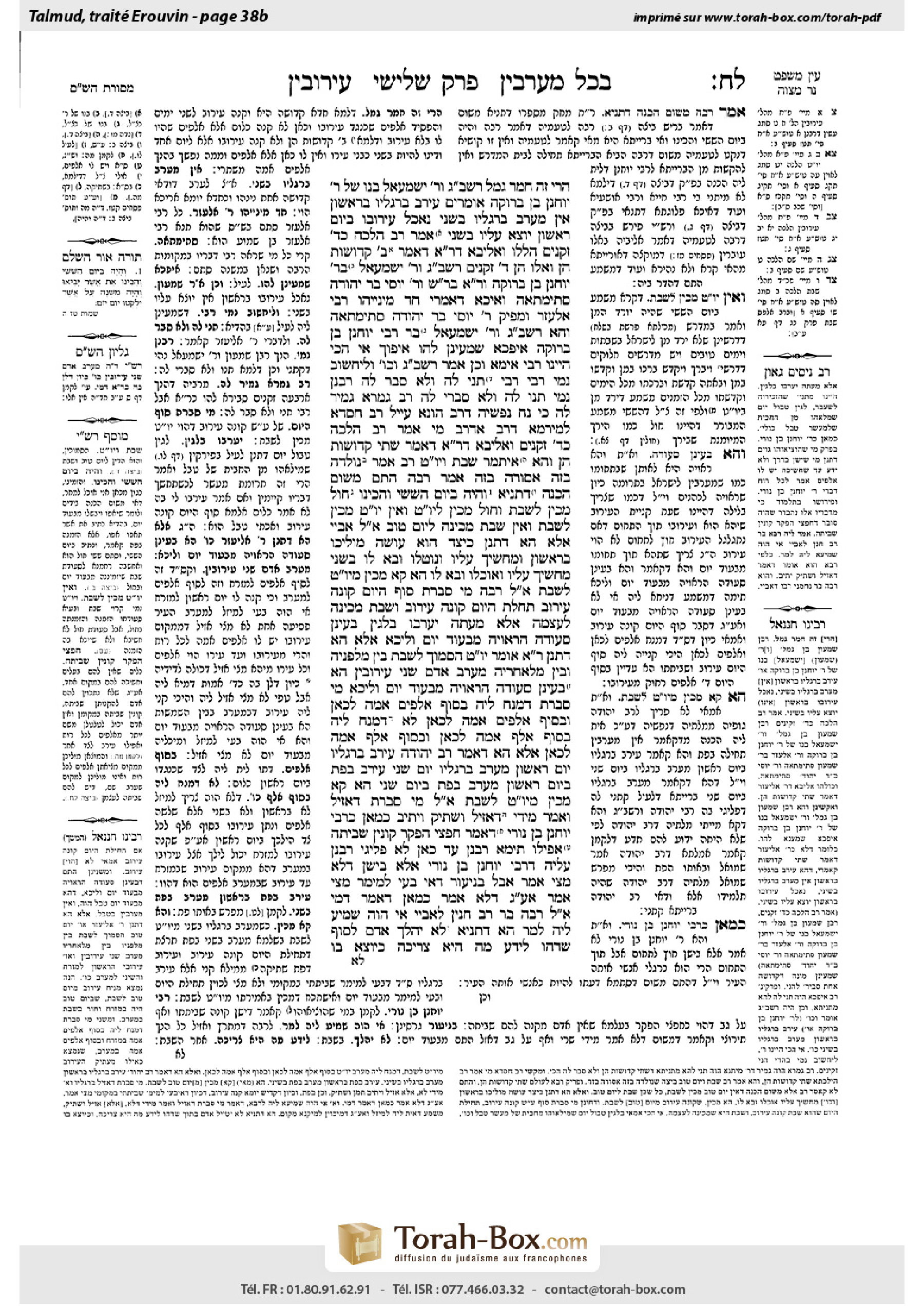
Eruvin 38b: Talmud study for Daf Yomi
Study the Talmud for Daf Yomi with scanned pages, Hebrew text, English translations from Sefaria and AI-generated French translations.
Passage selection and English or AI-generated French translation are available where the scan has annotations. Daf Study is independent of Torah-Box and Sefaria.
Browse Eruvin · עירובין · All tractatesEruvin 38b text and translations
This page of Eruvin includes the Aramaic text, an English translation and an AI-generated French translation, alongside the scan above.
עירובין ל״ח ב · Aramaic and Hebrew text
הֲרֵי זֶה חַמָּר גַּמָּל.
רַבָּן שִׁמְעוֹן בֶּן גַּמְלִיאֵל וְרַבִּי יִשְׁמָעֵאל בְּנוֹ שֶׁל רַבִּי יוֹחָנָן בֶּן בְּרוֹקָה אוֹמְרִים: עֵירַב בְּרַגְלָיו בָּרִאשׁוֹן — אֵין מְעָרֵב בְּרַגְלָיו בַּשֵּׁנִי, נֶאֱכַל עֵירוּבוֹ בְּיוֹם רִאשׁוֹן — יוֹצֵא עָלָיו בַּשֵּׁנִי.
אָמַר רַב: הֲלָכָה כְּאַרְבָּעָה זְקֵנִים הַלָּלוּ, וְאַלִּיבָּא דְּרַבִּי אֱלִיעֶזֶר דְּאָמַר שְׁתֵּי קְדוּשּׁוֹת הֵן. וְאֵלּוּ הֵן אַרְבָּעָה זְקֵנִים: רַבָּן שִׁמְעוֹן בֶּן גַּמְלִיאֵל וְרַבִּי יִשְׁמָעֵאל בְּרַבִּי יוֹחָנָן בֶּן בְּרוֹקָה וְרַבִּי אֱלִיעֶזֶר בְּרַבִּי שִׁמְעוֹן וְרַבִּי יוֹסֵי בַּר יְהוּדָה סְתִימְתָּאָה. וְאִיכָּא דְּאָמְרִי: חַד מִינַּיְיהוּ רַבִּי אֶלְעָזָר, וּמַפֵּיק רַבִּי יוֹסֵי בַּר יְהוּדָה סְתִימְתָּאָה.
וְהָא רַבָּן שִׁמְעוֹן בֶּן גַּמְלִיאֵל וְרַבִּי יִשְׁמָעֵאל בַּר רַבִּי יוֹחָנָן בֶּן בְּרוֹקָה אִיפְּכָא שָׁמְעִינַן לְהוּ! אֵיפוֹךְ.
אִי הָכִי, הַיְינוּ רַבִּי? אֵימָא: וְכֵן אָמַר רַבָּן שִׁמְעוֹן בֶּן גַּמְלִיאֵל וְכוּ׳.
וְלִיחְשׁוֹב נָמֵי רַבִּי! רַבִּי תָּנֵי לַהּ וְלָא סָבַר לַהּ.
רַבָּנַן נָמֵי תָּנוּ לַהּ וְלָא סָבְרִי לַהּ? רַב גְּמָרָא גְּמִיר לַהּ.
כִּי נָח נַפְשֵׁיהּ דְּרַב הוּנָא, עָיֵיל רַב חִסְדָּא לְמִירְמָא דְּרַב אַדְּרַב. מִי אָמַר רַב: הֲלָכָה כְּאַרְבָּעָה זְקֵנִים, וְאַלִּיבָּא דְּרַבִּי אֱלִיעֶזֶר דְּאָמַר שְׁתֵּי קְדוּשּׁוֹת הֵן?
וְהָא אִיתְּמַר: שַׁבָּת וְיוֹם טוֹב, רַב אָמַר: נוֹלְדָה בָּזֶה אֲסוּרָה בָּזֶה!
אָמַר רַבָּה: הָתָם — מִשּׁוּם הֲכָנָה.
דְּתַנְיָא: ״וְהָיָה בַּיּוֹם הַשִּׁשִּׁי וְהֵכִינוּ״ — חוֹל מֵכִין לְשַׁבָּת וְחוֹל מֵכִין לְיוֹם טוֹב, וְאֵין יוֹם טוֹב מֵכִין לְשַׁבָּת וְאֵין שַׁבָּת מְכִינָה לְיוֹם טוֹב.
אֲמַר לֵיהּ אַבָּיֵי, אֶלָּא הָא דִּתְנַן: כֵּיצַד הוּא עוֹשֶׂה — מוֹלִיכוֹ בָּרִאשׁוֹן, וּמַחְשִׁיךְ עָלָיו, וְנוֹטְלוֹ וּבָא לוֹ. בַּשֵּׁנִי מַחְשִׁיךְ עָלָיו, וְאוֹכְלוֹ וּבָא לוֹ. הָא קָא מֵכִין מִיּוֹם טוֹב לְשַׁבָּת!
אֲמַר לֵיהּ רַבָּה: מִי סָבְרַתְּ סוֹף הַיּוֹם קוֹנֶה עֵירוּב? תְּחִלַּת הַיּוֹם קוֹנָה עֵירוּב, וְשַׁבָּת מְכִינָה לְעַצְמָהּ.
אֶלָּא מֵעַתָּה — יְעָרְבוּ בְּלָגִין?
בָּעִינַן סְעוּדָה הָרְאוּיָה מִבְּעוֹד יוֹם, וְלֵיכָּא.
אֶלָּא הָא דִּתְנַן, רַבִּי אֱלִיעֶזֶר אוֹמֵר: יוֹם טוֹב הַסָּמוּךְ לַשַּׁבָּת, בֵּין מִלְּפָנֶיהָ וּבֵין מִלְּאַחֲרֶיהָ, מְעָרֵב אָדָם שְׁנֵי עֵירוּבִין. הָא בָּעִינַן סְעוּדָה הָרְאוּיָה מִבְּעוֹד יוֹם, וְלֵיכָּא.
מִי סָבְרַתְּ דְּמַנַּח לֵיהּ בְּסוֹף אַלְפַּיִם אַמָּה לְכָאן, וּבְסוֹף אַלְפַּיִם אַמָּה לְכָאן? לָא, דְּמַנַּח לֵיהּ בְּסוֹף אֶלֶף אַמָּה לְכָאן, וּבְסוֹף אֶלֶף אַמָּה לְכָאן.
אֶלָּא הָא דְּאָמַר רַב יְהוּדָה: עֵירַב בְּרַגְלָיו יוֹם רִאשׁוֹן — מְעָרֵב בְּרַגְלָיו יוֹם שֵׁנִי, עֵירַב בְּפַת בְּיוֹם רִאשׁוֹן — מְעָרֵב בְּפַת בְּיוֹם שֵׁנִי, הָא קָא מֵכִין מִיּוֹם טוֹב לַשַּׁבָּת!
אֲמַר לֵיהּ: מִי סָבְרַתְּ דְּאָזֵיל וְאָמַר מִידֵּי? דְּאָזֵיל וְשָׁתֵיק, וְיָתֵיב.
כְּמַאן? כְּרַבִּי יוֹחָנָן בֶּן נוּרִי, דְּאָמַר: חֶפְצֵי הֶפְקֵר קוֹנִין שְׁבִיתָה.
אֲפִילּוּ תֵּימָא רַבָּנַן, עַד כָּאן לָא פְּלִיגִי רַבָּנַן עֲלֵיהּ דְּרַבִּי יוֹחָנָן בֶּן נוּרִי אֶלָּא בְּיָשֵׁן, דְּלָא מָצֵי אָמַר. אֲבָל בְּנֵיעוֹר, דְּאִי בָּעֵי לְמֵימַר מָצֵי אָמַר — אַף עַל גַּב דְּלָא אָמַר, כְּמַאן דְּאָמַר דָּמֵי.
אֲמַר לֵיהּ רַבָּה בַּר רַב חָנִין לְאַבָּיֵי: אִי הֲוָה שְׁמִיעַ לֵיהּ לְמָר הָא דְּתַנְיָא: לֹא יְהַלֵּךְ אָדָם לְסוֹף שָׂדֵהוּ לֵידַע מָה הִיא צְרִיכָה; כַּיּוֹצֵא בּוֹ,
Eruvin 38b · English translation
This person is in the position of both a donkey driver, who must prod the animal from behind, and a camel driver, who must lead the animal from the front, i.e., he is pulled in two opposing directions. Since we are unsure whether the two days constitute one sanctity or two, he must act stringently as though the eiruv established for the first day is both effective and not effective for the second day, i.e., he must restrict his Shabbat movement to those areas where he would be permitted to go in both cases.
Rabban Shimon ben Gamliel and Rabbi Yishmael, son of Rabbi Yoḥanan ben Beroka, say: If he established an eiruv with his feet on the eve of the first day, he need not establish an eiruv with his feet on the eve of the second day, as his eiruv remains effective for the second day as well. Similarly, if he had made an eiruv by depositing food in the place where he wished to establish his residence, and his eiruv was eaten on the first day, he may still rely on it and go out beyond the limit permitted to the rest of the inhabitants of the town on the second day, as the two days constitute one sanctity; from the outset, the eiruv acquired his place of rest for both days.
Rav said: The halakha is in accordance with the opinion of these four Elders and in accordance with the opinion of Rabbi Eliezer, who said: When Shabbat and a Festival occur on consecutive days, they constitute two distinct sanctities. And these are the four Elders: Rabban Shimon ben Gamliel; Rabbi Yishmael, son of Rabbi Yoḥanan ben Beroka; Rabbi Eliezer, son of Rabbi Shimon; and Rabbi Yosei bar Yehuda, the one whose opinions were often recorded as unattributed mishnayot. And there are those who say: One of them is Rabbi Elazar, and remove from the list Rabbi Yosei bar Yehuda, the one whose statements were often recorded as unattributed mishnayot.
The Gemara raises a difficulty: Didn’t we hear that Rabban Shimon ben Gamliel and Rabbi Yishmael, son of Rabbi Yoḥanan ben Beroka, maintain the opposite opinion in the baraita cited above, namely that the two days constitute a single sanctity? The Gemara answers: Reverse the attributions in the baraita.
The Gemara asks: If so, this is exactly what Rabbi Yehuda HaNasi said. What is their dispute? The Gemara answers: Say that there is no disagreement between them, and the baraita should read as follows: And so too, Rabban Shimon ben Gamliel said that he agrees with what was stated above.
The Gemara now asks: Let us also count Rabbi Yehuda HaNasi among these Elders, as he too holds that the two days are distinct sanctities. The Gemara answers: Rabbi Yehuda HaNasi taught this opinion, and he himself did not hold it to be correct. He transmitted a ruling that he received from his teachers, but his own opinion was otherwise.
The Gemara raises a difficulty: If so, let us also say that the Rabbis, Rabban Shimon ben Gamliel, and Rabbi Yishmael also taught this law, and they themselves did not hold it to be correct. What proof is there that this represents their own opinions? The Gemara answers: Rav did not rely on the wording of these sources; rather, he learned by way of a definite tradition that these four Elders maintained this position.
The Gemara relates that when Rav Huna, Rav’s preeminent student, passed away, Rav Ḥisda entered the study hall to raise a contradiction between one statement of Rav and another statement of Rav: Did Rav actually say: The halakha is in accordance with the opinion of the four Elders and in accordance with the opinion of Rabbi Eliezer, who said that when Shabbat and a Festival fall out on consecutive days, they constitute two distinct sanctities?
Wasn’t it stated that with regard to a case where Shabbat and a Festival occur on consecutive days, Rav said: An egg that was laid on one is prohibited on the other, just as an egg that was laid on a Festival day is prohibited on that same day? This statement indicates that the two days constitute a single sanctity. How, then, can he say here that the halakha is in accordance with the opinion that they are two distinct sanctities?
Rabba said that a distinction may be drawn between the cases: There, the egg is prohibited on the second day not because the two days constitute a single sanctity but because of the prohibition against preparation, i.e., because it is prohibited to prepare things on a Festival for Shabbat or on Shabbat for a Festival.
As it was taught in a baraita: The verse that states: “And it shall come to pass, on the sixth day, when they shall prepare that which they bring in” (Exodus 16:5), indicates as follows: On an ordinary weekday one may prepare what is needed for Shabbat, and similarly, on an ordinary weekday one may prepare what is needed for a Festival. However, on a Festival one may not prepare for Shabbat, and on Shabbat one may not prepare for a Festival. Therefore, an egg that was laid on a Festival is prohibited on Shabbat not because they constitute a single sanctity, but because it is prohibited to prepare on one sanctified day for another.
Abaye said to him: But what about that which we learned in the mishna: What does he do if a Festival occurs on Friday, and he wishes to establish an eiruv that will be valid for the Festival and Shabbat? He or his agent takes the eiruv to the spot that he wishes to establish as his residence on the eve of the first day, and he stays there with it until nightfall, and then he takes it with him and goes away. On the eve of the second day, i.e., on Friday afternoon, he or his agent takes the eiruv back to the same place and stays there with it until nightfall, and then he may eat the eiruv and go away, if he so desires. Isn’t he preparing on a Festival for Shabbat? According to Rabba, this should be considered a prohibited act of preparation.
Rabba said to him: Do you think that the eiruv acquires one’s residence at the end of the day, i.e., at the last moment of Shabbat eve, which in this case is a Festival, so that this would involve prohibited preparation? The eiruv acquires his residence at the beginning of the day, i.e., at the first moment of Shabbat, which means that no preparations were made for Shabbat on the Festival, and on Shabbat one may prepare for Shabbat itself.
Abaye asked: But if that is so, one should be able to establish an eiruv with flasks of wine that were filled from a barrel of first-tithe that was still tevel with respect to teruma of the tithe, and with regard to which one said: Let this wine in the flask be teruma of the tithe for the wine in the barrel only after nightfall. If you say that an eiruv acquires one’s residence at the beginning of the day, why was it determined that one may not establish an eiruv with such wine?
The Gemara answers: In that case the eiruv is not valid for a different reason: We require a meal that is fit to be eaten while it is still day, and there is none, as the wine in the flask remains tevel and therefore unfit for drinking until nightfall.
Abaye asked further: But what about that which we learned in a mishna: Rabbi Eliezer says: If a Festival is adjacent to Shabbat, whether before it or after it, a person may establish two eiruvin. Why are these eiruvin valid? Don’t we require a meal that is fit to be eaten while it is still day, and there is none? Since one established his eiruv in one direction for the first day, he can only travel within a two-thousand-cubit radius of that location. Therefore, if he established his eiruv for the second day in the opposite direction, he cannot access that eiruv during the first day.
The Gemara responds: Do you think that we are dealing with a case where he placed one eiruv in the furthest possible spot at the end of two thousand cubits in this direction, and he placed the other eiruv in the furthest possible spot at the end of two thousand cubits in that direction, and he is therefore unable to go from one to the other on one day? No, the case is that he placed one eiruv at the end of one thousand cubits in the this direction, and he placed the other eiruv at the end of one thousand cubits in that direction, so that even after acquiring his residence on one side of the town by means of the first eiruv, he can still go to the spot where he left the other eiruv for the second day.
Abaye raised yet another difficulty: But what about that which Rav Yehuda said: If one established an eiruv with his feet for the first day, he may establish an eiruv with his feet for the second day; and if he established an eiruv with bread on the first day, he may establish an eiruv with bread on the second day? Isn’t he preparing from a Festival to Shabbat?
Rabba said to him: Do you think that one must go and say something at the site of the eiruv, therefore performing an act of preparation? He goes, and is silent, and sits there, and he automatically acquires his residence without having to say or do anything. This does not fall into the category of prohibited preparation.
Abaye asked: In accordance with whose opinion do you say that nothing must be said when establishing an eiruv teḥumin? It is in accordance with the opinion of Rabbi Yoḥanan ben Nuri, who said: A sleeping person acquires a Shabbat residence in the spot where he is sleeping. Even though he is comparable to ownerless property, ownerless property itself acquires a Shabbat residence and has its own Shabbat boundary, and there is no need for a person to establish a residence for it in a particular spot.
Rabba replied: Even if you say that my statement is in accordance with the opinion of the Rabbis, the Rabbis disagree with Rabbi Yoḥanan ben Nuri only with regard to a sleeping person, who cannot say anything, as he is asleep. Consequently, he cannot acquire a Shabbat residence. However, with regard to one who is awake, since if he wanted to speak he could speak, even though he did not say that he is acquiring his Shabbat residence, he is considered as one who did say that statement.
Rabba bar Rav Ḥanin said to Abaye: If the Master, Rabba, had heard that which was taught in the following baraita: A person may not walk to the end of his field on Shabbat to determine what work and repair it requires, which will be done after Shabbat. Similarly,
Eruvin 38b · Traduction française (IA)
Cette personne est dans la situation d’un conducteur de bête de somme, qui doit pousser l’animal de derrière, et d’un conducteur de chameau, qui doit guider l’animal de devant, c’est-à-dire qu’il est tiré dans deux directions opposées. Puisque nous ne sommes pas certains si les deux jours constituent une seule sanctité ou deux, il doit agir avec rigueur, comme si l’eiruv établi pour le premier jour était à la fois efficace et non efficace pour le deuxième jour, c’est-à-dire qu’il doit limiter ses déplacements du Shabbat aux zones où il serait autorisé à aller dans les deux cas.
Rabban Shimon ben Gamliel et Rabbi Yishmael, fils de Rabbi Yoḥanan ben Beroka, disent : Si l’on a établi un eiruv avec ses pieds la veille du premier jour, il n’est pas nécessaire d’établir un eiruv avec ses pieds la veille du deuxième jour, car l’eiruv reste efficace pour le deuxième jour également. De même, si l’on avait établi un eiruv en déposant de la nourriture dans l’endroit où l’on souhaitait établir sa résidence, et que l’eiruv avait été mangé le premier jour, il peut encore s’en fier et sortir au-delà de la limite autorisée aux autres habitants de la ville le deuxième jour, car les deux jours constituent une seule sanctité ; dès le début, l’eiruv a acquis sa place de repos pour les deux jours.
Rav dit : La halakha suit l’opinion de ces quatre Anciens et celle de Rabbi Eliezer, qui disait : Lorsque le Shabbat et un festival se succèdent, ils constituent deux sanctuaires distincts. Et ces quatre Anciens sont : Rabban Shimon ben Gamliel ; Rabbi Yishmael, fils de Rabbi Yoḥanan ben Beroka ; Rabbi Eliezer, fils de Rabbi Shimon ; et Rabbi Yosei bar Yehuda, celui dont les opinions étaient souvent enregistrées comme des mishnayot non attribuées. Et certains disent : L’un d’eux est Rabbi Elazar, et l’on retire de la liste Rabbi Yosei bar Yehuda, celui dont les déclarations étaient souvent enregistrées comme des mishnayot non attribuées.
Le Guemara soulève une difficulté : N’avons-nous pas entendu que Rabban Shimon ben Gamliel et Rabbi Yishmael, fils de Rabbi Yoḥanan ben Beroka, maintenaient l’opinion opposée dans la baraïta citée ci-dessus, à savoir que les deux jours constituent une seule sanctité ? Le Guemara répond : Inversez les attributions dans la baraïta.
Le Guemara demande : Si c’est ainsi, c’est exactement ce que Rabbi Yehuda HaNasi a dit. Quel est leur débat ? Le Guemara répond : Dites qu’il n’y a pas de désaccord entre eux, et la baraïta devrait lire comme suit : De même, Rabban Shimon ben Gamliel a dit qu’il s’accordait avec ce qui a été dit ci-dessus.
Le Guemara demande maintenant : Comptons également Rabbi Yehuda HaNasi parmi ces Anciens, car il maintient également que les deux jours sont des sanctuaires distincts. Le Guemara répond : Rabbi Yehuda HaNasi a enseigné cette opinion, mais il ne la considérait pas comme correcte. Il a transmis une décision qu’il avait reçue de ses maîtres, mais son propre avis était différent.
Le Guemara soulève une difficulté : Si c’est ainsi, disons aussi que les Rabbins, Rabban Shimon ben Gamliel et Rabbi Yishmael ont enseigné cette loi, et qu’ils ne la considéraient pas comme correcte. Quelle preuve y a-t-il que cela représente leur propre opinion ? Le Guemara répond : Rav n’a pas basé son enseignement sur le texte de ces sources ; plutôt, il a appris par une tradition certaine que ces quatre Anciens maintenaient cette position.
Le Guemara rapporte que lorsque Rav Huna, l’élève principal de Rav, est décédé, Rav Ḥisda est entré dans la salle de study pour élever une contradiction entre une déclaration de Rav et une autre déclaration de Rav : A-t-il vraiment dit : La halakha suit l’opinion des quatre Anciens et celle de Rabbi Eliezer, qui disait que lorsque le Shabbat et un festival tombent le même jour, ils constituent deux sanctuaires distincts ?
N’a-t-on pas dit que, concernant un cas où le Shabbat et un festival se succèdent, Rav a dit : Un œuf qui a été pondu le premier jour est interdit le deuxième jour, tout comme un œuf qui a été pondu un jour de festival est interdit le même jour ? Cette déclaration indique que les deux jours constituent une seule sanctité. Comment alors peut-il dire ici que la halakha suit l’opinion que les deux jours sont des sanctuaires distincts ?
Rabba dit qu’on peut distinguer les cas : Là, l’œuf est interdit le deuxième jour non pas parce que les deux jours constituent une seule sanctité, mais à cause de l’interdiction de préparation, c’est-à-dire à cause de l’interdiction de préparer des choses un jour de fête pour le Shabbat ou un jour de Shabbat pour un festival.
Comme il a été enseigné dans une baraïta : La verset qui dit : « Et cela arrivera, le sixième jour, quand ils auront préparé ce qu’ils apporteront » (Exode 16:5), indique ceci : Le jour ordinaire, on peut préparer ce qui est nécessaire pour le Shabbat, et de même, le jour ordinaire, on peut préparer ce qui est nécessaire pour un festival. Cependant, le jour de festival, on ne peut pas préparer pour le Shabbat, et le jour de Shabbat, on ne peut pas préparer pour un festival. Ainsi, un œuf qui a été pondu un jour de festival est interdit le Shabbat non pas parce qu’ils constituent une seule sanctité, mais à cause de l’interdiction de préparer un jour sanctifié pour un autre.
Abaye dit à lui : Mais que dire de ce que nous avons appris dans la mishna : Que fait-il s’un festival tombe le vendredi, et qu’il souhaite établir un eiruv valide pour le festival et le Shabbat ? Il ou son agent emmène l’eiruv vers l’endroit où il souhaite établir sa résidence la veille du premier jour, et il reste là avec l’eiruv jusqu’au coucher du soleil, puis il emmène l’eiruv avec lui et s’en va. La veille du deuxième jour, c’est-à-dire le vendredi après-midi, il ou son agent ramène l’eiruv au même endroit et reste là avec l’eiruv jusqu’au coucher du soleil, puis il peut manger l’eiruv et s’en aller, s’il le souhaite. N’est-ce pas une préparation le jour de festival pour le Shabbat ? Selon Rabba, cela devrait être considéré comme un acte interdit de préparation.
Rabba dit à lui : Penses-tu que l'eiruv acquiert la résidence de l'homme à la fin de la journée, c'est-à-dire au dernier moment de la veille de Shabbat, qui dans ce cas est un festival, de sorte que cela impliquerait une préparation interdite ? L'eiruv acquiert sa résidence au début de la journée, c'est-à-dire au premier moment de Shabbat, ce qui signifie que aucune préparation n'a été faite pour Shabbat sur le festival, et sur Shabbat on peut préparer pour Shabbat lui-même.
Abaye demanda : Mais si c'est ainsi, on devrait pouvoir établir un eiruv avec des flacons de vin remplis à partir d'une barrique de première tithe qui était encore tevel par rapport à la terouma de la tithe, et concernant laquelle on disait : Que ce vin dans le flacon soit la terouma de la tithe pour le vin dans la barrique seulement après la nuit. Si tu dis que l'eiruv acquiert la résidence de l'homme au début de la journée, pourquoi a-t-on décidé qu'on ne peut pas établir un eiruv avec ce vin ?
La Guemara répond : Dans ce cas, l'eiruv n'est pas valide pour une autre raison : nous exigeons un repas qui soit comestible pendant la journée, et il n'y en a pas, car le vin dans le flacon reste tevel et donc inadapté à la consommation jusqu'au coucher du soleil.
Abaye demanda encore : Mais que dire de ce que nous avons appris dans une mitsna : Rabbi Eliezer dit : Si un festival est adjacent à la Shabbat, qu'il soit avant ou après, une personne peut établir deux eiruvin. Pourquoi ces eiruvin sont-ils valides ? N'exigeons-nous pas un repas comestible pendant la journée, et il n'y en a pas ? Puisque l'on a établi son eiruv dans une direction pour le premier jour, il ne peut se déplacer qu'à deux mille coudées de ce lieu. Ainsi, s'il a établi son eiruv pour le deuxième jour dans la direction opposée, il ne peut pas accéder à cet eiruv pendant le premier jour.
La Guemara répond : Penses-tu que nous sommes dans un cas où il a placé un eiruv au point le plus éloigné de deux mille coudées dans cette direction, et l'autre eiruv au point le plus éloigné de deux mille coudées dans l'autre direction, de sorte qu'il est donc incapable de se déplacer d'un eiruv à l'autre en un seul jour ? Non, le cas est que l'on a placé un eiruv à la fin d'une mille coudées dans cette direction, et l'autre eiruv à la fin d'une mille coudées dans l'autre direction, de sorte qu'après avoir acquis sa résidence d'un côté de la ville grâce au premier eiruv, il peut encore se rendre au point où il a laissé l'autre eiruv pour le deuxième jour.
Abaye souleva une autre difficulté : Mais que dire de ce que Rav Yéhouda a dit : Si l'on établit un eiruv avec ses pieds pour le premier jour, on peut établir un eiruv avec ses pieds pour le deuxième jour ; et si l'on établit un eiruv avec du pain le premier jour, on peut établir un eiruv avec du pain le deuxième jour ? N'est-ce pas préparer du festival à la Shabbat ?
Rabba dit à lui : Penses-tu qu'il faut aller et dire quelque chose au lieu de l'eiruv, donc effectuer un acte de préparation ? Il va, et reste silencieux, et s'assied là, et il acquiert automatiquement sa résidence sans avoir à dire ou faire quoi que ce soit. Cela ne tombe pas dans la catégorie de la préparation interdite.
Abaye demanda : Selon l'opinion de qui dis-tu que rien n'a à être dit lors de l'établissement d'un eiruv teḥumin ? C'est selon l'opinion de Rabbi Yéhochanan ben Nuri, qui dit : Une personne endormie acquiert une résidence de Shabbat au lieu où elle dort. Même si elle est comparable à une propriété sans propriétaire, la propriété sans propriétaire elle-même acquiert une résidence de Shabbat et a sa propre limite de Shabbat, et il n'y a pas besoin qu'une personne établisse une résidence pour elle à un endroit particulier.
Rabba répondit : Même si tu dis que mon affirmation est selon l'opinion des Rabbins, les Rabbins ne s'opposent qu'à Rabbi Yéhochanan ben Nuri concernant une personne endormie, qui ne peut pas dire quelque chose, car elle dort. Ainsi, elle ne peut pas acquérir une résidence de Shabbat. Cependant, concernant une personne éveillée, puisque s'il voulait parler il aurait pu parler, même s'il n'a pas dit qu'il acquiert sa résidence de Shabbat, il est considéré comme ayant dit cette déclaration.
Rabba bar Rav Ḥanin dit à Abaye : Si le Maître, Rabba, avait entendu ce qui a été enseigné dans la baraïta suivante : Une personne ne peut pas marcher jusqu'à la fin de son champ le jour de Shabbat pour déterminer quel travail et quelle réparation il faut y faire, ce qui sera fait après Shabbat. De même,
Traduction française générée par IA à partir de l’édition anglaise de Sefaria. Vérifie toujours un passage avec le texte source.
Text from Sefaria: William Davidson Edition - Vocalized Aramaic (CC BY NC); William Davidson Edition - English (CC BY NC).