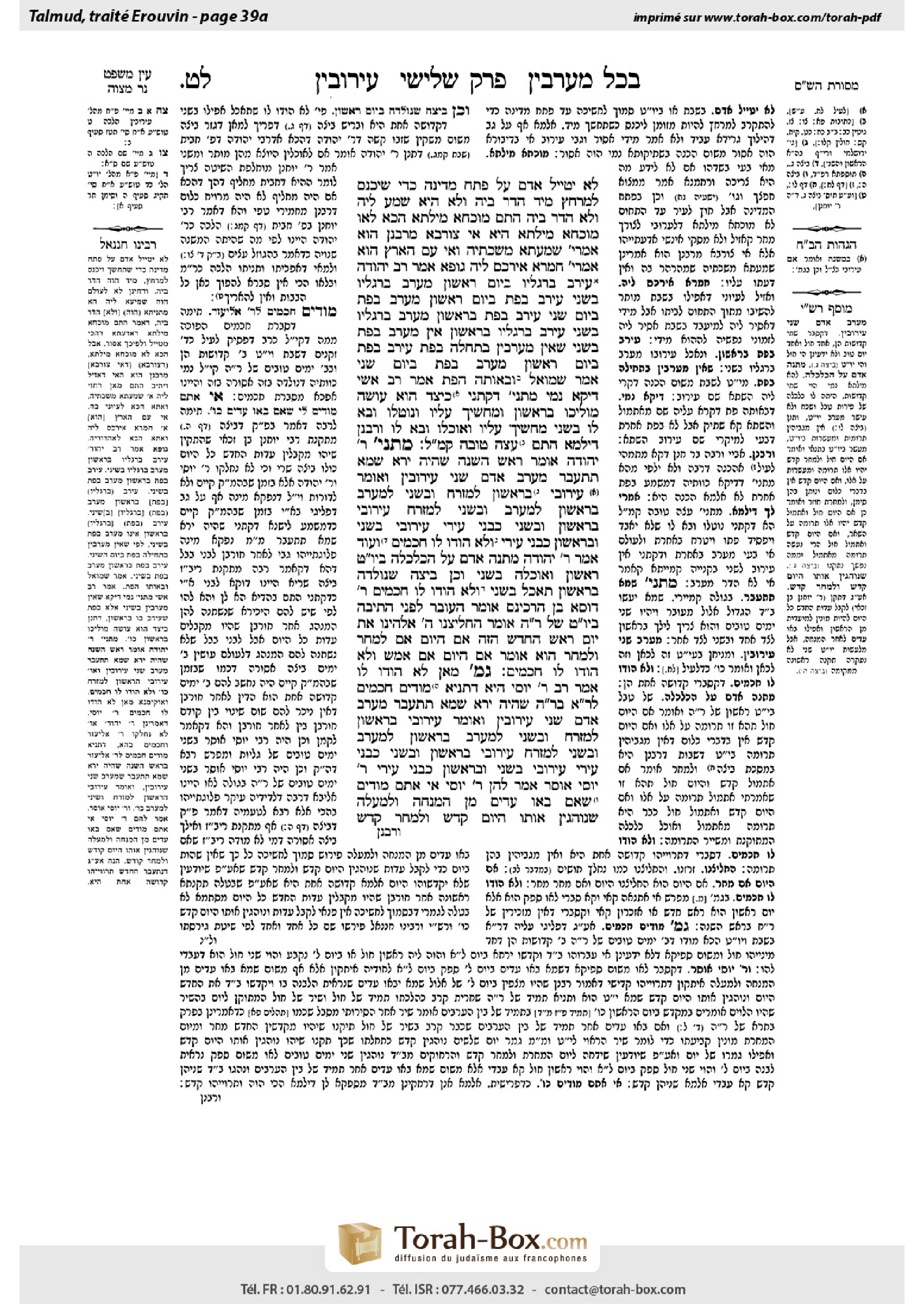
Eruvin 39a: Talmud study for Daf Yomi
Study the Talmud for Daf Yomi with scanned pages, Hebrew text, English translations from Sefaria and AI-generated French translations.
Passage selection and English or AI-generated French translation are available where the scan has annotations. Daf Study is independent of Torah-Box and Sefaria.
Browse Eruvin · עירובין · All tractatesEruvin 39a text and translations
This page of Eruvin includes the Aramaic text, an English translation and an AI-generated French translation, alongside the scan above.
עירובין ל״ט א · Aramaic and Hebrew text
לֹא יְטַיֵּיל אָדָם עַל פֶּתַח מְדִינָה כְּדֵי שֶׁיִּכָּנֵס לַמֶּרְחָץ מִיָּד, הָדַר בֵּיהּ!
וְלָא הִיא, שְׁמִעַ לֵיהּ וְלָא הֲדַר בֵּיהּ. הָתָם — מוֹכְחָא מִילְּתָא, הָכָא — לָאו מוֹכְחָא מִילְּתָא הִיא.
אִי צוּרְבָּא מֵרַבָּנַן הוּא, אָמְרִינַן: שְׁמַעְתָּא מְשַׁכְתֵּיהּ. וְאִי עַם הָאָרֶץ הוּא, אָמְרִינַן: חַמְרָא אִירְכַס לֵיהּ.
גּוּפָא, אָמַר רַב יְהוּדָה: עֵירַב בְּרַגְלָיו בְּיוֹם רִאשׁוֹן — מְעָרֵב בְּרַגְלָיו בְּשֵׁנִי. עֵירַב בְּפַת בְּיוֹם רִאשׁוֹן — מְעָרֵב בְּפַת בְּיוֹם שֵׁנִי.
עֵירַב בְּפַת בָּרִאשׁוֹן — מְעָרֵב בְּרַגְלָיו בַּשֵּׁנִי. עֵירַב בְּרַגְלָיו בָּרִאשׁוֹן — אֵין מְעָרֵב בְּפַת בַּשֵּׁנִי, שֶׁאֵין מְעָרְבִין בַּתְּחִלָּה בְּפַת.
עֵירַב בְּפַת בְּיוֹם רִאשׁוֹן מְעָרֵב בְּפַת בְּיוֹם שֵׁנִי, אָמַר שְׁמוּאֵל: וּבְאוֹתָהּ הַפַּת. אָמַר רַב אָשֵׁי: דַּיְקָא נָמֵי מַתְנִיתִין, דְּקָתָנֵי: כֵּיצַד הוּא עוֹשֶׂה? מוֹלִיכוֹ בָּרִאשׁוֹן, וּמַחְשִׁיךְ עָלָיו, וְנוֹטְלוֹ וּבָא לוֹ. בַּשֵּׁנִי, מַחְשִׁיךְ עָלָיו, וְאוֹכְלוֹ וּבָא לוֹ.
וְרַבָּנַן, דִּילְמָא הָתָם — עֵצָה טוֹבָה קָא מַשְׁמַע לַן.
מַתְנִי׳ רַבִּי יְהוּדָה אוֹמֵר: רֹאשׁ הַשָּׁנָה שֶׁהָיָה יָרֵא שֶׁמָּא תִּתְעַבֵּר, מְעָרֵב אָדָם שְׁנֵי עֵירוּבִין, וְאוֹמֵר: עֵירוּבִי בָּרִאשׁוֹן לַמִּזְרָח, וּבַשֵּׁנִי לַמַּעֲרָב. בָּרִאשׁוֹן לַמַּעֲרָב, וּבַשֵּׁנִי לַמִּזְרָח. עֵירוּבִי בָּרִאשׁוֹן, וּבַשֵּׁנִי כִּבְנֵי עִירִי. עֵירוּבִי בַּשֵּׁנִי, וּבְרִאשׁוֹן כִּבְנֵי עִירִי. וְלֹא הוֹדוּ לוֹ חֲכָמִים.
וְעוֹד אָמַר רַבִּי יְהוּדָה: מַתְנֶה אָדָם עַל הַכַּלְכַּלָּה בְּיוֹם טוֹב רִאשׁוֹן, וְאוֹכְלָהּ בַּשֵּׁנִי.
וְכֵן בֵּיצָה שֶׁנּוֹלְדָה בָּרִאשׁוֹן, תֵּאָכֵל בַּשֵּׁנִי. וְלֹא הוֹדוּ לוֹ חֲכָמִים.
רַבִּי דּוֹסָא בֶּן הַרְכִּינָס אוֹמֵר: הָעוֹבֵר לִפְנֵי הַתֵּיבָה בְּיוֹם טוֹב שֶׁל רֹאשׁ הַשָּׁנָה, אוֹמֵר: ״הַחְלִיצֵנוּ ה׳ אֱלֹהֵינוּ אֶת יוֹם רֹאשׁ הַחֹדֶשׁ הַזֶּה, אִם הַיּוֹם אִם לְמָחָר״. וּלְמָחָר הוּא אוֹמֵר: ״אִם הַיּוֹם אִם אֶמֶשׁ״. וְלֹא הוֹדוּ לוֹ חֲכָמִים.
גְּמָ׳ מַאן ״לֹא הוֹדוּ לוֹ״? אָמַר רַב: רַבִּי יוֹסֵי הִיא, דְּתַנְיָא: מוֹדִים חֲכָמִים לְרַבִּי אֱלִיעֶזֶר בְּרֹאשׁ הַשָּׁנָה שֶׁהָיָה יָרֵא שֶׁמָּא תִּתְעַבֵּר, מְעָרֵב אָדָם שְׁנֵי עֵירוּבִין, וְאוֹמֵר: עֵירוּבִי בָּרִאשׁוֹן לַמִּזְרָח, וּבַשֵּׁנִי לַמַּעֲרָב. בָּרִאשׁוֹן לַמַּעֲרָב, וּבַשֵּׁנִי לַמִּזְרָח. עֵירוּבִי בָּרִאשׁוֹן, וּבַשֵּׁנִי כִּבְנֵי עִירִי. עֵירוּבִי בַּשֵּׁנִי, וּבָרִאשׁוֹן כִּבְנֵי עִירִי. רַבִּי יוֹסֵי אוֹסֵר.
אָמַר לָהֶן רַבִּי יוֹסֵי: אִי אַתֶּם מוֹדִים שֶׁאִם בָּאוּ עֵדִים מִן הַמִּנְחָה וּלְמַעְלָה, שֶׁנּוֹהֲגִין אוֹתוֹ הַיּוֹם קֹדֶשׁ וּלְמָחָר קֹדֶשׁ?!
Eruvin 39a · English translation
a person may not stroll at the entrance to the city toward the end of Shabbat or a Festival in order to enter a bathhouse immediately upon the conclusion of Shabbat, then Rabba would have retracted his statement with regard to an eiruv. This baraita indicates that even walking on Shabbat for something one needs after Shabbat falls into the category of prohibited preparation.
The Gemara rejects this argument: And this is not correct. Rabba heard this baraita but did not retract his ruling, as a distinction can be drawn between the cases. There, in the baraita pertaining to one who walks to the end of his field, or one who strolls at the entrance to the city, it is clear to all observers that he is doing so in order to determine what work the field needs after Shabbat, or to enter the bathhouse immediately after Shabbat, respectively. Whereas here, with regard to an eiruv, it is not clear to others that one’s actions are for the purpose of establishing an eiruv.
The Gemara explains: If he is a Torah scholar [tzurva merabbanan], we, the observers, would say: Perhaps his study pulled him, i.e., he was engrossed in his study and was not paying attention to where he was going. And if he is an ignoramus, we would say: Perhaps he lost his donkey and went to look for it. His actions give no indication that he is going to establish an eiruv for the following day, as establishing an eiruv does not require any recognizable action.
The Gemara now examines Rav Yehuda’s statement itself, which was cited in the course of the previous discussion. Rav Yehuda said: If one established an eiruv with his feet on the eve of the first day, he may establish an eiruv with his feet on the eve of the second day as well. If he established an eiruv with bread that he deposited in the place where he wishes to acquire his place of rest on the eve of the first day, he may establish an eiruv with bread on the eve of the second day as well.
If he established an eiruv with bread on the eve of the first day, and his eiruv was eaten, he may change and establish an eiruv with his feet on the eve of the second day. However, if he established an eiruv with his feet on the eve of the first day, he may not establish an eiruv with bread on the eve of the second day, as one may not initially establish an eiruv with bread on a Festival for the sake of Shabbat because it is prohibited to prepare on a Festival for Shabbat.
With regard to the statement: If he established an eiruv with bread on the eve of the first day, he may establish an eiruv with bread on the eve of the second day, Shmuel said: Only with the same bread. Rav Ashi said: The wording of the mishna is also precise according to this understanding, as we learned: What does he do if a Festival occurs on Friday, and he wishes to establish an eiruv that will be valid for both the Festival and Shabbat? He brings the eiruv to the spot that he wishes to establish as his residence on the eve of the first day, and he stays there with it until nightfall, and then he takes it with him and goes away. On the eve of the second day, he takes the eiruv back to the same place as the day before, and stays there with it until nightfall, and then he may eat the eiruv and go away. The wording of the mishna indicates that he must establish his eiruv for the second day with the same bread that he used for the first day, as argued by Shmuel.
The Gemara adds: And the Rabbis, who do not accept the opinion of Shmuel, argue that this is no proof, as perhaps there, the mishna is merely teaching us good advice as to how one can rely on a single eiruv and avoid having to prepare an additional eiruv for the second day.
MISHNA: During the time period when the Jewish calendar was established by the court according to the testimony of witnesses who had seen the new moon, Rosh HaShana would be observed for only one day if witnesses arrived on that day, and for two days if witnesses failed to arrive and the month of Elul was declared to be an extended, thirty-day month. Rabbi Yehuda says: With regard to Rosh HaShana, if one feared that the month of Elul might be extended, and he wanted to travel in two different directions on the two days that could be Rosh HaShana, this person may establish two eiruvin and say: My eiruv on the first day shall be to the east and on the second day to the west, or alternatively: On the first day it shall be to the west, and on the second day to the east. Similarly, he may say: My eiruv shall apply on the first day, but on the second day I shall be like the rest of the inhabitants of my town, or alternatively: My eiruv shall apply on the second day, but on the first day I shall be like the rest of the inhabitants of my town. And the Rabbis did not agree with him that the two days of Rosh HaShana can be divided in such a manner.
And Rabbi Yehuda said further, with regard to the two days of Rosh HaShana that one observes because he does not know which is the real day of the Festival: A person may make a condition with regard to a basket of tevel produce on the first day of the Festival and say as follows: If today is the Festival and tomorrow is an ordinary weekday I will separate the teruma and tithes tomorrow, and I have performed nothing today; if today is an ordinary weekday, I hereby separate the appropriate teruma and tithes now. He may then eat the produce on the second day of the Festival, since one of his two acts of tithing was certainly performed on an ordinary weekday.
And similarly, an egg that was laid on the first day of the Festival may be eaten on the second day, since one of the days is certainly an ordinary weekday. And the Rabbis did not agree with him even with regard to these two days.
Rabbi Dosa ben Harekinas says: One who passes before the ark in the synagogue and leads the congregation in prayer on the first day of the festival of Rosh HaShana says: Strengthen us, O Lord our God, on this day of the New Moon, whether it is today or tomorrow. And similarly, on the following day he says: Whether Rosh HaShana is today or yesterday. And the Rabbis did not agree with him that one should formulate his prayer in this conditional manner.
GEMARA: Who are the Sages who did not agree with Rabbi Yehuda? Rav said: It is those who follow the opinion of Rabbi Yosei, as it was taught in the Tosefta: Even though the Rabbis disagree with him about a Festival and Shabbat that occur on consecutive days and say that one cannot make two separate eiruvin for the two days, they concede to Rabbi Eliezer with regard to Rosh HaShana that if a person feared that the month of Elul might be extended, he may establish two eiruvin and say: My eiruv on the first day shall be to the east, and on the second day to the west, or: On the first day it shall be to the west, and on the second day to the east, or: My eiruv shall apply on the first day, but on the second day I shall be like the rest of the inhabitants of my town, or: My eiruv shall apply on the second day, but on the first day I shall be like the rest of the inhabitants of my town. But Rabbi Yosei prohibits it.
Rabbi Yosei said to the Rabbis: Don’t you concede that if witnesses came from the time of minḥa and onwards on the first day of Rosh HaShana and testified that they had seen the new moon, we do not rely on their testimony to sanctify that day as Rosh HaShana; rather, since their testimony was not given on time, we observe that day as sanctified and also the following day as sanctified? This indicates that the two days of Rosh HaShana are not observed out of doubt as to which is the proper day; rather, it is as though the two days are one long day that are imbued with one unified sanctity. Therefore, it should not be possible to divide them.
Eruvin 39a · Traduction française (IA)
Une personne ne peut pas se promener à l'entrée de la ville à la fin du Shabbat ou d'un festival afin d'entrer dans une salle de bain immédiatement après la fin du Shabbat, puis Rabba aurait rétracté son opinion concernant l'eiruv. Ce baraïta indique que même marcher le Shabbat pour quelque chose dont on a besoin après le Shabbat entre dans la catégorie des préparations interdites.
Le Guemara rejette cet argument : Cela n'est pas correct. Rabba a entendu ce baraïta mais n'a pas rétracté son décision, car une distinction peut être faite entre les cas. Là, dans le baraïta concernant celui qui marche jusqu'à la fin de son champ ou celui qui se promène à l'entrée de la ville, il est clair pour tous les observateurs qu'il le fait afin de déterminer quel travail son champ a besoin après le Shabbat, ou pour entrer dans la salle de bain immédiatement après le Shabbat, respectivement. En revanche, ici, concernant l'eiruv, il n'est pas clair pour les autres que ses actions visent à établir un eiruv.
Le Guemara explique : S'il est un savant [tzurva merabbanan], nous, les observateurs, dirions : Peut-être que son étude l'a attiré, c'est-à-dire qu'il était absorbé dans son étude et n'avait pas l'œil sur où il allait. Et s'il est un ignorant, nous dirions : Peut-être qu'il a perdu son âne et est allé le chercher. Ses actions ne donnent aucun signe qu'il va établir un eiruv pour le lendemain, car établir un eiruv ne nécessite aucune action reconnaissable.
Le Guemara examine maintenant l'affirmation de Rav Yehuda elle-même, qui a été citée lors de la discussion précédente. Rav Yehuda a dit : Si l'on a établi un eiruv avec ses pieds la veille du premier jour, on peut établir un eiruv avec ses pieds la veille du deuxième jour également. Si l'on a établi un eiruv avec du pain que l'on a déposé à l'endroit où l'on souhaite acquérir son lieu de repos la veille du premier jour, on peut établir un eiruv avec du pain la veille du deuxième jour également.
Si l'on a établi un eiruv avec du pain la veille du premier jour, et que son eiruv a été mangé, on peut changer et établir un eiruv avec ses pieds la veille du deuxième jour. Cependant, si l'on a établi un eiruv avec ses pieds la veille du premier jour, on ne peut pas établir un eiruv avec du pain la veille du deuxième jour, car on ne peut pas établir initialement un eiruv avec du pain un festival pour le compte du Shabbat, car il est interdit de préparer un festival pour le Shabbat.
Concernant l'affirmation : Si l'on a établi un eiruv avec du pain la veille du premier jour, on peut établir un eiruv avec du pain la veille du deuxième jour, Shmuel a dit : Seulement avec le même pain. Rav Ashi a dit : La formulation de la mishna est également précise selon cette compréhension, car nous avons appris : Que fait-il si un festival a lieu le vendredi et qu'il souhaite établir un eiruv valable à la fois pour le festival et le Shabbat ? Il amène l'eiruv à l'endroit où il souhaite établir son lieu de repos la veille du premier jour, et il reste là avec lui jusqu'au coucher du soleil, puis il le prend avec lui et s'en va. La veille du deuxième jour, il ramène l'eiruv au même endroit que la veille précédente, et il reste là avec lui jusqu'au coucher du soleil, puis il peut manger l'eiruv et s'en aller. La formulation de la mishna indique qu'il doit établir son eiruv pour le deuxième jour avec le même pain qu'il a utilisé pour le premier jour, comme l'argumente Shmuel.
Le Guemara ajoute : Et les Rabbins, qui ne suivent pas l'opinion de Shmuel, argumentent que cela n'est pas une preuve, car peut-être là, la Michna nous enseigne simplement un conseil utile sur la façon dont l'on peut se fier à un seul eiruv et éviter de devoir préparer un autre eiruv pour le deuxième jour.
MICHNA : Pendant la période où le calendrier juif était établi par le tribunal selon le témoignage des témoins ayant vu la lune nouvelle, Rosh HaShana était célébré pendant une seule journée si les témoins arrivaient ce jour-là, et pendant deux jours si les témoins n'arrivaient pas et le mois d'Elul était déclaré comme un mois de trente jours. Rabbi Yehuda dit : Concernant Rosh HaShana, si l'on craignait que le mois d'Elul puisse être prolongé, et qu'on voulait voyager dans deux directions différentes les deux jours qui pourraient être Rosh HaShana, cette personne peut établir deux eiruvin et dire : Mon eiruv du premier jour sera à l'est et celui du deuxième jour à l'ouest, ou inversement : Celui du premier jour sera à l'ouest et celui du deuxième jour à l'est. De même, il peut dire : Mon eiruv s'appliquera le premier jour, mais le deuxième jour je serai comme les autres habitants de ma ville, ou inversement : Mon eiruv s'appliquera le deuxième jour, mais le premier jour je serai comme les autres habitants de ma ville. Et les Rabbins n'ont pas accepté son opinion selon laquelle les deux jours de Rosh HaShana peuvent être divisés ainsi.
Et Rabbi Yehuda a dit plus loin, concernant les deux jours de Rosh HaShana que l'on observe parce qu'on ne sait pas lequel est le jour réel du festival : Une personne peut faire une condition concernant un panier de produits tevel sur le premier jour du festival et dire comme suit : Si aujourd'hui est le festival et demain est un jour ordinaire, je séparerai la terouma et les dîmes demain et j'ai accompli rien aujourd'hui ; si aujourd'hui est un jour ordinaire, je sépare maintenant la terouma et les dîmes appropriées. Il peut alors manger les produits le deuxième jour du festival, car l'un de ses deux actes de séparation des dîmes a certainement été accompli un jour ordinaire.
Et de même, un œuf qui a été pondu le premier jour du festival peut être mangé le deuxième jour, car l'un des jours est certainement un jour ordinaire. Et les Rabbins n'ont pas accepté son opinion même concernant ces deux jours.
Le Rabbi Dosa ben Harekinas dit : Celui qui passe devant l'arche dans la synagogue et conduit la communauté dans la prière le premier jour de la fête de Rosh HaShana dit : Renforce-nous, ô Seigneur notre Dieu, ce jour du Nouveau Mois, qu'il soit aujourd'hui ou demain. Et de même, le jour suivant, il dit : Que soit Rosh HaShana aujourd'hui ou hier. Et les Sages n'ont pas accepté qu'on formule sa prière ainsi, dans un conditionnel.
GUEMARA : Quels sont les Sages qui n'ont pas accepté l'opinion du Rabbi Yehuda ? Rav dit : Ce sont ceux qui suivent l'opinion du Rabbi Yosei, comme il a été enseigné dans la Tosefta : Même si les Sages divergent avec lui concernant un festival et un sabbat qui se suivent et disent qu'on ne peut pas établir deux eiruvin pour les deux jours, ils reconnaissent le Rabbi Eliezer concernant Rosh HaShana : si une personne craint que le mois d'Elul ne soit prolongé, il peut établir deux eiruvin et dire : Mon eiruv du premier jour sera à l'est, et du deuxième jour à l'ouest, ou : Du premier jour à l'ouest, et du deuxième jour à l'est, ou : Mon eiruv s'appliquera le premier jour, mais le deuxième jour je serai comme les autres habitants de ma ville, ou : Mon eiruv s'appliquera le deuxième jour, mais le premier jour je serai comme les autres habitants de ma ville. Mais le Rabbi Yosei interdit cela.
Le Rabbi Yosei dit aux Sages : Ne reconnaissez-vous pas que si des témoins sont venus à partir de l'après-midi du premier jour de Rosh HaShana et ont témoigné avoir vu la nouvelle lune, nous ne nous appuyons pas sur leur témoignage pour sanctifier ce jour comme Rosh HaShana ; plutôt, puisque leur témoignage n'a pas été donné à temps, nous observons que jour comme sanctifié et aussi le jour suivant comme sanctifié ? Cela montre que les deux jours de Rosh HaShana ne sont pas observés en cas de doute sur lequel est le jour correct ; plutôt, cela est comme si les deux jours formaient un seul jour, imprégné d'une sanctité unifiée. Par conséquent, il ne devrait pas être possible de les diviser.
Traduction française générée par IA à partir de l’édition anglaise de Sefaria. Vérifie toujours un passage avec le texte source.
Text from Sefaria: William Davidson Edition - Vocalized Aramaic (CC BY NC); William Davidson Edition - English (CC BY NC).