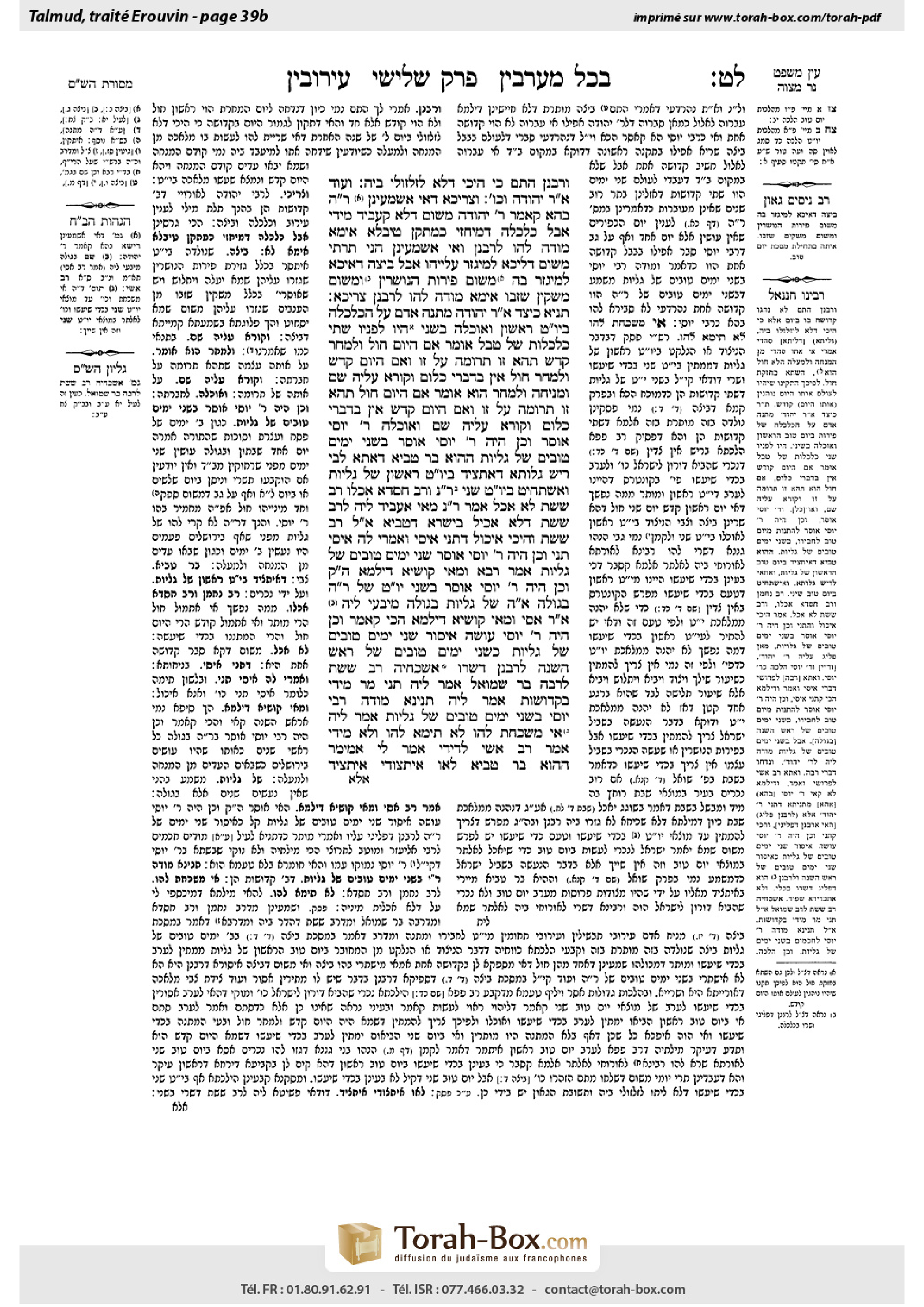
Eruvin 39b: Talmud study for Daf Yomi
Study the Talmud for Daf Yomi with scanned pages, Hebrew text, English translations from Sefaria and AI-generated French translations.
Passage selection and English or AI-generated French translation are available where the scan has annotations. Daf Study is independent of Torah-Box and Sefaria.
Browse Eruvin · עירובין · All tractatesEruvin 39b text and translations
This page of Eruvin includes the Aramaic text, an English translation and an AI-generated French translation, alongside the scan above.
עירובין ל״ט ב · Aramaic and Hebrew text
וְרַבָּנַן, הָתָם כִּי הֵיכִי דְּלָא לְזַלְזוֹלֵי בֵּיהּ.
וְעוֹד אָמַר רַבִּי יְהוּדָה וְכוּ׳.
וּצְרִיכָא. דְּאִי אַשְׁמְעִינַן רֹאשׁ הַשָּׁנָה — בְּהָא קָאָמַר רַבִּי יְהוּדָה, מִשּׁוּם דְּלָא קָעָבֵיד מִידֵּי. אֲבָל כַּלְכָּלָה, דְּמֶיחְזֵי כִּמְתַקֵּן טִיבְלָא — אֵימָא מוֹדֶה לְהוּ לְרַבָּנַן.
וְאִי אַשְׁמְעִינַן הָנֵי תַּרְתֵּי — מִשּׁוּם דְּלֵיכָּא לְמִיגְזַר עֲלַיְיהוּ. אֲבָל בֵּיצָה, דְּאִיכָּא לְמִיגְזַר בָּהּ מִשּׁוּם פֵּירוֹת הַנּוֹשְׁרִין וּמִשּׁוּם מַשְׁקִין שֶׁזָּבוּ — אֵימָא מוֹדֶה לְהוּ לְרַבָּנַן, צְרִיכָא.
תַּנְיָא, כֵּיצַד אָמַר רַבִּי יְהוּדָה מַתְנֶה אָדָם עַל הַכַּלְכָּלָה בְּיוֹם טוֹב רִאשׁוֹן וְאוֹכְלָהּ בַּשֵּׁנִי? הָיוּ לְפָנָיו שְׁתֵּי כַּלְכַּלּוֹת שֶׁל טֶבֶל, אוֹמֵר: אִם הַיּוֹם חוֹל וּלְמָחָר קֹדֶשׁ — תְּהֵא זוֹ תְּרוּמָה עַל זוֹ, וְאִם הַיּוֹם קֹדֶשׁ וּלְמָחָר חוֹל — אֵין בִּדְבָרַי כְּלוּם. וְקוֹרֵא עָלֶיהָ שֵׁם, וּמַנִּיחָהּ.
וּלְמָחָר הוּא אוֹמֵר: אִם הַיּוֹם חוֹל — תְּהֵא זוֹ תְּרוּמָה עַל זוֹ, וְאִם הַיּוֹם קֹדֶשׁ — אֵין בִּדְבָרַי כְּלוּם. וְקוֹרֵא עָלֶיהָ שֵׁם וְאוֹכְלָהּ. רַבִּי יוֹסֵי אוֹסֵר. וְכֵן הָיָה רַבִּי יוֹסֵי אוֹסֵר בִּשְׁנֵי יָמִים טוֹבִים שֶׁל גָּלִיּוֹת.
הָהוּא בַּר טַבְיָא דַּאֲתָא לְבֵי רֵישׁ גָּלוּתָא דְּאִתְּצִיד בְּיוֹם טוֹב רִאשׁוֹן שֶׁל גָּלִיּוֹת, וְאִשְׁתְּחִיט בְּיוֹם טוֹב שֵׁנִי.
רַב נַחְמָן וְרַב חִסְדָּא אֲכַלוּ, רַב שֵׁשֶׁת לָא אֲכַל. אָמַר רַב נַחְמָן: מַאי אֶעֱבֵיד לֵיהּ לְרַב שֵׁשֶׁת דְּלָא אָכֵיל בִּישְׂרָא דְטַבְיָא? אֲמַר לֵיהּ רַב שֵׁשֶׁת: וְהֵיכִי אֵיכוֹל דְּתָנֵי אִיסִי, וְאָמְרִי לַהּ אִיסִי תָּנֵי: וְכֵן הָיָה רַבִּי יוֹסֵי אוֹסֵר שְׁנֵי יָמִים טוֹבִים שֶׁל גָּלִיּוֹת!
אָמַר רָבָא: וּמַאי קוּשְׁיָא? דִּילְמָא הָכִי קָאָמַר: וְכֵן הָיָה רַבִּי יוֹסֵי אוֹסֵר בִּשְׁנֵי יָמִים טוֹבִים שֶׁל רֹאשׁ הַשָּׁנָה בַּגּוֹלָה! אִי הָכִי ״שֶׁל גָּלִיּוֹת״ — ״בַּגּוֹלָה״ מִיבְּעֵי לֵיהּ!
אָמַר רַב אַסִּי: וּמַאי קוּשְׁיָא? דִּילְמָא הָכִי קָאָמַר: וְכֵן הָיָה רַבִּי יוֹסֵי עוֹשֶׂה אִיסּוּר שְׁנֵי יָמִים טוֹבִים שֶׁל גָּלִיּוֹת, כִּשְׁנֵי יָמִים טוֹבִים שֶׁל רֹאשׁ הַשָּׁנָה לְרַבָּנַן דְּשָׁרוּ.
אַשְׁכְּחֵיהּ רַב שֵׁשֶׁת לְרַבָּה בַּר שְׁמוּאֵל, אֲמַר לֵיהּ: תָּנֵי מָר מִידֵּי בִּקְדוּשּׁוֹת? אֲמַר לֵיהּ תְּנֵינָא: מוֹדֶה רַבִּי יוֹסֵי בִּשְׁנֵי יָמִים טוֹבִים שֶׁל גָּלִיּוֹת. אֲמַר לֵיהּ: אִי מַשְׁכַּחַתְּ לְהוּ, לָא תֵּימָא לְהוּ וְלָא מִידֵּי.
אָמַר רַב אָשֵׁי: לְדִידִי אֲמַר לִי אַמֵּימָר: הָהוּא בַּר טַבְיָא לָאו אִיתְּצוּדֵי אִיתְּצִיד,
Eruvin 39b · English translation
And the Rabbis hold that there, the first day is not observed as a Festival by Torah law but due to rabbinic decree, so that people will not demean the day in future years and end up desecrating the Festival should the witnesses come on time. However, by Torah law it is an ordinary weekday, and therefore one can establish two separate eiruvin for the two days.
We learned in the mishna that in addition to his ruling with regard to eiruvin for the two days of Rosh HaShana, Rabbi Yehuda said further that the two days can be split with regard to a basket of tevel produce and an egg laid on the first day of the Festival.
The Gemara comments: And it was necessary to teach us all three laws, as they could not have been derived from one another. As, if he had only taught us the halakha with regard to establishing an eiruv for the two days of Rosh HaShana, one might have said that only in this case does Rabbi Yehuda say his ruling because in this case one does not actually do anything on the Festival itself. But in the case of a basket, where it appears as though one is rendering tevel fit on a Festival, say that Rabbi Yehuda concedes to the Rabbis that it is decreed prohibited.
And had he taught us only these two halakhot, we might have said that Rabbi Yehuda is lenient because there is no reason to issue a decree prohibiting them, as the potential prohibitions involved are not so severe. But in the case of an egg that was laid on the first day of a Festival, where there is reason to issue a decree prohibiting it, as explained in tractate Beitza, because of fruit that fall from a tree or due to liquids that oozed from fruit on a Festival, both of which the Sages prohibited as a safeguard against violating Torah prohibitions, say that Rabbi Yehuda concedes to the opinion of the Rabbis, which maintains that this egg may not be eaten even on the second day of the Festival. It was therefore necessary to teach us all three cases.
It was taught in a baraita: How is one to carry out what Rabbi Yehuda said, that a person may make a condition with regard to a basket of tevel produce on the first day of the Festival and then eat the produce on the second day? If there were two baskets of tevel produce before him, he says as follows: If today is an ordinary weekday and tomorrow is sanctified, let this basket be teruma for that basket; and if today is sanctified and tomorrow is an ordinary weekday, my statement has no significance. And he bestows upon the basket the name of teruma, and sets it aside.
And on the next day he says as follows: If today is an ordinary weekday, let this basket be teruma for that basket; and if today is sanctified, my statement has no significance. And He bestows upon the basket the name of teruma, and he may then eat the produce in the other basket, as teruma has definitely been separated on a weekday. Rabbi Yosei prohibits this. And, so too, Rabbi Yosei would prohibit this procedure even on the two Festival days of the Diaspora, even though the second day is only observed because of a doubt as to the proper day on which to observe the Festival.
The Gemara relates that a particular young deer was brought to the house of the Exilarch. The deer was trapped by a gentile on the first day of a Festival observed in the Diaspora and slaughtered on the second day of the Festival. The question arose whether it was permitted to eat it, based on the fact that one of these two days was certainly an ordinary weekday.
Rav Naḥman and Rav Ḥisda ate from it, but Rav Sheshet did not eat from it. Rav Naḥman said in a jesting manner: What can I do for Rav Sheshet, who does not eat deer meat? Rav Sheshet said to him: How can I eat it, as Isi taught, and some say that this should be read as a question: Didn’t Isi teach: And, so too, Rabbi Yosei would prohibit this procedure even on the two Festival days of the Diaspora?
Rava said: What is the difficulty? Perhaps this is what he said: And, so too, Rabbi Yosei would prohibit this procedure even on the two Festival days of Rosh HaShana in the Diaspora, but with regard to the two days of other Festivals observed in the Diaspora, he too would agree with Rabbi Yehuda and permit it. They said to him: If so, the phrase of the Diaspora is inappropriate. It should have said in the Diaspora.
Rav Asi said: What is the difficulty? Perhaps this is what he said: And so too, Rabbi Yosei would treat the prohibition of such a procedure on the two Festival days of the Diaspora as on the two Festival days of Rosh HaShana, according to the opinion of the Rabbis, who permit it. In any case, the proof from this baraita is inconclusive.
The Gemara further relates that afterward Rav Sheshet met Rabba bar Shmuel and said to him: Has the Master learned anything with regard to the two sanctities of a Festival and the like? Rabba bar Shmuel said to him: We have learned that Rabbi Yosei concedes with regard to the two Festival days of the Diaspora. Rav Sheshet said to him: If you happen to meet Rav Naḥman and Rav Ḥisda, who disagreed with me and ate the deer in the Exilarch’s house, do not tell them anything of what you just told me, lest they use this tannaitic source to embarrass me about my refusal to eat.
Rav Ashi said: Ameimar told me that the deer was not trapped on the Festival;
Eruvin 39b · Traduction française (IA)
Et les Rabbins affirment que là, le premier jour n'est pas célébré comme un festival selon la loi divine, mais grâce à un décret rabbinique, afin que les gens ne déshonorant pas le jour à l'avenir et ne finissent par profaner le festival en cas d'arrivée à temps des témoins. Cependant, selon la loi divine, c'est un jour ordinaire, et par conséquent, on peut établir deux eiruvin distincts pour les deux jours.
Nous avons appris dans la Michna que, en plus de son avis concernant l'établissement d'un eiruv pour les deux jours de Rosh HaShana, Rabbi Yehuda a dit en outre que les deux jours peuvent être séparés concernant un panier de produits tevel et un œuf pondu le premier jour du festival.
La Guemara commente : Il était nécessaire d'enseigner ces trois lois, car elles ne pouvaient pas être déduites les unes des autres. En effet, si on avait seulement appris la halakha concernant l'établissement d'un eiruv pour les deux jours de Rosh HaShana, on aurait pu penser que Rabbi Yehuda exprime son avis uniquement dans ce cas, car dans ce cas, on ne fait pas vraiment quelque chose pendant le festival lui-même. Mais dans le cas du panier, où il semble que l'on rend le tevel propre pendant le festival, disons que Rabbi Yehuda reconnaît le décret des Rabbins qui interdit cela.
Et s'il nous avait seulement appris ces deux halakhot, on aurait pu penser que Rabbi Yehuda est lenient, car il n'y a pas de raison de décréter une interdiction, car les prohibitions potentielles ne sont pas si graves. Mais dans le cas d'un œuf pondu le premier jour du festival, où il y a une raison de décréter une interdiction, comme expliqué dans le traité Beitza, en raison des fruits tombant d'un arbre ou des liquides s'écoulant des fruits pendant le festival, les Sages ont interdit cela comme mesure de précaution contre la violation des prohibitions de la Torah, disent que Rabbi Yehuda reconnaît l'opinion des Rabbins, qui affirment que cet œuf ne peut pas être mangé même le deuxième jour du festival. Il était donc nécessaire d'enseigner ces trois cas.
Il a été enseigné dans une baraïta : Comment faire ce que Rabbi Yehuda a dit, à savoir qu'une personne peut établir une condition concernant un panier de produits tevel le premier jour du festival et ensuite manger les produits le deuxième jour ? S'il y avait deux paniers de produits tevel devant lui, il dit comme suit : Si aujourd'hui est un jour ordinaire et demain est sanctifié, que ce panier soit terouma pour celui-ci ; et si aujourd'hui est sanctifié et demain est un jour ordinaire, mon discours n'a pas de sens. Et il donne au panier le nom de terouma et le sépare.
Et le lendemain, il dit comme suit : Si aujourd'hui est un jour ordinaire, que ce panier soit terouma pour celui-ci ; et si aujourd'hui est sanctifié, mon discours n'a pas de sens. Et il donne au panier le nom de terouma et il peut alors manger les produits dans le panier suivant, car la terouma a été certainement séparée un jour ordinaire. Rabbi Yosei interdit cela. Et de même, Rabbi Yosei interdirait cette procédure même sur les deux jours de festival de la Diaspora, même si le deuxième jour est seulement observé en raison d'un doute concernant le jour correct pour observer le festival.
La Guemara rapporte qu'un jeune cerf particulier a été amené chez l'Exilarch. Le cerf avait été piégé par un non-Juif le premier jour d'un festival célébré en diaspora et tué le deuxième jour du festival. La question s'est posée de savoir s'il était permis de le manger, en raison du fait que l'un de ces deux jours était certainement un jour ordinaire.
Rav Naḥman et Rav Ḥisda ont mangé de lui, mais Rav Sheshet n'a pas mangé de lui. Rav Naḥman a dit en plaisantant : Que puis-je faire pour Rav Sheshet, qui ne mange pas de viande de cerf ? Rav Sheshet lui a répondu : Comment puis-je le manger, puisque Isi a enseigné, et certains disent que cela devrait être lu comme une question : N'a-t-il pas enseigné Isi : Et de même, Rabbi Yosei interdirait cette procédure même sur les deux jours de festival de la diaspora ?
Rava a dit : Quelle est la difficulté ? Peut-être que c'est ce qu'il a dit : Et de même, Rabbi Yosei interdirait cette procédure même sur les deux jours de festival de la diaspora, mais concernant les deux jours d'autres festivals célébrés en diaspora, il serait d'accord avec Rabbi Yehuda et permettrait cela. Ils lui ont répondu : Si c'est ainsi, l'expression « en diaspora » est inadaptée. Il aurait dû dire « en diaspora ».
Rav Asi a dit : Quelle est la difficulté ? Peut-être que c'est ce qu'il a dit : Et de même, Rabbi Yosei traiterait l'interdiction de cette procédure sur les deux jours de festival de la diaspora comme sur les deux jours de festival de Rosh HaShana, selon l'opinion des Rabbins qui l'autorisent. En tout cas, la preuve tirée de ce baraïta est insuffisante.
La Guemara rapporte en outre que plus tard Rav Sheshet a rencontré Rabba bar Shmuel et lui a dit : Le Maître a-t-il appris quelque chose concernant les deux sanctuaires de festival et les semblables ? Rabba bar Shmuel lui a répondu : Nous avons appris que Rabbi Yosei reconnaît la validité concernant les deux jours de festival de la diaspora. Rav Sheshet lui a dit : Si vous rencontrez par hasard Rav Naḥman et Rav Ḥisda, qui s'opposaient à moi et ont mangé le cerf chez l'Exilarch, ne leur dites pas ce que vous venez de me dire, de peur qu'ils utilisent cette source tannaitique pour me ridiculiser à propos de mon refus de manger.
Rav Ashi a dit : Ameimar m'a dit que le cerf n'avait pas été piégé pendant le festival ;
Traduction française générée par IA à partir de l’édition anglaise de Sefaria. Vérifie toujours un passage avec le texte source.
Text from Sefaria: William Davidson Edition - Vocalized Aramaic (CC BY NC); William Davidson Edition - English (CC BY NC).