Eruvin 40a: Talmud study for Daf Yomi
Study the Talmud for Daf Yomi with scanned pages, Hebrew text, English translations from Sefaria and AI-generated French translations.
Passage selection and English or AI-generated French translation are available where the scan has annotations. Daf Study is independent of Torah-Box and Sefaria.
Browse Eruvin · עירובין · All tractatesEruvin 40a text and translations
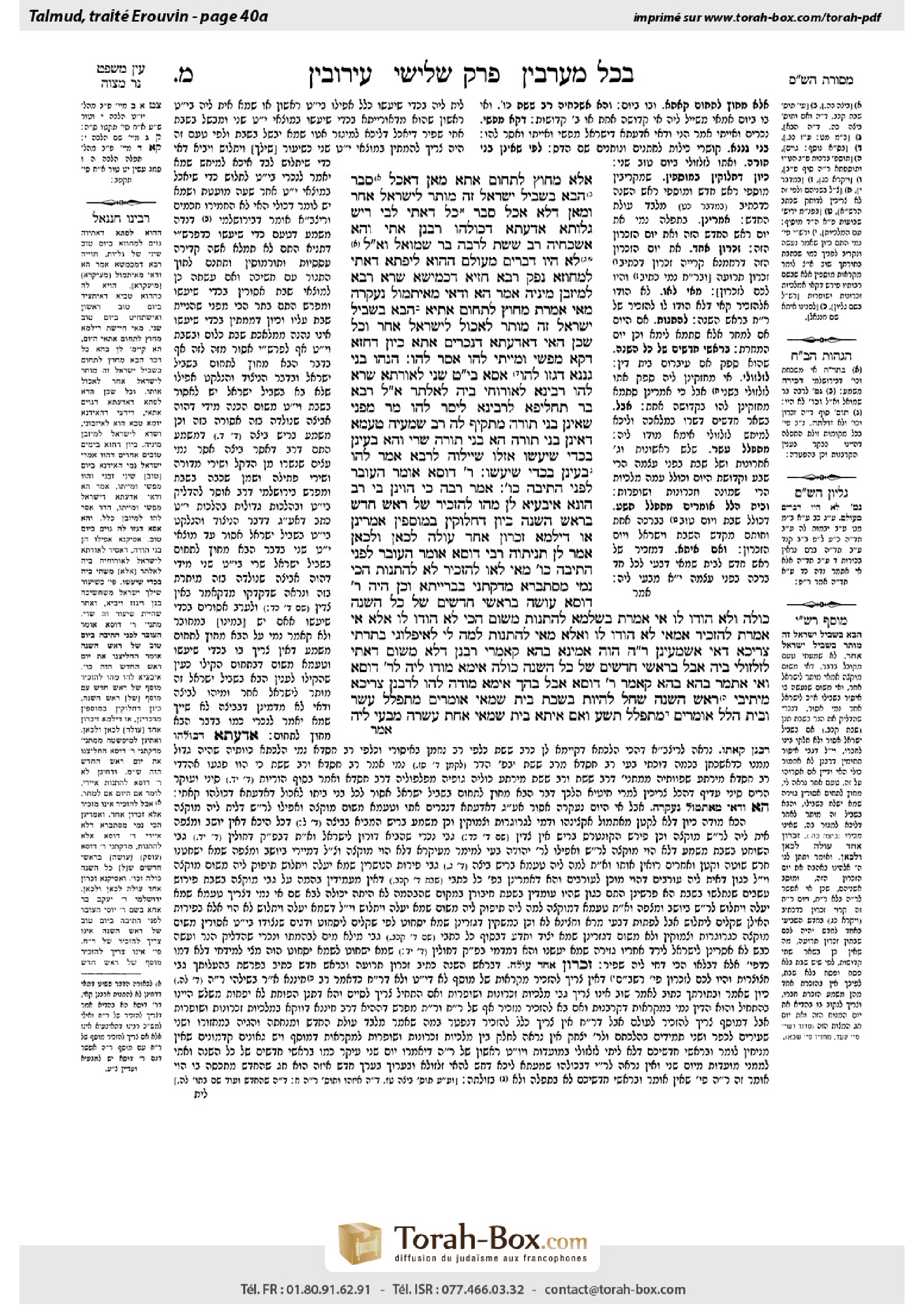
This page of Eruvin includes the Aramaic text, an English translation and an AI-generated French translation, alongside the scan above.
עירובין מ׳ א · Aramaic and Hebrew text
אֶלָּא מִחוּץ לַתְּחוּם אֲתָא. מַאן דַּאֲכַל סָבַר: הַבָּא בִּשְׁבִיל יִשְׂרָאֵל זֶה — מוּתָּר לְיִשְׂרָאֵל אַחֵר.
וּמַאן דְּלָא אֲכַל סָבַר: כׇּל דְּאָתֵי לְבֵי רֵישׁ גָּלוּתָא — אַדַּעְתָּא דְּכוּלְּהוּ רַבָּנַן אָתֵי.
וְהָא אַשְׁכְּחֵיהּ רַב שֵׁשֶׁת לְרַבָּה בַּר שְׁמוּאֵל וַאֲמַר לֵיהּ?! לֹא הָיוּ דְבָרִים מֵעוֹלָם.
הָהוּא לִיפְתָּא דְּאָתֵי לְמָחוֹזָא, נְפַק רָבָא, חַזְיָא דִּכְמִישָׁא, שְׁרָא רָבָא לְמִיזְבַּן מִינֵּיהּ. אָמַר: הָא וַדַּאי מֵאֶיתְמוֹל נֶעֶקְרָה.
מַאי אָמְרַתְּ, מִחוּץ לַתְּחוּם אָתְיָא? הַבָּא בִּשְׁבִיל יִשְׂרָאֵל זֶה, מוּתָּר לֶאֱכוֹל לְיִשְׂרָאֵל אַחֵר, וְכׇל שֶׁכֵּן הַאי דְּאַדַּעְתָּא דְגוֹיִם אֲתָא.
כֵּיוָן דַּחֲזָא דְּקָא מַפְּשִׁי וּמַיְיתִי לְהוּ — אֲסַר לְהוּ.
הָנְהוּ בְּנֵי גְנָנָא דְּגַזּוּ לְהוּ אָסָא בְּיוֹם טוֹב שֵׁנִי, לְאוּרְתָּא שְׁרָא לְהוּ רָבִינָא לְאוֹרוֹחֵי בֵּיהּ לְאַלְתַּר. אֲמַר לֵיהּ רָבָא בַּר תַּחְלִיפָא לְרָבִינָא: לֵיסַר לְהוּ מָר מִפְּנֵי שֶׁאֵינָן בְּנֵי תוֹרָה.
מַתְקֵיף לַהּ רַב שְׁמַעְיָה: טַעְמָא דְּאֵינָן בְּנֵי תוֹרָה, הָא בְּנֵי תוֹרָה שְׁרֵי?! וְהָא בָּעִינַן בִּכְדֵי שֶׁיֵּעָשׂוּ! אֲזַלוּ שַׁיְילוּהּ לְרָבָא, אֲמַר לְהוּ: בָּעִינַן בִּכְדֵי שֶׁיֵּעָשׂוּ.
רַבִּי דּוֹסָא אוֹמֵר הָעוֹבֵר לִפְנֵי הַתֵּיבָה כּוּ׳.
אָמַר רַבָּה: כִּי הֲוֵינַן בֵּי רַב הוּנָא, אִיבַּעְיָא לַן: מַהוּ לְהַזְכִּיר שֶׁל רֹאשׁ חֹדֶשׁ בְּרֹאשׁ הַשָּׁנָה? כֵּיוָן דַּחֲלוּקִין בְּמוּסָפִין, אָמְרִינַן? אוֹ דִילְמָא — זִכָּרוֹן אֶחָד עוֹלֶה לְכָאן וּלְכָאן?
אֲמַר לַן: תְּנֵיתוּהָ, רַבִּי דּוֹסָא אוֹמֵר: הָעוֹבֵר לִפְנֵי הַתֵּיבָה כּוּ׳ — מַאי לָאו לְהַזְכִּיר?
לֹא, לְהַתְנוֹת.
הָכִי נָמֵי מִסְתַּבְּרָא, מִדְּקָתָנֵי בְּבָרַיְיתָא: וְכֵן הָיָה רַבִּי דּוֹסָא עוֹשֶׂה בְּרָאשֵׁי חֳדָשִׁים שֶׁל כׇּל הַשָּׁנָה כּוּלָּהּ, וְלֹא הוֹדוּ לוֹ.
אִי אָמְרַתְּ בִּשְׁלָמָא לְהַתְנוֹת — מִשּׁוּם הָכִי לֹא הוֹדוּ לוֹ. אֶלָּא אִי אָמְרַתְּ לְהַזְכִּיר — אַמַּאי לֹא הוֹדוּ לוֹ?
וְאֶלָּא מַאי — לְהַתְנוֹת? לְמָה לִי לְאִיפְּלוֹגֵי בְּתַרְתֵּי? צְרִיכָא, דְּאִי אַשְׁמְעִינַן רֹאשׁ הַשָּׁנָה — הֲוָה אָמֵינָא: בְּהָא קָאָמְרִי רַבָּנַן דְּלָא — מִשּׁוּם דְּאָתֵי לְזַלְזוֹלֵי בֵּיהּ, אֲבָל בְּרָאשֵׁי חֳדָשִׁים שֶׁל כׇּל הַשָּׁנָה כּוּלָּהּ — אֵימָא מוֹדוּ לֵיהּ לְרַבִּי דּוֹסָא.
וְאִי אִתְּמַר בְּהָא — בְּהָא קָאָמַר רַבִּי דּוֹסָא, אֲבָל בְּהָךְ — אֵימָא מוֹדֶה לְהוּ לְרַבָּנַן. צְרִיכָא.
מֵיתִיבִי: רֹאשׁ הַשָּׁנָה שֶׁחָל לִהְיוֹת בְּשַׁבָּת, בֵּית שַׁמַּאי אוֹמְרִים: מִתְפַּלֵּל עֶשֶׂר, וּבֵית הִלֵּל אוֹמְרִים: מִתְפַּלֵּל תֵּשַׁע. וְאִם אִיתָא, בֵּית שַׁמַּאי אַחַת עֶשְׂרֵה מִבְּעֵי לֵיהּ?
Eruvin 40a · English translation
rather, it had already been caught beforehand, but it came to the Exilarch’s house on the Festival from outside the Shabbat limit and was slaughtered on that day. The one who ate from it, namely, Rav Naḥman and Rav Ḥisda, holds: Something that comes from outside the Shabbat limit for one Jew is permitted to another Jew. Since the deer was brought for the Exilarch, the Sages at his table were permitted to eat from it, and we do not prohibit them to derive benefit from something that a gentile did for another Jew.
And the one who did not eat from it, Rav Sheshet, holds: Anything that comes to the house of the Exilarch comes with all the Sages in mind, as it is known that the Exilarch invites them to dine with him on Festivals. Therefore, just as it was prohibited to the Exilarch himself, as it was brought from outside the Shabbat limit, so too, it was prohibited to all his guests.
The Gemara asks: Didn’t Rav Sheshet meet Rabba bar Shmuel and say to him what he said, indicating that the issue is related to the question of whether the two days are considered distinct sanctities? The Gemara answers: According to Ameimar’s version of the story, that encounter never happened.
The Gemara relates that a delivery of turnip was once brought to the town of Meḥoza by gentile merchants from outside the Shabbat limit on a Festival in the Diaspora. Rava went out to the market and saw that the turnips were withered, and therefore he permitted people to buy them immediately without having to wait the amount of time needed to bring similar items from outside the limit after the Festival. He said: These turnips were certainly uprooted from the ground yesterday, and no prohibited labor was performed with them today.
What might you say; that they came from outside the Shabbat limit and should therefore be prohibited? The accepted principle is: Something that comes for one Jew is permitted to be eaten by another Jew, and all the more so with regard to this delivery of turnip, which came with gentiles in mind, i.e., for their sake rather than for the sake of Jews. Therefore, if they are purchased by Jews, no prohibition is violated.
The Gemara adds: Once Rava saw that the gentile merchants started to bring increased quantities of turnips on Festival days for the sake of their Jewish customers, he prohibited the inhabitants of Meḥoza to buy them, for it was evident that they were now being brought for Jews.
The Gemara relates that certain canopy makers, who would braid myrtle branches into their canopies, once cut myrtles on the second day of a Festival, and in the evening Ravina permitted people to smell them immediately at the conclusion of the Festival. Rava bar Taḥalifa said to Ravina: The Master should prohibit them to do this, as they are not knowledgeable in Torah, and therefore we should be stringent with them lest they come to treat the sanctity of the second Festival day lightly.
Rav Shemaya strongly objects to this: The reason given here is that they are not knowledgeable in Torah; but if they were knowledgeable in Torah, would it be permitted? Don’t we require them to wait the time needed for the myrtle’s preparation, i.e., the time it takes to cut them? They went and asked Rava. He said to them: We require them to wait the time needed for the myrtle’s preparation.
The mishna cited Rabbi Dosa’s version of the Rosh HaShana prayer: Rabbi Dosa says: He who passes before the ark and leads the congregation in prayer on the first day of the festival of Rosh HaShana says: Strengthen us, O Lord our God, on this day of the New Moon, whether it is today or tomorrow.
Rabba said: When we were in the house of study of Rav Huna, we raised the following dilemma: What is the halakha with regard to whether it is proper to mention the New Moon during prayer on Rosh HaShana? The Gemara explains the two sides of the dilemma: Do we say that since they have separate additional offerings, as one additional offering is brought for the New Moon and another for Rosh HaShana, we mention them separately in prayer as well? Or perhaps one remembrance counts for both this and that? The Torah is referring to both Rosh HaShana and the New Moon as times of remembrance, and therefore perhaps simply mentioning that it is a Day of Remembrance should suffice.
Rav Huna said to us: You have already learned the answer to this question in the mishna, which states that Rabbi Dosa says: He who passes before the ark and leads the congregation in prayer on the first day and on the second day of Rosh HaShana mentions the New Moon in a conditional manner: On this day of the New Moon, whether it is today or tomorrow. But the Rabbis did not agree with him. What, is it not that the Rabbis disagree with Rabbi Dosa about the need to mention the New Moon during prayer on Rosh HaShana?
The Gemara refutes this proof: No, they disagree about whether to make a condition. The novelty in Rabbi Dosa’s teaching was not that mention must be made of the New Moon, but that a condition must be made due to the day’s uncertain status. The Rabbis disagree about that.
The Gemara comments: So too, it is reasonable to say that the dispute between Rabbi Dosa and the Rabbis relates to the condition and not to the very mention of the New Moon. This can be ascertained from the fact that it was taught in a baraita: And so too, Rabbi Dosa would do this on all the New Moons for which two days are kept out of doubt the entire year; and the Rabbis did not agree with him.
Granted, if you say that the disagreement was about whether to make a condition, that is why they did not agree with him with regard to the New Moon throughout the year, as they did not accept the whole idea of a conditional prayer. But if you say the main point of contention was whether to mention the New Moon at all, why didn’t they agree with him that the New Moon should be mentioned during prayer the rest of the year?
The Gemara asks: Rather, what is the disagreement about, whether or not to make a condition? Why do I need them to disagree in two cases? The issue is the same on Rosh HaShana as on any other New Moon. The Gemara answers: It was necessary to teach both cases, as, if he had only taught us the halakha with regard to Rosh HaShana, I might have said that only in this case did the Rabbis say that one should not mention the New Moon in a conditional manner because people might come to demean the day and perform prohibited labor. But in the case of an ordinary New Moon throughout the year, I might say that perhaps they agree with Rabbi Dosa, since labor is not prohibited on the New Moon, and therefore there is no reason for concern lest people come to treat it lightly.
And if the disagreement had only been stated in this case, in the case of an ordinary New Moon, one might say that only in this case did Rabbi Dosa say that a condition may be made. But in that other case of Rosh HaShana, I might say that he agrees with the Rabbis, due to concern lest people will come to treat the Festival lightly. It was therefore necessary to state the disagreement in both cases.
The Gemara raises an objection based on the Tosefta that states that in the case of Rosh HaShana that occurs on Shabbat, Beit Shammai say: One prays an Amida that contains ten blessings, including the nine blessings ordinarily recited on Rosh HaShana and an additional blessing in which Shabbat is mentioned. And Beit Hillel say: One prays an Amida that contains nine blessings, as Shabbat and the Festival are mentioned in the same blessing. And if there were an opinion that held that the New Moon must be separately mentioned in the Rosh HaShana prayer, then it should say that according to Beit Shammai, one must recite eleven blessings, i.e., nine for Rosh HaShana, one for Shabbat, and one for the New Moon.
Eruvin 40a · Traduction française (IA)
plutôt, il avait déjà été capturé auparavant, mais il est arrivé à la maison de l'Exilarch pendant la fête, depuis l'extérieur de la limite du Sabbat, et a été sacrifié ce jour-là. Celui qui a mangé de lui, à savoir Rav Naḥman et Rav Ḥisda, affirme : Ce qui vient de l'extérieur de la limite du Sabbat pour un Juif est permis à un autre Juif. Puisque le cerf était destiné à l'Exilarch, les Sages présents à sa table étaient autorisés à en manger, et nous ne prohibons pas de tirer un bénéfice de quelque chose que le gentil a fait pour un autre Juif.
Et celui qui n'a pas mangé de lui, Rav Sheshet, affirme : Tout ce qui arrive à la maison de l'Exilarch arrive avec l'intention de tous les Sages, car on sait que l'Exilarch invite les Sages à dîner avec lui pendant les fêtes. Ainsi, tout comme il était interdit à l'Exilarch lui-même, puisqu'il était arrivé de l'extérieur de la limite du Sabbat, de même, il était interdit à tous ses invités.
La Guemara pose la question : N'est-ce pas que Rav Sheshet a rencontré Rabba bar Shmuel et lui a dit ce qu'il avait dit, indiquant que la question est liée à la question de savoir si les deux jours sont considérés comme des sanctuaires distincts ? La Guemara répond : Selon la version d'Ameimar de l'histoire, cette rencontre n'a jamais eu lieu.
La Guemara rapporte qu'un chargement de navets a été apporté à la ville de Meḥoza par des marchands gentils depuis l'extérieur de la limite du Sabbat pendant une fête dans la diaspora. Rava est sorti au marché et a vu que les navets étaient fanés, et donc il a permis aux gens d'acheter immédiatement sans avoir à attendre le temps nécessaire pour apporter des articles similaires depuis l'extérieur de la limite après la fête. Il a dit : Ces navets ont certainement été arrachés de la terre hier, et aucun travail interdit n'a été effectué avec eux aujourd'hui.
Que diriez-vous, que ce sont des navets venant de l'extérieur de la limite du Sabbat et devraient donc être interdits ? Le principe accepté est : Ce qui vient pour un Juif est permis à un autre Juif de manger, et encore plus encore concernant ce chargement de navets, qui est venu avec l'intention des gentils, c'est-à-dire pour leur compte plutôt que pour celui des Juifs. Ainsi, si ils sont achetés par des Juifs, aucun interdit n'est violé.
La Guemara ajoute : Une fois que Rava a vu que les marchands gentils commençaient à apporter des quantités accrues de navets pendant les jours de fête pour le compte de leurs clients juifs, il a interdit aux habitants de Meḥoza d'acheter ceux-ci, car il était évident qu'ils étaient maintenant apportés pour les Juifs.
La Guemara rapporte qu'un certain fabricant de tentes, qui tressait des branches de myrte dans ses tentes, avait un jour coupé des myrtes le deuxième jour d'une fête, et en soirée Ravina permit aux gens de les sentir immédiatement à la fin de la fête. Rava bar Taḥalifa dit à Ravina : Le Maître devrait interdire cela, car ils ne sont pas savants en Torah, et donc nous devons être stricts avec eux de peur qu'ils traitent légèrement la sanctité du deuxième jour de la fête.
Rav Shemaya s'oppose fermement à cela : La raison donnée ici est qu'ils ne sont pas savants en Torah ; mais si ils étaient savants en Torah, serait-ce permis ? N'exigeons-nous pas qu'ils attendent le temps nécessaire pour la préparation des myrtes, c'est-à-dire le temps nécessaire pour les couper ? Ils sont allés demander à Rava. Il leur dit : Nous exigeons qu'ils attendent le temps nécessaire pour la préparation des myrtes.
La Michna cite la version de Rabbi Dosa de la prière de Rosh HaShana : Rabbi Dosa dit : Celui qui passe devant l'arche et conduit la congrégation dans la prière le premier jour de la fête de Rosh HaShana dit : Renforce-nous, ô Seigneur notre Dieu, ce jour de la Nouvelle Lune, qu'il soit aujourd'hui ou demain.
Rabba a dit : Quand nous étions dans la maison d'étude de Rav Huna, nous avons soulevé le suivant dilemme : Quelle est la halakha concernant la question de savoir si il est convenable de mentionner la Nouvelle Lune pendant la prière le jour de Rosh HaShana ? La Guemara explique les deux côtés du dilemme : Disons-nous que puisqu'ils ont des offrandes supplémentaires distinctes, comme une offrande supplémentaire est offerte pour la Nouvelle Lune et une autre pour Rosh HaShana, nous devons les mentionner séparément dans la prière également ? Ou peut-être une seule mention suffit pour les deux ? La Torah fait référence à la fois à Rosh HaShana et à la Nouvelle Lune comme des temps de souvenir, et donc peut-être simplement mentionner qu'il s'agit d'un jour de souvenir suffirait.
Rav Huna a dit à nous : Vous avez déjà appris la réponse à cette question dans la Michna, qui stipule que Rabbi Dosa dit : Celui qui passe devant l'arche et conduit la congrégation dans la prière le premier jour et le deuxième jour de Rosh HaShana mentionne la Nouvelle Lune de manière conditionnelle : Ce jour de la Nouvelle Lune, qu'il soit aujourd'hui ou demain. Mais les Rabbins n'ont pas accepté cela. Que signifie-t-il, n'est-ce pas que les Rabbins s'opposent à Rabbi Dosa concernant la nécessité de mentionner la Nouvelle Lune pendant la prière le jour de Rosh HaShana ?
La Guemara réfute cette preuve : Non, ils s'opposent à savoir si une condition doit être faite. L'originalité dans l'enseignement de Rabbi Dosa n'était pas que la mention de la Nouvelle Lune soit nécessaire, mais que une condition doit être faite en raison de l'incertitude du jour. Les Rabbins s'opposent à cela.
La Guemara commente : De même, il est raisonnable de dire que le débat entre Rabbi Dosa et les Rabbins concerne la condition et non la mention de la Nouvelle Lune elle-même. Cela peut être constaté du fait qu'il a été enseigné dans une baraïta : Et ainsi, Rabbi Dosa ferait cela pour toutes les Nouvelles Lunes pour lesquelles deux jours sont gardés en raison de doute tout au long de l'année ; et les Rabbins n'ont pas accepté cela.
D'accord, si vous dites que le désaccord était sur savoir si une condition devait être faite, c'est pourquoi ils n'ont pas accepté cela concernant la Nouvelle Lune tout au long de l'année, car ils n'ont pas accepté l'idée d'une prière conditionnelle. Mais si vous dites que le point principal de débat était savoir si la mention de la Nouvelle Lune devait avoir lieu du tout, pourquoi n'ont-ils pas accepté cela pour la mention de la Nouvelle Lune pendant la prière tout au long de l'année ?
Le Guemara pose la question : Mais alors, de quoi s'agit-il exactement, de poser une condition ou non ? Pourquoi avoir besoin qu'ils s'opposent dans deux cas ? La question est la même à Rosh HaShana qu'à toute autre nouvelle lune. Le Guemara répond : Il était nécessaire d'enseigner les deux cas, car, si l'on avait seulement enseigné la halakha concernant Rosh HaShana, je pourrais penser que c'est uniquement dans ce cas que les Sages ont dit qu'on ne doit pas mentionner la nouvelle lune de manière conditionnelle, de peur que les gens ne déshonorant le jour et ne travaillent pas dans des travaux interdits. Mais dans le cas d'une nouvelle lune ordinaire tout au long de l'année, je pourrais dire qu'ils pourraient être d'accord avec Rabbi Dosa, car le travail n'est pas interdit le jour de la nouvelle lune, et donc il n'y a pas de raison de s'inquiéter que les gens ne traitent ce jour avec légèreté.
Et si l'opposition avait été énoncée uniquement dans ce cas, celui d'une nouvelle lune ordinaire, on pourrait dire que c'est uniquement dans ce cas que Rabbi Dosa a dit qu'on peut poser une condition. Mais dans l'autre cas de Rosh HaShana, je pourrais dire qu'il est d'accord avec les Sages, en raison de la crainte que les gens traitent la fête avec légèreté. Il était donc nécessaire d'énoncer l'opposition dans les deux cas.
Le Guemara soulève un objet basé sur la Tosefta qui dit que dans le cas d'une Rosh HaShana qui tombe un sabbat, Beit Shammai disent : On prie une Amida contenant dix bénédictions, y compris les neuf bénédictions habituellement récitées à Rosh HaShana et une bénédictions supplémentaire dans laquelle le sabbat est mentionné. Et Beit Hillel disent : On prie une Amida contenant neuf bénédictions, car le sabbat et la fête sont mentionnés dans la même bénédictions. Et si l'il y avait une opinion qui disait que la nouvelle lune doit être mentionnée séparément dans la prière de Rosh HaShana, alors il devrait dire que selon Beit Shammai, on doit réciter onze bénédictions, c'est-à-dire neuf pour Rosh HaShana, une pour le sabbat et une pour la nouvelle lune.
Traduction française générée par IA à partir de l’édition anglaise de Sefaria. Vérifie toujours un passage avec le texte source.
Text from Sefaria: William Davidson Edition - Vocalized Aramaic (CC BY NC); William Davidson Edition - English (CC BY NC).