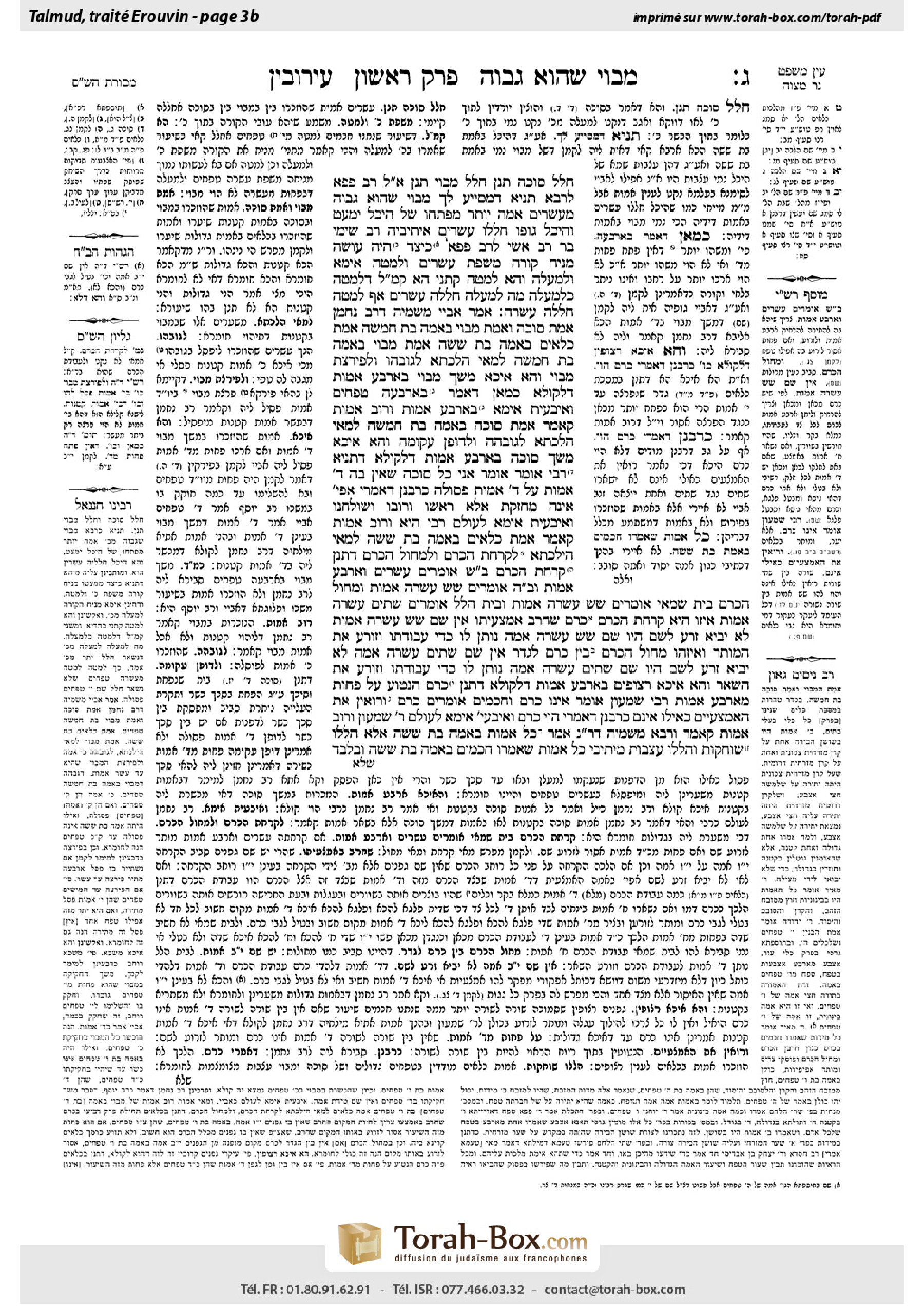
Eruvin 3b: Talmud study for Daf Yomi
Study the Talmud for Daf Yomi with scanned pages, Hebrew text, English translations from Sefaria and AI-generated French translations.
Passage selection and English or AI-generated French translation are available where the scan has annotations. Daf Study is independent of Torah-Box and Sefaria.
Browse Eruvin · עירובין · All tractatesEruvin 3b text and translations
This page of Eruvin includes the Aramaic text, an English translation and an AI-generated French translation, alongside the scan above.
עירובין ג׳ ב · Aramaic and Hebrew text
חֲלַל סוּכָּה תְּנַן, חֲלַל מָבוֹי תְּנַן.
אֲמַר לֵיהּ רַב פָּפָּא לְרָבָא, תַּנְיָא דִּמְסַיַּיע לָךְ: מָבוֹי שֶׁהוּא גָּבוֹהַּ מֵעֶשְׂרִים אַמָּה יוֹתֵר מִפִּתְחוֹ שֶׁל הֵיכָל יְמַעֵט. וְהֵיכָל גּוּפוֹ חֲלָלוֹ עֶשְׂרִים.
אֵיתִיבֵיהּ רַב שִׁימִי בַּר רַב אָשֵׁי לְרַב פָּפָּא: כֵּיצַד הָיָה עוֹשֶׂה — מַנִּיחַ קוֹרָה מִשְּׂפַת עֶשְׂרִים וּלְמַטָּה!
אֵימָא: ״וּלְמַעְלָה״. וְהָא ״לְמַטָּה״ קָתָנֵי!
הָא קָא מַשְׁמַע לַן, דִּלְמַטָּה כִּלְמַעְלָה: מָה לְמַעְלָה חֲלָלָהּ עֶשְׂרִים, אַף לְמַטָּה חֲלָלָהּ עֲשָׂרָה.
אָמַר אַבָּיֵי מִשְּׁמֵיהּ דְּרַב נַחְמָן: אַמַּת סוּכָּה וְאַמַּת מָבוֹי בְּאַמָּה בַּת חֲמִשָּׁה, אַמַּת כִּלְאַיִם בְּאַמָּה בַּת שִׁשָּׁה.
אַמַּת מָבוֹי בְּאַמָּה בַּת חֲמִשָּׁה, לְמַאי הִלְכְתָא? לְגוֹבְהוֹ וּלְפִירְצַת מָבוֹי.
וְהָא אִיכָּא מֶשֶׁךְ מָבוֹי בְּאַרְבַּע אַמּוֹת, דִּלְקוּלָּא!
כְּמַאן דְּאָמַר בְּאַרְבָּעָה טְפָחִים.
וְאִיבָּעֵית אֵימָא, בְּאַרְבַּע אַמּוֹת — וְרוֹב אַמּוֹת קָאָמַר.
אַמַּת סוּכָּה בְּאַמָּה בַּת חֲמִשָּׁה, לְמַאי הִלְכְתָא? לְגוֹבְהָהּ וּלְדוֹפֶן עֲקוּמָּה.
וְהָא אִיכָּא מֶשֶׁךְ סוּכָּה בְּאַרְבַּע אַמּוֹת, דִּלְקוּלָּא! דְּתַנְיָא, רַבִּי אוֹמֵר: אוֹמֵר אֲנִי, כׇּל סוּכָּה שֶׁאֵין בָּהּ אַרְבַּע אַמּוֹת עַל אַרְבַּע אַמּוֹת פְּסוּלָה!
כְּרַבָּנַן, דְּאָמְרִי: אֲפִילּוּ אֵינָהּ מַחְזֶקֶת אֶלָּא רֹאשׁוֹ וְרוּבּוֹ וְשׁוּלְחָנוֹ.
וְאִיבָּעֵית אֵימָא: לְעוֹלָם רַבִּי הִיא, וְרוֹב אַמּוֹת קָאָמַר.
אַמַּת כִּלְאַיִם בְּאַמָּה בַּת שִׁשָּׁה, לְמַאי הִילְכְתָא? לְקָרַחַת הַכֶּרֶם וְלִמְחוֹל הַכֶּרֶם.
דִּתְנַן: קָרַחַת הַכֶּרֶם, בֵּית שַׁמַּאי אוֹמְרִים: עֶשְׂרִים וְאַרְבַּע אַמּוֹת, וּבֵית הִלֵּל אוֹמְרִים: שֵׁשׁ עֶשְׂרֵה אַמּוֹת. וּמְחוֹל הַכֶּרֶם, בֵּית שַׁמַּאי אוֹמְרִים: שֵׁשׁ עֶשְׂרֵה אַמּוֹת, וּבֵית הִלֵּל אוֹמְרִים: שְׁתֵּים עֶשְׂרֵה אַמּוֹת.
אֵיזוֹ הִיא קָרַחַת הַכֶּרֶם? כֶּרֶם שֶׁחָרַב אֶמְצָעִיתוֹ, אֵין שָׁם שֵׁשׁ עֶשְׂרֵה אַמּוֹת לֹא יָבִיא זֶרַע לְשָׁם. הָיוּ שָׁם שֵׁשׁ עֶשְׂרֵה אַמָּה — נוֹתֵן לוֹ כְּדֵי עֲבוֹדָתוֹ, וְזוֹרֵעַ אֶת הַמּוֹתָר.
וְאֵיזֶהוּ מְחוֹל הַכֶּרֶם — בֵּין כֶּרֶם לַגָּדֵר. אֵין שָׁם שְׁתֵּים עֶשְׂרֵה אַמָּה, לֹא יָבִיא זֶרַע לְשָׁם. הָיוּ שָׁם שְׁתֵּים עֶשְׂרֵה אַמָּה — נוֹתֵן לוֹ כְּדֵי עֲבוֹדָתוֹ, וְזוֹרֵעַ אֶת הַשְּׁאָר.
וְהָא אִיכָּא רְצוּפִים בְּאַרְבַּע אַמּוֹת, דִּלְקוּלָּא! דִּתְנַן: כֶּרֶם הַנָּטוּעַ עַל פָּחוֹת מֵאַרְבַּע אַמּוֹת, רַבִּי שִׁמְעוֹן אוֹמֵר: אֵינוֹ כֶּרֶם. וַחֲכָמִים אוֹמְרִים: כֶּרֶם, וְרוֹאִין אֶת הָאֶמְצָעִיִּים כְּאִילּוּ אֵינָם.
כְּרַבָּנַן, דְּאָמְרִי הָוֵי כֶּרֶם. וְאִיבָּעֵית אֵימָא: לְעוֹלָם רַבִּי שִׁמְעוֹן, וְרוֹב אַמּוֹת קָאָמַר.
וְרָבָא מִשְּׁמֵיהּ דְּרַב נַחְמָן אָמַר: כׇּל אַמּוֹת בְּאַמָּה בַּת שִׁשָּׁה, אֶלָּא: הַלָּלוּ שׂוֹחֲקוֹת, וְהַלָּלוּ עֲצֵבוֹת.
מֵיתִיבִי: כׇּל אַמּוֹת שֶׁאָמְרוּ חֲכָמִים בְּאַמָּה בַּת שִׁשָּׁה, וּבִלְבַד
Eruvin 3b · English translation
as that which we learned in the mishna, with regard to the unfitness of a sukka higher than twenty cubits, is referring to the interior space of the sukka; and that which we learned in the mishna, that a cross beam spanning an alleyway that is more than twenty cubits must be lowered, is referring to the space at the entrance of the alleyway beneath the cross beam.
Rav Pappa said to Rava: A baraita was taught that supports your opinion: If the cross beam spanning the entrance of an alleyway is higher than twenty cubits off the ground, greater than the entrance of the Sanctuary, one must diminish its height. And the space of the entrance of the Sanctuary itself was twenty cubits high, and its roof was higher than twenty cubits. Apparently, the twenty cubits mentioned with regard to a sukka and an alleyway refers to the space beneath the roofing and the cross beam.
Rav Shimi bar Rav Ashi raised an objection to Rav Pappa from the Tosefta: How precisely would he do it? He places the cross beam from the edge of twenty cubits and below. Apparently, the entire cross beam must be within twenty cubits of the ground, and if any part of it rises above twenty it is unfit.
Rav Pappa replied: Emend the Tosefta and say: From the edge of twenty cubits and above. Rav Shimi retorted: But isn’t it taught: And below? What justification is there to completely reverse the meaning of the Tosefta?
Rava explained that there is no need to emend the language of the baraita, but merely to reinterpret it. The baraita is teaching us the following: The halakha below is like the halakha above. Just as above, with regard to the maximum height of the cross beam, it is the space beneath the cross beam that may not be more than twenty cubits, so too below, with regard to the minimum height of the cross beam, it is the space beneath the cross beam that may not be less than ten handbreadths. However, a cross beam placed within ten handbreadths of the ground is unfit and does not render it permitted to carry within the alleyway.
The Gemara considers the measure of the cubit mentioned in the mishna and elsewhere. Abaye said in the name of Rav Naḥman: The cubit mentioned with regard to the halakhot of sukka and the cubit mentioned in connection with the halakhot of an alleyway is a small cubit consisting of five handbreadths. In contrast, the cubit of a forbidden mixture of diverse kinds of seeds is a large cubit consisting of six handbreadths. Apparently, Rav Naḥman rules stringently in all cases.
The Gemara elaborates: The cubit of an alleyway is a cubit consisting of five handbreadths. With regard to what halakha does this ruling apply? It applies to the issue of the height of the cross beam spanning an alleyway that may not be more than twenty cubits high, and to the breach of an alleyway that may not be more than ten cubits wide.
The Gemara poses a question: But isn’t there also the issue of the minimal length of an alleyway? For carrying in an alleyway to be rendered permissible by means of a side post or a cross beam, it must be at least four cubits long. In that case, measuring the alleyway with small cubits will lead to a leniency.
The Gemara resolves this difficulty: Rav Naḥman holds in accordance with the one who said that the length of an alleyway need only be four handbreadths. However, a cubit mentioned in the context of an alleyway is always a small cubit, which is a stringency.
The Gemara proposes an alternative solution: And if you wish, say instead that actually Rav Naḥman holds in accordance with the opinion that the length of an alleyway must be four cubits, and in that case, the alleyway is measured with large cubits of six handbreadths as a stringency. When he is saying that the cubit of an alleyway is a cubit of five handbreadths, he is speaking of most, but not all, cubits mentioned in the context of an alleyway.
Rav Naḥman said that the cubit of a sukka is a small cubit consisting of five handbreadths. The Gemara asks: With regard to what halakha does this ruling apply? It applies to the halakha governing its height, i.e., that a sukka may not be more than twenty cubits high, and to the halakha of a curved wall. A sukka is considered valid if there are up to four cubits of invalid roofing, provided that this roofing is adjacent to one of the walls of the sukka. In that case, the invalid roofing is considered an extension of the wall, i.e., the wall is considered to be curved, and consequently, the entire sukka is valid. With regard to both halakhot, the ruling is stringent and distance is measured with small cubits.
The Gemara asks: But isn’t there also the halakha of the minimal length of a sukka, which must be at least four cubits long? If it is measured with small cubits, that will lead to a leniency. As it was taught in a baraita: Rabbi Yehuda HaNasi says: I say, any sukka that does not have in it an area of at least four cubits by four cubits is invalid.
The Gemara resolves this difficulty: Rav Naḥman holds in accordance with the opinion of the Rabbis, who say: A sukka is valid even if it holds only one’s head, most of his body, and his table.
The Gemara suggests another solution: And if you wish, say instead: Actually, Rav Naḥman’s statement holds true even if it is in accordance with the opinion of Rabbi Yehuda HaNasi that a sukka must be at least four cubits long. Indeed, the sukka is measured with large cubits consisting of six handbreadths, which is a stringency. And when he says that the cubit of a sukka is a cubit of five handbreadths, he is speaking of most, but not all, cubits mentioned with regard to sukka.
The Gemara continues: As stated above, Rav Naḥman said that the cubit of a forbidden mixture of diverse kinds of seeds is a cubit consisting of six handbreadths. The Gemara asks: With regard to what halakha does this ruling apply? It applies to the halakha of a clearing in a vineyard and to the halakha of the perimeter of a vineyard.
As we learned in a mishna in tractate Kilayim: With regard to a clearing in a vineyard, Beit Shammai say: Its measure is twenty-four cubits, and Beit Hillel say: Sixteen cubits. With regard to the perimeter of a vineyard, Beit Shammai say: Sixteen cubits, and Beit Hillel say: Twelve cubits.
The mishna explains: What is a clearing in a vineyard? It is referring to a vineyard whose middle section was laid bare of vines. If there are not sixteen cubits across in the clearing, one may not bring foreign seeds and sow them there, due to the Torah prohibition against sowing other crops in a vineyard (Deuteronomy 22:9). If there were sixteen cubits across in the clearing, one provides the vineyard with its requisite work area, i.e., four cubits along either side of the vines are left unsown to facilitate cultivation of the vines, and he sows the rest of the cleared area with foreign crops.
The mishna continues: What is the perimeter of a vineyard? It is the vacant area between the vineyard and the fence surrounding it. If there are not twelve cubits in that area, one may not bring foreign seeds and sow them there. If there were twelve cubits in that area, he provides the vineyard, with its requisite work area, four cubits, and he sows the rest.
The Gemara raises a difficulty: But isn’t there also the halakha of vines that planted consecutively, within four cubits of each other, with regard to which measuring the distance with large cubits would lead to a leniency? As we learned in a mishna: With regard to a vineyard that was planted in consecutive rows with less than four cubits between them, Rabbi Shimon says: Since the rows are planted so closely together, it is not considered a vineyard, and if one plants other crops there he is not liable. And the Rabbis say: It is a vineyard, and one regards the middle vines, those planted between two appropriately spaced rows, as if they are not there. One who plants other crops there is indeed liable. According to Rabbi Shimon’s opinion, measuring the distance between the rows with large cubits leads to leniency.
The Gemara resolves the difficulty: Rav Naḥman made his statement in accordance with the opinion of the Rabbis, who say that a densely planted vineyard is a vineyard. And if you wish, say instead: Actually, Rav Naḥman’s statement holds true even if it is in accordance with the opinion of Rabbi Shimon, that a densely planted vineyard is not a vineyard, and the distance between the rows is measured with small cubits consisting of five handbreadths as a stringency. When he says that the cubit of diverse kinds of seeds is a cubit consisting of six handbreadths, he is speaking of most, but not all, cubits mentioned with regard to a forbidden mixture of diverse kinds of seeds.
The above was based on the ruling of Rav Naḥman according to Abaye. But Rava said in the name of Rav Naḥman: All cubits mentioned in measurements by the Sages consisted of a large cubit of six handbreadths. However, these, the cubits mentioned with regard to diverse kinds of seeds, are measured with expansive handbreadths, with the fingers spread apart, whereas those, the cubits mentioned with regard to an alleyway and a sukka, are measured with compressed handbreadths, with the fingers held together.
The Gemara raises an objection from a baraita: All cubits that were mentioned by the Sages are cubits of six handbreadths, provided
Eruvin 3b · Traduction française (IA)
celui que nous avons appris dans la Michna, concernant l'inadéquation d'une sukka dont la hauteur est supérieure à vingt coudées, fait référence à l'espace intérieur de la sukka ; et celui que nous avons appris dans la Michna, selon lequel une poutre transversale qui traverse un passage dont la largeur est supérieure à vingt coudées doit être abaissée, fait référence à l'espace à l'entrée du passage sous la poutre.
Rav Pappa a dit à Rava : Une baraïta a été enseignée qui soutient votre opinion : Si la poutre transversale qui traverse l'entrée d'un passage est plus haute que vingt coudées au-dessus du sol, supérieure à l'entrée du Sanctuaire, il faut diminuer sa hauteur. Et la hauteur de l'entrée du Sanctuaire elle-même était de vingt coudées, et son toit était plus haut que vingt coudées. Apparemment, les vingt coudées mentionnées concernant la sukka et le passage font référence à l'espace sous le toit et la poutre.
Rav Shimi bar Rav Ashi a soulevé une objection contre Rav Pappa en citant la Tosefta : Comment exactement devrait-il procéder ? Il place la poutre à partir de la limite des vingt coudées et en dessous. Apparemment, toute la poutre doit être à l'intérieur de vingt coudées du sol, et si une partie d'elle dépasse vingt coudées, elle est inadéquate.
Rav Pappa répondit : Corrigez la Tosefta et dites : À partir de la limite des vingt coudées et au-dessus. Rav Shimi rétorqua : Mais n'est-ce pas enseigné : Et en dessous ? Quelle justification y a-t-il pour inverser complètement le sens de la Tosefta ?
Rava expliqua que la langue de la baraïta n'avait pas besoin d'être modifiée, mais simplement interprétée. La baraïta nous enseigne ce qui suit : La halakha en dessous est comme la halakha au-dessus. Tout comme au-dessus, concernant la hauteur maximale de la poutre, c'est l'espace sous la poutre qui ne doit pas dépasser vingt coudées, de même en dessous, concernant la hauteur minimale de la poutre, c'est l'espace sous la poutre qui ne doit pas être inférieur à dix paumes. Cependant, une poutre placée à moins de dix paumes du sol est inadéquate et ne rend pas permis de porter dans le passage.
La Guemara examine la mesure de la coudée mentionnée dans la mishna et ailleurs. Abaye dit en nom de Rav Naḥman : La coudée mentionnée concernant les halakhot de la sukka et la coudée mentionnée en lien avec les halakhot du passage est une petite coudée composée de cinq paumes. En revanche, la coudée concernant la mixture interdite de diverses semences est une grande coudée composée de six paumes. Apparemment, Rav Naḥman règlement strictement dans tous les cas.
La Guemara développe : La coudée du passage est une coudée composée de cinq paumes. Concernant quelle halakha cette décision s'applique-t-elle ? Elle s'applique à la question de la hauteur de la poutre transversale qui traverse un passage, qui ne doit pas dépasser vingt coudées, et à la largeur d'un passage qui ne doit pas dépasser dix coudées.
La Guemara pose une question : Mais n'y a-t-il pas aussi la question de la longueur minimale du passage ? Pour que le port dans un passage soit rendu permis grâce à une poutre transversale ou à un poteau latéral, il doit être au moins de quatre coudées de long. Dans ce cas, mesurer le passage avec des petites coudées entraînerait une facilité.
La Guemara résout cette difficulté : Rav Naḥman suit l'opinion de celui qui dit que la longueur du passage doit être d'au moins quatre paumes. Cependant, une coudée mentionnée dans le contexte d'un passage est toujours une petite coudée, ce qui est une stricteur.
La Guemara propose une autre solution : Et si vous le souhaitez, dites plutôt que, en réalité, Rav Naḥman suit l'opinion selon laquelle la longueur du passage doit être de quatre coudées, et dans ce cas, le passage est mesuré avec des grandes coudées de six paumes comme une stricteur. Lorsqu'il dit que la coudée du passage est une coudée de cinq paumes, il parle de la plupart, mais pas de toutes, des coudées mentionnées dans le contexte d'un passage.
Rav Naḥman a dit que la coudée de la sukka est une petite coudée composée de cinq paumes. La Guemara pose une question : Concernant quelle halakha cette décision s'applique-t-elle ? Elle s'applique à la halakha concernant sa hauteur, c'est-à-dire que la sukka ne doit pas dépasser vingt coudées de hauteur, et à la halakha du mur courbe. Une sukka est considérée comme valide si elle contient jusqu'à quatre coudées de toiture invalide, à condition que cette toiture soit adjacente à l'un des murs de la sukka. Dans ce cas, la toiture invalide est considérée comme une extension du mur, c'est-à-dire que le mur est considéré comme courbe, et par conséquent, toute la sukka est valide. Concernant ces deux halakhot, la décision est stricte et la mesure est faite avec des petites coudées.
La Guemara pose une question : Mais n'y a-t-il pas aussi la halakha concernant la longueur minimale de la sukka, qui doit être au moins de quatre coudées ? Si elle est mesurée avec des petites coudées, cela entraînerait une facilité. Comme il a été enseigné dans une baraïta : Rabbi Yehuda HaNasi dit : Je dis, toute sukka qui ne contient pas une surface d'au moins quatre coudées par quatre coudées est invalide.
La Guemara résout cette difficulté : Rav Naḥman suit l'opinion des Rabbins, qui disent : Une sukka est valide même si elle contient seulement la tête, la plupart du corps et la table de la personne.
La Guemara suggère une autre solution : Et si vous le souhaitez, dites plutôt : En réalité, l'affirmation de Rav Naḥman est vraie même si elle s'inscrit dans l'opinion de Rabbi Yehuda HaNasi selon laquelle la sukka doit être au moins de quatre coudées de long. En effet, la sukka est mesurée avec des grandes coudées composées de six paumes, ce qui est une stricteur. Et lorsqu'il dit que la coudée de la sukka est une coudée de cinq paumes, il parle de la plupart, mais pas de toutes, des coudées mentionnées concernant la sukka.
La Guemara continue : Comme mentionné ci-dessus, Rav Naḥman a dit que le cubit d’un mélange interdit de semences diverses est un cubit composé de six paumes. La Guemara pose la question : À quel halakha cette décision s’applique-t-elle ? Elle s’applique à la halakha d’un espace découvert dans un vignoble et à la halakha de la périphérie d’un vignoble.
Comme nous l’avons appris dans une mitsva du traité Kilayim : Concernant un espace découvert dans un vignoble, Beit Shammai disent : Sa mesure est de vingt-quatre cubits, et Beit Hillel disent : Seize cubits. Concernant la périphérie d’un vignoble, Beit Shammai disent : Seize cubits, et Beit Hillel disent : Douze cubits.
La mitsva explique : Qu’est-ce qu’un espace découvert dans un vignoble ? Il s’agit d’un vignoble dont la partie centrale est dégagée des vignes. Si la largeur de l’espace découvert ne dépasse pas seize cubits, on ne peut pas y semer des semences étrangères, en raison de l’interdiction divine de semer d’autres cultures dans un vignoble (Deutéronome 22:9). Si la largeur de l’espace découvert est de seize cubits, on libère à la vigne son espace de travail nécessaire, c’est-à-dire quatre cubits sur chaque côté des vignes sont laissés non semés pour faciliter la culture des vignes, et on sème le reste de la zone dégagée avec des cultures étrangères.
La mitsna continue : Qu’est-ce que la périphérie d’un vignoble ? C’est la zone vide entre le vignoble et le mur qui le clôture. Si la largeur de cette zone ne dépasse pas douze cubits, on ne peut pas y semer des semences étrangères. Si la largeur de cette zone est de douze cubits, on libère à la vigne son espace de travail nécessaire, c’est-à-dire quatre cubits, et on sème le reste.
La Guemara soulève un problème : Mais n’y a-t-il pas aussi la halakha des vignes plantées de manière continue, à moins de quatre cubits les unes des autres, concernant laquelle mesurer la distance avec des cubits grands permettrait une facilité ? Comme nous l’avons appris dans une mitsna : Concernant un vignoble planté en rangées consécutives à moins de quatre cubits les unes des autres, Rabbi Shimon dit : Puisque les rangées sont plantées si étroitement, cela ne constitue pas un vignoble, et si l’on y plante d’autres cultures, on n’est pas puni. Et les Sages disent : C’est un vignoble, et on considère les vignes plantées entre deux rangées correctement espacées comme si elles n’étaient pas là. Celui qui y plante d’autres cultures est effectivement puni. Selon l’opinion de Rabbi Shimon, mesurer la distance entre les rangées avec des cubits grands permet une facilité.
La Guemara résout ce problème : Rav Naḥman a formulé son opinion conformément à l’opinion des Sages, qui disent qu’un vignoble planté dense est un vignoble. Et si vous le souhaitez, dites plutôt : En réalité, l’affirmation de Rav Naḥman est vraie même si elle s’applique à l’opinion de Rabbi Shimon, qui dit qu’un vignoble planté dense n’est pas un vignoble, et la distance entre les rangées est mesurée avec des cubits petits composés de cinq paumes, en tant que stricteur. Lorsqu’il dit que le cubit des semences diverses est un cubit composé de six paumes, il parle de la plupart, mais pas de tous, des cubits mentionnés concernant un mélange interdit de semences diverses.
L'affirmation ci-dessus s'appuie sur la décision de Rav Naḥman selon Abaye. Mais Rava, dans le nom de Rav Naḥman, dit : Tous les cubits mentionnés dans les mesures par les Sages étaient des cubits de six paumes. Cependant, ceux-ci, les cubits mentionnés concernant les semences diverses, sont mesurés avec des paumes étendues, les doigts écartés, tandis que ceux-ci, les cubits mentionnés concernant un passage ou une sukkah, sont mesurés avec des paumes serrées, les doigts rapprochés.
La Guemara soulève un objet à partir d'une baraïta : Tous les cubits mentionnés par les Sages sont des cubits de six paumes, à condition que
Traduction française générée par IA à partir de l’édition anglaise de Sefaria. Vérifie toujours un passage avec le texte source.
Text from Sefaria: William Davidson Edition - Vocalized Aramaic (CC BY NC); William Davidson Edition - English (CC BY NC).