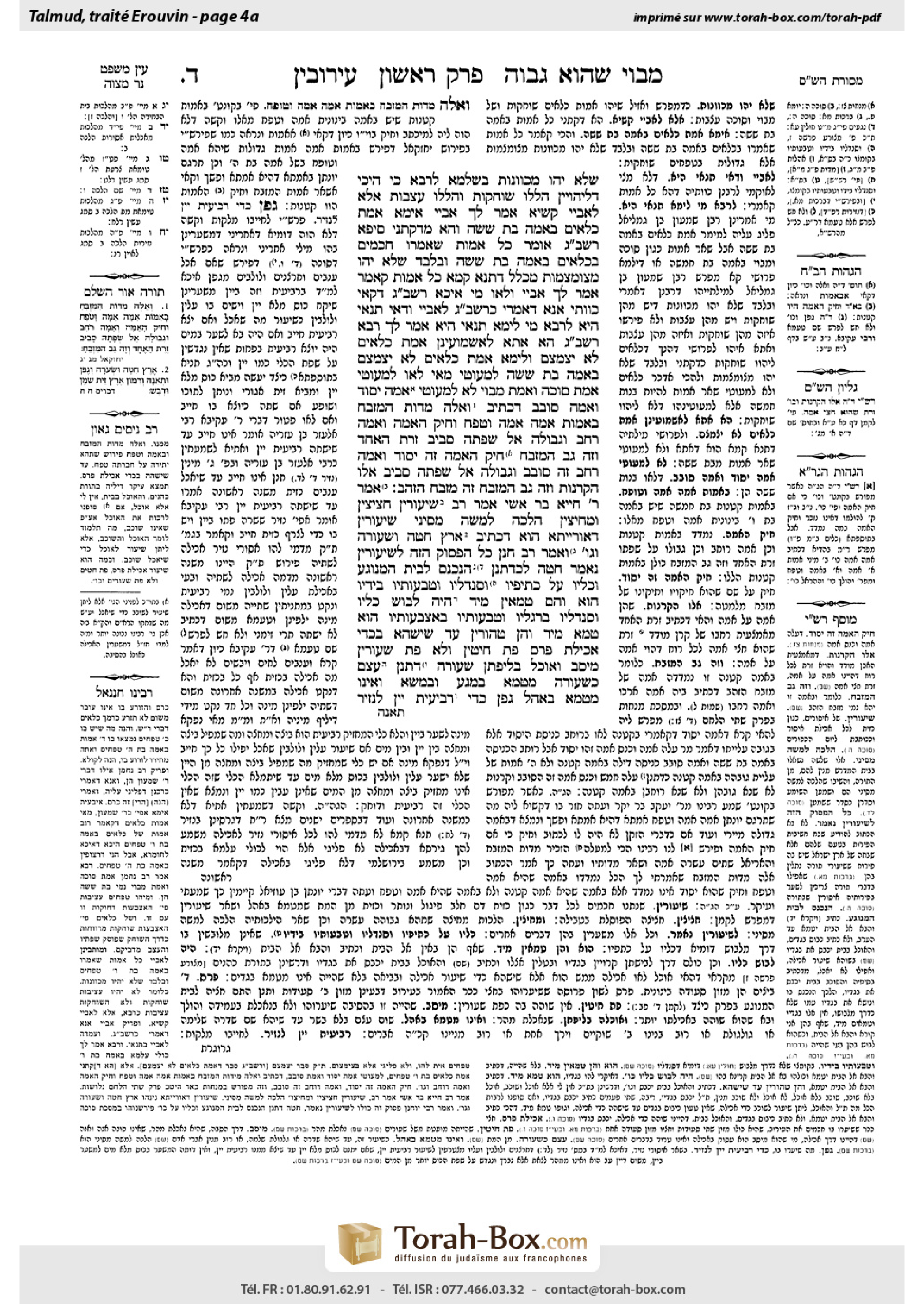
Eruvin 4a: Talmud study for Daf Yomi
Study the Talmud for Daf Yomi with scanned pages, Hebrew text, English translations from Sefaria and AI-generated French translations.
Passage selection and English or AI-generated French translation are available where the scan has annotations. Daf Study is independent of Torah-Box and Sefaria.
Browse Eruvin · עירובין · All tractatesEruvin 4a text and translations
This page of Eruvin includes the Aramaic text, an English translation and an AI-generated French translation, alongside the scan above.
עירובין ד׳ א · Aramaic and Hebrew text
שֶׁלֹּא יְהוּ מְכֻוּוֹנוֹת. בִּשְׁלָמָא לְרָבָא — כִּי הֵיכִי דְּלִיהֶוְיָין הַלָּלוּ שׂוֹחֲקוֹת וְהַלָּלוּ עֲצֵבוֹת. אֶלָּא לְאַבָּיֵי קַשְׁיָא!
אָמַר לָךְ אַבָּיֵי, אֵימָא: אַמַּת כִּלְאַיִם בְּאַמָּה בַּת שִׁשָּׁה.
וְהָא מִדְּקָתָנֵי סֵיפָא: רַבָּן שִׁמְעוֹן בֶּן גַּמְלִיאֵל אוֹמֵר: כׇּל אַמּוֹת שֶׁאָמְרוּ חֲכָמִים בְּכִלְאַיִם בְּאַמָּה בַּת שִׁשָּׁה, וּבִלְבַד שֶׁלֹּא יְהוּ מְצוּמְצָמוֹת, מִכְּלָל דְּתַנָּא קַמָּא כׇּל אַמּוֹת קָאָמַר!
אָמַר לָךְ אַבָּיֵי: וְלָאו מִי אִיכָּא רַבָּן שִׁמְעוֹן בֶּן גַּמְלִיאֵל דְּקָאֵי כְּווֹתִי, אֲנָא דַּאֲמַרִי כְּרַבָּן שִׁמְעוֹן בֶּן גַּמְלִיאֵל.
לְאַבָּיֵי וַדַּאי תַּנָּאֵי הִיא. לְרָבָא מִי לֵימָא תַּנָּאֵי הִיא?
אָמַר לָךְ רָבָא: רַבָּן שִׁמְעוֹן בֶּן גַּמְלִיאֵל הָא אֲתָא לְאַשְׁמוֹעִינַן: אַמַּת כִּלְאַיִם לֹא יְצַמְצֵם.
וְלֵימָא: ״אַמַּת כִּלְאַיִם לֹא יְצַמְצֵם״, בְּאַמָּה בַּת שִׁשָּׁה לְמַעוֹטֵי מַאי? לָאו לְמַעוֹטֵי אַמַּת סוּכָּה וְאַמַּת מָבוֹי?
לָא, לְמַעוֹטֵי אַמָּה יְסוֹד וְאַמָּה סוֹבֵב,
דִּכְתִיב: ״וְאֵלֶּה מִדּוֹת הַמִּזְבֵּחַ בָּאַמּוֹת אַמָּה אַמָּה וָטֹפַח וְחֵיק הָאַמָּה וְאַמָּה רֹחַב וּגְבוּלָהּ אֶל שְׂפָתָהּ סָבִיב זֶרֶת הָאֶחָד וְזֶה גַּב הַמִּזְבֵּחַ״. ״חֵיק הָאַמָּה״ — זֶה יְסוֹד, ״וְאַמָּה רֹחַב״ — זֶה סוֹבֵב, ״וּגְבוּלָהּ אֶל שְׂפָתָהּ סָבִיב״ — אֵלּוּ הַקְּרָנוֹת, ״וְזֶה גַּב הַמִּזְבֵּחַ״ — זֶה מִזְבַּח הַזָּהָב.
אָמַר רַבִּי חִיָּיא בַּר אָשֵׁי אָמַר רַב: שִׁיעוּרִין חֲצִיצִין וּמְחִיצִין, הֲלָכָה לְמֹשֶׁה מִסִּינַי.
שִׁיעוּרִין?! דְּאוֹרָיְיתָא הוּא! דִּכְתִיב: ״אֶרֶץ חִטָּה וּשְׂעוֹרָה וְגוֹ׳״, וְאָמַר רַב חָנָן: כׇּל הַפָּסוּק הַזֶּה לְשִׁיעוּרִין נֶאֱמַר —
״חִטָּה״, לִכְדִתְנַן: הַנִּכְנָס לַבַּיִת הַמְנוּגָּע וְכֵלָיו עַל כְּתֵיפָיו, וְסַנְדָּלָיו וְטַבְּעוֹתָיו בְּיָדָיו — הוּא וְהֵם טְמֵאִין מִיָּד. הָיָה לָבוּשׁ כֵּלָיו, וְסַנְדָּלָיו בְּרַגְלָיו, וְטַבְּעוֹתָיו בְּאֶצְבְּעוֹתָיו הוּא טָמֵא מִיָּד, וְהֵן טְהוֹרִין עַד שֶׁיִּשְׁהֶא בִּכְדֵי אֲכִילַת פְּרָס — פַּת חִיטִּין וְלֹא פַּת שְׂעוֹרִין, מֵיסֵב וְאוֹכֵל בְּלִיפְתָּן.
״שְׂעוֹרָה״, דִּתְנַן: עֶצֶם כִּשְׂעוֹרָה מְטַמֵּא בְּמַגָּע וּבְמַשָּׂא, וְאֵינוֹ מְטַמֵּא בְּאֹהֶל.
״גֶּפֶן״: כְּדֵי רְבִיעִית יַיִן לְנָזִיר.
Eruvin 4a · English translation
that they are not precisely a cubit. Granted, according to Rava, the baraita means: So that these, the cubits of diverse kinds of seeds, should be measured with expansive handbreadths, and those, the cubits of sukka, should be measured with depressed handbreadths. However, according to Abaye, it is difficult.
The Gemara answers: Abaye could have said to you: Emend the baraita and say: The cubit of diverse kinds of seeds mentioned by the Sages is measured with a cubit of six handbreadths, not the other cubits.
The Gemara raises a difficulty. However, from the fact that it is taught in the latter clause of the baraita that Rabban Shimon ben Gamliel says: All the cubits that the Sages mentioned with regard to diverse kinds of seeds are measured with cubits of six handbreadths, provided that they are not measured with exact handbreadths? This proves by inference that the anonymous first tanna is speaking of all cubits, and not only those in the case of diverse kinds of seeds.
The Gemara answers that Abaye could have said to you: Isn’t there Rabban Shimon ben Gamliel, who holds in accordance with my opinion? I stated my opinion in accordance with the opinion of Rabban Shimon ben Gamliel.
The Gemara comments: According to Abaye, the issue of large and small cubits is certainly subject to a dispute between tanna’im, as his ruling can only be in accordance with the opinion of Rabban Shimon ben Gamliel. According to Rava, however, must it be said that this is subject to a dispute between tanna’im?
The Gemara answers: This is not necessarily the case, as Rava could have said to you: Rabban Shimon ben Gamliel does not dispute the basic teaching of the anonymous first tanna that all the cubits mentioned by the Sages are cubits of six handbreadths. Rather, he came to teach us this: One should not reduce the cubit of diverse kinds of seeds, i.e., one should not measure it with depressed handbreadths.
The Gemara raises an objection. And if that is the case, let him say: One must not reduce the cubit of diverse kinds of seeds. What does the phrase: A cubit consisting of six handbreadths come to exclude? Does it not come to exclude the cubit of a sukka and the cubit of an alleyway, which are measured with cubits of five handbreadths?
The Gemara rejects this argument. No, Rabban Shimon ben Gamliel’s formulation comes to exclude the cubit of the base of the altar, which is the bottom level of the altar, one cubit high with a ledge one cubit wide, and the cubit of the surrounding ledge of the altar, which is five cubits above the base, six cubits above the ground, and one cubit wide. Everyone agrees that those cubits are small cubits of five handbreadths.
As it is written: “And these are the measures of the altar by cubits; the cubit is a cubit and a handbreadth, the bottom shall be a cubit, and the breadth a cubit, and its border by its edge round about shall be a span: And this shall be the higher part of the altar” (Ezekiel 43:13). And the Sages explained this verse as follows: “The bottom shall be a cubit,” this is the base of the altar; “and the breadth a cubit,” this is the surrounding ledge of the altar; “and its border by its edge round about,” these are the horns of the altar, i.e., extensions of the corners of the altar; “and this shall be the higher part of the altar,” this refers to the golden altar that stood inside the Sanctuary and was also measured by small cubits.
Since the Gemara discussed measurements, it proceeds to cite that which Rabbi Ḥiyya bar Ashi said that Rav said: The measures relating to mitzvot in the Torah, and the halakhot governing interpositions that invalidate ritual immersions, and the halakhot of partitions are all halakhot transmitted to Moses from Sinai. These halakhot have no basis in the Written Torah, but according to tradition they were orally transmitted by God to Moses together with the Written Torah.
The Gemara questions this assertion: Are measures a halakha transmitted to Moses from Sinai? They are written in the Torah, as it is written: “A land of wheat, and barley, and vines, and figs, and pomegranates, a land of olive oil and honey” (Deuteronomy 8:8), and Rav Ḥanan said: This entire verse was stated for the purpose of teaching measures with regard to different halakhot in the Torah.
Wheat was mentioned as the basis for calculating the time required for one to become ritually impure when entering a house afflicted with leprosy, as that which we learned in a mishna: One who enters a house afflicted with leprosy of the house (see Leviticus 14), and his clothes are draped over his shoulders, and his sandals and his rings are in his hands, both he and they, the clothes, sandals, and rings, immediately become ritually impure. However, if he was dressed in his clothes, and his sandals were on his feet, and his rings were on his fingers, he immediately becomes ritually impure, but they, the clothes, sandals, and rings, remain pure until he stays in the house long enough to eat half a loaf of bread. This calculation is based on wheat bread, which takes less time to eat, and not on barley bread, and it relates to one who is reclining and eating it together with relish, which hastens the eating. This is a Torah measurement connected specifically to wheat.
Barley is also used as a basis for measurements, as we learned in a mishna: A bone from a corpse the size of a grain of barley imparts ritual impurity through contact and by being carried, but it does not impart impurity by means of a tent, i.e., if the bone was inside a house, it does not render all the articles in the house ritually impure.
The halakhic measure determined by a vine is the quantity of a quarter-log of wine for a nazirite. A nazirite, who is prohibited to drink wine, is liable to be flogged if he drinks that measure.
Eruvin 4a · Traduction française (IA)
qu'ils ne sont pas précisément un cubit. En effet, selon Rava, la baraïta signifie : Afin que ces cubits, ceux des diverses semences, soient mesurés avec des paumes étendues, et ceux, les cubits de la sukka, soient mesurés avec des paumes abaissées. Cependant, selon Abaye, cela est difficile.
Le Guemara répond : Abaye aurait pu te dire : Corrige la baraïta et dis : Le cubit des diverses semences mentionné par les Sages est mesuré avec un cubit de six paumes, et non les autres cubits.
Le Guemara soulève une difficulté. Cependant, du fait qu'il est enseigné dans la seconde partie de la baraïta que Rabban Shimon ben Gamliel dit : Tous les cubits mentionnés par les Sages concernant les diverses semences sont mesurés avec des cubits de six paumes, à condition qu'ils ne soient pas mesurés avec des paumes exactes. Cela prouve par déduction que le tanna anonyme premier parle de tous les cubits, et non seulement ceux dans le cas des diverses semences.
Le Guemara répond que Abaye aurait pu te dire : N'est-ce pas Rabban Shimon ben Gamliel, qui suit mon opinion ? J'ai exprimé mon opinion selon l'opinion de Rabban Shimon ben Gamliel.
Le Guemara commente : Selon Abaye, la question des cubits grands et petits est certainement sujette à un débat entre les tannaïm, car sa décision ne peut être que selon l'opinion de Rabban Shimon ben Gamliel. Selon Rava, cependant, doit-on dire que cela est sujette à un débat entre les tannaïm ?
Le Guemara répond : Ce n'est pas nécessairement le cas, car Rava aurait pu te dire : Rabban Shimon ben Gamliel ne conteste pas la base enseignée par le tanna anonyme premier, selon lequel tous les cubits mentionnés par les Sages sont des cubits de six paumes. Il a simplement voulu nous enseigner cela : On ne doit pas réduire le cubit des diverses semences, c'est-à-dire on ne doit pas le mesurer avec des paumes abaissées.
Le Guemara soulève une objection. Et si c'est le cas, qu'il dise : On ne doit pas réduire le cubit des diverses semences. Quelle est la signification de la phrase : Un cubit composé de six paumes vise à exclure ? N'est-ce pas pour exclure le cubit de la sukka et le cubit de l'allée, qui sont mesurés avec des cubits de cinq paumes ?
Le Guemara rejette cet argument. Non, la formulation de Rabban Shimon ben Gamliel vise à exclure le cubit de la base de l'autel, qui est le niveau inférieur de l'autel, un cubit de haut avec une plateforme un cubit de large, et le cubit de la plateforme entourant l'autel, qui est cinq cubits au-dessus de la base, six cubits au-dessus du sol, et un cubit de large. Tout le monde convient que ces cubits sont des cubits petits de cinq paumes.
Comme il est écrit : « Et ces sont les mesures de l'autel en cubits ; le cubit est un cubit et une paume, la base sera un cubit, et la largeur un cubit, et sa bordure par son bord tout autour sera un tefach : et cela sera la partie supérieure de l'autel » (Ezechiel 43:13). Et les Sages ont expliqué cette verset ainsi : « La base sera un cubit », c'est la base de l'autel ; « et la largeur un cubit », c'est la plateforme entourant l'autel ; « et sa bordure par son bord tout autour », ce sont les cornes de l'autel, c'est-à-dire les prolongements des angles de l'autel ; « et cela sera la partie supérieure de l'autel », cela fait référence à l'autel d'or qui se trouvait à l'intérieur du Saint des Saints et qui était aussi mesuré avec des cubits petits.
Puisque le Guemara a discuté des mesures, il passe à citer ce que Rabbi Ḥiyya bar Ashi a dit que Rav a dit : Les mesures concernant les mitsvot dans la Torah, et les halakhot régissant les interpositions qui invalident les ablutions rituelles, et les halakhot des cloisons sont toutes des halakhot transmises à Moïse depuis le Sinaï. Ces halakhot n'ont pas de base dans la Torah écrite, mais selon la tradition, elles ont été transmises oralement par Dieu à Moïse ensemble avec la Torah écrite.
Le Guemara questionne cette affirmation : Les mesures sont-elles une halakha transmise à Moïse depuis le Sinaï ? Elles sont écrites dans la Torah, car il est écrit : « Une terre de blé, et de seigle, et de vigne, et de figue, et de pamplemousses, une terre d'huile d'olive et de miel » (Deutéronome 8:8), et Rav Ḥanan a dit : Cette versette a été prononcée à l'effet d'enseigner des mesures concernant différentes halakhot dans la Torah.
Le blé a été mentionné comme la base pour calculer le temps requis pour qu'une personne devienne impure rituellement en entrant dans une maison atteinte de la peste, car cela que nous avons appris dans une mitsna : Celui qui entre dans une maison atteinte de la peste de la maison (voir Lévitique 14), et ses vêtements sont sur ses épaules, et ses sandales et ses bagues sont dans ses mains, lui et eux, les vêtements, les sandales et les bagues, deviennent immédiatement impurs rituellement. Cependant, s'il était vêtu de ses vêtements, et ses sandales étaient sur ses pieds, et ses bagues étaient sur ses doigts, il devient immédiatement impur rituellement, mais eux, les vêtements, les sandales et les bagues, restent purs jusqu'à ce qu'il reste dans la maison assez longtemps pour manger une moitié de pain. Ce calcul est basé sur le pain de blé, qui prend moins de temps à manger, et non sur le pain de seigle, et il concerne celui qui s'allonge et le mange avec de la sauce, ce qui accélère la consommation. C'est une mesure de la Torah liée spécifiquement au blé.
Le seigle est également utilisé comme base pour les mesures, comme nous l'avons appris dans une mitsna : Une osselette provenant d'un cadavre, de la taille d'une graine de seigle, transmet l'impureté rituelle par contact et par transport, mais elle ne transmet pas l'impureté par le moyen d'une tente, c'est-à-dire si l'osselette était à l'intérieur d'une maison, elle ne rend pas tous les objets de la maison impurs rituellement.
La mesure halakhique déterminée par une vigne est la quantité d'un quart de log de vin pour un nazir. Un nazir, qui est interdit de boire du vin, est puni de flagellation s'il boit cette mesure.
Traduction française générée par IA à partir de l’édition anglaise de Sefaria. Vérifie toujours un passage avec le texte source.
Text from Sefaria: William Davidson Edition - Vocalized Aramaic (CC BY NC); William Davidson Edition - English (CC BY NC).