Eruvin 40b: Talmud study for Daf Yomi
Study the Talmud for Daf Yomi with scanned pages, Hebrew text, English translations from Sefaria and AI-generated French translations.
Passage selection and English or AI-generated French translation are available where the scan has annotations. Daf Study is independent of Torah-Box and Sefaria.
Browse Eruvin · עירובין · All tractatesEruvin 40b text and translations
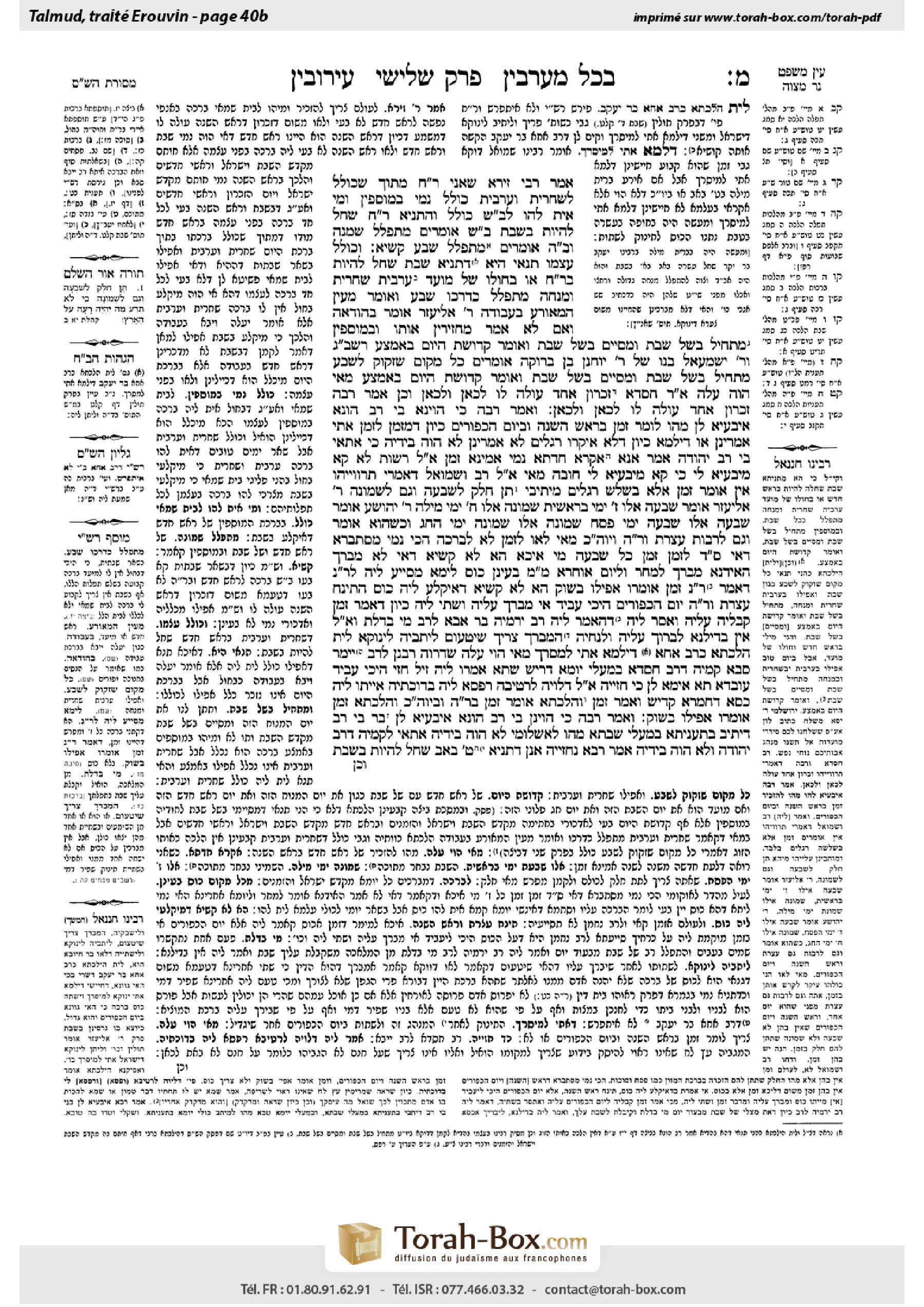
This page of Eruvin includes the Aramaic text, an English translation and an AI-generated French translation, alongside the scan above.
עירובין מ׳ ב · Aramaic and Hebrew text
אָמַר רַבִּי זֵירָא: שָׁאנֵי רֹאשׁ חֹדֶשׁ, מִתּוֹךְ שֶׁכּוֹלֵל לְשַׁחֲרִית וְעַרְבִית, כּוֹלֵל נָמֵי בְּמוּסָפִין.
וּמִי אִית לְהוּ לְבֵית שַׁמַּאי כּוֹלֵל? וְהָתַנְיָא: רֹאשׁ חֹדֶשׁ שֶׁחָל לִהְיוֹת בְּשַׁבָּת, בֵּית שַׁמַּאי אוֹמְרִים: מִתְפַּלֵּל שְׁמֹנֶה, וּבֵית הִלֵּל אוֹמְרִים: מִתְפַּלֵּל שֶׁבַע. קַשְׁיָא.
וְכוֹלֵל עַצְמוֹ — תַּנָּאֵי הִיא, דְּתַנְיָא: שַׁבָּת שֶׁחָל לִהְיוֹת בְּרֹאשׁ חֹדֶשׁ אוֹ בְּחוּלּוֹ שֶׁל מוֹעֵד, עַרְבִית שַׁחֲרִית וּמִנְחָה מִתְפַּלֵּל כְּדַרְכּוֹ שֶׁבַע, וְאוֹמֵר מֵעֵין הַמְאוֹרָע בָּעֲבוֹדָה. רַבִּי אֱלִיעֶזֶר אוֹמֵר: בַּהוֹדָאָה, וְאִם לֹא אָמַר מַחֲזִירִין אוֹתוֹ.
וּבְמוּסָפִין מַתְחִיל בְּשֶׁל שַׁבָּת, וּמְסַיֵּים בְּשֶׁל שַׁבָּת, וְאוֹמֵר קְדוּשַּׁת הַיּוֹם בָּאֶמְצַע.
רַבָּן שִׁמְעוֹן בֶּן גַּמְלִיאֵל וְרַבִּי יִשְׁמָעֵאל בְּנוֹ שֶׁל רַבִּי יוֹחָנָן בֶּן בְּרוֹקָה אוֹמְרִים: כׇּל מָקוֹם שֶׁזָּקוּק לְשֶׁבַע — מַתְחִיל בְּשֶׁל שַׁבָּת וּמְסַיֵּים בְּשֶׁל שַׁבָּת, וְאוֹמֵר קְדוּשַּׁת הַיּוֹם בָּאֶמְצַע.
מַאי הֲוָה עֲלַהּ? אָמַר רַב חִסְדָּא: זִכָּרוֹן אֶחָד עוֹלֶה לוֹ לְכָאן וּלְכָאן. וְכֵן אָמַר רַבָּה: זִכָּרוֹן אֶחָד עוֹלֶה לוֹ לְכָאן וּלְכָאן.
וְאָמַר רַבָּה: כִּי הֲוֵינָא בֵּי רַב הוּנָא, אִיבַּעְיָא לַן: מַהוּ לוֹמַר זְמַן בְּרֹאשׁ הַשָּׁנָה וּבְיוֹם הַכִּפּוּרִים? כֵּיוָן דְּמִזְּמַן לִזְמַן אָתֵי — אָמְרִינַן, אוֹ דִילְמָא כֵּיוָן דְּלֹא אִיקְּרוּ רְגָלִים לָא אָמְרִינַן. לָא הֲוָה בִּידֵיהּ.
כִּי אֲתַאי בֵּי רַב יְהוּדָה, אֲמַר: אֲנָא אַקָּרָא חַדְתָּא נָמֵי אָמֵינָא זְמַן. אָמְרִי לֵיהּ: רְשׁוּת לָא קָא מִיבַּעְיָא לִי, כִּי קָא מִיבַּעְיָא לִי חוֹבָה מַאי? אָמַר לִי: רַב וּשְׁמוּאֵל דְּאָמְרִי תַּרְוַויְיהוּ: אֵין אוֹמֵר זְמַן אֶלָּא בְּשָׁלֹשׁ רְגָלִים.
מֵיתִיבִי: ״תֶּן חֵלֶק לְשִׁבְעָה וְגַם לִשְׁמוֹנָה״, רַבִּי אֱלִיעֶזֶר אוֹמֵר: ״שִׁבְעָה״ — אֵלּוּ שִׁבְעָה יְמֵי בְּרֵאשִׁית, ״שְׁמוֹנָה״ — אֵלּוּ שְׁמוֹנָה יְמֵי מִילָה. רַבִּי יְהוֹשֻׁעַ אוֹמֵר: ״שִׁבְעָה״ — אֵלּוּ שִׁבְעָה יְמֵי פֶסַח, ״שְׁמוֹנָה״ — אֵלּוּ שְׁמוֹנָה יְמֵי הַחַג. וּכְשֶׁהוּא אוֹמֵר ״וְגַם״ — לְרַבּוֹת עֲצֶרֶת וְרֹאשׁ הַשָּׁנָה וְיוֹם הַכִּפּוּרִים.
מַאי לָאו לִזְמַן? לֹא, לִבְרָכָה.
הָכִי נָמֵי מִסְתַּבְּרָא, דְּאִי סָלְקָא דַעְתָּךְ לִזְמַן — זְמַן כׇּל שִׁבְעָה מִי אִיכָּא? הָא לָא קַשְׁיָא: דְּאִי לָא מְבָרֵךְ הָאִידָּנָא — מְבָרֵךְ לִמְחַר וּלְיוֹם אוּחְרָא.
מִכׇּל מָקוֹם — בָּעִינַן כּוֹס? לֵימָא מְסַיַּיע לֵיהּ לְרַב נַחְמָן. דְּאָמַר רַב נַחְמָן: זְמַן אוֹמְרוֹ אֲפִילּוּ בַּשּׁוּק. הָא לָא קַשְׁיָא, דְּאִיקְּלַע לֵיהּ כּוֹס.
הָתִינַח עֲצֶרֶת וְרֹאשׁ הַשָּׁנָה, יוֹם הַכִּפּוּרִים הֵיכִי עָבֵיד? אִי מְבָרֵךְ עֲלֵיהּ וְשָׁתֵי לֵיהּ — כֵּיוָן דְּאָמַר זְמַן, קַבְּלֵיהּ עֲלֵיהּ וַאֲסִר לֵיהּ.
דְּהָאֲמַר לֵיהּ רַב יִרְמְיָה בַּר אַבָּא לְרַב: מִי בָּדְלַתְּ? וַאֲמַר לֵיהּ: אִין, בָּדֵילְנָא.
לִבְרוֹךְ עֲלֵיהּ וְלַנְּחֵיהּ — הַמְבָרֵךְ צָרִיךְ שֶׁיִּטְעוֹם! לִיתְּבֵיהּ לְיָנוֹקָא — לֵית הִלְכְתָא כְּרַב אַחָא, דִּילְמָא אָתֵי לְמִסְרַךְ.
מַאי הָוֵי עֲלַהּ? שַׁדְּרוּהּ רַבָּנַן לְרַב יֵימַר סָבָא קַמֵּיהּ דְּרַב חִסְדָּא בְּמַעֲלֵי יוֹמָא דְּרֵישׁ שַׁתָּא, אֲמַרוּ לֵיהּ: זִיל חֲזִי הֵיכִי עָבֵיד עוֹבָדָא, תָּא אֵימָא לַן. כִּי חַזְיֵיהּ אֲמַר לֵיהּ: דַּלְיוּהּ לִרְטִיבָה רָפְסָא לֵיהּ בְּדוּכְתֵּיהּ. אַיְיתוֹ לֵיהּ כָּסָא דְחַמְרָא, קַדֵּישׁ וַאֲמַר זְמַן.
וְהִלְכְתָא: אוֹמֵר זְמַן בְּרֹאשׁ הַשָּׁנָה וְיוֹם הַכִּפּוּרִים. וְהִלְכְתָא: זְמַן — אוֹמְרוֹ אֲפִילּוּ בַּשּׁוּק.
וְאָמַר רַבָּה, כִּי הֲוֵינַן בֵּי רַב הוּנָא אִיבַּעְיָא לַן: בַּר בֵּי רַב דְּיָתֵיב בְּתַעֲנִיתָא בְּמַעֲלֵי שַׁבְּתָא, מַהוּ לְאַשְׁלוֹמֵי? לָא הֲוָה בִּידֵיהּ. אֲתַאי לְקַמֵּיהּ דְּרַב יְהוּדָה וְלָא הֲוָה בִּידֵיהּ.
אָמַר רָבָא: נֶחְזְיֵיהּ אֲנַן, דְּתַנְיָא: תִּשְׁעָה בְּאָב שֶׁחָל לִהְיוֹת בְּשַׁבָּת
Eruvin 40b · English translation
Rabbi Zeira said: The New Moon is different, for while it must indeed be mentioned according to Beit Shammai, it does not require a separate blessing. Since the New Moon is included in the regular morning and evening prayers without a separate blessing, it is included in the additional prayer as well without a separate blessing.
The Gemara asks: And do Beit Shammai accept the view that one should include the New Moon in the regular prayer? Wasn’t it taught in a baraita that with regard to a New Moon that occurs on Shabbat, Beit Shammai say: One must pray an Amida that includes eight blessings in the additional prayer, including a separate blessing for the New Moon; and Beit Hillel say: One must pray an Amida that includes seven blessings, as Shabbat and the New Moon are mentioned in the same blessing? Therefore, according to Beit Shammai, we do not include the New Moon and other days in the same blessing, and the fact that the New Moon does not have its own blessing on Rosh HaShana is because one mention of remembrance counts for both Rosh HaShana and New Moon. The Gemara comments: Indeed, this is difficult.
The Gemara comments: The issue of whether or not one should include the mention of the New Moon in the blessing pertaining to the sanctity of the day of Shabbat is itself the subject of a dispute between the tanna’im, as it was taught in a baraita with regard to a Shabbat that occurs on a New Moon or on one of the intermediate days of a Festival: For the evening, morning, and afternoon prayers, one prays in his usual manner and recites seven blessings, and says a passage pertaining to the event of the day, i.e. May there rise and come [ya’aleh veyavo], during the blessing of Temple service. Rabbi Eliezer disagrees and says that this passage is said during the blessing of thanksgiving. And if he did not recite it, we require him to return to the beginning of the prayer and repeat it.
And in the additional prayer, one begins the fourth blessing, the special blessing for the additional service, with Shabbat, and concludes it with Shabbat, and says a passage referring to the sanctity of the day of the New Moon or the Festival in the middle. Therefore, only in the additional prayer is the New Moon included in the blessing for the sanctity of the day.
On the other hand, Rabban Shimon ben Gamliel and Rabbi Yishmael, son of Rabbi Yoḥanan ben Beroka, say: Wherever one is obligated to recite seven blessings, including the evening, morning, and afternoon prayers, he begins the fourth blessing with Shabbat and concludes it with Shabbat, and he says a passage referring to the sanctity of the day of the New Moon or the Festival in the middle. In their opinion, the New Moon is included in the blessing of the sanctity of the day in all the prayers of the day.
Returning to the fundamental question of whether the New Moon must be mentioned separately on Rosh HaShana, the Gemara asks: What conclusion was reached about this issue? Rav Ḥisda said: One mention of remembrance counts for both this and that. And so too, Rabba said: One mention of remembrance counts for both this and that.
Having discussed the Rosh HaShana prayers, the Gemara addresses related issues. Rabba said: When I was in the house of study of Rav Huna, we raised the following dilemma: What is the halakha with regard to saying the blessing for time, i.e., Who has given us life [sheheḥeyanu], on Rosh HaShana and Yom Kippur? The two sides of the dilemma are as follows: Do we say that since these Festivals come at fixed times of the year, we recite the blessing: Who has given us life, just as we would for any other joyous event that occurs at fixed intervals? Or do we say, perhaps, that since these Festivals are not called pilgrim Festivals [regalim], we do not recite: Who has given us life, as the joy that they bring is insufficient? Rav Huna did not have an answer at hand.
When I came to the house of study of Rav Yehuda, he said: I recite the blessing for time even on a new gourd, and I certainly recite the blessing on Rosh HaShana and Yom Kippur. I said to him: I have no dilemma about the fact that one has the option of reciting the blessing for time; the dilemma I have is about whether there is an obligation to recite the blessing. What is the halakha in this regard? Rav Yehuda said to me that it was Rav and Shmuel who both said: One recites the blessing for time only on the three pilgrim Festivals.
The Gemara raises an objection based upon the following baraita: The verse states: “Give a portion to seven, and also to eight” (Ecclesiastes 11:2). Rabbi Eliezer says: “Seven,” these are the seven days of Creation; “eight,” these are the eight days until circumcision. Rabbi Yehoshua says: “Seven,” these are the seven days of Passover; “eight,” these are the eight days of the festival of Sukkot. And when it says: “And also,” like every other instance of the word “also” in the Torah, this comes to include; what it includes is Shavuot, and Rosh HaShana, and Yom Kippur.
What, is this exposition not coming to teach us that on these days one is obligated to recite the blessing for time? The Gemara responds: No, it is referring to the blessing recited over the special sanctity of the day.
The Gemara comments: So too, it is reasonable to explain, as if it would enter your mind to say that it is referring to the blessing for time, is there a blessing for time that is recited all seven days of the Festival? It is recited only on the first day. The Gemara refutes this argument: This is not difficult, as it means that if he does not recite the blessing for time now, he recites the blessing tomorrow or the following day, as all seven days are part of the pilgrim Festival.
The Gemara asks: In any case, we require that this blessing be recited over a cup of wine, and most people do not have cups of wine for the intermediate days of a Festival. Let us say that this supports Rav Naḥman, as Rav Naḥman said: The blessing for time may be recited even in the market, without a cup of wine. The Gemara responds: This is not difficult, as the case is that he happened to have a cup; but without a cup of wine, the blessing may not be recited.
The Gemara asks: Granted, one can recite the blessing over a cup of wine on Shavuot and Rosh HaShana; but what does one do on Yom Kippur? If you say that he should recite the blessing over a cup of wine before the actual commencement of Yom Kippur and drink it, there is a difficulty: Since he recited the blessing for time, he accepted the sanctity of the day upon himself, and therefore caused the wine to be prohibited to himself by the laws of Yom Kippur.
As didn’t Rav Yirmeya bar Abba say the following to Rav, upon observing him recite kiddush before the actual commencement of Shabbat: Have you therefore accepted the obligation to abstain from labor from this point on? And he said to him: Yes, I have accepted the obligation to abstain from labor. This indicates that once one recites kiddush and accepts upon himself the sanctity of the day, all the laws of the day apply to him. Accordingly, if one recited the blessing for time for Yom Kippur, he may no longer eat or drink.
And if you say that he should recite the blessing over a cup of wine and leave it and drink it only after the conclusion of Yom Kippur, this too is difficult, as the principle is that one who recites a blessing over a cup of wine must taste from it. If you say that he should give it to a child, who is not obligated to fast, this too is not feasible because the halakha is not in accordance with the opinion of Rav Aḥa, who made a similar suggestion with regard to a different matter, due to a concern that perhaps the child will come to be drawn after it. The child might come to drink wine on Yom Kippur even in future years after he comes of age, and we do not institute a practice that might turn into a stumbling block.
The Gemara asks: What conclusion was reached about this matter? Must one recite the blessing: Who has given us life, on Rosh HaShana and Yom Kippur? The Sages sent Rav Yeimar the Elder before Rav Ḥisda on the eve of Rosh HaShana. They said to him: Go, see how he acts in this regard and then come and tell us. When Rav Ḥisda saw Rav Yeimar, he said to him in the words of a folk saying: One who picks up a moist log, which is not fit for firewood, must want to do something on the spot. In other words, you certainly have come to me with some purpose in mind, and not just for a visit. They brought him a cup of wine, and he recited kiddush and the blessing for time.
The Gemara concludes: The halakha is that one recites the blessing for time on Rosh HaShana and on Yom Kippur, and the halakha is that one may recite the blessing for time even in the market, as it does not require a cup of wine.
Having discussed a question that was raised during Rabba’s student years, the Gemara now records another such question. And Rabba also said: When we were in the house of study of Rav Huna, we raised the following dilemma: A student in his master’s house who is fasting on Shabbat eve, what is the halakha with regard to whether he has to complete the fast until the end of the day? Do we perhaps say that he must stop fasting before Shabbat, so as not to enter Shabbat weary from his fast? Rav Huna did not have an answer at hand. I subsequently came before Rav Yehuda, and he too did not have an answer at hand.
Rava said: Let us look ourselves for an answer from the sources. As it was taught in a baraita in the case of the Ninth of Av that occurs on Shabbat,
Eruvin 40b · Traduction française (IA)
Rabbi Zeira a dit : La Nouvelle Lune est différente, car bien qu'elle doive effectivement être mentionnée selon l'opinion de Beit Shammai, elle ne nécessite pas une bénédiction séparée. Puisque la Nouvelle Lune est incluse dans les prières matinales et vespérales régulières sans bénédiction séparée, elle est également incluse dans la prière supplémentaire sans bénédiction séparée.
Le Guemara pose la question : Et Beit Shammai acceptent-ils l'opinion selon laquelle la Nouvelle Lune doit être incluse dans la prière régulière ? N'avait-il pas été enseigné dans une baraïta que concernant une Nouvelle Lune qui tombe un sabbat, Beit Shammai disent : On doit prier une Amida qui inclut huit bénédictions dans la prière supplémentaire, y compris une bénédiction séparée pour la Nouvelle Lune ; et Beit Hillel disent : On doit prier une Amida qui inclut sept bénédictions, car le sabbat et la Nouvelle Lune sont mentionnés dans la même bénédiction ? Ainsi, selon Beit Shammai, la Nouvelle Lune et les autres jours ne sont pas inclus dans la même bénédiction, et le fait que la Nouvelle Lune n'ait pas sa propre bénédiction sur Rosh HaShana est dû au fait qu'une mention de souvenir suffit pour les deux, Rosh HaShana et la Nouvelle Lune. Le Guemara commente : En effet, cela est difficile.
Le Guemara commente : La question de savoir si l'on doit inclure la mention de la Nouvelle Lune dans la bénédiction concernant la sainteté du jour du sabbat est elle-même l'objet d'un débat entre les tannaïm, comme il a été enseigné dans une baraïta concernant un sabbat qui tombe une Nouvelle Lune ou l'un des jours intermédiaires d'un festival : Pour les prières du soir, de la matinée et de l'après-midi, on prie selon sa manière habituelle et on récite sept bénédictions, et on dit un passage concernant l'événement du jour, c'est-à-dire Ya'aleh Veyavo, pendant la bénédiction du service du Temple. Rabbi Eliezer désaccorde et dit que ce passage est dit pendant la bénédiction de remerciement. Et si l'on n'a pas récité ce passage, on exige qu'il revienne au début de la prière et le répète.
Et dans la prière supplémentaire, on commence la quatrième bénédiction, la bénédiction spéciale pour la prière supplémentaire, avec le sabbat, et on la termine avec le sabbat, et on dit un passage concernant la sainteté du jour de la Nouvelle Lune ou du festival au milieu. Ainsi, seule dans la prière supplémentaire la Nouvelle Lune est incluse dans la bénédiction de la sainteté du jour.
Du côté opposé, Rabban Shimon ben Gamliel et Rabbi Yishmael, fils de Rabbi Yoḥanan ben Beroka, disent : Partout où l'on est tenu de réciter sept bénédictions, y compris les prières du soir, de la matinée et de l'après-midi, on commence la quatrième bénédiction avec le sabbat et on la termine avec le sabbat, et on dit un passage concernant la sainteté du jour de la Nouvelle Lune ou du festival au milieu. Selon leur opinion, la Nouvelle Lune est incluse dans la bénédiction de la sainteté du jour dans toutes les prières de la journée.
En revenant à la question fondamentale de savoir si la Nouvelle Lune doit être mentionnée séparément sur Rosh HaShana, le Guemara pose la question : Quelle conclusion a-t-on tirée à ce sujet ? Rav Ḥisda a dit : Une mention de souvenir suffit pour les deux. Et de même, Rabba a dit : Une mention de souvenir suffit pour les deux.
Ayant discuté des prières de Rosh HaShana, la Guemara aborde des questions connexes. Rabba a dit : Quand j'étais dans la maison d'étude de Rav Huna, nous avons soulevé le suivant dilemme : Quelle est la halakha concernant la récitation de la bénédiction pour le temps, c'est-à-dire Shehecheyanu, sur Rosh HaShana et Yom Kippur ? Les deux côtés du dilemme sont les suivants : Disons-nous que puisque ces fêtes arrivent à des moments fixes de l'année, on récite la bénédiction : Qui nous a donné la vie, comme on le ferait pour tout autre événement joyeux qui arrive à des moments fixes ? Ou disons-nous, peut-être, que puisque ces fêtes ne sont pas appelées fêtes de pèlerinage [regalim], on ne récite pas : Qui nous a donné la vie, car la joie qu'elles apportent est insuffisante ? Rav Huna n'avait pas de réponse à portée de main.
Quand je suis venu chez la maison d'étude de Rav Yehuda, il a dit : Je récite la bénédiction pour le temps même sur un nouveau gourde, et je récite certainement la bénédiction sur Rosh HaShana et Yom Kippur. J'ai dit à lui : Je n'ai pas de dilemme sur le fait qu'on ait l'option de réciter la bénédiction pour le temps ; le dilemme que j'ai est sur le fait de savoir s'il y a une obligation de réciter la bénédiction. Quelle est la halakha à ce sujet ? Rav Yehuda m'a dit que c'était Rav et Shmuel qui avaient tous les deux dit : On récite la bénédiction pour le temps seulement sur les trois fêtes de pèlerinage.
La Guemara soulève un objet basé sur la suivante baraïta : La Torah dit : « Donnez une part à sept, et aussi à huit » (Lévitique 11:2). Rabbi Eliezer dit : « Sept », ces sont les sept jours de la Création ; « huit », ces sont les huit jours jusqu'au circoncision. Rabbi Yehoshua dit : « Sept », ces sont les sept jours de Pessah ; « huit », ces sont les huit jours du festival de Tabernacles. Et quand il dit : « Et aussi », comme chaque autre occurrence du mot « aussi » dans la Torah, cela vient inclure ; ce qu'il inclut sont Shavuot, et Rosh HaShana, et Yom Kippur.
Qu'est-ce que cette explication ne vient pas enseigner que sur ces jours on est tenu de réciter la bénédiction pour le temps ? Le Guemara répond : Non, il s'agit de la bénédiction récitée sur la sainteté spéciale du jour.
Le Guemara commente : De même, il est raisonnable d'expliquer, comme si cela entrait dans votre esprit de dire qu'il s'agit de la bénédiction pour le temps, est-il une bénédiction pour le temps qui est récitée sur les sept jours du festival ? Elle est récitée seulement le premier jour. Le Guemara réfute cet argument : Ce n'est pas difficile, car cela signifie que si l'on ne récite pas la bénédiction pour le temps maintenant, on la récite demain ou le jour suivant, car les sept jours font partie du festival de pèlerinage.
Le Guemara pose la question : Dans tous les cas, nous exigeons que cette bénédiction soit récitée sur un verre de vin, et la plupart des gens n'ont pas de verres de vin pour les jours intermédiaires d'un festival. Disons que cela soutient R. Naḥman, car R. Naḥman a dit : La bénédiction du temps peut être récitée même dans la rue, sans verre de vin. Le Guemara répond : Ce n'est pas difficile, car le cas est celui où il a eu un verre à portée de main ; mais sans verre de vin, la bénédiction ne peut pas être récitée.
Le Guemara pose la question : C'est admis qu'on peut réciter la bénédiction sur un verre de vin pour le Sivan et la Rosh HaShana ; mais que faire le Yom Kippour ? Si vous dites qu'il doit réciter la bénédiction sur un verre de vin avant le commencement réel du Yom Kippour et boire, il y a une difficulté : puisqu'il a récité la bénédiction du temps, il a accepté la sainteté du jour sur lui-même, et donc a rendu le vin interdit à lui-même selon les lois du Yom Kippour.
Comme R. Yirmeya bar Abba n'a-t-il pas dit à R., en le voyant réciter le Kiddush avant le commencement réel du Shabbat : Ainsi tu as accepté l'obligation de ne pas travailler à partir de maintenant ? Et il a répondu à lui : Oui, j'ai accepté l'obligation de ne pas travailler. Cela montre que dès qu'on récite le Kiddush et qu'on accepte la sainteté du jour sur soi, toutes les lois du jour s'appliquent à lui. Ainsi, si on récite la bénédiction du temps pour le Yom Kippour, on ne peut plus manger ou boire.
Et si vous dites qu'il doit réciter la bénédiction sur un verre de vin et le laisser là et le boire seulement après la fin du Yom Kippour, cela est également difficile, car le principe est que celui qui récite une bénédiction sur un verre de vin doit en goûter. Si vous dites qu'il doit le donner à un enfant, qui n'est pas tenu de jeûner, cela n'est pas réalisable non plus, car la halakha n'est pas selon l'opinion de R. Aḥa, qui a fait une suggestion similaire concernant une autre question, en raison d'une crainte que l'enfant puisse être attiré par cela. L'enfant pourrait venir à boire du vin le Yom Kippour même dans les années futures après son âge adulte, et nous ne mettons pas en place une pratique qui pourrait devenir un obstacle.
Le Guemara pose la question : Quelle conclusion a-t-on tirée à ce sujet ? Doit-on réciter la bénédiction : Qui nous a donné la vie, le Rosh HaShana et le Yom Kippour ? Les Sages ont envoyé R. Yeimar le Vieux auprès de R. Ḥisda la veille du Rosh HaShana. Ils lui ont dit : Va, vois comment il agit à ce sujet et ensuite viens nous le dire. Lorsque R. Ḥisda a vu R. Yeimar, il lui a dit en paroles d'une devise populaire : Celui qui ramasse un bâton humide, qui n'est pas adapté comme bois de chauffage, veut certainement faire quelque chose sur place. En d'autres termes, tu es certainement venu vers moi avec un but précis, et non simplement pour une visite. Ils lui ont apporté un verre de vin, et il a récité le kiddush et la bénédiction du temps.
Le Guemara conclut : La halakha est que l'on récite la bénédiction du temps le Rosh HaShana et le Yom Kippour, et la halakha est que l'on peut réciter la bénédiction du temps même dans la rue, car elle ne nécessite pas un verre de vin.
Ayant discuté d'une question soulevée durant les années d'études de Rabba, le Guemara enregistre maintenant une autre telle question. Et Rabba a dit : Lorsque nous étions dans la maison d'étude de R. Huna, nous avons soulevé le suivant dilemme : Un étudiant dans la maison de son maître qui jeûne le soir du Shabbat, quelle est la halakha concernant s'il doit achever le jeûne jusqu'à la fin de la journée ? Disons-nous peut-être qu'il doit arrêter le jeûne avant le Shabbat, afin de ne pas entrer dans le Shabbat fatigué de son jeûne ? R. Huna n'avait pas de réponse à portée de main. J'ai ensuite été présenter devant R. Yehuda, et il non plus n'avait pas de réponse à portée de main.
Rava a dit : Recherchons nous-même une réponse dans les sources. Comme il a été enseigné dans une baraïta dans le cas de la neuvième de Av qui tombe un Shabbat,
Traduction française générée par IA à partir de l’édition anglaise de Sefaria. Vérifie toujours un passage avec le texte source.
Text from Sefaria: William Davidson Edition - Vocalized Aramaic (CC BY NC); William Davidson Edition - English (CC BY NC).