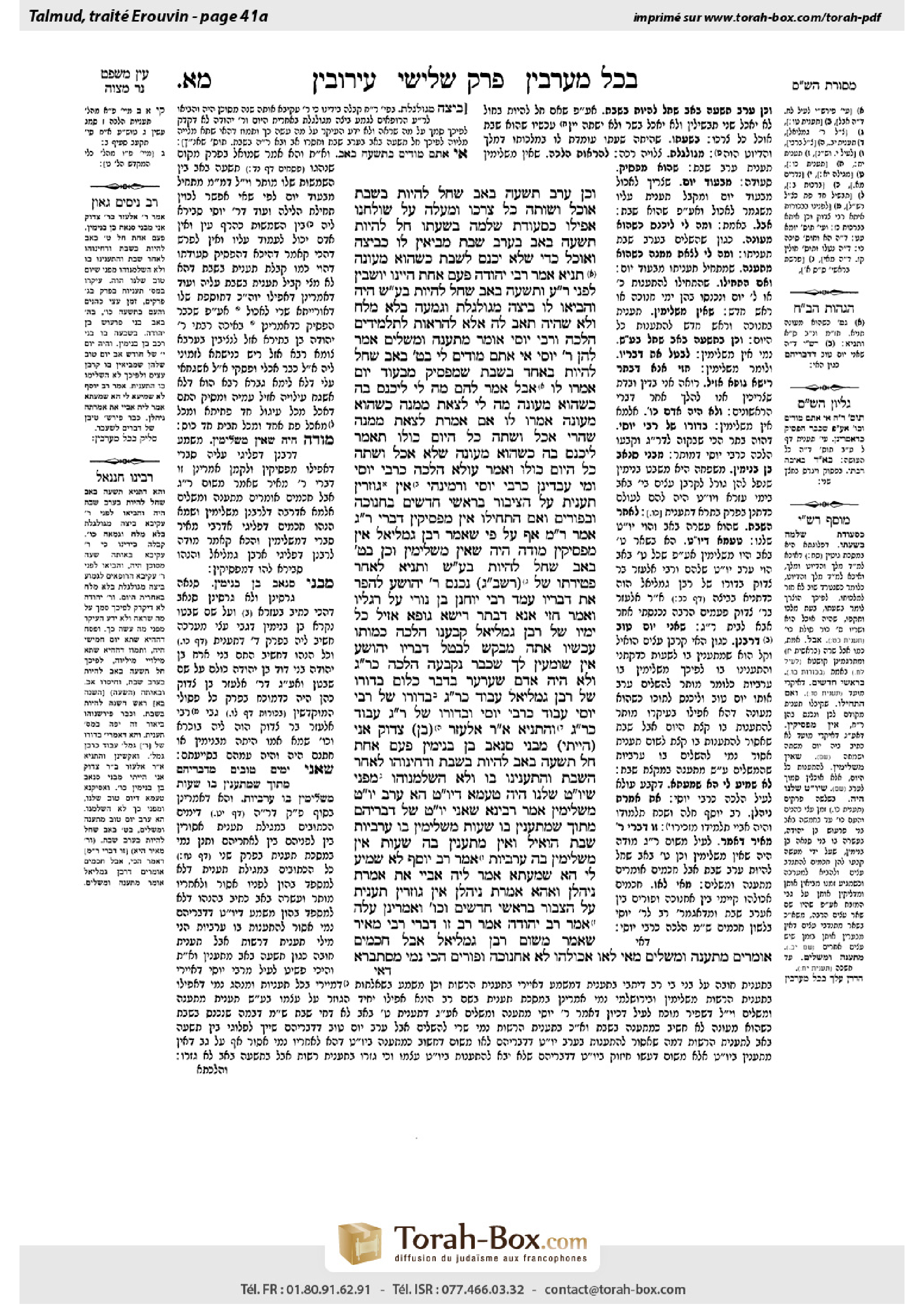
Eruvin 41a: Talmud study for Daf Yomi
Study the Talmud for Daf Yomi with scanned pages, Hebrew text, English translations from Sefaria and AI-generated French translations.
Passage selection and English or AI-generated French translation are available where the scan has annotations. Daf Study is independent of Torah-Box and Sefaria.
Browse Eruvin · עירובין · All tractatesEruvin 41a text and translations
This page of Eruvin includes the Aramaic text, an English translation and an AI-generated French translation, alongside the scan above.
עירובין מ״א א · Aramaic and Hebrew text
וְכֵן עֶרֶב תִּשְׁעָה בְּאָב שֶׁחָל לִהְיוֹת בְּשַׁבָּת, אוֹכֵל וְשׁוֹתֶה כׇּל צָרְכּוֹ, וּמַעֲלֶה עַל שׁוּלְחָנוֹ אֲפִילּוּ כִּסְעוּדַת שְׁלֹמֹה בִּשְׁעָתוֹ. חָל לִהְיוֹת תִּשְׁעָה בְּאָב בְּעֶרֶב שַׁבָּת — מְבִיאִין לוֹ כְּבֵיצָה וְאוֹכֵל, כְּדֵי שֶׁלֹּא יִכָּנֵס לַשַּׁבָּת כְּשֶׁהוּא מְעוּנֶּה.
תַּנְיָא, אָמַר רַבִּי יְהוּדָה: פַּעַם אַחַת הָיִינוּ יוֹשְׁבִין לִפְנֵי רַבִּי עֲקִיבָא, וְתִשְׁעָה בְּאָב שֶׁחָל לִהְיוֹת בְּעֶרֶב שַׁבָּת הָיָה. וְהֵבִיאוּ לוֹ בֵּיצָה מְגוּלְגֶּלֶת, וּגְמָעָהּ בְּלֹא מֶלַח. וְלֹא שֶׁהָיָה תָּאֵב לָהּ, אֶלָּא לְהַרְאוֹת לַתַּלְמִידִים הֲלָכָה.
וְרַבִּי יוֹסֵי אוֹמֵר: מִתְעַנֶּה וּמַשְׁלִים. אָמַר לָהֶן רַבִּי יוֹסֵי: אִי אַתֶּם מוֹדִים לִי בְּתִשְׁעָה בְּאָב שֶׁחָל לִהְיוֹת בְּאֶחָד בַּשַּׁבָּת, שֶׁמַּפְסִיק מִבְּעוֹד יוֹם? אָמְרוּ לוֹ: אֲבָל. אָמַר לָהֶם: מַה לִּי לִיכָּנֵס בָּהּ כְּשֶׁהוּא מְעוּנֶּה, מַה לִּי לָצֵאת מִמֶּנָּה כְּשֶׁהוּא מְעוּנֶּה.
אָמְרוּ לוֹ: אִם אָמַרְתָּ לָצֵאת מִמֶּנָּה — שֶׁהֲרֵי אָכַל וְשָׁתָה כׇּל הַיּוֹם כּוּלּוֹ, תֹּאמַר לִיכָּנֵס בָּהּ כְּשֶׁהוּא מְעוּנֶּה, שֶׁלֹּא אָכַל וְשָׁתָה כׇּל הַיּוֹם כּוּלּוֹ.
וְאָמַר עוּלָּא: הֲלָכָה כְּרַבִּי יוֹסֵי. וּמִי עָבְדִינַן כְּרַבִּי יוֹסֵי? וּרְמִינְהִי: אֵין גּוֹזְרִין תַּעֲנִית עַל הַצִּיבּוּר בְּרָאשֵׁי חֳדָשִׁים, בַּחֲנוּכָּה וּבְפוּרִים. וְאִם הִתְחִילוּ — אֵין מַפְסִיקִין, דִּבְרֵי רַבָּן גַּמְלִיאֵל. אָמַר רַבִּי מֵאִיר: אַף עַל פִּי שֶׁאָמַר רַבָּן גַּמְלִיאֵל אֵין מַפְסִיקִין, מוֹדֶה הָיָה שֶׁאֵין מַשְׁלִימִין, וְכֵן בְּתִשְׁעָה בְּאָב שֶׁחָל לִהְיוֹת בְּעֶרֶב שַׁבָּת.
וְתַנְיָא: לְאַחַר פְּטִירָתוֹ שֶׁל רַבָּן גַּמְלִיאֵל, נִכְנַס רַבִּי יְהוֹשֻׁעַ לְהָפֵר אֶת דְּבָרָיו. עָמַד רַבִּי יוֹחָנָן בֶּן נוּרִי עַל רַגְלָיו וְאָמַר: חָזֵי אֲנָא דְּבָתַר רֵישָׁא גּוּפָא אָזֵיל. כׇּל יָמָיו שֶׁל רַבָּן גַּמְלִיאֵל קָבַעְנוּ הֲלָכָה כְּמוֹתוֹ, עַכְשָׁיו אַתָּה מְבַקֵּשׁ לְבַטֵּל דְּבָרָיו?! יְהוֹשֻׁעַ, אֵין שׁוֹמְעִין לְךָ, שֶׁכְּבָר נִקְבְּעָה הֲלָכָה כְּרַבָּן גַּמְלִיאֵל, וְלֹא הָיָה אָדָם שֶׁעִרְעֵר בַּדָּבָר כְּלוּם.
בְּדוֹרוֹ שֶׁל רַבָּן גַּמְלִיאֵל עֲבוּד כְּרַבָּן גַּמְלִיאֵל, בְּדוֹרוֹ שֶׁל רַבִּי יוֹסֵי עֲבוּד כְּרַבִּי יוֹסֵי.
וּבְדוֹרוֹ שֶׁל רַבָּן גַּמְלִיאֵל עֲבוּד כְּרַבָּן גַּמְלִיאֵל? וְהָתַנְיָא, אָמַר רַבִּי אֶלְעָזָר (בֶּן) צָדוֹק: אֲנִי (הָיִיתִי) מִבְּנֵי סְנָאָב בֶּן בִּנְיָמִין. פַּעַם אַחַת חָל תִּשְׁעָה בְּאָב לִהְיוֹת בְּשַׁבָּת, וּדְחִינוּהוּ לְאַחַר הַשַּׁבָּת, וְהִתְעַנִּינוּ בּוֹ, וְלֹא הִשְׁלַמְנוּהוּ, מִפְּנֵי שֶׁיּוֹם טוֹב שֶׁלָּנוּ הָיָה. טַעְמָא דְּיוֹם טוֹב, הָא עֶרֶב יוֹם טוֹב — מַשְׁלִימִין!
אָמַר רָבִינָא: שָׁאנֵי יוֹם טוֹב שֶׁל דִּבְרֵיהֶם, מִתּוֹךְ שֶׁמִּתְעַנִּין בּוֹ שָׁעוֹת — מַשְׁלִימִין בּוֹ עַרְבִיּוֹת. שַׁבָּת, הוֹאִיל וְאֵין מִתְעַנִּין בָּהּ שָׁעוֹת — אֵין מַשְׁלִימִין בָּהּ עַרְבִיּוֹת.
אָמַר רַב יוֹסֵף: לָא שְׁמִיעַ לִי הָא שְׁמַעְתָּא. אֲמַר לֵיהּ אַבָּיֵי: אַתְּ אֲמַרְתְּ נִיהֲלַן, וְאַהָא אֲמַרְתְּ נִיהֲלַן: אֵין גּוֹזְרִין תַּעֲנִית עַל הַצִּבּוּר בְּרָאשֵׁי חֳדָשִׁים וְכוּ׳, וְאָמְרִינַן עֲלַהּ, אָמַר רַב יְהוּדָה אָמַר רַב: זוֹ דִּבְרֵי רַבִּי מֵאִיר שֶׁאָמַר מִשּׁוּם רַבָּן גַּמְלִיאֵל, אֲבָל חֲכָמִים אוֹמְרִים: מִתְעַנֶּה וּמַשְׁלִים.
מַאי לָאו, אַכּוּלְּהוּ? לָא, אַחֲנוּכָּה וּפוּרִים.
הָכִי נָמֵי מִסְתַּבְּרָא,
Eruvin 41a · English translation
and so too, on the eve of the Ninth of Av that occurs on Shabbat, one need not reduce the amount of food he eats; rather, he may eat and drink as much as he requires and bring to his table a meal even like that of King Solomon in his time. If the Ninth of Av occurs on Shabbat eve, we bring him an egg-bulk of food toward end of the day, and he eats it, so that he not enter Shabbat in a state of affliction.
It was taught in a baraita that Rabbi Yehuda said: We were once sitting before Rabbi Akiva, and it was the Ninth of Av that occurs on Shabbat eve, and they brought him a slightly cooked egg, and he swallowed it without salt. And it was not that he desired it so much that he ate it; rather, he did so to show the students the halakha that one need not complete the fast when the Ninth of Av occurs on Shabbat eve, so as not enter Shabbat in a state of affliction.
And Rabbi Yosei says: He must fast and complete the fast. Rabbi Yosei said to the other Sages: Don’t you agree with me with regard to the Ninth of Av that occurs on Sunday, that one must stop eating on Shabbat while it is still day? They said to him: Indeed, we agree. Rabbi Yosei said to them: What is the difference to me between entering Shabbat in a state of affliction and leaving it in a state of affliction? If one stops eating before Shabbat is over, he is spending part of Shabbat fasting, and yet even the Sages concede that one must do so.
They said to him: There is a difference. If you said that one may leave Shabbat in a state of affliction, that is because he ate and drank the entire day and will not suffer if he fasts a few minutes at the end of the day. Can you say that it is the same to enter Shabbat in a state of affliction, when he has not eaten or drunk anything the entire day?
And Ulla said: The halakha is in accordance with the opinion of Rabbi Yosei, and on the Ninth of Av that occurs on Shabbat eve one must complete the fast. The Gemara poses a question: Do we really act in accordance with the opinion of Rabbi Yosei? And the Gemara raises a contradiction based upon the following mishna: We do not initially decree a fast upon the public on the New Moon, Hanukkah, or Purim, and if the community had already begun a cycle of fasts and one of them fell out on one of these days, they do not interrupt the series; this is the statement of Rabban Gamliel. Rabbi Meir said: Even though Rabban Gamliel said that they do not interrupt the series, he conceded that they do not complete the fast on one of these days, and so too, the fast on the Ninth of Av that occurs on Shabbat eve is not completed.
And it was taught in a related baraita: Following the death of Rabban Gamliel, Rabbi Yehoshua entered the study hall to annul Rabban Gamliel’s statement with regard to fasts. Rabbi Yoḥanan ben Nuri stood on his feet and said: I see that the appropriate policy is that the body must follow the head, i.e., we must follow the statements of the earlier authorities and not deviate from established halakha. All of Rabban Gamliel’s life we established the halakha in accordance with his opinion, and now you seek to annul his statement? Yehoshua, we do not listen to you, as the halakha has already been established in accordance with the opinion of Rabban Gamliel. And there was no one who disputed this statement in any way. Therefore, this baraita demonstrates that when the Ninth of Av occurs on Shabbat eve, one must observe the fast but not complete it, and this was the accepted practice.
The Gemara resolves the difficulty, arguing that this proof is not conclusive: Indeed, in the generation of Rabban Gamliel they acted in accordance with the opinion of Rabban Gamliel, but in the generation of Rabbi Yosei they acted in accordance with the opinion of Rabbi Yosei, and from then on, the halakha follows his view.
The Gemara asks: And is it correct that in the generation of Rabban Gamliel they acted in accordance with the opinion of Rabban Gamliel? Wasn’t it taught in a baraita that Rabbi Elazar ben Tzadok, a contemporary of Rabban Gamliel, said: I am a descendant of Sena’av ben Binyamin, who observed a family festival on the tenth of Av. One time, the Ninth of Av occurred on Shabbat, and we postponed it until after Shabbat, as we do not observe the fast on Shabbat, and we fasted on Sunday but did not complete the fast because that day was our Festival. This indicates that the reason they did not complete the fast is that the day itself was a Festival for them, but on the eve of a Festival, they would indeed complete it. This proves that even in the generation of Rabban Gamliel, they did complete fasts on the eve of Shabbat and Festivals.
Ravina said that this story poses no difficulty: A rabbinic Festival is different, as they are not as stringent as Shabbat or Festivals stated in the Torah, and the festival of the family of Sena’av was not a Festival from the Torah, but one established by the Sages. Since one may fast on such a Festival for a number of hours, i.e., one may fast on it for part of the day, one also completes a fast observed on the eve of such a Festival until the evening. With regard to Shabbat, however, since one may not fast on it even for several hours, one does not complete a fast observed on Shabbat eve.
Rav Yosef said: I did not hear this ruling that the halakha is in accordance with the opinion of Rabbi Yosei. Rav Yosef had fallen ill and forgotten his learning and so was unable to remember that such a ruling had been issued. His student, Abaye, said to him: You yourself told us this halakha, and it was with regard to this point that you told it to us, as we learned in a mishna: We do not initially decree a fast upon the public on the New Moon, on Hanukkah, or on Purim. Rabbi Meir said: Even though Rabban Gamliel said that if the community had already begun a cycle of fasts, they do not interrupt the series, he conceded that they do not complete the fast on one of these days, and similarly, the fast of the Ninth of Av that occurs on Shabbat eve is not completed. And we said with regard to this mishna that Rav Yehuda said that Rav said: This is the statement that Rabbi Meir said in the name of Rabban Gamliel. But the Rabbis say: One must fast and complete the fast.
What? Does the Rabbis’ ruling that one must complete the fast not refer to all the cases mentioned in the mishna, including that of the Ninth of Av that occurs on Shabbat eve? No, it was stated only with regard to Hanukkah and Purim, but one would not complete a fast on Shabbat eve.
The Gemara comments: So too, it is reasonable to explain that this ruling does not apply to Shabbat eve,
Eruvin 41a · Traduction française (IA)
Et de même, le soir de la neuvième de l'Av qui tombe un sabbat, on ne doit pas réduire la quantité de nourriture qu'on mange ; plutôt, on peut manger et boire autant que nécessaire et présenter à sa table un repas même semblable à celui du roi Salomon à son époque. Si la neuvième de l'Av tombe le soir du sabbat, on lui apporte une quantité d'aliments égale à un œuf vers la fin de la journée, et il les mange, afin qu'il ne pénètre pas le sabbat dans un état de tristesse.
Il fut enseigné dans une baraïta que Rabbi Yéhuda dit : Nous étions assis devant Rabbi Akiva, et c'était la neuvième de l'Av qui tombait le soir du sabbat, et on lui apporta un œuf légèrement cuit, qu'il engloutit sans sel. Et ce n'était pas parce qu'il avait envie de le manger qu'il le mangeait ; plutôt, il le fit pour montrer aux élèves la halakha selon laquelle on ne doit pas achever le jeûne lorsque la neuvième de l'Av tombe le soir du sabbat, afin de ne pas entrer dans le sabbat dans un état de tristesse.
Et Rabbi Yosei dit : Il doit jeûner et achever le jeûne. Rabbi Yosei dit aux autres Sages : Ne vous êtes-vous pas d'accord avec moi concernant la neuvième de l'Av qui tombe un dimanche, que l'on doit arrêter de manger le sabbat pendant qu'il est encore jour ? Ils lui dirent : En effet, nous sommes d'accord. Rabbi Yosei dit à ceux-ci : Qu'y a-t-il de différent pour moi entre entrer le sabbat dans un état de tristesse et en sortir dans un état de tristesse ? Si l'on arrête de manger avant que le sabbat ne soit terminé, on passe une partie du sabbat à jeûner, et même les Sages reconnaissent qu'on doit le faire.
Ils lui dirent : Il y a une différence. Si vous dites qu'on peut sortir du sabbat dans un état de détresse, c'est parce qu'on a mangé et bu toute la journée et qu'on ne souffrira pas s'il jeûne quelques minutes à la fin de la journée. Pourriez-vous dire que c'est la même chose d'entrer le sabbat dans un état de détresse, quand on n'a pas mangé ou bu toute la journée ?
Et Ulla dit : La halakha suit l'opinion de Rabbi Yosei, et lors de la neuvième de l'Av qui tombe le soir du sabbat, on doit achever le jeûne. La Guemara pose une question : Nous agissons vraiment selon l'opinion de Rabbi Yosei ? Et la Guemara soulève une contradiction basée sur la suivante mitsva : Nous ne décrétons pas initialement un jeûne public sur la nouvelle lune, Hanoukka ou Purim, et si la communauté avait déjà commencé une série de jeûnes et l'un d'entre eux tombait sur l'un de ces jours, ils ne l'interrompent pas ; c'est l'opinion de Rabban Gamliel. Rabbi Meir dit : Même si Rabban Gamliel a dit qu'ils ne l'interrompent pas, il a admis qu'ils ne terminent pas le jeûne sur l'un de ces jours, et de même, le jeûne de la neuvième de l'Av qui tombe le soir du sabbat n'est pas achevé.
Et il fut enseigné dans une baraïta liée : Après la mort de Rabban Gamliel, Rabbi Yéhoshua entra dans la salle de study pour annuler l'opinion de Rabban Gamliel concernant les jeûnes. Rabbi Yochanan ben Nuri se leva et dit : Je vois que la politique appropriée est que le corps doit suivre la tête, c'est-à-dire que nous devons suivre les paroles des autorités précédentes et ne pas dévier de la halakha établie. Toute la vie de Rabban Gamliel, nous avons établi la halakha selon son opinion, et maintenant vous cherchez à annuler son décret ? Yéhoshua, nous ne t'écoutons pas, car la halakha a déjà été établie selon l'opinion de Rabban Gamliel. Et personne n'a contesté cette déclaration d'une manière quelconque. Ainsi, cette baraïta démontre que lors de la neuvième de l'Av qui tombe le soir du sabbat, on doit observer le jeûne mais ne pas l'achever, et c'était la pratique acceptée.
La Guemara résout cette difficulté, en argumentant que cette preuve n'est pas concluante : En effet, dans la génération de Rabban Gamliel, ils agissaient selon l'opinion de Rabban Gamliel, mais dans la génération de Rabbi Yosei, ils agissaient selon l'opinion de Rabbi Yosei, et depuis lors, la halakha suit son point de vue.
La Guemara demande : Et est-ce correct que dans la génération de Rabban Gamliel, ils agissaient selon son opinion ? N'était-ce pas enseigné dans une baraïta que Rabbi Eléazar ben Tzadok, un contemporain de Rabban Gamliel, a dit : Je suis descendant de Sena'av ben Binyamin, qui célébrait un festival familial le dixième d'Av. Une fois, la neuvième d'Av tomba un sabbat, et nous l'avons reportée après le sabbat, car nous ne jeûnons pas le sabbat, et nous avons jeûné le dimanche mais n'avons pas achevé le jeûne car ce jour était notre festival. Cela montre que la raison pour laquelle ils n'ont pas achevé le jeûne est que ce jour-là était un festival pour eux, mais lors de l'eve de festival, ils auraient effectivement achevé le jeûne. Cela prouve que même dans la génération de Rabban Gamliel, ils achevaient les jeûnes lors de l'eve du sabbat et des festivals.
Ravina dit que cette histoire ne pose pas de difficulté : un festival rabbinique est différent, car ils ne sont pas aussi stricts que le sabbat ou les festivals mentionnés dans la Torah, et le festival de la famille de Sena'av n'était pas un festival de la Torah, mais un festival établi par les Sages. Puisque l'on peut jeûner sur de tels festivals pendant plusieurs heures, c'est-à-dire que l'on peut jeûner sur eux pendant une partie de la journée, l'on acheve aussi un jeûne observé lors de l'eve de tels festivals jusqu'au soir. En ce qui concerne le sabbat, cependant, puisque l'on ne peut pas jeûner même pendant plusieurs heures, l'on ne termine pas un jeûne observé lors de l'eve du sabbat.
Rav Yosef dit : Je n'ai pas entendu cette décision selon laquelle la halakha suit l'opinion de Rabbi Yosei. Rav Yosef avait été malade et avait oublié ses études, et donc n'avait pas pu se souvenir que telle décision avait été rendue. Son élève, Abaye, lui dit : Vous-même nous avez dit cette halakha, et c'était à ce sujet que vous nous l'avez dit, comme nous l'avons appris dans une mishna : Nous ne décrétons pas initialement un jeûne public sur la nouvelle lune, sur Hanoukka ou sur Purim. Rabbi Meir dit : Même si Rabban Gamliel a dit que si la communauté avait déjà commencé une série de jeûnes, ils ne l'interrompent pas, il a admis qu'ils ne terminent pas le jeûne sur l'un de ces jours, et de même, le jeûne de la neuvième de l'Av qui tombe le soir du sabbat n'est pas achevé. Et nous avons dit concernant cette mishna que Rav Yéhuda a dit que Rav a dit : C'est l'opinion que Rabbi Meir a exprimée au nom de Rabban Gamliel. Mais les Rabbins disent : On doit jeûner et achever le jeûne.
Quelle est la chose? La décision des Sages selon laquelle on doit achever le jeûne ne s'applique-t-elle pas à tous les cas mentionnés dans la mishna, y compris celui du neuvième d'Av qui tombe à la veille du sabbat? Non, elle a été émise uniquement concernant Hanouka et Purim, mais on ne jeûne pas à la veille du sabbat.
La Guemara commente : De même, il est raisonnable d'expliquer que cette décision ne s'applique pas à la veille du sabbat,
Traduction française générée par IA à partir de l’édition anglaise de Sefaria. Vérifie toujours un passage avec le texte source.
Text from Sefaria: William Davidson Edition - Vocalized Aramaic (CC BY NC); William Davidson Edition - English (CC BY NC).