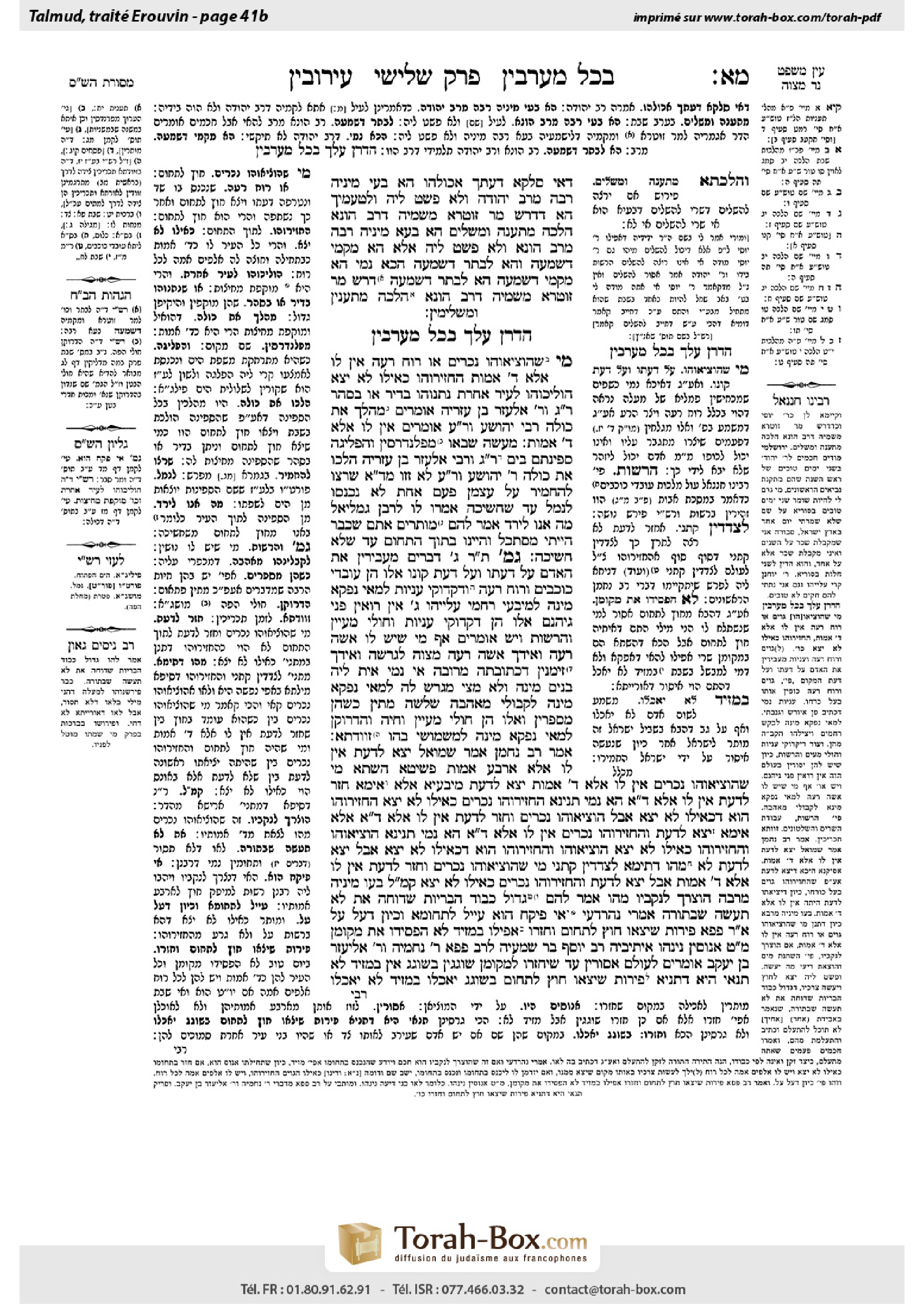
Eruvin 41b: Talmud study for Daf Yomi
Study the Talmud for Daf Yomi with scanned pages, Hebrew text, English translations from Sefaria and AI-generated French translations.
Passage selection and English or AI-generated French translation are available where the scan has annotations. Daf Study is independent of Torah-Box and Sefaria.
Browse Eruvin · עירובין · All tractatesEruvin 41b text and translations
This page of Eruvin includes the Aramaic text, an English translation and an AI-generated French translation, alongside the scan above.
עירובין מ״א ב · Aramaic and Hebrew text
דְּאִי סָלְקָא דַעְתָּךְ אַכּוּלְּהוּ — הָא בָּעֵי מִינֵּיהּ רַבָּה מֵרַב יְהוּדָה וְלָא פְּשַׁט לֵיהּ!
וּלְטַעְמָיךְ, הָא דְּדָרֵשׁ מָר זוּטְרָא מִשְּׁמֵיהּ דְּרַב הוּנָא: הֲלָכָה, מִתְעַנֶּה וּמַשְׁלִים. הָא בְּעָא מִינֵּיהּ רַבָּה מֵרַב הוּנָא וְלָא פְּשַׁט לֵיהּ?!
אֶלָּא: הָא — מִקַּמֵּי דְּשַׁמְעַהּ, וְהָא — לְבָתַר דְּשַׁמְעַהּ, הָכָא נָמֵי: הָא — מִקַּמֵּי דְּשַׁמְעַהּ, הָא — לְבָתַר דְּשַׁמְעַהּ.
דָּרֵשׁ מָר זוּטְרָא מִשְּׁמֵיהּ דְּרַב הוּנָא: הֲלָכָה, מִתְעַנִּין וּמַשְׁלִימִין.
הַדְרָן עֲלָךְ בַּכֹּל מְעָרְבִין
מַתְנִי׳ מִי שֶׁהוֹצִיאוּהוּ נׇכְרִים, אוֹ רוּחַ רָעָה — אֵין לוֹ אֶלָּא אַרְבַּע אַמּוֹת.
הֶחְזִירוּהוּ — כְּאִילּוּ לֹא יָצָא.
הוֹלִיכוּהוּ לְעִיר אַחֶרֶת, נְתָנוּהוּ בְּדִיר אוֹ בְּסַהַר, רַבָּן גַּמְלִיאֵל וְרַבִּי אֶלְעָזָר בֶּן עֲזַרְיָה אוֹמְרִים: מְהַלֵּךְ אֶת כּוּלָּהּ. רַבִּי יְהוֹשֻׁעַ וְרַבִּי עֲקִיבָא אוֹמְרִים: אֵין לוֹ אֶלָּא אַרְבַּע אַמּוֹת.
מַעֲשֶׂה שֶׁבָּאוּ מִפְּלַנְדַּרְסִין, וְהִפְלִיגָה סְפִינָתָם בַּיָּם. רַבָּן גַּמְלִיאֵל וְרַבִּי אֶלְעָזָר בֶּן עֲזַרְיָה הָלְכוּ אֶת כּוּלָּהּ, רַבִּי יְהוֹשֻׁעַ וְרַבִּי עֲקִיבָא לֹא זָזוּ מֵאַרְבַּע אַמּוֹת, שֶׁרָצוּ לְהַחֲמִיר עַל עַצְמָן.
פַּעַם אַחַת לֹא נִכְנְסוּ לַנָּמָל עַד שֶׁחָשֵׁיכָה, אָמְרוּ לוֹ לְרַבָּן גַּמְלִיאֵל: מָה אָנוּ לֵירֵד?
אָמַר לָהֶם: מוּתָּרִים אַתֶּם, שֶׁכְּבָר הָיִיתִי מִסְתַּכֵּל וְהָיִינוּ בְּתוֹךְ הַתְּחוּם עַד שֶׁלֹּא חָשֵׁיכָה.
גְּמָ׳ תָּנוּ רַבָּנַן: שְׁלֹשָׁה דְּבָרִים מַעֲבִירִין אֶת הָאָדָם עַל דַּעְתּוֹ וְעַל דַּעַת קוֹנוֹ, אֵלּוּ הֵן: נׇכְרִים, וְרוּחַ רָעָה, וְדִקְדּוּקֵי עֲנִיּוּת.
לְמַאי נָפְקָא מִינַּהּ? לְמִיבְעֵי רַחֲמֵי עֲלַיְיהוּ.
שְׁלֹשָׁה אֵין רוֹאִין פְּנֵי גֵיהִנָּם, אֵלּוּ הֵן: דִּקְדּוּקֵי עֲנִיּוּת, וְחוֹלֵי מֵעַיִין, וְהָרְשׁוּת. וְיֵשׁ אוֹמְרִים: אַף מִי שֶׁיֵּשׁ לוֹ אִשָּׁה רָעָה.
וְאִידָּךְ? אִשָּׁה רָעָה מִצְוָה לְגָרְשָׁהּ.
וְאִידָּךְ? זִימְנִין דִּכְתוּבָּתָהּ מְרוּבָּה. אִי נָמֵי, אִית לֵיהּ בָּנִים מִינַּהּ, וְלָא מָצֵי מְגָרֵשׁ לַהּ.
לְמַאי נָפְקָא מִינַּהּ? לְקַבּוֹלֵי מֵאַהֲבָה.
שְׁלֹשָׁה מֵתִין כְּשֶׁהֵן מְסַפְּרִין, וְאֵלּוּ הֵן: חוֹלִי מֵעַיִין, וְחַיָּה, וְהִדְרוֹקָן.
לְמַאי נָפְקָא מִינַּהּ: לְמַשְׁמוֹשֵׁי בְּהוּ זְוַודְתָּא.
אָמַר רַב נַחְמָן אָמַר שְׁמוּאֵל: יָצָא לְדַעַת — אֵין לוֹ אֶלָּא אַרְבַּע אַמּוֹת. פְּשִׁיטָא, הַשְׁתָּא מִי שֶׁהוֹצִיאוּהוּ נׇכְרִים אֵין לוֹ אֶלָּא אַרְבַּע אַמּוֹת, יָצָא לְדַעַת מִיבַּעְיָא?!
אֶלָּא אֵימָא: חָזַר לְדַעַת — אֵין לוֹ אֶלָּא אַרְבַּע אַמּוֹת.
הָא נָמֵי תְּנֵינָא: הֶחְזִירוּהוּ נׇכְרִים כְּאִילּוּ לֹא יָצָא. הֶחְזִירוּהוּ הוּא דִּכְאִילּוּ לֹא יָצָא, אֲבָל הוֹצִיאוּהוּ נׇכְרִים וְחָזַר לְדַעַת — אֵין לוֹ אֶלָּא אַרְבַּע אַמּוֹת!
אֶלָּא אֵימָא, יָצָא לְדַעַת וְהֶחְזִירוּהוּ נׇכְרִים — אֵין לוֹ אֶלָּא אַרְבַּע אַמּוֹת.
הָא נָמֵי תְּנֵינָא: הוֹצִיאוּהוּ וְהֶחְזִירוּהוּ כְּאִילּוּ לֹא יָצָא. הוֹצִיאוּהוּ וְהֶחְזִירוּהוּ — הוּא דִּכְאִילּוּ לֹא יָצָא, אֲבָל יָצָא לְדַעַת — לָא!
מַהוּ דְּתֵימָא, לִצְדָדִין קָתָנֵי: מִי שֶׁהוֹצִיאוּהוּ נׇכְרִים וְחָזַר לְדַעַת — אֵין לוֹ אֶלָּא אַרְבַּע אַמּוֹת, אֲבָל יָצָא לְדַעַת וְהֶחְזִירוּהוּ נׇכְרִים — כְּאִילּוּ לֹא יָצָא, קָא מַשְׁמַע לַן.
בְּעוֹ מִינֵּיהּ מֵרַבָּה: הוּצְרַךְ לִנְקָבָיו מַהוּ? אָמַר לָהֶם: גָּדוֹל כְּבוֹד הַבְּרִיּוֹת שֶׁדּוֹחֶה אֶת לֹא תַעֲשֶׂה שֶׁבַּתּוֹרָה.
אָמְרִי נְהַרְדָּעֵי: אִי פִּיקֵּחַ הוּא עָיֵיל לִתְחוּמָא, וְכֵיוָן דְּעָל — עָל.
אָמַר רַב פָּפָּא: פֵּירוֹת שֶׁיָּצְאוּ חוּץ לַתְּחוּם וְחָזְרוּ, אֲפִילּוּ בְּמֵזִיד — לֹא הִפְסִידוּ אֶת מְקוֹמָן. מַאי טַעְמָא? אֲנוּסִין נִינְהוּ.
אֵיתִיבֵיהּ רַב יוֹסֵף בַּר שְׁמַעְיָה לְרַב פָּפָּא: רַבִּי נְחֶמְיָה וְרַבִּי אֱלִיעֶזֶר בֶּן יַעֲקֹב אוֹמְרִים: לְעוֹלָם אֲסוּרִין, עַד שֶׁיַּחְזְרוּ לִמְקוֹמָן שׁוֹגְגִין. בְּשׁוֹגֵג אִין, בְּמֵזִיד לָא!
תַּנָּאֵי הִיא, דְּתַנְיָא: פֵּירוֹת שֶׁיָּצְאוּ חוּץ לַתְּחוּם, בְּשׁוֹגֵג — יֵאָכֵלוּ, בְּמֵזִיד — לֹא יֵאָכֵלוּ.
Eruvin 41b · English translation
as, if it should enter your mind to say that Rav Yehuda said that the halakha is in accordance with the opinion of the Rabbis with regard to all the cases in the mishna, including that of the Ninth of Av that occurs on Shabbat eve, there is a difficulty: Didn’t Rabba raise a dilemma before Rav Yehuda with regard to this issue, and he did not answer him? This demonstrates that he did not have a decisive ruling on this subject.
The Gemara responds: And according to your opinion, that the issue had not been resolved, there is a difficulty with that which Mar Zutra expounded in the name of Rav Huna: The halakha is that one fasts and completes the fast on Shabbat eve. Didn’t Rabba also raise this dilemma before Rav Huna, and he too did not answer him? How could Mar Zutra have reported this halakhic ruling in the name of Rav Huna?
Rather, you must say that this dilemma that Rabba raised to Rav Huna was before Rav Huna heard Rav’s ruling on the subject; whereas this, i.e., Rav Huna’s statement as cited by Mar Zutra, was made after he heard Rav’s ruling on the matter, and the problem was resolved for him. Here, too, with regard to Rav Yehuda, we can say that this dilemma that Rabba raised before Rav Yehuda was before Rav Yehuda heard Rav’s ruling on the topic, and therefore he did not know how to answer Rabba; whereas this, i.e., Rav Yehuda’s statement in the name of Rav, was made after he heard it.
The Gemara repeats the statement cited above in passing: Mar Zutra expounded in the name of Rav Huna: The halakha is that one fasts and completes the fast on the eves of Shabbat and Festivals.
MISHNA: With regard to one whom gentiles forcibly took him out beyond the Shabbat limit, or if an evil spirit took him out, i.e., he was temporarily insane, and found himself outside the Shabbat limit, he has only four cubits that he may walk from where he is standing.
If the gentiles returned him, or if he came back while still under the influence of the evil spirit, it is as though he had never left his Shabbat limit, and he may move about within his original limit as before.
If the gentiles brought him to a different city that was surrounded by walls, or if they put him into a pen or a stable, i.e., animal enclosures, the Sages disagree. Rabban Gamliel and Rabbi Elazar ben Azarya say: He may walk about the entire city, as the whole city is considered like four cubits. Rabbi Yehoshua and Rabbi Akiva say: He has only four cubits from where he was placed.
The mishna relates: There was an incident where all of these Sages were coming from Pelandarsin, an overseas location, and their boat set sail on the sea on Shabbat, taking them beyond their Shabbat limit. Rabban Gamliel and Rabbi Elazar ben Azarya walked about the entire boat, as they hold that the entire boat is considered like four cubits, while Rabbi Yehoshua and Rabbi Akiva did not move beyond four cubits, as they sought to be stringent with themselves.
The mishna further relates that on one occasion, they did not enter the port [namel] until after nightfall on Shabbat eve. The others said to Rabban Gamliel: What is the halakha with regard to alighting from the boat at this time? In other words, were we already within the city’s limit before Shabbat commenced?
He said to them: You are permitted to alight, as I was watching, and I observed that we were already within the city’s limit before nightfall. We acquired our resting place in the city during the twilight period. Therefore, it is permitted to walk throughout the city even after nightfall.
GEMARA: Since the Gemara discussed one who stepped beyond the Shabbat limit due to an evil spirit, the Gemara cites a related baraita, in which the Sages taught: Three matters cause a person to act against his own will and the will of his Maker, and they are: Gentiles, and an evil spirit, and the depths of extreme poverty.
The Gemara asks: What is the practical halakhic difference that emerges from this statement? The Gemara answers: It is significant as it teaches one to request mercy for people who suffer from those problems.
The Gemara cites a related teaching: Three classes of people do not see the face of Gehenna, because the suffering that they bear in this world atones for their sins, and they are: Those suffering the depths of extreme poverty, those afflicted with intestinal disease, and those oppressed by creditors. And some say: Even one who has an evil wife who constantly harasses him.
The Gemara asks: And why don’t the other Sages include one with an evil wife among those who will not be punished in Gehenna? The Gemara answers: They maintain that it is a mitzva to divorce an evil wife. Therefore, that source of distress can be remedied.
And why do the other Sages include an evil wife? The Gemara answers: Sometimes payment of her marriage contract is very large, and consequently he cannot divorce her since he cannot afford to pay it. Alternatively, he has children from her, and he cannot raise them himself, and therefore he cannot divorce her.
The Gemara asks: What is the practical halakhic difference that emerges from this statement? The Gemara answers: It is significant as it teaches one to accept those afflictions with love, knowing that they will exempt him from the punishment of Gehenna.
It was similarly taught: Three classes of people are liable to die while conversing with others, i.e., to die suddenly, although they appear to be in good health and are capable of engaging in conversation, and they are: Those afflicted with intestinal sickness, and a woman in childbirth, and one who is sick with edema [hidrokan].
Once again the Gemara asks: What is the practical halakhic difference that emerges from this statement? The Gemara answers: It is significant as it teaches one to prepare shrouds for them, in case they need them suddenly.
The Gemara proceeds to analyze the mishna: Rav Naḥman said that Shmuel said: If one knowingly went out beyond the Shabbat limit, he has only four cubits that he may walk. The Gemara asks: This is obvious. Now, if with regard to one whom gentiles forcibly took out beyond the Shabbat limit, he has only four cubits, with regard to one who knowingly went out, is it necessary to teach that he has no more than four cubits within which he may walk?
Rather, say that Rav Naḥman’s statement means: If he returned knowingly to within the Shabbat limit after having been taken out by gentiles, he has only four cubits within which he may walk, but no more.
The Gemara asks: This, too, we learned from a precise reading of the mishna: If the gentiles returned him to within the Shabbat limit it is as though he had never left the Shabbat limit, and he may move about as before. By inference, it is specifically when the gentiles themselves returned him that it is as though he never left his Shabbat limit. However, if gentiles took him out, and then he returned knowingly to his Shabbat limit, it is as though he left knowingly, and he has only four cubits within which he may walk.
Rather, say Rav Naḥman’s statement as follows: If he knowingly went out beyond the Shabbat limit, and was later forcibly returned by gentiles to within his limit, he has only four cubits that he may walk, although he was restored to within his limit against his will.
The Gemara raises a difficulty: This, too, we learned from a precise reading of the mishna: If gentiles forcibly took him out and later returned him, it is as though he never left. By inference, it is specifically when the gentiles themselves forcibly took him out and then themselves returned him that it is as though he never left the Shabbat limit. However, if he knowingly went out, no, that is not the halakha, even if he was later forcibly returned by gentiles.
The Gemara answers: Rav Naḥman’s statement is necessary lest you say that perhaps the mishna is not referring to one specific case, but rather it is teaching disjunctively, i.e., referring to two separate cases, as follows: One who was forcibly taken out beyond the Shabbat limit by gentiles and later returned knowingly has only four cubits within which to walk. But if he knowingly went out beyond the Shabbat limit and was later forcibly returned by gentiles, it is as though he had never left, and he may move within his original limit as before. Therefore, Rav Naḥman teaches us that if he willingly went out beyond the Shabbat limit and was later forcibly returned by gentiles, it is considered as though he had returned knowingly, so that he has only four cubits within which to walk.
They raised a dilemma before Rabba: If a person who is restricted to an area of four cubits needed to relieve himself and no secluded spot is available, what is the halakha? He said to them: The Sages established a principle that great is human dignity, which even supersedes a negative precept of the Torah, and therefore a person is permitted to overstep the Shabbat limit fixed by the Sages in order to relieve himself modestly.
The Sages of Neharde’a said: If this person is clever, he will enter into his original Shabbat limit, and since he was permitted to enter it, he entered, and may remain there.
Rav Pappa said: With regard to produce that was taken out beyond the Shabbat limit and was later returned, even if this was done intentionally, the produce has not lost its place; rather, it may still be carried within the entire limit. What is the reason for this halakha? It is that the produce did not go out willingly, but was taken due to circumstances beyond its control.
Rav Yosef bar Shemaya raised an objection to the opinion of Rav Pappa from a baraita: Rabbi Neḥemya and Rabbi Eliezer ben Ya’akov say: It is actually prohibited to carry the produce beyond four cubits, unless it was returned to its place unwittingly. By inference, if it was returned unwittingly, yes, it is permitted, but if it was returned intentionally, it is not.
The Gemara answers: This is subject to a dispute between the tanna’im, as it was taught in a baraita: With regard to produce that was taken out beyond the Shabbat limit, if it was taken out unwittingly, it may be eaten; but if it was taken out intentionally, it may not be eaten.
Eruvin 41b · Traduction française (IA)
car, si l'idée vous vient de dire que Rav Yehuda a dit que la halakha suit l'opinion des Sages concernant tous les cas de la mitsna, y compris celui de la neuvième de l'Av qui tombe le soir du Shabbat, il y a une difficulté : n'est-ce pas que Rabba a posé un dilemme à Rav Yehuda concernant cette question, et qu'il n'a pas répondu ? Cela montre qu'il n'avait pas une décision définitive sur ce sujet.
La Guemara répond : et selon votre opinion, que la question n'avait pas été résolue, il y a une difficulté avec ce que Mar Zutra a exposé en nom de Rav Huna : la halakha est que l'on jeûne et qu'on termine le jeûne le soir du Shabbat. N'est-ce pas que Rabba a également posé ce dilemme à Rav Huna, et qu'il n'a pas répondu non plus ? Comment Mar Zutra a-t-il pu rapporter cette décision halakhique en nom de Rav Huna ?
Plutôt, vous devez dire que ce dilemme que Rabba a posé à Rav Huna était avant que Rav Huna n'ait entendu la décision de Rav sur la question ; tandis que celui-ci, c'est-à-dire la déclaration de Rav Huna citée par Mar Zutra, a été fait après qu'il eut entendu la décision de Rav sur la question, et la difficulté a été résolue pour lui. De même, concernant Rav Yehuda, nous pouvons dire que ce dilemme que Rabba a posé devant Rav Yehuda était avant que Rav Yehuda n'ait entendu la décision de Rav sur le sujet, et donc il ne savait pas comment répondre à Rabba ; tandis que celui-ci, c'est-à-dire la déclaration de Rav Yehuda en nom de Rav, a été faite après qu'il l'ait entendue.
La Guemara répète la déclaration citée ci-dessus en passant : Mar Zutra a expliqué en nom de Rav Huna : La halakha est que l'on jeûne et qu'on termine le jeûne le soir du Shabbat et des fêtes.
MICHNA : Concernant celui que les gentils ont forcé à sortir au-delà de la limite du Shabbat, ou si un esprit malin l'a fait sortir, c'est-à-dire s'il était temporairement fou, et qu'il s'est trouvé en dehors de la limite du Shabbat, il a seulement quatre cubits qu'il peut marcher depuis l'endroit où il se trouve.
Si les gentils l'ont ramené, ou s'il est revenu encore sous l'influence de l'esprit malin, c'est comme s'il n'avait jamais quitté sa limite du Shabbat, et il peut se déplacer dans sa limite originale comme avant.
Si les gentils l'ont amené dans une autre ville entourée de murs, ou s'ils l'ont mis dans un enclos ou une étable, c'est-à-dire des enclos pour animaux, les Sages s'entendent à l'unanimité. Rabban Gamliel et Rabbi Elazar ben Azarya disent : Il peut marcher dans toute la ville, car toute la ville est considérée comme quatre cubits. Rabbi Yehoshua et Rabbi Akiva disent : Il a seulement quatre cubits depuis l'endroit où il a été placé.
La mitsva relate : Il y avait un cas où tous ces Sages venaient de Pelandarsin, un lieu éloigné, et leur bateau a pris la mer sur le Shabbat, les emmenant au-delà de leur limite du Shabbat. Rabban Gamliel et Rabbi Elazar ben Azarya ont marché dans tout le bateau, car ils considèrent que tout le bateau est comme quatre cubits, tandis que Rabbi Yehoshua et Rabbi Akiva n'ont pas bougé au-delà de quatre cubits, car ils voulaient être stricts avec eux-mêmes.
La mitsva relate également que lors d'une occasion, ils n'ont pas entré dans le port jusqu'après le coucher du soleil du soir du Shabbat. Les autres ont dit à Rabban Gamliel : Quelle est la halakha concernant l'arrêt du bateau à ce moment-là ? En d'autres termes, étions-nous déjà dans la limite de la ville avant que le Shabbat ne commence ?
Il a dit à ceux-ci : Vous êtes autorisés à vous reposer, car j'étais présent et j'ai observé que nous étions déjà à l'intérieur des limites de la ville avant le coucher du soleil. Nous avons acquis notre lieu de repos dans la ville durant la période du crépuscule. Par conséquent, il est permis de marcher dans toute la ville même après le coucher du soleil.
GUEMARA : Puisque la Guemara a discuté d'une personne qui a dépassé la limite du Shabbat en raison d'un esprit malin, la Guemara cite une baraïta liée, dans laquelle les Sages ont enseigné : Trois choses font agir une personne contre sa propre volonté et celle de son Créateur, et ce sont : les Gentils, l'esprit malin, et les profondeurs de la pauvreté extrême.
La Guemara demande : Quelle est la différence halakhique pratique qui découle de cette déclaration ? La Guemara répond : Cela est important car cela enseigne à demander la miséricorde pour les personnes souffrant de ces problèmes.
La Guemara cite une enseignement lié : Trois classes de personnes ne voient pas le visage de Gehenna, car la souffrance qu'ils endurent dans ce monde expie leurs péchés, et ce sont : ceux souffrant des profondeurs de la pauvreté extrême, ceux atteints d'une maladie intestinale, et ceux opprimés par des créanciers. Et certains disent : même celui qui a une femme mauvaise qui l'harcèle constamment.
La Guemara demande : Et pourquoi les autres Sages n'incluent-ils pas celui qui a une femme mauvaise parmi ceux qui ne seront pas punis à Gehenna ? La Guemara répond : Ils maintiennent que c'est une mitsva de divorcer une femme mauvaise. Par conséquent, cette source de souffrance peut être résolue.
Et pourquoi les autres Sages incluent-ils une femme mauvaise ? La Guemara répond : Parfois le paiement du contrat de mariage est très élevé, et par conséquent il ne peut pas divorcer d'elle car il ne peut pas se le permettre. Alternativement, il a des enfants d'elle, et il ne peut pas les élever lui-même, et par conséquent il ne peut pas divorcer d'elle.
La Guemara demande : Quelle est la différence halakhique pratique qui découle de cette déclaration ? La Guemara répond : Cela est important car cela enseigne à accepter ces afflictions avec de l'amour, sachant qu'elles exemptent de la punition du Gehenna.
Il a également été enseigné : Trois classes de personnes sont tenues de mourir pendant qu'elles conversent avec d'autres, c'est-à-dire de mourir soudainement, bien qu'elles paraissent en bonne santé et soient capables de converser, et ce sont : ceux atteints d'une maladie intestinale, une femme en accouchement, et celui qui souffre d'œdème [hidrokan].
Une fois de plus, la Guemara pose la question : Quelle est la différence halakhique pratique qui découle de cette déclaration ? La Guemara répond : Cela est important car cela enseigne à préparer des draps pour eux, en cas qu'ils en aient besoin soudainement.
La Guemara poursuit son analyse de la michna : Rav Naḥman a dit que Shmuel a dit : Si une personne est sortie volontairement au-delà des limites du Shabbat, elle ne peut marcher que sur quatre cubits. La Guemara pose la question : Cela est évident. Maintenant, si c'est le cas d'une personne qui a été fortement emmenée par des non-Juifs au-delà des limites du Shabbat, elle ne peut marcher que sur quatre cubits, et dans le cas d'une personne qui est sortie volontairement, est-il nécessaire d'enseigner qu'elle ne peut marcher que sur quatre cubits ?
Plutôt, disons que la déclaration de Rav Naḥman signifie : Si il est revenu volontairement à l'intérieur des limites du Shabbat après avoir été emmené par des non-Juifs, il ne peut marcher que sur quatre cubits, mais pas plus.
La Guemara pose la question : Cela aussi, nous l'avons appris d'une lecture précise de la michna : Si les non-Juifs l'ont ramené à l'intérieur des limites du Shabbat, c'est comme s'il n'avait jamais quitté les limites du Shabbat, et il peut se déplacer comme avant. Par déduction, c'est spécifiquement lorsque les non-Juifs eux-mêmes l'ont ramené qu'il est comme s'il n'avait jamais quitté ses limites du Shabbat. Cependant, si les non-Juifs l'ont emmené, et qu'il est revenu volontairement à ses limites du Shabbat, c'est comme s'il avait quitté volontairement, et il ne peut marcher que sur quatre cubits.
Plutôt, disons la déclaration de Rav Naḥman ainsi : Si une personne est sortie volontairement au-delà des limites du Shabbat, et qu'elle a été plus tard fortement ramenée par des non-Juifs à l'intérieur de ses limites, elle ne peut marcher que sur quatre cubits, même si elle a été ramenée à l'intérieur de ses limites contre sa volonté.
La Guemara soulève une difficulté : Cela aussi, nous l'avons appris d'une lecture précise de la michna : Si les non-Juifs l'ont emmené et plus tard l'ont ramené, c'est comme s'il n'avait jamais quitté. Par déduction, c'est spécifiquement lorsque les non-Juifs eux-mêmes l'ont emmené et plus tard eux-mêmes l'ont ramené qu'il est comme s'il n'avait jamais quitté les limites du Shabbat. Cependant, si une personne est sortie volontairement, non, cela n'est pas la halakha, même s'il a été plus tard fortement ramené par des non-Juifs.
La Guemara répond : La déclaration de Rav Naḥman est nécessaire pour éviter que l'on dise que peut-être la michna ne fait pas référence à un cas spécifique, mais plutôt qu'elle enseigne de manière disjunctive, c'est-à-dire en référence à deux cas séparés, comme suit : Celui qui a été emmené contre sa volonté au-delà du limites du Shabbat par des non-Juifs et qui a ensuite été ramené volontairement a seulement quatre cubits dans lesquels il peut marcher. Mais si il est sorti volontairement au-delà du limites du Shabbat et a été plus tard emmené contre sa volonté par des non-Juifs, c'est comme s'il n'avait jamais quitté, et il peut se déplacer dans son limites original comme avant. Ainsi, Rav Naḥman nous enseigne que si il est sorti volontairement au-delà du limites du Shabbat et a été plus tard emmené contre sa volonté par des non-Juifs, cela est considéré comme s'il avait volontairement retourné, de sorte qu'il ne peut marcher que sur quatre cubits.
Ils ont soulevé un dilemme devant Rabba : Si une personne limitée à une zone de quatre cubits a besoin de s'excuser et qu'il n'y a pas de coin discret disponible, quelle est la halakha ? Il a dit à eux : Les Sages ont établi un principe que la dignité humaine est grande, ce qui même supersedes une interdiction de la Torah, et par conséquent, une personne est autorisée à dépasser le limites du Shabbat fixé par les Sages afin de s'excuser modestement.
Les Sages de Neharde’a dirent : Si cette personne est rusé, il entrera dans son limites du Shabbat original, et puisqu'il était autorisé à entrer, il est entré, et peut rester là.
Rav Pappa dit : En ce qui concerne les produits qui ont été emmenés au-delà des limites du Shabbat et qui ont été ramenés plus tard, même si cela a été fait intentionnellement, les produits n'ont pas perdu leur place ; ils peuvent encore être portés dans l'ensemble des limites. Quelle est la raison de cette halakha ? C'est que les produits n'ont pas quitté volontairement, mais ont été emmenés en raison de circonstances au-delà de leur contrôle.
Rav Yosef bar Shemaya a soulevé une objection contre l'opinion de Rav Pappa à partir d'une baraïta : Rabbi Néhemya et Rabbi Eliezer ben Ya’akov disent : Il est en réalité interdit de porter les produits au-delà de quatre cubits, sauf s'ils ont été ramenés à leur place sans intention. Par déduction, si ils ont été ramenés sans intention, oui, cela est permis, mais si ils ont été ramenés intentionnellement, cela n'est pas permis.
La Guemara répond : Cela est sujet à un débat entre les tannaïm, comme il a été enseigné dans une baraïta : En ce qui concerne les produits qui ont été emmenés au-delà des limites du Shabbat, si ils ont été emmenés sans intention, ils peuvent être mangés ; mais si ils ont été emmenés intentionnellement, ils ne peuvent pas être mangés.
Traduction française générée par IA à partir de l’édition anglaise de Sefaria. Vérifie toujours un passage avec le texte source.
Text from Sefaria: William Davidson Edition - Vocalized Aramaic (CC BY NC); William Davidson Edition - English (CC BY NC).