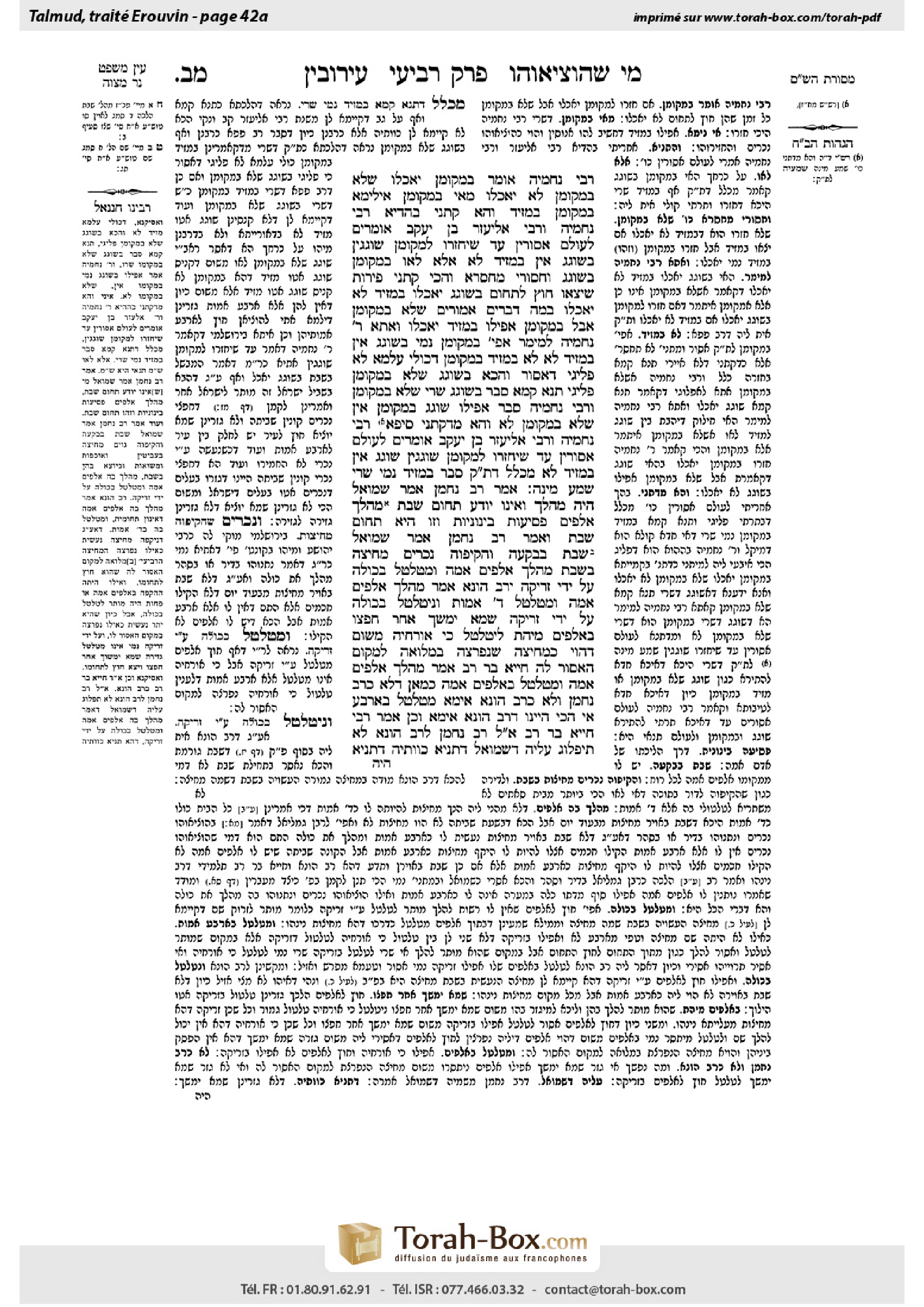
Eruvin 42a: Talmud study for Daf Yomi
Study the Talmud for Daf Yomi with scanned pages, Hebrew text, English translations from Sefaria and AI-generated French translations.
Passage selection and English or AI-generated French translation are available where the scan has annotations. Daf Study is independent of Torah-Box and Sefaria.
Browse Eruvin · עירובין · All tractatesEruvin 42a text and translations
This page of Eruvin includes the Aramaic text, an English translation and an AI-generated French translation, alongside the scan above.
עירובין מ״ב א · Aramaic and Hebrew text
רַבִּי נְחֶמְיָה אוֹמֵר: בִּמְקוֹמָן — יֵאָכֵלוּ, שֶׁלֹּא בִּמְקוֹמָן — לֹא יֵאָכֵלוּ.
מַאי בִּמְקוֹמָן? אִילֵּימָא: בִּמְקוֹמָן — בְּמֵזִיד, וְהָא קָתָנֵי בְּהֶדְיָא, רַבִּי נְחֶמְיָה וְרַבִּי אֱלִיעֶזֶר בֶּן יַעֲקֹב אוֹמְרִים: לְעוֹלָם אֲסוּרִין עַד שֶׁיַּחְזְרוּ לִמְקוֹמָן שׁוֹגְגִין. בְּשׁוֹגֵג — אִין, בְּמֵזִיד — לָא.
אֶלָּא לָאו: בִּמְקוֹמָן — בְּשׁוֹגֵג, וְחַסּוֹרֵי מְחַסְּרָא, וְהָכִי קָתָנֵי: פֵּירוֹת שֶׁיָּצְאוּ חוּץ לַתְּחוּם, בְּשׁוֹגֵג — יֵאָכֵלוּ, בְּמֵזִיד — לֹא יֵאָכֵלוּ.
בַּמֶּה דְּבָרִים אֲמוּרִים — שֶׁלֹּא בִּמְקוֹמָן, אֲבָל בִּמְקוֹמָן — אֲפִילּוּ בְּמֵזִיד יֵאָכֵלוּ. וַאֲתָא רַבִּי נְחֶמְיָה לְמֵימַר: אֲפִילּוּ בִּמְקוֹמָן נָמֵי, בְּשׁוֹגֵג — אִין, בְּמֵזִיד — לָא.
לָא, בְּמֵזִיד בִּמְקוֹמָן — דְּכוּלֵּי עָלְמָא לָא פְּלִיגִי דְּאָסוּר, וְהָכָא בְּשׁוֹגֵג שֶׁלֹּא בִּמְקוֹמָן פְּלִיגִי: תַּנָּא קַמָּא סָבַר בְּשׁוֹגֵג שְׁרֵי שֶׁלֹּא בִּמְקוֹמָן, וְרַבִּי נְחֶמְיָה סָבַר אֲפִילּוּ שׁוֹגֵג, בִּמְקוֹמָן — אִין, שֶׁלֹּא בִּמְקוֹמָן — לָא.
וְהָא מִדְּקָתָנֵי סֵיפָא: רַבִּי נְחֶמְיָה וְרַבִּי אֱלִיעֶזֶר בֶּן יַעֲקֹב אוֹמְרִים: לְעוֹלָם אֲסוּרִין עַד שֶׁיַּחְזְרוּ לִמְקוֹמָן שׁוֹגְגִין, שׁוֹגֵג — אִין, בְּמֵזִיד — לָא, מִכְּלָל דְּתַנָּא קַמָּא סָבַר: בְּמֵזִיד נָמֵי שְׁרֵי. שְׁמַע מִינַּהּ.
אָמַר רַב נַחְמָן אָמַר שְׁמוּאֵל: הָיָה מְהַלֵּךְ וְאֵינוֹ יוֹדֵעַ תְּחוּם שַׁבָּת, מְהַלֵּךְ אַלְפַּיִם פְּסִיעוֹת בֵּינוֹנִיּוֹת, וְזוֹ הִיא תְּחוּם שַׁבָּת.
וְאָמַר רַב נַחְמָן אָמַר שְׁמוּאֵל: שָׁבַת בְּבִקְעָה, וְהִקִּיפוּהָ נׇכְרִים מְחִיצָה בְּשַׁבָּת — מְהַלֵּךְ אַלְפַּיִם אַמָּה, וּמְטַלְטֵל בְּכוּלָּהּ עַל יְדֵי זְרִיקָה.
וְרַב הוּנָא אָמַר: מְהַלֵּךְ אַלְפַּיִם אַמָּה, וּמְטַלְטֵל אַרְבַּע אַמּוֹת. וְנִיטַּלְטֵל בְּכוּלַּהּ עַל יְדֵי זְרִיקָה?
שֶׁמָּא יִמָּשֵׁךְ אַחַר חֶפְצוֹ.
בְּאַלְפַּיִם מִיהַת לִיטַלְטֵל כִּי אוֹרְחֵיהּ!
מִשּׁוּם דְּהָוֵי כִּמְחִיצָה שֶׁנִּפְרְצָה בִּמְלוֹאָהּ לְמָקוֹם הָאָסוּר לָהּ.
חִיָּיא בַּר רַב אָמַר: מְהַלֵּךְ אַלְפַּיִם אַמָּה, וּמְטַלְטֵל בְּאַלְפַּיִם אַמָּה. כְּמַאן? דְּלָא כְּרַב נַחְמָן וְלָא כְּרַב הוּנָא!
אֵימָא: מְטַלְטֵל בְּאַרְבַּע. אִי הָכִי, הַיְינוּ דְּרַב הוּנָא. אֵימָא: וְכֵן אָמַר רַבִּי חִיָּיא בַּר רַב.
אֲמַר לֵיהּ רַב נַחְמָן לְרַב הוּנָא: לָא תִּיפְלוֹג עֲלֵיהּ דִּשְׁמוּאֵל, דְּתַנְיָא כְּווֹתֵיהּ. דְּתַנְיָא:
Eruvin 42a · English translation
Rabbi Neḥemya says: If the produce was returned and is now in its original place, it may be eaten; but if it is not in its original place, i.e., if it is still beyond the Shabbat limit, it may not be eaten.
The Gemara clarifies: What is meant by: In its place? If you say that the produce was returned to its place intentionally, there is a difficulty, as it was explicitly taught in a baraita: Rabbi Neḥemya and Rabbi Eliezer ben Ya’akov say: It is actually prohibited to carry the produce beyond four cubits, unless it was returned to its place unwittingly. By inference, only if it was returned unwittingly is it indeed permitted, but if it was returned intentionally, it is not permitted.
Rather, does it not mean that the produce was returned to its place unwittingly, and the baraita is incomplete and it teaches the following: With regard to produce that was taken out beyond the Shabbat limit, if it was taken out unwittingly, it may be eaten; but if it was taken out intentionally, it may not be eaten.
In what case is this statement said? In a case where the produce is not in its original place, i.e., it is still beyond the Shabbat limit. But if it was returned and is now in its original place, even if it was returned intentionally, it may be eaten. And Rabbi Neḥemya came to say: Even if the produce was returned and is now in its original place, a distinction applies. If it was returned unwittingly, yes, it is permitted; but if it was returned intentionally, it is not.
The Gemara rejects this explanation: No, this is not necessarily the case, as the baraita can also be explained as follows: If the produce was returned intentionally to its place, everyone agrees, i.e., both the first tanna and Rabbi Neḥemya, that it is forbidden. However, here they disagree with regard to produce that was unwittingly taken out beyond the Shabbat limit and was not returned, so that it is not in its original place. The first tanna holds that if the produce was taken out unwittingly, it is permitted to be eaten, even if it is not in its original place. However, Rabbi Neḥemya holds that even if the produce was taken out unwittingly, if it was returned to its original place, it is permitted; but if it was not returned to its original place, it is not permitted.
The Gemara objects to this reading: However, since the latter clause of this baraita teaches that Rabbi Neḥemya and Rabbi Eliezer ben Ya’akov say: Actually, carrying the produce beyond four cubits is prohibited, unless it was returned to its place unwittingly, and by inference, only if it was unwittingly returned is it indeed permitted; however, if it was returned intentionally, it is not permitted. And since Rabbi Neḥemya maintains that produce that was intentionally returned to its place is forbidden, by inference, the first tanna holds that even if it was returned intentionally, it is also permitted. If so, the preceding explanation cannot be accepted, and the Gemara concludes: Indeed, learn from here that Rav Pappa’s opinion is supported by the opinion of the first tanna.
Rav Naḥman said that Shmuel said: If one was walking in a certain place and does not know where the Shabbat limit lies, he may take two thousand medium strides in each direction from the spot he acquired as his place of residence, and this is the Shabbat limit, for a medium stride is approximately a cubit.
And Rav Naḥman also said that Shmuel said: If one established residence in a valley, and gentiles surrounded the entire area with a partition for the purpose of residence on Shabbat, he may walk only two thousand cubits in each direction, as he cannot rely on partitions that were not present when he acquired his place of residence. However, he may carry in the entire partitioned area, as in any other private domain, even in the part that is beyond his two thousand cubits, but only by means of throwing, as he himself cannot accompany the object past two thousand cubits.
Rav Huna said: He may walk two thousand cubits; however, even within this area he may carry objects only a distance of four cubits, as in a karmelit. The Gemara asks: And let him be permitted to carry in the entire partitioned area by means of throwing. Although he himself is limited in where he may walk, the partitions render it a private domain, and he should be permitted to carry in the entire area.
The Gemara answers: The Sages prohibited this as a preventive measure, lest he be drawn after his object. It is prohibited for him to leave the two thousand cubit limit, but were he permitted to carry by means of throwing, he might follow his object and go out beyond his permitted limit.
The Gemara asks: Within two thousand cubits, at any rate, let him carry the object in his usual manner. Since he may traverse this area, there should be no concern that he might come to be drawn after the object.
The Gemara answers that this is prohibited due to another aspect of the laws of eiruvin, namely because this is similar to the case of a partition that is breached in its entirety, leaving the space open to a place into which it is prohibited to carry. Since he may not carry more than two thousand cubits, and the enclosed area is larger than two thousand cubits, the area that is permitted to him is breached in its entirety, left open to an area that is prohibited to him. Consequently, carrying is prohibited in the entire area, even by means of throwing.
However, Ḥiyya bar Rav said: In that case, he may walk two thousand cubits, and he may also carry objects within these two thousand cubits. The Gemara poses a question: In accordance with whose opinion did Ḥiyya bar Rav issue his ruling? It is neither in accordance with the opinion of Rav Naḥman, nor in accordance with the opinion of Rav Huna, while this dispute would appear to leave no place for a third opinion.
The Gemara answers: Read Ḥiyya bar Rav’s ruling as follows: He may carry objects only a distance of four cubits. The Gemara asks: If so, this is the same as the opinion of Rav Huna. The Gemara answers: Read it then as follows: And similarly, Rabbi Ḥiyya bar Rav said.
Rav Naḥman said to Rav Huna: Do not argue with the opinion of Shmuel as cited by Rav Naḥman with regard to a field surrounded by a partition on Shabbat, as it was taught in a baraita in accordance with his opinion. As it was taught in a baraita:
Eruvin 42a · Traduction française (IA)
Rabbi Néhémia dit : Si les produits ont été rendus et sont maintenant à leur place d'origine, ils peuvent être mangés ; mais s'ils ne sont pas à leur place d'origine, c'est-à-dire s'ils sont encore au-delà de la limite du Shabbat, ils ne peuvent pas être mangés.
La Guemara clarifie : De quoi parle-t-on par « à sa place » ? Si l'on dit que les produits ont été rendus à leur place de manière intentionnelle, il y a une difficulté, car cela a été explicitement enseigné dans une baraïta : Rabbi Néhémia et Rabbi Eliezer ben Ya'akov disent : Il est en réalité interdit de porter les produits au-delà de quatre cubits, sauf s'ils ont été rendus à leur place de manière involontaire. Par conséquent, seul s'il a été rendu involontairement est-il autorisé, mais s'il a été rendu intentionnellement, il n'est pas autorisé.
Plutôt, ne signifie-t-il pas que les produits ont été rendus à leur place de manière involontaire, et la baraïta est incomplète et elle enseigne ceci : En ce qui concerne les produits qui ont été sortis au-delà de la limite du Shabbat, s'ils ont été sortis involontairement, ils peuvent être mangés ; mais s'ils ont été sortis intentionnellement, ils ne peuvent pas être mangés.
Dans quel cas cette déclaration est-elle faite ? Dans un cas où les produits ne sont pas à leur place d'origine, c'est-à-dire qu'ils sont encore au-delà de la limite du Shabbat. Mais si ils ont été ramenés et sont maintenant à leur place d'origine, même s'ils ont été ramenés intentionnellement, ils peuvent être mangés. Et Rabbi Néhémia a dit : Même si les produits ont été ramenés et sont maintenant à leur place d'origine, une distinction s'applique. S'ils ont été ramenés sans intention, oui, ils sont autorisés ; mais s'ils ont été ramenés intentionnellement, ils ne le sont pas.
La Guemara rejette cette explication : Non, cela n'est pas nécessairement le cas, car la baraïta peut aussi être interprétée ainsi : Si les produits ont été ramenés intentionnellement à leur place, tout le monde est d'accord, c'est-à-dire à la fois le premier tanna et Rabbi Néhémia, qu'ils sont interdits. Cependant, ici ils s'opposent concernant les produits qui ont été sortis involontairement au-delà de la limite du Shabbat et qui n'ont pas été ramenés, de sorte qu'ils ne sont pas à leur place d'origine. Le premier tanna considère que si les produits ont été sortis involontairement, ils peuvent être mangés, même s'ils ne sont pas à leur place d'origine. Cependant, Rabbi Néhémia considère que même si les produits ont été sortis involontairement, s'ils ont été ramenés à leur place d'origine, ils sont autorisés ; mais s'ils n'ont pas été ramenés à leur place d'origine, ils ne le sont pas.
La Guemara s'oppose à cette lecture : Cependant, puisque la dernière partie de cette baraïta enseigne que Rabbi Néhémia et Rabbi Eliezer ben Ya'akov disent : En réalité, porter les produits au-delà de quatre cubits est interdit, sauf s'ils ont été rendus à leur place de manière involontaire, et par conséquent, seul s'ils ont été rendus involontairement est-il autorisé ; mais s'ils ont été rendus intentionnellement, ils ne le sont pas. Et puisque Rabbi Néhémia considère que les produits qui ont été rendus intentionnellement à leur place sont interdits, par conséquent, le premier tanna considère que même s'ils ont été rendus intentionnellement, ils sont autorisés. Si c'est ainsi, l'explication précédente ne peut pas être acceptée, et la Guemara conclut : En effet, apprenez de là que l'opinion de Rav Pappa est soutenue par l'opinion du premier tanna.
Rav Naḥman a dit que Shmuel a dit : Si l'on marche dans un certain lieu et qu'on ne sait pas où se trouve la limite du Shabbat, on peut prendre deux mille pas moyens dans chaque direction depuis le lieu qu'on a acquis comme lieu de résidence, et c'est la limite du Shabbat, car un pas moyen est d'environ un cubit.
Et Rav Naḥman a aussi dit que Shmuel a dit : Si l'on a établi sa résidence dans une vallée, et que les gentils ont entouré toute la zone d'un mur pour la résidence du Shabbat, on peut marcher seulement deux mille cubits dans chaque direction, car on ne peut pas compter sur des murs qui n'étaient pas présents lorsqu'on a acquis son lieu de résidence. Cependant, on peut porter dans toute la zone murée, comme dans tout autre domaine privé, même dans la partie qui est au-delà des deux mille cubits, mais seulement par lancer, car on ne peut pas accompagner l'objet au-delà des deux mille cubits.
Rav Huna a dit : On peut marcher deux mille cubits ; cependant, même à l'intérieur de cette zone, on peut porter des objets seulement à une distance de quatre cubits, comme dans un karmelit. La Guemara répond : Et laissez-le porter l'objet dans toute la zone murée par lancer. Bien qu'il lui soit limité dans la zone où il peut marcher, les murs rendent la zone un domaine privé, et il devrait être autorisé à porter dans toute la zone.
La Guemara répond : Les Sages ont interdit cela comme mesure préventive, de peur qu'il suive son objet. Il est interdit pour lui de sortir du limites des deux mille cubits, mais s'il était autorisé à porter par lancer, il pourrait suivre son objet et sortir au-delà de sa limite autorisée.
La Guemara pose une question : Au moins dans les deux mille cubits, laissez-le porter l'objet de la manière habituelle. Puisque il peut parcourir cette zone, il ne devrait pas y avoir de crainte qu'il vienne à suivre l'objet.
La Guemara répond que cela est interdit en raison d'un autre aspect des lois des erouvin, à savoir parce que cela ressemble au cas d'un mur qui est entièrement rompu, laissant l'espace ouvert vers un lieu où il est interdit de porter. Puisqu'il ne peut porter plus de deux mille cubits, et que la zone enclose est plus grande que deux mille cubits, la zone autorisée est entièrement rompue, ouverte vers une zone interdite. Par conséquent, le port est interdit dans toute la zone, même par lancer.
Cependant, Hiyaa bar Rav a dit : Dans ce cas, il peut marcher deux mille cubits, et il peut aussi porter des objets dans ces deux mille cubits. La Guemara pose une question : Selon l'opinion de qui a-t-il rendu son jugement ? C'est ni selon l'opinion de Rav Naḥman, ni selon l'opinion de Rav Huna, alors que ce débat semble ne laisser aucune place pour une troisième opinion.
La Guemara répond : Lisez la décision de Chija bar Rava ainsi : Il peut porter des objets à une distance de quatre coudées. La Guemara demande : Si c’est ainsi, cela correspond à l’opinion de Rava Huna. La Guemara répond : Lisez-la alors ainsi : Et de même, Chija bar Rava a dit.
Rav Naḥman a dit à Rava Huna : Ne discutez pas de l’opinion de Shmuel telle que la cite Rav Naḥman concernant un champ entouré d’un mur le sabbat, car cela a été enseigné dans une baraïta conformément à son opinion. Comme il a été enseigné dans une baraïta :
Traduction française générée par IA à partir de l’édition anglaise de Sefaria. Vérifie toujours un passage avec le texte source.
Text from Sefaria: William Davidson Edition - Vocalized Aramaic (CC BY NC); William Davidson Edition - English (CC BY NC).