Eruvin 42b: Talmud study for Daf Yomi
Study the Talmud for Daf Yomi with scanned pages, Hebrew text, English translations from Sefaria and AI-generated French translations.
Passage selection and English or AI-generated French translation are available where the scan has annotations. Daf Study is independent of Torah-Box and Sefaria.
Browse Eruvin · עירובין · All tractatesEruvin 42b text and translations
This page of Eruvin includes the Aramaic text, an English translation and an AI-generated French translation, alongside the scan above.
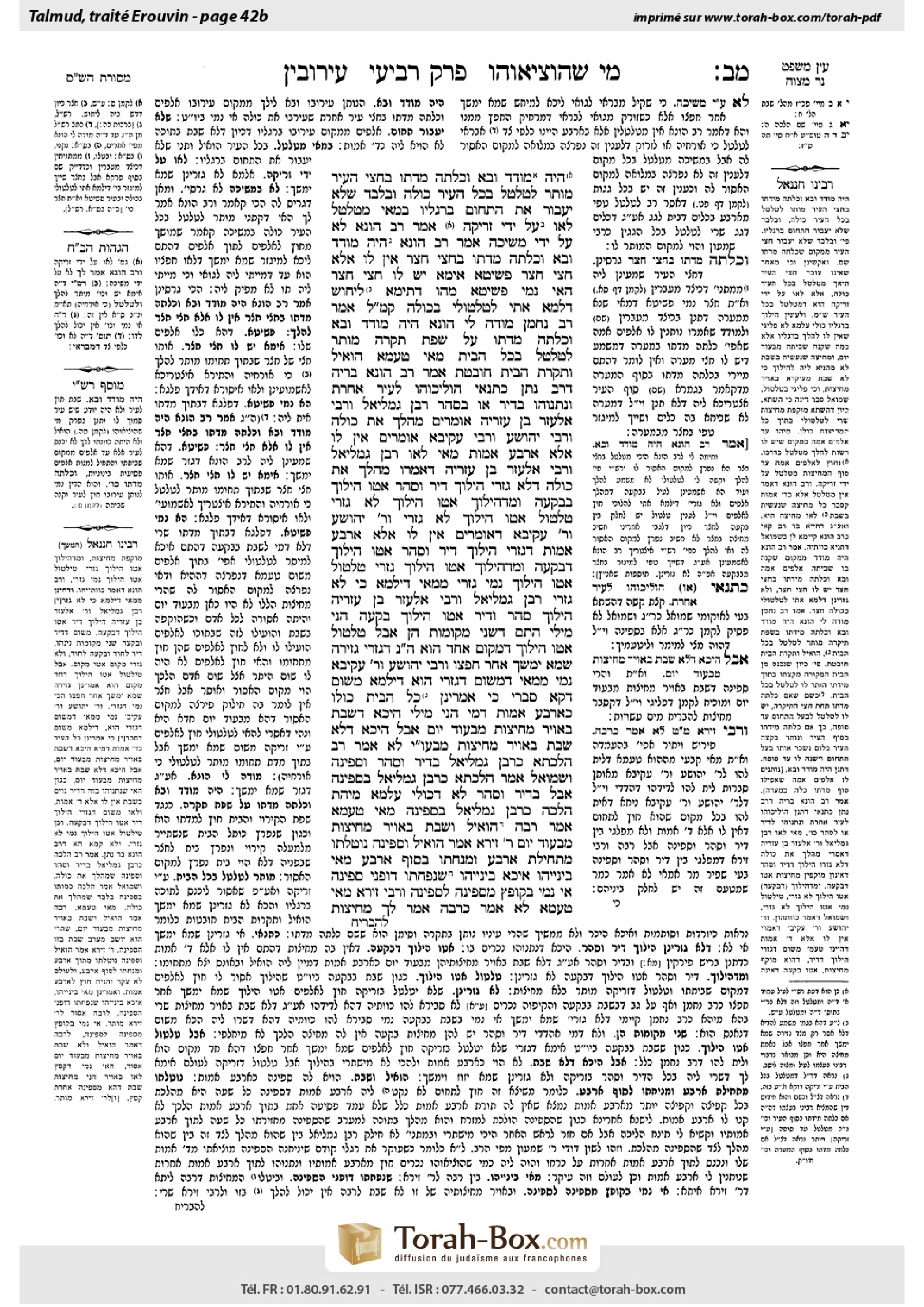
עירובין מ״ב ב · Aramaic and Hebrew text
הָיָה מוֹדֵד וּבָא, וְכָלְתָה מִדָּתוֹ בַּחֲצִי הָעִיר — מוּתָּר לְטַלְטֵל בְּכׇל הָעִיר כּוּלָּהּ, וּבִלְבַד שֶׁלֹּא יַעֲבוֹר אֶת הַתְּחוּם בְּרַגְלָיו. מַאי מְטַלְטֵל, לָאו עַל יְדֵי זְרִיקָה?
אָמַר רַב הוּנָא: לָא, עַל יְדֵי מְשִׁיכָה.
אָמַר רַב הוּנָא: הָיָה מוֹדֵד וּבָא, וְכָלְתָה מִדָּתוֹ בַּחֲצִי חָצֵר — אֵין לוֹ אֶלָּא חֲצִי חָצֵר.
פְּשִׁיטָא! אֵימָא: יֵשׁ לוֹ חֲצִי חָצֵר.
הַאי נָמֵי פְּשִׁיטָא? מַהוּ דְּתֵימָא: לֵיחוּשׁ דִּלְמָא אָתֵי לְטַלְטוֹלֵי בְּכוּלַּהּ, קָא מַשְׁמַע לַן.
אָמַר רַב נַחְמָן, מוֹדֶה לִי הוּנָא: הָיָה מוֹדֵד וּבָא וְכָלְתָה מִדָּתוֹ עַל שְׂפַת תִּקְרָה — מוּתָּר לְטַלְטֵל בְּכׇל הַבַּיִת.
מַאי טַעְמָא — הוֹאִיל וְתִקְרַת הַבַּיִת חוֹבֶטֶת.
אָמַר רַב הוּנָא בְּרֵיהּ דְּרַב נָתָן: כְּתַנָּאֵי. הוֹלִיכוּהוּ לְעִיר אַחֶרֶת, וּנְתָנוּהוּ בְּדִיר אוֹ בְּסַהַר, רַבָּן גַּמְלִיאֵל וְרַבִּי אֶלְעָזָר בֶּן עֲזַרְיָה אוֹמְרִים: מְהַלֵּךְ אֶת כּוּלָּהּ. וְרַבִּי יְהוֹשֻׁעַ וְרַבִּי עֲקִיבָא אוֹמְרִים: אֵין לוֹ אֶלָּא אַרְבַּע אַמּוֹת.
מַאי לָאו, רַבָּן גַּמְלִיאֵל וְרַבִּי אֶלְעָזָר בֶּן עֲזַרְיָה דְּאָמְרוּ: מְהַלֵּךְ אֶת כּוּלָּהּ — דְּלָא גָּזְרִי הִילּוּךְ דִּיר וְסַהַר אַטּוּ הִילּוּךְ בְּבִקְעָה;
וּמִדְּהִילּוּךְ אַטּוּ הִילּוּךְ לָא גָּזְרִי, טִלְטוּל אַטּוּ הִילּוּךְ לָא גָּזְרִי.
וְרַבִּי יְהוֹשֻׁעַ וְרַבִּי עֲקִיבָא דְּאוֹמְרִים: אֵין לוֹ אֶלָּא אַרְבַּע אַמּוֹת, דְּגָזְרִי הִילּוּךְ דִּיר וְסַהַר אַטּוּ הִילּוּךְ דְּבִקְעָהּ; וּמִדְּהִילּוּךְ אַטּוּ הִילּוּךְ גָּזְרִי, טִלְטוּל אַטּוּ הִילּוּךְ נָמֵי גָּזְרִי.
מִמַּאי? דִּילְמָא כִּי לָא גָּזְרִי רַבָּן גַּמְלִיאֵל וְרַבִּי אֶלְעָזָר בֶּן עֲזַרְיָה הִילּוּךְ סַהַר וְדִיר אַטּוּ הִילּוּךְ בִּקְעָה, הָנֵי מִילֵּי הָתָם דִּשְׁנֵי מְקוֹמוֹת הֵן.
אֲבָל טִלְטוּל אַטּוּ הִילּוּךְ דְּמָקוֹם אֶחָד הוּא, הָכִי נָמֵי דְּגָזְרִי, גְּזֵירָה שֶׁמָּא יִמָּשֵׁךְ אַחֵר חֶפְצוֹ.
וְרַבִּי יְהוֹשֻׁעַ וְרַבִּי עֲקִיבָא נָמֵי, מִמַּאי דְּמִשּׁוּם דְּגָזְרִי הוּא? דִּילְמָא מִשּׁוּם דְּקָא סָבְרִי כִּי אָמְרִינַן כָּל הַבַּיִת כּוּלּוֹ כְּאַרְבַּע אַמּוֹת דָּמֵי, הָנֵי מִילֵּי הֵיכָא דְּשָׁבַת בַּאֲוִיר מְחִיצּוֹת מִבְּעוֹד יוֹם.
אֲבָל הֵיכָא דְּלֹא שָׁבַת בַּאֲוִיר מְחִיצּוֹת מִבְּעוֹד יוֹם — לָא.
אָמַר רַב: הִלְכְתָא כְּרַבָּן גַּמְלִיאֵל בְּדִיר וְסַהַר וּסְפִינָה. וּשְׁמוּאֵל אָמַר: הִלְכְתָא כְּרַבָּן גַּמְלִיאֵל, בִּסְפִינָה, אֲבָל בְּדִיר וְסַהַר — לָא.
דְּכוּלֵּי עָלְמָא מִיהַת הֲלָכָה כְּרַבָּן גַּמְלִיאֵל בִּסְפִינָה, מַאי טַעְמָא?
אָמַר רַבָּה: הוֹאִיל וְשָׁבַת בַּאֲוִיר מְחִיצּוֹת מִבְּעוֹד יוֹם.
רַבִּי זֵירָא אָמַר: הוֹאִיל וּסְפִינָה נוֹטַלְתּוֹ מִתְּחִילַּת אַרְבַּע וּמַנַּחְתּוֹ בְּסוֹף אַרְבַּע.
מַאי בֵּינַיְיהוּ? אִיכָּא בֵּינַיְיהוּ שֶׁנִּפְחֲתוּ דּוֹפְנֵי סְפִינָה. אִי נָמֵי: בְּקוֹפֵץ מִסְּפִינָה לִסְפִינָה.
וְרַבִּי זֵירָא, מַאי טַעְמָא לָא אָמַר כְּרַבָּה? אָמַר לָךְ: מְחִיצּוֹת,
Eruvin 42b · English translation
If a person was measuring the two thousand cubits of his Shabbat limit from the spot where he deposited his eiruv, and his measuring ended in the middle of the city, he is permitted to carry throughout the city, provided that he does not overstep the limit by foot, i.e., that he does not walk beyond his permitted limit in the middle of the city. If he cannot walk about on foot, how can he carry throughout the city? Is it not by means of throwing? This presents a difficulty for Rav Huna, who prohibits carrying by means of throwing in a place where it is prohibited to walk.
Rav Huna said: No, it means that he may carry in the city by means of pulling, i.e., he is permitted to pull objects from the other side of the city to the side where he is permitted to walk, for in this manner there is no concern that he might be drawn after the object, since he is bringing the object to him.
Similarly, Rav Huna said: If a person was measuring the two thousand cubits of his Shabbat limit from the spot where he deposited his eiruv, and his measuring ended in the middle of a courtyard, he has only half the courtyard in which to walk.
The Gemara raises a difficulty: It is obvious that he is not permitted to walk beyond his Shabbat limit. The Gemara answers: Read Rav Huna’s statement as follows: He has half a courtyard, i.e., Rav Huna addresses a different aspect of the issue; namely, he permits carrying in half the courtyard.
The Gemara asks: However, this too is obvious, for why should it be prohibited for him to carry in a private domain where he is permitted to walk? The Gemara answers: Lest you say that we should be concerned that if he is permitted to carry in half the courtyard, he might come to carry in the entire courtyard. Consequently, Rav Huna teaches us that this concern is not taken into account.
Rav Naḥman said: Rav Huna agrees with me that carrying is not prohibited in a comparable case, out of concern that the person be drawn after the object he is carrying: If a person was measuring the two thousand cubits of his Shabbat limit from the spot where he deposited his eiruv, and his measuring ended at the edge of the roof of a house, most of which stood outside his Shabbat limit, he is permitted to carry throughout the house by means of throwing.
What is the reason that Rav Huna agrees in this case? Because the edge of the roof of the house is regarded as if it presses down vertically at the end of his Shabbat limit, thus creating a partition, and so there is no concern that he might pass beyond this partition and be drawn after his object.
Rav Huna, son of Rav Natan, said: The dispute between Shmuel and Rav Huna is parallel to a dispute between tanna’im recorded in the mishna: If the gentiles brought him to a different city beyond his Shabbat limit, or if they put him in a pen or a stable, the Sages disagree. Rabban Gamliel and Rabbi Elazar ben Azarya say: He may walk about the entire stable or pen. Since they are enclosed by a partition, their entire area is considered like only four cubits. Rabbi Yehoshua and Rabbi Akiva say: He has only four cubits from where he was deposited.
Is it not the case that Rabban Gamliel and Rabbi Elazar ben Azarya, who said: He may walk about the entire area, do not prohibit walking in a pen or a stable due to walking in a field where one is limited to four cubits? Rather, they say that since the stable is surrounded by partitions, it is not similar to a field, in which a person may not leave his four cubits.
And since they did not prohibit walking in a pen or a stable due to the limits imposed on walking in a field, they would certainly not prohibit carrying in a pen due to the limits imposed on walking in a field. Rather, they would permit a person to carry in a field that had been enclosed on Shabbat by gentiles, and even to throw into the part lying beyond his two thousand cubits, parallel to the opinion of Shmuel who did not decree against this.
And is it not the case that Rabbi Yehoshua and Rabbi Akiva, who say that he has only four cubits, prohibit walking in a pen or a stable due to the limits imposed on walking in a field? And since they prohibit walking in a pen or a stable due to the limits imposed on walking in a field, they would also prohibit carrying past the two thousand cubit limit by means of throwing due to the limits imposed on walking past there, in accordance with Rav Huna’s opinion.
The Gemara rejects this comparison: From what do you infer that this is the case? Perhaps Rabban Gamliel and Rabbi Elazar ben Azarya did not prohibit walking in a pen or a stable due to the limits imposed on walking in a field, but this applies only there, because they are two distinct places. In other words, the pen and stable are enclosed by partitions, while the field is not, and there is no reason to prohibit walking in one place out of concern that one might come to act improperly in a different place.
However, as for the prohibition of carrying due to the limits imposed on walking, where it is all one place, might we also say that even Rabban Gamliel and Rabbi Elazar ben Azarya would decree against carrying as a preventive measure, lest the person be drawn after his object and come to walk in a place prohibited to him.
The comparison can also be rejected from another angle: And with regard to Rabbi Yehoshua and Rabbi Akiva too, from what can it be inferred that they prohibit walking beyond four cubits due to a decree? Perhaps it is because they hold that when we say that the entire house is considered like four cubits, this applies only where one acquired his place of residence within the airspace of the partitions of the house while it was still day, i.e., prior to the onset of Shabbat.
However, where he did not acquire his place of residence within the airspace of the partitions of the house while it was still day, the house, and all the more so the stable or pen, is not considered as four cubits; rather, it is measured based on the actual number of cubits it contains. Based on this explanation, this ruling indicates nothing with regard to the issue of throwing beyond the two-thousand cubit limit. Consequently, the Gemara rejects the link between the dispute of the tanna’im in the mishna and that of Rav Naḥman and Rav Huna.
Rav said: The halakha is in accordance with the opinion of Rabban Gamliel with regard to a pen, a stable, and a boat. And Shmuel said: The halakha is in accordance with the opinion of Rabban Gamliel with regard to a boat, but not with regard to a stable or a pen.
The Gemara poses a question: At any rate, all agree, i.e., both Rav and Shmuel, that the halakha is in accordance with the opinion of Rabban Gamliel with regard to a boat. What is the reason that the halakha is different in this case than in the other cases?
Rabba said: This is since he acquired his place of residence within the partitions of the boat while it was still day, in which case it is reasonable to say that the entire boat is considered as if it is only four cubits.
Rabbi Zeira said: This is since the boat constantly moves the person out of his four cubits, lifting him from the beginning of four cubits and placing him at the end of four cubits. Since in any case he cannot restrict himself to any particular four cubits, even if he wished to do so, it is reasonable to say that he is permitted to walk about the entire boat.
The Gemara asks: What is the practical difference between these two explanations? The Gemara answers: There is a practical difference between them with regard to a case where the walls of the boat were breached, so that the person is no longer located between its partitions. Alternatively, there is a difference with regard to a case where the person jumped from one boat to another, so that he is no longer on the boat where he had acquired his place of residence. In both of these cases, Rabba’s reason no longer applies, but Rabbi Zeira’s reason does.
The Gemara asks: As for Rabbi Zeira, what is the reason that he did not state his opinion in accordance with the opinion of Rabba, whose explanation is more straightforward? The Gemara answers: He could have said to you: The sides of a boat are not regarded as proper partitions,
Eruvin 42b · Traduction française (IA)
Si une personne mesurait les deux mille coudées de sa limite de sabbat à partir du point où elle avait déposé son eiruv, et que sa mesure s'arrêtait au milieu de la ville, elle est autorisée à porter des objets à travers toute la ville, à condition qu'elle ne dépasse pas sa limite par le pied, c'est-à-dire qu'elle ne marche pas au-delà de sa limite permise au milieu de la ville. Si elle ne peut pas marcher librement, comment peut-elle porter des objets à travers la ville ? N'est-ce pas par l'intermédiaire du lancer ? Cela pose un problème pour Rav Huna, qui interdit le port par lancer dans un lieu où il est interdit de marcher.
Rav Huna dit : Non, cela signifie qu'elle peut porter des objets dans la ville par le tirage, c'est-à-dire qu'elle est autorisée à tirer des objets du côté opposé de la ville vers le côté où elle est autorisée à marcher, car ainsi il n'y a pas de crainte qu'elle suive l'objet, puisqu'elle apporte l'objet vers elle.
De même, Rav Huna dit : Si une personne mesurait les deux mille coudées de sa limite de sabbat à partir du point où elle avait déposé son eiruv, et que sa mesure s'arrêtait au milieu d'un courtil, elle n'a que la moitié du courtil où elle peut marcher.
La Guemara soulève un doute : Il est évident qu'il n'est pas autorisé à marcher au-delà de sa limite de sabbat. La Guemara répond : Lisez la déclaration de Rav Huna ainsi : Il a la moitié du courtil, c'est-à-dire que Rav Huna aborde un aspect différent de la question ; à savoir, il autorise le port dans la moitié du courtil.
La Guemara demande : Cependant, cela aussi est évident, car pourquoi interdireait-on le port dans un domaine privé où il est autorisé à marcher ? La Guemara répond : Pour éviter que vous ne disiez que nous devons avoir peur qu'en permettant le port dans la moitié du courtil, il puisse finir par porter dans l'ensemble du courtil. Ainsi, Rav Huna nous enseigne que cette crainte n'est pas prise en compte.
Rav Naḥman dit : Rav Huna est d'accord avec moi sur le fait que le port n'est pas interdit dans un cas comparable, en raison de la crainte que la personne suive l'objet qu'elle transporte : Si une personne mesurait les deux mille coudées de sa limite de sabbat à partir du point où elle avait déposé son eiruv, et que sa mesure s'arrêtait à la limite du toit d'une maison, dont la majorité était en dehors de sa limite de sabbat, elle est autorisée à porter des objets à travers la maison par lancer.
Quelle est la raison pour laquelle Rav Huna est d'accord dans ce cas ? Parce que l'extrémité du toit de la maison est considérée comme si elle pesait verticalement à la fin de sa limite de sabbat, créant ainsi une séparation, et donc il n'y a pas de crainte qu'il puisse dépasser cette séparation et être attiré par son objet.
Rav Huna, fils de Rav Natan, dit : Le débat entre Shmuel et Rav Huna est parallèle à un débat entre des tannaïm rapportés dans la mishna : Si les Gentils l'ont conduit dans une autre ville au-delà de sa limite de sabbat, ou s'ils l'ont mis dans un enclos ou une écurie, les Sages sont en désaccord. Rabban Gamliel et Rabbi Elazar ben Azarya disent : Il peut marcher librement dans l'ensemble de l'écurie ou de l'enclos. Puisqu'ils sont entourés d'une séparation, leur surface totale est considérée comme si elle était de quatre coudées. Rabbi Yehoshua et Rabbi Akiva disent : Il n'a que quatre coudées à partir du point où il a été déposé.
N'est-ce pas le cas que Rabban Gamliel et Rabbi Elazar ben Azarya, qui disaient : Il peut marcher librement dans l'ensemble de la surface, n'interdisent pas la marche dans un enclos ou une écurie en raison de la limitation de la marche dans un champ où l'on est limité à quatre coudées ? Plutôt, ils disent que puisque l'écurie est entourée de séparations, elle n'est pas comparable à un champ, dans lequel une personne ne peut pas sortir de ses quatre coudées.
Et puisque ils n'interdisaient pas le port dans un enclos ou une écurie en raison des limites imposées à la marche dans un champ, ils ne prohiberaient certainement pas le port dans un enclos en raison des limites imposées à la marche dans un champ. Plutôt, ils autoriseraient une personne à porter dans un champ qui avait été entouré le sabbat par les Gentils, et même à lancer dans la partie située au-delà de ses deux mille coudées, parallèlement à l'opinion de Shmuel qui n'avait pas imposé cette interdiction.
Et n'est-ce pas le cas que Rabbi Yehoshua et Rabbi Akiva, qui disent qu'il n'a que quatre coudées, interdisent la marche dans un enclos ou une écurie en raison des limites imposées à la marche dans un champ ? Et puisque ils interdisent la marche dans un enclos ou une écurie en raison des limites imposées à la marche dans un champ, ils interdiraient également le port au-delà de la limite de deux mille coudées par lancer en raison des limites imposées à la marche au-delà de cette limite, conformément à l'opinion de Rav Huna.
La Guemara rejette cette comparaison : De quoi inférez-vous que c'est le cas ? Peut-être que Rabban Gamliel et Rabbi Elazar ben Azarya n'interdisaient pas la marche dans un enclos ou une écurie en raison des limites imposées à la marche dans un champ, mais cela s'applique uniquement là, car ils sont deux lieux distincts. En d'autres termes, l'enclos et l'écurie sont entourés de séparations, tandis que le champ n'en a pas, et il n'y a pas de raison d'interdire la marche dans un lieu en raison de la crainte qu'on vienne à agir de manière incorrecte dans un autre lieu.
Cependant, concernant l'interdiction du port en raison des limites imposées à la marche, où il s'agit d'un seul lieu, pourrait-on aussi dire que même Rabban Gamliel et Rabbi Elazar ben Azarya décréteraient l'interdiction du port comme mesure préventive, de peur que la personne suive son objet et vienne à marcher dans un lieu interdit.
Cette comparaison peut aussi être rejetée d'un autre point de vue : Et concernant Rabbi Yehoshua et Rabbi Akiva également, de quoi peut-on inférer qu'ils interdisent la marche au-delà de quatre coudées en raison d'un décret ? Peut-être parce qu'ils pensent que lorsque nous disons que l'ensemble de la maison est considéré comme quatre coudées, cela s'applique uniquement là où l'on a acquis son lieu de résidence dans l'espace aérien des séparations de la maison pendant la journée, c'est-à-dire avant l'entrée du sabbat.
Cependant, là où il n'a pas acquis son lieu de résidence dans l'espace aérien des cloisons de la maison pendant que c'était encore jour, la maison, et encore plus la stabulation ou l'étable, n'est pas considérée comme quatre cubits ; plutôt, elle est mesurée selon le nombre réel de cubits qu'elle contient. Selon cette explication, cette décision indique rien concernant la question de jeter au-delà de la limite de deux mille cubits. Ainsi, la Guemara rejette le lien entre le débat des tannaïm dans la mitsna et celui de Rav Naḥman et Rav Huna.
Rav dit : La halakha suit l'opinion de Rabban Gamliel concernant une stabulation, une étable et un bateau. Et Shmuel dit : La halakha suit l'opinion de Rabban Gamliel concernant un bateau, mais pas concernant une stabulation ou une étable.
La Guemara pose une question : En tout cas, tous s'accordent, c'est-à-dire à la fois Rav et Shmuel, sur le fait que la halakha suit l'opinion de Rabban Gamliel concernant un bateau. Quelle est la raison pour laquelle la halakha diffère dans ce cas par rapport aux autres cas ?
Rabba dit : C'est parce qu'il a acquis son lieu de résidence dans les cloisons du bateau pendant que c'était encore jour, dans ce cas il est raisonnable de dire que l'ensemble du bateau est considéré comme si c'était seulement quatre cubits.
Rabbi Zeira dit : C'est parce que le bateau fait constamment bouger la personne hors de ses quatre cubits, le soulevant du début des quatre cubits et le plaçant à la fin des quatre cubits. Puisque, en tout cas, il ne peut se restreindre à aucun quatre cubits particulier, même s'il le voulait, il est raisonnable de dire qu'il est autorisé à marcher librement sur l'ensemble du bateau.
La Guemara pose une question : Quelle est la différence pratique entre ces deux explications ? La Guemara répond : Il y a une différence pratique entre elles concernant un cas où les murs du bateau étaient percés, de sorte que la personne n'était plus située entre ses cloisons. Alternativement, il y a une différence concernant un cas où la personne saute d'un bateau à un autre, de sorte qu'elle n'est plus sur le bateau où elle avait acquis son lieu de résidence. Dans ces deux cas, la raison de Rabba ne s'applique plus, mais la raison de Rabbi Zeira s'applique.
La Guemara pose la question : En ce qui concerne Rabbi Zeira, quelle est la raison pour laquelle il n'a pas exprimé son opinion conformément à celle de Rabba, dont l'explication est plus directe ? La Guemara répond : Il aurait pu dire à vous : Les côtés d'un bateau ne sont pas considérés comme des cloisons appropriées,
Traduction française générée par IA à partir de l’édition anglaise de Sefaria. Vérifie toujours un passage avec le texte source.
Text from Sefaria: William Davidson Edition - Vocalized Aramaic (CC BY NC); William Davidson Edition - English (CC BY NC).