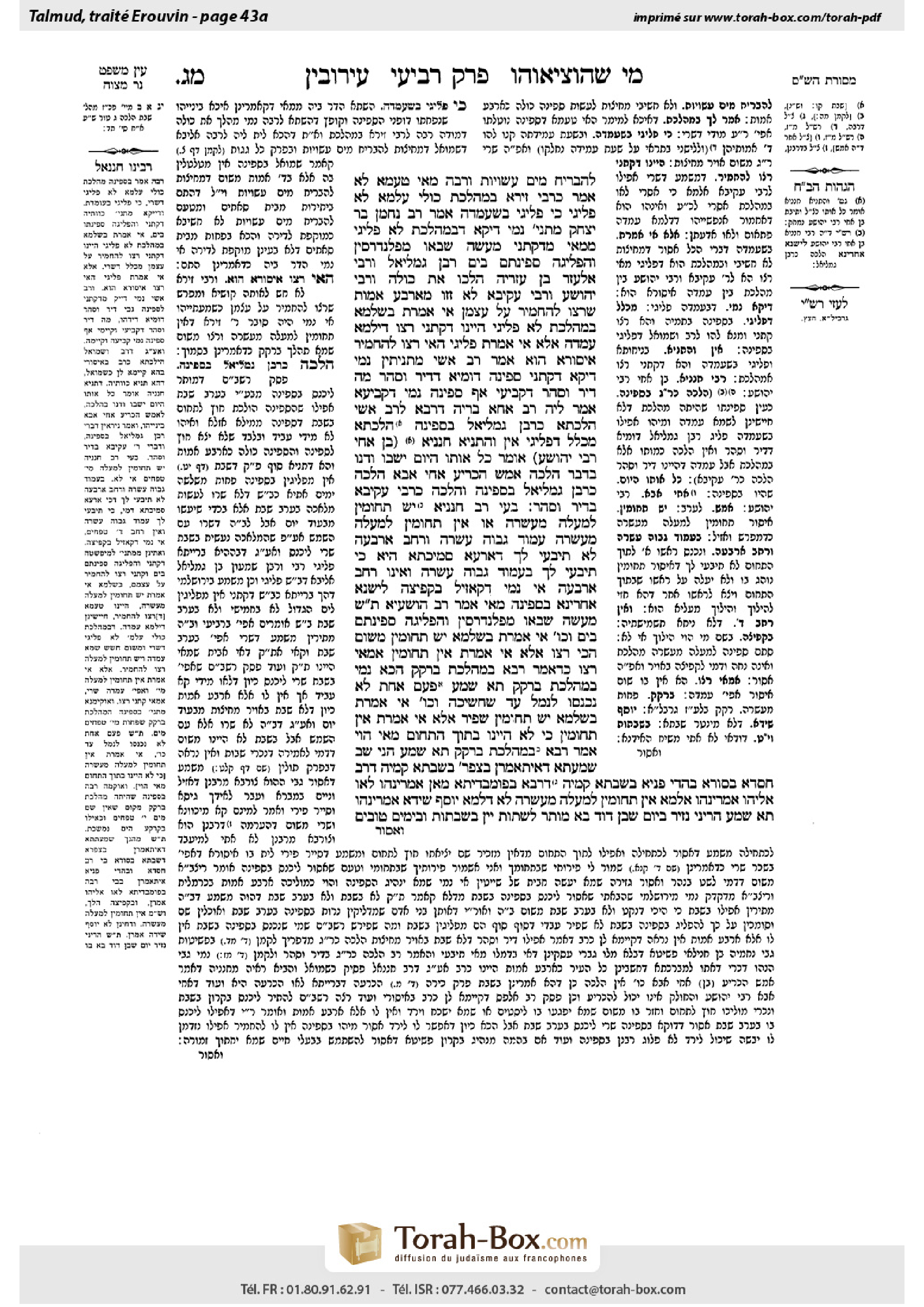
Eruvin 43a: Talmud study for Daf Yomi
Study the Talmud for Daf Yomi with scanned pages, Hebrew text, English translations from Sefaria and AI-generated French translations.
Passage selection and English or AI-generated French translation are available where the scan has annotations. Daf Study is independent of Torah-Box and Sefaria.
Browse Eruvin · עירובין · All tractatesEruvin 43a text and translations
This page of Eruvin includes the Aramaic text, an English translation and an AI-generated French translation, alongside the scan above.
עירובין מ״ג א · Aramaic and Hebrew text
לְהַבְרִיחַ מַיִם עֲשׂוּיוֹת.
וְרַבָּה, מַאי טַעְמָא לָא אָמַר כְּרַבִּי זֵירָא? בִּמְהַלֶּכֶת — כּוּלֵּי עָלְמָא לָא פְלִיגִי. כִּי פְּלִיגִי בְּשֶׁעָמְדָה.
אָמַר רַב נַחְמָן בַּר יִצְחָק: מַתְנִיתִין נָמֵי דַּיְקָא דְּבִמְהַלֶּכֶת לָא פְּלִיגִי. מִמַּאי? מִדְּקָתָנֵי: מַעֲשֶׂה שֶׁבָּאוּ מִפְּלַנְדַּרְסִין וְהִפְלִיגָה סְפִינָתָם בַּיָּם. רַבָּן גַּמְלִיאֵל וְרַבִּי אֶלְעָזָר בֶּן עֲזַרְיָה הָלְכוּ אֶת כּוּלָּהּ, וְרַבִּי יְהוֹשֻׁעַ וְרַבִּי עֲקִיבָא לֹא זָזוּ מֵאַרְבַּע אַמּוֹת, שֶׁרָצוּ לְהַחֲמִיר עַל עַצְמָן.
אִי אָמְרַתְּ בִּשְׁלָמָא בִּמְהַלֶּכֶת לָא פְּלִיגִי — הַיְינוּ דְּקָתָנֵי ״רָצוּ״, דִּילְמָא עָמְדָה.
אֶלָּא אִי אָמְרַתְּ פְּלִיגִי, הַאי ״רָצוּ לְהַחֲמִיר״ — אִיסּוּרָא הוּא!
אָמַר רַב אָשֵׁי: מַתְנִיתִין נָמֵי דַּיְקָא, דְּקָתָנֵי: סְפִינָה, דֻּומְיָא דְּדִיר וְסַהַר. מָה דִּיר וְסַהַר — דִּקְבִיעִי, אַף סְפִינָה נָמֵי דִּקְבִיעָא.
אֲמַר לֵיהּ רַב אַחָא בְּרֵיהּ דְּרָבָא לְרַב אָשֵׁי: הִלְכְתָא כְּרַבָּן גַּמְלִיאֵל בִּסְפִינָה, הִלְכְתָא מִכְּלָל דִּפְלִיגִי!
אִין, וְהָתַנְיָא חֲנַנְיָא (בֶּן אֲחִי רַבִּי יְהוֹשֻׁעַ) אוֹמֵר: כׇּל אוֹתוֹ הַיּוֹם יָשְׁבוּ וְדָנוּ בִּדְבַר הֲלָכָה, אֶמֶשׁ הִכְרִיעַ אֲחִי אַבָּא הֲלָכָה כְּרַבָּן גַּמְלִיאֵל בִּסְפִינָה, וַהֲלָכָה כְּרַבִּי עֲקִיבָא בְּדִיר וְסַהַר.
בָּעֵי רַב חֲנַנְיָא: יֵשׁ תְּחוּמִין לְמַעְלָה מֵעֲשָׂרָה, אוֹ אֵין תְּחוּמִין לְמַעְלָה מֵעֲשָׂרָה?
עַמּוּד גָּבוֹהַּ עֲשָׂרָה וְרָחָב אַרְבָּעָה, לָא תִּיבְּעֵי לָךְ — דְּאַרְעָא סְמִיכְתָּא הִיא.
כִּי תִּיבְּעֵי לָךְ, בְּעַמּוּד גָּבוֹהַּ עֲשָׂרָה וְאֵינוֹ רָחָב אַרְבָּעָה. אִי נָמֵי, דְּקָאָזֵיל בִּקְפִיצָה.
לִישָּׁנָא אַחֲרִינָא: בִּסְפִינָה, מַאי?
אָמַר רַב הוֹשַׁעְיָא, תָּא שְׁמַע: מַעֲשֶׂה שֶׁבָּאוּ מִפְּלַנְדַּרְסִין וְהִפְלִיגָה סְפִינָתָם בַּיָּם וְכוּ׳, אִי אָמְרַתְּ בִּשְׁלָמָא יֵשׁ תְּחוּמִין — מִשּׁוּם הָכִי רָצוּ. אֶלָּא, אִי אָמְרַתְּ אֵין תְּחוּמִין — אַמַּאי רָצוּ?!
כִּדְאָמַר רָבָא — בִּמְהַלֶּכֶת בִּרְקָק, הָכָא נָמֵי — בִּמְהַלֶּכֶת בִּרְקָק.
תָּא שְׁמַע: פַּעַם אַחַת לֹא נִכְנְסוּ לַנָּמָל עַד שֶׁחָשֵׁיכָה וְכוּ׳. אִי אָמְרַתְּ בִּשְׁלָמָא יֵשׁ תְּחוּמִין — שַׁפִּיר, אֶלָּא אִי אָמְרַתְּ אֵין תְּחוּמִין — כִּי לֹא הָיִינוּ בְּתוֹךְ הַתְּחוּם, מַאי הָוֵי!
אָמַר רָבָא: בִּמְהַלֶּכֶת בִּרְקָק.
תָּא שְׁמַע: הָנֵי שָׁב שְׁמַעְתָּא דְּאִיתְאַמְרָן בְּצַפְרָא בְּשַׁבְּתָא קַמֵּיהּ דְּרַב חִסְדָּא בְּסוּרָא, בַּהֲדֵי פַּנְיָא בְּשַׁבְּתָא קַמֵּיהּ דְּרָבָא בְּפוּמְבְּדִיתָא.
מַאן אַמְרִינְהוּ? לָאו אֵלִיָּהוּ אַמְרִינְהוּ? אַלְמָא אֵין תְּחוּמִין לְמַעְלָה מֵעֲשָׂרָה! לָא, דִּלְמָא יוֹסֵף שֵׁידָא אַמְרִינְהוּ.
תָּא שְׁמַע: הֲרֵינִי נָזִיר בַּיּוֹם שֶׁבֶּן דָּוִד בָּא — מוּתָּר לִשְׁתּוֹת יַיִן בְּשַׁבָּתוֹת וּבְיָמִים טוֹבִים,
Eruvin 43a · English translation
for they are only made to keep the water out; that is to say, a boat’s walls are not designed to turn it into a place of residence, but to protect it from the water. Therefore, they do not have the status of partitions made for the purpose of residence.
The Gemara asks: As for Rabba, what is the reason he did not state his opinion in accordance with the opinion of Rabbi Zeira? The Gemara answers: With regard to a boat that is moving, all agree, i.e., even Rabbi Yehoshua and Rabbi Akiva, that one is permitted to walk about the entire boat. They disagree only with regard to a boat that is stationary. Rabban Gamliel holds that the boat’s walls constitute effective partitions, whereas Rabbi Yehoshua disagrees.
Rav Naḥman bar Yitzḥak said: The mishna is also precise in its implication that the tanna’im do not disagree with regard to a moving boat. The Gemara asks: From where is this implied? From that which is taught: There was an incident where all of these Sages were coming from Pelandarsin, and their boat set sail on the sea on Shabbat, taking them out beyond their Shabbat limit. Rabban Gamliel and Rabbi Elazar ben Azarya walked about the entire boat, while Rabbi Yehoshua and Rabbi Akiva did not move beyond four cubits, as they sought to be stringent with themselves.
Rav Naḥman bar Yitzḥak explains: Granted, if you say that they do not disagree with regard to a moving boat, that is why it is taught that they sought to be stringent with themselves, i.e., they wished to practice stringency although they were under no obligation to do so, as they were concerned that perhaps the boat will stand, i.e., come to a stop.
But if you say that they disagree even in the case of a boat that is moving, this phrase: Sought to be stringent, is problematic, for the mishna should not refer to a desire to be stringent, as according to their opinion it is an outright prohibition.
With regard to the previous issue, Rav Ashi said: The mishna is also precise, implying this point in another manner as well, for it teaches the law governing a boat parallel to the law governing a pen and a stable. Just as a pen and a stable are fixed in their place, so too, the mishna discusses a boat that is fixed in its place.
Rav Aḥa, son of Rava, said to Rav Ashi: Rav and Shmuel both said that the halakha is in accordance with Rabban Gamliel with regard to a boat, and if they had to decide the halakha, then this proves by inference that the tanna’im disagreed about the issue. This is difficult, as the words: They wished to be stringent upon themselves, imply that there was no fundamental dispute at all.
Rav Ashi replied: Yes, the tanna’im do in fact disagree about a boat that is standing. When the mishna says that Rabbi Yehoshua and Rabbi Akiva wished to be stringent upon themselves, implying that there is no real dispute, it is referring to a boat that is stationary. And it was taught in a baraita: Ḥananya, son of Rabbi Yehoshua’s brother, says: All that day they spent on the boat, they sat and discussed the matter of halakha; and come evening my father’s brother, i.e., Rabbi Yehoshua, determined: The halakha is in accordance with the opinion of Rabban Gamliel with regard to a moving boat, i.e., one is permitted to walk about all of it. And the halakha is in accordance with the opinion of Rabbi Akiva with regard to a pen and a stable, i.e., one may only walk four cubits in them, and the same applies to a stationary boat.
Rav Ḥananya raised a dilemma: Does the prohibition of Shabbat limits apply above ten handbreadths from the ground, or perhaps does the prohibition of Shabbat limits not apply above ten handbreadths? In other words, does the Shabbat limit apply only close to the ground, in which case walking more than ten handbreadths above the ground, would be permitted?
The Gemara clarifies the case in which this dilemma arises: With regard to a post ten handbreadths high and four handbreadths wide, partly within the limit and partly outside of it, this case should not be a dilemma for you. Such a stable post is like solid ground, although it differs from the surrounding area in height; therefore, it is prohibited to walk from the part within the limit to the part outside of it.
The case where there should be a dilemma for you is that of a post ten handbreadths high but not four handbreadths wide, or the like. Alternatively, the case is one where he advances by way of a leap in the air above ten handbreadths from the ground.
The Gemara presents another version of the previous dilemma: What is the halakha with regard to a boat sailing on the surface of the water more than ten handbreadths from the sea or river bed? Does the prohibition of Shabbat limits apply or not?
Rav Hoshaya said: Come and hear a resolution to this dilemma from what was taught in the mishna: It once happened that all of these Sages were coming from Pelandarsin, and their boat set sail on the sea, etc. Granted, if you say that the prohibition of Shabbat limits applies above ten handbreadths, this is why Rabbi Yehoshua and Rabbi Akiva sought to be stringent. However, if you say that the prohibition of Shabbat limits does not apply above ten handbreadths, why did they seek to be stringent?
The Gemara answers: It may be suggested as Rava said with regard to a parallel case, establishing that case as one where the boat was moving through shallow, swampy water; here, too, we are dealing with a case where the boat was moving through shallow, swampy water, within ten handbreadths of the sea’s bed, so that the prohibition of Shabbat limits certainly applies.
The Gemara cites another proof. Come and hear a resolution from the mishna: On one occasion on a Shabbat eve, they did not enter the port until after nightfall, etc. Granted, if you say that the prohibition of Shabbat limits applies above ten handbreadths, it was well that they asked whether or not they may disembark. However, if you say that the prohibition of Shabbat limits does not apply above ten handbreadths, even if Rabban Gamliel had told them: We were not within the city’s limit before nightfall, what difference would it have made? They could have alighted from the boat, for the boat was above ten handbreadths, where the prohibition of Shabbat limits does not apply.
The Gemara answers that Rava said: The mishna refers to a case where the boat was moving through shallow, swampy water within ten handbreadths of the sea’s bed.
The Gemara cites another proof: Come and hear a resolution from the incident involving the seven teachings that were first said on Shabbat morning before Rav Ḥisda in Sura and then repeated toward the conclusion of that Shabbat before Rava in Pumbedita, despite the fact that the distance between them is too great for someone to have traversed it on Shabbat.
Who said those teachings, and delivered them from one place to the other? Was it not Elijah the Prophet, who traveled from Sura to Pumbedita by way of a miraculous leap through the air above ten handbreadths from the ground, who said them? Apparently, the prohibition of Shabbat limits does not apply above ten handbreadths, for Elijah would not have transgressed this prohibition. The Gemara rejects this argument: This is no proof; perhaps Yosef the demon, who does not observe Shabbat, reported these teachings and brought them from Sura to Pumbedita.
The Gemara attempts to bring a different proof: Come and hear that which was taught in a baraita: With regard to one who said: I will be a nazirite on the day that the son of David comes, i.e., upon the arrival of the Messiah, he is permitted to drink wine on Shabbat and Festivals, for the Messiah will not arrive on one of those days.
Eruvin 43a · Traduction française (IA)
car ils sont conçus uniquement pour empêcher l'eau d'entrer ; c'est-à-dire que les parois d'un bateau ne sont pas conçues pour en faire un lieu de résidence, mais pour le protéger contre l'eau. Ainsi, elles n'ont pas le statut de cloisons destinées à la résidence.
La Guemara pose la question : En ce qui concerne Rabba, pourquoi n'a-t-il pas exprimé son opinion conformément à celle de Rabbi Zeira ? La Guemara répond : En ce qui concerne un bateau en mouvement, tous s'accordent, c'est-à-dire même Rabbi Yéhoshua et Rabbi Akiva, sur le fait qu'on est autorisé à marcher librement à bord du bateau. Ils ne s'entendent que concernant un bateau immobile. Rabban Gamliel considère que les parois du bateau constituent des cloisons efficaces, tandis que Rabbi Yéhoshua en désaccorde.
Rav Naḥman bar Yitzḥak dit : La Michna est aussi précise dans son implication que les tannaïm ne s'entendent pas concernant un bateau en mouvement. La Guemara pose la question : D'où cette implication ? De ce qui est enseigné : Il y avait un incident où tous ces Sages venaient de Pelandarsin, et leur bateau s'est mis en mer le sabbat, les emmenant au-delà de leur limite sabbatique. Rabban Gamliel et Rabbi Eléazar ben Azaria ont marché librement à bord du bateau, tandis que Rabbi Yéhoshua et Rabbi Akiva ne sont pas sortis de quatre cubits, car ils souhaitaient être stricts avec eux-mêmes.
Rav Naḥman bar Yitzḥak explique : Bien sûr, si vous dites qu'ils ne s'entendent pas concernant un bateau en mouvement, c'est pourquoi il est enseigné qu'ils souhaitaient être stricts avec eux-mêmes, c'est-à-dire qu'ils souhaitaient pratiquer la stricteur même s'ils n'étaient pas obligés de le faire, car ils craignaient que le bateau s'arrête, c'est-à-dire vienne à s'immobiliser.
Mais si vous dites qu'ils s'entendent même dans le cas d'un bateau en mouvement, cette phrase : Souhaitaient être stricts, est problématique, car la Michna ne devrait pas faire référence à un désir de stricteur, car selon leur opinion, c'est une interdiction absolue.
Concernant la question précédente, Rav Ashi dit : La Michna est aussi précise, impliquant ce point d'une autre manière, car elle enseigne la loi concernant un bateau parallèlement à celle concernant un enclos et un écurie. Tout comme un enclos et un écurie sont fixés à leur place, de même la Michna discute d'un bateau fixé à sa place.
Rav Aḥa, fils de Rava, dit à Rav Ashi : Rav et Shmuel ont tous deux dit que la halakha suit Rabban Gamliel concernant un bateau, et si ils devaient décider la halakha, cela prouve par déduction que les tannaïm étaient divisés sur ce point. Cela est difficile, car les mots : Ils souhaitaient être stricts avec eux-mêmes, impliquent qu'il n'y avait pas de débat fondamental.
Rav Ashi répondit : Oui, les tannaïm s'entendent effectivement sur un bateau immobile. Lorsque la Michna dit que Rabbi Yéhoshua et Rabbi Akiva souhaitaient être stricts avec eux-mêmes, impliquant qu'il n'y a pas de débat réel, elle fait référence à un bateau immobile. Et il a été enseigné dans une baraïta : Hananya, fils du frère de Rabbi Yéhoshua, dit : Toute la journée qu'ils ont passée sur le bateau, ils ont discuté de la matière de la halakha ; et en fin de journée, mon oncle, c'est-à-dire Rabbi Yéhoshua, a décidé : La halakha suit l'opinion de Rabban Gamliel concernant un bateau en mouvement, c'est-à-dire qu'on est autorisé à marcher partout à bord. Et la halakha suit l'opinion de Rabbi Akiva concernant un enclos et un écurie, c'est-à-dire qu'on ne peut marcher que quatre cubits dedans, et cela s'applique aussi à un bateau immobile.
Rav Hananya a soulevé un dilemme : La prohibition des limites sabbatiques s'applique-t-elle au-dessus de dix paumes de haut, ou peut-être la prohibition des limites sabbatiques ne s'applique-t-elle pas au-dessus de dix paumes de haut ? En d'autres termes, la limite sabbatique s'applique-t-elle seulement près du sol, dans le cas où marcher au-dessus de dix paumes du sol serait autorisé ?
La Guemara clarifie le cas dans lequel ce dilemme survient : concernant un poteau de dix paumes de haut et de quatre paumes de large, partie dans la limite et partie en dehors, ce cas ne devrait pas être un dilemme pour vous. Un tel poteau est comme du sol ferme, bien qu'il diffère de l'entourage en hauteur ; par conséquent, il est interdit de marcher de la partie dans la limite à la partie en dehors.
Le cas où il devrait y avoir un dilemme pour vous est celui d'un poteau de dix paumes de haut mais pas de quatre paumes de large, ou un cas similaire. Alternativement, le cas est celui où l'on avance par un saut dans l'air au-dessus de dix paumes du sol.
La Guemara présente une autre version du dilemme précédent : quelle est la halakha concernant un bateau naviguant à la surface de l'eau à plus de dix paumes de la côte ou du lit du fleuve ? La prohibition des limites sabbatiques s'applique-t-elle ou non ?
Rav Hoshaya dit : Venez écouter une résolution à ce dilemme à partir de ce qui a été enseigné dans la Michna : Il s'est produit un jour où tous ces Sages venaient de Pelandarsin, et leur bateau s'est mis en mer, etc. Bien sûr, si vous dites que la prohibition des limites sabbatiques s'applique au-dessus de dix paumes, c'est pourquoi Rabbi Yéhoshua et Rabbi Akiva souhaitaient être stricts. Cependant, si vous dites que la prohibition des limites sabbatiques ne s'applique pas au-dessus de dix paumes, pourquoi souhaitaient-ils être stricts ?
La Guemara répond : On peut suggérer comme Rava l'a dit concernant un cas parallèle, établissant ce cas comme celui où le bateau naviguait à travers de l'eau peu profonde et marécageuse ; ici aussi, nous sommes en présence d'un cas où le bateau naviguait à travers de l'eau peu profonde et marécageuse, à moins de dix paumes du lit de la mer, de sorte que la prohibition des limites sabbatiques s'applique certainement.
La Guemara cite une autre preuve. Venez écouter une résolution tirée de la Michna : Un jour, lors de la veille de la fête, ils n'ont pas pénétré dans le port jusqu'après le coucher du soleil, etc. Admettons que vous disiez que la prohibition des limites du Shabbat s'applique à dix coudées, il aurait été bien qu'ils aient demandé s'ils pouvaient débarquer. Cependant, si vous disiez que la prohibition des limites du Shabbat ne s'applique pas à dix coudées, même si Rabban Gamliel leur avait dit : Nous n'étions pas à l'intérieur des limites de la ville avant le coucher du soleil, quelle différence cela aurait-il fait ? Ils auraient pu descendre du bateau, car le bateau était à dix coudées, là où la prohibition des limites du Shabbat ne s'applique pas.
La Guemara répond que Rava a dit : La Michna fait référence à un cas où le bateau naviguait à travers de l'eau peu profonde, marécageuse, à dix coudées du fond de la mer.
La Guemara cite une autre preuve : Venez écouter une résolution tirée de l'incident des sept enseignements qui furent dits en premier lieu le matin de la fête par Rav Ḥisda à Sura, puis répétés à la fin de cette fête par Rava à Pumbedita, malgré le fait que la distance entre eux est trop grande pour qu'on puisse y traverser le Shabbat.
Qui a dit ces enseignements et les a transmis d'un lieu à un autre ? N'était-ce pas Elie le Prophète, qui est allé de Sura à Pumbedita par un saut miraculeux à travers l'air, à dix coudées au-dessus du sol, qui les a dit ? Apparemment, la prohibition des limites du Shabbat ne s'applique pas à dix coudées, car Elie n'aurait pas transgressé cette prohibition. La Guemara rejette cet argument : Cela n'est pas une preuve ; peut-être que Yosef le démon, qui ne respecte pas le Shabbat, a rapporté ces enseignements et les a apportés de Sura à Pumbedita.
La Guemara tente de présenter une autre preuve : Venez écouter ce qui a été enseigné dans une baraïta : Concernant celui qui dit : Je serai nazirite le jour où viendra le fils de David, c'est-à-dire à l'arrivée du Messie, il est permis de boire du vin le Shabbat et les fêtes, car le Messie n'arrivera pas un de ces jours-là.
Traduction française générée par IA à partir de l’édition anglaise de Sefaria. Vérifie toujours un passage avec le texte source.
Text from Sefaria: William Davidson Edition - Vocalized Aramaic (CC BY NC); William Davidson Edition - English (CC BY NC).