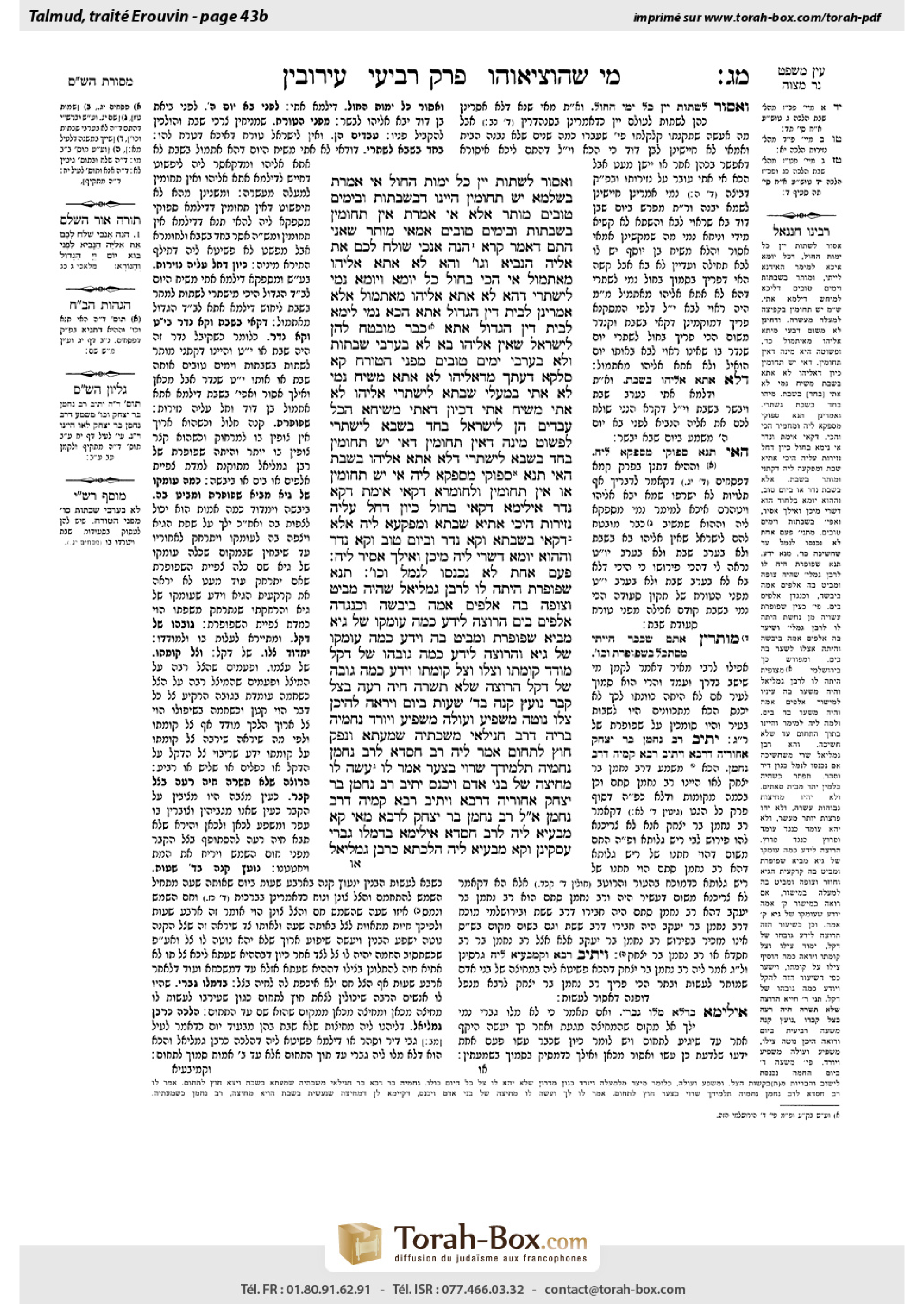
Eruvin 43b: Talmud study for Daf Yomi
Study the Talmud for Daf Yomi with scanned pages, Hebrew text, English translations from Sefaria and AI-generated French translations.
Passage selection and English or AI-generated French translation are available where the scan has annotations. Daf Study is independent of Torah-Box and Sefaria.
Browse Eruvin · עירובין · All tractatesEruvin 43b text and translations
This page of Eruvin includes the Aramaic text, an English translation and an AI-generated French translation, alongside the scan above.
עירובין מ״ג ב · Aramaic and Hebrew text
וְאָסוּר לִשְׁתּוֹת יַיִן כׇּל יְמוֹת הַחוֹל.
אִי אָמְרַתְּ בִּשְׁלָמָא יֵשׁ תְּחוּמִין — הַיְינוּ דִּבְשַׁבָּתוֹת וּבְיָמִים טוֹבִים מוּתָּר. אֶלָּא אִי אָמְרַתְּ אֵין תְּחוּמִין, בְּשַׁבָּתוֹת וּבְיָמִים טוֹבִים אַמַּאי מוּתָּר?
שָׁאנֵי הָתָם, דְּאָמַר קְרָא: ״הִנֵּה אָנֹכִי שֹׁלֵחַ לָכֶם אֵת אֵלִיָּה הַנָּבִיא וְגוֹ׳״, וְהָא לָא אֲתָא אֵלִיָּהוּ מֵאֶתְמוֹל.
אִי הָכִי, בְּחוֹל כֹּל יוֹמָא וְיוֹמָא נָמֵי לִישְׁתְּרֵי, דְּהָא לָא אֲתָא אֵלִיָּהוּ מֵאֶתְמוֹל? אֶלָּא אָמְרִינַן: לְבֵית דִּין הַגָּדוֹל אֲתָא. הָכָא נָמֵי לֵימָא: לְבֵית דִּין הַגָּדוֹל אֲתָא?
כְּבָר מוּבְטָח לָהֶן לְיִשְׂרָאֵל שֶׁאֵין אֵלִיָּהוּ בָּא לֹא בְּעַרְבֵי שַׁבָּתוֹת וְלֹא בְּעַרְבֵי יָמִים טוֹבִים, מִפְּנֵי הַטּוֹרַח.
קָא סָלְקָא דַּעְתָּךְ מִדְּאֵלִיָּהוּ לָא אֲתָא, מָשִׁיחַ נָמֵי לָא אָתֵי, בְּמַעֲלֵי שַׁבְּתָא לִישְׁתְּרֵי! אֵלִיָּהוּ לָא אָתֵי, מָשִׁיחַ אָתֵי. דְּכֵיוָן דְּאָתֵי מְשִׁיחָא — הַכֹּל עֲבָדִים הֵן לְיִשְׂרָאֵל.
בְּחַד בְּשַׁבָּא לִישְׁתְּרֵי? לִפְשׁוֹט מִינַּהּ דְּאֵין תְּחוּמִין, דְּאִי יֵשׁ תְּחוּמִין — בְּחַד בְּשַׁבָּא לִישְׁתְּרֵי, דְּלָא אֲתָא אֵלִיָּהוּ בְּשַׁבָּת?!
הַאי תַּנָּא סַפּוֹקֵי מְסַפְּקָא לֵיהּ אִי יֵשׁ תְּחוּמִין אוֹ אֵין תְּחוּמִין, וּלְחוּמְרָא.
דְּקָאֵי אֵימַת דְּקָא נָדַר? אִילֵּימָא דְּקָאֵי בְּחוֹל — כֵּיוָן דְּחָל עֲלֵיהּ נְזִירוּת, הֵיכִי אָתְיָא שַׁבְּתָא וּמַפְקְעָא לֵיהּ?
אֶלָּא דְּקָאֵי בְּשַׁבְּתָא וְקָא נָדַר, וּבְיוֹם טוֹב וְקָא נָדַר, וְהָהוּא יוֹמָא דְּשָׁרֵי לֵיהּ, מִיכָּן וְאֵילָךְ — אֲסִיר לֵיהּ.
פַּעַם אַחַת לֹא נִכְנְסוּ לַנָּמָל וְכוּ׳.
תָּנָא: שְׁפוֹפֶרֶת הָיְתָה לוֹ לְרַבָּן גַּמְלִיאֵל שֶׁהָיָה מַבִּיט וְצוֹפֶה בָּהּ אַלְפַּיִם אַמָּה בַּיַּבָּשָׁה, וּכְנֶגְדָּהּ אַלְפַּיִם בַּיָּם.
הָרוֹצֶה לֵידַע כַּמָּה עוֹמְקוֹ שֶׁל גֵּיא, מֵבִיא שְׁפוֹפֶרֶת וּמַבִּיט בָּהּ, וְיֵדַע כַּמָּה עוֹמְקוֹ שֶׁל גַּיְא.
וְהָרוֹצֶה לֵידַע כַּמָּה גּוֹבְהוֹ שֶׁל דֶּקֶל — מוֹדֵד קוֹמָתוֹ וְצִלּוֹ, וְצֵל קוֹמָתוֹ וְיֵדַע כַּמָּה גּוֹבַהּ שֶׁל דֶּקֶל.
הָרוֹצֶה שֶׁלֹּא תִּשְׁרֶה חַיָּה רָעָה בְּצֵל קֶבֶר — נוֹעֵץ קָנֶה בְּאַרְבַּע שָׁעוֹת בַּיּוֹם, וְיִרְאֶה לְהֵיכָן צִלּוֹ נוֹטֶה, מְשַׁפֵּיעַ וְעוֹלֶה מְשַׁפֵּיעַ וְיוֹרֵד.
נְחֶמְיָה בְּרֵיהּ דְּרַב חֲנִילַאי מְשַׁכְתֵּיהּ שְׁמַעְתָּא, וּנְפַק חוּץ לַתְּחוּם. אֲמַר לֵיהּ רַב חִסְדָּא לְרַב נַחְמָן: נְחֶמְיָה תַּלְמִידְךָ שָׁרוּי בְּצַעַר.
אָמַר לוֹ: עֲשֵׂה לוֹ מְחִיצָה שֶׁל בְּנֵי אָדָם, וְיִכָּנֵס.
יָתֵיב רַב נַחְמָן בַּר יִצְחָק אֲחוֹרֵיהּ דְּרָבָא, וְיָתֵיב רָבָא קַמֵּיהּ דְּרַב נַחְמָן. אֲמַר לֵיהּ רַב נַחְמָן בַּר יִצְחָק לְרָבָא: מַאי קָא מִבַּעְיָא לֵיהּ לְרַב חִסְדָּא?
אִילֵּימָא בִּדְמָלוּ גַּבְרֵי עָסְקִינַן, וְקָא מִבַּעְיָא לֵיהּ: הִלְכְתָא כְּרַבָּן גַּמְלִיאֵל,
Eruvin 43b · English translation
However, he is prohibited to drink wine on all weekdays, in case the Messiah has come and he has not yet been informed.
The Gemara clarifies: Granted, if you say that the prohibition of Shabbat limits applies above ten handbreadths, that is why on Shabbat and Festivals he is permitted to drink wine, for the Messiah will certainly not arrive from outside the Shabbat limit on those days. But if you say that the prohibition of Shabbat limits does not apply above ten handbreadths, why is he permitted to drink wine on Shabbat and Festivals?
The Gemara answers: It is different there, as the verse stated: “Behold I will send you Elijah the prophet, before the coming of the great and dreadful day of the Lord; and he shall turn the heart of the fathers to the children, and the heart of the children to their fathers” (Malachi 3:23–24). This verse teaches that Elijah will arrive the day before the coming of the Messiah. Since Elijah did not come the previous day, the Messiah will not come today, and therefore he may drink.
The Gemara rejects this argument: If so, on weekdays, too, he should be permitted to drink wine each and every day, as Elijah did not arrive the previous day. Rather, the reason for the prohibition on weekdays must be that we say that Elijah may already have arrived at the Great Court, but it has not yet become a matter of public knowledge. Likewise, here too we should say that Elijah already arrived the previous day at the Great Court, on the eve of Shabbat or a Festival.
The Gemara answers: It has already been promised to the Jewish people that Elijah will not come either on the eve of Shabbat or on the eve of a Festival, due to the trouble, lest people go out to greet him and not have time to complete all their preparations for the sacred day.
The Gemara comments: It might enter your mind to say that since Elijah will not come on Shabbat eve due to the trouble involved, the Messiah will also not come then, and if so, on Shabbat eve he should also be permitted to drink wine. However, this reasoning is rejected: It is only Elijah who will not arrive on Shabbat eve, but the Messiah himself may arrive, for once the Messiah comes, all the nations will be subservient to the Jewish people, and they will help them prepare whatever is needed for Shabbat.
The Gemara raises a difficulty: He should be permitted to drink wine on a Sunday, for if Elijah cannot come on Shabbat, the Messiah will not come on a Sunday. Let us resolve from here that the prohibition of Shabbat limits does not apply above ten handbreadths, as if the prohibition of Shabbat limits applies above ten handbreadths, on Sunday he should be permitted to drink wine, as Elijah cannot come on Shabbat.
The Gemara answers: This tanna was uncertain whether there is a prohibition of Shabbat limits above ten handbreadths or there is no prohibition of Shabbat limits. Therefore, he ruled stringently in this regard concerning Sunday.
The Gemara poses a question: When did the person who took the vow of naziriteship arise and take his vow? If you say he arose and took his vow on a weekday, since the vow of naziriteship already took effect, how can Shabbat come and annul it? Naziriteship cannot take effect one day and be annulled on the next; rather, once it applies, it remains in effect for the entire period of his vow.
Rather, it must be that he arose on Shabbat and took his vow, or else he arose on a Festival and took his vow, and it is only on that day that he is permitted to drink wine, as the Messiah will not come; but from that day on he is prohibited to drink wine, for once the naziriteship takes effect on a weekday, it remains in effect from that point onwards, even on Shabbat and Festivals.
It was taught in the mishna: On one occasion, they did not enter the port until after nightfall on Shabbat eve, and they asked Rabban Gamliel whether they were permitted to alight from the boat. He told them that they were permitted to alight, for he had been watching, and he knew that they had entered within the city’s limit before nightfall, and therefore they may walk throughout the city.
In order to clarify this issue, the Gemara cites that which was taught in a baraita: Rabban Gamliel had a special tube through which he would look and see a distance of two thousand cubits on land, and also determine a corresponding distance of two thousand cubits at sea.
In general, one who wishes to know the depth of a valley can bring such a tube and look through it, and he will know the depth of the valley.
The Gemara cites another statement with regard to measurements: One who wishes to know the height of a palm tree, but does not want to actually climb the tree to measure it, can measure his own height, and the length of his own shadow, and the length of the shadow of the height of the palm tree, and calculate the proportions, and he will know the height of the palm tree.
The Gemara cites related advice: If, out of honor for the dead, one wishes that a wild beast should not rest in the shade of a grave, he should insert a reed into the ground at the end of the fourth hour of the day, roughly ten o’clock in the morning, when it is hot in the sun and cooler in the shade, and beasts begin to seek shelter in the shade. And he should observe in which direction the shadow of the reed inclines, and then slant the gravestone upwards and downwards until he finds an angle at which it casts no shadow at that hour, and the beasts will not come to rest at the grave during the heat of the day.
The Gemara relates that Neḥemya, son of Rav Ḥanilai, was once so engrossed in his learning that he did not notice that he was going out beyond his Shabbat limit. Rav Ḥisda said to Rav Naḥman: Your student Neḥemya is in distress, as he is outside the Shabbat limit and cannot enter. What can we do for him?
Rav Naḥman said to him: Establish a human partition for him, i.e., people who are permitted to go out there should line up and form human walls, through which he is permitted to walk and thereby reenter the Shabbat limit.
Rav Naḥman bar Yitzḥak sat behind Rava, and Rava sat in the first row before Rav Naḥman. Rav Naḥman bar Yitzḥak said to Rava: What precisely was Rav Ḥisda’s dilemma that he addressed to Rav Naḥman with regard to Neḥemya’s distress?
The Gemara explains: If you say that we are dealing with a case where the space between Neḥemya and the Shabbat limit could be filled with people who had established an eiruv and were permitted to go out beyond the Shabbat limit and establish a human partition for Neḥemya, and then it can be argued that the dilemma that he raised was: Is the halakha in accordance with the opinion of Rabban Gamliel that a person may walk throughout an enclosed area, although he had not established residence there before Shabbat while it was still day, and the same applies to a human partition of this kind;
Eruvin 43b · Traduction française (IA)
Cependant, il est interdit de boire du vin tous les jours de la semaine, de peur que le Messie soit venu et qu'il n'ait pas encore été informé.
La Guemara clarifie : Cela est vrai, si vous dites que la prohibition des limites du Shabbat s'applique à dix paumes, c'est pourquoi, le Shabbat et les Fêtes, il est permis de boire du vin, car le Messie ne viendra certainement pas d'extérieur de la limite du Shabbat ces jours-là. Mais si vous dites que la prohibition des limites du Shabbat ne s'applique pas à dix paumes, pourquoi est-il permis de boire du vin le Shabbat et les Fêtes ?
La Guemara répond : C'est différent là, car la Parashia dit : « Voici que je t'envoie Elie le prophète, avant la venue du grand et redoutable jour du Seigneur ; et il fera revenir le cœur des pères vers les enfants, et le cœur des enfants vers leurs pères » (Micha 3:23–24). Cette Parashia enseigne que Elie arrivera la veille de la venue du Messie. Puisque Elie n'est pas venu la veille, le Messie ne viendra pas aujourd'hui, et donc il peut boire.
La Guemara rejette cet argument : Si c'est ainsi, il devrait être permis de boire du vin chaque jour de la semaine, car Elie n'est pas venu la veille. Plutôt, la raison de la prohibition pendant les jours de semaine doit être que nous disons que Elie pourrait déjà être arrivé au Grand Tribunal, mais cela n'a pas encore été rendu public. De même, ici aussi, nous devrions dire que Elie est déjà arrivé la veille au Grand Tribunal, à la veille du Shabbat ou d'une Fête.
La Guemara répond : Il a déjà été promis au peuple juif que Elie ne viendra pas non plus à la veille du Shabbat ou à la veille d'une Fête, en raison de la difficulté, de peur que les gens sortent le saluer et n'aient pas le temps de terminer toutes leurs préparations pour la journée sainte.
La Guemara commente : Il pourrait entrer en vous l'idée de dire que puisque Elie ne viendra pas à la veille du Shabbat en raison de la difficulté, le Messie ne viendra pas non plus alors, et si c'est ainsi, il devrait être permis de boire du vin à la veille du Shabbat. Cependant, cette raisonning est rejetée : C'est seulement Elie qui ne viendra pas à la veille du Shabbat, mais le Messie lui-même pourrait arriver, car une fois que le Messie est venu, toutes les nations seront soumises au peuple juif, et elles aideront à préparer ce qui est nécessaire pour le Shabbat.
La Guemara soulève une difficulté : Il devrait être permis de boire du vin le dimanche, car si Elie ne peut pas venir le Shabbat, le Messie ne viendra pas le dimanche. Résolvons cela ici que la prohibition des limites du Shabbat ne s'applique pas à dix paumes, car si la prohibition des limites du Shabbat s'applique à dix paumes, le dimanche il devrait être permis de boire du vin, car Elie ne peut pas venir le Shabbat.
La Guemara répond : Ce tanna était incertain quant à l'existence de la prohibition des limites du Shabbat au-delà de dix paumes ou non. Par conséquent, il a décidé strictement concernant le dimanche.
La Guemara pose une question : Quand est-ce que la personne qui a pris le serment de naziriteship est survenue et a pris son serment ? Si vous dites qu'il est survenu et a pris son serment un jour de semaine, puisque le serment de naziriteship a déjà pris effet, comment le Shabbat peut-il l'annuler ? Le naziriteship ne peut pas prendre effet un jour et être annulé le lendemain ; plutôt, une fois qu'il s'applique, il reste en vigueur pendant toute la durée de son serment.
Plutôt, il faut que l'homme ait levé le Shabbat et ait pris son serment, ou bien qu'il ait levé un jour de fête et ait pris son serment, et c'est seulement ce jour-là qu'il est permis de boire du vin, car le Messie ne viendra pas ; mais à partir de ce jour, il est interdit de boire du vin, car une fois que le statut de nazir s'applique un jour de semaine, il reste en vigueur à partir de ce moment, même le Shabbat et les jours de fête.
Il a été enseigné dans la Michna : Une fois, ils n'ont pas pénétré dans le port jusqu'après le coucher du soleil à la veille du Shabbat, et ils ont demandé à Rabban Gamliel s'ils étaient autorisés à descendre du bateau. Il leur a répondu qu'ils étaient autorisés à descendre, car il avait surveillé et savait qu'ils avaient pénétré dans les limites de la ville avant le coucher du soleil, et donc ils pouvaient marcher librement dans la ville.
Afin de clarifier cette question, la Guemara cite ce qui a été enseigné dans une baraïta : Rabban Gamliel avait un tube spécial par lequel il pouvait voir une distance de deux mille coudées sur terre, et aussi déterminer une distance correspondante de deux mille coudées en mer.
En général, celui qui veut connaître la profondeur d'une vallée peut apporter un tel tube et regarder à travers, et il saura la profondeur de la vallée.
La Guemara cite une autre déclaration concernant les mesures : Celui qui veut connaître la hauteur d'un palmier, mais ne veut pas monter sur l'arbre pour mesurer, peut mesurer sa propre hauteur, la longueur de son ombre, et la longueur de l'ombre de la hauteur du palmier, et calculer les proportions, et il saura la hauteur du palmier.
La Guemara cite un conseil lié : Si, par honneur pour les morts, on veut que les bêtes sauvages ne reposent pas à l'ombre d'une tombe, on devrait insérer un roseau dans le sol à la fin de la quatrième heure de la journée, vers dix heures du matin, quand il fait chaud au soleil et plus frais à l'ombre, et les bêtes commencent à chercher un abri à l'ombre. Et on devrait observer dans quelle direction l'ombre du roseau s'incline, puis incliner la pierre tombale vers le haut et le bas jusqu'à ce qu'on trouve un angle où elle ne jette pas d'ombre à cette heure, et les bêtes ne viendront pas se reposer à la tombe pendant la chaleur de la journée.
La Guemara rapporte que Néhémia, fils de Raba Ḥanilai, était un jour tellement absorbé dans son étude qu'il ne s'aperçut pas qu'il sortait du périmètre de la fête. Raba Ḥisda dit à Raba Naḥman : Votre élève Néhémia est dans une détresse, car il est hors du périmètre de la fête et ne peut pas rentrer. Que pouvons-nous faire pour lui ?
Raba Naḥman dit à lui : Établissez un mur humain pour lui, c'est-à-dire que des personnes autorisées à sortir là devraient se ranger et former des murs humains, par lesquels il est autorisé à marcher et ainsi réentrer dans le périmètre de la fête.
Raba Naḥman bar Yitzḥak était assis derrière Rava, et Rava était assis en première rangée avant Raba Naḥman. Raba Naḥman bar Yitzḥak dit à Rava : Quelle était précisément la difficulté de Raba Ḥisda qui l'a adressée à Raba Naḥman concernant la détresse de Néhémia ?
La Guemara explique : Si vous dites que nous sommes dans un cas où l'espace entre Néhémia et le périmètre de la fête pourrait être rempli de personnes ayant établi un eiruv et autorisées à sortir au-delà du périmètre de la fête et à établir un mur humain pour Néhémia, alors on peut arguer que la difficulté qu'il a soulevée était : La halakha suit-elle l'opinion de Rabban Gamliel selon laquelle une personne peut marcher dans une zone enclose, même s'il n'avait pas établi son domicile là avant la fête alors qu'il était encore jour, et la même chose s'applique à un tel mur humain ;
Traduction française générée par IA à partir de l’édition anglaise de Sefaria. Vérifie toujours un passage avec le texte source.
Text from Sefaria: William Davidson Edition - Vocalized Aramaic (CC BY NC); William Davidson Edition - English (CC BY NC).