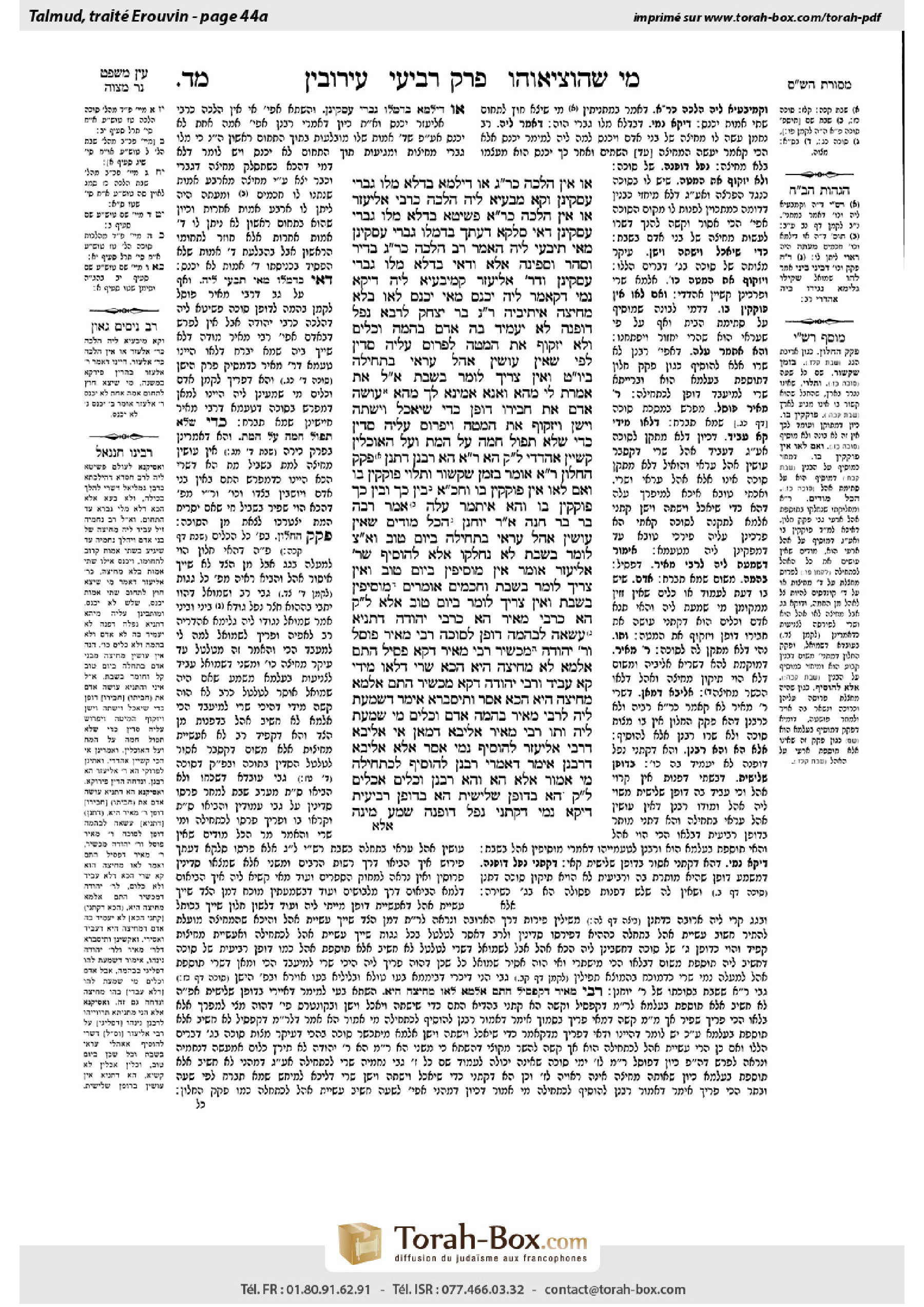
Eruvin 44a: Talmud study for Daf Yomi
Study the Talmud for Daf Yomi with scanned pages, Hebrew text, English translations from Sefaria and AI-generated French translations.
Passage selection and English or AI-generated French translation are available where the scan has annotations. Daf Study is independent of Torah-Box and Sefaria.
Browse Eruvin · עירובין · All tractatesEruvin 44a text and translations
This page of Eruvin includes the Aramaic text, an English translation and an AI-generated French translation, alongside the scan above.
עירובין מ״ד א · Aramaic and Hebrew text
אוֹ אֵין הֲלָכָה כְּרַבָּן גַּמְלִיאֵל. אוֹ דִילְמָא, בִּדְלָא מָלוּ גַּבְרֵי עָסְקִינַן, וְקָא מִבַּעְיָא לֵיהּ: הֲלָכָה כְּרַבִּי אֱלִיעֶזֶר, אוֹ אֵין הֲלָכָה כְּרַבִּי אֱלִיעֶזֶר?
פְּשִׁיטָא בִּדְלָא מָלוּ גַּבְרֵי עָסְקִינַן, דְּאִי סָלְקָא דַעְתָּךְ בִּדְמָלוּ גַּבְרֵי עָסְקִינַן, מַאי תִּיבְּעֵי לֵיהּ? הָאָמַר רַב: הֲלָכָה כְּרַבָּן גַּמְלִיאֵל בְּדִיר וְסַהַר וּסְפִינָה! אֶלָּא וַדַּאי בִּדְלָא מָלוּ גַּבְרֵי עָסְקִינַן, וּדְרַבִּי אֱלִיעֶזֶר קָמִיבַּעְיָא לֵיהּ.
דַּיְקָא נָמֵי, דְּקָאֲמַר לֵיהּ ״יִכָּנֵס״. מַאי ״יִכָּנֵס״ — לָאו בְּלֹא מְחִיצָה?!
אֵיתִיבֵיהּ רַב נַחְמָן בַּר יִצְחָק לְרָבָא: נָפַל דּוֹפְנָהּ — לֹא יַעֲמִיד בָּהּ אָדָם בְּהֵמָה וְכֵלִים. וְלֹא יִזְקוֹף אֶת הַמִּטָּה לִפְרוֹס עָלֶיהָ סָדִין, לְפִי שֶׁאֵין עוֹשִׂין אֹהֶל עֲרַאי בַּתְּחִילָּה בְּיוֹם טוֹב, וְאֵין צָרִיךְ לוֹמַר בַּשַּׁבָּת.
אֲמַר לֵיהּ: אַתְּ אָמְרַתְּ לִי מֵהָא, וַאֲנָא אָמֵינָא לָךְ מֵהָא: עוֹשֶׂה אָדָם אֶת חֲבֵירוֹ דּוֹפֶן כְּדֵי שֶׁיֹּאכַל וְיִשְׁתֶּה וְיִשַׁן. וְיִזְקוֹף אֶת הַמִּטָּה וְיִפְרוֹס עָלֶיהָ סָדִין כְּדֵי שֶׁלֹּא תִּפּוֹל חַמָּה עַל הַמֵּת וְעַל הָאוֹכָלִין.
קַשְׁיָין אַהֲדָדֵי! לָא קַשְׁיָא: הָא — רַבִּי אֱלִיעֶזֶר, הָא — רַבָּנַן, דִּתְנַן: פְּקַק הַחַלּוֹן, רַבִּי אֱלִיעֶזֶר אוֹמֵר: בִּזְמַן שֶׁקָּשׁוּר וְתָלוּי — פּוֹקְקִין בּוֹ, וְאִם לָאו — אֵין פּוֹקְקִין בּוֹ. וַחֲכָמִים אוֹמְרִים: בֵּין כָּךְ וּבֵין כָּךְ פּוֹקְקִין בּוֹ.
וְהָא: אִיתְּמַר עֲלַהּ, אָמַר רַבָּה בַּר בַּר חָנָה אָמַר רַבִּי יוֹחָנָן: הַכֹּל מוֹדִים שֶׁאֵין עוֹשִׂין אֹהֶל עֲרַאי בַּתְּחִילָּה בְּיוֹם טוֹב, וְאֵין צָרִיךְ לוֹמַר בְּשַׁבָּת. לֹא נֶחְלְקוּ אֶלָּא לְהוֹסִיף, שֶׁרַבִּי אֱלִיעֶזֶר אוֹמֵר: אֵין מוֹסִיפִין בְּיוֹם טוֹב, וְאֵין צָרִיךְ לוֹמַר בְּשַׁבָּת. וַחֲכָמִים אוֹמְרִים: מוֹסִיפִין בְּשַׁבָּת, וְאֵין צָרִיךְ לוֹמַר בְּיוֹם טוֹב!
אֶלָּא לָא קַשְׁיָא: הָא — כְּרַבִּי מֵאִיר, הָא — כְּרַבִּי יְהוּדָה. דְּתַנְיָא: עֲשָׂאָהּ לִבְהֵמָה דּוֹפֶן לַסּוּכָּה, רַבִּי מֵאִיר פּוֹסֵל, וְרַבִּי יְהוּדָה מַכְשִׁיר.
רַבִּי מֵאִיר דְּקָא פָּסֵיל הָתָם — אַלְמָא לָא מְחִיצָה הִיא, הָכָא שָׁרֵי, דְּלָאו מִידֵּי קָא עָבֵיד.
וְרַבִּי יְהוּדָה דְּקָא מַכְשִׁיר הָתָם — אַלְמָא מְחִיצָה הִיא, הָכָא אָסַר.
וְתִיסְבְּרָא? אֵימַר דְּשָׁמְעַתְּ לֵיהּ לְרַבִּי מֵאִיר בְּהֵמָה. אָדָם וְכֵלִים מִי שָׁמְעַתְּ לֵיהּ?
וְתוּ — רַבִּי מֵאִיר אַלִּיבָּא דְּמַאן? אִי אַלִּיבָּא דְּרַבִּי אֱלִיעֶזֶר — לְהוֹסִיף נָמֵי אָסַר.
אֶלָּא אַלִּיבָּא דְּרַבָּנַן, אֵימַר דְּאָמְרִי רַבָּנַן לְהוֹסִיף, לְכַתְּחִילָּה מִי אֲמוּר?
אֶלָּא: הָא וְהָא רַבָּנַן. וְכֵלִים אַכֵּלִים לָא קַשְׁיָא, הָא — בְּדוֹפֶן שְׁלִישִׁית, הָא — בְּדוֹפֶן רְבִיעִית.
דַּיְקָא נָמֵי, דְּקָתָנֵי: נָפַל דּוֹפְנָהּ. שְׁמַע מִינַּהּ.
Eruvin 44a · English translation
or is the halakha not in accordance with the opinion of Rabban Gamliel? Or perhaps we are dealing with a case where the space between Neḥemya and the Shabbat limit could not be filled with people who had established an eiruv and were permitted to establish a human partition for Neḥemya. In that case, there were enough people to establish partitions from where Neḥemya was standing to within two cubits from the limit, and the dilemma that Rav Ḥisda raised was: Is the halakha in accordance with the opinion of Rabbi Eliezer, who says that someone who went two cubits outside of his Shabbat limit may reenter it, or is the halakha not in accordance with the opinion of Rabbi Eliezer?
The Gemara answers: This is obvious that we are dealing with a case where the space between Neḥemya and the Shabbat limit could not be filled with people, as if it should enter your mind that we are dealing with a case where the space between Neḥemya and the Shabbat limit could be fully filled with people, what is Rav Ḥisda’s dilemma? Didn’t Rav say: The halakha is in accordance with the opinion of Rabban Gamliel with regard to a pen, a stable, and a boat? Rather, we must be dealing with a case where the space between Neḥemya and the Shabbat limit could not be filled with people, and the dilemma that he raised was about the ruling of Rabbi Eliezer.
The Gemara comments: This interpretation is also precise and implicit in Rav Naḥman’s answer, for Rav Naḥman said to Rav Ḥisda: Establish a human partition for him, and let him reenter his Shabbat limit. Doesn’t the statement: Let him reenter, mean that he may reenter even without a partition along those two additional two cubits, i.e., that after he passes through the human partitions, he would still need to cross the remaining two cubits on his own without the benefit of a partition?
Rav Naḥman bar Yitzḥak raised an objection to the opinion of Rava with regard to the principle of making a human partition on Shabbat, from a baraita: If the wall of a sukka fell on a Festival or on Shabbat, thus rendering the sukka unfit for the mitzva, one may not position people, animals or utensils there in its place in order to form a wall, nor may one turn a bed upright in order to spread a sheet over it, which will thereby serve as a partition, because one may not make a temporary tent for the first time on a Festival, and, needless to say, this is prohibited on Shabbat. This indicates that a human partition may not be erected on Shabbat.
Rava said to him: You state to me that this is prohibited from this baraita, but I can state to you that it is permitted from this other baraita: A person may position his fellow as a wall, so that he may eat, drink, and sleep in a sukka, and he is likewise permitted to turn a bed upright in order to spread a sheet over it, so that the sun should not beat down on a corpse, or on food.
The Gemara comments: If so, these two baraitot contradict one another. The Gemara answers: This is not difficult; this baraita that teaches that it is prohibited reflects the opinion of Rabbi Eliezer, whereas this other baraita that teaches that it is permitted reflects the opinion of the Rabbis. As we learned in a mishna: With regard to a window shutter that is not fixed to the wall with hinges, Rabbi Eliezer says: If it is tied to the wall and hangs from the window, one may shut the window with it; but if not, one may not shut the window with it, since one may not erect a tent, even a temporary one, on Shabbat. But the Rabbis say: In either case, one may shut the window with it. This indicates that the Rabbis permit constructing a temporary wall of this sort on Shabbat, and they also permit the construction of a temporary wall in the case of a sukka.
The Gemara raises a difficulty: But wasn’t it stated with regard to this dispute: Rabba bar bar Ḥana said that Rabbi Yoḥanan said: All agree that one may not make a temporary tent for the first time on a Festival, and, needless to say, this is prohibited on Shabbat. The Rabbis and Rabbi Eliezer disagree only with regard to adding a temporary tent to a permanent structure, as in the case of a window shutter. As Rabbi Eliezer says: One may not add a temporary tent to a permanent structure even on a Festival; and, needless to say, this is prohibited on Shabbat. And the Rabbis say: One may add a temporary tent to a permanent structure on Shabbat, and needless to say, this is permitted on a Festival. This indicates that there is no opinion that grants license to construct a temporary wall for the first time.
Rather, the Gemara resolves the contradiction differently: This is not difficult, as this baraita that permits the positioning of an animal or a person as a wall was taught in accordance with the opinion of Rabbi Meir, and this baraita that prohibits it was taught in accordance with the opinion of Rabbi Yehuda. As it was taught in a baraita: With regard to one who positions an animal to serve as the wall of a sukka, Rabbi Meir deems it unfit, out of concern that the animal might leave, whereas Rabbi Yehuda deems it fit.
Rabbi Meir, who deems the wall unfit there, with regard to a sukka, apparently holds that a partition established from a living creature is not a partition and he would here, in the case of Shabbat, rule that it is permitted to construct such a wall, as he is not doing anything, since it is not considered actual construction.
However, Rabbi Yehuda, who deems the wall to be fit there, with regard to a sukka, apparently holds that it is a proper partition; and he would here, in the case of Shabbat, prohibit the construction of such a partition.
The Gemara raises a difficulty: And how can you understand it in that manner? Say that you heard that Rabbi Meir deemed the sukka to be unfit in the case where an animal was used to serve as a partition, but did you hear that he deemed the sukka to be similarly unfit if a person or utensils were used as walls? The reason that an animal may not be used as a partition, according to his opinion, is because it might leave. This concern does not apply to people or utensils, since a person is under his own control and can remain standing, and utensils do not move themselves. Since the baraita validates partitions established with people and utensils as well as animals, it cannot be based on the opinion of Rabbi Meir.
And furthermore, even if you do not differentiate as above, and instead assume that the consideration that the animal might leave is pertinent, according to whose opinion does Rabbi Meir state his opinion with regard to constructing a temporary tent on Shabbat? If it is according to the opinion of his teacher Rabbi Eliezer, this is difficult, as he even prohibited adding a window shutter, i.e., a temporary tent, to a permanent structure.
Rather, you must say that he stated his opinion in accordance with the opinion of the Rabbis. However, even according to their opinion, say that the Rabbis only said that one is permitted to add a temporary tent to a permanent structure; but did they say that it is permitted to construct a partition or a tent for the first time?
Rather, say that both this baraita and that baraita follow the opinion of the Rabbis, and this is the resolution of the various contradictions: With regard to the contradiction between the one ruling concerning utensils and the other ruling concerning utensils, this is not difficult, as this ruling that prohibits the construction of an additional wall refers to the third wall of a sukka, which renders it fit for the mitzva; whereas this other ruling that permits the construction of an additional wall refers to the fourth wall of a sukka, which is insignificant, as a sukka need not have four walls.
This interpretation is also precise in the wording of the baraita, as the baraita that prohibits the construction of an additional wall uses the following phrase: If its wall fell. This indicates a wall that is significant, i.e., a wall that renders it fit for use, rather than any wall, as stated in the baraita that permits it. The Gemara concludes: Learn from this that the correct resolution is to differentiate between the third and fourth wall of a sukka.
Eruvin 44a · Traduction française (IA)
ou la halakha ne correspond pas à l'opinion de Rabban Gamliel ? Ou peut-être nous sommes en présence d'un cas où l'espace entre Neḥemya et la limite du Shabbat ne pouvait pas être comblé par des personnes ayant établi un eiruv et autorisées à établir une partition humaine pour Neḥemya. Dans ce cas, il y avait suffisamment de personnes pour établir des partitions depuis l'endroit où Neḥemya se tenait jusqu'à deux coudées de la limite, et le dilemme que Rav Ḥisda a soulevé est le suivant : La halakha correspond-elle à l'opinion de Rabbi Eliezer, qui affirme qu'une personne qui sort deux coudées en dehors de sa limite du Shabbat peut réentrer, ou la halakha ne correspond-elle pas à l'opinion de Rabbi Eliezer ?
La Guemara répond : Cela est évident que nous sommes en présence d'un cas où l'espace entre Neḥemya et la limite du Shabbat ne pouvait pas être comblé par des personnes, car si cela vous venait à l'esprit que nous sommes en présence d'un cas où l'espace entre Neḥemya et la limite du Shabbat pouvait être pleinement comblé par des personnes, que signifie le dilemme de Rav Ḥisda ? N'a-t-il pas dit : La halakha correspond à l'opinion de Rabban Gamliel concernant un enclos, un étable et un bateau ? Plutôt, nous devons être en présence d'un cas où l'espace entre Neḥemya et la limite du Shabbat ne pouvait pas être comblé par des personnes, et le dilemme qu'il a soulevé concerne la décision de Rabbi Eliezer.
La Guemara commente : Cette interprétation est également précise et implicite dans la réponse de Rav Naḥman, car Rav Naḥman a dit à Rav Ḥisda : Établissez une partition humaine pour lui, et laissez-le réentrer dans sa limite du Shabbat. N'indique-t-il pas que l'expression « laissez-le réentrer » signifie qu'il peut réentrer même sans une partition sur ces deux coudées supplémentaires, c'est-à-dire que, après avoir traversé les partitions humaines, il lui faudrait encore traverser les deux coudées restantes seul, sans bénéficier d'une partition ?
Rav Naḥman bar Yitzḥak a soulevé une objection contre l'opinion de Rava concernant le principe d'établir une partition humaine le Shabbat, à partir d'une baraïta : Si la paroi d'un sukka tombe pendant un festival ou le Shabbat, rendant ainsi le sukka inadapté à la mitsva, on ne peut pas placer des personnes, des animaux ou des ustensiles là où la paroi était, afin de former une paroi, ni ne peut-on dresser un lit en position verticale afin de poser un drap dessus, ce qui servirait ainsi de partition, car on ne peut pas ériger un abri temporaire pour la première fois pendant un festival, et, sans doute, cela est interdit le Shabbat. Cela indique que l'érection d'une partition humaine est interdite le Shabbat.
Rava a répondu à lui : Vous affirmez que cela est interdit selon cette baraïta, mais je peux affirmer que cela est permis selon une autre baraïta : Une personne peut placer son camarade comme une paroi, afin qu'il puisse manger, boire et dormir dans un sukka, et il est également autorisé à dresser un lit en position verticale afin de poser un drap dessus, afin que le soleil ne frappe pas un cadavre ou des aliments.
La Guemara commente : Si c'est ainsi, ces deux baraitot s'opposent l'une à l'autre. La Guemara répond : Ce n'est pas difficile ; cette baraïta qui enseigne que cela est interdit reflète l'opinion de Rabbi Eliezer, tandis que cette autre baraïta qui enseigne que cela est permis reflète l'opinion des Rabbins. Comme nous avons appris dans une mitsna : Concernant une volette non fixée au mur par des gonds, Rabbi Eliezer dit : Si elle est attachée au mur et pend de la fenêtre, on peut fermer la fenêtre avec elle ; mais si non, on ne peut pas fermer la fenêtre avec elle, car on ne peut pas ériger un abri temporaire, même temporaire, le Shabbat. Mais les Rabbins disent : Dans les deux cas, on peut fermer la fenêtre avec elle. Cela indique que les Rabbins autorisent la construction d'une paroi temporaire de ce genre le Shabbat, et ils autorisent également la construction d'une paroi temporaire dans le cas d'un sukka.
La Guemara soulève une difficulté : Mais n'était-il pas dit concernant ce débat : Rabba bar bar Ḥana a dit que Rabbi Yoḥanan a dit : Tout le monde est d'accord sur le fait qu'on ne peut pas ériger un abri temporaire pour la première fois pendant un festival, et, sans doute, cela est interdit le Shabbat. Les Rabbins et Rabbi Eliezer ne s'opposent que concernant l'ajout d'un abri temporaire à une structure permanente, comme dans le cas d'une volette. Comme Rabbi Eliezer dit : On ne peut pas ajouter un abri temporaire à une structure permanente même pendant un festival ; et, sans doute, cela est interdit le Shabbat. Et les Rabbins disent : On peut ajouter un abri temporaire à une structure permanente le Shabbat, et sans doute, cela est autorisé pendant un festival. Cela indique qu'il n'y a pas d'opinion qui autorise la construction d'une paroi temporaire pour la première fois.
Plutôt, la Guemara résout le paradoxe différemment : Ce n'est pas difficile, car cette baraïta qui autorise la position d'un animal ou d'une personne comme paroi a été enseignée selon l'opinion de Rabbi Meir, et cette baraïta qui l'interdit a été enseignée selon l'opinion de Rabbi Yehuda. Comme il a été enseigné dans une baraïta : Concernant celui qui place un animal pour servir de paroi à un sukka, Rabbi Meir considère cela comme inadapté, par crainte que l'animal parte, tandis que Rabbi Yehuda considère cela comme adapté.
Rabbi Meir, qui considère la paroi comme inadaptée dans ce cas, concernant un sukka, semble tenir que la partition établie à partir d'un être vivant n'est pas une partition, et il serait ici, dans le cas du Shabbat, de règle qu'il est permis d'établir une telle paroi, car il ne fait rien, car cela n'est pas considéré comme une construction réelle.
Cependant, Rabbi Yehuda, qui considère la paroi comme adaptée dans ce cas, concernant un sukka, semble tenir qu'il s'agit d'une paroi appropriée ; et il serait ici, dans le cas du Shabbat, d'interdire la construction de telle partition.
La Guemara soulève une difficulté : Et comment peut-on comprendre cela ainsi ? Disons que tu as entendu que le maître Rabbi Meïr considérait la sukka comme non conforme dans le cas où un animal était utilisé comme mur, mais as-tu entendu qu'il considérait également la sukka comme non conforme si un homme ou des ustensiles étaient utilisés comme murs ? La raison pour laquelle un animal ne peut pas être utilisé comme mur, selon son avis, est qu'il pourrait s'éloigner. Cette préoccupation ne s'applique pas aux hommes ou aux ustensiles, car un homme est sous son propre contrôle et peut rester debout, et les ustensiles ne se déplacent pas seuls. Puisque la baraïta valide les murs établis avec des hommes et des ustensiles ainsi qu'avec des animaux, elle ne peut pas être fondée sur l'opinion de Rabbi Meïr.
Et de plus, même si tu ne fais pas la distinction comme ci-dessus, et que tu supposes plutôt que la préoccupation que l'animal pourrait s'éloigner est pertinente, selon l'opinion de qui Rabbi Meïr exprime son avis concernant la construction d'une tente provisoire le sabbat ? Si c'est selon l'opinion de son maître Rabbi Eliezer, cela est difficile, car il a même interdit d'ajouter une volet de fenêtre, c'est-à-dire une tente provisoire, à une structure permanente.
Plutôt, tu dois dire qu'il a exprimé son avis selon l'opinion des Rabbins. Cependant, même selon leur opinion, disons que les Rabbins n'ont dit qu'on est autorisé à ajouter une tente provisoire à une structure permanente ; mais n'ont-ils pas dit qu'il est permis de construire un mur ou une tente pour la première fois ?
Plutôt, disons que ces deux baraitot suivent l'opinion des Rabbins, et c'est la résolution des diverses contradictions : En ce qui concerne la contradiction entre la décision concernant les ustensiles et l'autre décision concernant les ustensiles, cela n'est pas difficile, car cette décision interdisant la construction d'un mur supplémentaire concerne le troisième mur d'une sukka, ce qui la rend apte à la mitsva ; tandis que cette autre décision autorisant la construction d'un mur supplémentaire concerne le quatrième mur d'une sukka, qui est insignifiant, car une sukka n'a pas besoin de quatre murs.
Cette interprétation est également précise dans le wording de la baraïta, car la baraïta interdisant la construction d'un mur supplémentaire utilise la phrase suivante : Si son mur s'est effondré. Cela indique un mur important, c'est-à-dire un mur qui rend la sukka apte à l'usage, plutôt que n'importe quel mur, comme le dit la baraïta qui l'autorise. La Guemara conclut : Apprends-en que la résolution correcte est de distinguer entre le troisième et le quatrième mur d'une sukka.
Traduction française générée par IA à partir de l’édition anglaise de Sefaria. Vérifie toujours un passage avec le texte source.
Text from Sefaria: William Davidson Edition - Vocalized Aramaic (CC BY NC); William Davidson Edition - English (CC BY NC).