Eruvin 44b: Talmud study for Daf Yomi
Study the Talmud for Daf Yomi with scanned pages, Hebrew text, English translations from Sefaria and AI-generated French translations.
Passage selection and English or AI-generated French translation are available where the scan has annotations. Daf Study is independent of Torah-Box and Sefaria.
Browse Eruvin · עירובין · All tractatesEruvin 44b text and translations
This page of Eruvin includes the Aramaic text, an English translation and an AI-generated French translation, alongside the scan above.
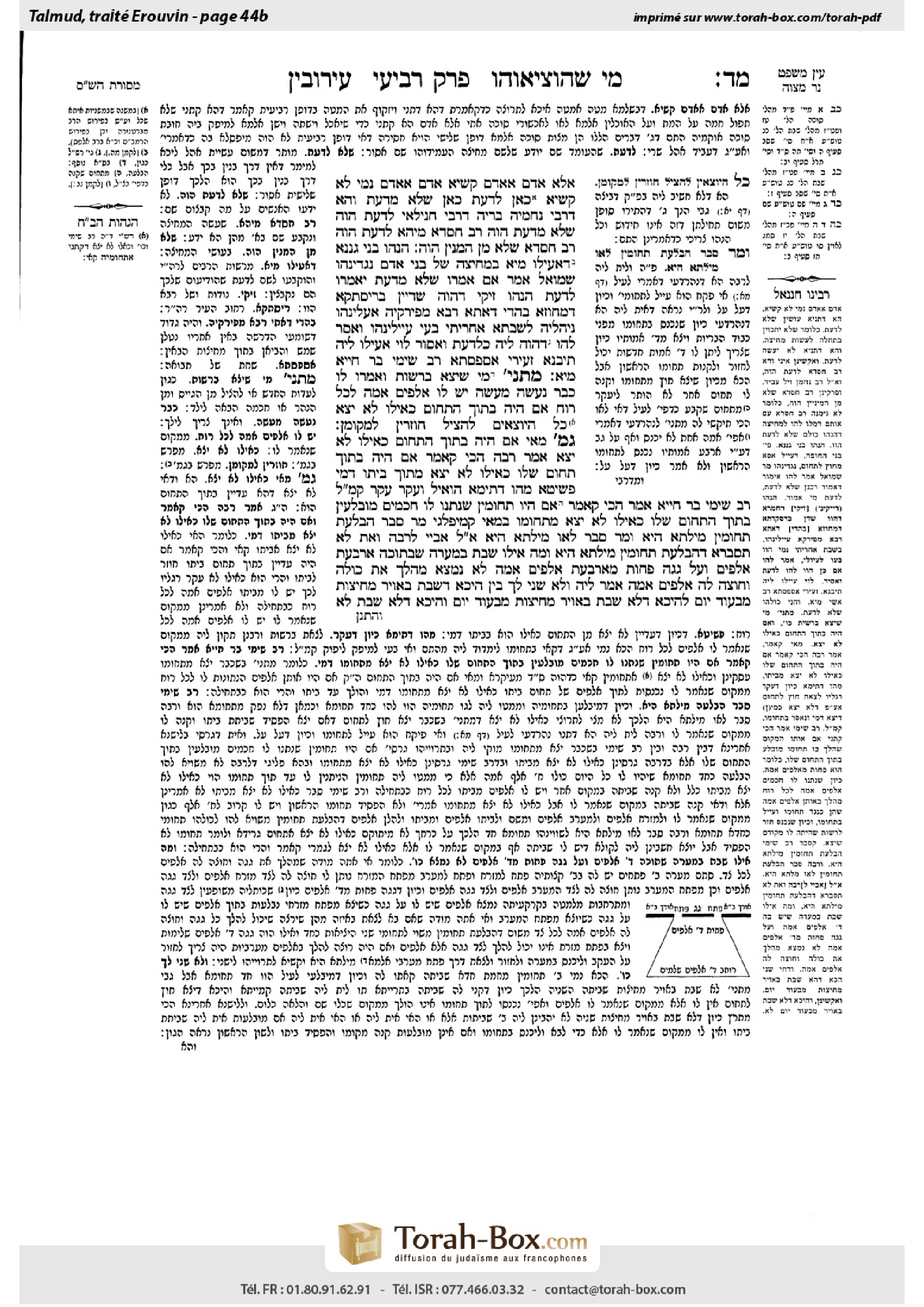
עירובין מ״ד ב · Aramaic and Hebrew text
אֶלָּא אָדָם אַאָדָם קַשְׁיָא!
אָדָם אַאָדָם נָמֵי לָא קַשְׁיָא: כָּאן — לְדַעַת, כָּאן — שֶׁלֹּא מִדַּעַת.
וְהָא דְּרַבִּי נְחֶמְיָה בְּרֵיהּ דְּרַבִּי חֲנִילַאי, לְדַעַת הֲוָה! שֶׁלֹּא מִדַּעַת הֲוָה.
רַב חִסְדָּא, מִיהָא לְדַעַת הֲוָה! רַב חִסְדָּא, שֶׁלֹּא מִן הַמִּנְיָן הֲוָה.
הָנְהוּ בְּנֵי גְנָנָא דְּאַעִילוּ מַיָּא בִּמְחִיצָה שֶׁל בְּנֵי אָדָם. נַגְּדִינְהוּ שְׁמוּאֵל. אֲמַר: אִם אָמְרוּ שֶׁלֹּא מִדַּעַת, יֹאמְרוּ לְדַעַת?!
הָנְהוּ זִיקֵי דַּהֲוָה שַׁדְיָין בְּרִיסְתְּקָא דְמָחוֹזָא, בַּהֲדֵי דַּאֲתָא רָבָא מִפִּירְקֵיהּ, אַעְלִינְהוּ נִיהֲלֵיהּ. לְשַׁבְּתָא אַחֲרִיתִי בָּעֵי עַיְּילִינְהוּ, וַאֲסַר לְהוּ, דְּהָוֵה לֵיהּ כִּלְדַעַת — וְאָסוּר.
לֵוִי, אַעִילוּ לֵיהּ תִּיבְנָא, זְעֵירִי — אַסְפַּסְתָּא, רַב שִׁימִי בַּר חִיָּיא — מַיָּא.
מַתְנִי׳ מִי שֶׁיָּצָא בִּרְשׁוּת, וְאָמְרוּ לוֹ: ״כְּבָר נַעֲשָׂה מַעֲשֶׂה״ — יֵשׁ לוֹ אַלְפַּיִם אַמָּה לְכׇל רוּחַ.
אִם הָיָה בְּתוֹךְ הַתְּחוּם — כְּאִילּוּ לֹא יָצָא. כׇּל הַיּוֹצְאִים לְהַצִּיל — חוֹזְרִין לִמְקוֹמָן.
גְּמָ׳ מַאי ״אִם הָיָה בְּתוֹךְ הַתְּחוּם כְּאִילּוּ לֹא יָצָא״? אָמַר רַבָּה, הָכִי קָאָמַר: אִם הָיָה בְּתוֹךְ תְּחוּם שֶׁלּוֹ — כְּאִילּוּ לֹא יָצָא מִתּוֹךְ בֵּיתוֹ דָּמֵי.
פְּשִׁיטָא? מַהוּ דְּתֵימָא: הוֹאִיל וְעָקַר — עָקַר, קָא מַשְׁמַע לַן.
רַב שִׁימִי בַּר חִיָּיא אָמַר, הָכִי קָאָמַר: אִם הָיוּ תְּחוּמִין שֶׁנָּתְנוּ לוֹ חֲכָמִים מוּבְלָעִין בְּתוֹךְ הַתְּחוּם שֶׁלּוֹ, כְּאִילּוּ לֹא יָצָא מִתְּחוּמוֹ.
בְּמַאי קָמִיפַּלְגִי? מָר סָבַר הַבְלָעַת תְּחוּמִין מִילְּתָא הִיא, וּמָר סָבַר לָאו מִילְּתָא הִיא.
אֲמַר לֵיהּ אַבָּיֵי לְרַבָּה: וְאַתְּ לָא תִּסְבְּרָא דְּהַבְלָעַת תְּחוּמִין מִילְּתָא הִיא? וּמָה אִילּוּ שָׁבַת בִּמְעָרָה, שֶׁבְּתוֹכָהּ אַרְבַּעַת אֲלָפִים וְעַל גַּגָּהּ פָּחוֹת מֵאַרְבַּעַת אֲלָפִים אַמָּה — לֹא נִמְצָא מְהַלֵּךְ אֶת כּוּלָּהּ, וְחוּצָה לָהּ אַלְפַּיִם אַמָּה?
אֲמַר לֵיהּ: וְלָא שָׁנֵי לָךְ בֵּין הֵיכָא דְּשָׁבַת בָּאֲוִיר מְחִיצּוֹת מִבְּעוֹד יוֹם, לְהֵיכָא דְּלֹא שָׁבַת בַּאֲוִיר מְחִיצּוֹת מִבְּעוֹד יוֹם?
וְהֵיכָא דְּלֹא שָׁבַת, לָא?
Eruvin 44b · English translation
However, with regard to the contradiction between the one ruling concerning a person and the other ruling concerning a person, it is difficult, for one baraita states that one may not use a person as the wall of a sukka, while the other says that one may use a person as a wall and even states explicitly that he may do this: So that he may eat, drink and sleep in the sukka. That implies that this is permitted even if it is the third wall that is missing.
The Gemara answers: With regard to the contradiction between the one ruling concerning a person and the other ruling concerning a person, it is also not difficult. Here, where it is prohibited, the baraita refers to a case where that person knowingly served as a partition; whereas here, where it is permitted, it refers to a case where that person unknowingly served as a partition, which is not the usual manner of building. This is not the case with regard to utilizing a utensil as a partition. Since the utensil lacks knowledge, it is considered a partition regardless of how it is placed, and it is prohibited in all cases.
The Gemara raises a difficulty: However, the case involving Rabbi Neḥemya, son of Rabbi Ḥanilai, was a case where people knowingly served as a partition, as the people were instructed to go out and serve as a human partition. The Gemara answers: In fact, that was a case where people unknowingly served as a partition, i.e., they were unaware why they were called, and were made into a partition without their knowledge.
The Gemara asks: However, Rav Ḥisda, who gathered the people to that spot, was in any case present knowingly. The Gemara answers: While Rav Ḥisda was there knowingly, he was not among the designated people who served as a partition.
The Gemara relates that there were these members of a wedding party who engaged the many people present to bring water in on Shabbat from a public domain to a private domain through walls comprised of people who knew that they were being used as partitions for that purpose. Shmuel instructed that they should be flogged. He said with regard to this matter: If the Sages said that a partition is effective when the people act unknowingly, does this mean that they would also say that this is permitted ab initio when they knowingly serve as a partition?
The Gemara relates that there were once these flasks lying in the market [ristaka] of Meḥoza on Shabbat and could not be moved. When Rava was coming from his discourse accompanied by a throng of people, his attendants brought the flasks into his house, as the crowd of people created human partitions, upon which the attendants capitalized for this purpose. On another Shabbat they wanted to bring them in again, but Rava prohibited them from doing so, reasoning: This is like the case where the people knowingly served as partitions, for presumably the people now knew that they were being used for this purpose, and it is therefore prohibited.
The Gemara further relates that Levi was brought straw through human partitions comprised of people who were unknowingly used for this purpose, and in the same manner Ze’eiri was brought fodder [aspasta], and Rav Shimi bar Ḥiyya was brought water.
MISHNA: With regard to one who was permitted to leave his Shabbat limit, i.e., he went out to testify that he had seen the new moon or for some life-saving purpose, and they said to him along the way: The action has already been performed, and there is no need for you to travel for that purpose, he has two thousand cubits in each direction from the location where he was standing when this was told to him.
If he was within his original limit, it is considered as if he had not left his limit, and he may return to his original location. The Sages formulated a principle: All who go out to battle and save lives may return to their original locations on Shabbat.
GEMARA: The Gemara asks: What is the meaning of the statement: If he was within his original limit, it is considered as if he had never left? Given that he has not left his original boundary, it is clear that he remains within his original limit. Rabba said: The mishna is saying as follows: If he was within his original limit, it is considered as if he had never left his house. He is allowed to walk two thousand cubits in each direction from his house.
The Gemara asks: It is obvious that if he remained within his limit, he is considered as if he were in his house. Why is this statement necessary? The Gemara answers: Lest you say that, since he moved from his place with intention to leave his limit and go elsewhere, he moved and nullified his original place of residence. If so, his original place of residence would no longer determine his Shabbat limit, and instead he would have two thousand cubits in each direction from the location where he was standing when he was told that he need not travel. Therefore, the mishna teaches us that it is nonetheless considered as if he had never left his house.
Rav Shimi bar Ḥiyya said that the mishna is saying as follows: If he left his original Shabbat limit, but the new limit of two thousand cubits in each direction that the Sages granted him is subsumed within his original limit, so that if he walks those two thousand cubits, he can return to within his original limit, then it is as if he had never left his original limit, and he may return to his house.
The Gemara comments: With regard to what principle do Rabba and Rav Shimi bar Ḥiyya disagree? One Sage, Rav Shimi, holds that the subsuming of Shabbat limits, i.e., if one’s original limit is subsumed within the new limit, one may pass from one to the other, is something significant and may be relied upon, whereas this Sage, Rabba, holds that it is nothing significant and cannot be relied upon.
Abaye said to Rabba: Do you not hold that the subsuming of Shabbat limits is something significant? And what if he established residence in a cave that has entrances at its two ends, which on the inside of the cave is four thousand cubits across, but atop its roof it is less than four thousand cubits across? Is it not the case that he may walk the entire length of the roof and two thousand cubits outside it in either direction? The entire interior of the cave is considered as if it were four cubits, and he is permitted to walk another two thousand cubits in each direction from each of its entrances. Consequently, he is permitted to walk along the roof, two thousand cubits from the eastern entrance in the direction of the western entrance and vice versa. However, since the distance across the roof is less than four thousand cubits, these two limits are subsumed within one another, and he is permitted to walk the entire length of the roof, given that when two limits are subsumed within one another, one may pass from one to the other.
Rabba said to Abaye: Do you not distinguish between a case where the person established residence within the airspace of partitions before Shabbat while it was still day, as in the case of the cave, and a case where he did not establish residence within the airspace of partitions before Shabbat while it was still day, as in the case of the mishna? The principle governing the Shabbat limits being subsumed in one another only applies in the former case, where both of the Shabbat limits were established before Shabbat, but not in the latter case, where the two limits were established at different times, one before Shabbat and one on Shabbat.
Abaye raised a difficulty: And in a case where he did not acquire his place of residence within those partitions before Shabbat, does the principle governing the subsuming of limits not apply?
Eruvin 44b · Traduction française (IA)
Cependant, concernant la contradiction entre la décision concernant une personne et l'autre décision concernant une personne, c'est difficile, car une baraïta affirme qu'on ne peut pas utiliser une personne comme mur de la sukka, tandis que l'autre affirme qu'on peut utiliser une personne comme mur et précise même explicitement qu'on peut le faire : afin qu'il puisse manger, boire et dormir dans la sukka. Cela implique que cela est permis même si le troisième mur manque.
La Guemara répond : Concernant la contradiction entre la décision concernant une personne et l'autre décision concernant une personne, cela n'est pas non plus difficile. Ici, où il est interdit, la baraïta fait référence à un cas où cette personne a volontairement servi de partition ; tandis que là, où il est permis, il s'agit d'un cas où cette personne a inconsciemment servi de partition, ce qui n'est pas la manière habituelle de construire. Cela ne s'applique pas concernant l'utilisation d'un ustensile comme partition. Puisque l'ustensile n'a pas de connaissance, il est considéré comme une partition indépendamment de la manière dont il est placé, et il est interdit dans tous les cas.
La Guemara soulève une difficulté : Cependant, le cas de Rabbi Néchemyah, fils de Rabbi Ḥanilai, était un cas où les gens ont volontairement servi de partition, car les gens avaient été instruits de sortir et de servir en tant que partition humaine. La Guemara répond : En réalité, ce fut un cas où les gens ont inconsciemment servi de partition, c'est-à-dire qu'ils ignoraient pourquoi ils avaient été appelés et ont été faits en partition sans leur connaissance.
La Guemara pose la question : Cependant, Rav Ḥisda, qui avait rassemblé les gens à cet endroit, était présent de toute évidence. La Guemara répond : Bien que Rav Ḥisda fût présent de toute évidence, il n'était pas parmi les gens désignés qui servaient de partition.
La Guemara rapporte que des membres d'une fête nuptiale avaient fait appel à de nombreux gens présents pour apporter de l'eau le sabbat d'un domaine public à un domaine privé à travers des murs composés de personnes qui savaient qu'ils étaient utilisés comme partitions à cet effet. Shmuel ordonna qu'ils soient battus. Il dit à ce sujet : Si les Sages disent qu'une partition est efficace lorsque les gens agissent inconsciemment, cela signifie-t-il qu'ils diraient aussi que cela est permis dès le début lorsqu'ils agissent volontairement en tant que partition ?
La Guemara rapporte qu'il y avait des flacons posés dans le marché [ristaka] de Meḥoza le sabbat et qu'ils ne pouvaient pas être déplacés. Lorsque Rava revenait de sa discussion accompagné d'un groupe de personnes, ses serviteurs ont amené les flacons chez lui, car le groupe de personnes avait créé des partitions humaines, et les serviteurs en avaient profité à cet effet. Un autre sabbat, ils souhaitaient les ramener, mais Rava les a interdit de le faire, en raisonnant ainsi : Cela ressemble au cas où les gens ont volontairement servi de partitions, car probablement les gens savent maintenant qu'ils sont utilisés à cet effet, et cela est donc interdit.
La Guemara ajoute que Levi a été amené avec des cloisons humaines composées de personnes qui étaient inconsciemment utilisées à cet effet, et de la même manière Ze’eiri a été amené avec du foin [aspasta], et Rav Shimi bar Ḥiyya a été amené avec de l'eau.
MICHNA : Concernant celui qui était autorisé à sortir de sa limite du sabbat, c'est-à-dire qu'il est sorti pour témoigner qu'il avait vu la nouvelle lune ou pour une raison de sauvegarde de vie, et qu'on lui a dit en chemin : L'action a déjà été accomplie, et il n'a plus besoin de voyager à cet effet, il a deux mille coudées dans chaque direction depuis l'endroit où il était debout lorsqu'on lui a dit cela.
Si il était à l'intérieur de sa limite originale, cela est considéré comme s'il n'avait pas quitté sa limite, et il peut retourner à son lieu d'origine. Les Sages ont formulé un principe : Tous ceux qui sortent pour la guerre et la sauvegarde de vie peuvent retourner à leur lieu d'origine le sabbat.
GUEMARA : La Guemara pose une question : Quelle est la signification de l'affirmation : Si l'homme était à l'intérieur de sa limite originale, cela est considéré comme s'il n'avait jamais quitté ? Puisque l'homme n'a pas quitté sa limite originale, il est clair qu'il reste à l'intérieur de sa limite originale. Rabba a dit : La Michna affirme ainsi : Si l'homme était à l'intérieur de sa limite originale, cela est considéré comme s'il n'avait jamais quitté sa maison. Il est autorisé à marcher deux mille coudées dans chaque direction depuis sa maison.
La Guemara pose une question : Il est évident que si l'homme restait à l'intérieur de sa limite, il est considéré comme s'il était à sa maison. Pourquoi cette affirmation est-elle nécessaire ? La Guemara répond : Pour éviter de dire que, puisque l'homme a quitté sa place avec l'intention de quitter sa limite et d'aller ailleurs, il a quitté et a annulé son lieu d'origine. Si tel est le cas, son lieu d'origine ne déterminerait plus sa limite du sabbat, et au lieu de cela, il aurait deux mille coudées dans chaque direction depuis l'endroit où il était debout lorsqu'on lui a dit qu'il n'avait pas besoin de voyager. Ainsi, la Michna nous enseigne que cela est néanmoins considéré comme s'il n'avait jamais quitté sa maison.
Rav Shimi bar Ḥiyya a dit que la Michna affirme ainsi : Si l'homme a quitté sa limite originale du sabbat, mais la nouvelle limite de deux mille coudées dans chaque direction que les Sages lui ont accordée est incluse dans sa limite originale, de sorte qu'en marchant ces deux mille coudées, il peut retourner à l'intérieur de sa limite originale, alors cela est considéré comme s'il n'avait jamais quitté sa limite originale, et il peut retourner à sa maison.
La Guemara commente : Concernant quel principe Rabba et Rav Shimi bar Ḥiyya s'opposent-ils ? Un Sage, Rav Shimi, affirme que l'inclusion des limites du sabbat, c'est-à-dire si la limite originale est incluse dans la nouvelle limite, on peut passer d'une à l'autre, est quelque chose de significatif et peut être mis en pratique, tandis que ce Sage, Rabba, affirme que cela n'est pas significatif et ne peut pas être mis en pratique.
Abaye dit à Rabba : Ne considères-tu pas que l'extension des limites du Shabbat est une chose importante ? Et que dirais-tu si une personne s'était établie dans une grotte ayant deux entrées à ses deux extrémités, et dont la largeur à l'intérieur de la grotte est de quatre mille coudées, mais dont la largeur au-dessus du toit est inférieure à quatre mille coudées ? N'est-ce pas le cas où il peut marcher sur l'ensemble de la longueur du toit et deux mille coudées en dehors de celui-ci dans chaque direction ? L'intérieur de la grotte est considéré comme si c'était de quatre coudées, et il est autorisé à marcher deux mille coudées dans chaque direction à partir de chaque entrée. Ainsi, il peut marcher sur le toit, deux mille coudées à partir de l'entrée orientale dans la direction de l'entrée occidentale et vice versa. Cependant, puisque la largeur du toit est inférieure à quatre mille coudées, ces deux limites sont subsumées l'une dans l'autre, et il est autorisé à marcher sur l'ensemble de la longueur du toit, car lorsque deux limites sont subsumées l'une dans l'autre, on peut passer d'une à l'autre.
Rabba dit à Abaye : Ne fais-tu pas la distinction entre un cas où la personne s'était établie dans l'espace entre les cloisons avant le Shabbat, alors qu'il était encore jour, comme dans le cas de la grotte, et un cas où il n'avait pas établi sa résidence dans l'espace entre les cloisons avant le Shabbat, alors qu'il était encore jour, comme dans le cas de la Michna ? Le principe selon lequel les limites du Shabbat sont subsumées l'une dans l'autre s'applique uniquement dans le premier cas, où les deux limites du Shabbat avaient été établies avant le Shabbat, mais pas dans le second cas, où les deux limites avaient été établies à des moments différents, l'une avant le Shabbat et l'autre pendant le Shabbat.
Abaye souleva une difficulté : Et dans un cas où la personne n'avait pas acquis sa résidence dans ces cloisons avant le Shabbat, ne s'applique-t-il pas le principe selon lequel les limites sont subsumées l'une dans l'autre ?
Traduction française générée par IA à partir de l’édition anglaise de Sefaria. Vérifie toujours un passage avec le texte source.
Text from Sefaria: William Davidson Edition - Vocalized Aramaic (CC BY NC); William Davidson Edition - English (CC BY NC).