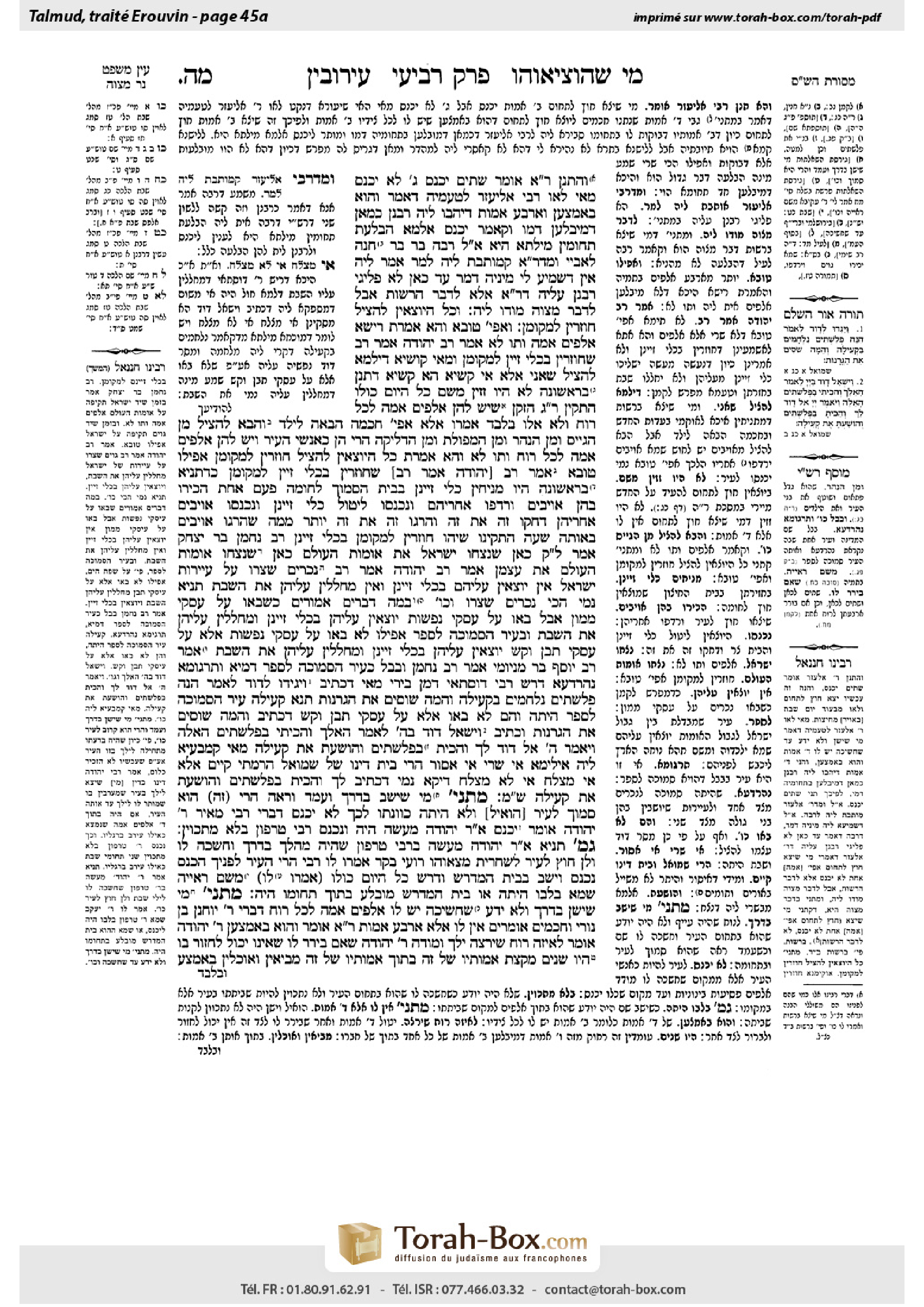
Eruvin 45a: Talmud study for Daf Yomi
Study the Talmud for Daf Yomi with scanned pages, Hebrew text, English translations from Sefaria and AI-generated French translations.
Passage selection and English or AI-generated French translation are available where the scan has annotations. Daf Study is independent of Torah-Box and Sefaria.
Browse Eruvin · עירובין · All tractatesEruvin 45a text and translations
This page of Eruvin includes the Aramaic text, an English translation and an AI-generated French translation, alongside the scan above.
עירובין מ״ה א · Aramaic and Hebrew text
וְהָתְנַן רַבִּי אֱלִיעֶזֶר אוֹמֵר: שְׁתַּיִם — יִכָּנֵס, שְׁלֹשָׁה — לֹא יִכָּנֵס. מַאי לָאו, רַבִּי אֱלִיעֶזֶר לְטַעְמֵיהּ דְּאָמַר וְהוּא בְּאֶמְצָעָן —
וְאַרְבַּע אַמּוֹת דִּיהַבוּ לֵיהּ רַבָּנַן כְּמַאן דְּמִיבַּלְעָן דָּמוּ, וְקָאָמַר ״יִכָּנֵס״ — אַלְמָא הַבְלָעַת תְּחוּמִין מִילְּתָא הִיא.
אֲמַר לֵיהּ רַבָּה בַּר בַּר חָנָה לְאַבָּיֵי: וּמִדְּרַבִּי אֱלִיעֶזֶר קָמוֹתְבַתְּ לֵיהּ לְמָר? אֲמַר לֵיהּ: אִין, דִּשְׁמִיעַ לִי מִינֵּיהּ דְּמָר: עַד כָּאן לָא פְּלִיגִי רַבָּנַן עֲלֵיהּ דְּרַבִּי אֱלִיעֶזֶר אֶלָּא לִדְבַר הָרְשׁוּת, אֲבָל לִדְבַר מִצְוָה מוֹדוּ לֵיהּ.
וְכׇל הַיּוֹצְאִין לְהַצִּיל חוֹזְרִין לִמְקוֹמָן. וַאֲפִילּוּ טוּבָא? וְהָא אָמְרַתְּ רֵישָׁא: ״אַלְפַּיִם אַמָּה״, וְתוּ לָא!
אָמַר רַב יְהוּדָה אָמַר רַב: שֶׁחוֹזְרִין בִּכְלֵי זַיִין לִמְקוֹמָן. וּמַאי קוּשְׁיָא? דִּילְמָא לְהַצִּיל שָׁאנֵי!
אֶלָּא אִי קַשְׁיָא, הָא קַשְׁיָא: דִּתְנַן בָּרִאשׁוֹנָה לֹא הָיוּ זָזִין מִשָּׁם כׇּל הַיּוֹם כּוּלּוֹ.
הִתְקִין רַבָּן גַּמְלִיאֵל הַזָּקֵן שֶׁיֵּשׁ לָהֶן אַלְפַּיִם אַמָּה לְכׇל רוּחַ. וְלֹא אֵלּוּ בִּלְבַד אָמְרוּ, אֶלָּא אֲפִילּוּ חֲכָמָה הַבָּאָה לְיַלֵּד, וְהַבָּא לְהַצִּיל מִן הַגַּיִיס וּמִן הַנָּהָר וּמִן הַמַּפּוֹלֶת וּמִן הַדְּלֵיקָה — הֲרֵי הֵן כְּאַנְשֵׁי הָעִיר, וְיֵשׁ לָהֶן אַלְפַּיִם אַמָּה לְכׇל רוּחַ.
וְתוּ לָא? וְהָא אָמְרַתְּ: כׇּל הַיּוֹצְאִין לְהַצִּיל חוֹזְרִין לִמְקוֹמָן — אֲפִילּוּ טוּבָא!
אָמַר רַב [יְהוּדָה אָמַר רַב]: שֶׁחוֹזְרִין בִּכְלֵי זַיִין לִמְקוֹמָן, כִּדְתַנְיָא: בָּרִאשׁוֹנָה הָיוּ מַנִּיחִין כְּלֵי זֵיינָן בַּבַּיִת הַסָּמוּךְ לַחוֹמָה.
פַּעַם אַחַת הִכִּירוּ בָּהֶן אוֹיְבִים וְרָדְפוּ אַחֲרֵיהֶם, וְנִכְנְסוּ לִיטּוֹל כְּלֵי זֵיינָן, וְנִכְנְסוּ אוֹיְבִים אַחֲרֵיהֶן. דָּחֲקוּ זֶה אֶת זֶה, וְהָרְגוּ זֶה אֶת זֶה יוֹתֵר מִמַּה שֶּׁהָרְגוּ אוֹיְבִים. בְּאוֹתָהּ שָׁעָה הִתְקִינוּ שֶׁיְּהוּ חוֹזְרִין לִמְקוֹמָן בִּכְלֵי זֵיינָן.
רַב נַחְמָן בַּר יִצְחָק אָמַר: לָא קַשְׁיָא. כָּאן — שֶׁנִּצְּחוּ יִשְׂרָאֵל אֶת אוּמּוֹת הָעוֹלָם, כָּאן — שֶׁנִּצְּחוּ אוּמּוֹת הָעוֹלָם אֶת עַצְמָן.
אָמַר רַב יְהוּדָה אָמַר רַב: נׇכְרִים שֶׁצָּרוּ עַל עַיְירוֹת יִשְׂרָאֵל — אֵין יוֹצְאִין עֲלֵיהֶם בִּכְלֵי זֵיינָן, וְאֵין מְחַלְּלִין עֲלֵיהֶן אֶת הַשַּׁבָּת.
תַּנְיָא נָמֵי הָכִי נׇכְרִים שֶׁצָּרוּ וְכוּ׳. בַּמֶּה דְּבָרִים אֲמוּרִים, כְּשֶׁבָּאוּ עַל עִסְקֵי מָמוֹן, אֲבָל בָּאוּ עַל עִסְקֵי נְפָשׁוֹת — יוֹצְאִין עֲלֵיהֶן בִּכְלֵי זֵיינָן, וּמְחַלְּלִין עֲלֵיהֶן אֶת הַשַּׁבָּת.
וּבָעִיר הַסְּמוּכָה לַסְּפָר, אֲפִילּוּ לֹא בָּאוּ עַל עִסְקֵי נְפָשׁוֹת אֶלָּא עַל עִסְקֵי תֶּבֶן וָקַשׁ — יוֹצְאִין עֲלֵיהֶן בִּכְלֵי זֵיינָן, וּמְחַלְּלִין עֲלֵיהֶן אֶת הַשַּׁבָּת.
אָמַר רַב יוֹסֵף בַּר מִנְיוֹמֵי אָמַר רַב נַחְמָן: וּבָבֶל, כָּעִיר הַסְּמוּכָה לַסְּפָר דָּמְיָא. וְתַרְגּוּמָא: נְהַרְדְּעָא.
דָּרֵשׁ רַבִּי דּוֹסְתַּאי דְּמִן בֵּירֵי: מַאי דִּכְתִיב: ״וַיַּגִּידוּ לְדָוִד לֵאמֹר הִנֵּה פְלִשְׁתִּים נִלְחָמִים בִּקְעִילָה וְהֵמָּה שׁוֹסִים אֶת הַגֳּרָנוֹת״.
תָּנָא: קְעִילָה עִיר הַסְּמוּכָה לַסְּפָר הָיְתָה, וְהֵם לֹא בָּאוּ אֶלָּא עַל עִסְקֵי תֶּבֶן וָקַשׁ, דִּכְתִיב: ״וְהֵמָּה שׁוֹסִים אֶת הַגֳּרָנוֹת״. וּכְתִיב ״וַיִּשְׁאַל דָּוִד בַּה׳ לֵאמֹר הַאֵלֵךְ וְהִכֵּיתִי בַּפְּלִשְׁתִּים הָאֵלֶּה וַיֹּאמֶר ה׳ אֶל דָּוִד לֵךְ וְהִכִּיתָ בַפְּלִשְׁתִּים וְהוֹשַׁעְתָּ אֶת קְעִילָה״.
מַאי קָמִבַּעְיָא לֵיהּ? אִילֵּימָא אִי שְׁרֵי אִי אָסוּר — הֲרֵי בֵּית דִּינוֹ שֶׁל שְׁמוּאֵל הָרָמָתִי קַיָּים.
אֶלָּא: אִי מַצְלַח אִי לָא מַצְלַח. דַּיְקָא נָמֵי, דִּכְתִיב: ״לֵךְ וְהִכִּיתָ בַפְּלִשְׁתִּים וְהוֹשַׁעְתָּ אֶת קְעִילָה״, שְׁמַע מִינַּהּ.
מַתְנִי׳ מִי שֶׁיָּשַׁב בַּדֶּרֶךְ, וְעָמַד וְרָאָה הֲרֵי (זֶה) הוּא סָמוּךְ לָעִיר, [הוֹאִיל] וְלֹא הָיְתָה כַּוּוֹנָתוֹ לְכָךְ — לֹא יִכָּנֵס. דִּבְרֵי רַבִּי מֵאִיר.
רַבִּי יְהוּדָה אוֹמֵר: יִכָּנֵס. אָמַר רַבִּי יְהוּדָה: מַעֲשֶׂה הָיָה וְנִכְנַס רַבִּי טַרְפוֹן בְּלֹא מִתְכַּוֵּין.
גְּמָ׳ תַּנְיָא, אָמַר רַבִּי יְהוּדָה: מַעֲשֶׂה בְּרַבִּי טַרְפוֹן שֶׁהָיָה מְהַלֵּךְ בַּדֶּרֶךְ וְחָשְׁכָה לוֹ, וְלָן חוּץ לָעִיר. לְשַׁחֲרִית מְצָאוּהוּ רוֹעֵי בָקָר, אָמְרוּ לוֹ: רַבִּי, הֲרֵי הָעִיר לְפָנֶיךָ, הִכָּנֵס! נִכְנַס וְיָשַׁב בְּבֵית הַמִּדְרָשׁ, וְדָרַשׁ כׇּל הַיּוֹם כּוּלּוֹ.
(אָמְרוּ לוֹ): מִשָּׁם רְאָיָיה? שֶׁמָּא בְּלִבּוֹ הָיְתָה, אוֹ בֵּית הַמִּדְרָשׁ מוּבְלָע בְּתוֹךְ תְּחוּמוֹ הָיָה.
מַתְנִי׳ מִי שֶׁיָּשַׁן בַּדֶּרֶךְ וְלָא יָדַע שֶׁחָשֵׁיכָה — יֵשׁ לוֹ אַלְפַּיִם אַמָּה לְכׇל רוּחַ, דִּבְרֵי רַבִּי יוֹחָנָן בֶּן נוּרִי.
וַחֲכָמִים אוֹמְרִים: אֵין לוֹ אֶלָּא אַרְבַּע אַמּוֹת. רַבִּי אֱלִיעֶזֶר אוֹמֵר: וְהוּא בְּאֶמְצָעָן.
רַבִּי יְהוּדָה אוֹמֵר: לְאֵיזֶה רוּחַ שֶׁיִּרְצֶה יֵלֵךְ. וּמוֹדֶה רַבִּי יְהוּדָה שֶׁאִם בֵּירַר לוֹ, שֶׁאֵינוֹ יָכוֹל לַחֲזוֹר בּוֹ.
הָיוּ שְׁנַיִם, מִקְצָת אַמּוֹתָיו שֶׁל זֶה בְּתוֹךְ אַמּוֹתָיו שֶׁל זֶה — מְבִיאִין וְאוֹכְלִין בָּאֶמְצַע,
Eruvin 45a · English translation
Didn’t we learn in a mishna that Rabbi Eliezer says: If a person left his Shabbat limit by walking two cubits beyond it, he may reenter his original limit; but if he left his Shabbat limit by walking three cubits beyond it, he may not reenter. What, is it not that Rabbi Eliezer follows his standard line of reasoning, in that he said with regard to the four cubits a person is allotted wherever he is, he is set in the middle of them, i.e., he may walk two cubits in each direction?
The Gemara explains that the four cubits that the Sages gave a person are regarded here as being subsumed within his original limit, and it is for this reason that he said: He may reenter his original limit. Apparently he is of the opinion that the subsuming of one Shabbat limit within another is something significant.
Rabba bar bar Ḥana said to Abaye: Do you raise an objection against our Master, Rabba, from the statement of Rabbi Eliezer? But isn’t the halakha in accordance with the opinion of Rabbi Eliezer? Abaye said to him: Yes, as I heard from our Master himself that the Rabbis disagree with Rabbi Eliezer only with regard to one who went beyond his limit for a voluntary matter, but with regard to one who went out for a mitzva matter, they agree with him about the subsuming of limits, i.e., that if one limit is subsumed in another, it is permitted to pass between them. This demonstrates that the halakha recognizes the principle of the subsuming of limits.
The mishna teaches: All who go out to save lives may return to their original locations on Shabbat. The Gemara asks: Does this mean that he may return to his original place even if he went out more than two thousand cubits beyond his limit? Didn’t the first clause say that a person who was permitted to travel beyond his Shabbat limit is allotted two thousand cubits, and no more?
Rav Yehuda said that Rav said: What this means is that they may return with their weapons to their original locations, provided they are within two thousand cubits. The Gemara asks: What is the difficulty with returning home in this situation? Perhaps in the case where people went out to fight and save lives the law is different, and they are allowed to go home even if they went more than two thousand cubits beyond the limit.
Rather, if there is a difficulty, this is the difficulty: As we learned in a mishna in tractate Rosh HaShana, at first they would take the witnesses who had come to Jerusalem from a distant place on Shabbat to testify that they had seen the new moon, and bring them into a special courtyard, and they would not move from there the entire day. This was in accordance with the law governing one who was permitted to go out beyond his limit, as once he fulfilled his mission, he was no longer permitted to move beyond four cubits.
However, Rabban Gamliel the Elder instituted that they should have two thousand cubits in each direction, so that witnesses not refrain from coming to testify. And it is not only these whom the Sages said are given two thousand cubits in the place that they have reached, but even a midwife who comes to deliver a child, and one who comes to rescue Jews from an invasion of gentile troops or from a river or a collapsed building or a fire; they are like the inhabitants of the town at which they arrive, and they have two thousand cubits in each direction.
The question may be raised: Are they given no more than two thousand cubits? Didn’t it say in the mishna: All who go out to save lives may return to their original locations on Shabbat, which indicates that they may walk even more than two thousand cubits?
In response, Rav Yehuda said that Rav said: We must not infer from the mishna that they may go home even if they went out more than two thousand cubits from their limit, but rather that they may return with their weapons to their original locations, provided that they are within two thousand cubits. As it was taught in the Tosefta: At first those returning from a rescue mission would place their weapons in the first house that they encountered upon their return, i.e., the house nearest the wall, to avoid carrying on Shabbat any more than necessary.
Once, their enemies noticed that they were no longer carrying their weapons, and they chased after them; and the defenders entered the house to take up their weapons and fight, and their enemies entered after them, causing great confusion. In the chaos, the defenders began to push one another, and they killed more of each other than their enemies killed of them. At that time the Sages instituted that they should return to their locations, i.e., their destinations, with their weapons.
The Gemara cites an alternate resolution that Rav Naḥman bar Yitzḥak said: This is not difficult. Here, in the mishna in Rosh HaShana where they only permitted two thousand cubits, it is referring to a situation where the Jews defeated the nations of the world, i.e., the gentiles, in battle; in such a case there is no concern and they need not return to their original locations. Whereas here, in the mishna which indicates that the Sages permitted even more than two thousand cubits, it is referring to a situation where the nations of the world defeated themselves, i.e., the Jews, whom the Gemara refers to euphemistically as themselves; in such a case the Sages allowed the defeated soldiers to return to their original locations.
Since the Gemara discussed war on Shabbat, the Gemara cites Rav Yehuda, who said that Rav said: With regard to gentiles who besieged Jewish towns, they may not go out to fight against them with their weapons, nor may they desecrate Shabbat in any other way due to them, but rather they must wait until after Shabbat.
That was also taught in a baraita, with a caveat: With regard to gentiles who besieged, etc. In what case is this said? It is said in a case where the gentiles came and besieged the town with regard to monetary matters, i.e., banditry. However, if they came with regard to lives, i.e., there is concern that the gentiles will attack, they may go out against them with their weapons, and they may desecrate Shabbat due to them.
And with regard to a town that is located near the border, even if the gentiles did not come with regard to lives, but rather with regard to matters of hay and straw, i.e., to raid and spoil the town, they may go out against them with their weapons, and they may desecrate Shabbat due to them, as the border must be carefully guarded, in order to prevent enemies from gaining a foothold there.
Rav Yosef bar Manyumi said that Rav Naḥman said: And Babylonia is considered like a town located near the border, and war may be waged there on Shabbat even if the gentiles came for financial gain. And this means the city of Neharde’a, which was located near the border.
Rabbi Dostai of the town of Biri expounded: What is the meaning of that which is written: “And they told David, saying: Behold, the Philistines are fighting against Ke’ila, and they rob the threshing floors” (i Samuel 23:1), after which David asked God how he should respond.
It was taught in a baraita: Ke’ila was a town located near the border, and the Philistines came only with regard to matters of hay and straw, as it is written: “And they rob the threshing floors.” And in the next verse it is written: “Therefore David inquired of the Lord, saying: Shall I go and smite these Philistines? And the Lord said to David: Go and smite the Philistines, and save Ke’ila” (i Samuel 23:2), which indicates that war may be waged in a border town on Shabbat, even with regard to monetary matters.
The Gemara refutes this proof by asking: What is David’s dilemma? If you say that he had a halakhic question and was in doubt whether it was permitted or prohibited to fight the Philistines on Shabbat, it is possible to respond: But the court of Samuel from Rama was then in existence, and rather than inquire by way of the Urim VeTummim he should have inquired of the Great Sanhedrin.
Rather, he asked: Will he succeed or will he not succeed in his war? The Gemara comments: This is also precise in the language of the verse, as it is written in the response to David’s query: “Go and smite the Philistines, and save Ke’ila.” Learn from this, from the assurance that God gave David of his victory, that this was the subject of his inquiry.
MISHNA: With regard to a person who was sitting along the road on Shabbat eve toward nightfall, unaware that he was within the city’s Shabbat limit, and when he stood up after Shabbat had already commenced, he saw that he was near the town, i.e., within its limit, since he had not intended to acquire his place of residence in the town, he may not enter it, but rather he measures two thousand cubits from his place; this is the statement of Rabbi Meir.
Rabbi Yehuda says: He may enter the town. Rabbi Yehuda said: It once happened that Rabbi Tarfon entered a town on Shabbat without intention from the beginning of Shabbat to establish residence in the city.
GEMARA: It was taught in a baraita that Rabbi Yehuda said: It once happened that Rabbi Tarfon was walking along the way on Shabbat eve, and night fell upon him, and he spent the night outside the town. In the morning, cowherds who came to graze their cattle outside the town found him and said to him: Master, the town is before you; enter. He entered and sat in the study hall and taught the entire day. This indicates that one is permitted to enter.
The other Rabbis said to Rabbi Yehuda: Do you bring proof from there? Perhaps he had it in mind the day before to acquire residence in the city, or perhaps the study hall was subsumed within his Shabbat limit. If the study hall was within two thousand cubits of the spot where he established residence, all agree that he may enter there.
MISHNA: With regard to one who was sleeping along the road on Shabbat eve and did not know that night had fallen, he has two thousand cubits in each direction; this is the statement of Rabbi Yoḥanan ben Nuri, who maintains that knowledge and awareness are not necessary for one to acquire residence, but rather, a person’s presence in a given location establishes residence there.
But the Rabbis say: He has only four cubits, as since he did not knowingly acquire residence, he did not establish a Shabbat limit. Rabbi Eliezer says: He has only four cubits total and he is in the middle of them, i.e., he has two cubits in each direction.
Rabbi Yehuda says: He may walk four cubits in any direction he wishes. But Rabbi Yehuda agrees that if he selected for himself the direction in which he wants to walk those four cubits, he cannot retract and walk four cubits in a different direction.
With regard to a case where there were two people in this situation, positioned in such a way that part of the four cubits of one were subsumed within the four cubits of the other, they may each bring food and eat together in the shared area in the middle,
Eruvin 45a · Traduction française (IA)
N’ont-nous pas appris dans une mitsna que Rabbi Eliezer dit : Si une personne a dépassé sa limite de Shabbat en marchant deux coudées de plus, elle peut réentrer dans sa limite originale ; mais si elle a dépassé sa limite de Shabbat en marchant trois coudées de plus, elle ne peut pas réentrer. Qu’est-ce que cela signifie ? N’est-ce pas que Rabbi Eliezer suit sa ligne de raisonnement habituelle, en ce sens qu’il a dit concernant les quatre coudées que l’on accorde à une personne partout où elle est, qu’elle est placée au milieu d’elles, c’est-à-dire qu’elle peut marcher deux coudées dans chaque direction ?
La Guemara explique que les quatre coudées que les Sages accordent à une personne sont considérées ici comme étant comprises dans sa limite originale, et c’est pour cette raison qu’il a dit : Il peut réentrer dans sa limite originale. Apparemment, il est de l’avis que l’inclusion d’une limite de Shabbat dans une autre est quelque chose de significatif.
Rabba bar bar Ḥana a dit à Abaye : Est-ce que tu soulèves une objection contre notre Maître, Rabba, à partir de la déclaration de Rabbi Eliezer ? Mais n’est-ce pas que la halakha suit l’opinion de Rabbi Eliezer ? Abaye a dit à lui : Oui, comme je l’ai entendu de notre Maître lui-même que les Rabbins ne s’accordent avec Rabbi Eliezer qu’en ce qui concerne celui qui est sorti au-delà de sa limite pour une affaire volontaire, mais concernant celui qui est sorti pour une affaire de mitsva, ils s’accordent avec lui sur l’inclusion des limites, c’est-à-dire que si une limite est incluse dans une autre, il est permis de passer entre elles. Cela démontre que la halakha reconnaît le principe d’inclusion des limites.
La mitsva enseigne : Tous ceux qui sortent pour sauver des vies peuvent revenir à leur lieu d’origine le Shabbat. La Guemara demande : cela signifie-t-il qu’il peut revenir à son lieu d’origine même s’il est sorti de plus de deux mille coudées au-delà de sa limite ? N’a-t-il pas dit dans la première clause que la personne qui est autorisée à voyager au-delà de sa limite de Shabbat est accordée deux mille coudées, et pas plus ?
Rav Yehuda a dit que Rav a dit : Ce que cela signifie, c’est qu’ils peuvent revenir avec leurs armes à leur lieu d’origine, à condition qu’ils soient à l’intérieur de deux mille coudées. La Guemara demande : Quel est le problème avec le retour à la maison dans ce cas ? Peut-être que dans le cas où les gens sont sortis pour combattre et sauver des vies, la loi est différente, et ils sont autorisés à rentrer chez eux même s’ils sont sortis de plus de deux mille coudées au-delà de la limite.
Plutôt, si c’est un problème, c’est ce problème : Comme nous avons appris dans une mitsva du traité Rosh HaShana, au début ils prenaient les témoins qui étaient venus à Jérusalem d’un lieu éloigné le Shabbat pour témoigner qu’ils avaient vu la nouvelle lune, et ils les amenaient dans un jardin spécial, et ils ne bougeaient pas de là toute la journée. Cela était en conformité avec la loi concernant celui qui était autorisé à sortir au-delà de sa limite, car une fois qu’il avait accompli sa mission, il n’était plus autorisé à se déplacer au-delà de quatre coudées.
Cependant, Rabban Gamliel l’Ancien a institué qu’ils devaient avoir deux mille coudées dans chaque direction, afin que les témoins ne se privent pas de venir témoigner. Et ce n’est pas seulement ces personnes que les Sages ont dits être accordées deux mille coudées dans le lieu où ils sont arrivés, mais même une sage-femme qui vient accoucher, et celui qui vient sauver des Juifs d’une invasion de troupes païennes ou d’un fleuve ou d’un bâtiment effondré ou d’un feu ; ils sont comme les habitants de la ville où ils arrivent, et ils ont deux mille coudées dans chaque direction.
La question peut être soulevée : Sont-ils limités à deux mille coudées ? N’a-t-il pas dit dans la mitsna : Tous ceux qui sortent pour sauver des vies peuvent revenir à leur lieu d’origine le Shabbat, ce qui indique qu’ils peuvent marcher même plus de deux mille coudées ?
En réponse, Rav Yehuda a dit que Rav a dit : Nous ne devons pas en déduire de la mitsna qu’ils peuvent rentrer chez eux même s’ils sont sortis de plus de deux mille coudées au-delà de leur limite, mais plutôt qu’ils peuvent revenir avec leurs armes à leur lieu d’origine, à condition qu’ils soient à l’intérieur de deux mille coudées. Comme cela a été enseigné dans la Tosefta : Au début, ceux qui revenaient d’une mission de sauvetage mettaient leurs armes dans la première maison qu’ils rencontraient sur leur retour, c’est-à-dire la maison la plus proche du mur, afin d’éviter de porter sur le Shabbat plus que nécessaire.
Un jour, leurs ennemis remarquèrent qu’ils ne portaient plus leurs armes et les poursuivirent ; les défenseurs entrèrent dans la maison pour prendre leurs armes et combattre, et leurs ennemis entrèrent après eux, causant une grande confusion. Dans la confusion, les défenseurs commencèrent à pousser les uns les autres, et ils tuèrent plus d’entre eux que leurs ennemis n’avaient tué d’entre eux. À cette époque, les Sages instituèrent qu’ils devaient retourner à leurs lieux, c’est-à-dire leurs destinations, avec leurs armes.
La Guemara cite une résolution alternative que Rav Naḥman bar Yitzḥak dit : Ce n’est pas difficile. Ici, dans la mitsna du traité Rosh HaShana où ils permirent seulement deux mille coudées, il s’agit d’une situation où les Juifs vainquirent les nations du monde, c’est-à-dire les païens, en guerre ; dans ce cas, il n’y a pas de préoccupation et ils n’ont pas besoin de revenir à leur lieu d’origine. En revanche, dans la mitsna qui indique que les Sages permirent même plus de deux mille coudées, il s’agit d’une situation où les nations du monde combattirent contre eux-mêmes, c’est-à-dire les Juifs, que la Guemara désigne de manière euphémique ; dans ce cas, les Sages autorisèrent les soldats vaincus à revenir à leur lieu d’origine.
Puisque la Guemara discutait de la guerre le Shabbat, la Guemara cite Rav Yehuda, qui rapporte que Rav dit : Concernant les païens qui assiégeaient les villes juives, ils ne doivent pas sortir pour combattre contre eux avec leurs armes, ni déshonorer le Shabbat d’une autre manière à cause d’eux, mais ils doivent attendre jusqu’après le Shabbat.
Cela a également été enseigné dans une baraïta, avec une réserve : En ce qui concerne les Gentils qui assiégeaient, etc. Dans quel cas cela est-il dit ? C'est dans le cas où les Gentils sont venus assiéger la ville en matière de propriété, c'est-à-dire en tant que bandits. Cependant, si ils sont venus en matière de vie, c'est-à-dire s'il y a un danger que les Gentils attaquent, ils peuvent sortir avec leurs armes et peuvent profaner le Sabbat à cause d'eux.
Et en ce qui concerne une ville située près de la frontière, même si les Gentils n'ont pas venu en matière de vie, mais plutôt en matière de foin et de paille, c'est-à-dire pour piller la ville, ils peuvent sortir avec leurs armes et peuvent profaner le Sabbat à cause d'eux, car la frontière doit être soigneusement gardée afin d'empêcher les ennemis d'y prendre pied.
Rav Yosef bar Manyumi a dit que Rav Naḥman a dit : Babylone est considérée comme une ville située près de la frontière, et la guerre peut être menée là le Sabbat même si les Gentils sont venus pour des gains financiers. Et cela signifie la ville de Neharde’a, qui était située près de la frontière.
Rabbi Dostai de la ville de Biri a expliqué : Quelle est la signification de ce qui est écrit : « Et ils dirent à David, disant : Voici que les Philistins combattent contre Ke’ila, et ils pillent les claies » (1 Samuel 23:1), après quoi David demanda à Dieu comment il devait agir.
Cela a été enseigné dans une baraïta : Ke’ila était une ville située près de la frontière, et les Philistins sont venus uniquement en matière de foin et de paille, comme il est écrit : « Et ils pillent les claies ». Et dans le verset suivant, il est écrit : « Donc David consulta le Seigneur, disant : Dois-je aller et combattre ces Philistins ? Et le Seigneur dit à David : Va et combats les Philistins, et sauve Ke’ila » (1 Samuel 23:2), ce qui indique que la guerre peut être menée dans une ville frontalière le Sabbat, même en matière de propriété.
La Guemara réfute cette preuve en demandant : Quel était le dilemme de David ? Si vous dites qu'il avait une question halakhique et qu'il était en doute quant à la permission ou à l'interdiction de combattre les Philistins le Sabbat, il est possible de répondre : Mais la cour de Samuel de Rama était alors en existence, et plutôt que de consulter par l'intermédiaire des Urim VeTummim, il aurait dû consulter le Grand Sanhédrin.
Au contraire, il demanda : réussira-t-il ou non dans sa guerre ? La Guemara commente : cela est aussi précis dans la langue du verset, car il est écrit dans la réponse à la question de David : « Va et combats les Philistins, et sauve Ke’ila ». Apprends-en, de l'assurance que Dieu a donnée à David de sa victoire, que c'était la question de son inquiétude.
MICHNA : En ce qui concerne une personne qui était assise sur la route le soir du Sabbat, sans savoir qu'elle était à l'intérieur de la limite du Sabbat de la ville, et quand elle s'est levée après que le Sabbat avait déjà commencé, elle a vu qu'elle était près de la ville, c'est-à-dire à l'intérieur de sa limite, puisqu'elle n'avait pas l'intention d'acquérir sa résidence dans la ville, elle ne peut pas entrer, mais plutôt elle mesure deux mille coudées depuis son lieu ; c'est la déclaration de Rabbi Meir.
Rabbi Yehuda dit : il peut entrer dans la ville. Rabbi Yehuda a dit : il s'est produit une fois que Rabbi Tarfon est entré dans une ville le Sabbat sans intention, depuis le début du Sabbat jusqu'à l'établissement de sa résidence dans la ville.
GUEMARA : Il a été enseigné dans une baraïta que Rabbi Yehuda a dit : Il s'est produit une fois que Rabbi Tarfon marchait sur la route le soir du Sabbat, et la nuit est tombée sur lui, et il a passé la nuit en dehors de la ville. Le matin, des bergers qui venaient paître leurs bêtes en dehors de la ville l'ont trouvé et lui ont dit : Maître, la ville est devant toi ; entre. Il est entré et s'est assis dans la salle de study et a enseigné toute la journée. Cela indique qu'on est autorisé à entrer.
Les autres Rabbins ont dit à Rabbi Yehuda : Est-ce que vous apportez une preuve là-dessus ? Peut-être qu'il avait l'intention la veille d'acquérir une résidence dans la ville, ou peut-être que la salle de study était incluse dans sa limite du Sabbat. Si la salle de study était à deux mille coudées du lieu où il avait établi sa résidence, tous conviennent qu'il peut entrer là.
MICHNA : En ce qui concerne une personne qui dormait sur la route le soir du Sabbat et ne savait pas que la nuit était tombée, il a deux mille coudées dans chaque direction ; c'est la déclaration de Rabbi Yoḥanan ben Nuri, qui affirme que la connaissance et la conscience ne sont pas nécessaires pour acquérir une résidence, mais plutôt la présence d'une personne dans un lieu établit la résidence.
Mais les Rabbins disent : Il a seulement quatre coudées, car puisqu'il n'a pas intentionnellement acquis une résidence, il n'a pas établi une limite du Sabbat. Rabbi Eliezer dit : Il a seulement quatre coudées au total et il est au milieu d'entre eux, c'est-à-dire il a deux coudées dans chaque direction.
Rabbi Yehuda dit : Il peut marcher quatre coudées dans toute la direction qu'il souhaite. Mais Rabbi Yehuda convient que si l'on a choisi la direction dans laquelle on veut marcher ces quatre coudées, on ne peut pas reculer et marcher quatre coudées dans une autre direction.
En ce qui concerne un cas où il y avait deux personnes dans cette situation, placées de telle sorte que partie des quatre coudées d'une était incluse dans les quatre coudées de l'autre, ils peuvent chacun apporter de la nourriture et manger ensemble dans la zone partagée au milieu,
Traduction française générée par IA à partir de l’édition anglaise de Sefaria. Vérifie toujours un passage avec le texte source.
Text from Sefaria: William Davidson Edition - Vocalized Aramaic (CC BY NC); William Davidson Edition - English (CC BY NC).