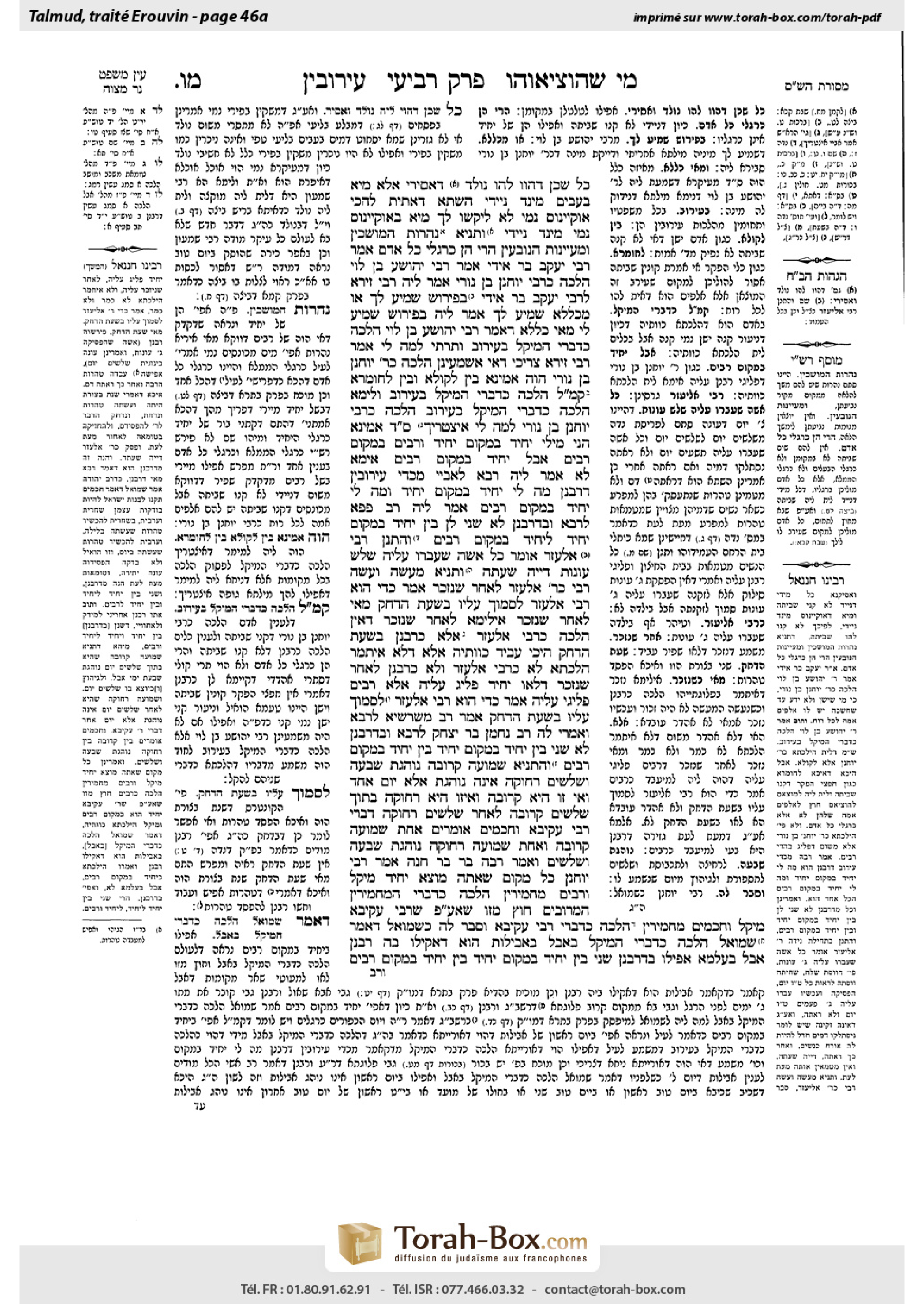
Eruvin 46a: Talmud study for Daf Yomi
Study the Talmud for Daf Yomi with scanned pages, Hebrew text, English translations from Sefaria and AI-generated French translations.
Passage selection and English or AI-generated French translation are available where the scan has annotations. Daf Study is independent of Torah-Box and Sefaria.
Browse Eruvin · עירובין · All tractatesEruvin 46a text and translations
This page of Eruvin includes the Aramaic text, an English translation and an AI-generated French translation, alongside the scan above.
עירובין מ״ו א · Aramaic and Hebrew text
כׇּל שֶׁכֵּן דְּהָווּ לְהוּ נוֹלָד, דַּאֲסִירִי!
אֶלָּא: מַיָּא בְּעָבִים מֵינָד נָיְידִי. הַשְׁתָּא דְּאָתֵית לְהָכִי, אוֹקְיָינוֹס נָמֵי לָא לִיקְשׁוֹ לָךְ, מַיָּא בְּאוֹקְיָינוֹס נָמֵי מֵינָד נָיְידִי, וְתַנְיָא: נְהָרוֹת הַמּוֹשְׁכִין וּמַעְיָינוֹת הַנּוֹבְעִין הֲרֵי הֵן כְּרַגְלֵי כׇּל אָדָם.
אָמַר רַבִּי יַעֲקֹב בַּר אִידֵּי אָמַר רַבִּי יְהוֹשֻׁעַ בֶּן לֵוִי: הֲלָכָה כְּרַבִּי יוֹחָנָן בֶּן נוּרִי. אֲמַר לֵיהּ רַבִּי זֵירָא לְרַבִּי יַעֲקֹב בַּר אִידִי: בְּפֵירוּשׁ שְׁמִיעַ לָךְ אוֹ מִכְּלָלָא שְׁמִיעַ לָךְ? אֲמַר לֵיהּ: בְּפֵירוּשׁ שְׁמִיעַ לִי.
מַאי כְּלָלָא? דְּאָמַר רַבִּי יְהוֹשֻׁעַ בֶּן לֵוִי: הֲלָכָה כְּדִבְרֵי הַמֵּיקֵל בְּעֵירוּב.
וְתַרְתֵּי לְמָה לִי?!
אָמַר רַבִּי זֵירָא: צְרִיכִי, דְּאִי אַשְׁמְעִינַן הֲלָכָה כְּרַבִּי יוֹחָנָן בֶּן נוּרִי, הֲוָה אָמֵינָא בֵּין לְקוּלָּא וּבֵין לְחוּמְרָא, קָא מַשְׁמַע לַן הֲלָכָה כְּדִבְרֵי הַמֵּיקֵל בְּעֵירוּב.
וְלֵימָא ״הֲלָכָה כְּדִבְרֵי הַמֵּיקֵל בְּעֵירוּב״. הֲלָכָה כְּרַבִּי יוֹחָנָן בֶּן נוּרִי לְמָה לִי?
אִיצְטְרִיךְ, סָלְקָא דַּעְתָּךְ אָמֵינָא הָנֵי מִילֵּי יָחִיד בִּמְקוֹם יָחִיד וְרַבִּים בִּמְקוֹם רַבִּים, אֲבָל יָחִיד בִּמְקוֹם רַבִּים — אֵימָא לָא.
אֲמַר לֵיהּ רָבָא לְאַבָּיֵי: מִכְּדֵי עֵירוּבִין דְּרַבָּנַן, מָה לִי יָחִיד בִּמְקוֹם יָחִיד, וּמָה לִי יָחִיד בִּמְקוֹם רַבִּים!
אֲמַר לֵיהּ רַב פָּפָּא לְרָבָא: וּבִדְרַבָּנַן לָא שָׁנֵי לַן בֵּין יָחִיד בִּמְקוֹם יָחִיד לְיָחִיד בִּמְקוֹם רַבִּים!
וְהָתְנַן, רַבִּי אֶלְעָזָר אוֹמֵר: כׇּל אִשָּׁה שֶׁעָבְרוּ עָלֶיהָ שָׁלֹשׁ עוֹנוֹת — דַּיָּיהּ שְׁעָתָהּ.
וְתַנְיָא: מַעֲשֶׂה וְעָשָׂה רַבִּי כְּרַבִּי אֶלְעָזָר. לְאַחַר שֶׁנִּזְכַּר, אָמַר: כְּדַי הוּא רַבִּי אֶלְעָזָר לִסְמוֹךְ עָלָיו בִּשְׁעַת הַדְּחָק.
מַאי ״לְאַחַר שֶׁנִּזְכַּר״? אִילֵּימָא: לְאַחַר שֶׁנִּזְכַּר דְּאֵין הֲלָכָה כְּרַבִּי אֶלְעָזָר אֶלָּא כְּרַבָּנַן — בִּשְׁעַת הַדְּחָק הֵיכִי עָבֵיד כְּווֹתֵיהּ!
אֶלָּא: דְּלָא אִיתְּמַר הִלְכְתָא לָא כְּרַבִּי אֶלְעָזָר וְלָא כְּרַבָּנַן. ״לְאַחַר שֶׁנִּזְכַּר״ דְּלָאו יָחִיד פְּלִיג עֲלֵיהּ אֶלָּא רַבִּים פְּלִיגִי עֲלֵיהּ, אָמַר: כְּדַי הוּא רַבִּי אֶלְעָזָר לִסְמוֹךְ עָלָיו בִּשְׁעַת הַדְּחָק.
אָמַר רַב מְשַׁרְשְׁיָא לְרָבָא, וְאָמְרִי לַהּ רַב נַחְמָן בַּר יִצְחָק לְרָבָא: וּבִדְרַבָּנַן לָא שָׁנֵי בֵּין יָחִיד בִּמְקוֹם יָחִיד, בֵּין יָחִיד בִּמְקוֹם רַבִּים?
וְהָתַנְיָא: שְׁמוּעָה קְרוֹבָה נוֹהֶגֶת שִׁבְעָה וּשְׁלֹשִׁים, רְחוֹקָה אֵינָהּ נוֹהֶגֶת אֶלָּא יוֹם אֶחָד.
וְאֵי זוֹ הִיא קְרוֹבָה וְאֵיזוֹ הִיא רְחוֹקָה? בְּתוֹךְ שְׁלֹשִׁים — קְרוֹבָה, לְאַחַר שְׁלֹשִׁים — רְחוֹקָה, דִּבְרֵי רַבִּי עֲקִיבָא. וַחֲכָמִים אוֹמְרִים: אַחַת שְׁמוּעָה קְרוֹבָה וְאַחַת שְׁמוּעָה רְחוֹקָה נוֹהֶגֶת שִׁבְעָה וּשְׁלֹשִׁים.
וְאָמַר רַבָּה בַּר בַּר חָנָה אָמַר רַבִּי יוֹחָנָן: כׇּל מָקוֹם שֶׁאַתָּה מוֹצֵא יָחִיד מֵיקֵל וְרַבִּים מֵחֲמִירִין, הֲלָכָה כְּדִבְרֵי הַמַּחְמִירִין הַמְרוּבִּים, חוּץ מִזּוֹ, שֶׁאַף עַל פִּי שֶׁרַבִּי עֲקִיבָא מֵיקֵל וַחֲכָמִים מֵחֲמִירִין — הֲלָכָה כְּדִבְרֵי רַבִּי עֲקִיבָא.
וְסָבַר לַהּ כִּשְׁמוּאֵל, דְּאָמַר שְׁמוּאֵל: הֲלָכָה כְּדִבְרֵי הַמֵּיקֵל בְּאֵבֶל.
בַּאֲבֵילוּת הוּא דְּאַקִּילוּ בַּהּ רַבָּנַן, אֲבָל בְּעָלְמָא — אֲפִילּוּ בִּדְרַבָּנַן שָׁנֵי בֵּין יָחִיד בִּמְקוֹם יָחִיד בֵּין יָחִיד בִּמְקוֹם רַבִּים.
Eruvin 46a · English translation
The Gemara raises a difficulty: If the water was previously not in its current state, all the more so should it be considered as something that came into being [nolad] on the Festival, and consequently it is prohibited to carry it. Something that came into being or assumed its present form on Shabbat or Festivals is considered set-aside [muktze] and may not be handled on Shabbat or Festivals.
Rather, we should say: The water in clouds is in constant motion and therefore does not acquire residence there. The Gemara comments: Now that you have arrived at this answer, the ocean should also not be difficult for you, as the water in the ocean is also in constant motion. And it was taught in a baraita: Flowing rivers and streaming springs are like the feet of all people, as their waters do not acquire residence in any particular place. The same law also applies to clouds and seas.
Rabbi Ya’akov bar Idi said that Rabbi Yehoshua ben Levi said: The halakha is in accordance with the opinion of Rabbi Yoḥanan ben Nuri, that one who was asleep at the beginning of Shabbat may travel two thousand cubits in every direction. Rabbi Zeira said to Rabbi Ya’akov bar Idi: Did you hear this halakha explicitly from Rabbi Yehoshua ben Levi, or did you understand it by inference from some other ruling that he issued? Rabbi Ya’akov bar Idi said to him: I heard it explicitly from him.
The Gemara asks: From what other teaching could this ruling be inferred? The Gemara explains: From that which Rabbi Yehoshua ben Levi said: The halakha is in accordance with the lenient opinion with regard to an eiruv.
The Gemara asks: Why do I need both? Why was it necessary for Rabbi Yehoshua ben Levi to state both the general ruling that the halakha is in accordance with the lenient opinion with regard to an eiruv, and also the specific ruling that the halakha is in accordance with the opinion of Rabbi Yoḥanan ben Nuri on this issue?
Rabbi Zeira said: Both rulings were necessary, as had he informed us only that the halakha is in accordance with the opinion of Rabbi Yoḥanan ben Nuri, I would have said that the halakha is in accordance with him whether this is a leniency, i.e., that a sleeping person acquires residence and may walk two thousand cubits in every direction, or whether it is a stringency, i.e., that ownerless utensils acquire residence and can be carried only two thousand cubits from that place. Consequently, he teaches us that the halakha is in accordance with the lenient opinion with regard to an eiruv, so that we rule in accordance with Rabbi Yoḥanan ben Nuri only when it entails a leniency.
The Gemara asks: Let him state only that the halakha is in accordance with the lenient opinion with regard to an eiruv. Why do I need the statement that the halakha is in accordance with the opinion of Rabbi Yoḥanan ben Nuri?
The Gemara answers: This ruling was necessary as well, for had he informed us only that the halakha is in accordance with the lenient opinion with regard to an eiruv, it might have entered your mind to say that this statement applies only to disputes in which a single authority disagrees with another single authority, or several authorities disagree with several other authorities. But when a single authority maintains a lenient opinion against several authorities who maintain a more stringent position, you might have said that we do not rule in his favor. Hence, it was necessary to state that the halakha is in accordance with the opinion of Rabbi Yoḥanan ben Nuri although he disputes the Rabbis.
Rava said to Abaye: Now, since the laws of eiruvin are rabbinic in origin, what reason is there for me to differentiate between a disagreement of a single authority with a single authority and a disagreement of a single authority with several authorities?
Rav Pappa said to Rava: Is there no difference with regard to rabbinic laws between a disagreement of a single authority with a single authority, and a disagreement of a single authority with several authorities?
Didn’t we learn in a mishna that Rabbi Elazar says: Any woman who passed three expected menstrual cycles without experiencing bleeding is presumed not to be menstruating. If afterward she sees blood, it is enough that she be regarded as ritually impure due to menstruation from the time that she examined herself and saw that she had a discharge, rather than retroactively for up to twenty-four hours. The Rabbis, however, maintain that this halakha applies only to an older woman or to a woman after childbirth, for whom it is natural to stop menstruating, but not to a normal young woman for whom three periods have passed without bleeding.
And it was taught in a baraita: It once happened that Rabbi Yehuda HaNasi ruled that the halakha is in accordance with the opinion of Rabbi Elazar. After he remembered that Rabbi Elazar’s colleagues disagree with him on this matter and that he had apparently ruled incorrectly, he nonetheless said: Rabbi Elazar is worthy to rely upon in exigent circumstances.
The Gemara comments: What is the meaning of: After he remembered? If you say that it means after he remembered that the halakha is not in accordance with the opinion of Rabbi Elazar but rather in accordance with the opinion of the Rabbis, then how could he rule in accordance with him even in exigent circumstances, given that the halakha had been decided against him?
Rather, it must be that the halakha had not been stated on this matter, neither in accordance with the opinion of Rabbi Elazar, nor in accordance with the opinion of the Rabbis. And after he remembered that it was not a single authority who disagreed with Rabbi Elazar, but rather several authorities who disagreed with him, he nonetheless said: Rabbi Elazar is worthy to rely upon in exigent circumstances. This demonstrates that even with a dispute that involves a rabbinic decree, such as whether a woman is declared ritually impure retroactively, there is room to distinguish between a disagreement of a single authority and a single authority, and a disagreement of a single authority and several authorities.
Rav Mesharshiya said to Rava, and some say it was Rav Naḥman bar Yitzḥak who said to Rava: Is there no difference with regard to rabbinic laws between a disagreement of a single authority with a single authority, and a disagreement of a single authority with several authorities?
Wasn’t it was taught in a baraita: If a person receives a proximate report that one of his close relatives has died, he practices all the customs of the intense seven day mourning period as well as the customs of the thirty day mourning period. But if he receives a distant report, he practices only one day of mourning.
What is considered a proximate report, and what is considered a distant report? If the report arrives within thirty days of the close relative’s passing, it is regarded as proximate, and if it arrives after thirty days it is considered distant; this is the statement of Rabbi Akiva. But the Rabbis say: Both in the case of a proximate report and in the case of a distant report, the grieving relative practices the seven-day mourning period and the thirty-day mourning period.
And Rabba bar bar Ḥana said that Rabbi Yoḥanan said: Wherever you find that a single authority is lenient with regard to a certain halakha and several other authorities are stringent, the halakha is in accordance with the words of the stringent authorities, who constitute the majority, except for here, where despite the fact that the opinion of Rabbi Akiva is lenient and the opinion of the Rabbis is more stringent, the halakha is in accordance with the opinion of Rabbi Akiva.
And Rabbi Yoḥanan holds like Shmuel, as Shmuel said: The halakha is in accordance with the lenient opinion with regard to mourning practices, i.e., wherever there is a dispute with regard to mourning customs, the halakha is in accordance with the lenient opinion.
From here the Gemara infers: It is only with regard to mourning practices that the Sages were lenient, but in general, with regard to other areas of halakha, even in the case of rabbinic laws there is a difference between a disagreement of a single authority with a single authority and a disagreement of a single authority with several authorities. This being the case, Rabbi Yehoshua ben Levi did well to rule explicitly that the halakha is in accordance with the opinion of Rabbi Yoḥanan ben Nuri, even though he is a single authority who ruled leniently in dispute with the Rabbis.
Eruvin 46a · Traduction française (IA)
Le Guemara soulève une difficulté : Si l'eau n'était pas dans son état actuel auparavant, encore davantage devrait-on considérer qu'elle est née [nolad] pendant le festival, et par conséquent il est interdit de la transporter. Tout ce qui est né ou a pris sa forme actuelle le sabbat ou les festivals est considéré comme objet mis à l'écart [muktze] et ne peut être manipulé le sabbat ou les festivals.
Plutôt, nous devons dire : L'eau dans les nuages est constamment en mouvement et donc ne s'installe pas là. Le Guemara commente : Maintenant que vous avez trouvé cette réponse, la mer ne devrait pas non plus vous poser problème, car l'eau dans la mer est également constamment en mouvement. Et cela a été enseigné dans une baraïta : Les rivières et les sources en mouvement sont comme les pieds de tous les gens, car leurs eaux ne s'installent pas dans un lieu particulier. La même loi s'applique également aux nuages et aux mers.
Rabbi Ya’akov bar Idi a dit que Rabbi Yehoshua ben Levi a dit : La halakha suit l'opinion de Rabbi Yoḥanan ben Nuri, que celui qui dormait au début du sabbat peut voyager deux mille coudées dans toutes les directions. Rabbi Zeira a dit à Rabbi Ya’akov bar Idi : As-tu entendu cette halakha explicitement de Rabbi Yehoshua ben Levi, ou l'as-tu compris par déduction à partir d'un autre jugement qu'il a rendu ? Rabbi Ya’akov bar Idi a répondu à lui : J'ai entendu cela explicitement de lui.
Le Guemara pose la question : D'après quelle autre enseignement pourrait-on déduire cette décision ? Le Guemara explique : D'après ce que Rabbi Yehoshua ben Levi a dit : La halakha suit l'opinion leniente concernant l'eiruv.
Le Guemara pose la question : Pourquoi ai-je besoin des deux ? Pourquoi était-il nécessaire que Rabbi Yehoshua ben Levi ait déclaré à la fois la décision générale que la halakha suit l'opinion leniente concernant l'eiruv, et la décision spécifique que la halakha suit l'opinion de Rabbi Yoḥanan ben Nuri sur ce sujet ?
Rabbi Zeira a dit : Ces deux décisions étaient nécessaires, car s'il nous avait simplement informés que la halakha suit l'opinion de Rabbi Yoḥanan ben Nuri, j'aurais dit que la halakha suit son opinion que ce soit s'il s'agit d'une leniencé, c'est-à-dire que la personne endormie acquiert un lieu et peut marcher deux mille coudées dans toutes les directions, ou s'il s'agit d'une stringence, c'est-à-dire que les ustensiles sans propriétaire acquièrent un lieu et peuvent être transportés seulement à deux mille coudées de ce lieu. Par conséquent, il nous apprend que la halakha suit l'opinion leniente concernant l'eiruv, afin que nous décidions selon Rabbi Yoḥanan ben Nuri uniquement lorsqu'il s'agit d'une leniencé.
Le Guemara pose la question : Pourquoi ne pas simplement dire que la halakha suit l'opinion leniente concernant l'eiruv ? Pourquoi avoir besoin de la déclaration selon laquelle la halakha suit l'opinion de Rabbi Yoḥanan ben Nuri ?
Le Guemara répond : Cette décision était nécessaire également, car s'il nous avait simplement informés que la halakha suit l'opinion leniente concernant l'eiruv, cela aurait pu entrer dans votre esprit de penser que cette déclaration s'applique uniquement aux désaccords où une seule autorité s'oppose à une autre seule autorité, ou plusieurs autorités s'opposent à plusieurs autres autorités. Mais lorsque une seule autorité maintient une opinion leniente contre plusieurs autorités qui maintiennent une position plus stricte, vous auriez pu dire que nous ne décidons pas en son faveur. Ainsi, il était nécessaire de dire que la halakha suit l'opinion de Rabbi Yoḥanan ben Nuri même s'il s'oppose aux Rabbins.
Rava a dit à Abaye : Maintenant, puisque les lois des eiruvin sont d'origine rabbinique, quelle raison y a-t-il pour que je distingue entre un désaccord d'une autorité avec une autorité et un désaccord d'une autorité avec plusieurs autorités ?
Rav Pappa a dit à Rava : N'y a-t-il pas de différence concernant les lois rabbiniques entre un désaccord d'une autorité avec une autorité et un désaccord d'une autorité avec plusieurs autorités ?
N'avons-nous pas appris dans une mishna que Rabbi Elazar dit : Toute femme qui a passé trois cycles menstruels attendus sans avoir eu des saignements est considérée comme ne pas menstruante. Si ensuite elle voit du sang, il suffit qu'elle soit considérée comme impure à cause des menstrues à partir du moment où elle s'est examinée et a vu qu'elle avait un dégagement, plutôt qu'en rétroaction pendant vingt-quatre heures. Les Rabbins, cependant, maintiennent que cette halakha s'applique uniquement à une femme plus âgée ou à une femme après l'accouchement, pour qui il est naturel de cesser de menstruer, mais pas à une jeune femme normale dont trois cycles ont passé sans saignement.
Et cela a été enseigné dans une baraïta : Il s'est une fois produit que Rabbi Yehuda HaNasi a décidé que la halakha suit l'opinion de Rabbi Elazar. Après qu'il se soit souvenu que les collègues de Rabbi Elazar s'opposaient à lui sur ce point et qu'il avait apparemment rendu une décision erronée, il a tout de même dit : Rabbi Elazar est digne de confiance en cas d'urgence.
Le Guemara commente : Quelle est la signification de : Après qu'il se soit souvenu ? Si vous dites que cela signifie après qu'il se soit souvenu que la halakha ne suit pas l'opinion de Rabbi Elazar mais celle des Rabbins, alors comment pouvait-il décider selon lui même en cas d'urgence, étant donné que la halakha avait été décidée contre lui ?
En effet, cela doit signifier que la halakha n'avait pas été établie sur ce point, ni conformément à l'opinion du Rabbi Elazar, ni conformément à l'opinion des Sages. Et après qu'il se souvint que ce n'était pas un seul autorité qui s'opposait à Rabbi Elazar, mais plutôt plusieurs autorités qui s'opposaient à lui, il a tout de même dit : Rabbi Elazar est digne d'être suivi en cas d'urgence. Cela montre que même dans un désaccord impliquant un décret rabbinique, tel que la déclaration rétroactive de la souillure rituelle d'une femme, il existe une distinction entre un désaccord d'une seule autorité et une seule autorité, et un désaccord d'une seule autorité et plusieurs autorités.
Rav Mesharshiya a dit à Rava, et certains disent que c'était Rav Naḥman bar Yitzḥak qui a dit à Rava : N'y a-t-il pas de différence concernant les lois rabbiniques entre un désaccord d'une seule autorité avec une seule autorité, et un désaccord d'une seule autorité avec plusieurs autorités ?
N'était-ce pas enseigné dans une baraïta : Si une personne reçoit un rapport proche selon lequel l'un de ses parents proches est décédé, il pratique toutes les coutumes du deuil intense de sept jours ainsi que celles du deuil de trente jours. Mais s'il reçoit un rapport éloigné, il pratique seulement un jour de deuil.
Qu'est-ce qui est considéré comme un rapport proche et qu'est-ce qui est considéré comme un rapport éloigné ? Si le rapport arrive dans les trente jours suivant le décès du parent proche, il est considéré comme proche, et s'il arrive après trente jours, il est considéré comme éloigné ; c'est l'opinion de Rabbi Akiva. Mais les Sages disent : Qu'importe que le rapport soit proche ou éloigné, le parent en deuil pratique le deuil de sept jours et le deuil de trente jours.
Et Rabba bar bar Ḥana a dit que Rabbi Yoḥanan a dit : Lorsque vous trouvez qu'une seule autorité est clémente concernant une certaine halakha et plusieurs autres autorités sont strictes, la halakha suit les paroles des autorités strictes, qui constituent la majorité, sauf ici, où malgré le fait que l'opinion de Rabbi Akiva est clémente et l'opinion des Sages est plus stricte, la halakha suit l'opinion de Rabbi Akiva.
Et Rabbi Yoḥanan suit l'opinion de Shmuel, car Shmuel a dit : La halakha suit l'opinion clémente concernant les pratiques du deuil, c'est-à-dire que partout où il y a un désaccord concernant les coutumes du deuil, la halakha suit l'opinion clémente.
De là, la Guemara conclut : C'est seulement concernant les pratiques du deuil que les Sages ont été cléments, mais en général, concernant d'autres domaines de halakha, même dans le cas des lois rabbiniques, il existe une différence entre un désaccord d'une seule autorité avec une seule autorité et un désaccord d'une seule autorité avec plusieurs autorités. Ainsi, Rabbi Yehoshua ben Levi a bien fait de trancher explicitement que la halakha suit l'opinion de Rabbi Yoḥanan ben Nuri, même s'il est une seule autorité qui a tranché clémentement en désaccord avec les Sages.
Traduction française générée par IA à partir de l’édition anglaise de Sefaria. Vérifie toujours un passage avec le texte source.
Text from Sefaria: William Davidson Edition - Vocalized Aramaic (CC BY NC); William Davidson Edition - English (CC BY NC).