Eruvin 46b: Talmud study for Daf Yomi
Study the Talmud for Daf Yomi with scanned pages, Hebrew text, English translations from Sefaria and AI-generated French translations.
Passage selection and English or AI-generated French translation are available where the scan has annotations. Daf Study is independent of Torah-Box and Sefaria.
Browse Eruvin · עירובין · All tractatesEruvin 46b text and translations
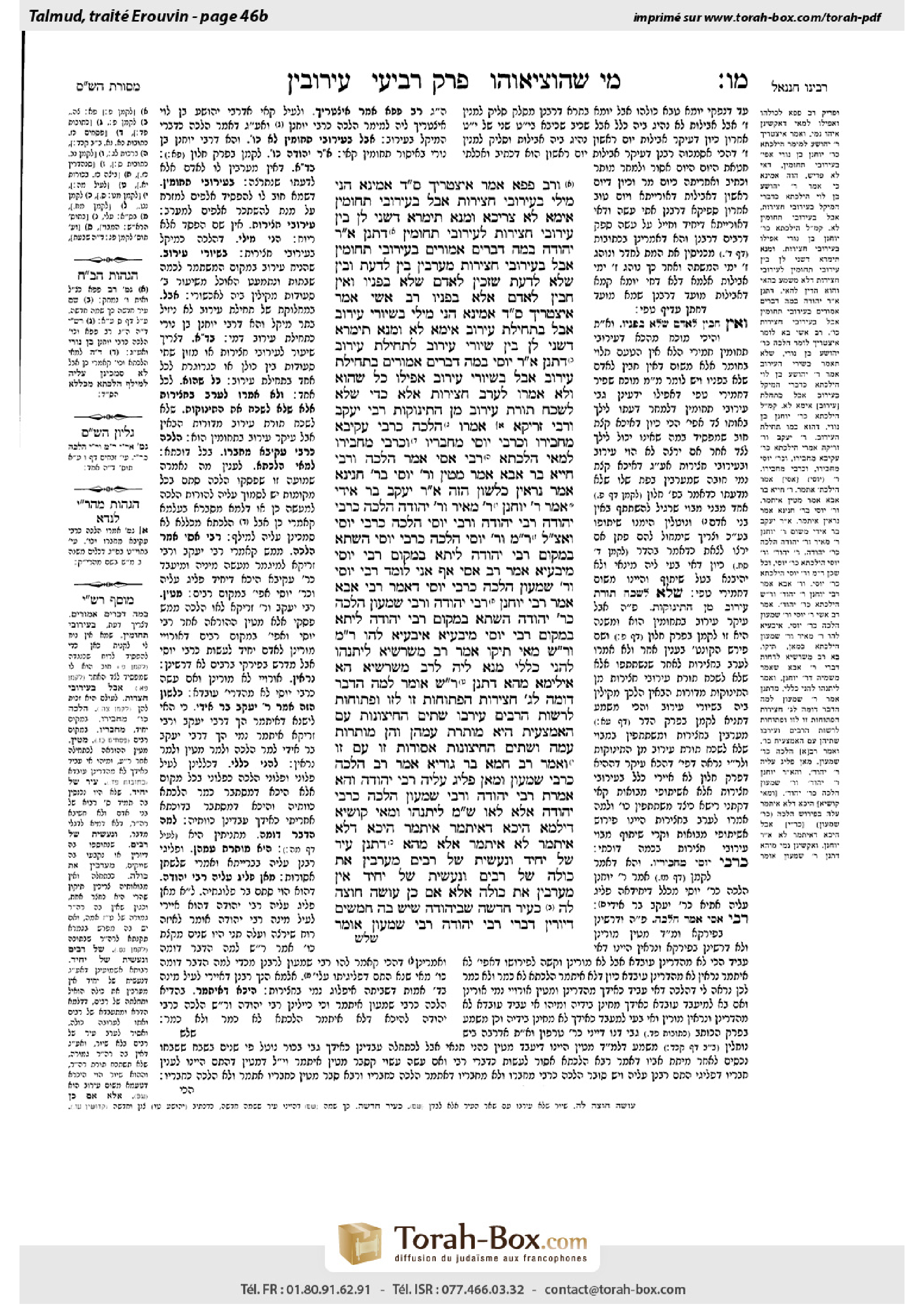
This page of Eruvin includes the Aramaic text, an English translation and an AI-generated French translation, alongside the scan above.
עירובין מ״ו ב · Aramaic and Hebrew text
וְרַב פָּפָּא אָמַר, אִיצְטְרִיךְ, סָלְקָא דַּעְתָּךְ אָמֵינָא: הָנֵי מִילֵּי בְּעֵירוּבֵי חֲצֵירוֹת, אֲבָל בְּעֵירוּבֵי תְחוּמִין — אֵימָא לָא צְרִיכָא.
וּמְנָא תֵּימְרָא דְּשָׁנֵי לַן בֵּין עֵירוּבֵי חֲצֵירוֹת לְעֵירוּבֵי תְּחוּמִין — דִּתְנַן, אָמַר רַבִּי יְהוּדָה: בַּמֶּה דְּבָרִים אֲמוּרִים — בְּעֵירוּבֵי תְחוּמִין, אֲבָל בְּעֵירוּבֵי חֲצֵירוֹת מְעָרְבִין בֵּין לְדַעַת וּבֵין שֶׁלֹּא לְדַעַת, שֶׁזָּכִין לְאָדָם שֶׁלֹּא בְּפָנָיו, וְאֵין חָבִין לְאָדָם אֶלָּא בְּפָנָיו.
רַב אָשֵׁי אָמַר: אִיצְטְרִיךְ, סָלְקָא דַּעְתָּךְ אָמֵינָא, הָנֵי מִילֵּי בְּשִׁיּוּרֵי עֵירוּב, אֲבָל בִּתְחִילַּת עֵירוּב — אֵימָא לָא.
וּמְנָא תֵּימְרָא דְּשָׁנֵי לַן בֵּין שִׁיּוּרֵי עֵירוּב לִתְחִילַּת עֵירוּב — דִּתְנַן, אָמַר רַבִּי יוֹסֵי: בַּמֶּה דְּבָרִים אֲמוּרִים — בִּתְחִילַּת עֵירוּב, אֲבָל בְּשִׁיּוּרֵי עֵירוּב — אֲפִילּוּ כָּל שֶׁהוּא.
וְלֹא אָמְרוּ לְעָרֵב חֲצֵירוֹת, אֶלָּא כְּדֵי שֶׁלֹּא לְשַׁכֵּחַ תּוֹרַת עֵירוּב מִן הַתִּינוֹקוֹת.
רַבִּי יַעֲקֹב וְרַבִּי זְרִיקָא אָמְרוּ: הֲלָכָה כְּרַבִּי עֲקִיבָא מֵחֲבֵירוֹ, וּכְרַבִּי יוֹסֵי מֵחֲבֵרָיו, וּכְרַבִּי מֵחֲבֵירוֹ.
לְמַאי הִלְכְתָא? רַבִּי אַסִּי אָמַר: הֲלָכָה. וְרַבִּי חִיָּיא בַּר אַבָּא אָמַר: מַטִּין. וְרַבִּי יוֹסֵי בְּרַבִּי חֲנִינָא אָמַר: נִרְאִין.
כַּלָּשׁוֹן הַזֶּה אָמַר רַבִּי יַעֲקֹב בַּר אִידֵּי אָמַר רַבִּי יוֹחָנָן: רַבִּי מֵאִיר וְרַבִּי יְהוּדָה — הֲלָכָה כְּרַבִּי יְהוּדָה, רַבִּי יְהוּדָה וְרַבִּי יוֹסֵי — הֲלָכָה כְּרַבִּי יוֹסֵי. וְאֵין צָרִיךְ לוֹמַר רַבִּי מֵאִיר וְרַבִּי יוֹסֵי — הֲלָכָה כְּרַבִּי יוֹסֵי. הַשְׁתָּא בִּמְקוֹם רַבִּי יְהוּדָה לֵיתָא, בִּמְקוֹם רַבִּי יוֹסֵי מִיבַּעְיָא?!
אָמַר רַב אַסִּי: אַף אֲנִי לוֹמֵד: רַבִּי יוֹסֵי וְרַבִּי שִׁמְעוֹן — הֲלָכָה כְּרַבִּי יוֹסֵי, דְּאָמַר רַבִּי אַבָּא אָמַר רַבִּי יוֹחָנָן: רַבִּי יְהוּדָה וְרַבִּי שִׁמְעוֹן — הֲלָכָה כְּרַבִּי יְהוּדָה. הַשְׁתָּא בִּמְקוֹם רַבִּי יְהוּדָה לֵיתָא, בִּמְקוֹם רַבִּי יוֹסֵי מִיבַּעְיָא?
אִיבַּעְיָא לְהוּ: רַבִּי מֵאִיר וְרַבִּי שִׁמְעוֹן, מַאי? תֵּיקוּ.
אָמַר רַב מְשַׁרְשְׁיָא: לֵיתַנְהוּ לְהָנֵי כְּלָלֵי. מְנָא לֵיהּ לְרַב מְשַׁרְשְׁיָא הָא?
אִילֵּימָא מֵהָא דִּתְנַן: רַבִּי שִׁמְעוֹן אוֹמֵר לְמָה הַדָּבָר דּוֹמֶה — לְשָׁלֹשׁ חֲצֵירוֹת הַפְּתוּחוֹת זוֹ לָזוֹ וּפְתוּחוֹת לִרְשׁוּת הָרַבִּים. עֵירְבוּ שְׁתַּיִם הַחִיצוֹנוֹת עִם הָאֶמְצָעִית — הִיא מוּתֶּרֶת עִמָּהֶן וְהֵן מוּתָּרוֹת עִמָּהּ, וּשְׁתַּיִם הַחִיצוֹנוֹת אֲסוּרוֹת זוֹ עִם זוֹ.
וְאָמַר רַב חָמָא בַּר גּוּרְיָא אָמַר רַב: הֲלָכָה כְּרַבִּי שִׁמְעוֹן. וּמַאן פְּלִיג עֲלֵיהּ — רַבִּי יְהוּדָה. וְהָא אָמְרַתְּ: רַבִּי יְהוּדָה וְרַבִּי שִׁמְעוֹן — הֲלָכָה כְּרַבִּי יְהוּדָה. אֶלָּא לָאו שְׁמַע מִינַּהּ: לֵיתַנְהוּ?
וּמַאי קוּשְׁיָא, דִּילְמָא הֵיכָא דְּאִיתְּמַר — אִיתְּמַר, הֵיכָא דְּלָא אִיתְּמַר — לָא אִיתְּמַר.
אֶלָּא, מֵהָא דִּתְנַן: עִיר שֶׁל יָחִיד וְנַעֲשֵׂית שֶׁל רַבִּים — מְעָרְבִין אֶת כּוּלָּהּ. שֶׁל רַבִּים וְנַעֲשֵׂית שֶׁל יָחִיד — אֵין מְעָרְבִין אֶת כּוּלָּהּ אֶלָּא אִם כֵּן עוֹשֶׂה חוּצָה לָהּ, כָּעִיר חֲדָשָׁה שֶׁבִּיהוּדָה שֶׁיֵּשׁ בָּהּ חֲמִשִּׁים דָּיוֹרִין — דִּבְרֵי רַבִּי יְהוּדָה.
רַבִּי שִׁמְעוֹן אוֹמֵר:
Eruvin 46b · English translation
Rav Pappa said a different explanation for the fact that Rabbi Yehoshua ben Levi made both statements: It was necessary for Rabbi Yehoshua ben Levi to inform us that the halakha is in accordance with the opinion of Rabbi Yoḥanan ben Nuri, because had he said only that the halakha follows the lenient opinion with regard to an eiruv, it could have entered your mind to say that this statement applies only with regard to the laws governing the eiruv of courtyards, which are entirely rabbinic in origin. But with regard to the more stringent laws governing the eiruv of Shabbat limits, you would have said that we should not rule leniently, and therefore it was necessary to make both statements.
The Gemara asks: And from where do you say that we distinguish between an eiruv of courtyards and an eiruv of Shabbat limits? As we learned in a mishna that Rabbi Yehuda said: In what case is this statement said, that an eiruv may be established for another person only with his knowledge? It was said with regard to an eiruv of Shabbat limits, but with regard to an eiruv of courtyards, an eiruv may be established for another person whether with his knowledge or without his knowledge, as one may act in a person’s interest in his absence; however, one may not act to a person’s disadvantage in his absence. One may act unilaterally on someone else’s behalf when the action is to that other person’s benefit; however, when it is to the other person’s detriment, or when there are both advantages and disadvantages to him, one may act on the other person’s behalf only if one has been explicitly appointed as an agent. Since an eiruv of courtyards is always to a person’s benefit, it can be established even without his knowledge. However, with regard to an eiruv of Shabbat limits, while it enables one to walk in one direction, it disallows him from walking in the opposite direction. Therefore, it can be established only with his knowledge.
Rav Ashi said that Rabbi Yehoshua ben Levi’s need to issue two rulings can be explained in another manner: It is necessary for Rabbi Yehoshua ben Levi to inform us that the halakha is in accordance with the opinion of Rabbi Yoḥanan ben Nuri, as if he had said only that the halakha is in accordance with the lenient opinion with regard to an eiruv, it could have entered your mind to say that this statement applies only with regard to the remnants of an eiruv, i.e., an eiruv that had been properly established, where the concern is that it might subsequently have become invalid. But with regard to an initial eiruv, i.e., an eiruv that is just being established and has not yet taken effect, you might have said that we should not rule leniently, and therefore it was necessary to issue both rulings.
The Gemara asks: And from where do you say that we distinguish between the remnants of an eiruv and an initial eiruv? As we learned in a mishna: Rabbi Yosei said: In what case is this statement said, that the Sages stipulated that a fixed quantity of food is necessary for establishing an eiruv? It is said with regard to an initial eiruv, i.e., when setting up an eiruv for the first time; however, with regard to the remnants of an eiruv, i.e., on a subsequent Shabbat when the measure may have become diminished, even a minimal amount suffices.
And they said to establish an eiruv for courtyards only after all the inhabitants of the city merge their alleyways and become like the inhabitants of a single courtyard, so that the law of eiruv should not be forgotten by the children, who may not be aware of the arrangement that has been made with regard to the alleyways.
Since the Gemara discussed the principles cited with regard to halakhic decision-making, it cites additional principles. Rabbi Ya’akov and Rabbi Zerika said: The halakha is in accordance with the opinion of Rabbi Akiva in disputes with any individual Sage, and the halakha is in accordance with the opinion of Rabbi Yosei even in disputes with other Sages, and the halakha is in accordance with the opinion of Rabbi Yehuda HaNasi in disputes with any individual Sage.
The Gemara asks: With regard to what halakha do these principles apply, meaning, to what degree are they binding? Rabbi Asi said: This is considered binding halakha. And Rabbi Ḥiyya bar Abba said: One is inclined toward such a ruling in cases where an individual asks, but does not issue it as a public ruling in all cases. And Rabbi Yosei, son of Rabbi Ḥanina, said: It appears that one should rule this way, but it is not an established halakha that is considered binding with regard to issuing rulings.
Rabbi Ya’akov bar Idi said that Rabbi Yoḥanan said: In the case of a dispute between Rabbi Meir and Rabbi Yehuda, the halakha is in accordance with the opinion of Rabbi Yehuda; in the case of a dispute between Rabbi Yehuda and Rabbi Yosei, the halakha is in accordance with the opinion of Rabbi Yosei; and, needless to say, in the case of a dispute between Rabbi Meir and Rabbi Yosei, the halakha is in accordance with the opinion of Rabbi Yosei. As now, if in disputes with Rabbi Yehuda, the opinion of Rabbi Meir is not accepted as law, need it be stated that in disputes with Rabbi Yosei, Rabbi Meir’s opinion is rejected? Rabbi Yehuda’s opinion is not accepted in disputes with Rabbi Yosei.
Rav Asi said: I also learn based on the same principle that in a dispute between Rabbi Yosei and Rabbi Shimon, the halakha is in accordance with the opinion of Rabbi Yosei. As Rabbi Abba said that Rabbi Yoḥanan said: In cases of dispute between Rabbi Yehuda and Rabbi Shimon, the halakha is in accordance with the opinion of Rabbi Yehuda. Now, if where it is opposed by Rabbi Yehuda the opinion of Rabbi Shimon is not accepted as law, where it is opposed by the opinion of Rabbi Yosei, with whom the halakha is in accordance against Rabbi Yehuda, is it necessary to say that the halakha is in accordance with the opinion of Rabbi Yosei?
The Gemara raises a dilemma: In a dispute between Rabbi Meir and Rabbi Shimon, what is the halakha? No sources were found to resolve this dilemma, and it stands unresolved.
Rav Mesharshiya said: These principles of halakhic decision-making are not to be relied upon. The Gemara asks: From where does Rav Mesharshiya derive this statement?
If you say that he derived it from that which we learned in the mishna that Rabbi Shimon said: To what is this comparable? It is like three courtyards that open into one another, and also open into a public domain. If the two outer courtyards established an eiruv with the middle one, the residents of the middle one are permitted to carry to the two outer ones, and they are permitted to carry to it, but the residents of the two outer courtyards are prohibited to carry from one to the other, as they did not establish an eiruv with one another.
And Rav Ḥama bar Gurya said that Rav said: The halakha is in accordance with the opinion of Rabbi Shimon; and who disagrees with Rabbi Shimon on this matter? It is Rabbi Yehuda. Didn’t you say: In disputes between Rabbi Yehuda and Rabbi Shimon, the halakha is in accordance with the opinion of Rabbi Yehuda? Rather, can we not conclude from this mishna that these principles should not be relied upon?
The Gemara rejects this argument: What is the difficulty posed by this ruling? Perhaps where it is stated explicitly to the contrary, it is stated, but where it is not stated explicitly to the contrary, it is not stated, and these principles apply.
Rather, the proof is from that which we learned elsewhere in a mishna: If a city that belongs to a single individual subsequently becomes one that belongs to many people, one may establish an eiruv of courtyards for all of it. But if the city belongs to many people, and it falls into the possession of a single individual, one may not establish an eiruv for all of it, unless he excludes from the eiruv an area the size of the town of Ḥadasha in Judea, which contains fifty residents; this is the statement of Rabbi Yehuda.
Rabbi Shimon says:
Eruvin 46b · Traduction française (IA)
Rav Pappa a dit une autre explication concernant le fait que Rabbi Yéhoshua ben Lévi a formulé deux déclarations : Il était nécessaire que Rabbi Yéhoshua ben Lévi nous informe que la halakha suit l'opinion de Rabbi Yochanan ben Nuri, car s'il avait dit seulement que la halakha suit l'opinion leniente concernant un eiruv, cela aurait pu entrer dans votre esprit de penser que cette déclaration s'applique uniquement aux lois régissant l'eiruv des courtyards, qui sont entièrement d'origine rabbinique. Mais concernant les lois plus strictes régissant l'eiruv des limites du Shabbat, vous auriez dit que nous ne devrions pas adopter une position leniente, et c'est pourquoi il était nécessaire de formuler deux déclarations.
Le Guemara pose la question : Et d'où dis-tu que nous distinguons entre un eiruv des courtyards et un eiruv des limites du Shabbat ? Comme nous avons appris dans une mitsna que Rabbi Yéhuda a dit : Dans quel cas cette déclaration est-elle formulée, que l'eiruv peut être établi pour une autre personne seulement avec son consentement ? Elle a été formulée concernant un eiruv des limites du Shabbat, mais concernant un eiruv des courtyards, un eiruv peut être établi pour une autre personne avec ou sans son consentement, car on peut agir dans l'intérêt d'une personne en son absence ; toutefois, on ne peut pas agir à son détriment en son absence. On peut agir unilatéralement au nom d'une autre personne lorsque l'action est bénéfique pour cette personne ; toutefois, lorsque l'action est à son détriment ou lorsque l'action comporte à la fois des avantages et des inconvénients, on peut agir au nom de cette personne uniquement si l'on est explicitement désigné comme agent. Puisque l'eiruv des courtyards est toujours bénéfique pour une personne, il peut être établi même sans son consentement. Toutefois, concernant l'eiruv des limites du Shabbat, bien qu'il permette de marcher dans une direction, il interdit de marcher dans l'autre direction. Par conséquent, il peut être établi uniquement avec son consentement.
Rav Ashi a dit que la nécessité pour Rabbi Yéhoshua ben Lévi de formuler deux déclarations peut être expliquée d'une autre manière : Il était nécessaire que Rabbi Yéhoshua ben Lévi nous informe que la halakha suit l'opinion de Rabbi Yochanan ben Nuri, car s'il avait dit seulement que la halakha suit l'opinion leniente concernant un eiruv, cela aurait pu entrer dans votre esprit de penser que cette déclaration s'applique uniquement aux restes d'un eiruv, c'est-à-dire un eiruv qui avait été correctement établi, où la préoccupation est que celui-ci puisse ensuite devenir invalide. Mais concernant un eiruv initial, c'est-à-dire un eiruv qui est juste établi et qui n'a pas encore pris effet, vous auriez pu dire que nous ne devrions pas adopter une position leniente, et c'est pourquoi il était nécessaire de formuler deux déclarations.
Le Guemara pose la question : Et d'où dis-tu que nous distinguons entre les restes d'un eiruv et un eiruv initial ? Comme nous avons appris dans une mitsva : Rabbi Yosei a dit : Dans quel cas cette déclaration est-elle formulée, que les Sages ont stipulé qu'une quantité fixe de nourriture est nécessaire pour établir un eiruv ? Elle est formulée concernant un eiruv initial, c'est-à-dire lors de l'établissement d'un eiruv pour la première fois ; toutefois, concernant les restes d'un eiruv, c'est-à-dire lors d'un Shabbat ultérieur où la mesure peut avoir diminué, même une quantité minimale suffit.
Et ils dirent qu'il fallait établir un eiruv pour les courtyards seulement après que tous les habitants de la ville aient fusionné leurs allées et deviennent comme les habitants d'un seul courtyard, afin que la loi de l'eiruv ne soit pas oubliée par les enfants, qui peuvent ne pas être conscients de l'arrangement fait concernant les allées.
Puisque la Guemara a discuté des principes cités concernant la prise de décision halakhique, elle cite d'autres principes. Rabbi Yaakov et Rabbi Zerika dirent : La halakha suit l'opinion de Rabbi Akiva dans les cas de désaccord avec tout sage individuel, et la halakha suit l'opinion de Rabbi Yosei même dans les cas de désaccord avec d'autres sages, et la halakha suit l'opinion de Rabbi Yéhuda HaNasi dans les cas de désaccord avec tout sage individuel.
La Guemara pose la question : Concernant quelle halakha ces principes s'appliquent-ils, c'est-à-dire à quel point sont-ils contraignants ? Rabbi Asi a dit : Cela est considéré comme une halakha contraignante. Et Rabbi Ḥiyya bar Abba a dit : On est enclin à adopter une telle décision dans les cas où un individu demande, mais on ne l'applique pas comme une décision publique dans tous les cas. Et Rabbi Yosei, fils de Rabbi Ḥanina, a dit : Il semble que l'on devrait adopter cette décision, mais ce n'est pas une halakha établie qui est considérée comme contraignante concernant l'émission de décisions.
Rabbi Yaakov bar Idi a dit que Rabbi Yoḥanan a dit : Dans le cas d'un désaccord entre Rabbi Meir et Rabbi Yéhuda, la halakha suit l'opinion de Rabbi Yéhuda ; dans le cas d'un désaccord entre Rabbi Yéhuda et Rabbi Yosei, la halakha suit l'opinion de Rabbi Yosei ; et, sans dire autre chose, dans le cas d'un désaccord entre Rabbi Meir et Rabbi Yosei, la halakha suit l'opinion de Rabbi Yosei. Maintenant, si dans les désaccords avec Rabbi Yéhuda, l'opinion de Rabbi Meir n'est pas acceptée comme loi, pourquoi dire que dans les désaccords avec Rabbi Yosei, l'opinion de Rabbi Meir est rejetée ? L'opinion de Rabbi Yéhuda n'est pas acceptée dans les désaccords avec Rabbi Yosei.
Rav Asi a dit : Je dois aussi apprendre selon le même principe que dans un désaccord entre Rabbi Yosei et Rabbi Shimon, la halakha suit l'opinion de Rabbi Yosei. Comme Rabbi Abba a dit que Rabbi Yochanan a dit : Dans les cas de désaccord entre Rabbi Yéhuda et Rabbi Shimon, la halakha suit l'opinion de Rabbi Yéhuda. Maintenant, si là où il est opposé à Rabbi Yéhuda, l'opinion de Rabbi Shimon n'est pas acceptée comme loi, là où il est opposé à l'opinion de Rabbi Yosei, avec qui la halakha suit contre Rabbi Yéhuda, est-il nécessaire de dire que la halakha suit l'opinion de Rabbi Yosei ?
Le Guemara soulève un dilemme : Dans un désaccord entre Rabbi Meir et Rabbi Shimon, quelle est la halakha ? Aucune source n'a été trouvée pour résoudre ce dilemme, et il reste sans solution.
Rav Mesharshiya a dit : Ces principes de décision halachique ne doivent pas être mis en application. La Guemara demande : D'où Rav Mesharshiya tire-t-il cette déclaration ?
Si vous dites qu'il le tire de ce que nous avons appris dans la mitsva que Rabbi Shimon a dit : À quoi cela ressemble-t-il ? C'est comme trois courtyards qui s'ouvrent les uns vers les autres et qui s'ouvrent également vers un domaine public. Si les deux courtyards externes ont établi un eiruv avec le courtyard central, les résidents du courtyard central sont autorisés à porter dans les deux courtyards externes, et ils sont autorisés à porter dans celui-ci, mais les résidents des deux courtyards externes sont interdits de porter d'un à l'autre, car ils n'ont pas établi un eiruv entre eux.
Et Rav Ḥama bar Gurya a dit que Rav a dit : La halakha suit l'opinion de Rabbi Shimon ; et qui s'oppose à Rabbi Shimon sur ce point ? C'est Rabbi Yehuda. N'avez-vous pas dit : Dans les désaccords entre Rabbi Yehuda et Rabbi Shimon, la halakha suit l'opinion de Rabbi Yehuda ? Plutôt, ne pouvons-nous pas conclure à partir de cette mitsva que ces principes ne doivent pas être mis en application ?
La Guemara rejette cet argument : Quel est le problème posé par cette décision ? Peut-être que là où il est dit explicitement le contraire, il est dit, mais là où il n'est pas dit explicitement le contraire, il n'est pas dit, et ces principes s'appliquent.
Plutôt, la preuve vient de ce que nous avons appris ailleurs dans une mitsna : Si une ville appartenant à un seul individu devient ensuite une ville appartenant à plusieurs personnes, on peut établir un eiruv des courtyards pour toute cette ville. Mais si la ville appartient à plusieurs personnes et passe en possession d'un seul individu, on ne peut pas établir un eiruv pour toute cette ville, à moins qu'il exclue d'un eiruv une zone de la taille de la ville de Ḥadasha en Judée, qui contient cinquante habitants ; c'est l'opinion de Rabbi Yehuda.
Rabbi Shimon dit :
Traduction française générée par IA à partir de l’édition anglaise de Sefaria. Vérifie toujours un passage avec le texte source.
Text from Sefaria: William Davidson Edition - Vocalized Aramaic (CC BY NC); William Davidson Edition - English (CC BY NC).