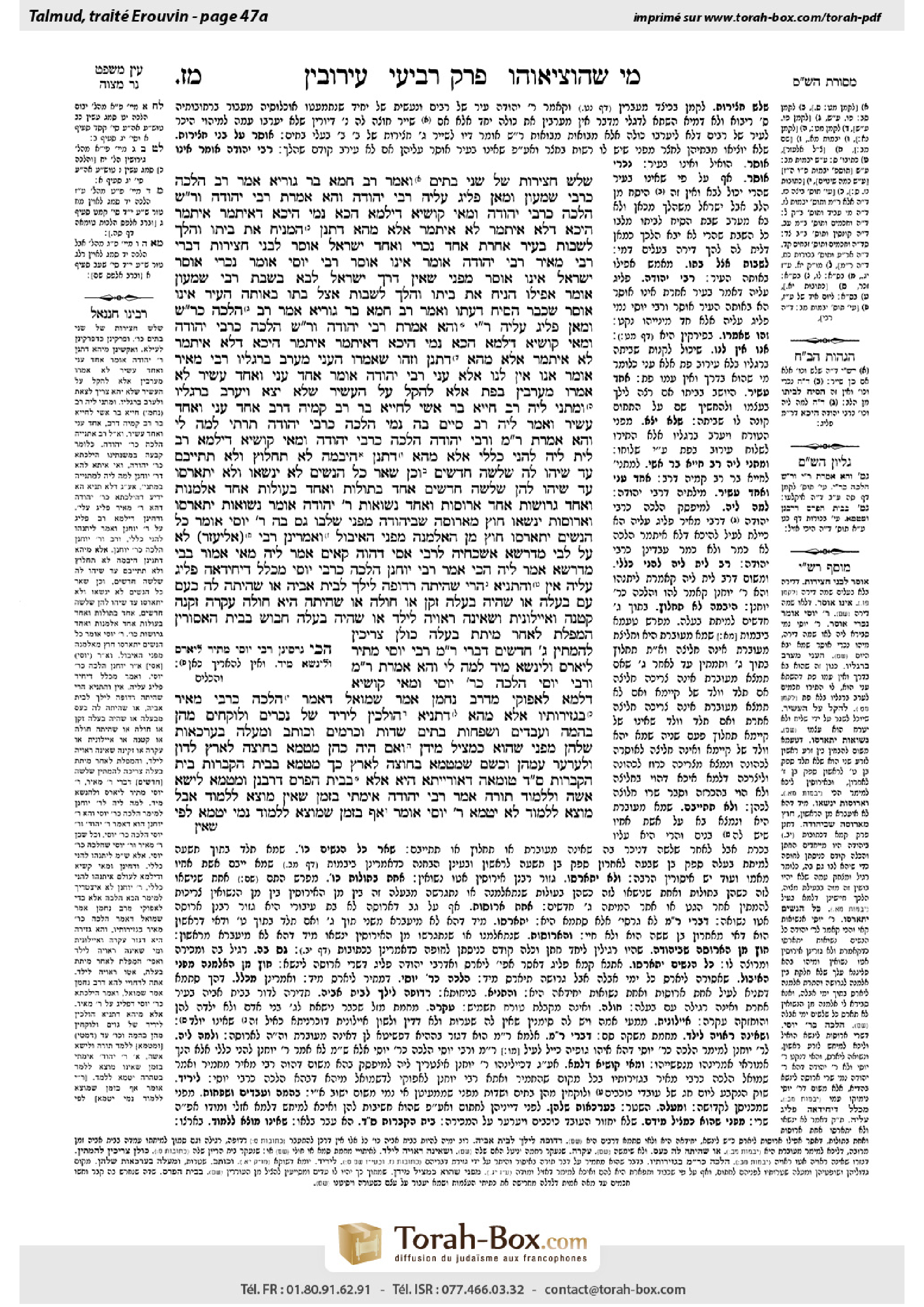
Eruvin 47a: Talmud study for Daf Yomi
Study the Talmud for Daf Yomi with scanned pages, Hebrew text, English translations from Sefaria and AI-generated French translations.
Passage selection and English or AI-generated French translation are available where the scan has annotations. Daf Study is independent of Torah-Box and Sefaria.
Browse Eruvin · עירובין · All tractatesEruvin 47a text and translations
This page of Eruvin includes the Aramaic text, an English translation and an AI-generated French translation, alongside the scan above.
עירובין מ״ז א · Aramaic and Hebrew text
שָׁלֹשׁ חֲצֵירוֹת שֶׁל שְׁנֵי בָתִּים. וְאָמַר רַב חָמָא בַּר גּוּרְיָא אָמַר רַב: הֲלָכָה כְּרַבִּי שִׁמְעוֹן. וּמַאן פְּלִיג עֲלֵיהּ — רַבִּי יְהוּדָה. וְהָא אָמְרַתְּ: רַבִּי יְהוּדָה וְרַבִּי שִׁמְעוֹן — הֲלָכָה כְּרַבִּי יְהוּדָה!
ומַאי קוּשְׁיָא? דִילְמָא הָכָא נָמֵי, הֵיכָא דְּאִיתְּמַר — אִיתְּמַר, הֵיכָא דְּלָא אִיתְּמַר — לָא אִיתְּמַר.
אֶלָּא, מֵהָא דִּתְנַן: הַמַּנִּיחַ אֶת בֵּיתוֹ וְהָלַךְ לִשְׁבּוֹת בְּעִיר אַחֶרֶת, אֶחָד נָכְרִי וְאֶחָד יִשְׂרָאֵל — אוֹסֵר לִבְנֵי חֲצֵירוֹת, דִּבְרֵי רַבִּי מֵאִיר.
רַבִּי יְהוּדָה אוֹמֵר: אֵינוֹ אוֹסֵר. רַבִּי יוֹסֵי אוֹמֵר: נָכְרִי — אוֹסֵר, יִשְׂרָאֵל — אֵינוֹ אוֹסֵר, מִפְּנֵי שֶׁאֵין דֶּרֶךְ יִשְׂרָאֵל לָבֹא בַּשַּׁבָּת. רַבִּי שִׁמְעוֹן אוֹמֵר: אֲפִילּוּ הִנִּיחַ אֶת בֵּיתוֹ וְהָלַךְ לִשְׁבּוֹת אֵצֶל בִּתּוֹ בְּאוֹתָהּ הָעִיר — אֵינוֹ אוֹסֵר, שֶׁכְּבָר הִסִּיחַ דַּעְתּוֹ.
וְאָמַר רַב חָמָא בַּר גּוּרְיָא אָמַר רַב: הֲלָכָה כְּרַבִּי שִׁמְעוֹן, וּמַאן פְּלִיג עֲלֵיהּ — רַבִּי יְהוּדָה. וְהָא אָמְרַתְּ רַבִּי יְהוּדָה וְרַבִּי שִׁמְעוֹן הֲלָכָה כְּרַבִּי יְהוּדָה!
וּמַאי קוּשְׁיָא? דִּלְמָא הָכָא נָמֵי, הֵיכָא דְּאִיתְּמַר — אִיתְּמַר, הֵיכָא דְּלָא אִיתְּמַר — לָא אִיתְּמַר.
אֶלָּא, מֵהָא דִּתְנַן: וְזֶהוּ שֶׁאָמְרוּ הֶעָנִי מְעָרֵב בְּרַגְלָיו. רַבִּי מֵאִיר אוֹמֵר: אָנוּ אֵין לָנוּ אֶלָּא עָנִי.
רַבִּי יְהוּדָה אוֹמֵר: אֶחָד עָנִי וְאֶחָד עָשִׁיר. לֹא אָמְרוּ מְעָרְבִין בְּפַת אֶלָּא לְהָקֵל עַל הֶעָשִׁיר, שֶׁלֹּא יֵצֵא וִיעָרֵב בְּרַגְלָיו.
וּמַתְנֵי לֵיהּ רַב חִיָּיא בַּר אָשֵׁי לְחִיָּיא בַּר רַב קַמֵּיהּ דְּרַב: אֶחָד עָנִי וְאֶחָד עָשִׁיר. וַאֲמַר לֵיהּ רַב, סַיֵּים בָּהּ נָמֵי: הֲלָכָה כְּרַבִּי יְהוּדָה.
תַּרְתֵּי לְמָה לִי, וְהָא אָמְרַתְּ: רַבִּי מֵאִיר וְרַבִּי יְהוּדָה — הֲלָכָה כְּרַבִּי יְהוּדָה!
וּמַאי קוּשְׁיָא? דִּילְמָא רַב לֵית לֵיהּ לְהָנֵי כְּלָלֵי?
אֶלָּא, מֵהָא דִּתְנַן: הַיְּבָמָה לֹא תַּחֲלוֹץ וְלֹא תִּתְיַיבֵּם עַד שֶׁיְּהוּ לָהּ שְׁלֹשָׁה חֳדָשִׁים.
וְכֵן שְׁאָר כׇּל הַנָּשִׁים לֹא יִנָּשְׂאוּ וְלֹא יִתְאָרְסוּ עַד שֶׁיְּהוּ לָהֶן שְׁלֹשָׁה חֳדָשִׁים, אֶחָד בְּתוּלוֹת וְאֶחָד בְּעוּלוֹת, אֶחָד אַלְמָנוֹת וְאֶחָד גְּרוּשׁוֹת, אֶחָד אֲרוּסוֹת וְאֶחָד נְשׂוּאוֹת.
רַבִּי יְהוּדָה אוֹמֵר: נְשׂוּאוֹת — יִתְאָרְסוּ.
וַאֲרוּסוֹת — יִנָּשְׂאוּ, חוּץ מֵאֲרוּסָה שֶׁבִּיהוּדָה, מִפְּנֵי שֶׁלִּבּוֹ גַּס בָּהּ.
רַבִּי יוֹסֵי אוֹמֵר: כׇּל הַנָּשִׁים יִתְאָרְסוּ, חוּץ מִן הָאַלְמָנָה — מִפְּנֵי הָאִיבּוּל.
וְאָמְרִינַן: רַבִּי אֱלִיעֶזֶר לָא עָל לְבֵי מִדְרְשָׁא. אַשְׁכְּחֵיהּ לְרַבִּי אַסִּי דַּהֲוָה קָאֵים. אֲמַר לֵיהּ: מַאי אֲמוּר בְּבֵי מִדְרְשָׁא? אֲמַר לֵיהּ, הָכִי אֲמַר רַבִּי יוֹחָנָן: הֲלָכָה כְּרַבִּי יוֹסֵי. מִכְּלָל דִּיחִידָאָה פְּלִיג עֲלֵיהּ?
אִין, וְהָתַנְיָא: הֲרֵי שֶׁהָיְתָה רְדוּפָה לֵילֵךְ לְבֵית אָבִיהָ, אוֹ שֶׁהָיְתָה לָהּ כַּעַס עִם בַּעְלָהּ, אוֹ שֶׁהָיָה בַּעְלָהּ זָקֵן אוֹ חוֹלֶה, אוֹ שֶׁהָיְתָה הִיא חוֹלָה, עֲקָרָה, זְקֵנָה, קְטַנָּה וְאַיְילוֹנִית, וְשֶׁאֵינָהּ רְאוּיָה לֵילֵד, אוֹ שֶׁהָיָה בַּעְלָהּ חָבוּשׁ בְּבֵית הָאֲסוּרִין, הַמַּפֶּלֶת לְאַחַר מִיתַת בַּעְלָהּ — כּוּלָּן צְרִיכִין לְהַמְתִּין שְׁלֹשָׁה חֳדָשִׁים, דִּבְרֵי רַבִּי מֵאִיר. רַבִּי יוֹסֵי מַתִּיר לֵיאָרֵס וְלִינָּשֵׂא מִיָּד.
לְמָה לִי? וְהָא אָמְרַתְּ רַבִּי מֵאִיר וְרַבִּי יוֹסֵי — הֲלָכָה כְּרַבִּי יוֹסֵי!
וּמַאי קוּשְׁיָא? דִּלְמָא לְאַפּוֹקֵי מִדְּרַב נַחְמָן אָמַר שְׁמוּאֵל, דְּאָמַר: הֲלָכָה כְּרַבִּי מֵאִיר בִּגְזֵירוֹתָיו.
אֶלָּא, מֵהָא דְּתַנְיָא: הוֹלְכִין לְיָרִיד שֶׁל נׇכְרִים וְלוֹקְחִים מֵהֶן בְּהֵמָה וַעֲבָדִים וּשְׁפָחוֹת, בָּתִּים שָׂדוֹת וּכְרָמִים, וְכוֹתֵב וּמַעֲלֶה בְּעַרְכָּאוֹת שֶׁלָּהֶן, מִפְּנֵי שֶׁהוּא כְּמַצִּיל מִיָּדָן.
וְאִם הָיָה כֹּהֵן — מִטַּמֵּא בְּחוּצָה לָאָרֶץ לָדוּן וּלְעַרְעֵר עִמָּהֶן. וּכְשֵׁם שֶׁמִּטַּמֵּא בְּחוּצָה לָאָרֶץ — כָּךְ מִטַּמֵּא בְּבֵית הַקְּבָרוֹת.
בֵּית הַקְּבָרוֹת סָלְקָא דַּעְתָּךְ?! טוּמְאָה דְּאוֹרָיְיתָא הִיא!
אֶלָּא בְּבֵית הַפְּרָס, דְּרַבָּנַן.
וּמִטַּמֵּא לִישָּׂא אִשָּׁה, וְלִלְמוֹד תּוֹרָה. אָמַר רַבִּי יְהוּדָה: אֵימָתַי — בִּזְמַן שֶׁאֵין מוֹצֵא לִלְמוֹד, אֲבָל מוֹצֵא לִלְמוֹד — לֹא יִטַּמָּא.
רַבִּי יוֹסֵי אוֹמֵר: אַף בִּזְמַן שֶׁמּוֹצֵא לִלְמוֹד — נָמֵי יִטַּמָּא, לְפִי
Eruvin 47a · English translation
The excluded area need not be so large; rather, three courtyards each containing two houses are sufficient for this purpose. And Rav Ḥama bar Gurya said that Rav said: The halakha is in accordance with the opinion of Rabbi Shimon; and who disagrees with Rabbi Shimon on this matter? It is Rabbi Yehuda. Didn’t you say: In a case where Rabbi Yehuda and Rabbi Shimon disagree, the halakha is in accordance with the opinion of Rabbi Yehuda? This teaches that one should not rely on these principles.
The Gemara rejects this argument as well: What is the difficulty here? Perhaps here, too, where it is stated explicitly that the halakha is in accordance with Rabbi Shimon, it is stated, but where it is not stated explicitly, it is not stated, and the principle that the halakha is in accordance with the opinion of Rabbi Yehuda applies.
Rather, the proof is from that which we learned elsewhere in a mishna: With regard to one who left his house without making an eiruv of courtyards, and established residence for Shabbat in a different town, whether he was a gentile or a Jew, his lack of participation prohibits the other residents of the courtyards in which he has a share to carry objects from their houses to the courtyard, because he did not establish an eiruv with them, and failure to include a house in the eiruv imposes restrictions upon all the residents of the courtyard. This is the statement of Rabbi Meir.
Rabbi Yehuda says: His lack of participation does not prohibit the others to carry, since he is not present there. Rabbi Yosei says: Lack of participation in an eiruv by a gentile who is away prohibits the others to carry, because he might return on Shabbat; but lack of participation by a Jew who is not present does not prohibit the others to carry, as it is not the way of a Jew to return on Shabbat once he has already established his residence elsewhere. Rabbi Shimon says: Even if he left his house and established residence for Shabbat with his daughter in the same town, his lack of participation does not prohibit the residents of his courtyard to carry, even though he is permitted to return home, because he has already removed it, i.e., returning, from his mind.
And Rav Ḥama bar Gurya said that Rav said: The halakha is in accordance with the opinion of Rabbi Shimon. And who disagrees with him? It is Rabbi Yehuda. Didn’t you say: When there is a dispute between Rabbi Yehuda and Rabbi Shimon, the halakha is in accordance with the opinion of Rabbi Yehuda? This teaches that one cannot rely upon these principles.
The Gemara rejects this argument again: What is the difficulty here? Perhaps here, too, where it is explicitly stated that the halakha is in accordance with the opinion of Rabbi Shimon, it is stated; but where such a ruling is not stated, it is not stated, and the principle that the halakha is in accordance with the opinion of Rabbi Yehuda is relied upon.
Rather, the proof is from that which we learned in the mishna. And that is what the Sages meant when they said: A pauper can establish an eiruv with his feet; that is to say, he may walk to a place within his Shabbat limit and declare: Here shall be my place of residence, and then his Shabbat limit is measured from that spot. Rabbi Meir says: We apply this law only to a pauper, who does not have food for two meals; only such a person is permitted to establish his eiruv by walking to the spot that he wishes to acquire as his place of residence.
Rabbi Yehuda says: This allowance applies both to a pauper and to a wealthy person. Indeed, they said that one can establish an eiruv with bread only in order to make placing an eiruv easier for a wealthy person, so that he need not trouble himself and go out and establish an eiruv with his feet, but the basic eiruv is established by walking to the spot one will acquire as his place of residence.
And Rav Ḥiyya bar Ashi once taught this law to Ḥiyya bar Rav in the presence of Rav, saying: This allowance applies both to a pauper and to a wealthy person, and Rav said to him: When you teach this law, conclude also with this ruling: The halakha is in accordance with the opinion of Rabbi Yehuda.
The Gemara asks: Why do I need a second ruling? Didn’t you already say: When there is a dispute between Rabbi Meir and Rabbi Yehuda, the halakha is in accordance with the opinion of Rabbi Yehuda? The fact that Rav needed to specify that the halakha is in accordance with the opinion of Rabbi Yehuda on this matter indicates that he does not accept the general principle that when there is a dispute between Rabbi Meir and Rabbi Yehuda, the halakha is in accordance with the opinion of Rabbi Yehuda.
The Gemara rejects this reasoning: What is the difficulty here? Perhaps Rav does not accept these principles, but the other Sages accept them.
Rather, the Gemara brings a proof from that which we learned in another mishna with regard to a woman waiting for her brother-in-law, i.e., a woman whose husband died without children but who is survived by a brother. The brother-in-law is obligated by Torah law either to perform levirate marriage with his deceased brother’s widow, or to free her to marry others by participating in ḥalitza. The woman waiting for her brother-in-law may neither participate in ḥalitza nor undergo levirate marriage until three months have passed following her husband’s death, due to concern that she may be pregnant from him, in which case she is exempt from levirate marriage and ḥalitza. After the three-month waiting period it will become clear whether she is pregnant from her husband.
And similarly, all other women may not be married or even betrothed until three months have passed following their divorce or the death of their husbands, whether they are virgins or non-virgins, whether they are widows or divorcees, and whether they became widowed or divorced when they were betrothed or married. In all cases, the woman may not marry for three months. Otherwise, if she is within the first three months of her pregnancy from her first husband, and she gives birth six months later, a doubt would arise as to the identity of the father. The Sages did not differentiate between cases where this concern is applicable and where it is not; rather, they fixed a principle that applies universally.
Rabbi Yehuda says: A woman who had been married when she became widowed or divorced may be betrothed immediately, as couples do not have relations during the period of their betrothal. However, she may not marry until three months have passed, in order to differentiate between any possible offspring from the first and second husband.
A woman who had only been betrothed when she became widowed or divorced may be married immediately, as it may be assumed that the couple did not have relations during the period of their betrothal. This is except for a betrothed woman in Judea, because there the bridegroom’s heart is bold, as it was customary for couples to be alone together during the period of betrothal, and consequently there is a suspicion that they might have had relations, in which case she might be carrying his child. However, no similar concern applies in other places.
Rabbi Yosei says: All the women listed above may be betrothed immediately, because the decree applies only with regard to marriage; this is except for a widow, who must wait for a different reason, because of the mourning for her deceased husband.
And we said with regard to this: It once happened that Rabbi Eliezer did not come to the study hall. He met Rabbi Asi, who was standing, and said to him: What did they say today in the study hall? He said to him that Rabbi Yoḥanan said as follows: The halakha is in accordance with the opinion of Rabbi Yosei. Rabbi Eliezer asked: By inference, can it be inferred from the fact that the halakha is in accordance with his opinion that only a single authority disagrees with him?
Rabbi Asi answered: Yes, and so it was taught in the following baraita: If a woman was eager to go to her father’s house and did not remain with her husband during his final days, or if she was angry with her husband and they separated, or if her husband was elderly or sick and could not father children, or if she was sick, or barren, or an elderly woman, or a minor, or a sexually underdeveloped woman who is incapable of bearing children, or a woman who was unfit to give birth for any other reason, or if her husband was imprisoned in jail, or if she had miscarried after the death of her husband, so that there is no longer any concern that she might be pregnant from him, all these women must wait three months before remarrying or even becoming betrothed; this is the statement of Rabbi Meir, who maintains that this decree applies to all women, even when the particular situation renders it unnecessary. In all these cases Rabbi Yosei permits the woman to be betrothed and to marry immediately.
The Gemara resumes its question: Why do I need Rabbi Yoḥanan to state that the halakha is in accordance with Rabbi Yosei? Didn’t you say: In a dispute between Rabbi Meir and Rabbi Yosei, the halakha is in accordance with the opinion of Rabbi Yosei, and therefore the halakha should be in accordance with him here as well? This implies that the principle is not to be relied upon.
The Gemara rejects this argument: What is the difficulty here? Perhaps this ruling comes to exclude what Rav Naḥman said that Shmuel said: Although there are many cases in which the halakha is not in accordance with the opinion of Rabbi Meir, nonetheless, the halakha is in accordance with Rabbi Meir with respect to his decrees, i.e., in those cases where he imposed a restriction in a particular case due to its similarity to another case. For this reason Rabbi Yoḥanan had to say that the halakha here is in accordance with the opinion of Rabbi Yosei, notwithstanding its opposition to Rabbi Meir’s decree.
Rather, the proof that these principles do not apply is from that which was taught in the following baraita: One may go to a fair of idolatrous gentiles and buy animals, slaves, and maidservants from them, as the purchase raises them to a more sanctified state; and he may buy houses, fields, and vineyards from them, due to the mitzva to settle Eretz Yisrael; and he may write the necessary deeds and confirm them in their gentile courts with an official seal, even though this involves an acknowledgement of their authority, because it is as though he were rescuing his property from their hands, as the court’s confirmation and stamp of approval prevents the sellers from appealing the sale and retracting it.
And if he is a priest, he may become ritually impure by going outside Eretz Yisrael, where the earth and air are impure, in order to litigate with them and to contest their claims. And just as a priest may become ritually impure by going outside Eretz Yisrael, so may he become ritually impure for this purpose by entering into a cemetery.
The Gemara interrupts its presentation of the baraita to express surprise at this last ruling: Can it enter your mind to say that a priest may enter a cemetery? This would make him ritually impure by Torah law. How could the Sages permit a priest to become ritually impure by Torah law?
Rather, the baraita is referring to an area where there is uncertainty with regard to the location of a grave or a corpse [beit haperas], owing to the fact that a grave had been unwittingly plowed over, and the bones may have become scattered throughout the field. Such a field imparts ritual impurity only by rabbinic law.
The baraita continues: And a priest may likewise become ritually impure and leave Eretz Yisrael in order to marry a woman or to study Torah there. Rabbi Yehuda said: When does this allowance apply? When he cannot find a place to study in Eretz Yisrael. But if the priest can find a place to study in Eretz Yisrael, he may not become ritually impure by leaving the country.
Rabbi Yosei says: Even when he can find a place to study Torah in Eretz Yisrael, he may also leave the country and become ritually impure, because
Eruvin 47a · Traduction française (IA)
La zone exclue n'a besoin d'être aussi grande ; plutôt, trois courtyards chacun contenant deux maisons suffisent à cet effet. Et Rav Ḥama bar Gurya a dit que Rav a dit : la halakha suit l'opinion de Rabbi Shimon ; et qui s'oppose à Rabbi Shimon sur ce point ? C'est Rabbi Yehuda. N'avez-vous pas dit : dans un cas où Rabbi Yehuda et Rabbi Shimon s'opposent, la halakha suit l'opinion de Rabbi Yehuda ? Cela enseigne que l'on ne doit pas se fier à ces principes.
La Guemara rejette cet argument également : Quel est le problème ici ? Peut-être ici aussi, où il est dit explicitement que la halakha suit l'opinion de Rabbi Shimon, il est dit, mais où il n'est pas dit explicitement, il n'est pas dit, et le principe que la halakha suit l'opinion de Rabbi Yehuda s'applique.
Au contraire, la preuve vient de ce que nous avons appris ailleurs dans une mitsna : Concernant celui qui a quitté sa maison sans établir un eiruv de courtyards et a établi son résidence pour le sabbat dans une autre ville, qu'il soit gentil ou juif, son manque de participation interdit aux autres résidents des courtyards dans lesquels il a une part de porter des objets de leurs maisons vers le courtyard, car il n'a pas établi un eiruv avec eux, et l'omission d'inclure une maison dans l'eiruv impose des restrictions à tous les résidents du courtyard. C'est l'opinion de Rabbi Meir.
Rabbi Yehuda dit : Son manque de participation n'interdit pas aux autres de porter, car il n'est pas présent là. Rabbi Yosei dit : Le manque de participation d'un gentil absent interdit aux autres de porter, car il pourrait revenir le sabbat ; mais le manque de participation d'un juif absent n'interdit pas aux autres de porter, car ce n'est pas la manière des juifs de revenir le sabbat après avoir établi leur résidence ailleurs. Rabbi Shimon dit : Même s'il a quitté sa maison et a établi sa résidence pour le sabbat avec sa fille dans la même ville, son manque de participation n'interdit pas aux résidents de son courtyard de porter, même s'il est autorisé à rentrer chez lui, car il a déjà retiré cela, c'est-à-dire le retour, de son esprit.
Et Rav Ḥama bar Gurya a dit que Rav a dit : La halakha suit l'opinion de Rabbi Shimon. Et qui s'oppose à lui ? C'est Rabbi Yehuda. N'avez-vous pas dit : Lorsqu'il y a un désaccord entre Rabbi Yehuda et Rabbi Shimon, la halakha suit l'opinion de Rabbi Yehuda ? Cela enseigne que l'on ne peut pas se fier à ces principes.
La Guemara rejette à nouveau cet argument : Quel est le problème ici ? Peut-être ici aussi, où il est dit explicitement que la halakha suit l'opinion de Rabbi Shimon, il est dit ; mais où une telle décision n'est pas explicitement mentionnée, elle ne l'est pas, et le principe que la halakha suit l'opinion de Rabbi Yehuda est appliqué.
Au contraire, la preuve vient de ce que nous avons appris dans la Michna. Et c'est ce que les Sages voulaient dire lorsqu'ils ont dit : Un pauvre peut établir un eiruv avec ses pieds ; c'est-à-dire qu'il peut marcher jusqu'à un endroit dans sa limite de sabbat et déclarer : Ici sera mon lieu de résidence, et alors sa limite de sabbat est mesurée à partir de cet endroit. Rabbi Meir dit : Nous appliquons cette loi uniquement à un pauvre, qui n'a pas de nourriture pour deux repas ; seul ce genre de personne est autorisé à établir son eiruv en marchant jusqu'à l'endroit qu'il souhaite acquérir comme lieu de résidence.
Rabbi Yehuda dit : Cette concession s'applique à la fois au pauvre et au riche. En effet, ils ont dit qu'on peut établir un eiruv avec du pain uniquement afin de faciliter l'établissement d'un eiruv pour un riche, de sorte qu'il n'ait pas besoin de se fatiguer et de sortir pour établir un eiruv avec ses pieds, mais l'eiruv de base est établi en marchant jusqu'à l'endroit qu'on souhaite acquérir comme lieu de résidence.
Et Rav Ḥiyya bar Ashi a un jour enseigné cette loi à Ḥiyya bar Rav en présence de Rav, disant : Cette concession s'applique à la fois au pauvre et au riche, et Rav a dit à lui : Lorsque vous enseignez cette loi, terminez aussi avec cette décision : La halakha suit l'opinion de Rabbi Yehuda.
La Guemara pose la question : Pourquoi ai-je besoin d'une deuxième décision ? N'avez-vous pas déjà dit : Lorsqu'il y a un désaccord entre Rabbi Meir et Rabbi Yehuda, la halakha suit l'opinion de Rabbi Yehuda ? Le fait que Rav ait eu besoin de spécifier que la halakha suit l'opinion de Rabbi Yehuda sur ce point indique qu'il ne reconnaît pas le principe général que lorsqu'il y a un désaccord entre Rabbi Meir et Rabbi Yehuda, la halakha suit l'opinion de Rabbi Yehuda.
La Guemara rejette cette raisonnement : Quel est le problème ici ? Peut-être Rav ne reconnaît pas ces principes, mais les autres Sages les reconnaissent.
Au contraire, la Guemara apporte une preuve à partir de ce que nous avons appris dans une autre mitsva concernant une femme attendant son frère de loi, c'est-à-dire une femme dont le mari est décédé sans enfants mais qui est survivante par un frère. Le frère de loi est tenu par la loi toranique de soit accomplir le mariage levirat ou de libérer sa veuve en participant à la ḥalitza. La femme attendant son frère de loi ne peut ni participer à la ḥalitza ni accomplir le mariage levirat jusqu'à ce que trois mois aient passé après la mort de son mari, en raison de la crainte qu'elle puisse être enceinte de lui, dans ce cas elle est dispensée du mariage levirat et de la ḥalitza. Après la période d'attente de trois mois, il sera clair si elle est enceinte de son mari.
Et de même, toutes les autres femmes ne peuvent pas se marier ou même se fiancer jusqu'à ce que trois mois aient passé après leur divorce ou la mort de leur mari, qu'elles soient vierges ou non vierges, veuves ou divorcées, et qu'elles soient devenues veuves ou divorcées lorsqu'elles étaient fiancées ou mariées. Dans tous les cas, la femme ne peut pas se marier pendant trois mois. Sinon, si elle est enceinte pendant les trois premiers mois de sa grossesse avec son premier mari, et qu'elle accouche six mois plus tard, il y aurait un doute sur l'identité du père. Les Sages n'ont pas fait de distinction entre les cas où cette préoccupation s'applique et ceux où elle ne s'applique pas ; ils ont établi un principe applicable universellement.
Rabbi Yehuda dit : Une femme qui s'était mariée lorsqu'elle est devenue veuve ou divorcée peut être fiancée immédiatement, car les couples ne sont pas en relations pendant la période de leur fiançage. Cependant, elle ne peut pas se marier jusqu'à ce que trois mois aient passé, afin de distinguer tout enfant possible du premier et du second mari.
Une femme qui s'était seulement fiancée lorsqu'elle est devenue veuve ou divorcée peut être mariée immédiatement, car on peut supposer que le couple n'a pas eu de relations pendant la période de leur fiançage. Cela s'applique à l'exception d'une femme fiancée en Judée, car là-bas le cœur du mari est hardi, car il était coutumier que les couples soient seuls ensemble pendant la période de fiançage, et par conséquent il y a un soupçon qu'ils pourraient avoir eu des relations, dans ce cas elle pourrait être enceinte de lui. Cependant, il n'y a pas de préoccupation similaire ailleurs.
Rabbi Yosei dit : Toutes les femmes mentionnées ci-dessus peuvent être fiancées immédiatement, car la déclaration s'applique uniquement en ce qui concerne le mariage ; cela s'applique à l'exception d'une veuve, qui doit attendre pour une autre raison, à cause du deuil pour son mari décédé.
Et nous avons dit à propos de cela : Il arriva une fois que Rabbi Eliezer n'est pas venu à la salle de étude. Il a rencontré Rabbi Asi, qui était debout, et lui a dit : Qu'est-ce que disent-ils aujourd'hui dans la salle de étude ? Il lui a répondu que Rabbi Yoḥanan a dit comme suit : La halakha suit l'opinion de Rabbi Yosei. Rabbi Eliezer a demandé : Par déduction, peut-on déduire du fait que la halakha suit son opinion que seul un autorité s'oppose à lui ?
Rabbi Asi a répondu : Oui, et ainsi il a été enseigné dans la baraïta suivante : Si une femme avait envie d'aller chez son père et n'avait pas resté avec son mari pendant ses derniers jours, ou si elle était en colère avec son mari et ils s'étaient séparés, ou si son mari était âgé ou malade et ne pouvait pas avoir d'enfants, ou si elle était malade, stérile, ou une femme âgée, ou une mineure, ou une femme sexuellement sous-développée incapable d'avoir des enfants, ou une femme qui n'était pas apte à accoucher pour une autre raison, ou si son mari était en prison, ou si elle avait eu un avortement après la mort de son mari, de sorte qu'il n'y a plus de préoccupation qu'elle puisse être enceinte de lui, toutes ces femmes doivent attendre trois mois avant de se remarier ou même de se fiancer ; c'est l'opinion de Rabbi Meir, qui maintient que cette déclaration s'applique à toutes les femmes, même lorsque la situation particulière rend cette déclaration inutile. Dans tous ces cas, Rabbi Yosei permet à la femme d'être fiancée et de se marier immédiatement.
La Guemara reprend sa question : Pourquoi ai-je besoin de Rabbi Yoḥanan pour dire que la halakha suit l'opinion de Rabbi Yosei ? N'as-tu pas dit : Dans un débat entre Rabbi Meir et Rabbi Yosei, la halakha suit l'opinion de Rabbi Yosei, et par conséquent la halakha devrait suivre celle-ci ici aussi ? Cela implique que ce principe ne peut pas être utilisé.
La Guemara rejette cet argument : Quel est le problème ici ? Peut-être que cette décision vise à exclure ce que Rav Naḥman a rapporté que Shmuel a dit : Bien que dans beaucoup de cas la halakha ne suit pas l'opinion de Rabbi Meir, néanmoins la halakha suit Rabbi Meir concernant ses décrets, c'est-à-dire dans les cas où il a imposé une restriction dans un cas particulier en raison de sa similitude avec un autre cas. Pour cette raison Rabbi Yoḥanan a dû dire que la halakha ici suit l'opinion de Rabbi Yosei, malgré son opposition aux décrets de Rabbi Meir.
Plutôt, la preuve que ces principes ne s'appliquent pas vient de ce qui a été enseigné dans la baraïta suivante : On peut aller à un marché des idolâtres et acheter des animaux, des esclaves et des servantes, car l'achat les élève à un état plus sanctifié ; et il peut acheter des maisons, des champs et des vignobles d'eux, en raison de la mitsva de s'établir en Eretz Yisrael ; et il peut écrire les actes nécessaires et les confirmer dans leurs tribunaux païens avec une empreinte officielle, même si cela implique une reconnaissance de leur autorité, car c'est comme s'il sauvait ses biens de leurs mains, car la confirmation et l'approbation du tribunal empêchent les vendeurs de contester la vente et de la révoquer.
Et si c'est un prêtre, il peut devenir impur rituellement en sortant d'Eretz Yisrael, où la terre et l'air sont impurs, afin de litiger avec eux et de contester leurs revendications. Et tout comme un prêtre peut devenir impur rituellement en sortant d'Eretz Yisrael, il peut devenir impur rituellement pour cette raison en entrant dans un cimetière.
La Guemara interrompt sa présentation de la baraïta pour exprimer sa surprise à propos de cette dernière décision : Pourquoi penses-tu que le prêtre peut entrer dans un cimetière ? Cela le rendrait impur rituellement selon la loi de la Torah. Comment les Sages ont-ils permis au prêtre de devenir impur rituellement selon la loi de la Torah ?
Plutôt, la baraïta fait référence à un lieu où il y a une incertitude concernant la localisation d'un tombeau ou d'un cadavre [beit haperas], en raison du fait qu'un tombeau avait été accidentellement labouré, et les os pourraient avoir été dispersés dans le champ. Un tel champ transmet l'impureté rituelle uniquement selon la loi rabbinique.
La baraïta continue : Un prêtre peut également devenir impur rituellement et quitter la Terre d'Israël afin de se marier ou d'étudier la Torah là-bas. Rabbi Yéhuda dit : Dans quel cas cela s'applique-t-il ? Lorsqu'il ne peut pas trouver un lieu pour étudier en Terre d'Israël. Mais si le prêtre peut trouver un lieu pour étudier en Terre d'Israël, il ne doit pas devenir impur rituellement en quittant le pays.
Rabbi Yosei dit : Même lorsqu'il peut trouver un lieu pour étudier la Torah en Terre d'Israël, il peut également quitter le pays et devenir impur rituellement, car
Traduction française générée par IA à partir de l’édition anglaise de Sefaria. Vérifie toujours un passage avec le texte source.
Text from Sefaria: William Davidson Edition - Vocalized Aramaic (CC BY NC); William Davidson Edition - English (CC BY NC).