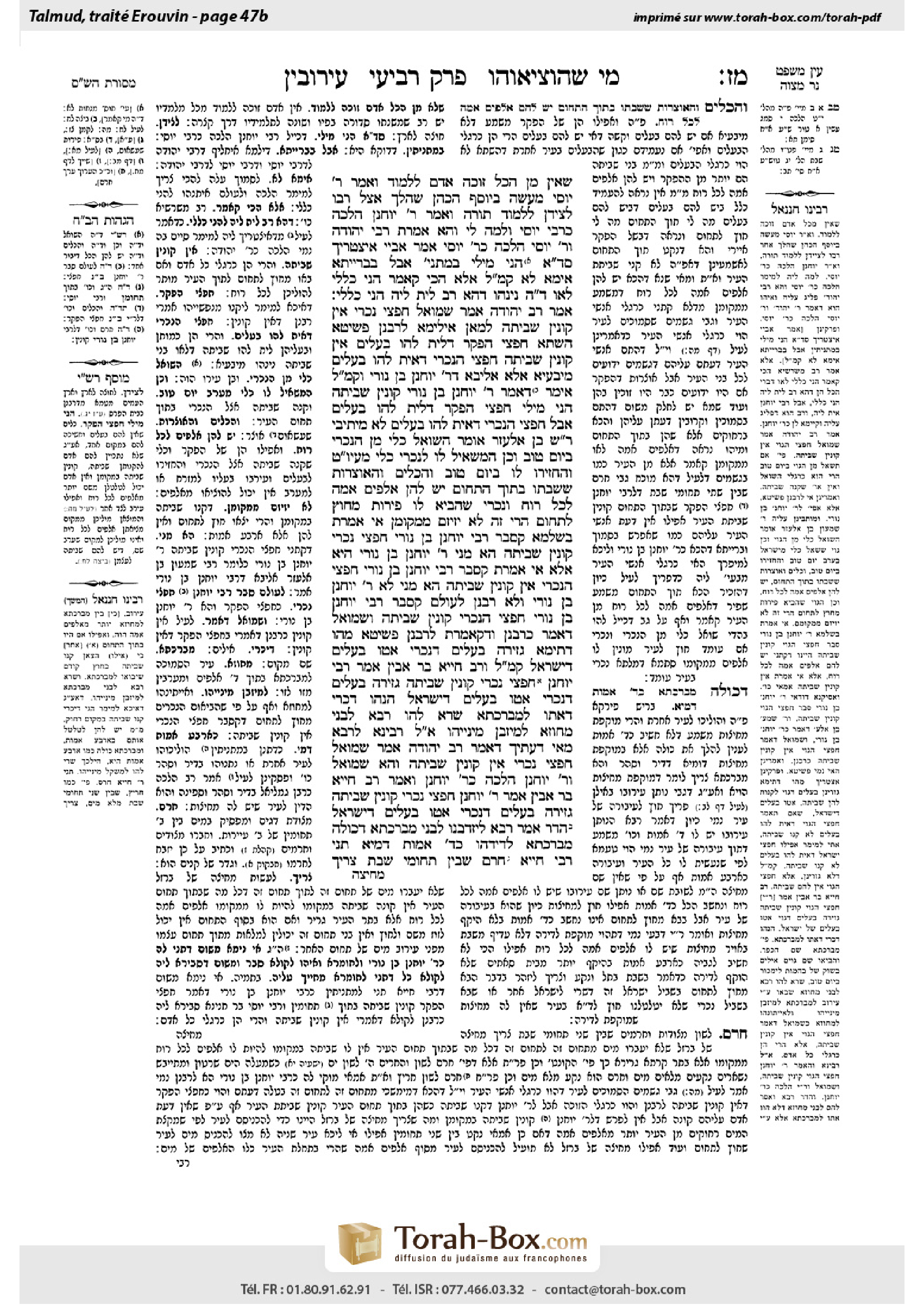
Eruvin 47b: Talmud study for Daf Yomi
Study the Talmud for Daf Yomi with scanned pages, Hebrew text, English translations from Sefaria and AI-generated French translations.
Passage selection and English or AI-generated French translation are available where the scan has annotations. Daf Study is independent of Torah-Box and Sefaria.
Browse Eruvin · עירובין · All tractatesEruvin 47b text and translations
This page of Eruvin includes the Aramaic text, an English translation and an AI-generated French translation, alongside the scan above.
עירובין מ״ז ב · Aramaic and Hebrew text
שֶׁאֵין מִן הַכֹּל זוֹכֶה אָדָם לִלְמוֹד. וְאָמַר רַבִּי יוֹסֵי: מַעֲשֶׂה בְּיוֹסֵף הַכֹּהֵן שֶׁהָלַךְ אֵצֶל רַבּוֹ לְצַיְדָּן לִלְמוֹד תּוֹרָה.
וְאָמַר רַבִּי יוֹחָנָן: הֲלָכָה כְּרַבִּי יוֹסֵי. וּלְמָה לִי? וְהָא אָמְרַתְּ רַבִּי יְהוּדָה וְרַבִּי יוֹסֵי — הֲלָכָה כְּרַבִּי יוֹסֵי!
אָמַר אַבָּיֵי: אִיצְטְרִיךְ, סָלְקָא דַּעְתָּךְ אָמֵינָא: הָנֵי מִילֵּי — בְּמַתְנִיתִין, אֲבָל בְּבָרַיְיתָא — אֵימָא לָא. קָא מַשְׁמַע לַן
אֶלָּא הָכִי קָאָמַר: הָנֵי כְּלָלֵי לָאו דִּבְרֵי הַכֹּל נִינְהוּ, דְּהָא רַב לֵית לֵיהּ הָנֵי כְּלָלֵי.
אָמַר רַב יְהוּדָה אָמַר שְׁמוּאֵל: חֶפְצֵי נָכְרִי אֵין קוֹנִין שְׁבִיתָה.
לְמַאן, אִילֵּימָא לְרַבָּנַן — פְּשִׁיטָא! הַשְׁתָּא חֶפְצֵי הֶפְקֵר דְּלֵית לְהוּ בְּעָלִים, אֵין קוֹנִין שְׁבִיתָה. חֶפְצֵי הַנׇּכְרִי, דְּאִית לְהוּ בְּעָלִים, מִיבַּעְיָא?
אֶלָּא אַלִּיבָּא דְּרַבִּי יוֹחָנָן בֶּן נוּרִי, וְקָא מַשְׁמַע לַן: אֵימַר דְּאָמַר רַבִּי יוֹחָנָן בֶּן נוּרִי קוֹנִין שְׁבִיתָה — הָנֵי מִילֵּי חֶפְצֵי הֶפְקֵר, דְּלֵית לְהוּ בְּעָלִים. אֲבָל חֶפְצֵי הַנׇּכְרִי, דְּאִית לְהוּ בְּעָלִים — לָא.
מֵיתִיבִי, רַבִּי שִׁמְעוֹן בֶּן אֶלְעָזָר אוֹמֵר: הַשּׁוֹאֵל כְּלִי מִן הַנׇּכְרִי בְּיוֹם טוֹב, וְכֵן הַמַּשְׁאִיל לוֹ לַנׇּכְרִי כְּלִי מֵעֶרֶב יוֹם טוֹב וְהֶחְזִירוֹ לוֹ בְּיוֹם טוֹב, וְהַכֵּלִים וְהָאוֹצָרוֹת שֶׁשָּׁבְתוּ בְּתוֹךְ הַתְּחוּם — יֵשׁ לָהֶן אַלְפַּיִם אַמָּה לְכׇל רוּחַ. וְנׇכְרִי שֶׁהֵבִיא לוֹ פֵּירוֹת מִחוּץ לַתְּחוּם — הֲרֵי זֶה לֹא יְזִיזֵם מִמְּקוֹמָן.
אִי אָמְרַתְּ בִּשְׁלָמָא קָסָבַר רַבִּי יוֹחָנָן בֶּן נוּרִי חֶפְצֵי נׇכְרִי קוֹנִין שְׁבִיתָה, הָא מַנִּי — רַבִּי יוֹחָנָן בֶּן נוּרִי הִיא.
אֶלָּא אִי אָמְרַתְּ קָסָבַר רַבִּי יוֹחָנָן בֶּן נוּרִי חֶפְצֵי הַנׇּכְרִי אֵין קוֹנִין שְׁבִיתָה, הָא מַנִּי — לָא רַבִּי יוֹחָנָן בֶּן נוּרִי וְלָא רַבָּנַן!
לְעוֹלָם קָסָבַר רַבִּי יוֹחָנָן בֶּן נוּרִי חֶפְצֵי הַנׇּכְרִי קוֹנִין שְׁבִיתָה, וּשְׁמוּאֵל דְּאָמַר כְּרַבָּנַן, וּדְקָאָמְרַתְּ: לְרַבָּנַן פְּשִׁיטָא — מַהוּ דְּתֵימָא: גְּזֵירָה בְּעָלִים דְּנׇכְרִי אַטּוּ בְּעָלִים דְּיִשְׂרָאֵל, קָא מַשְׁמַע לַן.
וְרַב חִיָּיא בַּר אָבִין אָמַר רַבִּי יוֹחָנָן: חֶפְצֵי נׇכְרִי קוֹנִין שְׁבִיתָה, גְּזֵירָה בְּעָלִים דְּנׇכְרִי אַטּוּ בְּעָלִים דְּיִשְׂרָאֵל.
הָנְהוּ דִּכְרֵי דַּאֲתוֹ לִמְבָרַכְתָּא, שְׁרָא לְהוּ רָבָא לִבְנֵי מָחוֹזָא לְמִיזְבַּן מִינַּיְיהוּ.
אֲמַר לֵיהּ רָבִינָא לְרָבָא: מַאי דַּעְתָּיךְ, דְּאָמַר רַב יְהוּדָה אָמַר שְׁמוּאֵל: חֶפְצֵי נׇכְרִי אֵין קוֹנִין שְׁבִיתָה.
וְהָא שְׁמוּאֵל וְרַבִּי יוֹחָנָן — הֲלָכָה כְּרַבִּי יוֹחָנָן, וְאָמַר רַב חִיָּיא בַּר אָבִין אָמַר רַבִּי יוֹחָנָן: חֶפְצֵי נׇכְרִי קוֹנִין שְׁבִיתָה, גְּזֵירָה בְּעָלִים דְּנׇכְרִי אַטּוּ בְּעָלִים דְּיִשְׂרָאֵל?!
הֲדַר אָמַר רָבָא: לִיזְדַּבְּנוּ לִבְנֵי מְבָרַכְתָּא, דְּכוּלַּהּ מְבָרַכְתָּא לְדִידְהוּ כְּאַרְבַּע אַמּוֹת דָּמְיָא.
תָּנֵי רַבִּי חִיָּיא: חֵרֶם שֶׁבֵּין תְּחוּמֵי שַׁבָּת — צָרִיךְ
Eruvin 47b · English translation
a person does not merit to learn from everyone, and it is possible that the only suitable teacher for him lives outside of Eretz Yisrael. And Rabbi Yosei reported in support of his position: It once happened that Yosef the priest went to his teacher in Tzeidan, outside Eretz Yisrael, to learn Torah, although the preeminent Sage of his generation, Rabban Yoḥanan ben Zakkai, lived in Eretz Yisrael.
And Rabbi Yoḥanan said about this: The halakha is in accordance with the opinion of Rabbi Yosei. The Gemara asks: Why was it necessary for Rabbi Yoḥanan to issue this ruling? Didn’t you say: In disputes between Rabbi Yehuda and Rabbi Yosei, the halakha is in accordance with the opinion of Rabbi Yosei, and so it should be obvious that this halakha is in accordance with his opinion? Apparently, this principle is not accepted.
Abaye said: It was nonetheless necessary to issue this ruling, it could have entered your mind to say that this principle applies only with regard to disputes in the Mishna. But with regard to disputes in a baraita, say no, the principle does not apply. Therefore, Rabbi Yoḥanan is teaching us that the halakha is in accordance with the opinion of Rabbi Yosei in this case as well.
Since no proof has been found to support Rav Mesharshiya’s statement that there are no principles for issuing halakhic rulings, the Gemara emends his statement. Rather, this is what Rav Mesharshiya is saying: These principles were not accepted by all authorities, as in fact Rav did not accept these principles, as demonstrated above.
The Gemara returns to addressing acquisition of residence. Rav Yehuda said that Shmuel said: Objects belonging to a gentile do not acquire residence and do not have a Shabbat limit, either on their own account or due to the ownership of the gentile. Accordingly, if they were brought into a town from outside its limits, a Jew may carry them two thousand cubits in each direction.
The Gemara asks: In accordance with whose opinion was this statement made? If you say that it was made in accordance with the opinion of the Rabbis, it is obvious. Now, if unclaimed objects, which do not have owners, do not acquire residence, is it necessary to say that a gentile’s objects, which have an owner, do not acquire residence?
Rather, this statement must have been made in accordance with the opinion of Rabbi Yoḥanan ben Nuri, and Shmuel is teaching us that when we say that Rabbi Yoḥanan ben Nuri said that objects acquire residence, this applies only to unclaimed objects, which have no owners; but it does not apply to objects belonging to a gentile, which have owners.
The Gemara raises an objection from a baraita. Rabbi Shimon ben Elazar says: With regard to a Jew who borrowed a utensil from a gentile on a Festival, and similarly with regard to a Jew who lent a utensil to a gentile on the eve of a Festival and the gentile returned it to him on the Festival, and likewise utensils or bins that acquired residence within the city’s Shabbat limit, in all these cases the utensils have, i.e., can be moved, two thousand cubits in each direction. But if a gentile brought the Jew produce from outside the Shabbat limit, the Jew may not move it from its place.
Granted if you say that Rabbi Yoḥanan ben Nuri holds that objects that belong to a gentile acquire residence, one can say that this baraita is in accordance with whose opinion? It is in accordance with the opinion of Rabbi Yoḥanan ben Nuri, that even a gentile’s objects acquire residence.
However, if you say that Rabbi Yoḥanan ben Nuri holds that objects belonging to a gentile do not acquire residence, in accordance with whose opinion is this baraita? It is neither in accordance with that of Rabbi Yoḥanan ben Nuri nor that of the Rabbis.
The Gemara answers: Actually, say that Rabbi Yoḥanan ben Nuri holds that a gentile’s objects acquire residence, and that Shmuel, who said that they do not acquire residence, spoke in accordance with the opinion of the Rabbis. And with regard to that which you said, that according to the opinion of the Rabbis, it is obvious that a gentile’s objects do not acquire residence, so this ruling need not have been stated at all. The Gemara answers: That is incorrect, as you might have said that the Sages should issue a decree in the case of gentile owners that his objects acquire residence in his location and that they may not be carried beyond two thousand cubits from that spot, lest people carry objects belonging to a Jewish owners beyond their two-thousand-cubit limit. Therefore, it is teaching us that no decree was issued.
Rav Ḥiyya bar Avin, however, said that Rabbi Yoḥanan said: Objects that belong to a gentile indeed acquire residence, due to the aforementioned decree issued in the case of gentile owners due to the case of Jewish owners.
The Gemara relates that certain rams were brought to the town of Mavrakhta on Shabbat. Rava permitted the residents of Meḥoza to purchase them and take them home, although Mavrakhta was outside the Shabbat limit of Meḥoza and could be reached by the residents of Meḥoza only by way of an eiruv of Shabbat limits.
Ravina said to Rava: What is your reasoning in permitting these rams? You must rely upon that which Rav Yehuda said that Shmuel said: Objects belonging to a gentile do not acquire residence, and so they are permitted even if they were brought to Meḥoza from outside the Shabbat limit.
Isn’t the principle, in disputes between Shmuel and Rabbi Yoḥanan, that the halakha is in accordance with the opinion of Rabbi Yoḥanan? And Rav Ḥiyya bar Avin already said that Rabbi Yoḥanan said: Objects that belong to a gentile acquire residence, based on a decree in the case of a gentile owner, due to the case of a Jewish owner. The halakha is in accordance with his opinion.
Rava reconsidered and said: Let the rams be sold only to the residents of Mavrakhta. Although the rams acquired residence, and may be moved only four cubits as they were taken beyond their Shabbat limit, the legal status of all Mavrakhta is like four cubits for them. However, they may not be sold to the residents of Meḥoza, as the halakha is in accordance with the opinion of Rabbi Yoḥanan.
Rabbi Ḥiyya taught a baraita: A water-filled ditch [ḥerem] that lies between two Shabbat limits requires
Eruvin 47b · Traduction française (IA)
Une personne ne mérite pas d'apprendre auprès de tout le monde, et il est possible que l'unique professeur adapté pour lui demeure en dehors de la Terre d'Israël. Rabbi Yosei rapporta en soutien de sa position : Il s'est une fois produit que Yosef le prêtre alla chez son maître à Tzeidan, en dehors de la Terre d'Israël, pour apprendre la Torah, même si le sage prééminent de son époque, Rabban Yoḥanan ben Zakkai, demeurait en Terre d'Israël.
Et Rabbi Yoḥanan dit à ce sujet : La halakha suit l'opinion de Rabbi Yosei. La Guemara demande : Pourquoi était-il nécessaire que Rabbi Yoḥanan énonce cette décision ? N'avez-vous pas dit : Dans les désaccords entre Rabbi Yehuda et Rabbi Yosei, la halakha suit l'opinion de Rabbi Yosei, et donc il devrait être évident que cette halakha suit son opinion ? Apparemment, ce principe n'est pas accepté.
Abaye dit : Il était toutefois nécessaire d'émettre cette décision, car il pourrait entrer en votre esprit de dire que ce principe s'applique uniquement aux désaccords dans la Michna. Mais concernant les désaccords dans une baraïta, dites non, ce principe ne s'applique pas. Ainsi, Rabbi Yoḥanan nous enseigne que la halakha suit l'opinion de Rabbi Yosei dans ce cas également.
Puisque aucun élément ne soutient la déclaration de Rav Mesharshiya selon laquelle il n'y a pas de principes pour émettre des décisions halakhiques, la Guemara corrige sa déclaration. En réalité, c'est ce que Rav Mesharshiya dit : Ces principes n'ont pas été acceptés par tous les autorités, car en effet Rav n'a pas accepté ces principes, comme démontré ci-dessus.
La Guemara revient à l'acquisition de résidence. Rav Yehuda dit que Shmuel dit : Les objets appartenant à un non-Juif ne peuvent pas acquérir une résidence et n'ont pas de limite de Shabbat, qu'ils soient en leur propre nom ou en raison de la propriété du non-Juif. Ainsi, si on les amène dans une ville depuis l'extérieur de ses limites, un Juif peut porter ces objets deux mille coudées dans chaque direction.
La Guemara demande : Selon l'opinion de qui a-t-elle été formulée cette déclaration ? Si vous dites qu'elle a été formulée selon l'opinion des Rabbins, c'est évident. Maintenant, si les objets non réclamés, qui n'ont pas de propriétaires, ne peuvent pas acquérir une résidence, est-il nécessaire de dire que les objets d'un non-Juif, qui ont un propriétaire, ne peuvent pas non plus acquérir une résidence ?
En réalité, cette déclaration a dû être formulée selon l'opinion de Rabbi Yoḥanan ben Nuri, et Shmuel nous enseigne que lorsqu'on dit que Rabbi Yoḥanan ben Nuri a affirmé que les objets acquièrent une résidence, cela s'applique uniquement aux objets non réclamés, qui n'ont pas de propriétaires ; mais cela ne s'applique pas aux objets appartenant à un non-Juif, qui ont des propriétaires.
La Guemara soulève un objet d'argumentation à partir d'une baraïta. Rabbi Shimon ben Elazar dit : Concernant un Juif qui a emprunté un ustensile à un non-Juif pendant un festival, et de même concernant un Juif qui a prêté un ustensile à un non-Juif la veille d'un festival et que ce dernier l'a rendu à lui pendant le festival, ainsi que les ustensiles ou les bacs qui ont acquis une résidence à l'intérieur de la limite de Shabbat de la ville, dans tous ces cas, les ustensiles peuvent être déplacés, c'est-à-dire peuvent être transportés, deux mille coudées dans chaque direction. Mais si un non-Juif a apporté des produits à un Juif depuis l'extérieur de la limite de Shabbat, le Juif ne peut pas déplacer ces produits de leur lieu.
Admettons que vous disiez que Rabbi Yoḥanan ben Nuri considère que les objets appartenant à un non-Juif acquièrent une résidence, on peut dire que cette baraïta s'inscrit selon l'opinion de Rabbi Yoḥanan ben Nuri, qui considère même les objets d'un non-Juif comme acquérant une résidence.
Cependant, si vous dites que Rabbi Yoḥanan ben Nuri considère que les objets appartenant à un non-Juif ne peuvent pas acquérir une résidence, selon l'opinion de qui cette baraïta s'inscrit ? Elle n'est ni selon celle de Rabbi Yoḥanan ben Nuri ni celle des Rabbins.
La Guemara répond : En réalité, dites que Rabbi Yoḥanan ben Nuri considère que les objets d'un non-Juif acquièrent une résidence, et que Shmuel, qui dit qu'ils ne l'acquièrent pas, s'exprime selon l'opinion des Rabbins. Et concernant ce que vous avez dit, que selon l'opinion des Rabbins, il est évident que les objets d'un non-Juif ne peuvent pas acquérir une résidence, donc cette décision n'aurait pas besoin d'être émise. La Guemara répond : Cela est incorrect, car vous pourriez avoir pensé que les Sages devaient émettre un décret dans le cas des propriétaires non-Juifs, selon lequel leurs objets acquièrent une résidence à leur lieu et qu'ils ne peuvent pas être transportés au-delà de deux mille coudées de ce point, de peur que les gens transportent des objets appartenant à des propriétaires juifs au-delà de leur limite de deux mille coudées. Ainsi, elle nous enseigne que aucun décret n'a été émis.
Rav Ḥiyya bar Avin, cependant, dit que Rabbi Yoḥanan dit : Les objets appartenant à un non-Juif acquièrent effectivement une résidence, en raison du décret mentionné ci-dessus concernant les propriétaires non-Juifs en raison du cas des propriétaires juifs.
La Guemara rapporte que certains béliers ont été amenés à la ville de Mavrakhta le sabbat. Rava permit aux habitants de Meḥoza d'acheter ces béliers et de les emporter chez eux, même si Mavrakhta était en dehors de la limite de sabbat de Meḥoza et pouvait être atteinte uniquement par les habitants de Meḥoza via un eiruv de limites de sabbat.
Ravina dit à Rava : Quel est votre raisonnement pour permettre ces béliers ? Vous devez vous appuyer sur ce que Rav Yehuda rapporte que Shmuel a dit : Les objets appartenant à un non-Juif ne peuvent pas acquérir une résidence, et ainsi ils sont permis même s'ils ont été amenés à Meḥoza depuis l'extérieur de la limite de sabbat.
Ne serait-ce pas le principe, dans les désaccords entre Shmuel et Rabbi Yoḥanan, que la halakha suit l'opinion de Rabbi Yoḥanan ? Et Rav Ḥiyya bar Avin a déjà dit que Rabbi Yoḥanan a dit : Les objets appartenant à un non-Juif acquièrent une résidence, en raison du décret concernant les propriétaires non-Juifs, en raison du cas des propriétaires juifs. La halakha suit son opinion.
Rava a réexaminé et a dit : Que les béliers soient vendus uniquement aux habitants de Mavrakhta. Bien que les béliers aient acquis un lieu de résidence et ne puissent être déplacés que de quatre coudées, car ils ont été emportés au-delà de leur limite de sabbat, le statut juridique de toute Mavrakhta est comme si c'était seulement quatre coudées pour eux. Cependant, ils ne peuvent pas être vendus aux habitants de Meḥoza, car la halakha suit l'opinion de Rabbi Yoḥanan.
Rabbi Ḥiyya enseigna une baraïta : Un canal rempli d'eau [ḥerem] qui se trouve entre deux limites de sabbat exige
Traduction française générée par IA à partir de l’édition anglaise de Sefaria. Vérifie toujours un passage avec le texte source.
Text from Sefaria: William Davidson Edition - Vocalized Aramaic (CC BY NC); William Davidson Edition - English (CC BY NC).