Eruvin 48a: Talmud study for Daf Yomi
Study the Talmud for Daf Yomi with scanned pages, Hebrew text, English translations from Sefaria and AI-generated French translations.
Passage selection and English or AI-generated French translation are available where the scan has annotations. Daf Study is independent of Torah-Box and Sefaria.
Browse Eruvin · עירובין · All tractatesEruvin 48a text and translations
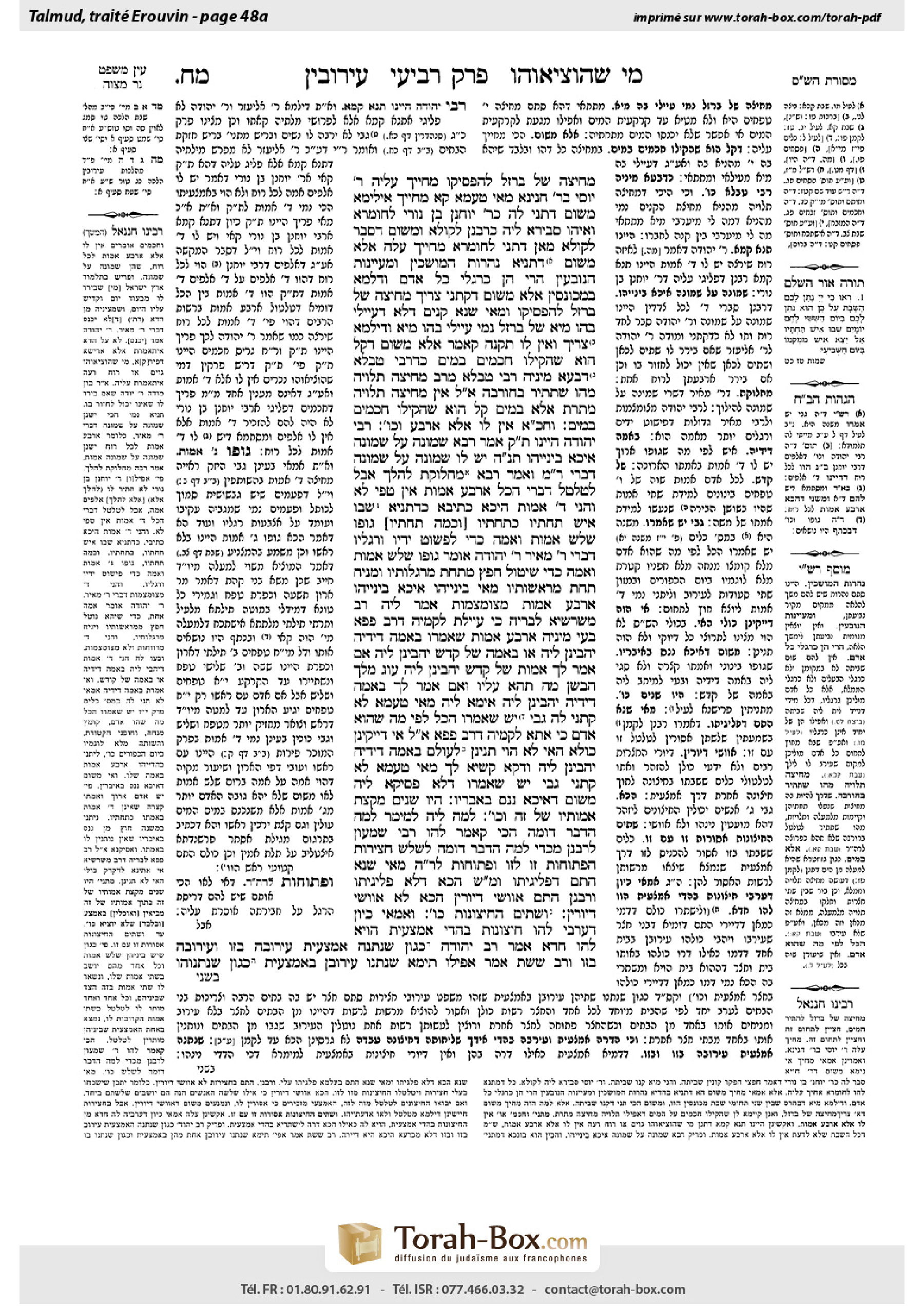
This page of Eruvin includes the Aramaic text, an English translation and an AI-generated French translation, alongside the scan above.
עירובין מ״ח א · Aramaic and Hebrew text
מְחִיצָה שֶׁל בַּרְזֶל לְהַפְסִיקוֹ. מְחַיֵּיךְ עֲלֵיהּ רַבִּי יוֹסֵי בְּרַבִּי חֲנִינָא.
מַאי טַעְמָא קָא מְחַיֵּיךְ? אִילֵּימָא מִשּׁוּם דְּתָנֵי לַהּ כְּרַבִּי יוֹחָנָן בֶּן נוּרִי לְחוּמְרָא, וְאִיהוּ סְבִירָא לֵיהּ כְּרַבָּנַן לְקוּלָּא. ומִשּׁוּם דְּסָבַר לְקוּלָּא, מַאן דְּתָנֵי לְחוּמְרָא מְחַיֵּיךְ עֲלֵהּ?
אֶלָּא, מִשּׁוּם דְּתַנְיָא: נְהָרוֹת הַמּוֹשְׁכִין וּמַעְיָינוֹת הַנּוֹבְעִין — הֲרֵי הֵן כְּרַגְלֵי כׇּל אָדָם.
וְדִילְמָא בִּמְכוּנָּסִין.
אֶלָּא, מִשּׁוּם דְּקָתָנֵי: ״צָרִיךְ מְחִיצָה שֶׁל בַּרְזֶל לְהַפְסִיקוֹ״. וּמַאי שְׁנָא קָנִים דְּלָא — דְּעָיְילִי בְּהוּ מַיָּא, שֶׁל בַּרְזֶל נָמֵי — עָיְילִי בְּהוּ מַיָּא.
וְדִילְמָא ״צָרִיךְ וְאֵין לוֹ תַּקָּנָה״ קָאָמַר.
מִשּׁוּם דְּקַל הוּא שֶׁהֵקֵילּוּ חֲכָמִים בְּמַיִם.
כִּדְרַבִּי טַבְלָא, דִּבְעָא מִינֵּיהּ רַבִּי טַבְלָא מֵרַב: מְחִיצָה תְּלוּיָה, מַהוּ שֶׁתַּתִּיר בְּחוּרְבָּה?
אֲמַר לֵיהּ: אֵין מְחִיצָה תְּלוּיָה מַתֶּרֶת אֶלָּא בְּמַיִם, קַל הוּא שֶׁהֵקֵילּוּ חֲכָמִים בְּמַיִם.
וַחֲכָמִים אוֹמְרִים אֵין לוֹ אֶלָּא אַרְבַּע וְכוּ׳. רַבִּי יְהוּדָה הַיְינוּ תַּנָּא קַמָּא!
אָמַר רָבָא: שְׁמוֹנֶה עַל שְׁמוֹנֶה אִיכָּא בֵּינַיְיהוּ. תַּנְיָא נָמֵי הָכִי: יֵשׁ לוֹ שְׁמוֹנֶה עַל שְׁמוֹנֶה, דִּבְרֵי רַבִּי מֵאִיר.
וְאָמַר רָבָא: מַחֲלוֹקֶת לְהַלֵּךְ, אֲבָל לְטַלְטֵל דִּבְרֵי הַכֹּל: אַרְבַּע אַמּוֹת — אִין, טְפֵי — לָא.
וְהָנֵי אַרְבַּע אַמּוֹת הֵיכָא כְּתִיבָא?
כִּדְתַנְיָא: ״שְׁבוּ אִישׁ תַּחְתָּיו״ — כְּתַחְתָּיו. [וְכַמָּה תַּחְתָּיו] גּוּפוֹ שָׁלֹשׁ אַמּוֹת, וְאַמָּה כְּדֵי לִפְשׁוֹט יָדָיו וְרַגְלָיו — דִּבְרֵי רַבִּי מֵאִיר. רַבִּי יְהוּדָה אוֹמֵר: גּוּפוֹ שָׁלֹשׁ אַמּוֹת, וְאַמָּה כְּדֵי שֶׁיִּטּוֹל חֵפֶץ מִתַּחַת מַרְגְּלוֹתָיו וּמַנִּיחַ תַּחַת מְרַאֲשׁוֹתָיו.
מַאי בֵּינַיְיהוּ, אִיכָּא בֵּינַיְיהוּ: אַרְבַּע אַמּוֹת מְצוּמְצָמוֹת.
אֲמַר לֵיהּ רַב מְשַׁרְשְׁיָא לִבְרֵיהּ: כִּי עָיְילַתְּ לְקַמֵּיהּ דְּרַב פָּפָּא, בְּעִי מִינֵּיהּ: אַרְבַּע אַמּוֹת שֶׁאָמְרוּ, בְּאַמָּה דִּידֵיהּ יָהֲבִינַן לֵיהּ, אוֹ בְּאַמָּה שֶׁל קֹדֶשׁ יָהֲבִינַן לֵיהּ?
אִם אָמַר לָךְ: אַמּוֹת שֶׁל קֹדֶשׁ יָהֲבִינַן לֵיהּ — עוֹג מֶלֶךְ הַבָּשָׁן מַה תְּהֵא עָלָיו? וְאִם אָמַר לָךְ בְּאַמָּה דִּידֵיהּ יָהֲבִינַן לֵיהּ, אֵימָא לֵיהּ: מַאי טַעְמָא לָא קָתָנֵי לַהּ גַּבֵּי ״יֵשׁ שֶׁאָמְרוּ הַכֹּל לְפִי מַה שֶּׁהוּא אָדָם״?
כִּי אֲתָא לְקַמֵּיהּ דְּרַב פָּפָּא, אֲמַר לֵיהּ: אִי דָּיְיקִינַן כּוּלֵּא הַאי, לָא הֲוֵי תָּנֵינַן.
לְעוֹלָם בְּאַמָּה דִּידֵיהּ יָהֲבִינַן לֵיהּ. וּדְקָא קַשְׁיָא לָךְ: מַאי טַעְמָא לָא קָתָנֵי גַּבֵּי ״יֵשׁ שֶׁאָמְרוּ״? — דְּלָא פְּסִיקָא לֵיהּ, מִשּׁוּם דְּאִיכָּא נַנָּס בְּאֵבָרָיו.
הָיוּ שְׁנַיִם מִקְצָת אַמּוֹתָיו שֶׁל זֶה וְכוּ׳. לְמָה לֵיהּ לְמֵימַר ״לְמָה הַדָּבָר דּוֹמֶה״?
הָכִי קָאֲמַר לְהוּ רַבִּי שִׁמְעוֹן לְרַבָּנַן: מִכְּדִי לְמָה הַדָּבָר דּוֹמֶה, לְשָׁלֹשׁ חֲצֵירוֹת הַפְּתוּחוֹת זוֹ לָזוֹ, וּפְתוּחוֹת לִרְשׁוּת הָרַבִּים, מַאי שְׁנָא הָתָם דִּפְלִיגִיתוּ, וּמַאי שְׁנָא הָכָא דְּלָא פְּלִיגִיתוּ?
וְרַבָּנַן: הָתָם אָוְושִׁי דָּיוֹרִין. הָכָא לָא אָוְושִׁי דָּיוֹרִין.
וּשְׁתַּיִם הַחִיצוֹנוֹת כּוּ׳. וְאַמַּאי? כֵּיוָן דְּעָרְבִי לְהוּ חִיצוֹנוֹת בַּהֲדֵי אֶמְצָעִית, הָוְיָא לְהוּ חֲדָא!
אָמַר רַב יְהוּדָה: כְּגוֹן שֶׁנָּתְנָה אֶמְצָעִית עֵירוּבָהּ בָּזוֹ וְעֵירוּבָהּ בָּזוֹ.
וְרַב שֵׁשֶׁת אָמַר: אֲפִילּוּ תֵּימָא שֶׁנָּתְנוּ עֵירוּבָן בָּאֶמְצָעִית, כְּגוֹן שֶׁנְּתָנוּהוּ
Eruvin 48a · English translation
an iron partition to divide it into two separate areas, so that the residents of both places may draw water from it. Rabbi Yosei, son of Rabbi Ḥanina, would laugh at this teaching, as he deemed it unnecessary.
The Gemara asks: Why did Rabbi Yosei, son of Rabbi Ḥanina, laugh? If you say that it is because Rabbi Ḥiyya taught the baraita stringently, in accordance with the opinion of Rabbi Yoḥanan ben Nuri, saying that ownerless objects acquire a place of residence, and Rabbi Yosei, son of Rabbi Ḥanina holds leniently, in accordance with the opinion of the Rabbis and says that those objects do not acquire residence, this is difficult. Just because he holds leniently, does he laugh at one who teaches stringently?
Rather, he must have laughed for a different reason, as it was taught in a baraita: Flowing rivers and streaming springs are like the feet of all people, as the water did not acquire residence in any particular spot. Consequently, one who draws water from rivers and springs may carry it wherever he is permitted to walk, even if it had previously been located outside his Shabbat limit. According to Rabbi Yosei, son of Rabbi Ḥanina, the same halakha should apply to the water in the ditch.
The Gemara rejects this argument: No proof can be brought from this ruling concerning rivers and springs, as perhaps we are dealing here with a ditch of still, collected water that belongs exclusively to the residents of that particular place.
Rather, Rabbi Yosei, son of Rabbi Ḥanina, must have laughed for a different reason, because Rabbi Ḥiyya taught in his baraita that the ditch requires an iron partition to divide it into two separate sections. Rabbi Yosei, son of Rabbi Ḥanina, argued: Why is a partition of reeds different, that we should say it is not effective in that case? Apparently, it is because water enters it and passes from one limit to the other. But this is difficult, as even in the case of a partition of iron, water enters it and passes from one limit to another, as it cannot be hermetically sealed. If so, what does the iron accomplish that the reeds do not accomplish?
The Gemara raises a difficulty: Perhaps the baraita is saying as follows: A water-filled ditch that lies between two Shabbat limits requires an iron partition to divide it into two separate sections. But there is no remedy, because it is impossible to hermetically seal a partition of that kind, and therefore its water may not be used.
Rather, you must say that Rabbi Yosei, son of Rabbi Ḥanina, laughed at Rabbi Ḥiyya’s teaching for a different reason, because the Sages were lenient with regard to water. The Rabbis said that a minimal partition suffices in the case of water. Consequently, there should be no need for an iron partition.
This is similar to the case involving Rabbi Tavla, as Rabbi Tavla asked of Rav: Does a suspended partition, i.e., a partition that is suspended and does not reach the ground, permit carrying in a ruin? Do we say that the remnants of the walls that are suspended in the air are considered as though they descend to the ground and close off the area, so that it is regarded as a private domain?
Rav said to him: A suspended partition of this kind permits carrying only in the case of water, as the Sages were lenient with regard to water. Just as the Sages were lenient about water with respect to a suspended partition, so too they should be lenient here and not require an iron partition; rather, a minimal partition should suffice, even one made of reeds.
The mishna taught: And the Rabbis say that if a person is sleeping at the onset of Shabbat and has no intention of acquiring residence in his location, he has only four cubits, whereas Rabbi Yehuda says he can walk four cubits in any direction he chooses. The Gemara asks: What is the dispute? The opinion of Rabbi Yehuda is the same as that of the first tanna, i.e., the Rabbis.
Rava said: There is a practical difference between them, as the Rabbis permit him to carry in an area of eight by eight cubits. Rabbi Yehuda maintains that he has only four cubits, in the direction of his choosing, whereas according to the Rabbis he has four cubits in every direction, which totals an area of eight by eight cubits. That was also taught explicitly in a baraita: He has eight by eight cubits; this is the statement of Rabbi Meir, which is the opinion of the Rabbis of the mishna.
And Rava further stated: This dispute between Rabbi Meir and Rabbi Yehuda relates only to walking, but as for carrying objects, all agree that to carry them four cubits is indeed permitted; but to carry them more than that is not.
The Gemara inquires about the basis of this law: These four cubits within which a person is always permitted to walk on Shabbat, where are they written in the Torah?
The Gemara answers: As it was taught in a baraita: The verse “Remain every man in his place; let no man go out of his place on the seventh day” (Exodus 16:29), means one must restrict his movement to an area equal to his place. And how much is the area of his place? A person’s body typically measures three cubits, and an additional cubit is needed in order to allow him to spread out his hands and feet, this is the statement of Rabbi Meir. Rabbi Yehuda says: A person’s body measures three cubits, and an additional cubit is needed in order to allow him to pick up an object from under his feet and place it under his head, meaning, to give him room to maneuver.
The Gemara asks: What is the practical difference between them? The Gemara answers: There is a practical difference between them in that Rabbi Yehuda provides him with exactly four cubits but no more; whereas Rabbi Meir maintains that we do not restrict him in this manner, but rather he is provided with expansive cubits, i.e., enough room to spread out his hands and feet, which measures slightly more than four cubits.
Rav Mesharshiya said to his son: When you come before Rav Pappa, inquire of him as follows: The four cubits [ammot] mentioned here, do we grant them to each person measured according to his own forearm [amma], i.e., the distance from his elbow to the tip of his index finger, or do we grant them measured according to the cubit [amma] used for consecrated property, i.e., a standard cubit of six medium handbreadths for everyone?
If he said to you that we provide him four cubits measured according to the standard cubit used for consecrated property, what will be with regard to Og, king of the Bashan, who is much larger than this? And if he said to you that we provide him four cubits measured according to his own forearm, say to him: Why was this halakha not taught together with the other matters whose measures are determined by the specific measure of the person involved, in the mishna that teaches: These are matters with regard to which they stated measures all in accordance with the specific measure of the person involved. This means that the measures are not fixed, but rather change in accordance with the person in question. If the four cubits are measured according to each person’s forearm, this law should have been included in the mishna.
When Rav Mesharshiya’s son came before Rav Pappa, the latter said to him: Were we to be so precise, we would not be able to learn anything at all, as we would be too busy answering such questions.
In fact, we grant him four cubits measured according to his own forearm. And as for that which was difficult for you, why was this law not taught in the mishna that teaches: These are matters with regard to which they stated measures all in accordance with the specific measure of the person involved? It is because this law is not absolutely clear-cut. It occasionally must be adjusted, since there may be a person whose limbs are small in relation to his body. With regard to such a person, we do not measure four cubits according to the size of his own forearm, but rather by the standard cubits used for consecrated property.
The mishna taught: If there were two people positioned in a way that part of the four cubits of the one were subsumed within the four cubits of the other, they each may bring food and eat together in the shared area in the middle. Rabbi Shimon likened this case to that of three courtyards that open one into another, where the two outer courtyards established an eiruv with the middle one. The Gemara asks: Why does Rabbi Shimon need to offer an analogy and say: To what may this be likened, and thus connect our case to a different issue?
The Gemara explains: This is what Rabbi Shimon said to the Rabbis: After all, to what is this similar? To three courtyards that open into one another, and that also open into a public domain. What is different there that you disagree with me and say that it is prohibited to carry from any one courtyard to any other, and what is different here that you do not disagree with me?
And how do the Rabbis reply? There the residents of the courtyards are numerous, and some might come to carry objects in a place where it is prohibited to do so; whereas here the residents are not numerous, and a mere three people can warn each other against Shabbat desecration.
The mishna taught: If the residents of the two outer courtyards established an eiruv with the middle one, it is permitted to carry from the middle one to the two outer ones, and it is permitted to carry from the two outer ones to the middle one. And it is prohibited to carry from one of the two outer courtyards to the other, as they did not establish a joint eiruv. The Gemara asks: Why is it prohibited? Since the residents of the outer courtyards established an eiruv with the middle one, they are as one, and consequently, they should all be permitted with one another.
Rav Yehuda said: The mishna is referring to a case where the two outer courtyards did not place their eiruv in the middle courtyard; rather, to a case where the residents of the middle courtyard placed its first eiruv in this courtyard and its second eiruv in that courtyard, so that the eiruv of each of the other courtyards is not in the middle courtyard.
And Rav Sheshet said: Even if you say that the residents of each of the outer courtyards placed their eiruv in the middle courtyard, they are still not considered a single courtyard, as we are dealing with a case where they placed each eiruv
Eruvin 48a · Traduction française (IA)
une cloison en fer pour le diviser en deux zones distinctes, de sorte que les habitants des deux lieux puissent puiser de l'eau à partir d'elle. Rabbi Yosei, fils de Rabbi Ḥanina, riait de cette enseignement, car il estimait qu'il était inutile.
Le Guemara demande : Pourquoi Rabbi Yosei, fils de Rabbi Ḥanina, riait-il ? Si l'on dit que c'est parce que Rabbi Ḥiyya a enseigné la baraïta de manière stricte, conformément à l'opinion de Rabbi Yoḥanan ben Nuri, affirmant que les objets abandonnés acquièrent un lieu de résidence, et que Rabbi Yosei, fils de Rabbi Ḥanina, est leniant, conformément à l'opinion des Rabbins et affirme que ces objets n'acquièrent pas de résidence, cela est difficile. Juste parce qu'il est leniant, ria-t-il d'une personne qui enseigne de manière stricte ?
Plutôt, il doit avoir ri pour une autre raison, car il a été enseigné dans une baraïta : Les rivières et les sources en cours d'écoulement sont comme les pieds de tous les gens, car l'eau n'acquiert pas de résidence dans un endroit particulier. Ainsi, celui qui puiser de l'eau à partir de rivières et de sources peut la transporter partout où il est autorisé à marcher, même si elle était auparavant située en dehors de son limites de Shabbat. Selon Rabbi Yosei, fils de Rabbi Ḥanina, la même halakha devrait s'appliquer à l'eau du canal.
Le Guemara rejette cet argument : On ne peut pas établir de preuve à partir de cette décision concernant les rivières et les sources, car peut-être nous sommes ici en présence d'un bassin d'eau calme, exclusivement appartenant aux habitants de ce lieu particulier.
Plutôt, Rabbi Yosei, fils de Rabbi Ḥanina, doit avoir ri pour une autre raison, car Rabbi Ḥiyya a enseigné dans sa baraïta que le bassin nécessite une cloison en fer pour le diviser en deux sections distinctes. Rabbi Yosei, fils de Rabbi Ḥanina, conteste : Pourquoi la cloison en roseaux est-elle différente, que nous devrions dire qu'elle n'est pas efficace dans ce cas ? Apparemment, c'est parce que l'eau entre dans le bassin et passe d'une limite à l'autre. Mais cela est difficile, car même dans le cas d'une cloison en fer, l'eau entre dans le bassin et passe d'une limite à l'autre, car elle ne peut pas être hermétiquement scellée. Si c'est ainsi, qu'est-ce que le fer accompli que les roseaux ne accomplissent pas ?
Le Guemara soulève une difficulté : Peut-être la baraïta dit cela : Un bassin d'eau entre deux limites de Shabbat nécessite une cloison en fer pour le diviser en deux sections distinctes. Mais il n'y a pas de solution, car il est impossible de sceller hermétiquement une telle cloison, et donc l'eau ne peut pas être utilisée.
Plutôt, vous devez dire que Rabbi Yosei, fils de Rabbi Ḥanina, a ri de l'enseignement de Rabbi Ḥiyya pour une autre raison, car les Sages étaient lenients concernant l'eau. Les Rabbins dirent qu'une cloison minimale suffit dans le cas de l'eau. Ainsi, il ne devrait pas y avoir besoin d'une cloison en fer.
Cela ressemble au cas de Rabbi Tavla, car Rabbi Tavla demanda à Rav : Une cloison suspendue, c'est-à-dire une cloison qui est suspendue et ne touche pas le sol, permet-elle de transporter dans un lieu en ruine ? Disons-nous que les restes des murs qui sont suspendus dans l'air sont considérés comme s'ils descendaient jusqu'au sol et fermaient la zone, de sorte qu'il est considéré comme un domaine privé ?
Rav répondit à lui : Une cloison suspendue de ce genre permet le transport uniquement dans le cas de l'eau, car les Sages étaient lenients concernant l'eau. Aussi bien que les Sages étaient lenients à l'égard de l'eau concernant une cloison suspendue, ainsi devraient-ils être lenients ici et ne pas exiger une cloison en fer ; plutôt, une cloison minimale devrait suffire, même celle en roseaux.
La Michna enseigna : Et les Rabbins disent que si une personne dort au début du Shabbat et n'a pas l'intention d'acquérir une résidence dans son lieu, elle n'a qu'un rayon de quatre cubits, tandis que Rabbi Yehuda dit qu'elle peut marcher quatre cubits dans toute la direction qu'elle choisit. Le Guemara demande : Quelle est la dispute ? L'opinion de Rabbi Yehuda est la même que celle du premier tanna, c'est-à-dire des Rabbins.
Rava dit : Il y a une différence pratique entre eux, car les Rabbins permettent de porter des objets dans une zone de huit par huit cubits. Rabbi Yehuda maintient qu'elle n'a qu'un rayon de quatre cubits, dans la direction qu'elle choisit, tandis que selon les Rabbins elle a quatre cubits dans toutes les directions, ce qui totalise une zone de huit par huit cubits. Cela a également été enseigné explicitement dans une baraïta : Il a huit par huit cubits ; c'est l'opinion de Rabbi Meir, qui est l'opinion des Rabbins de la Michna.
Et Rava ajouta : Cette dispute entre Rabbi Meir et Rabbi Yehuda concerne uniquement la marche, mais concernant le transport d'objets, tous s'accordent sur le fait que transporter quatre cubits est permis ; mais transporter plus que cela n'est pas permis.
Le Guemara interroge sur la base de cette loi : Ces quatre cubits dans lesquels une personne est toujours autorisée à marcher le Shabbat, où sont-ils écrits dans la Torah ?
Le Guemara répond : Comme il a été enseigné dans une baraïta : La verset « Restez chacun dans votre lieu ; personne ne doit sortir de son lieu le septième jour » (Exode 16:29), signifie qu'on doit restreindre son mouvement à une zone égale à son lieu. Et combien mesure la zone de son lieu ? La taille du corps d'une personne est généralement de trois cubits, et un cubit supplémentaire est nécessaire pour permettre à une personne de s'étendre les mains et les pieds, selon Rabbi Meir. Rabbi Yehuda dit : La taille du corps d'une personne est de trois cubits, et un cubit supplémentaire est nécessaire pour permettre à une personne de ramasser un objet sous ses pieds et de le placer sous sa tête, c'est-à-dire, lui donner de la place pour se déplacer.
Le Guemara demande : Quelle est la différence pratique entre eux ? Le Guemara répond : Il y a une différence pratique entre eux dans le sens où Rabbi Yehuda lui donne exactement quatre cubits mais pas plus ; tandis que Rabbi Meir maintient que nous ne le restreignons pas ainsi, mais plutôt qu'il est fourni avec des cubits étendus, c'est-à-dire assez de place pour s'étendre les mains et les pieds, ce qui mesure légèrement plus de quatre cubits.
Rav Mesharshiya dit à son fils : Lorsque tu viens devant Rav Pappa, interroge-le ainsi : Les quatre coudées mentionnées ici, les donnons-nous à chaque personne selon sa propre coudée, c'est-à-dire la distance de son coude à l'extrémité de son doigt index, ou les donnons-nous selon la coudée utilisée pour les biens consacrés, c'est-à-dire une coudée standard de six mains moyennes pour tout le monde ?
Si il t'a dit que nous donnons quatre coudées selon la coudée standard utilisée pour les biens consacrés, que deviendra-t-il concernant Og, roi de la Bashan, qui est bien plus grand que cela ? Et si il t'a dit que nous donnons quatre coudées selon sa propre coudée, dis-lui : Pourquoi cette halakha n'a-t-elle pas été enseignée ensemble avec les autres matières dont les mesures sont déterminées par la mesure spécifique de la personne concernée, dans la mitsva qui enseigne : Ces sont des matières concernant lesquelles ils ont dit les mesures toutes selon la mesure spécifique de la personne concernée. Cela signifie que les mesures ne sont pas fixes, mais varient selon la personne en question. Si les quatre coudées sont mesurées selon la coudée de chaque personne, cette loi aurait dû être incluse dans la mitsva.
Lorsque le fils de Rav Mesharshiya est venu devant Rav Pappa, le dernier a dit à lui : Si nous étions aussi précis, nous ne pourrions apprendre rien du tout, car nous serions trop occupés à répondre à de telles questions.
En réalité, nous lui donnons quatre coudées mesurées selon la coudée de son propre bras. Et concernant ce qui vous semblait difficile, pourquoi cette loi n'a-t-elle pas été enseignée dans la mitsva qui enseigne : Ces sont des matières concernant lesquelles ils ont dit les mesures toutes selon la mesure spécifique de la personne concernée ? C'est parce que cette loi n'est pas absolument claire. Elle doit parfois être ajustée, car il peut y avoir une personne dont les membres sont petits par rapport à son corps. Concernant une telle personne, nous ne mesurons pas quatre coudées selon la taille de sa propre coudée, mais plutôt selon les coudées standards utilisées pour les biens consacrés.
La mitsva enseignait : Si deux personnes étaient placées de telle sorte que partie des quatre coudées de l'une étaient incluses dans les quatre coudées de l'autre, chacun pouvait apporter de la nourriture et manger ensemble dans la zone partagée au milieu. Rabbi Shimon a comparé ce cas à celui de trois courtyards qui s'ouvrent les uns les autres, où les deux courtyards externes ont établi un eiruv avec le milieu. La Guemara demande : Pourquoi Rabbi Shimon a-t-il besoin de proposer une comparaison et de dire : À quoi cela peut-il être comparé, et ainsi relier notre cas à une autre question ?
La Guemara explique : C'est ce que Rabbi Shimon a dit aux Rabbins : Après tout, à quoi cela ressemble-t-il ? À trois courtyards qui s'ouvrent les uns les autres et qui s'ouvrent également vers un domaine public. Qu'est-ce qui est différent là-bas que vous contestez mon opinion et dites qu'il est interdit de porter de l'un à l'autre, et qu'est-ce qui est différent ici que vous ne contestez pas mon opinion ?
Et comment les Rabbins répondent-ils ? Là-bas, les habitants des courtyards sont nombreux, et certains pourraient venir porter des objets dans un lieu où il est interdit de le faire ; tandis que ici, les habitants ne sont pas nombreux, et trois personnes seulement peuvent avertir les uns les autres contre la transgression du Shabbat.
La mitsva enseignait : Si les habitants des deux courtyards externes ont établi un eiruv avec le milieu, il est permis de porter de celui-ci vers les deux externes, et il est permis de porter des deux externes vers le milieu. Il est interdit de porter d'un des deux externes vers l'autre, car ils n'ont pas établi un eiruv commun. La Guemara demande : Pourquoi est-ce interdit ? Puisque les habitants des courtyards externes ont établi un eiruv avec le milieu, ils sont comme un seul, et par conséquent, ils devraient tous être permis les uns envers les autres.
Rav Yehuda dit : La mitsva fait référence à un cas où les deux courtyards externes n'ont pas placé leur eiruv dans le courtyard milieu ; plutôt, à un cas où les habitants du courtyard milieu ont placé leur premier eiruv dans ce courtyard et leur deuxième eiruv dans celui-ci, de sorte que l'eiruv de chaque autre courtyard n'est pas dans le courtyard milieu.
Et Rav Sheshet dit : Même si vous dites que les habitants de chaque cour intérieure ont placé leur eiruv dans le cour central, ils ne sont toujours pas considérés comme un seul cour, car nous sommes dans un cas où ils ont placé chaque eiruv
Traduction française générée par IA à partir de l’édition anglaise de Sefaria. Vérifie toujours un passage avec le texte source.
Text from Sefaria: William Davidson Edition - Vocalized Aramaic (CC BY NC); William Davidson Edition - English (CC BY NC).