Eruvin 48b: Talmud study for Daf Yomi
Study the Talmud for Daf Yomi with scanned pages, Hebrew text, English translations from Sefaria and AI-generated French translations.
Passage selection and English or AI-generated French translation are available where the scan has annotations. Daf Study is independent of Torah-Box and Sefaria.
Browse Eruvin · עירובין · All tractatesEruvin 48b text and translations
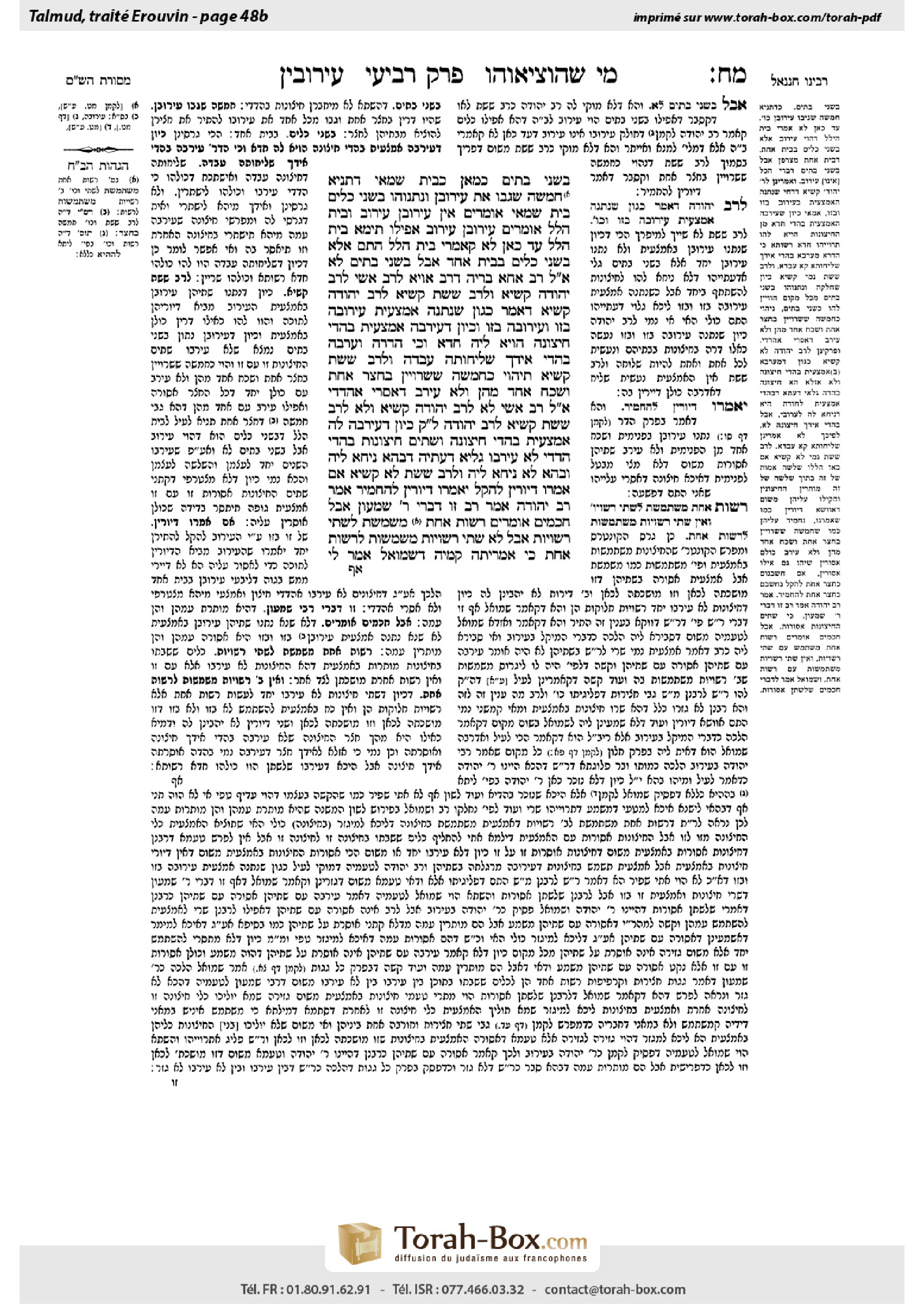
This page of Eruvin includes the Aramaic text, an English translation and an AI-generated French translation, alongside the scan above.
עירובין מ״ח ב · Aramaic and Hebrew text
בִּשְׁנֵי בָתִּים.
כְּמַאן? כְּבֵית שַׁמַּאי, דְּתַנְיָא: חֲמִשָּׁה שֶׁגָּבוּ אֶת עֵירוּבָן וּנְתָנוּהוּ בִּשְׁנֵי כֵלִים, בֵּית שַׁמַּאי אוֹמְרִים: אֵין עֵירוּבָן עֵירוּב. וּבֵית הִלֵּל אוֹמְרִים: עֵירוּבָן עֵירוּב.
אֲפִילּוּ תֵּימָא בֵּית הִלֵּל, עַד כָּאן לָא קָאָמְרִי בֵּית הִלֵּל הָתָם — אֶלָּא בִּשְׁנֵי כֵלִים בְּבַיִת אֶחָד, אֲבָל בִּשְׁנֵי בָתִּים, לָא.
אֲמַר לֵיהּ רַב אַחָא בְּרֵיהּ דְּרַב אַוְיָא לְרַב אָשֵׁי: לְרַב יְהוּדָה קַשְׁיָא וּלְרַב שֵׁשֶׁת קַשְׁיָא. לְרַב יְהוּדָה קַשְׁיָא דְּאָמַר: כְּגוֹן שֶׁנָּתְנָה אֶמְצָעִית עֵירוּבָהּ בָּזוֹ וְעֵירוּבָהּ בָּזוֹ, וְכֵיוָן דְּעֵירְבָה אֶמְצָעִית בַּהֲדֵי חִיצוֹנָה הָוְיָא לֵיהּ חֲדָא, וְכִי הָדְרָה וְעָרְבָה בַּהֲדֵי אִידַּךְ — שְׁלִיחוּתָהּ עָבְדָה.
וּלְרַב שֵׁשֶׁת קַשְׁיָא: תֶּיהְוֵי כַּחֲמִשָּׁה שֶׁשְּׁרוּיִין בְּחָצֵר אַחַת, וְשָׁכַח אֶחָד מֵהֶן וְלֹא עֵירַב — דְּאָסְרִי אַהֲדָדֵי!
אֲמַר לֵיהּ רַב אָשֵׁי: לָא לְרַב יְהוּדָה קַשְׁיָא וְלָא לְרַב שֵׁשֶׁת קַשְׁיָא. לְרַב יְהוּדָה לָא קַשְׁיָא: כֵּיוָן דְּעֵירְבָה לַהּ אֶמְצָעִית בַּהֲדֵי חִיצוֹנָה, וּשְׁתַּיִם חִיצוֹנוֹת בַּהֲדֵי הֲדָדֵי לָא עֵירְבוּ — גַּלְּיָא דַּעְתֵּיהּ דִּבְהָא נִיחָא לֵיהּ, וּבְהָא לָא נִיחָא לֵיהּ.
וּלְרַב שֵׁשֶׁת לָא קַשְׁיָא: אִם אָמְרוּ דָּיוֹרִין לְהָקֵל, יֹאמְרוּ דָּיוֹרִין לְהַחְמִיר?!
אָמַר רַב יְהוּדָה אָמַר רַב: זוֹ דִּבְרֵי רַבִּי שִׁמְעוֹן. אֲבָל חֲכָמִים אוֹמְרִים: רְשׁוּת אַחַת מְשַׁמֶּשֶׁת לִשְׁתֵּי רְשׁוּיוֹת. אֲבָל לָא שְׁתֵּי רְשׁוּיוֹת מְשַׁמְּשׁוֹת לִרְשׁוּת אַחַת.
כִּי אַמְרִיתַהּ קַמֵּיהּ דִּשְׁמוּאֵל, אֲמַר לִי:
Eruvin 48b · English translation
in two separate houses, and consequently the two outer courtyards do not join together and become as one.
The Gemara asks: In accordance with whose opinion did Rav Sheshet state that an eiruv placed in two houses, even within the same courtyard, does not join the houses together? He must have said this in accordance with the opinion of Beit Shammai, as it was taught in a baraita: With regard to five people who collected their eiruv and placed it in two separate utensils, even in a single house, Beit Shammai say: Their eiruv is not a valid eiruv, as the two parts of the eiruv have not been deposited in the same place, and Beit Hillel say: Their eiruv is a valid eiruv as long as the entire eiruv was deposited in a single domain.
The Gemara rejects this argument: Even if you say that this is in accordance with the opinion of Beit Hillel, Beit Hillel may have stated their opinion only there, with regard to two utensils that are located in one house and consequently, they join together. However, if the two utensils are located in two separate houses, even Beit Hillel agree that the eiruv is not valid.
Rav Aḥa, son of Rav Avya, said to Rav Ashi: The explanation of Rav Yehuda is difficult and the explanation of Rav Sheshet is difficult. The explanation of Rav Yehuda is difficult, as he said that it is speaking about a case where the middle courtyard put its first eiruv in the one courtyard and its second eiruv in the other courtyard. However, once the middle courtyard establishes an eiruv with one of the outer ones, they are regarded as one, so that when it later establishes an eiruv with the other outer courtyard, it acts also on behalf of the first outer courtyard, as both of them are treated like a single courtyard.
And the explanation of Rav Sheshet is difficult. Since the two outer courtyards placed their respective eiruvin in the middle courtyard, all are regarded as residents of the middle courtyard. And since each of the outer courtyards placed its eiruv in a different house, the case should be treated like that of five people who lived in the same courtyard, one of whom forgot and did not join the eiruv, where they all prohibit one another to carry in the courtyard. Similarly in this case, all should be prohibited to carry in the middle courtyard, the residents of the middle courtyard as well as the residents of the outer courtyards.
Rav Ashi said to him: It is not difficult according to the explanation of Rav Yehuda and it is not difficult according to the explanation of Rav Sheshet. It is not difficult according to the explanation of Rav Yehuda, since the residents of the middle courtyard established an eiruv with each of the two outer courtyards, and the residents of the two outer courtyards did not establish an eiruv with one another. The residents of each of the outer courtyards indicated that it desired to join with the middle courtyard, but did not desire to join with the other outer courtyard. Since the residents of the outer courtyards demonstrated that that they did not want to join together and form a common eiruv, they cannot be forced to do so.
And it is not difficult according to the explanation of Rav Sheshet. If they said that the people living in the outer courtyards are considered as residents of the middle courtyard as a leniency, so that they should be permitted to carry in the middle courtyard, does this mean that they will say that they are considered residents of the middle courtyard also as a stringency, so that they should be prohibited from carrying in the middle courtyard as if they live there?
Rav Yehuda said that Rav said: This statement in the mishna, that objects may be carried from either of the outer courtyards into the middle courtyard and also from the middle courtyard into either of the outer courtyards, is the statement of, i.e., in accordance with the opinion of, Rabbi Shimon. But the Rabbis say: One domain serves two domains. That is to say, it is permitted to carry objects from either of the outer courtyards into the inner one, as no prohibition is imposed upon the outer courtyards, given that both established an eiruv with the middle courtyard. But two domains do not serve one domain, meaning that it is prohibited to carry objects from the middle courtyard into either of the two outer courtyards. The utensils of the middle courtyard are drawn after the other two, meaning that were he to bring them into one of the outer courtyards, he would be regarded as having removed them from the other.
Rav Yehuda relates: When I recited this teaching before Shmuel, he said to me:
Eruvin 48b · Traduction française (IA)
dans deux maisons distinctes, et par conséquent les deux cours extérieures ne s'unissent pas et ne deviennent pas une seule.
La Guemara pose la question : Selon l'opinion de quel maître Rav Sheshet a-t-il affirmé qu'un eiruv placé dans deux maisons, même dans la même cour, ne permet pas de relier les maisons entre elles ? Il doit avoir dit cela selon l'opinion de Beit Shammai, comme il a été enseigné dans une baraïta : En ce qui concerne cinq personnes qui ont collecté leur eiruv et l'ont placé dans deux ustensiles distincts, même dans une seule maison, Beit Shammai disent : Leur eiruv n'est pas valable, car les deux parties de l'eiruv n'ont pas été déposées dans le même lieu, et Beit Hillel disent : Leur eiruv est valable tant que l'ensemble de l'eiruv a été déposé dans un seul domaine.
La Guemara rejette cet argument : Même si vous dites que cela est selon l'opinion de Beit Hillel, Beit Hillel pourrait avoir exprimé leur opinion uniquement dans le cas de deux ustensiles situés dans une même maison et par conséquent, ils s'unissent. Cependant, si les deux ustensiles sont situés dans deux maisons distinctes, même Beit Hillel conviennent que l'eiruv n'est pas valable.
Rav Aḥa, fils de Rav Avya, dit à Rav Ashi : L'explication de Rav Yehuda est difficile et celle de Rav Sheshet est difficile. L'explication de Rav Yehuda est difficile, car il disait qu'il s'agissait d'un cas où la cour centrale a posé son premier eiruv dans une cour et son deuxième eiruv dans l'autre cour. Cependant, une fois que la cour centrale a établi un eiruv avec l'une des cours extérieures, elles sont considérées comme une seule, de sorte que lorsqu'elle établit plus tard un eiruv avec l'autre cour extérieure, cela agit également en faveur de la première cour extérieure, car les deux sont traitées comme une seule cour.
Et l'explication de Rav Sheshet est difficile. Puisque les deux cours extérieures ont posé leurs eiruvin dans la cour centrale, tous sont considérés comme des habitants de la cour centrale. Et puisque chaque cour extérieure a posé son eiruv dans une maison différente, le cas devrait être traité comme celui de cinq personnes vivant dans la même cour, l'une d'entre elles ayant oublié de rejoindre l'eiruv, où ils interdisent mutuellement de porter des objets dans la cour. De même, dans ce cas, tous devraient être interdits de porter des objets dans la cour centrale, les habitants de la cour centrale ainsi que ceux des cours extérieures.
Rav Ashi dit à lui : Ce n'est pas difficile selon l'explication de Rav Yehuda et ce n'est pas difficile selon celle de Rav Sheshet. Ce n'est pas difficile selon l'explication de Rav Yehuda, car les habitants de la cour centrale ont établi un eiruv avec chacune des deux cours extérieures, et les habitants des deux cours extérieures n'ont pas établi un eiruv entre eux. Les habitants de chaque cour extérieure ont indiqué qu'ils souhaitaient s'unir avec la cour centrale, mais n'avaient pas souhaité s'unir avec l'autre cour extérieure. Puisque les habitants des cours extérieures ont montré qu'ils ne souhaitaient pas s'unir pour former un eiruv commun, ils ne peuvent pas être contraints de le faire.
Et ce n'est pas difficile selon l'explication de Rav Sheshet. Si l'on dit que les habitants des cours extérieures sont considérés comme des habitants de la cour centrale dans un sens de leniency, de sorte qu'ils devraient être autorisés à porter des objets dans la cour centrale, cela signifie-t-il qu'ils diraient qu'ils sont considérés comme des habitants de la cour centrale dans un sens de stringente, de sorte qu'ils devraient être interdits de porter des objets dans la cour centrale comme s'ils y habitaient ?
Rav Yehuda dit que Rav a dit : Cette déclaration dans la michna, selon laquelle des objets peuvent être portés de l'une des cours extérieures vers la cour centrale et aussi de la cour centrale vers l'une des cours extérieures, est la déclaration de, c'est-à-dire selon l'opinion de, Rabbi Shimon. Mais les Rabbins disent : Un domaine sert deux domaines. Cela signifie qu'il est permis de porter des objets de l'une des cours extérieures vers la cour centrale, car aucun interdit n'est imposé aux cours extérieures, étant donné que les deux ont établi un eiruv avec la cour centrale. Deux domaines ne servent pas un domaine, c'est-à-dire qu'il est interdit de porter des objets de la cour centrale vers l'une ou l'autre des cours extérieures. Les ustensiles de la cour centrale sont suivis par les deux autres, c'est-à-dire que s'il les apportait dans l'une des cours extérieures, il serait considéré comme s'il les avait retirés de l'autre.
Rav Yehuda rapporte : Lorsque j'ai récité cette enseignement devant Shmuel, il m'a dit :
Traduction française générée par IA à partir de l’édition anglaise de Sefaria. Vérifie toujours un passage avec le texte source.
Text from Sefaria: William Davidson Edition - Vocalized Aramaic (CC BY NC); William Davidson Edition - English (CC BY NC).