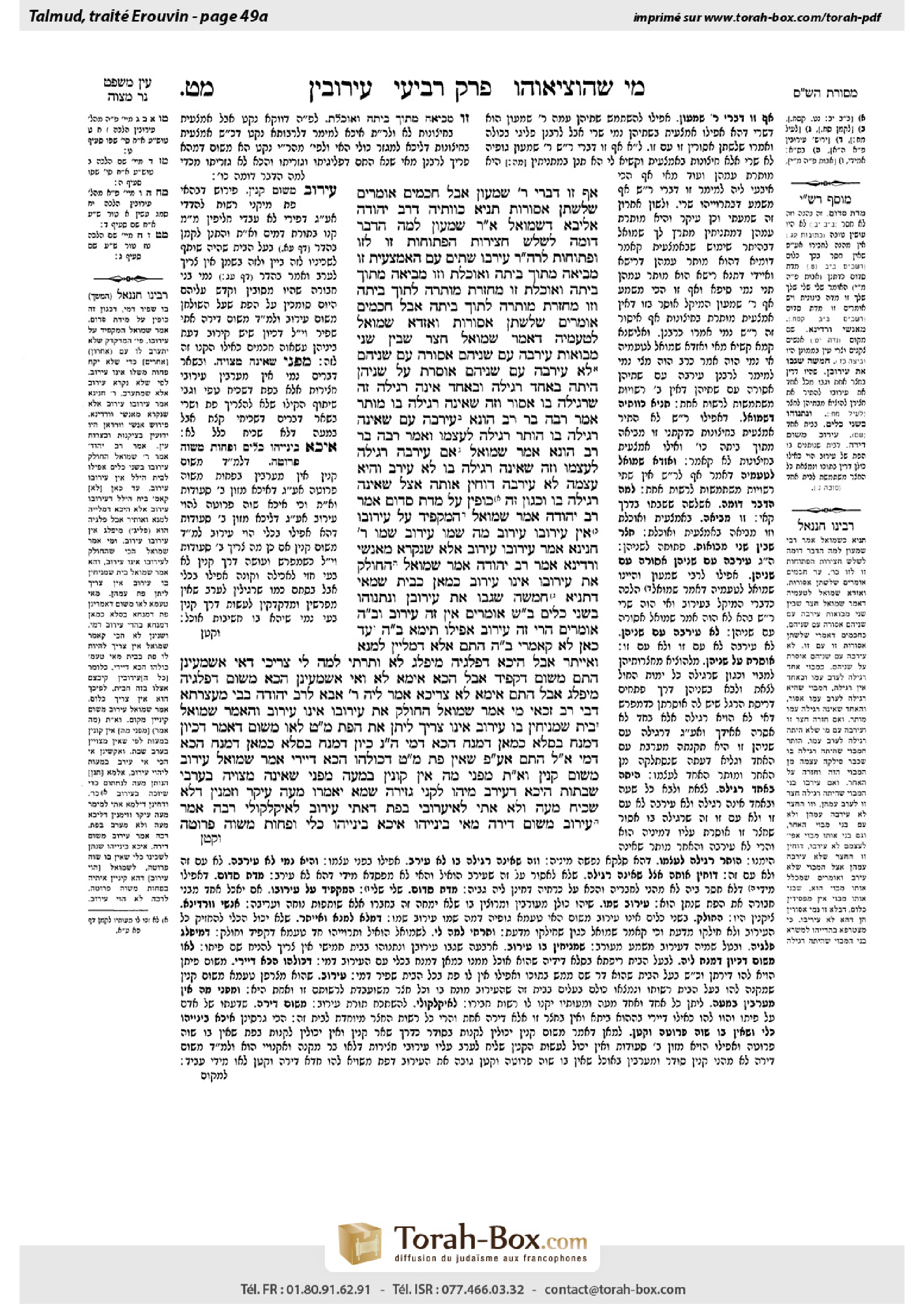
Eruvin 49a: Talmud study for Daf Yomi
Study the Talmud for Daf Yomi with scanned pages, Hebrew text, English translations from Sefaria and AI-generated French translations.
Passage selection and English or AI-generated French translation are available where the scan has annotations. Daf Study is independent of Torah-Box and Sefaria.
Browse Eruvin · עירובין · All tractatesEruvin 49a text and translations
This page of Eruvin includes the Aramaic text, an English translation and an AI-generated French translation, alongside the scan above.
עירובין מ״ט א · Aramaic and Hebrew text
אַף זוֹ דִּבְרֵי רַבִּי שִׁמְעוֹן, אֲבָל חֲכָמִים אוֹמְרִים: שְׁלָשְׁתָּן אֲסוּרוֹת.
תַּנְיָא כְּווֹתֵיהּ דְּרַב יְהוּדָה אַלִּיבָּא דִּשְׁמוּאֵל, אָמַר רַבִּי שִׁמְעוֹן: לְמָה הַדָּבָר דּוֹמֶה לְשָׁלֹשׁ חֲצֵירוֹת הַפְּתוּחוֹת זוֹ לָזוֹ וּפְתוּחוֹת לִרְשׁוּת הָרַבִּים, עֵירְבוּ שְׁתַּיִם עִם הָאֶמְצָעִית — זוֹ מְבִיאָה מִתּוֹךְ בֵּיתָהּ וְאוֹכֶלֶת, וְזוֹ מְבִיאָה מִתּוֹךְ בֵּיתָהּ וְאוֹכֶלֶת. זוֹ מַחְזֶרֶת מוֹתָרָהּ לְתוֹךְ בֵּיתָהּ, וְזוֹ מַחְזֶרֶת מוֹתָרָהּ לְתוֹךְ בֵּיתָהּ.
אֲבָל חֲכָמִים אוֹמְרִים: שְׁלָשְׁתָּן אֲסוּרוֹת.
וְאַזְדָּא שְׁמוּאֵל לְטַעְמֵיהּ, דְּאָמַר שְׁמוּאֵל: חָצֵר שֶׁבֵּין שְׁנֵי מְבוֹאוֹת, עֵירְבָה עִם שְׁנֵיהֶם — אֲסוּרָה עִם שְׁנֵיהֶם.
לֹא עֵירְבָה עִם שְׁנֵיהֶם — אוֹסֶרֶת עַל שְׁנֵיהֶן.
הָיְתָה בְּאֶחָד רְגִילָה, וּבְאֶחָד אֵינָהּ רְגִילָה, זֶה שֶׁרְגִילָה בּוֹ — אָסוּר, וְזֶה שֶׁאֵינָהּ רְגִילָה בּוֹ — מוּתָּר.
אָמַר רַבָּה בַּר רַב הוּנָא: עֵירְבָה עִם שֶׁאֵינָהּ רְגִילָה בּוֹ — הוּתַּר רְגִילָה לְעַצְמוֹ.
וְאָמַר רַבָּה בַּר רַב הוּנָא אָמַר שְׁמוּאֵל: אִם עֵירְבָה רְגִילָה לְעַצְמוֹ, וְזֶה שֶׁאֵינָהּ רְגִילָה בּוֹ לֹא עֵירַב, וְהִיא עַצְמָהּ לֹא עֵירְבָה — דּוֹחִין אוֹתָהּ אֵצֶל שֶׁאֵינָהּ רְגִילָה בּוֹ.
וּכְגוֹן זֶה כּוֹפִין עַל מִדַּת סְדוֹם.
אָמַר רַב יְהוּדָה אָמַר שְׁמוּאֵל: הַמַּקְפִּיד עַל עֵירוּבוֹ — אֵין עֵירוּבוֹ עֵירוּב. מָה שְׁמוֹ — עֵירוּב שְׁמוֹ.
רַבִּי חֲנִינָא אָמַר: עֵירוּבוֹ עֵירוּב, אֶלָּא שֶׁנִּקְרָא מֵאַנְשֵׁי וַרְדִּינָא.
אָמַר רַב יְהוּדָה אָמַר שְׁמוּאֵל: הַחוֹלֵק אֶת עֵירוּבוֹ — אֵינוֹ עֵירוּב.
כְּמַאן? כְּבֵית שַׁמַּאי, דְּתַנְיָא: חֲמִשָּׁה שֶׁגָּבוּ אֶת עֵירוּבָן וּנְתָנוּהוּ בִּשְׁנֵי כֵלִים, בֵּית שַׁמַּאי אוֹמְרִים: אֵין זֶה עֵירוּב, וּבֵית הִלֵּל אוֹמְרִים: הֲרֵי זֶה עֵירוּב!
אֲפִילּוּ תֵּימָא בֵּית הִלֵּל: עַד כָּאן לָא קָאָמְרִי בֵּית הִלֵּל הָתָם אֶלָּא דְּמָלְיָין לְמָנָא וְאִיַּיתַּר, אֲבָל הֵיכָא דְּפַלְגֵיהּ מִיפְלָג — לָא.
וְתַרְתֵּי, לְמָה לִי? צְרִיכִי, דְּאִי אַשְׁמְעִינַן הָתָם — מִשּׁוּם דְּקָפֵיד. אֲבָל הָכָא — אֵימָא לָא.
וְאִי אַשְׁמְעִינַן הָכָא — מִשּׁוּם דְּפַלְגֵיהּ מִיפְלָג, אֲבָל הָתָם — אֵימָא לָא, צְרִיכָא.
אֲמַר לֵיהּ רַבִּי אַבָּא לְרַב יְהוּדָה בְּבֵי מַעְצַרְתָּא דְּבֵי רַב זַכַּאי: מִי אָמַר שְׁמוּאֵל ״הַחוֹלֵק אֶת עֵירוּבוֹ — אֵינוֹ עֵירוּב״? וְהָאָמַר שְׁמוּאֵל: בַּיִת שֶׁמַּנִּיחִין בּוֹ עֵירוּב — אֵינוֹ צָרִיךְ לִיתֵּן אֶת הַפַּת. מַאי טַעְמָא, לָאו מִשּׁוּם דְּאָמַר דְּכֵיוָן דְּמַנַּח בְּסַלָּא — כְּמַאן דְּמַנַּח הָכָא דָּמֵי? הָכִי נָמֵי: כֵּיוָן דְּמַנַּח בְּסַלָּא — כְּמַאן דְּמַנַּח הָכָא דָּמֵי!
אֲמַר לֵיהּ: הָתָם — אַף עַל פִּי שֶׁאֵין פַּת, מַאי טַעְמָא — דְּכוּלְּהוּ הָכָא דָּיְירִי.
אָמַר שְׁמוּאֵל: עֵירוּב מִשּׁוּם קִנְיָן.
וְאִם תֹּאמַר: מִפְּנֵי מָה אֵין קוֹנִין בְּמָעָה — מִפְּנֵי שֶׁאֵינָהּ מְצוּיָה בְּעַרְבֵי שַׁבָּתוֹת.
הֵיכָא דְּעֵירַב, מִיהוּ לִקְנֵי!
גְּזֵירָה שֶׁמָּא יֹאמְרוּ מָעָה עִיקָּר, וְזִמְנִין דְּלָא שְׁכִיחַ מָעָה, וְלָא אָתֵי לְאִיעָרוֹבֵי בְּפַת, דְּאָתֵי עֵירוּב לְאִיקַלְקוֹלֵי.
רַבָּה אָמַר: עֵירוּב מִשּׁוּם דִּירָה.
מַאי בֵּינַיְיהוּ? אִיכָּא בֵּינַיְיהוּ: כְּלִי,
וּפָחוֹת מִשָּׁוֶה פְּרוּטָה,
Eruvin 49a · English translation
This teaching, that carrying objects from either of the outer courtyards into the middle courtyard is permitted, is also the statement of, i.e., in accordance with, the opinion of Rabbi Shimon. But the Rabbis say: All three courtyards are prohibited, that is to say, carrying is prohibited from any of the courtyards to any of the others.
It was taught in a baraita in accordance with the opinion of Rav Yehuda, in accordance with the opinion of Shmuel. Rabbi Shimon said: To what is this comparable? It is comparable to three courtyards that open into one another, and that also open into a public domain. If the two outer courtyards established an eiruv with the middle one, a resident of one of the outer courtyards may bring food from a house in that courtyard and eat it in the middle courtyard, and likewise a resident of the other courtyard may bring food from a house in that courtyard and eat it in the middle courtyard. And similarly, this resident may bring leftovers from the house where he ate back into the house in that courtyard, and that resident may bring leftovers from the house where he ate back into the house in this courtyard.
However, the Rabbis say: All three courtyards are prohibited. Since the residents of the outer courtyards are prohibited to carry from one outer courtyard to the other, this results in a place where carrying is prohibited, and such a place prohibits carrying in all three courtyards.
The Gemara notes that Shmuel follows his line of reasoning that he used elsewhere, as Shmuel said: With regard to a courtyard that is between two alleyways, if that courtyard established an eiruv with both alleyways, it is prohibited with both of them. Since the residents of the two alleyways are prohibited to carry from one to the other and the eiruv enables the residents of the two alleyways to carry in the courtyard, it is prohibited to carry from the courtyard into the alleyways, so that the residents of the alleyways do not transfer objects from one alleyway to the other via the courtyard.
If the courtyard did not establish an eiruv with either alleyway, it prohibits one to carry in both of them. Since the residents of the courtyard were accustomed to utilizing both alleyways and did not establish an eiruv with either alleyway, the result is that each alleyway has a courtyard that did not establish an eiruv, which prohibits carrying from the courtyard into either alleyway.
If, however, the residents of the courtyard were accustomed to utilizing only one alleyway, while they are not accustomed to utilizing one alleyway, then with regard to the alleyway which they are accustomed to utilizing, it is prohibited to carry there, as the residents of the courtyard did not establish an eiruv with it. But with regard to the alleyway which they are not accustomed to utilizing, it is permitted to carry there, as the residents of the courtyard are not considered residents of that alleyway.
Rabba bar Rav Huna said: With regard to residents of a courtyard who established an eiruv with the alleyway which they were not accustomed to utilizing, the alleyway which they were accustomed to utilizing is permitted to establish an eiruv on its own without the courtyard. The residents of the courtyard have demonstrated their intention to use the other alleyway, despite their not being accustomed to doing so.
And Rabba bar Rav Huna said that Shmuel said: If the alleyway which the residents of the courtyard were accustomed to utilizing established an eiruv on its own without the courtyard, while the alleyway which they were not accustomed to utilizing did not establish an eiruv, and also the courtyard itself did not establish an eiruv with either alleyway, we divert the residents of the courtyard to use the alleyway which they are not accustomed to utilizing. This is because there is one alleyway in which it is prohibited to carry due to the lack of an eiruv, and a second alleyway in which it is permitted to carry; while it is prohibited for the residents of the courtyard to carry. As explained above, were they to utilize the alleyway which they are accustomed to utilizing, the other residents of the alleyway would also be prohibited to carry from their courtyards into the alleyway, despite having established an eiruv for their own alleyway. However, if they use the other alleyway, the residents of that alleyway will not lose anything; since they did not establish an eiruv, it is prohibited for them to carry in that alleyway regardless.
In a case such as this, one compels another to refrain from behavior characteristic of Sodom. We force a person to waive his legal rights in order to prevent him from acting in a manner characteristic of the wicked city of Sodom. If one denies another use of his possessions, even though he would incur no loss or damage by granting use of his property, his conduct is considered to be characteristic of Sodom. The courts may sometimes compel such a person to waive his legal rights.
Rav Yehuda said that Shmuel said: With regard to one who is particular about his eiruv, i.e., that the other people should not eat of the food he contributed, his eiruv is not a valid eiruv. After all, what is its name? Joining [eiruv] is its name, indicating that it must be jointly owned [me’urav] by all the participants in the eiruv. If one person does not allow the other participants to eat of it, it does not belong to all of them and cannot be called an eiruv.
Rabbi Ḥanina said: Even in that case, his eiruv is a valid eiruv, however, that person is called one of the men of Vardina. The men of Vardina were renowned misers, meaning that he is considered to be like them.
Rav Yehuda also said that Shmuel said: With regard to one who divides his eiruv into two parts, his eiruv is not a valid eiruv. This is for the aforementioned reason that, by definition, an eiruv needs to be indicative of joining, and this eiruv is separated into different parts.
The Gemara asks: In accordance with whose opinion did Shmuel state this teaching? Could it be in accordance with the opinion of Beit Shammai, as it was taught in a baraita: With regard to five people who collected their eiruv and placed it in two separate utensils, Beit Shammai say: This is not a valid eiruv, whereas Beit Hillel say: This is an eiruv. It does not stand to reason that Shmuel would follow Beit Shammai, whose opinion is not accepted as normative law.
The Gemara answers: Even if you say that Shmuel stated his opinion in accordance with the opinion of Beit Hillel, Beit Hillel stated their opinion only there, where the first utensil was filled and there was still some food left over, and therefore, some of the leftover food had to be placed in a second utensil. But where they divided it from the outset, even Beit Hillel agree that the eiruv is not valid.
The Gemara asks: Why do I need two rulings that are based on the same principle, i.e., that an eiruv must demonstrate joining? The Gemara answers: Both rulings were necessary. As, had the Gemara taught us the ruling only there, with regard to one who is particular about his eiruv, one might have said that the eiruv is not valid because the person is particular and expressly does not desire that his eiruv be eaten by others. However here, with regard to one who divides the eiruv into different parts, one might say that his portion should not be considered as separated from the rest.
And had the Gemara taught us the ruling only here, with regard to one who divides his eiruv, one might have said that the eiruv is not valid because he divided it up, thereby physically separating himself from the others. However there, with regard to one who is particular about his eiruv, one might say that his portion should not be considered as separated from the rest, since no act of separation was performed. Consequently, both rulings were necessary.
Rabbi Abba said to Rav Yehuda in the olive press in Rav Zakkai’s house: Did Shmuel actually say that in the case of one who divides his eiruv, it is not a valid eiruv? Didn’t Shmuel say elsewhere: The house in which the eiruv is placed need not contribute bread for the eiruv. The Gemara asks: What is the reason for this ruling? Is it not because Shmuel maintains that since there is bread lying in a basket somewhere in the house, it is regarded as if it were placed here with the rest of the eiruv? Here too, one should say that since the bread is placed in a basket, i.e., in one of the two utensils containing the eiruv, it is regarded as if it were placed here with the rest of the eiruv.
Rav Yehuda said to him: There Shmuel validates the eiruv although there is no bread in the house in which the eiruv is deposited. And what is the reason for his ruling? It is because by placing food in a particular house, all the residents of the courtyard are regarded as living here. Therefore, those living in that house need not contribute bread for the eiruv, as they are certainly residents of the house.
Shmuel said: An eiruv that is deposited in a house is effective due to the principle of acquisition, as each person who contributes a portion of food acquires the right to a certain use of the residence and is considered one of its residents.
And if you say: Why then can one not acquire this right through payment of a coin such as a ma’a, but rather only through bread? It is because a ma’a is not always available on Shabbat eve, as many people spend all of their available money for the necessities of Shabbat, and it is difficult to find money available at that hour.
The Gemara asks: If so, according to Shmuel’s opinion, in a case where he established an eiruv with money, it should nonetheless acquire, i.e., be valid. According to his opinion, there is no fundamental reason to invalidate the acquisition of rights in the residence through the payment of money, yet there is no indication that this position is valid.
The Gemara answers: Even Shmuel did not permit one to establish an eiruv with money, due to a decree lest people say that a ma’a is essential, and sometimes a ma’a will not be available, and they will not come to prepare an eiruv with bread, and the halakhic category of eiruv will be forgotten.
Rabba disagreed with Shmuel and said: An eiruv is effective due to the principle of residence. Each person who contributes a portion of food is considered as if he resides, for that Shabbat, in the residence in which the food is deposited.
The Gemara asks: What is the practical, halakhic difference between these two understandings? The Gemara answers: There is a practical difference between them with regard to the question of whether an eiruv may be established with a utensil. If an eiruv is effective based on the principle of acquisition, in accordance with the opinion of Shmuel, then one should be able to establish an eiruv with a utensil; whereas, this would not constitute a valid eiruv, according to the opinion of Rabba.
And another practical difference between them is with regard to whether an eiruv may be established with food that is less than the value of a peruta. According to Shmuel’s opinion, this would not be a valid eiruv, as there is no acquisition with something less than the value of a peruta; whereas according to Rabba’s opinion, since an eiruv is effective by establishing a person’s residence, this can be done even with an amount of food worth less than a peruta.
Eruvin 49a · Traduction française (IA)
Cet enseignement, selon lequel il est permis de transporter des objets depuis l'un ou l'autre des courtyards extérieurs vers le courtyard central, est également la déclaration de, c'est-à-dire conformément à, l'opinion du Rabbi Shimon. Mais les Rabbins disent : tous les trois courtyards sont interdits, c'est-à-dire que le transport est interdit depuis n'importe quel courtyard vers n'importe quel autre.
Il a été enseigné dans une baraïta conformément à l'opinion du Rav Yehuda, conformément à l'opinion de Shmuel. Rabbi Shimon dit : à quoi cela ressemble-t-il ? Cela ressemble à trois courtyards qui s'ouvrent les uns vers les autres et qui s'ouvrent également vers un domaine public. Si les deux courtyards extérieurs ont établi un eiruv avec le courtyard central, un résident d'un des courtyards extérieurs peut apporter de la nourriture d'une maison dans ce courtyard et la manger dans le courtyard central, de même qu'un résident du deuxième courtyard peut apporter de la nourriture d'une maison dans ce courtyard et la manger dans le courtyard central. De même, ce résident peut apporter les restes de la maison où il a mangé dans la maison de ce courtyard, et ce résident peut apporter les restes de la maison où il a mangé dans la maison de ce courtyard.
Cependant, les Rabbins disent : tous les trois courtyards sont interdits. Puisque les résidents des courtyards extérieurs sont interdits de transporter d'un courtyard extérieur à l'autre, cela entraîne un lieu où le transport est interdit, et un tel lieu interdit le transport dans tous les trois courtyards.
La Guemara note que Shmuel suit sa ligne de raisonnement qu'il a utilisé ailleurs, car Shmuel a dit : concernant un courtyard qui est entre deux cours, si ce courtyard a établi un eiruv avec les deux cours, il est interdit de porter avec les deux. Puisque les résidents des deux cours sont interdits de porter d'une cours à l'autre et que l'eiruv permet aux résidents des deux cours de porter dans le courtyard, il est interdit de porter du courtyard vers les cours, afin que les résidents des cours ne transfèrent pas des objets d'une cours à l'autre via le courtyard.
Si le courtyard n'a pas établi un eiruv avec l'une ou l'autre des cours, il interdit de porter dans les deux. Puisque les résidents du courtyard étaient habitués à utiliser les deux cours et n'ont pas établi un eiruv avec l'une ou l'autre des cours, le résultat est que chaque cours a un courtyard qui n'a pas établi un eiruv, ce qui interdit de porter du courtyard vers l'une ou l'autre des cours.
Cependant, si les résidents du courtyard étaient habitués à utiliser seulement une cours, alors que leur usage de l'autre cours n'était pas habituel, alors concernant la cours qu'ils étaient habitués à utiliser, il est interdit de porter là-bas, car les résidents du courtyard n'ont pas établi un eiruv avec elle. Mais concernant la cours qu'ils n'étaient pas habitués à utiliser, il est permis de porter là-bas, car les résidents du courtyard ne sont pas considérés comme résidents de cette cours.
Rabba bar Rav Huna a dit : concernant les résidents d'un cour d'enclos qui ont établi un eiruv avec la rue qu'ils n'étaient pas habitués à utiliser, la rue qu'ils étaient habitués à utiliser est permise à établir un eiruv en son propre nom sans le cour d'enclos. Les résidents du cour d'enclos ont montré leur intention d'utiliser l'autre rue, malgré le fait qu'ils ne l'étaient pas habitués à le faire.
Et Rabba bar Rav Huna a dit que Shmuel a dit : si l'allée que les résidents du courtyard étaient habitués à utiliser a établi un eiruv en son propre nom sans le courtyard, alors que l'allée qu'ils n'étaient pas habitués à utiliser n'a pas établi d'eiruv, et que le courtyard lui-même n'a pas établi d'eiruv avec l'une ou l'autre des allées, nous orientons les résidents du courtyard à utiliser l'allée qu'ils n'étaient pas habitués à utiliser. Cela est dû au fait qu'il y a une allée dans laquelle il est interdit de transporter en raison de l'absence d'un eiruv, et une deuxième allée dans laquelle il est permis de transporter ; toutefois, il est interdit aux résidents du courtyard de transporter. Comme expliqué ci-dessus, s'ils utilisaient l'allée qu'ils étaient habitués à utiliser, les autres résidents de l'allée ne pourraient pas transporter depuis leurs courtyards vers l'allée, malgré le fait qu'ils aient établi un eiruv pour leur propre allée. Cependant, s'ils utilisent l'autre allée, les résidents de cette allée ne perdront rien ; puisqu'ils n'ont pas établi d'eiruv, il est interdit de transporter dans cette allée indépendamment.
Dans un cas tel que celui-ci, on force une personne à renoncer à ses droits légaux afin d'empêcher qu'elle agisse de manière caractéristique de la vilaine ville de Sodome. Si une personne refuse à une autre l'utilisation de ses biens, même si celle-ci ne subirait aucun préjudice ou dommage en lui permettant d'utiliser ses biens, son comportement est considéré comme caractéristique de Sodome. Les tribunaux peuvent parfois contraindre une telle personne à renoncer à ses droits légaux.
Rav Yehuda a dit que Shmuel a dit : concernant celui qui est particulier concernant son eiruv, c'est-à-dire que les autres ne devraient pas manger de la nourriture qu'il a contribuée, son eiruv n'est pas un eiruv valide. En effet, quel est son nom ? L'union [eiruv] est son nom, indiquant qu'il doit être conjointement possédé [me’urav] par tous les participants à l'eiruv. Si une personne ne permet pas aux autres participants de manger de cela, cela ne leur appartient pas tous ensemble et ne peut pas être appelé un eiruv.
Rabbi Ḥanina a dit : même dans ce cas, son eiruv est un eiruv valide, cependant, cette personne est appelée l'un des hommes de Vardina. Les hommes de Vardina étaient des gens connus pour leur avarice, ce qui signifie qu'il est considéré comme étant comme eux.
Rav Yehuda a également dit que Shmuel a dit : concernant celui qui divise son eiruv en deux parties, son eiruv n'est pas un eiruv valide. Cela est pour la raison mentionnée ci-dessus, à savoir que, par définition, un eiruv doit indiquer une union, et cet eiruv est divisé en différentes parties.
La Guemara pose la question : Selon l'opinion de qui Shmuel a-t-il formulé cette enseignement ? Pourrait-il s'agir de l'opinion de Beit Shammai, comme il a été enseigné dans une baraïta : En ce qui concerne cinq personnes qui ont collecté leur eiruv et l'ont placé dans deux ustensiles séparés, Beit Shammai disent : Cet eiruv n'est pas valide, tandis que Beit Hillel disent : Cet eiruv est valide. Il n'est pas logique que Shmuel suive l'opinion de Beit Shammai, dont l'opinion n'est pas reconnue comme la loi normative.
La Guemara répond : Même si vous dites que Shmuel a formulé son opinion selon l'opinion de Beit Hillel, Beit Hillel ont formulé leur opinion uniquement là où le premier ustensile était rempli et il restait encore de la nourriture, et donc, une partie de la nourriture restante devait être placée dans un deuxième ustensile. Mais là où ils ont divisé la nourriture dès le départ, même Beit Hillel conviennent que l'eiruv n'est pas valide.
La Guemara pose la question : Pourquoi ai-je besoin de deux jugements basés sur le même principe, à savoir que l'eiruv doit démontrer l'union ? La Guemara répond : Ces deux jugements étaient nécessaires. En effet, si la Guemara nous avait appris ce jugement uniquement là, concernant une personne qui est particulier concernant son eiruv, on aurait pu dire que l'eiruv n'est pas valide parce que la personne est particulier et exprès ne désire pas que son eiruv soit mangé par les autres. Cependant ici, concernant une personne qui divise son eiruv en différentes parties, on pourrait dire que sa part ne devrait pas être considérée comme séparée du reste.
Et si la Guemara nous avait appris ce jugement uniquement ici, concernant une personne qui divise son eiruv, on aurait pu dire que l'eiruv n'est pas valide parce qu'il l'a divisé, ce qui le sépare physiquement des autres. Cependant, là, concernant une personne qui est particulier concernant son eiruv, on pourrait dire que sa part ne devrait pas être considérée comme séparée du reste, car aucun acte de séparation n'a été effectué. Ainsi, ces deux jugements étaient nécessaires.
Rabbi Abba dit à Rav Yehuda dans la presse à olives de la maison de Rav Zakkai : Shmuel a-t-il vraiment dit que dans le cas d'une personne qui divise son eiruv, il n'est pas valide ? N'a-t-il pas dit ailleurs : La maison dans laquelle l'eiruv est placé n'a pas besoin de contribuer du pain pour l'eiruv ? La Guemara pose la question : Quelle est la raison de ce jugement ? N'est-ce pas parce que Shmuel maintient que puisque du pain est placé dans un panier quelque part dans la maison, il est considéré comme si on l'avait placé ici avec le reste de l'eiruv ? Ici aussi, on devrait dire que puisque le pain est placé dans un panier, c'est-à-dire dans l'un des deux ustensiles contenant l'eiruv, il est considéré comme si on l'avait placé ici avec le reste de l'eiruv.
Rav Yehuda dit à lui : Là, Shmuel valide l'eiruv même s'il n'y a pas de pain dans la maison où l'eiruv est déposé. Et quelle est la raison de ce jugement ? C'est parce que, en plaçant de la nourriture dans une maison particulière, tous les habitants du cour de la maison sont considérés comme habitant ici. Ainsi, ceux qui habitent dans cette maison n'ont pas besoin de contribuer du pain pour l'eiruv, car ils sont certainement des habitants de la maison.
Shmuel dit : Un eiruv déposé dans une maison est efficace en vertu du principe d'acquisition, car chaque personne qui contribue une part de nourriture acquiert le droit à une certaine utilisation de la résidence et est considérée comme l'un de ses habitants.
Et si vous dites : Pourquoi alors ne peut-on pas acquérir ce droit par le paiement d'une monnaie telle qu'une ma’a, mais plutôt uniquement par du pain ? C'est parce qu'une ma’a n'est pas toujours disponible le soir du Shabbat, car beaucoup de gens dépensent toute leur monnaie disponible pour les nécessités du Shabbat, et il est difficile de trouver de la monnaie à cette heure-là.
La Guemara pose la question : Si c'est ainsi, selon l'opinion de Shmuel, dans le cas où l'on a établi un eiruv avec de l'argent, il devrait néanmoins acquérir, c'est-à-dire être valide. Selon son opinion, il n'y a pas de raison fondamentale pour invalider l'acquisition des droits dans la résidence par le paiement d'argent, toutefois il n'y a pas d'indication que cette position soit valide.
La Guemara répond : Même Shmuel n’a pas permis d’établir un eiruv avec de l’argent, en raison d’un décret afin que les gens ne disent pas qu’une ma’a est essentielle, et parfois une ma’a ne sera pas disponible, et ils ne viendront pas préparer un eiruv avec du pain, et la catégorie halakhique de l’eiruv sera oubliée.
Rabba s’est opposé à Shmuel et a dit : Un eiruv est efficace en vertu du principe de résidence. Chaque personne qui contribue une part de nourriture est considérée comme s’il résidait, pour ce Shabbat, dans la résidence où la nourriture est déposée.
La Guemara pose la question : Quelle est la différence pratique, halakhique, entre ces deux compréhensions ? La Guemara répond : Il y a une différence pratique entre eux concernant la question de savoir si un eiruv peut être établi avec un ustensile. Si un eiruv est efficace en vertu du principe d’acquisition, selon l’opinion de Shmuel, alors on devrait pouvoir établir un eiruv avec un ustensile ; tandis que cela ne constituerait pas un eiruv valide, selon l’opinion de Rabba.
Et une autre différence pratique entre eux concerne la question de savoir si un eiruv peut être établi avec de la nourriture dont la valeur est inférieure à celle d'une peruta. Selon l'opinion de Shmuel, cela ne constituerait pas un eiruv valide, car il n'y a pas d'acquisition avec quelque chose de valeur inférieure à celle d'une peruta ; tandis que selon l'opinion de Rabba, puisque l'eiruv est efficace en établissant la résidence d'une personne, cela peut être fait même avec une quantité de nourriture dont la valeur est inférieure à celle d'une peruta.
Traduction française générée par IA à partir de l’édition anglaise de Sefaria. Vérifie toujours un passage avec le texte source.
Text from Sefaria: William Davidson Edition - Vocalized Aramaic (CC BY NC); William Davidson Edition - English (CC BY NC).