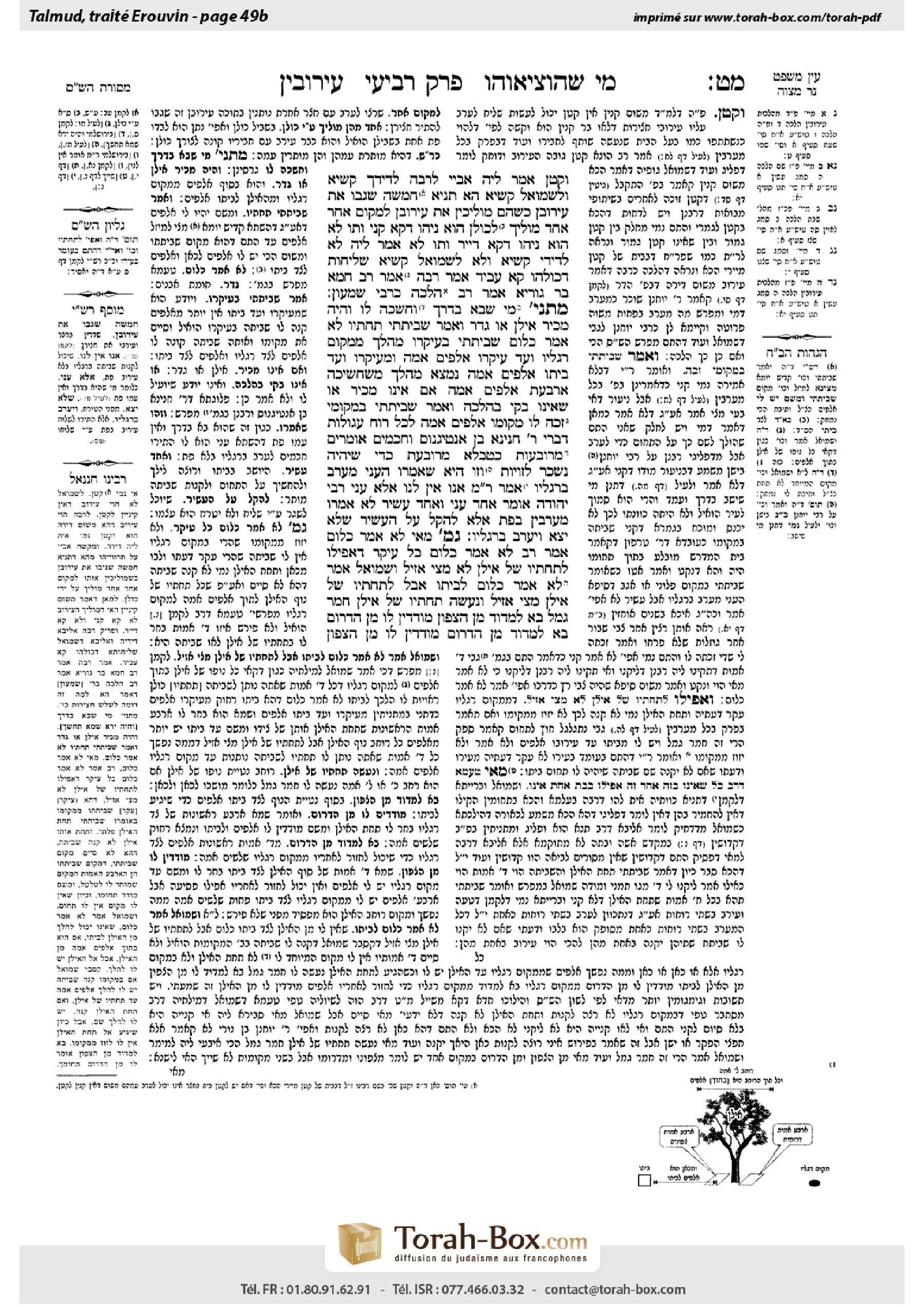
Eruvin 49b: Talmud study for Daf Yomi
Study the Talmud for Daf Yomi with scanned pages, Hebrew text, English translations from Sefaria and AI-generated French translations.
Passage selection and English or AI-generated French translation are available where the scan has annotations. Daf Study is independent of Torah-Box and Sefaria.
Browse Eruvin · עירובין · All tractatesEruvin 49b text and translations
This page of Eruvin includes the Aramaic text, an English translation and an AI-generated French translation, alongside the scan above.
עירובין מ״ט ב · Aramaic and Hebrew text
וְקָטָן.
אֲמַר לֵיהּ אַבָּיֵי לְרַבָּה: לְדִידָךְ קַשְׁיָא וְלִשְׁמוּאֵל קַשְׁיָא. הָא תַּנְיָא: חֲמִשָּׁה שֶׁגָּבוּ אֶת עֵירוּבָן, כְּשֶׁהֵם מוֹלִיכִין אֶת עֵירוּבָן לְמָקוֹם אַחֵר — אֶחָד מוֹלִיךְ לְכוּלָּן. הוּא נִיהוּ דְּקָא קָנֵי, וְתוּ לָא. הוּא נִיהוּ דְּקָא דָּיַיר, וְתוּ לָא!
אֲמַר לֵיהּ: לָא לְדִידִי קַשְׁיָא, וְלָא לִשְׁמוּאֵל קַשְׁיָא, שְׁלִיחוּת דְּכוּלְּהוּ קָא עָבֵיד.
אָמַר רַבָּה אָמַר רַב חָמָא בַּר גּוּרְיָא אָמַר רַב: הֲלָכָה כְּרַבִּי שִׁמְעוֹן.
מַתְנִי׳ מִי שֶׁבָּא בְּדֶרֶךְ וְחָשְׁכָה לוֹ, וְהָיָה מַכִּיר אִילָן אוֹ גָדֵר, וְאָמַר: ״שְׁבִיתָתִי תַּחְתָּיו״ — לֹא אָמַר כְּלוּם.
״שְׁבִיתָתִי בְּעִיקָּרוֹ״ — מְהַלֵּךְ מִמְּקוֹם רַגְלָיו וְעַד עִיקָּרוֹ אַלְפַּיִם אַמָּה, וּמֵעִיקָּרוֹ וְעַד בֵּיתוֹ אַלְפַּיִם אַמָּה. נִמְצָא מְהַלֵּךְ מִשֶּׁחָשֵׁיכָה אַרְבַּעַת אֲלָפִים אַמָּה.
אִם אֵינוֹ מַכִּיר, אוֹ שֶׁאֵינוֹ בָּקִי בַּהֲלָכָה, וְאָמַר ״שְׁבִיתָתִי בִּמְקוֹמִי״ — זָכָה לוֹ מְקוֹמוֹ אַלְפַּיִם אַמָּה לְכׇל רוּחַ.
עֲגוּלּוֹת, דִּבְרֵי רַבִּי חֲנִינָא בֶּן אַנְטִיגְנוֹס, וַחֲכָמִים אוֹמְרִים: מְרוּבָּעוֹת, כְּטַבְלָא מְרוּבַּעַת, כְּדֵי שֶׁיִּהְיֶה נִשְׂכָּר לַזָּוִיּוֹת.
וְזוֹ הִיא שֶׁאָמְרוּ: הֶעָנִי מְעָרֵב בְּרַגְלָיו. אָמַר רַבִּי מֵאִיר: אָנוּ אֵין לָנוּ אֶלָּא עָנִי. רַבִּי יְהוּדָה אוֹמֵר: אֶחָד עָנִי וְאֶחָד עָשִׁיר, לֹא אָמְרוּ מְעָרְבִין בְּפַת אֶלָּא לְהָקֵל עַל הֶעָשִׁיר, שֶׁלֹּא יֵצֵא וִיעָרֵב בְּרַגְלָיו.
גְּמָ׳ מַאי ״לֹא אָמַר כְּלוּם״?
אָמַר רַב: לֹא אָמַר כְּלוּם כׇּל עִיקָּר, דַּאֲפִילּוּ לְתַחְתָּיו שֶׁל אִילָן לָא מָצֵי אָזֵיל.
וּשְׁמוּאֵל אָמַר: לֹא אָמַר כְּלוּם לְבֵיתוֹ, אֲבָל לְתַחְתָּיו שֶׁל אִילָן מָצֵי אָזֵיל.
וְנַעֲשֶׂה תַּחְתָּיו שֶׁל אִילָן חַמָּר גַּמָּל.
בָּא לִמְדּוֹד מִן הַצָּפוֹן — מוֹדְדִין לוֹ מִן הַדָּרוֹם, בָּא לִמְדּוֹד מִן הַדָּרוֹם — מוֹדְדִין לוֹ מִן הַצָּפוֹן.
Eruvin 49b · English translation
And there is another practical difference between them with regard to the question whether a minor may collect the eiruv from the residents of the courtyard and deposit it in one of the houses. According to Shmuel’s opinion, this would not be a valid eiruv, for a minor cannot serve as an agent to effect acquisition, whereas according to Rabba’s opinion, the eiruv is valid, as the food itself establishes the common residence for all the residents.
Abaye said to Rabba: It is difficult according to your opinion that an eiruv is effective based on the principle of residence, and it is difficult according to the opinion of Shmuel that it is effective based on the principle of acquisition. As it was taught in a baraita: With regard to five people who collected their eiruv, when they take their eiruv elsewhere, in order to establish an eiruv together with another courtyard, one person may take it there for all of them. This indicates that it is only that person who acquires rights, and nobody else, and it is only that person who gains residence, and nobody else. In that case, how can the others rely on this eiruv?
Rabba said to him: It is neither difficult according to my opinion, nor is it difficult according to the opinion of Shmuel, as, the person who takes the eiruv acts as an agent, effecting acquisition or determining residence on behalf of all of them.
With regard to the case of the three courtyards addressed above, Rabba said that Rav Ḥama bar Gurya said that Rav said: The halakha is in accordance with the opinion of Rabbi Shimon that it is permitted to carry from the middle courtyard into either of the two outer ones; and vice versa, however, it is prohibited to carry from one outer courtyard to the other.
MISHNA: With regard to one who was coming along the way on Shabbat eve, and it grew dark while he was traveling, and he was familiar with a tree or a fence located two thousand cubits from his current location, and two thousand cubits from his house, and he said: My residence is beneath that tree, rather than in his present location, he has not said anything, as he did not establish a fixed location as his residence.
If, however, he said: My residence is at the tree’s trunk, he acquired residence there, and he may therefore walk from the place he is standing to the trunk of the tree two thousand cubits away, and from the trunk of the tree to his house, an additional two thousand cubits. Consequently, he walks after nightfall a total of four thousand cubits.
If one is not familiar with a tree or any other noticeable landmark, or if he is not an expert in the halakha, unaware that residence can be established from a distance, and he said: My residence is at my current location, then his presence at his current location acquires for him the right to walk two thousand cubits in each direction.
The manner in which the two thousand cubits are measured is the subject of a tannaitic dispute. These cubits are measured circularly, i.e., as a circle with a radius of two thousand cubits; this is the statement of Rabbi Ḥanina ben Antigenos. And the Rabbis say: These are measured squarely, i.e., as a square tablet, with each side measuring four thousand cubits, so that he gains the corners. He is permitted to walk from the middle to the corners of the square as well, a distance of approximately 2,800 cubits.
And this is the meaning of that which the Sages said: The pauper establishes an eiruv with his feet, i.e., one who does not have the bread required to establish an eiruv may walk anywhere within his Shabbat limit and declare: This is my residence, and his Shabbat limit is measured from that location. Rabbi Meir said: We have this leniency in effect only for a pauper, who does not have food for two meals. However, one who has bread may only establish residence with bread. Rabbi Yehuda says: This leniency is in effect for both a pauper and a wealthy person. The Sages said that one establishes an eiruv with bread only in order to be lenient with the wealthy person, so that he need not exert himself and go out and establish an eiruv with his feet. Instead, he can appoint an agent to place bread for him in that location. This, however, does not negate the option of personally going to that location in order to establish residence without bread.
GEMARA: We learned in the mishna that one who declares his intention to establish residence beneath a tree, without specifying the precise location, has not said anything. The Gemara asks: What is the precise meaning of he has not said anything?
Rav said: He has not said anything at all, and has failed to establish residence anywhere, and he may not even go to the place beneath that tree. His failure to specify a particular location prevents him from establishing residence beneath the tree. The fact that he sought to establish residence someplace other than his present location prevents him from establishing residence at his present location. Accordingly, he may walk no more than four cubits from the place that he is standing.
And Shmuel said: He has not said anything with regard to going to his home, if it is two thousand cubits past the tree; however, with regard to the area beneath the tree, if its bough is entirely within two thousand cubits of his present location he may indeed go there.
And when we learned in the mishna that he did not establish residence, it means that the legal status of the area beneath the tree becomes comparable to both a donkey driver, who walks behind the animal and prods it, and a camel driver, who walks before the animal and leads it in the sense that the tree is pulling him in both directions. Since he did not specify a particular location as his residence, any part of the area beneath the tree could be the place where he established residence.
Therefore, if he comes to measure two thousand cubits from the north of the tree in order to ascertain whether or not he may go to his home, because of the uncertainty with regard to the precise location where he established residence, one measures the distance for him stringently from the south. And likewise, if he comes to measure the distance to his home from the south, one measures the distance for him from the north.
Eruvin 49b · Traduction française (IA)
Il existe une autre différence pratique entre eux concernant la question de savoir si un mineur peut collecter l'eiruv auprès des habitants du courtil et le déposer dans l'une des maisons. Selon l'opinion de Shmuel, cela ne constituerait pas un eiruv valide, car un mineur ne peut pas agir en tant qu'agent pour accomplir l'acquisition, tandis que selon l'opinion de Rabba, l'eiruv est valide, car la nourriture elle-même établit la résidence commune pour tous les habitants.
Abaye dit à Rabba : C'est difficile selon votre opinion que l'eiruv soit efficace selon le principe de résidence, et c'est difficile selon l'opinion de Shmuel que l'eiruv soit efficace selon le principe d'acquisition. Comme il a été enseigné dans une baraïta : Concernant cinq personnes qui ont collecté leur eiruv, lorsqu'ils prennent leur eiruv ailleurs, afin d'établir un eiruv avec un autre courtil, une personne peut le prendre là pour tous. Cela indique que c'est uniquement cette personne qui acquiert des droits, et personne d'autre, et c'est uniquement cette personne qui gagne la résidence, et personne d'autre. Dans ce cas, comment les autres peuvent-ils compter sur cet eiruv ?
Rabba répondit à lui : Cela n'est pas difficile selon mon opinion, ni selon l'opinion de Shmuel, car la personne qui prend l'eiruv agit en tant qu'agent, accomplissant l'acquisition ou déterminant la résidence pour tous ceux-là.
Concernant le cas des trois courtyards mentionnés ci-dessus, Rabba dit que Rav Ḥama bar Gurya a dit que Rav a dit : La halakha suit l'opinion de Rabbi Shimon, qui permet de porter du courtil central vers l'un ou l'autre des deux courtyards externes ; et inversement, il est interdit de porter d'un courtil externe à l'autre.
MICHNA : Concernant celui qui marchait sur la route le soir du sabbat, et qu'il faisait nuit alors qu'il marchait, et qu'il connaissait un arbre ou un mur situé à deux mille coudées de son lieu actuel, et à deux mille coudées de sa maison, et qu'il disait : Ma résidence est sous cet arbre, plutôt que dans mon lieu actuel, il n'a pas établi un lieu fixe comme résidence.
Si cependant il disait : Ma résidence est au tronc de l'arbre, il acquiert la résidence là-bas, et il peut donc marcher de l'endroit où il est jusqu'au tronc de l'arbre, à deux mille coudées, et du tronc de l'arbre jusqu'à sa maison, une autre deux mille coudées. Ainsi, il marche après la nuit tombée un total de quatre mille coudées.
Si l'on ne connaît pas un arbre ou tout autre point de repère marquant, ou si l'on n'est pas expert en halakha, ignorant que la résidence peut être établie à distance, et qu'il dit : Ma résidence est à mon lieu actuel, alors sa présence à son lieu actuel acquiert pour lui le droit de marcher deux mille coudées dans chaque direction.
La manière dont les deux mille coudées sont mesurées est l'objet d'un débat tannaitique. Ces coudées sont mesurées en cercle, c'est-à-dire comme un cercle dont le rayon est de deux mille coudées, selon l'opinion de Rabbi Ḥanina ben Antigenos. Et les Rabbins disent : Ces coudées sont mesurées en carré, c'est-à-dire comme une plaque carrée, dont chaque côté mesure quatre mille coudées, de sorte qu'il gagne les angles. Il est autorisé à marcher du milieu aux angles du carré également, une distance d'environ 2 800 coudées.
C'est la signification de ce que les Sages ont dit : Le pauvre établit un eiruv avec ses pieds, c'est-à-dire celui qui n'a pas le pain nécessaire pour établir un eiruv peut marcher n'importe où dans sa limite du sabbat et déclarer : C'est ma résidence, et sa limite du sabbat est mesurée à partir de cet endroit. Rabbi Meir a dit : Nous avons cette indulgence uniquement pour le pauvre, qui n'a pas de nourriture pour deux repas. Cependant, celui qui a du pain peut seulement établir la résidence avec du pain. Rabbi Yehuda dit : Cette indulgence s'applique à la fois au pauvre et au riche. Les Sages ont dit qu'on établit un eiruv avec du pain uniquement afin d'être indulgent avec le riche, de sorte qu'il n'ait pas besoin de se fatiguer et de sortir pour établir un eiruv avec ses pieds. Au lieu de cela, il peut désigner un agent pour placer du pain à cet endroit. Cependant, cela n'annule pas l'option de se rendre personnellement à cet endroit afin d'établir la résidence sans pain.
GUEMARA : Nous avons appris dans la Michna que celui qui déclare son intention d'établir sa résidence sous un arbre, sans préciser le lieu exact, n'a pas dit quelque chose. La Guemara pose la question : Quelle est la signification exacte de n'avoir pas dit quelque chose ?
Rav a dit : Il n'a pas dit absolument rien, et n'a pas établi de résidence nulle part, et il ne peut même pas aller jusqu'au lieu sous cet arbre. Son échec à préciser un lieu précis l'empêche d'établir sa résidence sous l'arbre. Le fait qu'il ait cherché à établir sa résidence ailleurs que son lieu actuel l'empêche d'établir sa résidence à son lieu actuel. Ainsi, il ne peut marcher que quatre coudées à partir du lieu où il est.
Et Shmuel a dit : Il n'a pas dit quelque chose concernant l'aller chez lui, si c'est à deux mille coudées au-delà de l'arbre ; cependant, concernant la zone sous l'arbre, si ses branches sont entièrement à deux mille coudées de son lieu actuel, il peut effectivement y aller.
Et lorsque nous avons appris dans la mishna qu'il n'avait pas établi de résidence, cela signifie que le statut juridique de la zone sous l'arbre devient comparable à celui d'un conducteur de bête de somme, qui marche derrière l'animal et le pousse, et d'un conducteur de chameau, qui marche devant l'animal et le guide, dans le sens où l'arbre le tire dans les deux directions. Puisque il n'a pas précisé un lieu précis comme résidence, toute partie de la zone sous l'arbre pourrait être le lieu où il a établi sa résidence.
Ainsi, si l'on vient mesurer deux mille coudées à partir du nord de l'arbre afin de déterminer s'il peut aller chez lui, en raison de l'incertitude concernant l'emplacement exact où il a établi sa résidence, on mesure la distance pour lui de manière stricte à partir du sud. De même, si l'on vient mesurer la distance jusqu'à chez lui à partir du sud, on mesure la distance pour lui à partir du nord.
Traduction française générée par IA à partir de l’édition anglaise de Sefaria. Vérifie toujours un passage avec le texte source.
Text from Sefaria: William Davidson Edition - Vocalized Aramaic (CC BY NC); William Davidson Edition - English (CC BY NC).