Eruvin 50a: Talmud study for Daf Yomi
Study the Talmud for Daf Yomi with scanned pages, Hebrew text, English translations from Sefaria and AI-generated French translations.
Passage selection and English or AI-generated French translation are available where the scan has annotations. Daf Study is independent of Torah-Box and Sefaria.
Browse Eruvin · עירובין · All tractatesEruvin 50a text and translations
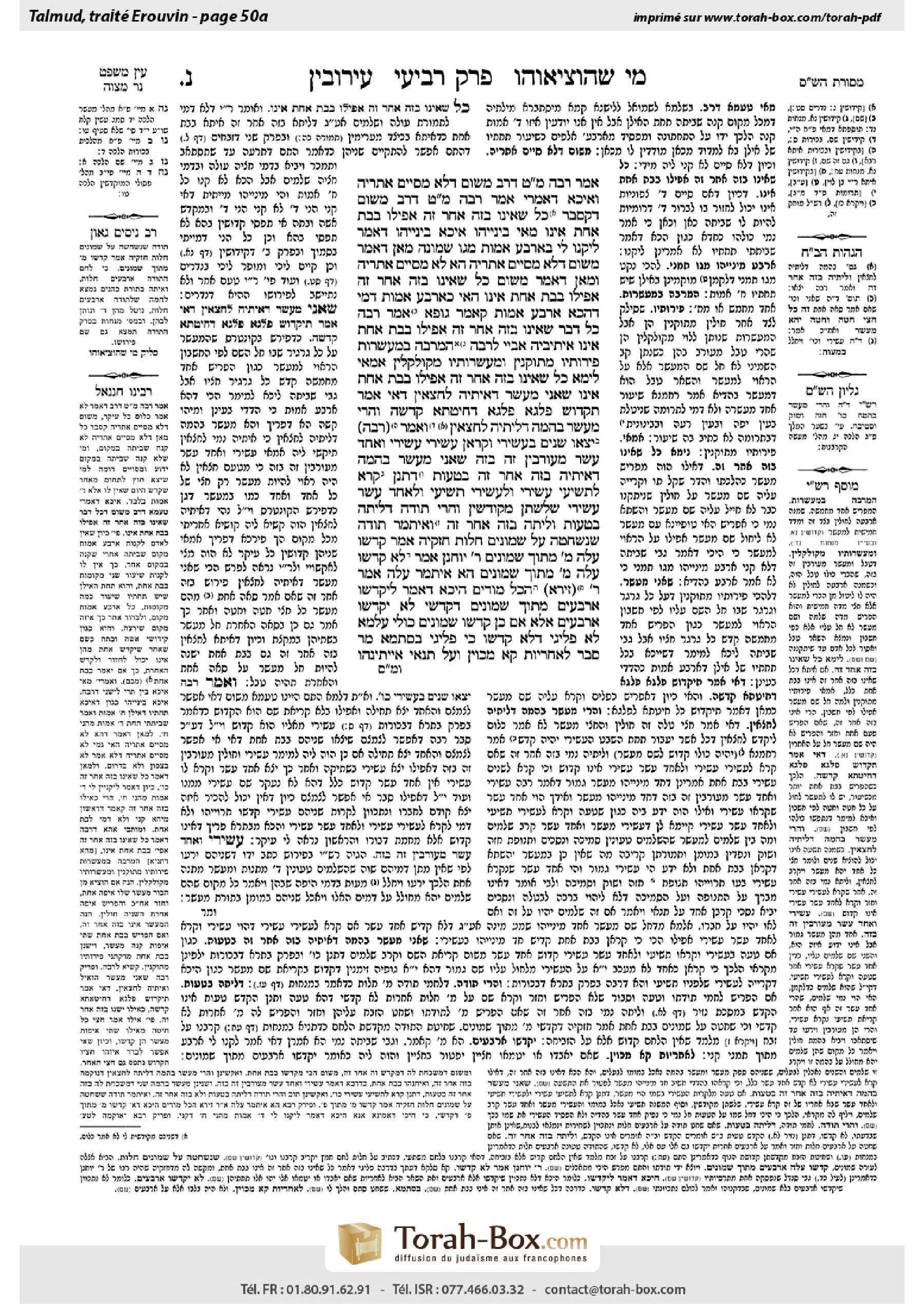
This page of Eruvin includes the Aramaic text, an English translation and an AI-generated French translation, alongside the scan above.
עירובין נ׳ א · Aramaic and Hebrew text
אָמַר רַבָּה: מַאי טַעְמָא דְּרַב — מִשּׁוּם דְּלָא מְסַיַּים אַתְרֵיהּ.
וְאִיכָּא דְאָמְרִי, אָמַר רַבָּה: מַאי טַעְמָא דְּרַב — מִשּׁוּם דְּקָסָבַר: כׇּל שֶׁאֵינוֹ בְּזֶה אַחַר זֶה — אֲפִילּוּ בְּבַת אַחַת אֵינוֹ.
מַאי בֵּינַיְיהוּ? אִיכָּא בֵּינַיְיהוּ דְּאָמַר: ״לִיקְנוֹ לִי בְּאַרְבַּע אַמּוֹת מִגּוֹ שְׁמוֹנֶה״.
מַאן דְּאָמַר מִשּׁוּם דְּלָא מְסַיַּים אַתְרֵיהּ — הָא לָא מְסַיַּים אַתְרֵיהּ.
וּמַאן דְּאָמַר מִשּׁוּם ״כׇּל שֶׁאֵינוֹ בְּזֶה אַחַר זֶה אֲפִילּוּ בְּבַת אַחַת אֵינוֹ״ — הַאי כְּאַרְבַּע אַמּוֹת דָּמֵי, דְּהָכָא אַרְבַּע אַמּוֹת קָאָמַר.
גּוּפָא, אָמַר רַבָּה: כׇּל דָּבָר שֶׁאֵינוֹ בְּזֶה אַחַר זֶה — אֲפִילּוּ בְּבַת אַחַת אֵינוֹ, אֵיתִיבֵיהּ אַבָּיֵי לְרַבָּה: הַמַּרְבֶּה בְּמַעַשְׂרוֹת — פֵּירוֹתָיו מְתוּקָּנִין, וּמַעְשְׂרוֹתָיו מְקוּלְקָלִין.
אַמַּאי? לֵימָא: כׇּל שֶׁאֵינוֹ בְּזֶה אַחַר זֶה — אֲפִילּוּ בְּבַת אַחַת אֵינוֹ!
שָׁאנֵי מַעֲשֵׂר דְּאִיתֵיהּ לַחֲצָאִין, דְּאִי אָמַר: ״תִּקְדּוֹשׁ פַּלְגָא פַּלְגָא דְחִיטְּתָא״ — קָדְשָׁה.
מַעְשַׂר בְּהֵמָה דְּלֵיתֵיהּ לַחֲצָאִין.
וְאָמַר (רַבָּה): יָצְאוּ שְׁנַיִם בַּעֲשִׂירִי, וּקְרָאָן עֲשִׂירִי — עֲשִׂירִי וְאַחַד עָשָׂר מְעוֹרָבִין זֶה בָּזֶה!
שָׁאנֵי מַעְשַׂר בְּהֵמָה דְּאִיתֵיהּ בְּזֶה אַחַר זֶה בְּטָעוּת.
דִּתְנַן: קָרָא לַתְּשִׁיעִי עֲשִׂירִי, וְלָעֲשִׂירִי תְּשִׁיעִי, וְלָאַחַד עָשָׂר עֲשִׂירִי — שְׁלָשְׁתָּן מְקוּדָּשִׁין.
וַהֲרֵי תּוֹדָה, דְּלֵיתַהּ בְּטָעוּת, וְלֵיתַהּ בְּזֶה אַחַר זֶה, וְאִיתְּמַר: תּוֹדָה שֶׁנִּשְׁחֲטָה עַל שְׁמוֹנִים חַלּוֹת, חִזְקִיָּה אָמַר: קָדְשׁוּ עֲלַהּ אַרְבָּעִים מִתּוֹךְ שְׁמוֹנִים, רַבִּי יוֹחָנָן אָמַר: לֹא קָדְשׁוּ עֲלַהּ אַרְבָּעִים מִתּוֹךְ שְׁמוֹנִים.
הָא אִיתְּמַר עֲלַהּ, אָמַר רַבִּי (זֵירָא): הַכֹּל מוֹדִים הֵיכָא דְּאָמַר ״לִיקְדְּשׁוּ אַרְבָּעִים מִתּוֹךְ שְׁמוֹנִים״ — דְּקָדְשִׁי, ״לֹא יִקְדְּשׁוּ אַרְבָּעִים אֶלָּא אִם כֵּן קָדְשׁוּ שְׁמוֹנִים״ — כּוּלֵּי עָלְמָא לָא פְּלִיגִי דְּלֹא קָדְשׁוּ.
כִּי פְּלִיגִי בִּסְתָמָא. מָר סָבַר: לְאַחְרָיוּת קָא מְכַוֵּין, וְעַל תְּנַאי אַיְיתִינְהוּ.
Eruvin 50a · English translation
Rabba said: What is the reason for Rav’s statement that one who declares his intention to establish residence beneath a tree has said nothing at all? It is because the place he designated is not precisely defined. Since he did not establish his residence in one particular location, he did not establish it at all.
And some say an alternative version of Rabba’s statement. Rabba said: What is the reason for the statement of Rav? It is Because he maintains: Anything that cannot be accomplished sequentially, due to halakhic or practical considerations, even simultaneously, cannot be accomplished, as one negates the other. In this case, since one cannot establish residence in an area of four cubits on one side of a tree and proceed to establish residence in an area of four cubits on the other side of the tree, neither can he simultaneously establish residence beneath a tree greater than four cubits.
The Gemara asks: What is the practical difference between these two versions of Rabba’s statement? The Gemara answers: There is a practical difference between them with regard to a case where he said: Let residence be acquired for me in four cubits of the eight or more cubits beneath that tree.
According to the one who said that it is because the place he designated is not precisely defined, here too, the place he designated is not precisely defined, as he failed to specify the precise location of the four cubits in which to establish his residence.
And according to the one who said it is because anything that cannot be accomplished sequentially even simultaneously it cannot be accomplished, this is considered as if he established his residence in four cubits, as here he stated that he is designated only four cubits as his place of residence.
The Gemara proceeds to analyze the matter of Rabba’s statement itself. Rabba said: Anything that cannot be accomplished sequentially even simultaneously it cannot be accomplished. Abaye raised an objection to the opinion of Rabba based on the Tosefta: One who increases tithes, i.e., he tithes two-tenths instead of one-tenth, the remainder of his produce is rendered fit for consumption, as he properly tithed it; however, his tithes are ruined, as the additional tenth is neither a tithe nor is it tithed produce. It is not a tithe because tithe status applies only to one tenth, and neither is it tithed produce as it was not tithed. Since it is unclear which of the two-tenths is the actual tithe and which is not, this produce may neither be treated as a tithe nor as tithed produce.
According to Rabba’s opinion, the question arises: Why should the produce be rendered fit for consumption? Let us say and apply his principle: Anything that cannot be accomplished sequentially; even simultaneously it cannot be accomplished. Since one may not designate two tenths sequentially, one tenth followed by a second tenth, likewise, he should be precluded from simultaneously designating two tenths of his produce as a tithe. Accordingly, it should be considered as though he had not designated any tithe at all, and therefore his produce should not be regarded as tithed.
Gemara answers: The case of a tithe is different, as tithe status takes effect partially, i.e., on less than a unit of produce. As if one said: Let half of each grain of wheat be designated as tithed, it is designated. Just as one can designate an entire grain of wheat as a tithe, he can likewise designate half a grain. In this case too, when one tithes two tenths of the produce, the ruling is not that one tenth is actual tithe and the other tenth is untithed produce mixed with the tithe. Instead, half of each grain of the set-aside portion is designated as a tithe, while the other half of each grain is not. Accordingly, the remainder of the produce is tithed, as one tenth of the total has been designated as first tithe. However, the portion designated as the tithe is ruined, because it is impossible to identify which part of each grain is designated.
Another objection was raised against Rabba’s opinion: Yet there is the case of the animal tithe, which does take effect partially, as one cannot consecrate half an animal for his tithe. Three times a year, the owner of a herd of kosher animals would gather all the animals born during the preceding period into an enclosure and let them out one by one. Every tenth animal would be marked with red paint to indicate that it was sacred. Only an entire animal could be consecrated as animal tithe, not a part of an animal.
And Rabba said: If two animals emerged from the enclosure together as the tenth, and he designated them both as the tenth, the tenth and eleventh animals are intermingled with each other. One is sacred with the sanctity of the animal tithe, while the other remains a peace-offering, but there is no way to determine which is which. The question arises: If the principle that anything which cannot be accomplished sequentially; even simultaneously it cannot be accomplished applies, neither animal is consecrated, as one cannot designate both the tenth and the eleventh animals as the animal tithe, one after the other.
The Gemara answers: The animal tithe is different, as two animals can indeed be designated as animal tithe one after the other in the case of an error. Although one cannot designate the tenth and eleventh animals as the animal tithe ab initio, if he did so in error they are both consecrated.
As we learned in a mishna: If one erred and designated the ninth animal as the tenth, and erred again and designated the tenth as the ninth and the eleventh as the tenth, all three animals are consecrated. The first is consecrated because it was designated as the tenth, the second because it actually is the tenth, while the third is also consecrated because it was designated as the tenth. Apparently, more than one animal can be consecrated as the animal tithe, if designated in error. Here too, a modicum of sanctity applies to the two animals that emerged together and were together designated as the tenth.
The Gemara raises another objection to Rabba’s principle. But there is the case of the forty loaves that accompany a thanks-offering, which are not consecrated if they were designated in error, and likewise are not consecrated if two sets of loaves were designated for the same offering one after the other. And yet it is stated that amora’im disagreed with regard to a thanks-offering that was slaughtered accompanied by eighty loaves, twice the required amount. Ḥizkiya said: Forty of the eighty loaves are consecrated, even though their identity cannot be determined; Rabbi Yoḥanan said: Not even forty of the eighty loaves are consecrated. It would appear that these amora’im disagree whether or not sanctity that cannot take effect in sequence can take effect simultaneously.
The Gemara rejects this contention. Wasn’t it stated with regard to this dispute that Rabbi Zeira said: Everyone, both Ḥizkiya and Rabbi Yoḥanan, concedes that in a case where the donor said: Let forty of the eighty loaves be consecrated, that the forty are consecrated; and in a case where he said: Let forty loaves only be consecrated if all eighty are consecrated, everyone agrees that they are not consecrated. This is in accordance with Rabba’s opinion.
When Ḥizkiya and Rabbi Yoḥanan disagree is with regard a case where the donor designated eighty loaves without stipulation how many he wants consecrated. One Sage, Ḥizkiya, maintains: Although he designated eighty loaves, he seeks to consecrate only forty, and when he sets aside eighty loaves, he merely intends to ensure that he will have forty, and he therefore brought the extra loaves on condition that if the first forty loaves are lost or become ritually impure, the second forty will be consecrated in their place. Consequently, the first forty loaves are consecrated.
Eruvin 50a · Traduction française (IA)
Rabba dit : Quelle est la raison de la déclaration de Rav selon laquelle celui qui déclare son intention d'établir sa résidence sous un arbre a dit rien du tout ? C'est parce que l'endroit qu'il a désigné n'est pas précisément défini. Puisqu'il n'a pas établi sa résidence dans un lieu particulier, il n'a pas établi sa résidence du tout.
Et certains disent une version alternative de la déclaration de Rabba. Rabba dit : Quelle est la raison de la déclaration de Rav ? C'est parce qu'il affirme : Tout ce qui ne peut pas être accompli séquentiellement, en raison de considérations halakhiques ou pratiques, même simultanément, ne peut pas être accompli, car l'un annule l'autre. Dans ce cas, puisqu'on ne peut pas établir sa résidence dans une surface de quatre cubits d'un côté d'un arbre et ensuite établir sa résidence dans une surface de quatre cubits de l'autre côté de l'arbre, on ne peut pas non plus établir sa résidence simultanément sous un arbre plus grand que quatre cubits.
Le Guemara pose la question : Quelle est la différence pratique entre ces deux versions de la déclaration de Rabba ? Le Guemara répond : Il existe une différence pratique entre elles concernant le cas où l'on dit : Que la résidence soit acquise pour moi dans quatre cubits des huit ou plus cubits sous cet arbre.
Selon celui qui dit que c'est parce que l'endroit qu'il a désigné n'est pas précisément défini, ici aussi, l'endroit qu'il a désigné n'est pas précisément défini, car il n'a pas précisé la localisation exacte des quatre cubits où établir sa résidence.
Et selon celui qui dit que c'est parce que tout ce qui ne peut pas être accompli séquentiellement, même simultanément, ne peut pas être accompli, cela est considéré comme s'il avait établi sa résidence dans quatre cubits, car ici il a indiqué qu'il désigne seulement quatre cubits comme lieu de résidence.
Le Guemara poursuit l'analyse de la déclaration de Rabba. Rabba dit : Tout ce qui ne peut pas être accompli séquentiellement, même simultanément, ne peut pas être accompli. Abaye a soulevé une objection contre l'opinion de Rabba, en se basant sur la Tosefta : Celui qui augmente les dîmes, c'est-à-dire qu'il dîme deux dixièmes au lieu d'un dixième, la production restante est considérée comme propre à la consommation, car il a dûment dîmé ; cependant, ses dîmes sont ruinées, car le dixième supplémentaire n'est ni une dîme ni une production dîmée. Il n'est pas une dîme car le statut de dîme s'applique uniquement à un dixième, et il n'est pas une production dîmée car il n'a pas été dîmé. Puisque c'est indéterminé quel des deux dixièmes est la dîme réelle et quel n'est pas, cette production ne peut ni être traitée comme une dîme ni comme une production dîmée.
Selon l'opinion de Rabba, la question se pose : Pourquoi la production devrait-elle être considérée comme propre à la consommation ? Disons et appliquons son principe : Tout ce qui ne peut pas être accompli séquentiellement ne peut pas non plus être accompli simultanément. Puisqu'on ne peut pas désigner deux dixièmes séquentiellement, un dixième suivi d'un second dixième, on devrait être empêché de désigner simultanément deux dixièmes de sa production comme dîme. Ainsi, il devrait être considéré comme s'il n'avait désigné aucune dîme du tout, et par conséquent, sa production ne devrait pas être considérée comme dîmée.
Le Guemara répond : Le cas des dîmes est différent, car le statut de dîme prend effet partiellement, c'est-à-dire sur moins d'une unité de production. Si l'on dit : Que la moitié de chaque grain de blé soit désignée comme dîme, cela est désigné. Tout comme l'on peut désigner un grain entier de blé comme dîme, l'on peut également désigner la moitié d'un grain. Dans ce cas également, lorsque l'on dîme deux dixièmes de la production, la décision n'est pas que l'un des dixièmes est la dîme réelle et l'autre est une production non dîmée mélangée avec la dîme. Au contraire, la moitié de chaque grain de la portion désignée est désignée comme dîme, tandis que l'autre moitié de chaque grain n'est pas. Ainsi, la production restante est dîmée, car un dixième du total a été désigné comme dîme. Cependant, la portion désignée comme dîme est ruinée, car il est impossible d'identifier quelle partie de chaque grain est désignée.
Une autre objection a été soulevée contre l'opinion de Rabba : Cependant, il existe le cas de la dîme d'animal, qui prend effet partiellement, car on ne peut consacrer demi-animal pour sa dîme. Trois fois par an, l'propriétaire d'un troupeau d'animaux kasher rassemblait tous les animaux nés pendant la période précédente dans un enclos et les faisait sortir un par un. Chaque dixième animal était marqué avec de la peinture rouge pour indiquer qu'il était sacré. Seul un animal entier pouvait être consacré comme dîme d'animal, pas une partie d'un animal.
Et Rabba dit : Si deux animaux sortent ensemble de l'enclos comme le dixième, et qu'il les désigne tous les deux comme le dixième, le dixième et le onzième animal sont mélangés entre eux. L'un est sacré avec la sanctité de la dîme d'animal, tandis que l'autre reste un offrande de paix, mais il n'y a aucun moyen de déterminer lequel est lequel. La question se pose : Si le principe selon lequel tout ce qui ne peut pas être accompli séquentiellement ne peut pas non plus être accompli simultanément s'applique, aucun des animaux n'est consacré, car on ne peut pas désigner à la fois le dixième et le onzième animal comme dîme d'animal, l'un après l'autre.
Le Guemara répond : La dîme d'animal est différente, car deux animaux peuvent effectivement être désignés comme dîme d'animal l'un après l'autre dans le cas d'une erreur. Bien qu'on ne puisse pas désigner à l'avance le dixième et le onzième animal comme dîme d'animal, s'il l'a fait par erreur, ils sont tous deux consacrés.
Comme nous l'avons appris dans une mitsna : Si l'on a commis une erreur et a désigné le neuvième animal comme le dixième, et s'est encore trompé en désignant le dixième comme le neuvième et le onzième comme le dixième, tous les trois animaux sont consacrés. Le premier est consacré car il a été désigné comme le dixième, le second car il est effectivement le dixième, tandis que le troisième est également consacré car il a été désigné comme le dixième. Apparemment, plus d'un animal peut être consacré comme dîme d'animal, si désigné par erreur. Ici aussi, une mesure de sanctité s'applique aux deux animaux qui sont sortis ensemble et qui ont été désignés ensemble comme le dixième.
La Guemara soulève une autre objection contre le principe de Rabba. Mais il y a le cas des quarante pains qui accompagnent un sacrifice de remerciement, qui ne sont pas consacrés s'ils ont été désignés par erreur, et de même ne sont pas consacrés si deux ensembles de pains ont été désignés pour le même sacrifice l'un après l'autre. Et pourtant il est dit que les amoraïm s'entendaient sur un sacrifice de remerciement qui a été immolé accompagné de quatre-vingts pains, double de la quantité requise. Ḥizkiya dit : Quarante des quatre-vingts pains sont consacrés, même si leur identité ne peut être déterminée ; Rabbi Yoḥanan dit : Même quarante des quatre-vingts pains ne sont pas consacrés. Il semble que ces amoraïm divergent sur le fait que la sanctité qui ne peut pas prendre effet dans une séquence peut prendre effet simultanément.
La Guemara rejette cette affirmation. N'était-il pas dit concernant ce débat que Rabbi Zeira a dit : Tout le monde, à la fois Ḥizkiya et Rabbi Yoḥanan, reconnaît que dans le cas où le donateur disait : Que quarante des quatre-vingts pains soient consacrés, ces quarante sont consacrés ; et dans le cas où il disait : Que quarante pains seulement soient consacrés si tous les quatre-vingts sont consacrés, tout le monde convient qu'ils ne sont pas consacrés. Cela s'accorde avec l'opinion de Rabba.
Le moment où Ḥizkiya et Rabbi Yoḥanan divergent est concernant un cas où le donateur a désigné quatre-vingts pains sans stipulation combien il voulait consacrer. Un sage, Ḥizkiya, maintient : Bien qu'il ait désigné quatre-vingts pains, il cherche à consacrer seulement quarante, et lorsqu'il met de côté quatre-vingts pains, il vise simplement à s'assurer qu'il aura quarante, et il a donc apporté les pains supplémentaires sous condition que si les premiers quarante pains sont perdus ou devenus impurs rituellement, les secondes quarante seront consacrés à leur place. Ainsi, les premiers quarante pains sont consacrés.
Traduction française générée par IA à partir de l’édition anglaise de Sefaria. Vérifie toujours un passage avec le texte source.
Text from Sefaria: William Davidson Edition - Vocalized Aramaic (CC BY NC); William Davidson Edition - English (CC BY NC).