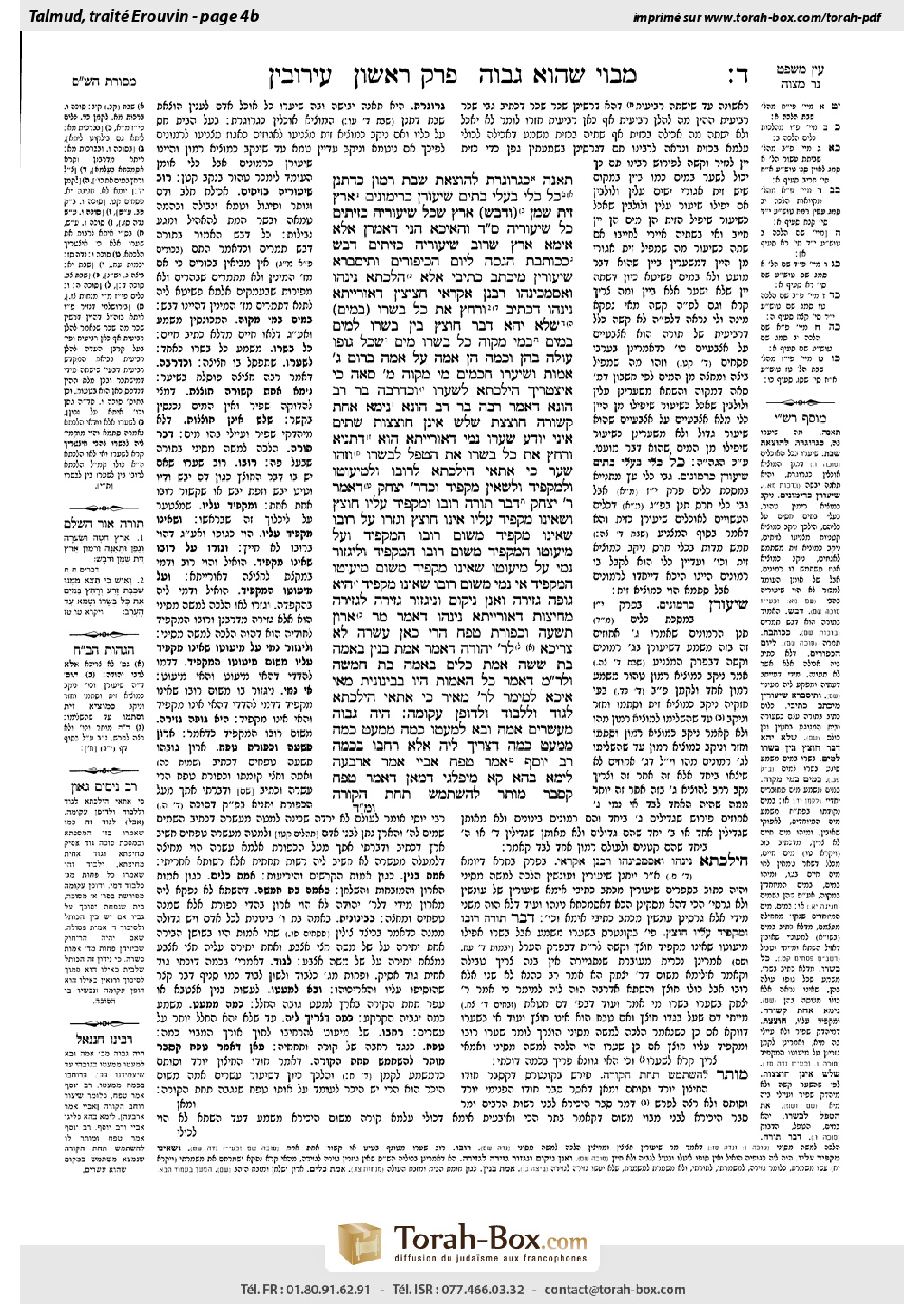
Eruvin 4b: Talmud study for Daf Yomi
Study the Talmud for Daf Yomi with scanned pages, Hebrew text, English translations from Sefaria and AI-generated French translations.
Passage selection and English or AI-generated French translation are available where the scan has annotations. Daf Study is independent of Torah-Box and Sefaria.
Browse Eruvin · עירובין · All tractatesEruvin 4b text and translations
This page of Eruvin includes the Aramaic text, an English translation and an AI-generated French translation, alongside the scan above.
עירובין ד׳ ב · Aramaic and Hebrew text
״תְּאֵנָה״: כִּגְרוֹגֶרֶת לְהוֹצָאַת שַׁבָּת.
״רִמּוֹן״, כְּדִתְנַן: כׇּל כְּלֵי בַּעֲלֵי בָתִּים שִׁיעוּרָן כְּרִימּוֹנִים.
״אֶרֶץ זֵית שֶׁמֶן (וּדְבָשׁ)״: אֶרֶץ שֶׁכׇּל שִׁיעוּרֶיהָ כְּזֵיתִים. כׇּל שִׁיעוּרֶיהָ סָלְקָא דַּעְתָּךְ?! וְהָאִיכָּא הָנֵי דַּאֲמַרַן! אֶלָּא אֵימָא: אֶרֶץ שֶׁרוֹב שִׁיעוּרֶיהָ כְּזֵיתִים.
״דְּבַשׁ״, כְּכוֹתֶבֶת הַגַּסָּה לְיוֹם הַכִּיפּוּרִים.
וְתִיסְבְּרָא שִׁיעוּרִין מִיכְתָּב כְּתִיבִי? אֶלָּא הִלְכְתָא נִינְהוּ, וְאַסְמְכִינְהוּ רַבָּנַן אַקְּרָאֵי.
חֲצִיצִין, דְּאוֹרָיְיתָא נִינְהוּ! דִּכְתִיב: ״וְרָחַץ אֶת כָּל בְּשָׂרוֹ (בַּמַּיִם)״, שֶׁלֹּא יְהֵא דָּבָר חוֹצֵץ בֵּין בְּשָׂרוֹ לַמַּיִם. ״בַּמַּיִם״ — בְּמֵי מִקְוֶה. ״כׇּל בְּשָׂרוֹ״ — מַיִם שֶׁכׇּל גּוּפוֹ עוֹלֶה בָּהֶן, וְכַמָּה הֵן — אַמָּה עַל אַמָּה בְּרוּם שָׁלֹשׁ אַמּוֹת. וְשִׁיעֲרוּ חֲכָמִים מֵי מִקְוֶה אַרְבָּעִים סְאָה.
כִּי אִיצְטְרִיךְ הִילְכְתָא, לִשְׂעָרוֹ. וְכִדְרַבָּה בַּר רַב הוּנָא, דְּאָמַר רַבָּה בַּר רַב הוּנָא: נִימָא אַחַת קְשׁוּרָה חוֹצֶצֶת, שָׁלֹשׁ אֵינָן חוֹצְצוֹת, שְׁתַּיִם אֵינִי יוֹדֵעַ.
שְׂעָרוֹ נָמֵי דְּאוֹרָיְיתָא הוּא, דְּתַנְיָא: ״וְרָחַץ אֶת כָּל בְּשָׂרוֹ״ — אֶת הַטָּפֵל לִבְשָׂרוֹ, וְזֶהוּ שֵׂעָר!
כִּי אֲתַאי הִילְכְתָא לְרוּבּוֹ וּלְמִיעוּטוֹ וּלְמַקְפִּיד וּלְשֶׁאֵין מַקְפִּיד, וְכִדְרַבִּי יִצְחָק.
דְּאָמַר רַבִּי יִצְחָק: דְּבַר תּוֹרָה רוּבּוֹ וּמַקְפִּיד עָלָיו חוֹצֵץ, וְשֶׁאֵינוֹ מַקְפִּיד עָלָיו אֵינוֹ חוֹצֵץ. וְגָזְרוּ עַל רוּבּוֹ שֶׁאֵינוֹ מַקְפִּיד מִשּׁוּם רוּבּוֹ הַמַּקְפִּיד, וְעַל מִיעוּטוֹ הַמַּקְפִּיד מִשּׁוּם רוּבּוֹ הַמַּקְפִּיד.
וְלִיגְזוֹר נָמֵי עַל מִיעוּטוֹ שֶׁאֵינוֹ מַקְפִּיד מִשּׁוּם מִיעוּטוֹ הַמַּקְפִּיד, אִי נָמֵי מִשּׁוּם רוּבּוֹ שֶׁאֵינוֹ מַקְפִּיד!
הִיא גּוּפַהּ גְּזֵירָה, וַאֲנַן נֵיקוּם וְנִיגְזוֹר גְּזֵירָה לִגְזֵירָה?!
מְחִיצּוֹת, דְּאוֹרָיְיתָא נִינְהוּ!
דְּאָמַר מָר: אָרוֹן תִּשְׁעָה וְכַפּוֹרֶת טֶפַח, הֲרֵי כָּאן עֲשָׂרָה.
לָא צְרִיכָא, לְרַבִּי יְהוּדָה דְּאָמַר: אַמַּת בִּנְיָן בְּאַמָּה בַּת שִׁשָּׁה. אַמַּת כֵּלִים בְּאַמָּה בַּת חֲמִשָּׁה.
וּלְרַבִּי מֵאִיר דְּאָמַר: כׇּל הָאַמּוֹת הָיוּ בְּבֵינוֹנִית, מַאי אִיכָּא לְמֵימַר?
לְרַבִּי מֵאִיר, כִּי אֲתַאי הִילְכְתָא — לְגוּד וּלְלָבוּד וּלְדוֹפֶן עֲקוּמָּה.
הָיָה גָּבוֹהַּ מֵעֶשְׂרִים אַמָּה וּבָא לְמַעֲטוֹ, כַּמָּה מְמַעֵט? כַּמָּה מְמַעֵט?! כַּמָּה דִּצְרִיךְ לֵיהּ!
אֶלָּא: רׇחְבּוֹ בְּכַמָּה? רַב יוֹסֵף אָמַר: טֶפַח, אַבָּיֵי אָמַר: אַרְבָּעָה.
לֵימָא בְּהָא קָא מִיפַּלְגִי דְּמַאן דְּאָמַר טֶפַח, קָסָבַר: מוּתָּר לְהִשְׁתַּמֵּשׁ תַּחַת הַקּוֹרָה,
Eruvin 4b · English translation
Fig alludes to the measure of a dried fig-bulk with regard to the halakhot of carrying out on Shabbat. One is liable for carrying food fit for human consumption on Shabbat, provided that he carries a dried fig-bulk of that food.
Pomegranate teaches the measure, as that which we learned in a mishna: All ritually impure wooden vessels belonging to ordinary homeowners become pure through being broken, as broken vessels cannot contract or maintain ritual impurity, and they are considered broken if they have holes the size of pomegranates.
The Sages interpreted: A land of olive oil and honey, as: A land, all of whose measures are olive-bulks. The Gemara poses a question: Does it enter your mind that it is a land all of whose measures are olives-bulks? Yet aren’t there those measures that we just mentioned above, which are not olive-bulks? Rather, say: A land, most of whose measures are olive-bulks, as most measures, e.g., those relating to forbidden foods and to impurity imparted by a corpse in a tent and by contact with an animal carcass, are olive-bulks.
Honey, i.e., dates from which date honey is extracted, also determines a measure, as with regard to eating on Yom Kippur, one is liable only if he eats a large date-bulk of food. Clearly, the measurements pertaining to mitzvot are explicitly written in the Torah and were not transmitted to Moses from Sinai.
The Gemara refutes this argument: And can you hold that all these measures are explicitly written in the Torah with regard to each of the halakhot mentioned above? Rather, they are halakhot that were transmitted to Moses from Sinai, and the Sages based them on verses in the Torah.
Rabbi Ḥiyya bar Ashi said above that Rav said that the laws governing interpositions that invalidate ritual immersion are halakhot transmitted to Moses from Sinai. The Gemara challenges this assertion: These, too, are written in the Torah, as it is written: “And he shall bathe all his flesh in the water” (Leviticus 15:16), and the Sages derived that nothing should intervene between his flesh and the water. The definite article in the phrase “in the water” indicates that this bathing is performed in water mentioned elsewhere, i.e., specifically in the water of a ritual bath, and not in just any water. And the phrase “all his flesh” indicates that it must be in water into which all of his body can enter, i.e., in which a person can immerse his entire body at once. And how much water is that? It is a cubit by a cubit by the height of three cubits. And the Sages calculated the volume of a ritual bath of this size and determined that the waters of a ritual bath measure forty se’a. As this is derived from the Written Torah, what need is there for a halakha transmitted to Moses from Sinai?
The Gemara answers: The halakha transmitted to Moses from Sinai is needed with regard to his hair, that it too must be accessible to the water without interposition. And this is in accordance with the opinion of Rabba bar Rav Huna, as Rabba bar Rav Huna said: A single hair tied in a knot constitutes an interposition and invalidates the immersion. Three hairs tied together in a knot do not constitute an interposition, because three hairs cannot be tied so tightly that water cannot penetrate them. With regard to two hairs tied together in a knot, I do not know the halakha. This halakha with regard to hair is a halakha transmitted to Moses from Sinai.
The Gemara raises a difficulty: The halakha with regard to his hair is also written in the Torah, as it was taught in a baraita: And he shall bathe all [et kol] his flesh. The superfluous word et comes to amplify and include that which is subordinate to his flesh, and that is hair.
The Gemara answers: The halakha transmitted to Moses from Sinai comes to teach the details of interpositions on the body with regard to its majority and its minority, and with regard to one who is particular and one who is not particular, in accordance with the opinion of Rabbi Yitzḥak.
As Rabbi Yitzḥak said: By Torah law, if there is an interposition between a person and the water, and it covers the majority of his body, and he is particular and wants the interposing substance removed, only then is it considered an interposition that invalidates immersion in a ritual bath. However, if he is not particular about that substance, it is not considered an interposition. The Sages, however, issued a decree prohibiting substances covering the majority of one’s body with regard to which he is not particular, due to substances covering the majority of one’s body with regard to which he is particular. And, they issued a decree prohibiting substances covering the minority of his body with regard to which one is particular, due to substances covering the majority of his body with regard to which one is particular.
The Gemara raises a question: Then let us also issue a decree deeming substances covering the minority of one’s body with regard to which he is not particular an interposition due to substances covering the minority of his body with regard to which one is particular, or alternatively, due to substances covering the majority of his body with regard to which he is not particular.
The Gemara answers: We do not issue that decree, because the halakha that deems both an interposition covering the minority of his body about which one is particular and an interposition covering the majority of his body about which one is not particular an interposition is itself a decree. Shall we then rise up and issue one decree to prevent violation of another decree? In any case, these details with regard to interpositions are neither written nor alluded to in the Torah; rather, they are halakhot transmitted to Moses from Sinai.
Rabbi Ḥiyya bar Ashi said that Rav said that the halakhot of partitions were transmitted to Moses from Sinai. The Gemara challenges this assertion as well: They are written in the Torah, as the fundamental principle that a partition ten handbreadths high establishes a separate domain is derived from the Torah.
As the Master said: The Holy Ark in the Tabernacle was nine handbreadths high, as the verse states that its height was a cubit and a half. A cubit contains six handbreadths, so its height totaled nine handbreadths. And the cover atop the Ark was one handbreadth, which total ten. There is a tradition that the Divine Presence does not descend into the domain of this world, which is derived from the verse that states that the Divine Presence would reveal itself from above the cover of the Ark. Apparently, a partition of ten handbreadths creates a separate domain.
The Gemara answers: The halakha transmitted to Moses from Sinai is necessary only according to the opinion of Rabbi Yehuda, who said: The cubit mentioned with regard to the building of the Tabernacle and the Temple was a large cubit of six handbreadths, whereas the cubit mentioned with regard to the sacred vessels was a cubit of five handbreadths. According to this opinion, the Ark, which was a cubit and a half, and its cover, which was a handbreadth, measured eight and a half handbreadths. Therefore, nothing can be derived with regard to a partition of ten handbreadths.
The Gemara poses a question. And according to the opinion of Rabbi Meir, who said: All the cubits were medium ones, regular cubits of six handbreadths; what can be said? Apparently, according to his opinion, the laws governing partitions are explicitly stated in the Torah.
The Gemara answers: According to the opinion of Rabbi Meir, the halakha with regard to a partition of ten handbreadths is indeed written in the Torah. However, the halakha transmitted to Moses from Sinai comes to teach other halakhot concerning partitions, e.g., the halakhot of extending [gode], according to which an existing partition is extended upward or downward to complete the requisite measure; and the halakhot of joining [lavud], according to which two solid surfaces are joined if they are separated by a gap of less than three handbreadths; and the halakhot of the curved wall of a sukka. A sukka is valid even if there are up to four cubits of invalid roofing, provided that this roofing is adjacent to one of the walls of the sukka. In that case, the invalid roofing is considered a bent extension of the wall. These concepts are certainly not written in the Torah.
The Gemara returns to the laws of alleyways: If the cross beam spanning the entrance to an alleyway was higher than twenty cubits from the ground and one comes to diminish its height, how much must he diminish it? The Gemara is surprised by the question: How much must he diminish it? The amount that he needs in order to render its height less than twenty cubits.
Rather, the space between the cross beam and the ground must, of course, be reduced to twenty cubits. However, when one raises the alleyway, how much must the width of the raised section be in order to render the alleyway fit for carrying within it? Rav Yosef said: One handbreadth. Abaye said: Four handbreadths.
The Gemara suggests: Let us say that these amora’im disagree about this: The one who said one handbreadth holds that one is permitted to utilize the area beneath the cross beam spanning the entrance to the alleyway, as he maintains that the cross beam serves as a partition, and the alleyway is considered as if it were sealed by a partition descending from the outer edge of the cross beam that faces the public domain. Since the area beneath the cross beam is part of the alleyway and is less than twenty cubits, there is a conspicuous demarcation for one standing in the alleyway.
Eruvin 4b · Traduction française (IA)
La figue fait référence à la mesure d'une figue sèche, concernant les halakhot de transport sur le Shabbat. On est tenu responsable de transporter un aliment adapté à la consommation humaine sur le Shabbat, à condition qu'il soit transporté en quantité égale à une figue sèche de ce aliment.
La pomegranade enseigne la mesure, comme nous l'avons appris dans une mitsna : Tous les objets en bois impurs appartenant aux habitants ordinaires deviennent purs en étant brisés, car les objets brisés ne peuvent ni contracter ni maintenir l'impureté rituelle, et sont considérés comme brisés s'ils ont des trous de la taille d'une pomegranade.
Les Sages ont interprété : Un pays d'huile d'olive et de miel, c'est-à-dire un pays dont toutes les mesures sont des mesures d'olives. La Guemara pose une question : N'avez-vous pas l'idée que c'est un pays dont toutes les mesures sont des mesures d'olives ? Et ne sont-ce pas des mesures que nous avons mentionnées ci-dessus, qui ne sont pas des mesures d'olives ? Plutôt, disons : Un pays dont la majorité des mesures sont des mesures d'olives, car la majorité des mesures, par exemple celles concernant les aliments interdits et l'impureté transmise par un cadavre dans une tente et par le contact avec un cadavre d'animaux, sont des mesures d'olives.
Le miel, c'est-à-dire les dattes d'où on extrait le miel, détermine également une mesure, comme concernant la consommation le Yom Kippur, on est tenu responsable uniquement s'il mange une quantité égale à une dattes sèche. Évidemment, les mesures relatives aux mitsvot sont explicitement écrites dans la Torah et n'ont pas été transmises à Moïse du Sinaï.
La Guemara réfute cet argument : Et pouvez-vous affirmer que toutes ces mesures sont explicitement écrites dans la Torah concernant chacune des halakhot mentionnées ci-dessus ? Plutôt, ce sont des halakhot transmises à Moïse du Sinaï, et les Sages les ont basées sur des versets de la Torah.
Rabbi Ḥiyya bar Ashi a dit ci-dessus que Rav a dit que les lois concernant les interpositions invalidant l'immersion rituelle sont des halakhot transmises à Moïse du Sinaï. La Guemara conteste cette affirmation : Ces lois sont également écrites dans la Torah, comme il est écrit : « Et il baignera toute sa chair dans l'eau » (Lévitique 15:16), et les Sages ont déduit que rien ne devait intervenir entre sa chair et l'eau. L'article défini dans la phrase « dans l'eau » indique que ce bain est effectué dans l'eau mentionnée ailleurs, c'est-à-dire spécifiquement dans l'eau d'un bain rituel, et non dans n'importe quelle eau. Et la phrase « toute sa chair » indique qu'il doit s'agir d'eau dans laquelle toute sa personne peut entrer, c'est-à-dire dans laquelle une personne peut s'immerger entièrement. Combien d'eau cela représente-t-il ? C'est un cubit par un cubit par la hauteur de trois cubits. Les Sages ont calculé le volume d'un bain rituel de cette taille et ont déterminé que les eaux d'un bain rituel mesurent quarante se'ot. Comme cela est déduit de la Torah écrite, à quoi bon une halakha transmise à Moïse du Sinaï ?
La Guemara répond : La halakha transmise à Moïse du Sinaï est nécessaire concernant ses cheveux, car ils aussi doivent être accessibles à l'eau sans interposition. Et cela est selon l'opinion de Rabba bar Rav Huna, car Rabba bar Rav Huna a dit : Un seul cheveu noué constitue une interposition et invalidate l'immersion. Trois cheveux noués ensemble ne constituent pas une interposition, car trois cheveux ne peuvent pas être noués si étroitement que l'eau ne puisse pas les traverser. Concernant deux cheveux noués ensemble, je ne sais pas la halakha. Cette halakha concernant les cheveux est une halakha transmise à Moïse du Sinaï.
La Guemara soulève un doute : La halakha concernant ses cheveux est également écrite dans la Torah, comme il a été enseigné dans une baraïta : « Et il baignera toute [et kol] sa chair ». Le mot superflu « et » sert à élargir et à inclure ce qui est subordonné à sa chair, c'est-à-dire les cheveux.
La Guemara répond : La halakha transmise à Moïse du Sinaï vient enseigner les détails des interpositions sur le corps concernant sa majorité et sa minorité, ainsi que concernant celui qui est particulier et celui qui ne l'est pas, selon l'opinion de Rabbi Yitzḥak.
Comme Rabbi Yitzḥak a dit : Selon la loi halakhique, si une interposition existe entre une personne et l'eau, et qu'elle couvre la majorité de son corps, et qu'il est particulier et veut que l'interposition soit retirée, alors elle est considérée comme une interposition invalidant l'immersion dans un bain rituel. Cependant, si il n'est pas particulier à ce sujet, elle n'est pas considérée comme une interposition. Les Sages, cependant, ont émis un décret interdisant les substances couvrant la majorité du corps d'une personne concernant lesquelles il n'est pas particulier, en raison des substances couvrant la majorité du corps d'une personne concernant lesquelles il est particulier. Et ils ont émis un décret interdisant les substances couvrant la minorité de son corps concernant lesquelles l'on est particulier, en raison des substances couvrant la majorité de son corps concernant lesquelles l'on est particulier.
La Guemara soulève une question : Alors, devons-nous également émettre un décret déclarant les substances couvrant la minorité du corps d'une personne concernant lesquelles il n'est pas particulier comme une interposition en raison des substances couvrant la minorité de son corps concernant lesquelles l'on est particulier, ou alternativement, en raison des substances couvrant la majorité de son corps concernant lesquelles l'on n'est pas particulier.
La Guemara répond : Nous n'émettons pas ce décret, car la halakha déclarant que les interpositions couvrant la minorité du corps concernant lesquels l'on est particulier et les interpositions couvrant la majorité du corps concernant lesquels l'on n'est pas particulier sont des interpositions est elle-même un décret. Devons-nous alors nous lever et émettre un décret pour empêcher la violation d'un autre décret ? En tout cas, ces détails concernant les interpositions ne sont ni écrits ni suggérés dans la Torah ; ils sont des halakhot transmises à Moïse du Sinaï.
Rabbi Ḥiyya bar Ashi a dit que Rav avait dit que les halakhot des cloisons étaient transmises à Moïse depuis Sinaï. La Guemara remet en question cette affirmation également : Elles sont écrites dans la Torah, car le principe fondamental selon lequel une cloison de dix tefachim de haut établit un domaine séparé est tiré de la Torah.
Comme le Maître a dit : L'Arca sainte dans le Tabernacle mesurait neuf tefachim de haut, comme le texte indique que sa hauteur était un coudée et demi. Une coudée contient six tefachim, donc sa hauteur totale était de neuf tefachim. Et la couverture au-dessus de l'Arca mesurait un tefach, ce qui faisait un total de dix. Il y a une tradition selon laquelle la Présence divine ne descend pas dans le domaine de ce monde, qui est tirée du texte qui indique que la Présence divine se révèle au-dessus de la couverture de l'Arca. Apparemment, une cloison de dix tefachim crée un domaine séparé.
La Guemara répond : La halakha transmise à Moïse depuis Sinaï est nécessaire uniquement selon l'opinion de Rabbi Yehuda, qui a dit : La coudée mentionnée concernant la construction du Tabernacle et du Temple était une coudée grande de six tefachim, tandis que la coudée mentionnée concernant les objets sacrés était une coudée de cinq tefachim. Selon cette opinion, l'Arca, qui mesurait un coudée et demi, et sa couverture, qui mesurait un tefach, mesuraient huit et demi tefachim. Ainsi, rien ne peut être tiré concernant une cloison de dix tefachim.
La Guemara pose une question. Selon l'opinion de Rabbi Meir, qui a dit : Toutes les coudées étaient des coudées moyennes, coudées régulières de six tefachim ; que peut-on dire ? Apparemment, selon son opinion, les lois concernant les cloisons sont explicitement énoncées dans la Torah.
La Guemara répond : Selon l'opinion de Rabbi Meir, la halakha concernant une cloison de dix tefachim est effectivement écrite dans la Torah. Cependant, la halakha transmise à Moïse depuis Sinaï vient enseigner d'autres halakhot concernant les cloisons, par exemple les halakhot de prolongement [gode], selon lesquelles une cloison existante est prolongée vers le haut ou vers le bas pour compléter la mesure requise ; et les halakhot de rapprochement [lavud], selon lesquelles deux surfaces solides sont jointes si elles sont séparées par un espace inférieur à trois tefachim ; et les halakhot du mur courbe d'une sukka. Une sukka est valide même s'il y a jusqu'à quatre coudées de toiture invalide, à condition que cette toiture soit adjacente à l'une des murs de la sukka. Dans ce cas, la toiture invalide est considérée comme une extension courbée du mur. Ces concepts ne sont certainement pas écrits dans la Torah.
La Guemara revient aux lois des cours : Si la poutre transversale sur l'entrée d'une cour était plus haute que vingt coudées du sol et qu'on vient diminuer sa hauteur, de combien doit-on la diminuer ? La Guemara est surprise par la question : De combien doit-on la diminuer ? La quantité nécessaire pour que sa hauteur soit inférieure à vingt coudées.
Plutôt, l'espace entre la poutre transversale et le sol doit, bien sûr, être réduit à vingt coudées. Cependant, lorsqu'on élève la cour, de combien doit être la largeur de la section élevée afin que la cour soit adaptée pour le transport à l'intérieur ? Rav Yosef a dit : Un tefach. Abaye a dit : Quatre tefachim.
La Guemara suggère : Faisons-nous dire que ces amoraïm sont en désaccord sur cela : Celui qui a dit un tefach maintient que l'on est autorisé à utiliser la zone sous la poutre transversale sur l'entrée de la cour, car il considère que la poutre sert de cloison, et la cour est considérée comme si elle était scellée par une cloison descendant de l'extrémité de la poutre qui fait face au domaine public. Puisque la zone sous la poutre fait partie de la cour et est inférieure à vingt coudées, il y a une délimitation évidente pour celui qui se trouve dans la cour.
Traduction française générée par IA à partir de l’édition anglaise de Sefaria. Vérifie toujours un passage avec le texte source.
Text from Sefaria: William Davidson Edition - Vocalized Aramaic (CC BY NC); William Davidson Edition - English (CC BY NC).