Eruvin 5a: Talmud study for Daf Yomi
Study the Talmud for Daf Yomi with scanned pages, Hebrew text, English translations from Sefaria and AI-generated French translations.
Passage selection and English or AI-generated French translation are available where the scan has annotations. Daf Study is independent of Torah-Box and Sefaria.
Browse Eruvin · עירובין · All tractatesEruvin 5a text and translations
This page of Eruvin includes the Aramaic text, an English translation and an AI-generated French translation, alongside the scan above.
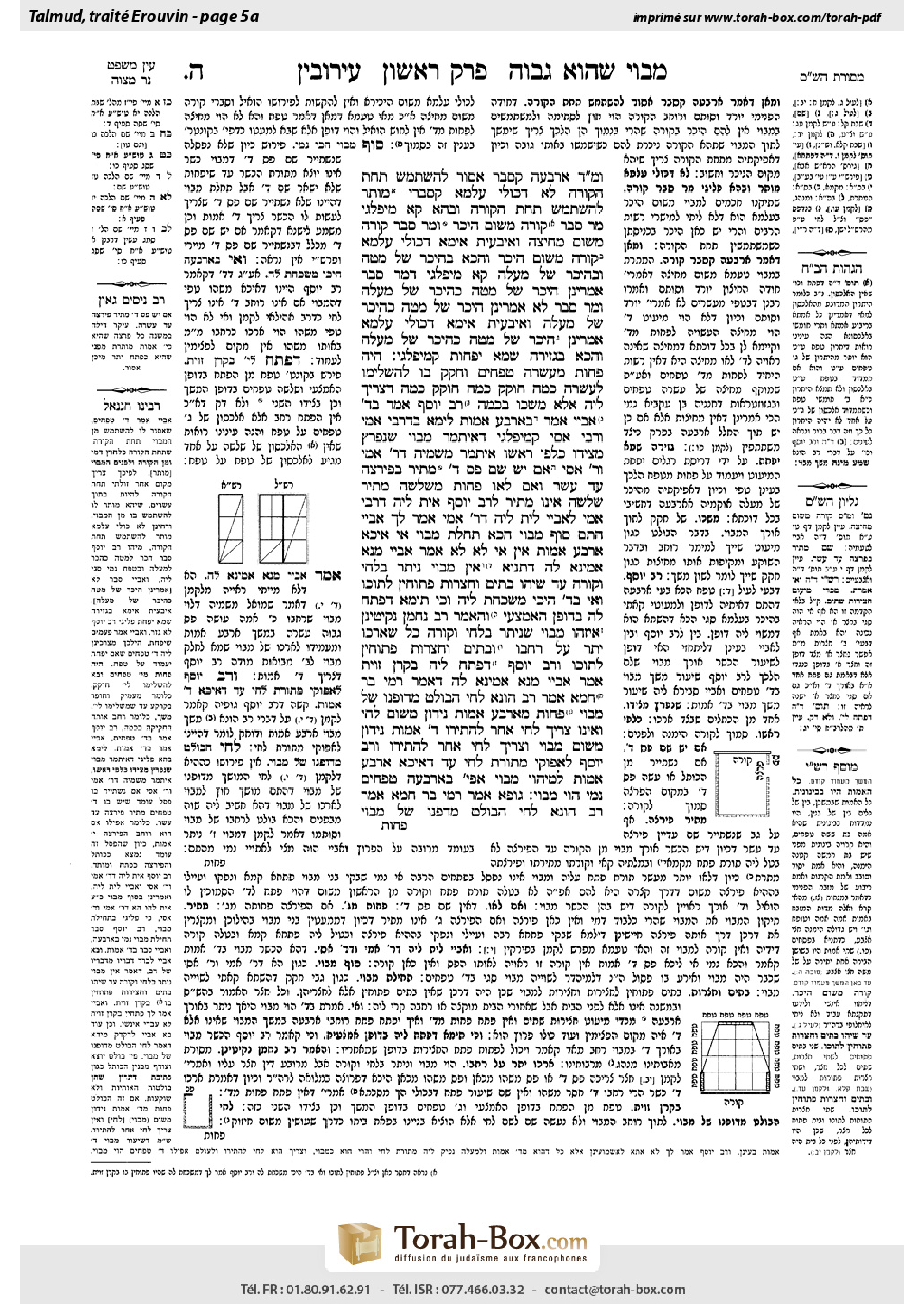
עירובין ה׳ א · Aramaic and Hebrew text
וּמַאן דְּאָמַר אַרְבָּעָה, קָסָבַר: אָסוּר לְהִשְׁתַּמֵּשׁ תַּחַת הַקּוֹרָה!
לָא, דְּכוּלֵּי עָלְמָא קָסָבְרִי מוּתָּר לְהִשְׁתַּמֵּשׁ תַּחַת הַקּוֹרָה, וּבְהָא קָא מִיפַּלְגִי: מָר סָבַר קוֹרָה מִשּׁוּם הֶיכֵּר, וּמָר סָבַר קוֹרָה מִשּׁוּם מְחִיצָה.
וְאִיבָּעֵית אֵימָא, דְּכוּלֵּי עָלְמָא קוֹרָה מִשּׁוּם הֶיכֵּר, וְהָכָא — בְּהֶיכֵּר שֶׁל מַטָּה וּבְהֶיכֵּר שֶׁל מַעְלָה קָא מִיפַּלְגִי, דְּמָר סָבַר אָמְרִינַן הֶיכֵּר שֶׁל מַטָּה כְּהֶיכֵּר שֶׁל מַעְלָה, וּמָר סָבַר לָא אָמְרִינַן הֶיכֵּר שֶׁל מַטָּה כְּהֶיכֵּר שֶׁל מַעְלָה.
וְאִיבָּעֵית אֵימָא: דְּכוּלֵּי עָלְמָא אָמְרִינַן: הֶיכֵּר שֶׁל מַטָּה כְּהֶיכֵּר שֶׁל מַעְלָה, וְהָכָא בִּגְזֵירָה שֶׁמָּא יִפְחוֹת קָמִיפַּלְגִי.
הָיָה פָּחוֹת מֵעֲשָׂרָה טְפָחִים וְחָקַק בּוֹ לְהַשְׁלִימוֹ לַעֲשָׂרָה, כַּמָּה חוֹקֵק? כַּמָּה חוֹקֵק?! כַּמָּה דִּצְרִיךְ לֵיהּ! אֶלָּא מִשְׁכּוֹ בְּכַמָּה? רַב יוֹסֵף אָמַר: בְּאַרְבָּעָה, אַבָּיֵי אָמַר: בְּאַרְבַּע אַמּוֹת.
לֵימָא בִּדְרַבִּי אַמֵּי וְרַבִּי אַסִּי קָמִיפַּלְגִי, דְּאִיתְּמַר: מָבוֹי שֶׁנִּפְרַץ מִצִּידּוֹ כְּלַפֵּי רֹאשׁוֹ, אִיתְּמַר מִשְּׁמֵיהּ דְּרַבִּי אַמֵּי וְרַבִּי אַסִּי: אִם יֵשׁ שָׁם פַּס אַרְבָּעָה — מַתִּיר בְּפִירְצָה עַד עֶשֶׂר.
וְאִם לָאו, פָּחוֹת מִשְּׁלֹשָׁה מַתִּיר. שְׁלֹשָׁה אֵינוֹ מַתִּיר. לְרַב יוֹסֵף אִית לֵיהּ דְּרַבִּי אַמֵּי, לְאַבָּיֵי לֵית לֵיהּ דְּרַבִּי אַמֵּי.
אָמַר לָךְ אַבָּיֵי: הָתָם סוֹף מָבוֹי, הָכָא תְּחִלַּת מָבוֹי. אִי אִיכָּא אַרְבַּע אַמּוֹת — אִין, אִי לָא — לָא.
אָמַר אַבָּיֵי: מְנָא אָמֵינָא לַהּ — דְּתַנְיָא: אֵין מָבוֹי נִיתָּר בְּלֶחִי וְקוֹרָה עַד שֶׁיְּהוּ בָּתִּים וַחֲצֵרוֹת פְּתוּחִין לְתוֹכוֹ.
וְאִי בְּאַרְבָּעָה הֵיכִי מַשְׁכַּחַתְּ לֵיהּ!
וְכִי תֵּימָא דְּפָתַח לֵהּ בְּדוֹפֶן הָאֶמְצָעִי, וְהָאָמַר רַב נַחְמָן: נְקִיטִינַן, אֵיזֶהוּ מָבוֹי שֶׁנִּיתָּר בְּלֶחִי וְקוֹרָה כֹּל שֶׁאׇרְכּוֹ יָתֵר עַל רׇחְבּוֹ, וּבָתִּים וַחֲצֵרוֹת פְּתוּחִין לְתוֹכוֹ.
וְרַב יוֹסֵף: דְּפָתַח לֵיה בְּקֶרֶן זָוִית.
אָמַר אַבָּיֵי: מְנָא אָמֵינָא לַהּ — דְּאָמַר רָמֵי בַּר חָמָא אָמַר רַב הוּנָא: לֶחִי הַבּוֹלֵט מִדּוֹפְנוֹ שֶׁל מָבוֹי, פָּחוֹת מֵאַרְבַּע אַמּוֹת — נִידּוֹן מִשּׁוּם לֶחִי, וְאֵינוֹ צָרִיךְ לֶחִי אַחֵר לְהַתִּירוֹ. אַרְבַּע אַמּוֹת — נִידּוֹן מִשּׁוּם מָבוֹי וְצָרִיךְ לֶחִי אַחֵר לְהַתִּירוֹ.
וְרַב יוֹסֵף? לְאַפּוֹקֵי מִתּוֹרַת לֶחִי עַד דְּאִיכָּא אַרְבַּע אַמּוֹת. לְמִיהְוֵי מָבוֹי אֲפִילּוּ בְּאַרְבָּעָה טְפָחִים נָמֵי הָוֵי מָבוֹי.
גּוּפָא. אָמַר רָמֵי בַּר חָמָא אָמַר רַב הוּנָא: לֶחִי הַבּוֹלֵט מִדׇּפְנוֹ שֶׁל מָבוֹי
Eruvin 5a · English translation
And the one who said four handbreadths holds that the alleyway is considered as if it were sealed from the inside edge of the cross beam, and consequently it is prohibited to utilize the area beneath the cross beam. As the area beneath the cross beam is not part of the alleyway, a significant demarcation, i.e., one of four handbreadths, is required within the alleyway itself.
The Gemara rejects this explanation: No, everyone agrees that it is permitted to utilize the area beneath the cross beam, and they disagree with regard to this: This Master, Rav Yosef, holds that a cross beam functions in an alleyway as a conspicuous marker that demarcates the alleyway from the public domain, and consequently a mere handbreadth is sufficient, as even a handbreadth is sufficiently conspicuous. And this Master, Abaye, holds that a cross beam serves as a partition, and a partition is not effective for an area of less than four handbreadths. The principle that an outer edge descends and seals the alleyway does not apply if the beam is higher than twenty cubits. In order for it to be considered a partition, there must be at least four handbreadths that are less than twenty cubits beneath the cross beam.
The Gemara proposes an alternative explanation: And if you wish, say instead that everyone agrees that a cross beam serves as a conspicuous marker, and here they disagree with regard to the relationship between a conspicuous marker below, i.e., the raised area of the alleyway, and a conspicuous marker above, i.e., the cross beam. This Master, Rav Yosef, holds that we say that the halakha that governs the conspicuous marker below is like the halakha that applies to the conspicuous marker above, and one handbreadth suffices. And this Master, Abaye, holds that we do not say that the halakha that governs the conspicuous marker below is like the halakha that applies to the conspicuous marker above. The lower sign must be more prominent and extend four handbreadths.
The Gemara proposes yet another explanation of the amoraic dispute: And if you wish, say instead that everyone agrees that we say that fundamentally, the halakha that governs the conspicuous marker below is like the halakha that applies to the conspicuous marker above, and even a handbreadth should suffice. But here they disagree whether the Sages decreed that four handbreadths are necessary, lest people treading upon it will erode and diminish the raised area. Rav Yosef is not concerned that it will be diminished and therefore holds that a raised area of a handbreadth is sufficient, whereas Abaye is concerned that the raised area of a handbreadth will erode to less than a handbreadth, rendering it inconspicuous, and the alleyway will come to be utilized in a prohibited manner.
The Gemara considers a new case: If the cross beam spanning the entrance to an alleyway was less than ten handbreadths above the ground, and one hollowed out the ground under the cross beam in order to complete the distance from the ground to the cross beam to ten, how much must he hollow out? The Gemara is surprised by the question: How much must he hollow out? However much is necessary for it to increase the height to at least ten handbreadths. Rather, the question is as follows: How far must the hollowed-out area extend into the alleyway in order to render it permitted to carry throughout the alleyway? Rav Yosef said: Four handbreadths. Abaye said: Four cubits.
The Gemara suggests: Let us say that these amora’im disagree with regard to the ruling of Rabbi Ami and Rabbi Asi. As it was stated with regard to the following question: If the side wall of an alleyway was breached toward its entrance, i.e., close to where the alleyway opens into the public domain, what is the halakha? It was stated in the name of Rabbi Ami and Rabbi Asi: If an upright board four handbreadths wide remains of the original wall or is set up where the original wall had ended, the cross beam or side post at the entrance to the alleyway renders it permitted to carry in the alleyway even if there is a breach of up to ten cubits wide.
And if there is no upright board there, the following distinction applies: If the breach is less than three handbreadths, the cross beam or side post renders it permitted to carry in the alleyway, based on the principle of lavud. If the breach is three or more handbreadths, the cross beam or side post does not render it permitted to carry. The Gemara proposes that Rav Yosef, who says that the hollowed-out area need only extend four handbreadths, adopts the opinion of Rabbi Ami, whereas Abaye, who requires a hollowed-out area of four cubits, does not adopt the opinion of Rabbi Ami.
The Gemara rejects this argument: Abaye could have said to you that the two cases are not comparable: There, in Rav Ami’s case, we are dealing with the final stage of an alleyway, i.e., an alleyway that had at first been properly structured, and only later did it become breached. Here, we are dealing with the initial stage of an alleyway, i.e., an alleyway that from the very outset did not fulfill the necessary conditions. In this case: If there are four cubits in the hollowed-out area, yes, it is considered an alleyway, and if not, no, it is not considered an alleyway.
Abaye said: From where do I say that a length of at least four cubits is required? As it was taught in a baraita: An alleyway is permitted by means of a side post or cross beam only if it has both houses opening into courtyards and courtyards opening into it, as only in that case can it be called an alleyway.
And if the entire length of the alleyway is only four handbreadths, as is indicated by Rav Yosef’s opinion, how can you find this case? Under what circumstances is it possible for such a short alleyway to have courtyards opening into it? Even if there are only two such courtyards, the entrance to each is at least four handbreadths wide.
And if you say that the alleyway opens into the courtyards through its middle wall, i.e., the alleyway is only four handbreadths long but is wide enough to have two entrances opening into two courtyards, this is difficult. Didn’t Rav Naḥman say that we hold on the authority of tradition: Which is an alleyway that is permitted by a side post or a cross beam? Any alleyway whose length is greater than its width and has houses and courtyards opening into it. Accordingly, if the alleyway is only four handbreadths long, its width must be even less than that. Consequently, argues Abaye, a length of at least four cubits is required.
And Rav Yosef, how would he respond to this? Rav Yosef explains that the baraita is dealing with a case where the courtyards open into the alleyway at its corners. In this way it is possible to have two openings, each of which is at least four handbreadths wide, although the length of the alleyway itself is no greater than four handbreadths, as the four handbreadths of the openings to the courtyards are divided between the width and the length of the alleyway.
Abaye further said: From where do I say that a length of at least four cubits is required? As Rami bar Ḥama said that Rav Huna said: With regard to a side post that protrudes from the wall on the side of an alleyway into the opening of the alleyway, if its protrusion was less than four cubits, it is deemed a side post that renders it permitted to carry in the alleyway, and no other side post is required to render it permitted to carry in it. However, if it protruded four cubits, that section is deemed an alleyway, as though there were an additional alleyway within an alleyway, and another side post is required to render it permitted to carry there. This shows that anything less than four cubits does not have the status of an alleyway, which supports the position of Abaye.
The Gemara asks: And Rav Yosef, how would he respond to this? Rav Yosef distinguishes between the cases: With regard to removing its status as a side post, this status remains until there are four cubits in the length of the side post. However, in order to be deemed an independent alleyway, even with a wall of four handbreadths it is also considered an alleyway.
The Gemara examines Rami bar Ḥama’s statement cited in the course of the previous discussion. As to the matter itself: Rami bar Ḥama said that Rav Huna said: With regard to a side post that protrudes from the wall on the side of an alleyway into the entrance of the alleyway,
Eruvin 5a · Traduction française (IA)
Celui qui a dit quatre paumes affirme que le passage est considéré comme étant scellé à partir de la bordure interne de la poutre transversale, et par conséquent il est interdit d'utiliser la zone sous la poutre transversale. Comme la zone sous la poutre transversale n'appartient pas au passage, une délimitation significative, c'est-à-dire une de quatre paumes, est nécessaire à l'intérieur même du passage.
La Guemara rejette cette explication : Non, tout le monde convient que l'utilisation de la zone sous la poutre transversale est permise, et ils s'entendent sur ce point : ce maître, Rav Yosef, affirme que la poutre transversale fonctionne dans un passage comme un marqueur évident qui délimite le passage du domaine public, et par conséquent une paume seule suffit, car même une paume est suffisamment évidente. Et ce maître, Abaye, affirme que la poutre transversale sert de séparateur, et un séparateur n'est pas efficace pour une zone inférieure à quatre paumes. Le principe selon lequel la bordure externe descend et scelle le passage ne s'applique pas si la poutre est plus haute que vingt coudées. Afin qu'elle soit considérée comme un séparateur, il faut qu'il y ait au moins quatre paumes qui soient inférieures à vingt coudées sous la poutre transversale.
La Guemara propose une autre explication : Et si vous le souhaitez, dites plutôt que tout le monde convient que la poutre transversale sert de marqueur évident, et ici ils s'entendent sur ce point : ce maître, Rav Yosef, affirme que nous disons que la halakha qui régit le marqueur évident en dessous, c'est-à-dire la zone élevée du passage, est comme la halakha qui s'applique au marqueur évident au-dessus, c'est-à-dire la poutre transversale, et une paume seule suffit. Et ce maître, Abaye, affirme que nous ne disons pas que la halakha qui régit le marqueur évident en dessous est comme la halakha qui s'applique au marqueur évident au-dessus. Le signe en dessous doit être plus évident et s'étendre de quatre paumes.
La Guemara propose une autre explication du désaccord entre les amoraïm : Et si vous le souhaitez, dites plutôt que tout le monde convient que nous disons que fondamentalement, la halakha qui régit le marqueur évident en dessous est comme la halakha qui s'applique au marqueur évident au-dessus, et même une paume devrait suffire. Mais ici ils divergent sur le fait que les Sages ont décrété que quatre paumes sont nécessaires, de peur que les personnes qui marchent dessus ne l'usent et ne l'altèrent. Rav Yosef n'est pas inquiet qu'il soit altéré et donc affirme que la zone élevée d'une paume suffit, tandis qu'Abaye est inquiet que la zone élevée d'une paume s'use à moins d'une paume, la rendant inévidente, et le passage viendrait à être utilisé de manière interdite.
La Guemara considère un nouveau cas : Si la poutre transversale qui traverse l'entrée d'un passage était inférieure à dix paumes au sol, et qu'on a creusé le sol sous la poutre transversale afin de compléter la distance du sol à la poutre transversale à dix, combien doit-on creuser ? La Guemara est surprise par la question : Combien doit-on creuser ? Autant que nécessaire pour qu'elle atteigne au moins dix paumes de hauteur. Plutôt, la question est la suivante : Combien doit s'étendre la zone creusée dans le passage afin qu'il soit permis de porter dans tout le passage ? Rav Yosef a dit : Quatre paumes. Abaye a dit : Quatre coudées.
La Guemara suggère : Disons que ces amoraïm s'entendent sur la décision de Rabbi Ami et Rabbi Asi. Comme il a été dit concernant la question suivante : Si le mur latéral d'un passage était percé vers son entrée, c'est-à-dire près de l'ouverture du passage vers le domaine public, quelle est la halakha ? Il a été dit en nom de Rabbi Ami et Rabbi Asi : Si une planche verticale de quatre paumes de large reste de l'ancien mur ou est installée là où l'ancien mur avait cessé, la poutre ou la poutre latérale à l'entrée du passage rend le passage permis à porter même s'il y a une percée de dix coudées de large.
Et si il n'y avait pas de planche verticale là, la distinction suivante s'applique : Si la percée est inférieure à trois paumes, la poutre ou la poutre latérale rend le passage permis à porter, selon le principe de lavud. Si la percée est de trois paumes ou plus, la poutre ou la poutre latérale ne rend pas le passage permis à porter. La Guemara propose que Rav Yosef, qui affirme que la zone creusée doit seulement s'étendre de quatre paumes, adopte l'opinion de Rabbi Ami, tandis qu'Abaye, qui exige une zone creusée de quatre coudées, ne suit pas l'opinion de Rabbi Ami.
La Guemara rejette cet argument : Abaye pourrait avoir dit à vous que les deux cas ne sont pas comparables : Là, dans le cas de Rabbi Ami, nous sommes en présence de la fin d'un passage, c'est-à-dire d'un passage qui avait d'abord été correctement structuré, et qui n'a ensuite été percé que plus tard. Ici, nous sommes en présence du début d'un passage, c'est-à-dire d'un passage qui n'a pas rempli les conditions nécessaires dès le départ. Dans ce cas : Si la zone creusée est de quatre coudées, oui, elle est considérée comme un passage, et si non, non, elle n'est pas considérée comme un passage.
Abaye a dit : D'où dis-je que la longueur minimale requise est de quatre coudées ? Comme il a été enseigné dans une baraïta : Un passage est permis grâce à une poutre latérale ou une poutre transversale uniquement si les maisons ouvrant sur des courtyards et les courtyards ouvrant sur lui sont présents, car seulement dans ce cas peut-on l'appeler un passage.
Et si la longueur totale du passage n'est que de quatre paumes, comme indiqué par l'opinion de Rav Yosef, comment pouvez-vous trouver ce cas ? Sous quelles circonstances est-il possible pour un tel passage court d'avoir des courtyards ouvrant sur lui ? Même s'il y a seulement deux tels courtyards, l'entrée de chacun est au moins de quatre paumes de large.
Et si vous dites que le passage s'ouvre sur les courtyards par son mur central, c'est-à-dire que le passage n'est long que de quatre tefachim mais suffisamment large pour avoir deux entrées s'ouvrant sur deux courtyards, cela est difficile. N'avait pas R. Naḥman dit que nous suivons la tradition : Quel est un passage qui est permis par un poteau latéral ou une traverse ? Tout passage dont la longueur est supérieure à sa largeur et qui a des maisons et des courtyards s'ouvrant sur lui. Ainsi, si le passage n'est que de quatre tefachim de long, sa largeur doit être encore moindre. Ainsi, argue Abaye, une longueur minimale de quatre coudées est requise.
Et R. Yosef, comment répondrait-il à cela ? R. Yosef explique que la baraïta traite d'un cas où les courtyards s'ouvrent sur le passage aux angles. Ainsi, il est possible d'avoir deux ouvertures, chacune d'au moins quatre tefachim de large, bien que la longueur du passage lui-même ne soit pas supérieure à quatre tefachim, car les quatre tefachim des ouvertures vers les courtyards sont divisés entre la largeur et la longueur du passage.
Abaye a dit de plus : D'où dis-je que une longueur minimale de quatre coudées est requise ? Comme Rami bar Ḥama a dit que R. Huna a dit : En ce qui concerne un poteau latéral qui dépasse du mur du côté d'un passage vers l'entrée du passage, si sa dépasse était inférieure à quatre coudées, il est considéré comme un poteau latéral qui permet de porter dans le passage, et aucun autre poteau latéral n'est requis pour permettre de porter là. Cependant, si sa dépasse était de quatre coudées, cette section est considérée comme un passage, comme s'il y avait un passage supplémentaire à l'intérieur d'un passage, et un autre poteau latéral est requis pour permettre de porter là. Cela montre que tout ce qui est inférieur à quatre coudées ne possède pas le statut de passage, ce qui soutient la position d'Abaye.
La Guemara pose la question : Et Rav Yosef, comment répondrait-il à cela ? Rav Yosef distingue entre les cas : En ce qui concerne l'annulation de son statut de poteau latéral, ce statut persiste jusqu'à ce qu'il y ait quatre coudées dans la longueur du poteau latéral. Cependant, afin d'être considéré comme un passage indépendant, même avec une muraille de quatre tefachim, il est également considéré comme un passage.
La Guemara examine l'affirmation de Rami bar Ḥama citée lors de la discussion précédente. En ce qui concerne la question elle-même : Rami bar Ḥama a dit que Rav Huna a dit : En ce qui concerne un poteau latéral qui dépasse du mur du côté d'un passage vers l'entrée du passage,
Traduction française générée par IA à partir de l’édition anglaise de Sefaria. Vérifie toujours un passage avec le texte source.
Text from Sefaria: William Davidson Edition - Vocalized Aramaic (CC BY NC); William Davidson Edition - English (CC BY NC).