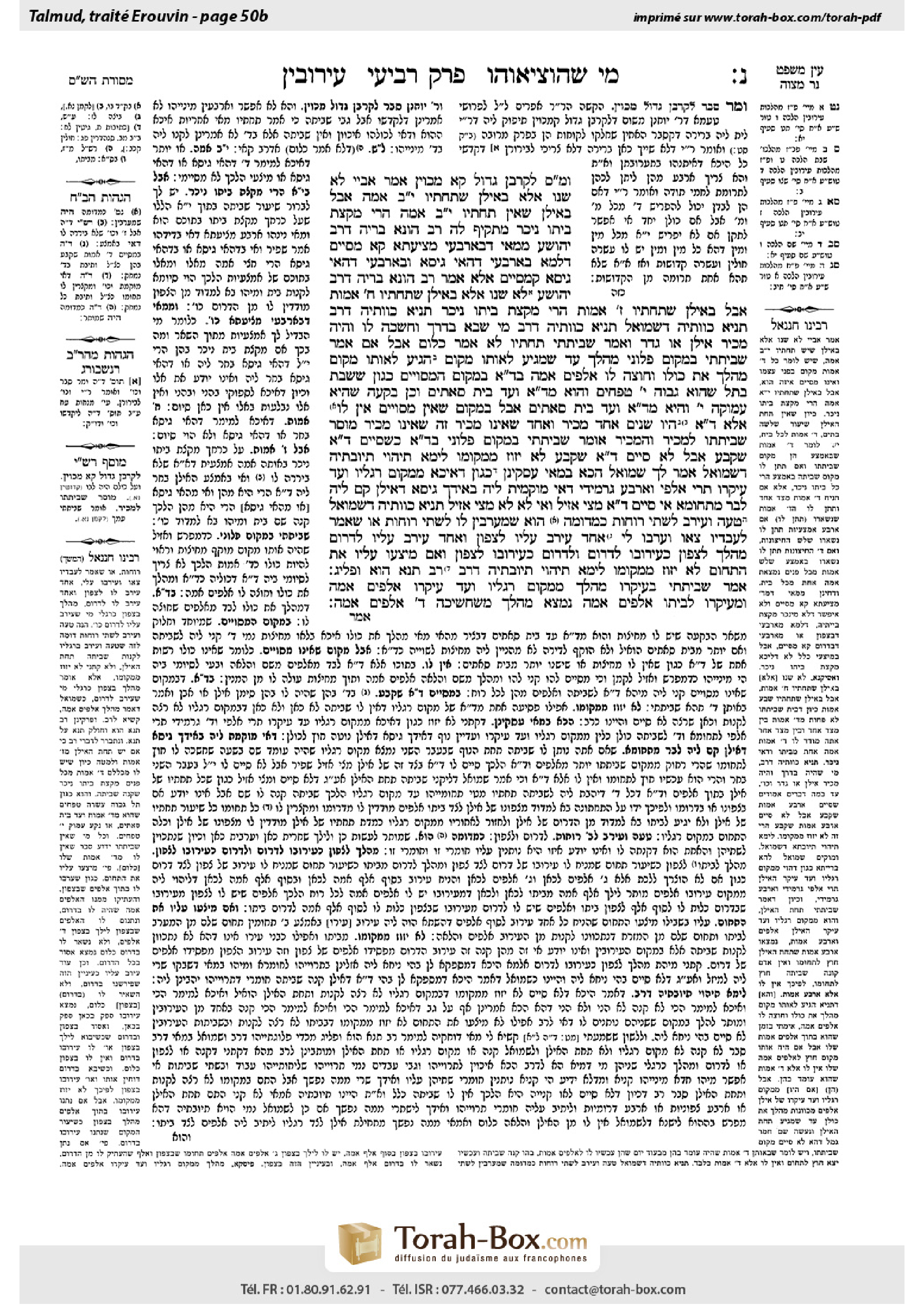
Eruvin 50b: Talmud study for Daf Yomi
Study the Talmud for Daf Yomi with scanned pages, Hebrew text, English translations from Sefaria and AI-generated French translations.
Passage selection and English or AI-generated French translation are available where the scan has annotations. Daf Study is independent of Torah-Box and Sefaria.
Browse Eruvin · עירובין · All tractatesEruvin 50b text and translations
This page of Eruvin includes the Aramaic text, an English translation and an AI-generated French translation, alongside the scan above.
עירובין נ׳ ב · Aramaic and Hebrew text
וּמָר סָבַר: לְקׇרְבָּן גָּדוֹל קָא מְכַוֵּין.
אָמַר אַבָּיֵי: לֹא שָׁנוּ אֶלָּא בְּאִילָן שֶׁתַּחְתָּיו שְׁתֵּים עֶשְׂרֵה אַמָּה, אֲבָל בְּאִילָן שֶׁאֵין שְׁתֵּים עֶשְׂרֵה אַמָּה, הֲרֵי מִקְצָת בֵּיתוֹ נִיכָּר.
מַתְקֵיף לַהּ רַב הוּנָא בְּרֵיהּ דְּרַב יְהוֹשֻׁעַ: מִמַּאי דִּבְאַרְבְּעִי מְצִיעָתָא קָא מְסַיַּים, דִּלְמָא בְּאַרְבְּעִי דְּהַאי גִּיסָא וּבְאַרְבְּעִי דְּהַאי גִּיסָא קָמְסַיַּים!
אֶלָּא אָמַר רַב הוּנָא בְּרֵיהּ דְּרַב יְהוֹשֻׁעַ: לֹא שָׁנוּ אֶלָּא בְּאִילָן שֶׁתַּחְתָּיו שְׁמוֹנֶה אַמּוֹת, אֲבָל בְּאִילָן שֶׁתַּחְתָּיו שֶׁבַע אַמּוֹת — הֲרֵי מִקְצָת בֵּיתוֹ נִיכָּר.
תַּנְיָא כְּווֹתֵיהּ דְּרַב, תַּנְיָא כְּווֹתֵיהּ דִּשְׁמוּאֵל.
תַּנְיָא כְּווֹתֵיהּ דְּרַב: מִי שֶׁבָּא בַּדֶּרֶךְ וְחָשְׁכָה לוֹ, וְהָיָה מַכִּיר אִילָן אוֹ גָדֵר, וְאָמַר: ״שְׁבִיתָתִי תַּחְתָּיו״ — לֹא אָמַר כְּלוּם. אֲבָל אִם אָמַר: ״שְׁבִיתָתִי בְּמָקוֹם פְּלוֹנִי״ — מְהַלֵּךְ עַד שֶׁמַּגִּיעַ לְאוֹתוֹ מָקוֹם. הִגִּיעַ לְאוֹתוֹ מָקוֹם — מְהַלֵּךְ אֶת כּוּלּוֹ וְחוּצָה לוֹ אַלְפַּיִם אַמָּה.
בַּמֶּה דְּבָרִים אֲמוּרִים — בְּמָקוֹם הַמְסוּיָּים, כְּגוֹן שֶׁשָּׁבַת בְּתֵל שֶׁהוּא גָּבוֹהַּ עֲשָׂרָה טְפָחִים, וְהוּא מֵאַרְבַּע אַמּוֹת וְעַד בֵּית סָאתַיִם.
וְכֵן בִּקְעָה שֶׁהִיא עֲמוּקָּה עֲשָׂרָה, וְהִיא מֵאַרְבַּע אַמּוֹת וְעַד בֵּית סָאתַיִם. אֲבָל בְּמָקוֹם שֶׁאֵין מְסוּיָּים — אֵין לוֹ אֶלָּא אַרְבַּע אַמּוֹת.
הָיוּ שְׁנַיִם, אֶחָד מַכִּיר וְאֶחָד שֶׁאֵינוֹ מַכִּיר — זֶה שֶׁאֵינוֹ מַכִּיר מוֹסֵר שְׁבִיתָתוֹ לַמַּכִּיר, וְהַמַּכִּיר אוֹמֵר: ״שְׁבִיתָתִי בְּמָקוֹם פְּלוֹנִי״.
בַּמֶּה דְּבָרִים אֲמוּרִים — כְּשֶׁסִּיֵּים אַרְבַּע אַמּוֹת שֶׁקָּבַע. אֲבָל לֹא סִיֵּים אַרְבַּע אַמּוֹת שֶׁקָּבַע — לֹא יָזוּז מִמְּקוֹמוֹ.
לֵימָא תֶּיהְוֵי תְּיוּבְתֵּיהּ דִּשְׁמוּאֵל? אָמַר לָךְ שְׁמוּאֵל: הָכָא בְּמַאי עָסְקִינַן, כְּגוֹן דְּאִיכָּא מִמְּקוֹם רַגְלָיו וְעַד עִיקָּרוֹ תְּרֵי אַלְפֵי וְאַרְבַּע גַּרְמִידֵי, דְּאִי מוֹקְמֵית לֵיהּ בְּאִידַּךְ גִּיסָא דְּאִילָן — קָם לֵיהּ לְבַר מִתְּחוּמָא.
אִי סַיֵּים אַרְבַּע אַמּוֹת — מָצֵי אָזֵיל, וְאִי לָא — לָא מָצֵי אָזֵיל.
תַּנְיָא כְּווֹתֵיהּ דִּשְׁמוּאֵל: טָעָה וְעֵירַב לִשְׁתֵּי רוּחוֹת, כִּמְדוּמֶּה הוּא שֶׁמְּעָרְבִין לוֹ לִשְׁתֵּי רוּחוֹת, אוֹ שֶׁאָמַר לַעֲבָדָיו ״צְאוּ וְעָרְבוּ לִי״, אֶחָד עֵירַב עָלָיו לַצָּפוֹן וְאֶחָד עֵירַב עָלָיו לַדָּרוֹם — מְהַלֵּךְ לַצָּפוֹן כְּעֵירוּבוֹ לַדָּרוֹם, וְלַדָּרוֹם כְּעֵירוּבוֹ לַצָּפוֹן.
וְאִם מִיצְּעוּ עָלָיו אֶת הַתְּחוּם — לֹא יָזוּז מִמְּקוֹמוֹ.
לֵימָא תֶּיהְוֵי תְּיוּבְתֵּיהּ דְּרַב? רַב תַּנָּא הוּא וּפָלֵיג.
אָמַר שְׁבִיתָתִי בְּעִיקָּרוֹ — מְהַלֵּךְ מִמְּקוֹם רַגְלָיו וְעַד עִיקָּרוֹ אַלְפַּיִם אַמָּה, וּמֵעִיקָּרוֹ לְבֵיתוֹ אַלְפַּיִם אַמָּה. נִמְצָא מְהַלֵּךְ מִשֶּׁחָשֵׁיכָה אַרְבַּעַת אֲלָפִים אַמָּה.
Eruvin 50b · English translation
And the other Sage, Rabbi Yoḥanan, maintains: He intends to bring a large offering of eighty loaves, and therefore none of the loaves are consecrated.
Abaye said: They only taught Rav’s ruling that one cannot establish residence beneath a tree without precisely defining a particular location, with regard to a tree beneath which there are at least twelve cubits. However, with regard to a tree beneath which there are not twelve cubits, he can establish residence there, as at least part of his residence is conspicuous. In that case, there is a partial overlap between the middle four cubits beneath the tree and the four cubits nearest him and the four cubits farthest from him, and consequently each necessarily contains at least part of his residence.
Rav Huna, son of Rav Yehoshua, strongly objects to this: From where is it ascertained that he designates his residence in the four middle cubits, so that there is a partial overlap with both the nearest and the farthest cubits; perhaps he designates it in the four cubits on this side or in the four cubits on the other side? Since he does not know which location he designated as his residence, he did not establish residence anywhere beneath the tree.
Rather, Rav Huna, son of Rav Yehoshua, said: Abaye’s statement must be emended. They taught this only with regard to a tree that has at least eight cubits beneath it. However, with regard to a tree that has only seven cubits beneath it, even if one did not establish a particular location, he acquires residence, as at least part of his residence is conspicuous, as any four cubits must include at least one cubit of his residence.
With regard to the dispute between Rav and Shmuel, the Gemara notes that one baraita was taught in accordance with the opinion of Rav and another baraita was taught in accordance with the opinion of Shmuel.
The Gemara elaborates. A baraita was taught in accordance with the opinion of Rav: With regard to one who was coming along the way on Shabbat eve, and it grew dark while he was traveling, and he was familiar with a tree or a fence within two thousand cubits of his current location, and he said: My residence is beneath that tree, he has not said anything of legal consequence. However, if he said: My residence is in such-and-such place, he walks until he reaches that place. Once he reached that place that he established as his residence, he walks through all of it and another two thousand cubits beyond it.
In what case are these matters, that he establishes four cubits as his residence, and another two thousand cubits in each direction, stated? In a case where he selected a well-defined, clearly demarcated place, i.e., a case where he established residence on a mound ten handbreadths high, and its area ranges from a minimum of four cubits to a maximum of two beit se’a.
And, likewise, that is the halakha when he establishes residence on a plain ten handbreadths deeper than the surrounding area, and its area ranges from a minimum of four cubits to a maximum of two beit se’a. However, if he selected a place that is not defined, e.g., in the middle of a plain, he does not establish residence, and accordingly he has only four cubits in which to move.
If two people were walking together, one of whom is familiar with a particular location in the distance, and one of whom is not familiar with it, the one who is not familiar with it entrusts his right to designate his residence to the one who is familiar with it, and the one who is familiar with it says: My residence is in such-and-such place.
In what case are these matters, that he acquires four cubits as his residence and another two thousand cubits in each direction, stated? In a case where he defined the four cubits that he seeks to establish as his residence. However, if he did not define the four cubits that he seeks to establish as his residence, he may not move from his current place, as neither did he seek to establish residence there, nor did he acquire it in the location he sought to establish residence. This baraita is in accordance with the opinion of Rav that one who fails to designate the four cubits he seeks to establish as residence has no residence at all.
Gemara poses a question: Let us say that this baraita is a conclusive refutation of the opinion of Shmuel? The Gemara answers: There is no difficulty, as Shmuel could have said to you: With what are we dealing here? We are dealing with a special case, where from the place he is standing to the trunk of the tree there is a distance of two thousand and four cubits, so that if you were to establish residence on the other side of the tree, it would be situated outside his Shabbat limit.
Consequently, if he designated his four cubits on the near side of the tree he may go there; and if not, he may not go from the place he is standing. In other words, since he did not establish residence in a particular location, the concern is that he sought to establish it beyond his two thousand cubit limit.
A baraita was taught in accordance with the opinion of Shmuel. If one erred and established an eiruv in two directions at once, for example, if in his ignorance he imagined that it is permitted to establish an eiruv in two directions, that he may extend the distance that he may walk on Shabbat in two opposite directions, or if he said to his servants: Go out and establish an eiruv for me, without specifying the direction, and one established an eiruv for him to the north, and one established an eiruv for him to the south, he may walk to the north as far as he is permitted go based on his eiruv to the south, and he may walk to the south as far as he is permitted go based on his eiruv to the north. In other words, the assumption is that he established residence in both directions based on the eiruv in each direction, and he must therefore take both into consideration before moving.
And consequently, if each eiruv was placed two thousand cubits in opposite directions placing him in the middle of the limit, he may not move from his current location, as it is prohibited to venture beyond either limit. Apparently, even if one did not establish residence in a particular location, as in this case he has acquired residence in both places, nonetheless, the halakha is that residence has been established in his current location, in accordance with the opinion of Shmuel.
The Gemara poses a question: Let us say that this baraita is a conclusive refutation of the opinion of Rav? The Gemara answers: This baraita indeed differs with Rav’s ruling. Nevertheless, his opinion is not disqualified, as Rav himself had tanna status and therefore, unlike later amora’im, could disagree with opinions of tanna’im.
We learned in the mishna that if, however, he said: My residence is at the trunk of the tree, he established residence there, and he may walk from the place that he is standing to the trunk of the tree, up to two thousand cubits, and from the trunk of the tree to his house another two thousand cubits. Ultimately, he may walk after nightfall a total distance of four thousand cubits.
Eruvin 50b · Traduction française (IA)
Et l'autre Sage, Rabbi Yoḥanan, affirme : Il veut apporter une offrande importante de soixante-dix pains, et par conséquent aucun de ces pains n'est consacré.
Abaye dit : Ils n'ont enseigné que la décision de Rav selon laquelle on ne peut pas établir un lieu de résidence sous un arbre sans définir précisément une localisation particulière, concernant un arbre sous lequel il y a au moins douze coudées. Cependant, concernant un arbre sous lequel il y a moins de douze coudées, il peut établir sa résidence là, car au moins une partie de sa résidence est visible. Dans ce cas, il y a un chevauchement partiel entre les quatre coudées du milieu sous l'arbre et les quatre coudées les plus proches de lui et les quatre coudées les plus éloignés, et par conséquent chaque partie contient nécessairement au moins une partie de sa résidence.
Rav Huna, fils de Rav Yehoshua, s'oppose fermement à cela : D'où sait-on qu'il a désigné sa résidence dans les quatre coudées du milieu, de sorte qu'il y a un chevauchement partiel avec à la fois les coudées les plus proches et les plus éloignés ; peut-être a-t-il désigné sa résidence dans les quatre coudées de ce côté ou dans les quatre coudées de l'autre côté ? Puisqu'il ne sait pas quelle localisation il a désignée comme sa résidence, il n'a pas établi sa résidence sous l'arbre.
Plutôt, Rav Huna, fils de Rav Yehoshua, dit : La déclaration d'Abaye doit être corrigée. Ils ont enseigné cela uniquement concernant un arbre qui a au moins huit coudées sous lui. Cependant, concernant un arbre qui a seulement sept coudées sous lui, même si l'on n'a pas établi une localisation particulière, on acquiert la résidence, car au moins une partie de sa résidence est visible, car toute série de quatre coudées doit inclure au moins une coudée de sa résidence.
Concernant le débat entre Rav et Shmuel, le Guemara note que l'on a enseigné une baraïta selon l'opinion de Rav et une autre baraïta selon l'opinion de Shmuel.
Le Guemara développe. Une baraïta a été enseignée selon l'opinion de Rav : Concernant celui qui marchait le long du chemin le soir du sabbat, et qu'il faisait nuit alors qu'il marchait, et qu'il connaissait un arbre ou un mur à deux mille coudées de son lieu actuel, et qu'il disait : Ma résidence est sous cet arbre, il n'a pas dit quelque chose d'important. Cependant, si il disait : Ma résidence est à telle et telle place, il marche jusqu'à ce qu'il arrive à cette place. Une fois qu'il a atteint la place qu'il a établie comme sa résidence, il marche à travers tout cela et deux mille coudées au-delà.
Dans quel cas ces règles, qu'il établit quatre coudées comme sa résidence et deux mille coudées dans chaque direction, sont-elles énoncées ? Dans un cas où il a sélectionné un lieu bien défini, clairement délimité, c'est-à-dire un cas où il a établi sa résidence sur un tertre de dix paumes de haut, et sa surface varie d'une minimum de quatre coudées à un maximum de deux beit se’a.
Et de même, c'est la halakha lorsqu'il établit sa résidence sur une plaine de dix paumes plus profonde que l'entourage, et sa surface varie d'une minimum de quatre coudées à un maximum de deux beit se’a. Cependant, si il a sélectionné un lieu non défini, par exemple au milieu d'une plaine, il n'établit pas sa résidence, et par conséquent il n'a que quatre coudées dans lesquels il peut se déplacer.
Si deux personnes marchaient ensemble, l'une connaissant une localisation particulière à distance, et l'autre ne connaissant pas cette localisation, celui qui ne connaissait pas la confie son droit de désigner sa résidence à celui qui connaissait, et celui qui connaissait dit : Ma résidence est à telle et telle place.
Dans quel cas ces matières, qu'il acquiert quatre coudées comme sa résidence et deux mille coudées dans chaque direction, sont-elles énoncées ? Dans un cas où il a défini les quatre coudées qu'il cherche à établir comme sa résidence. Cependant, si ce n'est pas le cas, il ne peut pas se déplacer de son lieu actuel, car ni il n'a cherché à établir sa résidence là, ni il n'a acquis cette résidence au lieu qu'il cherchait à établir. Cette baraïta est selon l'opinion de Rav que celui qui néglige de désigner les quatre coudées qu'il cherche à établir comme sa résidence n'a aucune résidence du tout.
Le Guemara pose une question : Disons que cette baraïta est une réfutation définitive de l'opinion de Shmuel ? Le Guemara répond : Il n'y a pas de difficulté, car Shmuel aurait pu dire : Avec quoi sommes-nous occupés ici ? Nous sommes occupés par un cas particulier, où la distance du lieu où il se trouve au tronc de l'arbre est de deux mille et quatre coudées, de sorte que si l'on établissait sa résidence du côté opposé de l'arbre, il serait situé en dehors de sa limite du sabbat.
Par conséquent, s'il a désigné ses quatre coudées du côté proche de l'arbre, il peut y aller ; et s'il n'a pas désigné, il ne peut pas partir du lieu où il se trouve. En d'autres termes, puisqu'il n'a pas établi sa résidence dans une localisation particulière, la préoccupation est qu'il a cherché à établir sa résidence au-delà de sa limite de deux mille coudées.
Une baraïta a été enseignée conformément à l'opinion de Shmuel. Si l'on s'est trompé et a établi un eiruv dans les deux directions à la fois, par exemple, si, par ignorance, on a cru qu'il était permis d'établir un eiruv dans les deux directions afin d'étendre la distance qu'on peut marcher le sabbat dans les deux directions opposées, ou si l'on a dit à ses serviteurs : « Sortez et établissez un eiruv pour moi », sans préciser la direction, et l'un a établi un eiruv pour lui au nord, et l'autre un eiruv pour lui au sud, il peut marcher au nord jusqu'à la distance qu'il est autorisé à parcourir grâce à son eiruv au sud, et il peut marcher au sud jusqu'à la distance qu'il est autorisé à parcourir grâce à son eiruv au nord. En d'autres termes, l'hypothèse est qu'il a établi sa résidence dans les deux directions grâce à l'eiruv de chaque direction, et il doit donc prendre les deux en compte avant de se déplacer.
Et par conséquent, si chaque eiruv avait été placé à deux mille coudées dans des directions opposées, le plaçant au milieu de la limite, il ne peut pas se déplacer de son emplacement actuel, car il est interdit de sortir au-delà de l'une ou l'autre limite. Apparemment, même si l'on n'avait pas établi sa résidence dans un lieu particulier, comme dans ce cas il a acquis une résidence dans les deux lieux, néanmoins, la halakha est que la résidence a été établie à son emplacement actuel, conformément à l'opinion de Shmuel.
La Guemara pose une question : Supposons que ce baraïta soit une réfutation définitive de l'opinion de Rav ? La Guemara répond : Ce baraïta diffère effectivement de la décision de Rav. Cependant, son opinion n'est pas invalidée, car Rav lui-même avait le statut de tanna et donc, contrairement aux amoraïm ultérieurs, pouvait s'opposer aux opinions des tannaïm.
Nous avons appris dans la mishna que si, cependant, il disait : Ma résidence est au tronc de l'arbre, il a établi sa résidence là, et il peut marcher depuis l'endroit où il se trouve jusqu'au tronc de l'arbre, jusqu'à deux mille coudées, et du tronc de l'arbre jusqu'à sa maison, une autre deux mille coudées. Finalement, il peut marcher après le coucher du soleil une distance totale de quatre mille coudées.
Traduction française générée par IA à partir de l’édition anglaise de Sefaria. Vérifie toujours un passage avec le texte source.
Text from Sefaria: William Davidson Edition - Vocalized Aramaic (CC BY NC); William Davidson Edition - English (CC BY NC).